Original citation:
Duncan, David A., Allegretti, Francesco and Woodruff, D. P.. (2012) Water does partially dissociate on the perfect TiO2(110) surface : a quantitative structure determination. Physical Review B (Condensed Matter and Materials Physics), Vol.86 . Article no. 045411
Permanent WRAP url:
http://wrap.warwick.ac.uk/53600
Copyright and reuse:
The Warwick Research Archive Portal (WRAP) makes the work of researchers of the University of Warwick available open access under the following conditions. Copyright © and all moral rights to the version of the paper presented here belong to the individual author(s) and/or other copyright owners. To the extent reasonable and practicable the material made available in WRAP has been checked for eligibility before being made available.
Copies of full items can be used for personal research or study, educational, or not-for-profit purposes without prior permission or charge. Provided that the authors, title and full bibliographic details are credited, a hyperlink and/or URL is given for the original metadata page and the content is not changed in any way.
Publisher’s statement:
http://link.aps.org/doi/10.1103/PhysRevB.86.045411
A note on versions:
The version presented here may differ from the published version or, version of record, if you wish to cite this item you are advised to consult the publisher’s version. Please see the ‘permanent WRAP url’ above for details on accessing the published version and note that access may require a subscription.
Water does partially dissociate on the perfect TiO
2(110) surface: a
quantitative structure determination
D.A.Duncan1, F. Allegretti1,2 and D.P. Woodruff1∗
1
Physics Department,University of Warwick, Coventry, CV4 7AL, UK
2
Physik Department E20, Technische Universität München, James-Franck Str. 1,
München, D-85748, Germany
Abstract
There has been a long-standing controversy as to whether water can dissociate on perfect
areas of a TiO2(110) surface; most early theoretical work indicated this dissociation was
facile, while experiments indicated little or no dissociation. More recently the consensus of
most theoretical calculations is that no dissociation occurs. New results presented here, based
on analysis of scanned-energy mode photoelectron diffraction data from the OH component
of O 1s photoemission, show the coexistence of molecular water and OH species in both atop
(OHt) and bridging (OHbr) sites. OHbr can arise from reaction with oxygen vacancy defect
sites (Ovac), but OHt have only been predicted to arise from dissociation on the perfect areas of
the surface. The relative concentrations of OHt and OHbr sites arising from these two
dissociation mechanisms are found to be fully consistent with the initial concentration Ovac
sites, while the associated Ti-O bondlengths of the OHt and OHbr species are found to be
1.85±0.08Å and 1.94±0.07 Å, respectively.
PACS : 68.43.Fg ; 68.47.Gh ; 68.49.Jk ; 82.65.+r
∗
The (110) surface of the rutile phase of TiO2 is the most-studied of all oxide surfaces [1, 2, 3],
not least because of the technological importance of titania as a heterogeneous catalyst, and
particularly the discovery some 30 years ago of the photochemical production of hydrogen
from water over titania [4]. However, despite the importance of this TiO2/H2O interaction,
aspects of the interaction of water with TiO2(110) have remained controversial. In particular,
for many years most theoretical studies, mainly based on density functional theory (DFT),
predicted that dissociation of H2O on a perfectly-ordered stoichiometric surface should be
facile, at least at some coverages, while experiments have generally been interpreted as
indicating that this not the case. The appropriate computational methods to tackle this
problem correctly have been a source of significant controversy [5, 6, 7, 8, 9], but the most
recent calculations favour entirely or mostly molecular adsorption, apparently bringing theory
and experiment into agreement [10, 11, 12, 13]. However, the computed energy differences
between molecular and dissociated states are small (typically ~0.1 eV or less), and a very
recent experimental photoemission study has presented evidence for the presence of a
dissociated species on the well-ordered surface at low temperature [14], reopening the
question. In contrast to this situation on the perfect surface, it is widely agreed that water
dissociation does occur at the surface oxygen vacancy sites of a defected surface; bridging
oxygen atom vacancies are replaced by an OH species with the remaining H atoms from the
water bonding to adjacent bridging oxygen atoms, leading to a healing of the vacancy and the
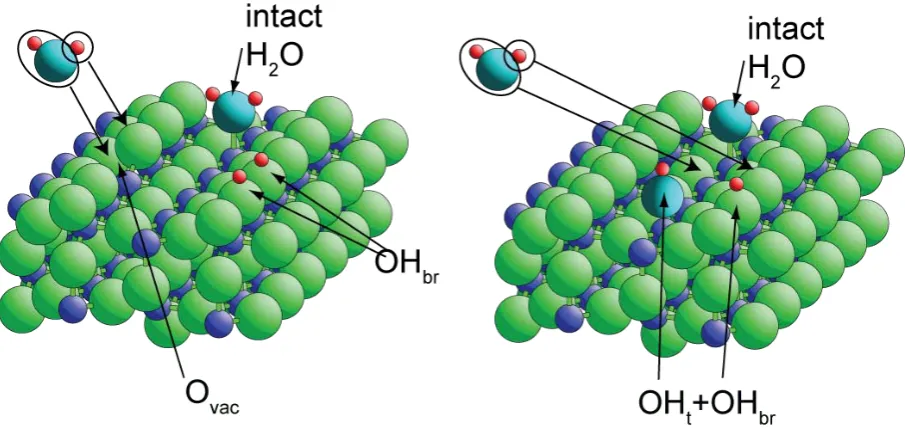
creation of two bridging hydroxyl (OHbr) species (Fig. 1). This process has been predicted in a
number of DFT studies and has been observed rather directly by scanning tunnelling
microscopy (STM) [15, 16]. On undefected regions of the surface, the same STM
experiments show that molecular water is located atop the undercoordinated surface Ti atoms,
while scanned-energy photoelectron diffraction (PhD) studies shows the associated Ti-O
bondlength to be 2.21 Å [17, 18]. Relatively recent DFT calculations [19
10
] have stressed that
on the perfect TiO2(110) surface, the dissociated state (which appears to be marginally
energetically disfavoured [ ]) may only be ‘pseudo-dissociated’ in that the resulting surface
species, a hydroxyl species atop a surface Ti atom (OHt) and an adjacent hydroxylated
bridging O atom producing an OHbr (Fig. 1), may be unable to separate on the surface.
Indeed, it is suggested that the detached H atom from the (atop) molecular water may switch
rapidly between the OHt species and the two adjacent bridging O atoms on either side, making
it difficult or impossible to identify this process in STM, a technique that detects only a
Here we show that using the PhD technique we can not only demonstrate the presence of
these coadsorbed OHbr and OHt species as a result of water dissociation, coexistent with intact
molecular adsorption, but can also determine the local Ti-O bondlengths of these two species.
We find these values to be in excellent agreement with the published DFT results for the
dissociated species. As such, we show that the newly-achieved theoretical consensus that
water dissociation does not dissociate on the perfect TiO2(110) surface is not, after all,
consistent with experiment. An earlier theoretical treatment [5] indicating that coadsorbed
molecular water and dissociated water can coexist on the surface is, however, in agreement
with our results.
A key result that underpins our study comes from the investigation by Walle et al. [14] of the
temperature dependence of O 1s soft X-ray photoelectron spectroscopy (SXPS) data from the
TiO2(110)/water surface. It is well-established that at low temperatures (<~230 K) this
spectrum comprises three components, a main peak from the oxide substrate, a second
component shifted by ~1.3 eV to higher binding energy associated with surface OH species,
and a third peak at a larger chemical shift (~3.5 eV) associated with molecular water. Walle et
al. showed that the OH component corresponds not only to a state that is stable above room
temperature, assigned to the OHbr species associated with dissociation at defect sites (e.g.
[20]), but also to a second state that desorbs at essentially the same temperature as the
molecular water (~240 K), and which has a substantial coverage even on an almost perfect
starting surface. The implication is that the additional OH detected at low temperature is the
combined OHbr + OHt pseudo-dissociated state predicted by theory, and that recombination of
these components leads to desorption below room temperature
In order to establish that this is, indeed, the case, we have applied the PhD technique [21, 22]
to this problem. Photoelectron diffraction exploits the coherent interference of the directly
emitted component of a photoelectron wavefield arising from a core level of a surface atom
with components of the same wavefield elastically scattered by neighbouring atoms. In PhD
the photon energy, and hence the photoelectron energy and its associated wavelength, is
scanned causing scattering pathways to switch in and out of phase. The resulting modulation
spectra of photoemission intensity as a function of energy in fixed directions allows the
location of the emitter to be determined, relative to the underlying substrate atoms, through
binding energy depends on the bonding environment of the emitter atom, PhD modulation
spectra can be extracted from specific spectral components, rendering the technique not only
elementally specific, but also chemical-state specific. We have previously applied this method
to investigate the adsorption of water on TiO2(110), but in this earlier study [17, 18] we
focussed only on the adsorption geometry of the molecular water species. PhD data were also
extracted from the intermediate binding energy peak, but a superficial qualitative analysis
suggested that this feature may arise from the oxidic O atoms, and no quantitative analysis
was undertaken. There is now ample evidence that this intermediate peak is from surface OH
species [14, 20, 23] and with hindsight we now see that the similarity of the PhD from the
oxidic and OH oxygen atoms stems from the fact that both of these atoms occupy similar atop
and bridging sites relative to the underlying bulk oxide, as we show below. Moreover, our
new detailed analysis reveals that while the PhD from the hydroxyl and oxidic O 1s
components are, indeed, somewhat similar, there are also important differences. Notice, too,
that even SXP spectra from a nominally clean surface typically contain a significant
component of the intermediate OH feature due to hydroxylation of the Ovac states by the small
amount of water in the gas phase under UHV conditions; the O 1s spectrum obtained after
removing adsorbed water by heating may therefore appear the same as this ‘clean’ surface
spectrum, but in reality both surfaces have a significant OHbr coverage.
Here we present the results of a full quantitative analysis of the O 1s PhD from this hydroxyl
component of the earlier data, obtained from the TiO2(110) surface at ~190 K after exposure
to water at lower temperature. Details of the experimental methods are reported in the earlier
publications [17, 18]. Briefly, the experiments were conducted in an ultra-high vacuum
surface science end-station of BESSY II, equipped for sample cleaning, heating and cooling.
Characterisation in situ was achieved by low energy electron diffraction (LEED) and by
soft-X-ray photoelectron spectroscopy (SXPS) using the incident synchrotron radiation. A clean
well-characterised rutile TiO2(110) surface was prepared which gave a sharp (1x1) LEED
pattern and a Ti 2p photoemission spectrum showing only a weak high kinetic energy
shoulder. This surface was exposed to ~10-6 mbar.s of H2O at a temperature of 125 K, heated
to ~230 K, and held at 190-200 K during measurement of the PhD spectra to avoid multilayer
film formation from residual gas-phase water. PhD modulation spectra were obtained by
recording a sequence of photoelectron energy distribution curves (EDCs) around the O 1s
peaks at 4 eV steps in photon energy, in the photoelectron energy range of approximately
chemically-shifted Gaussian peaks (oxide, OH, water), a step, and a template background.
The resultant O 1s hydroxyl PhD spectra recorded in some directions were dominated by
noise at the higher energies, and these spectra were truncated prior to comparison with theory
to reduce the impact of this noise on the R-factors (reliability-factors [21, 22]) associated with
comparison with theory. Structure determination from the PhD spectra obtained from the OH
component was achieved through the use of multiple scattering simulations for trial model
structures using computer codes developed by Fritzsche [24, 25, 26
22
]. Structural optimisation
to find the best agreement between theory and experiment, as judged by the lowest value of
the R-factor, was achieved using our normal procedure (e.g. [ , 27]). Specifically, we
explored models involving different fractional occupations of OHbr and OHt species, and
allowed optimisation of a range of local structural parameters including both Ti-O
bondlengths and local near-surface relaxations. A search of all possible lateral positions at all
reasonable Ti-O bondlengths for the location of the second OH species (coadsorbed with
OHbr), showed the OHt site to give much the best fit to the PhD data.
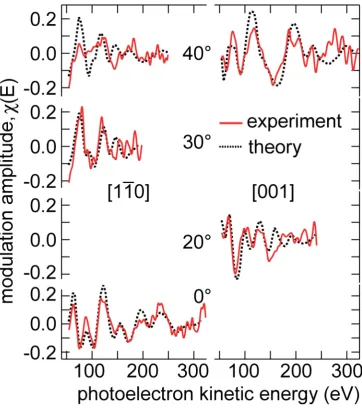
The structure yielding the lowest R-factor value (0.31) for a set of spectra recorded in five
different directions (Fig. 2) was found to correspond to an OHt:OHbr co-occupation ratio of
30:70. The OHt species has a Ti-O bondlength of 1.85±0.08 Å, while for the OHbr species this
bondlength is 1.94±0.07 Å. This latter value is in excellent agreement with the value of
1.97±0.05 Å found by Unterberger et al. [23] using the same PhD technique to study a surface
hydroxylated by exposure to atomic hydrogen, and thus containing only OHbr species. These
bondlengths are fully consistent with strong chemisorption and are much shorter than the
value associated with molecular water in the Ti-atop site on this surface (2.21±0.02 Å) [17,
18]. Few of the published DFT calculations on this system quote bondlength values for
comparison with experiment; for example, ref. [10] gives perfect agreement with experiment
for the Ti-Owater bondlength, but provides no details of the dissociated state. Menetrey et al.
[28
23
] find a slightly longer value for Ti-Owater of 2.28 Å, but also report the Ti-OHt bondlength
to be 1.85 Å. These authors do not quote the Ti-OHbr bondlength on the perfect surface, but
on the initially-defected surface they give a value of 2.09 Å; this is quite similar to the value
of 2.04 Å obtained recently in calculations for 0.5 ML of OHbr on the surface [ ]. Only two
earlier studies report values for the Ti-OHt and Ti-OHbr bondlengths coexisting in the
dissociated state on the perfect surface; these are 1.87 Å and 2.06 Å [29], and 1.63 Å and 1.87
Å [30], respectively. While the latter pair of values includes at least one that seems
and are clearly consistent with our experimental finding that the Ti-OHt distance is
significantly shorter than that of the Ti-OHbr bond, with particularly good quantitative
agreement for the Ti-Ot bondlength.
A further key parameter in the optimising the agreement between the results of the multiple
scattering calculations and our experiments is the fractional coverage of OHt species. For
water dissociation on a perfect TiO2(110) surface, we expect an equal number of OHt and
OHbr species, but it is now well-established that even well-prepared surfaces contain a
significant number (typically up to ~10%: we find a value of 6-7% in our study as shown
below) of Ovac defects, each of which will lead to two OHbr species following exposure to
water. 30% occupation of OHt species, as found in our PhD structure optimisation, implies
that a further 30% of the OH species are OHbr arising from dissociation at perfect areas of the
surface, while the remaining 40% of OHbr must be associated with defect-site dissociation. In
order to estimate the absolute coverages in our experiments we make use of the calibration of
the O 1s chemical shift of molecular water as a function of its coverage provided by Ketteler
et al. [20]; according to this dependence, the chemical shift of 3.5-3.6 eV seen in our data
corresponds to a water coverage of approximately 0.25 ML. This is significantly less, but
much more reliable and precise, than the rather crude estimate reported previously of
0.45-0.90 ML [18] that was based on the attenuation of the oxidic O 1s and Ti 2p photoemission
resulting from the water adsorption. The coverage estimated in this way is not only sensitive
to the estimated value of the photoelectron attenuation length, but also to how one defines the
‘thickness’ of a submonolayer coverage of water; indeed, this approach actually led to
estimated thicknesses using the O 1s and Ti 2p attenuations that differed by 50%. We should
note, however, that we now see that this earlier coverage estimate was for the combined
H2O/OH surface layer, so in fact the wide range does cover the new value for this combined
coverage. In particular, using the coverage value of 0.25 ML for the H2O obtained from the
new calibration of Ketteler et al. [20], the measured intensity ratio of the O 1s OH and H2O
signals then leads to an OH coverage of 0.28 ML in the coadsorbed state, and a combined
coverage of 0.53 ML.
Using this same calibration, we find the intensity of the OH component after annealing the
surface to 370 K (and also of the OH component on the initial ‘clean’ surface) to be 0.13 ML,
similar preparation conditions [31]. If the OH coverage arising from dissociation on the
perfect areas of the surface is (0.28-0.13)=0.15 ML, then the expected OHt coverage is 0.075
ML, corresponding to 27% of the total OH coverage, in excellent agreement with the figure of
30% obtained from the PhD data analysis.
Of course, there is finite precision in the determination of the OHt concentration in the PhD
analysis, and this we establish by determining how large a change in the parameter is required
for the associated R-factor to exceed the sum of its minimum value, Rmin, (for the best-fit
structure) and the estimated variance in this minimum value var(Rmin) [21, 22]. PhD
modulations measured in directions that correspond to ~180° backscattering from a
nearest-neighbour substrate atom are generally dominated by scattering from this one nearest-neighbour, so
the normal emission spectrum is expected to have modulations that are most strongly
influenced by scattering from the atop species. Using this most-sensitive spectrum to estimate
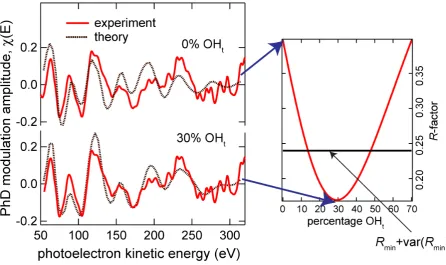
the precision yields a fractional occupation value for the OHt species of 30(-15/+18)%, clearly
excluding the possibility that only OHbr species are present. This is illustrated in Fig. 3 which
shows comparisons of the experimental PhD spectrum at normal emission with simulations
for 0% and 30% OHt species, together with a plot of the variation of the associated R-factor as
a function of the fractional occupation value (the horizontal line corresponding to R = Rmin +
var(Rmin)).
In summary, our use of the chemical-state specificity of the PhD technique has allowed us to
demonstrate that, at temperatures of ~190-200 K, water adsorption on TiO2(110) leads to the
formation of both OHt and OHbr species coadsorbed with molecular water, whereas only OHbr
species are formed by reaction of water with Ovac defects on the surface. This qualitative
result is consistent with predictions of those theoretical calculations that identify a dissociated
state on a perfect surface that forms an OHt + OHbr pair of species that may be unable to move
apart. Moreover, the Ti-OH bondlengths found for these two species, 1.85±0.08Å (OHt), and
1.94±0.07 Å (OHbr), are also consistent with theoretical calculations.
We should, perhaps, stress that the PhD technique is sensitive only to the local geometry of
the photoemitting atoms, and particularly to the location of the emitter atom relative to the
underlying substrate atoms. It is insensitive to the location of other nearby adsorbed species.
to establish whether the OHt species are always adjacent on the surface to an OHbr species (as
would be the case in the pseudo-dissociated state) or adjacent on the surface to an intact water
molecule to which it may be hydrogen-bonded, as suggested in another theoretical treatment
[5]. Similarly, our earlier determination of the local adsorption site of the intact water
molecules [17, 18] is not influenced by whether or not water dimers are formed on the surface
[32]. These various pairings of coadsorbed species only influence the PhD data if they result
in significant changes (such as off-site displacements of greater than ~0.2 Å) in the local sites
of the individual species.
However, our results conflict with the results of those more recent theoretical studies
indicating no dissociation of water should occur on the perfect TiO2(110) surface. We should
stress, however, that the dissociated state we detect is coexistent with intact molecular water,
with only ~30% ([0.15 ML/2]/0.25 ML) of the water molecules adsorbed onto the perfect
surface being dissociated; in fact a half-dissociated state was proposed in early DFT
calculations [5], and even a very recent study [10] finds this state to be only marginally
disfavoured energetically.
The authors acknowledge the partial support of the Engineering and Physical Sciences
Research Council (UK) for this work. The computing facilities were provided by the Centre
for Scientific Computing of the University of Warwick with support from the Science
Fig. 1 Schematic diagram of the interaction of molecular H2O with TiO2(110) on (left) a
surface containing bridging oxygen vacancies, Ovac, to produce two bridging hydroxyl
species, OHbr and (right) on a perfect surface to produce atop and bridging hydroxyl species,
OHt and OHbr. The diagrams show both the component parts of a water molecule approaching
the dissociation sites, and the resulting pair of surface OH species produced. At low
Figure 2: Comparison of the experimental O 1s (OH) PhD spectra with theoretical simulations
Fig. 3 Dependence of the level of agreement between experiment and theory for the normal
emission PhD spectrum as a function of the fractional occupation of OHt species. On the left
are shown theory/experiment comparisons for 0% and 30% OHt occupation, on the right is
References
1 U. Diebold, Surf. Sci. Rep. 48, 53 (2003).
2 M.A. Henderson, Surf. Sci. Rep. 46,5 (2002).
3 C.L. Pang, R. Lindsay, and G. Thornton, Chem. Soc. Rev. 37, 2328 (2008).
4 A. Fujishima and K. Honda, Nature 238, 37 (1972).
5 P.J.D. Lindan, N.M. Harrison, and M.J. Gillan, Phys. Rev. Lett. 80, 762
(1998).
6 P.J.D. Lindan and C.Zhang, Phys. Rev. B 72, 075439 (2005).
7 L. A. Harris and A. A. Quong, Phys. Rev. Lett. 93, 086105 (2004).
8 P.J.D. Lindan and C. Zhang, Phys. Rev. Lett. 95, 029601 (2005).
9 L. A. Harris and A. A. Quong, Phys. Rev. Lett. 95, 029602 (2005).
10 P. Kowalski, B. Meyer, and D. Marx, Phys. Rev. B 79, 115410 (2009).
11 L.-M. Liu et al. Phys. Rev. B 82, 161415 (2010).
12 B. Hammer, S. Wendt, and F. Besenbacher, Top. Catal. 53, 423 (2010).
13 H. Xu et al. J. Phys. Chem. C 115, 19710 (2011).
14 L.E. Walle, et al., Phys. Rev. B 80, 235436 (2009).
15 I.M. Brookes, C.A. Muryn, and G. Thornton, Phys. Rev. Lett. 87, 266103
(2001).
16 R. Schaub, et al., Phys. Rev. Lett. 87, 266104 (2001).
17 F. Allegretti, et al., Phys. Rev. Lett. 95, 226104 (2005).
18 F. Allegretti, et al., Surf. Sci. 600, 1487 (2006).
19 S. Wendt, et al., Phys. Rev. Lett. 96, 066107 (2006).
20 G. Ketteler, et al. J. Phys. Chem. C 111, 8278 (2007).
21 D.P. Woodruff and A.M. Bradshaw, Rep. Prog. Phys., 57, 1029 (1994)
22 D.P. Woodruff, Surf. Sci. Rep., 62, 1 (2007).
23 W. Unterberger, et al., Phys. Rev. B, 84, 115461 (2011).
24 V. Fritzsche, J. Phys.: Condens. Matter 2, 1413 (1990).
25 V. Fritzsche, Surf. Sci. 265, 187 (1992).
26 V. Fritzsche, Surf. Sci. 213, 648 (1989).
27 D. A. Duncan, J.I.J. Choi, and D.P. Woodruff, Surf. Sci, 606, 278 (2012).
13
29 J. Goniakowski and M.J. Gillan, Surf. Sci., 350, 145 (1996).
30 D. Vogtenhuber, R. Podloucky, and J. Redinger, Surf. Sci., 402-404, 798
(1998).
31 E. Lira, et al. . Am. Chem. Soc. 133, 6529 (2011).