Original citation:
Cormode, Graham and Jowhari, Hossein. (2014) A second look at counting triangles in graph streams. Theoretical Computer Science, Volume 552 . pp. 44-51. ISSN 0304-3975
Permanent WRAP url:
http://wrap.warwick.ac.uk/63458
Copyright and reuse:
The Warwick Research Archive Portal (WRAP) makes this work by researchers of the University of Warwick available open access under the following conditions. Copyright © and all moral rights to the version of the paper presented here belong to the individual author(s) and/or other copyright owners. To the extent reasonable and practicable the material made available in WRAP has been checked for eligibility before being made available.
Copies of full items can be used for personal research or study, educational, or not-for-profit purposes without prior permission or charge. Provided that the authors, title and full bibliographic details are credited, a hyperlink and/or URL is given for the original metadata page and the content is not changed in any way.
Publisher’s statement:
“NOTICE: this is the author’s version of a work that was accepted for publication in Theoretical Computer Science. Changes resulting from the publishing process, such as peer review, editing, corrections, structural formatting, and other quality control
mechanisms may not be reflected in this document. Changes may have been made to this work since it was submitted for publication. A definitive version was subsequently published in Theoretical Computer Science, Volume 552. (2014)
DOI http://dx.doi.org/10.1016/j.tcs.2014.07.025 ¨
A note on versions:
The version presented here may differ from the published version or, version of record, if you wish to cite this item you are advised to consult the publisher’s version. Please see the ‘permanent WRAP url’ above for details on accessing the published version and note that access may require a subscription.
A Second Look at Counting Triangles in Graph Streams
Graham Cormode, Hossein Jowharia,b,
a[email protected], Corresponding author b[email protected]
Abstract
In this paper we present improved results on the problem of counting triangles in edge streamed graphs. For graphs withmedges and at leastT triangles, we show that an extra look over the stream yields a two-pass streaming algorithm that uses
O( m
4.5√T)space and outputs a(1 +)approximation of the number of triangles
in the graph. This improves upon the two-pass streaming tester of Braverman, Ostrovsky and Vilenchik, ICALP 2013, which distinguishes between triangle-free graphs and graphs with at least T triangle using O(Tm1/3) space. Also, in terms
of dependence on T, we show that more passes would not lead to a better space bound. In other words, we prove there is no constant pass streaming algorithm that distinguishes between triangle-free graphs from graphs with at least T triangles usingO(T1m/2+ρ)space for any constantρ≥0.
1. Introduction
Many applications produce output in form of graphs, defined an edge at a time. These include social networks that produce edges corresponding to new friendships or other connections between entities in the network; communication networks, where each edge represents a communication (phone call, email, text message) between a pair of participants; and web graphs, where each edge repre-sents a link between pages. Over such graphs, we wish to answer questions about the induced graph, relating to the structure and properties.
themselves friends. Counting the number of friendships within a graph is there-fore a measure of the closeness of friendship activities. Another use of the number of triangles is as a parameter for evaluation of large graph models [LBKT08].
For these reasons, and for the fundamental nature of the problem, there have been numerous studies of the problem of counting or enumerating triangles in var-ious models of data access: external memory [LWZW10, HTC13]; map-reduce [SV11, PT12, TKMF09]; and RAM model [SW05, Tso08]. Indeed, it seems that triangle counting and enumeration is becoming ade factobenchmark for testing “big data” systems and their ability to process complex queries. The reason is that the prob-lem captures an essentially hard probprob-lem within big data: accurately measuring the degree of correlation. In this paper, we study the problem of triangle counting over (massive) streams of edges. In this case, lower bounds from communication complexity can be applied to show that exactly counting the number of triangles essentially requires storing the full input, so instead we look for methods which can approximate the number of triangles. In this direction, there has been series of works that have attempted to capture the right space complexity for algorithms that approximate the number of triangles. However most of these works have fo-cused on one pass algorithms and thus, due to the hard nature of the problem, their space bounds have become complicated, suffering from dependencies on multiple graph parameters such as maximum degree, number of paths of length 2, number of cycles of length 4, etc.
In a recent work by Bravermanet al.[BOV13], it has been shown that at the expense of an extra pass over stream, a straightforward sampling strategy gives a sublinear bound that depends only onm(number of edges) andT (a lower bound on the number of triangles1). More precisely [BOV13] have shown that one ex-tra pass yields an algorithm that distinguishes between triangle-free graphs from graphs with at least T triangles using O(Tm1/3) words of space. Although their
algorithm does not give an estimate of the number of triangles and more impor-tant is not clearly superior to theO(mT∆)one pass algorithm by [PT12, PTTW13] (especially for graphs with small maximum degree∆), it creates some hope that perhaps with the expense of extra passes one could get improved and cleaner space complexities that beat the one pass bound for a wider range of graphs. In particular
1In this and prior works, some assumption on the number of triangles is required. This is due
in part to the fact that distinguishing triangle-free graphs from those with one or more triangle requires space proportional to the number of edges. Other works have required even stronger assumptions, such as a bound onT2, the number of paths of length 2, or the maximum degree of
one might ask is there aO(mT)space multi-pass algorithm? In this paper, while we refute such a possibility, we show that a more modest bound is possible. Specifi-cally here we show modifications to the sampling strategy of [BOV13] along with a different analysis results in a 2-pass(1 +)approximation algorithm that uses onlyO( m
4.5√T)space. We also observe that this bound is attainable in one pass–
if we can make the string assumption that the order of edge arrivals is random. Additionally, via a reduction to a hard communication complexity problem, we demonstrate that this bound is optimal in terms of its dependence on T. In other words there is no constant pass algorithm that distinguishes between triangle-free graphs from graphs with at least T triangles using O(T1m/2+ρ) for any constant
ρ > 0. We also give a similar two pass algorithm that has better dependence on
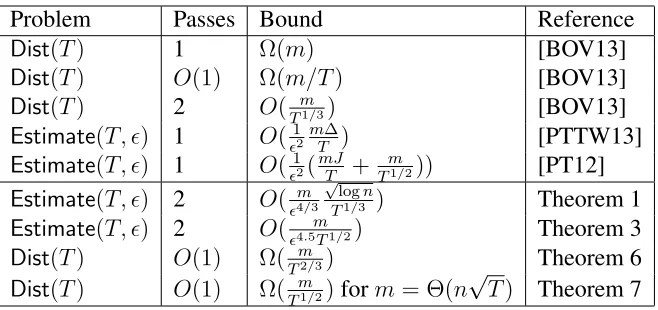
but sacrifices the optimal dependence onT. Our results are summarized in Figure 2 in terms of the problem addressed, bound provided, and number of passes.
In line with prior work, we assume a simple graph – that is, each edge of the graph is presented exactly once in the stream. Note that our lower bounds immediately hold for the case when edges are repeated.
Algorithms for Triangle Counting in Graph Streams. The triangle counting problem has attracted particular attention in the model of graph streams: there is now a substantial body of study in this setting. Algorithms are evaluated on the amount of space that they require, the number of passes over the input stream that they take, and the time taken to process each update. Different variations arise de-pending on whether deletions of edges are permitted, or the stream is ‘insert-only’; and whether arrivals are ordered in a particular way, so that all edges incident on one node arrive together, or the edges are randomly ordered or adversarially or-dered.
The work of Jowhari and Ghodsi [JG05] first studied the most popular of these combinations: insert-only, adversarial ordering. The general approach, common to many streaming algorithms, is to build a randomized estimator for the desired quantity, and then repeat this sufficiently many times to provide a guaranteed ac-curacy. Their approach begins by sampling an edge uniformly from the stream of
m arriving edges onn vertices. Their estimator then counts the number of trian-gles incident on a sampled edge. Since the ordering is adversarial, the estimator has to keep track of all edges incident on the sampled edge, which in the worst case is bounded by ∆, the maximum degree. The sampling process is repeated
O(12
m∆
T )times (using the assumed bound on the number of triangles,T), leading
to a total space requirement proportial toO(12
m∆2
T )to give anrelative error
the error in the count is at mostεt(with constant probability, since the algorithm is randomized). The process can be completed with a single pass over the input. Jowhari and Ghodsi also consider the case where edges may be deleted, in which case a randomized estimator using “sketch” techniques is introduced, improving over a previous sketch algorithm due to Bar-Yossefet al.[BYKS02].
The work of Buriolet al. [BFL+06] also adopted a sampling approach, and built a one-pass estimator with smaller working space. An algorithm is proposed which samples uniformly an edge from the stream, then picks a third node, and scans the remainder of the stream to see if the triangle on these three nodes is present. Recall thatnis the number of nodes in the graph,mis number of edges, andT ≤tis lower bound on the (true) number of triangles. To obtain an accurate estimate of number of triangles in the graph, this procedure is repeated indepen-dentlyO(εmn2T)times to achieverelative error.
Recent work by Pavan et al. [PTTW13] extends the sampling approach of Buriol et al.: instead of picking a random node to complete the triangle with a sampled edge, their estimator samples a second edge that is incident on the first sampled edge. This estimator is repeated O(m2∆T)times, where ∆represents the
maximum degree of any node. That is, this improves the bound of Buriol et al. by a factor of n/∆. In the worst case,∆ = n, but in general we expect∆to be substantially smaller thann.
Bravermanet al. [BOV13] take a different approach to sampling. Instead of building a single estimator and repeating, their algorithms sample a set of edges, and then look for triangles induced by the sampled edges. Specifically, an al-gorithm which takes two passes over the input stream distinguishes triangle-free graphs from those withT triangles in spaceO(m/T1/3).
For graphs withW ≥ m whereW is the number of wedges (paths of length 2), Jhaet al.[JSP13] have shown a single passO(12m/
√
T)space algorithm that returns an additive error estimation of the number of triangles.
Pagh and Tsourakakis [PT12] propose an algorithm in the MapReduce model of computation. However, it can naturally be adapted to the streaming setting. The algorithm conceptually assigns a “color” to each vertex randomly from C
colors (this can be accomplished, for example, with a suitable hash function). The algorithm then stores each monochromatic edge, i.e. each edge from the input such that both vertices have the same color. Counting the number of triangles in this induced graph, and scaling up by a factor ofC2 gives an estimator fort. The space used isO(m/C)in expectation. SettingC appropriately yields a one-pass algorithm with space O˜(mTJ + √m
T), where J denotes the maximum number of
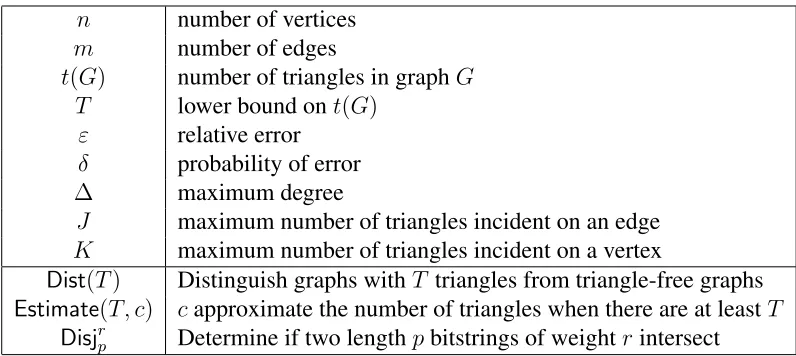
n number of vertices
m number of edges
t(G) number of triangles in graphG T lower bound ont(G)
ε relative error
δ probability of error
∆ maximum degree
J maximum number of triangles incident on an edge
K maximum number of triangles incident on a vertex
Dist(T) Distinguish graphs withT triangles from triangle-free graphs Estimate(T, c) capproximate the number of triangles when there are at leastT
[image:6.612.110.508.123.301.2]Disjrp Determine if two lengthpbitstrings of weightrintersect
Figure 1: Table of notation
Lower bounds for triangle counting. A lower bound in the streaming model is presented by Bar-Yossef et al. [BYKS02]. They argue that there are (dense) families of graphs over n nodes such that any algorithm that approximates the number of triangles must useΩ(n2)space. The construction essentially encodes
Ω(n2) bits of information, and uses the presence or absence of a single triangle to recover a single bit. Bravermanet al.[BOV13] show a lower bound ofΩ(m)
by demonstrating a family of graphs with m chosen between n and n2. Their construction encodes m bits in a graph, then adds τ edges such that there are eitherτ triangles or 0 triangles, which reveal the value of an encoded bit.
For algorithms which take a constant number of passes over the input stream, Jowhari and Ghodsi [JG05] show that still Ω(n/T) space is needed to approxi-mate the number of triangles up to a constant factor, based on a similar encoding and testing argument. Specifically, they create a graph that encodes two binary strings, so that the resulting graph hasT triangles if the strings are disjoint, and
2. Preliminaries and Results
In this section, we define additional notation and define the problems that we study.
As mentioned above, we uset(G)to denote the number of triangles in a graph
G = (V, E). Let J(G) denote the maximum number of triangles that share an edge inG, andK(G)the maximum number incident on any vertex. We use t, J
andKwhenGis clear from the context.
Problems Studied. We define some problems related to counting the number of triangles in a graph stream. These all depend on a parameter T that gives a promise on the number of triangles in the graph.
Dist(T): Given a stream of edges, distinguish graphs with at leastT triangles from triangle-free graphs.
Estimate(T, ): Given the edge stream of a graph with at least T triangles, outputswhere(1−)·t(G)≤s≤(1 +)·t(G).
Observe that any algorithm which promises to approximate the number of triangles for < 1must at least be able to distinguish the case of 0 triangles or
T triangles. Consequently, we provide lower bounds for the Dist(T) problem, and upper bounds for the Estimate(T, )problem. Our lower bounds rely on the hardness of well-known problems from communication complexity. In particular, we make use of the hardness ofDisjrp:
Problem 1 TheDisjrpproblem involves two players, Alice and Bob, who each have binary vectors of length p. Each vector has Hamming weightr, i.e. rentries set to one. The players want to distinguish non-intersecting inputs from inputs that do intersect.
This problem is “hard” in the (randomized) communication complexity set-ting: it requires a large amount of communication between the players in order to provide a correct answer with sufficient probability [KN97]. Specifically,Disjrp requires Ω(r) bits of communication for any r < p/2, over multiple rounds of interaction between Alice and Bob.
Problem Passes Bound Reference
Dist(T) 1 Ω(m) [BOV13]
Dist(T) O(1) Ω(m/T) [BOV13]
Dist(T) 2 O(Tm1/3) [BOV13]
Estimate(T, ) 1 O(12
m∆
T ) [PTTW13]
Estimate(T, ) 1 O(1
2(mJT +Tm1/2)) [PT12] Estimate(T, ) 2 O(4m/3
√
logn
T1/3 ) Theorem 1
Estimate(T, ) 2 O(4.5mT1/2) Theorem 3
Dist(T) O(1) Ω(Tm2/3) Theorem 6
Dist(T) O(1) Ω( m
T1/2)form= Θ(n
√
[image:8.612.142.471.123.278.2]T) Theorem 7
Figure 2: Summary of results
additional term ofmJ/T. This extra term can be large: as big asm in the case that all triangles are incident on the same edge; here, we show that this term can be avoided at the cost of an additional pass.
Our results improve over the 2-pass bounds given in [BOV13]. We show that theEstimate(T, )problem can be solved with dependence onT−1/3(not just the decision problem Dist(T)), and that the dependence on T can be improved to
T−1/2, at the expense of higher dependence on.
Comparing with the additive estimator of [JSP13], while our sampling strategy is somewhat similar, using an extra pass over the stream we return a relative error estimation of the number of triangles. However, [JSP13] requires the condition
W ≥ m on W (the number of paths of length 2), while our biased estimator (Algorithm I) has no such condition. This is achieved at the expense of higher dependence on.
Our analysis assumes familiarity with techniques from randomized algorithms: first, second and exponential moments methods, in the form of the Markov in-equality, Chebyshev inin-equality, and Chernoff bounds [MR95].
3. Upper bounds
Algorithm I (unbiased estimator).
Letp∈(0,1]. The value ofpis determined by the analysis.
In the first pass, the algorithm stores each edge independently at random with probabilityp. LetG0 = (V, E0)be the sampled subgraph.
In the second pass, the algorithm, upon reading the edgeei ∈/ E0, counts
the number of new triangles in(V, E0∪{ei})and adds it to a global counter s. At the end of the second pass, the algorithm outputs Y = 3p2(1s−p) as
the estimate fort(G).
Theorem 1 Algorithm I is a 2-pass randomized streaming algorithm forEstimate(T, )
that usesO(m4/3
√
logn
T1/3 )space.
PROOF: Let T represent the set of triangles in the graph. For the analysis, we
partition T into several groups through the following process. Fix an L ∈ [1, t]
(determined below). Pick an arbitrary edge e ∈ E with at leastLtriangles on it. We notionally assign the triangles oneto the edgee. Let this be the setTe ⊆ T.
Continue this process until all the remaining edges participate in fewer than L
unassigned triangles. Let T0
be the unassigned triangles. Note that either of Te
andT0 may be empty.
LetXibe the indicator random variable associated with thei-th triangle inT. We haveXi = 1with probability3p2(1−p). For each edgee, letse =Pi∈TeXi
and definesT0 =P
i∈T0Xi. We haves=
P
e∈Ese+sT0 and the expectation ofs isE(s) = 3p2(1−p)t.
First we analyse the concentration ofsT0. We haveE(sT0) = 3p2(1−p)|T0|. We also compute
Var(sT0) =E(sT20)−E2(sT0)
≤ X
i∈T0
E(Xi2) + X
i∈T06=j∈T0
E(XiXj)−E2(sT0)
≤3p2(1−p)|T0|+ (4p3(1−p)2+p4(1−p))|T0|L.
at most|T0|L such triangle pairs. For pairs of triangles which do not share any
edge, their contribution to the sum is outweighted by the term−E(sT0)2.
Since (1 −p) < 1 and p < 1 we simplify this expression to Var(sT0) <
3p2|T0|+ 5p3|T0|L. By the Chebyshev inequality,
Pr[|sT0 −E(sT0)| ≥p2t]≤
Var(sT0) 2p4t2 ≤
3|T0|
2p2t2 +
5|T0|L
2pt2 (1)
To bound the deviation of each se, we use the Chernoff bound. Let Ze be
the event corresponding toe /∈ E0. Since the edges are sampled independently, conditioned onZe, the random variables{Xi}i∈Te are independent. Moreover we
haveE(Xi|Ze) =p2. From the Chernoff bound, we get
Pr[|se−E(se)| ≥E(se)|Ze]≤e−
p2|Te|2
2 ≤e−
p2L2
2 (2)
Similarly, conditioned onZe, the random variables{Xi}i∈Te are independent
andE(Xi|Z¯e) = 2p(1−p).
Pr[|se−E(se)| ≥E(se)|Ze]≤e−p(1−p)|Te|2 ≤e−p(1−p)L2 (3)
From (2) and (3), for eache∈E, we get
Pr[|se−E(se)| ≥E(se)]≤e−
p2L2
2 (4)
Therefore using the union bound and the fact that the number of edges with non-emptyTeis bounded byt/L, we get
Pr " X e se−
X
e
E(se)
≥X
e
E(se)
#
≤ t
Le
−p2L2
2 (5)
Sincet ≥ T and settingL = (t)2/3 andp = Ω( 1 4/3
√
logn
T1/3 )with large enough
constants, the probabilities in (1) and (5) will be bounded by a small constant. The expected number of edges in the sampled graphG0ispm, and can be shown to be tightly concentrated around its expectation via a Chernoff bound on the Binomial tail probability, so the space usage is as stated above. This proves our theorem.
case, this takes O(n) time for edges incident on high degree vertices, but other bounds can be given for this time cost, as a function ofpand the degree of each node.
It is possible to extend this algorithm to the case where each edge may appear multiple times in the stream. Two modifications are needed to handle the fact that an edge may appear multiple times. The first is that the we must sample each edge with probability p, regardless of its multiplicity in the stream. This can be achieved by using a hash function to determine whether the edge is sampled: the edge is hashed to the range [0. . .1], and is sampled if the hash value is below
p. The second is that we need to count the number of distinct triangles formed in the second pass. This can be done by using a distinct counting algorithm in place of the global counter, applied to the triangles as described by their three nodes [BYJK+02].
We now modify this algorithm to work in the random order streaming model, where all permutations of the input are equally likely [GM09].
Corollary 2 Assuming the data arrives in random order, there is a one-pass ran-domized streaming algorithm forEstimate(T, )that usesO(4m/3
√
logn
T1/3 )space.
PROOF: The one-pass algorithm collapses the two passes of Algorithm I into one.
That is, the algorithm stores each edge into graphG0 with probabilityp, and also counts the number of triangles completed inG0 by each edge from the streamG.
The analysis follows the same outline as the main theorem, with some modi-fication. First, we now have Pr[Xi = 1] = p2(1−p), since the unsampled edge
must be the last in the stream order, andE(s)is correspondingly lower by a factor of 3. ThenE(Xi|Zi) = p2/3, since to count trianglei, we must have that the first
two edges are seen before edgeein the stream. Likewise,E(Xi|Z¯i) = 2p(1−p)/3,
since we must have the unsampled edge appear after the two sampled edges. This causes us to rescalepby a constant, which does not change the asymptotic cost of the algorithm.
Note that the requirement of random order is important for the one-pass result. Because we split the analysis based on the particular edges, the order in which these edges appear can affect the outcome. If the edgee were to always appear after the two other edges in trianglei, thenE(Xi|Ze)would be 0. Hence, we need
Algorithm II (biased estimator).
Repeat the followingl ≥16/times independently in parallel and output the minimum of the outcomes.
In the first pass, pick every edge with probability p (the value of p is determined below.)
In the second pass, count the total number of triangles detected: both those where all three edges were sampled in the first pass, and where two edges were sampled in the first pass, and the completing edge observed in the second pass. Letrbe the total number of triangles detected. Output
r 3p2(1−p)+p3.
Theorem 3 Algorithm II is a 2-pass randomized streaming algorithm forEstimate(T, )
that usesO( m
4.5√T)space.
PROOF: LetRbe the output of Algorithm II. As in the previous proof, letT repre-sent the set of triangles in the graph. Consider one instance of the basic estimator, and letXbe the outcome of this instance. LetXidenote the indicator random
vari-able associated with the ith triangle inT being detected. By simple calculation, we havePr[Xi = 1] = 3p2(1−p) +p3andE(X) = 3p2(1−1p)+p3
P
i∈T E[Xi] =t.
Thus, X is an unbiased estimator for t; however, R, which is the minimum of
l independent repetitions of X, is biased. By the Markov inequality, Pr[X ≥
(1 +)E(X)]≤1/(1 +). Therefore, picking≤1, we can conclude,
Pr[R≤(1 +)t]≥(1−Pr[X≥(1 +)t]16/)≥1−
1 2
16
≥1−10−4.
However, proving a lower bound onR is more complex, and requires a more involved analysis. First, we show that most triangles share an edge with a limited number of triangles. More precisely, letL⊆Edenote the set of edges where each
e ∈ L belongs to at most 3pt/ triangles. We callL the set oflight edges and
H =E\Ltheheavyedges. We claim there existsS ⊆ T such that|S| ≥(1−)t
and every triangle in S has at least two light edges. This is true because there can be at most 3t
3√t/ = √
theavy edges, and moreover every two distinct edges
belong to at most one triangle.
For each trianglei∈ S, fix two of its light edges. LetYi denote the indicator
random variable for the event where the algorithm picks these two light edges of
i ∈ S in the first pass. We have E(Yi) = p2 and always Yi ≤ Xi. Therefore,
probability ofY being less than(1−)|S|is small, even after taking the minimum of thelparallel repetitions. LetY = p12
P
i∈SYi.We have
E(Y) =|S| ≥(1−)t.
We also have
Var(Y) = E(Y2)−E2(Y)≤ 1 p2|S|+
1
p|S|
p
t/.
The first term comes from P
i∈S 1
p4E(Yi2), and the second term arises from pairs
of triangles which share a light edge, of which there are at most |S|pt/(since the edge is light), and which are both sampled with probability p3. Using the Chebyshev inequality and assuming < 12, we have
Pr[Y <(1−)2t] ≤ Pr[Y <(1−)|S|]
≤ Var(Y)
2|S|2
≤ 1
2
1
p2|S| +
p
t/ p|S|
!
< 1 2
2
p2t +
2
p√t
.
SinceT ≤ t, settingp > 320
3.5√T, allows the above probability to be bounded
by 160 . Now the probability that the minimum of16/independent trials is below the designated threshold is at most 160 16 = 1/10. Therefore with probability at least 1−(1/10−4 + 1/10) the output of the algorithm is within the interval
[(1−2)t,(1 +)t]. This proves the statement of our theorem.
Asymptotically, the running time of this algorithm is the same as Algorithm I, since in both the dominating cost is that of finding the number of triangles completed by an edge seen in the second pass. It can also be extended to handle multiple occurrences of edges in the same manner as Algorithm I, by using hash based sampling and approximate distinct counting.
Corollary 4 Assuming the data arrives in random order, there is a one-pass
ran-domized streaming algorithm forEstimate(T, )that usesO( m
PROOF: Under random order, we can combine the first and second passes of
algorithm II. We count all triangles formed asr: either those with all three edges sampled, or those with two edges sampled and the third observed subsequently in the stream. The estimator is now pr2, since the probability of counting any triangle
is p3 (for all three edges sampled) plus p2(1−p)(for the first two edges in the stream sampled, and the third unsampled). The same analysis as for Theorem 3 then follows: we partition the edges in to light and heavy sets, and bound the probability of sampling a subset of triangles. A triangle with two light edges is counted if both light edges are sampled, and the heavy edge arrives last. This happens with probabilityp2/3. We can nevertheless argue that we are unlikely to undercount such triangles, following the same Chebyshev analysis as above. This allows us to conclude that the estimator is good.
Again, random order is critical to make this algorithm work in one pass: an adversarial order could arrange the heavy edges to always come last (increasing the probability of counting a triangle under this analysis) or always first (giving zero probability of counting a triangle under this analysis). It remains an open question to understand whether these bounds can be obtained in a single pass without the random order assumption.
4. Lower bounds
We now show lower bounds for the problemDist(T), to distinguish between the caset = 0andt ≥ T. Our first result builds upon a lower bound from prior work, and amplifies the hardness. We formally state the previous result:
Lemma 5 [BOV13] Every constant pass streaming algorithm for Dist(T) re-quiresΩ(mT)space.
Theorem 6 Any constant pass streaming algorithm forDist(T)requiresΩ( m T2/3)
space.
PROOF: Given a graph G = (V, E)with m edges we can create a graph G0 = (V0, E0)withmT2edges andt(G0) =T3t(G). We do so by replacing each vertex v ∈ V withT vertices{v1, . . . , vT} and replacing the edge(u, v) ∈ E with the edge set{u1, . . . , uT} × {v1, . . . , vT}. Clearly any triangle inGwill be replaced
by T3 triangles in G0 and every triangle in G0 corresponds to a triangle in G.
Moreover this reduction can be peformed in a streaming fashion usingO(1)space. Therefore a streaming algorithm forDist(T)usingo(Tm2/3)(applied toG
0
imply ano(m)streaming algorithm forDist(1). But from Lemma 5, we have that Dist(1)requiresΩ(m)space for constant pass algorithms. This is a contradiction and as a result our claim is proved.
Our next lower bound more directly shows the hardness by a reduction to the hard communication problem ofDisjrp for the case of up to a quadratic number of triangles.
Theorem 7 For any ρ > 0 and T ≤ n2, there is no constant pass streaming algorithm forDist(T)that takesO(T1m/2+ρ)space.
PROOF: We show that there are families of graphs with Θ(n
√
T) edges and T
triangles such that distinguishing them from triangle-free graphs in a constant number of passes requiresΩ(n)space. This is enough to prove our theorem.
We use a reduction from a standard set intersection problem, here denoted by Disjn/n 4. Giveny ∈ {0,1}n, Bob constructs a bipartite graph G = (A∪B, E)
whereA = {a1, . . . , an}andB = {b1, . . . , b√T}. He connectsai to all vertices in B iff y[i] = 1. On the other hand, Alice adds vertices C = {c1, . . . , c√T}
to G. She adds the edge set C ×B. Also for each i ∈ [√T] and j ∈ [n], she adds the edge(ci, aj)iffx[j] = 1. We observe that ifxandy(uniquely) intersect
there will be precisely T triangles passing through each vertex of C. Since there is no edge between the vertices in C, in total we will have T triangles. On the other hand, if x andy represent disjoint sets, there will be no triangles inG. In both cases, the number of edges is between2n√T and3n√T, overO(n)vertices (using the boundT2 ≤n). Considering the lower bound for theDisjrp(Section 2), our claim is proved following a standard argument: a space efficient streaming algorithm would imply an efficient communication protocol between Alice and Bob whose messages are the memory state of the algorithm executed on their respective portions of the input (transformed into graph form). Since any such protocol requiresΩ(n)bits of communication, this shows the claimedΩ(n)space lower bound.
Acknowledgments. We thank Andrew McGregor, Srikanta Tirthapura and Vladimir
Braverman for several helpful conversations.
[BOV13] Vladimir Braverman, Rafail Ostrovsky, and Dan Vilenchik, How hard is counting triangles in the streaming model?, ICALP (1), 2013, pp. 244–254.
[BYJK+02] Z. Bar-Yossef, T.S. Jayram, R. Kumar, D. Sivakumar, and L. Tre-visian, Counting distinct elements in a data stream, Proceedings of RANDOM 2002, 2002, pp. 1–10.
[BYKS02] Z. Bar-Yossef, R. Kumar, and D. Sivakumar, Reductions in stream-ing algorithms, with an application to countstream-ing triangles in graphs, ACM-SIAM Symposium on Discrete Algorithms, 2002, pp. 623– 632.
[GM09] Sudipto Guha and Andrew McGregor,Stream order and order statis-tics: Quantile estimation in random-order streams, SIAM J. Com-put.38(2009), no. 5, 2044–2059.
[HTC13] Xiaocheng Hu, Yufei Tao, and Chin-Wan Chung,Massive graph tri-angulation, Proceedings of the 2013 ACM SIGMOD International Conference on Management of Data, 2013, pp. 325–336.
[JG05] Hossein Jowhari and Mohammad Ghodsi,New streaming algorithms for counting triangles in graphs, COCOON, 2005, pp. 710–716.
[JSP13] Madhav Jha, C. Seshadhri, and Ali Pinar,A space efficient streaming algorithm for triangle counting using the birthday paradox, KDD, 2013, pp. 589–597.
[KN97] E. Kushilevitz and N. Nisan,Communication complexity, Cambridge University Press, 1997.
[LBKT08] Jure Leskovec, Lars Backstrom, Ravi Kumar, and Andrew Tomkins, Microscopic evolution of social networks, KDD, 2008, pp. 462–470.
[LWZW10] Zhiyu Liu, Chen Wang, Qiong Zou, and Huayong Wang, Cluster-ing coefficient queries on massive dynamic social networks, WAIM, 2010, pp. 115–126.
[PT12] Rasmus Pagh and Charalampos E. Tsourakakis, Colorful triangle
counting and a mapreduce implementation, Inf. Process. Lett. 112
(2012), no. 7, 277–281.
[PTTW13] A. Pavan, Kanat Tangwongsan, Srikanta Tirthapura, and Kun-Lung
Wu,Counting and sampling triangles from a graph stream, PVLDB,
2013.
[SV11] Siddharth Suri and Sergei Vassilvitskii, Counting triangles and the curse of the last reducer, WWW, 2011, pp. 607–614.
[SW05] Thomas Schank and Dorothea Wagner,Finding, counting and listing all triangles in large graphs, an experimental study, WEA, 2005, pp. 606–609.
[TKMF09] Charalampos E. Tsourakakis, U. Kang, Gary L. Miller, and Chris-tos Faloutsos,Doulion: counting triangles in massive graphs with a coin, KDD, 2009, pp. 837–846.