ISSN Print: 2327-4352
DOI: 10.4236/jamp.2019.71014 Jan. 22, 2019 166 Journal of Applied Mathematics and Physics
Wavelet Collocation Method for Solving Elliptic
Singularly Perturbed Problem
Bin Lin
School of Mathematics and Statistics, Lingnan Normal University, Zhanjiang, China
Abstract
Wavelet collocation method is used to solve an elliptic singularly perturbed problem with two parameters. The B-spline function is used as a single mother wavelet, which leads to a tri-diagonal linear system. The accuracy of the proposed method is demonstrated by test problem and the result shows the reliability and efficiency of the method.
Keywords
B-Spline Functions, Wavelet Collocation Method, Elliptic Singularly Perturbed Problems
1. Introduction
Wavelet functions are finite-energy functions with well localization properties. Any function of L R2
( )
can be expressed by the dilation and translation of wavelet functions. Wavelet analysis has been found success in many science and engineering. The stiffness matrix is sparse when wavelet functions is used as trial functions, so wavelet methods are especially suitable for singular perturbed and a local severe gradients problem. Wavelets have many excellent properties such as orthogonality, compact support, exact representation, flexibility to represent functions at different levels of resolution.In the paper, we consider the following an elliptic singularly perturbed prob-lem with two parameters.
( )
( )
( )
( )
1 2
: x y , , in
Lu = − ∆ +ε u ε a x u b x u+ +c x u f x y= Ω (1)
0, on
u= ∂Ω (2)
where Ω =
( ) ( )
0,1 × 0,1 , ε ε1, 2 is a small positive parameter, a x( )
, b x( )
and( )
c x are sufficiently smooth real-valued functions. How to cite this paper: Lin, B. (2019)
Wavelet Collocation Method for Solving Elliptic Singularly Perturbed Problem. Jour-nal of Applied Mathematics and Physics, 7, 166-171.
https://doi.org/10.4236/jamp.2019.71014
Received: December 25, 2018 Accepted: January 19, 2019 Published: January 22, 2019
Copyright © 2019 by author(s) and Scientific Research Publishing Inc. This work is licensed under the Creative Commons Attribution International License (CC BY 4.0).
http://creativecommons.org/licenses/by/4.0/
DOI: 10.4236/jamp.2019.71014 167 Journal of Applied Mathematics and Physics This problem, arising in chemical flow reactor theory [1] as well as in case of boundary layers controlled by suction (or blowing) of some fluid [2], has been studied by several authors [3][4][5][6]. The former research is already done a lot of work, but we want to improve it. It is so attractive to mathematicians due to the fact that modeling of physical problems often requires the solution of boundary value problems with many small parameters. It is well known that usual numerical treatment of singular perturbation problems gives major com-putational difficulties and fail to give accurate solutions. The former research is already done a lot of work, but we want to improve it further improved
The aim of this paper is to given a wavelet collocation method to solve an el-liptic singularly perturbed problem with two parameters, the 3rd order B-spline
function is used as a single mother wavelet to construct the numerical method. This method is tested for its efficiency by handling an example.
2. Construction of Wavelet Collocation Method
2.1. Spline Scaling Function
The expression formula of the 3rd order B-spline function
( )
4
N x is
( )
(
)
[
)
[
)
[
)
[
)
3
3 2 1
3 2 4 0 3
3 2
1 0,1 6
1 2 2 2 1,2
2 3
d 1 4 10 22 2,3
2 3
1 2 8 32 3,4
6 3
0 others
x
x x x
N x N x x x x
x x x
τ τ
− + − +
= − = − + −
− + − +
∫
(3)The 3rd order B-spline function
( )
4
N x is usually used to calculate in practice, and is easy and efficient.
2.2. Tensor Product
Supposing that one-dimensional scaling functions φ1
( )
x , φ2( )
x generate multi-resolution analyses{ }
1j
V ,
{ }
2j
V respectively, the tensor product space of 1
j
V and 2
j
V is
1 2
j j j
V V= ⊗V
(4) where ⊗ is the Kroneck symbol, the span of 1
j
V is
{
2j2 1φ(
2j−k)
}
and that of 2j
V is
{
2j2 2φ(
2j−l)
}
.Two-dimensional functions are written in the form
( )
2(
)
, , , 2j 2j ,2j
j k l
f x y = f x k− y l−
(
x y,)
1( ) ( )
x 2 yφ =φ φ (5)
The
{
φ
j k l, ,( )
x y k l Z, ; , ∈}
is the span of Vj and{ }
Vj generates a multi-correspon-DOI: 10.4236/jamp.2019.71014 168 Journal of Applied Mathematics and Physics dingly. The 3rd order B-spline function
( )
4
N x was selected as the basis, then the two dimensional scaling function is
( )
1( ) ( )
2( ) ( )
4 4
,
x y x y N x N y
φ =φ φ =
(6)
2.3. Construct of the Basis Function
We consider two dimensional functions f x y
(
,)
and select the two dimen-sional scaling functions as the basis functions. A square domain[ ] [ ]
0,1× 0,1 is separated by a uniform grid with intervals N=2j, the grid sizes are denoted by(
)
1 2 ,j
h= j Z∈ , and the grid points are denoted by
, 0,1,2, ,2j m
x =mh m= (7) , 0,1,2, ,2j
n
y =nh n= (8) The approximated numerical values of u at the grid point
(
x ym, n)
are de-noted by um n,(
m n Z, ∈)
The basis function is defined as
( )
1( ) ( )
24 4
, x xi y yi
x y x y N N
h h
φ
=φ
φ
= − − (9)
2.4. Solve an Elliptic Singularly Perturbed Problem
In the proposed algorithm, the 3rd order B-spline function( )
4 ,
N x y is used as a single mother wavelet, i.e. φ
( )
x y, =N x y4( )
, and dilation and translation ofmother wavelet functions can construct any function of L R2
( )
2 .( )
1 21 2
1 2
1 1
, 4 4
1 1
, N N j j j j
j j
x x y y
S x y C N N
h h + + =− =− − − =
∑ ∑
(10)The approximated numerical values of u at the grid point
(
x ym, n)
are de-noted by(
)
1 21 2
1 2
1 1
, 4 4
1 1
, N N m j n j
m n j j
j j
x x y y
S x y C N N
h h + + =− =− − − =
∑ ∑
(11)
Substituting (11) into Equation (1) for all the nodes, we can obtain the fol-lowing linear equations
( )
( )
1 2 1 2
1 2 1 2 1 2 1 2 1 2 1 2 1 1 1
, 4 4 4 4
2
1 1 1 1
, 2 4 4
1 1
4 4
1
N N m j n j m j n j
j j j j
N N m j n j
j j j j
m j n j
x x y y x x y y
C N N N N
h h h h
h
x x y y
C a mh N N
h h h
x x y y
b mh N N
h h ε ε + + =− =− + + =− =− − − − − − ′′ ′′ + − − ′ + − − ′ +
∑ ∑
∑ ∑
( )
1 2(
)
1 2
1 2
1 1
, 4 4
1 1 , in
N N m j n j
j j m n
j j
x x y y
c mh C N N f x y
h h + + =− =− − −
+ = Ω
∑ ∑
(12) 1 2 1 2 1 2 1 1, 4 4
1 1 0 on
N N
m j n j
j j j j
x x y y
C N N
h h + + =− =− − − = ∂Ω
DOI: 10.4236/jamp.2019.71014 169 Journal of Applied Mathematics and Physics Above linear equations are written in matrix form as
B C F⋅ = (14)
The B-spline function is a useful wavelet basis function, the stiffness matrix is sparse. When it is used as trial functions, which leads to a tri-diagonal linear system. Hence the wavelet collocation method using the 3rd order B-spline
func-tion N x y4
( )
, as a basis function applied to an elliptic singularly perturbedproblem has a unique solution S x y
( )
, given by Equation (10).3. Numerical Results
In the section, we illustrate the numerical techniques discussed in the previous section by the following problems.
The point-wise errors are given by
( )
i( ) ( )
i iE x = S x −u x
For every ε the computed maximum point-wise errors are given by
( )
( )
0
max
N
i i
i N
E u x S x
≤ ≤
= −
A test problem [6] is given by
(
)
( )
( ) ( )
1 2
: 3 x , , in 0,1 0,1
Lu = − ∆ +ε u ε −x u u f x y+ = Ω = ×
with the boundary conditions 0
u= on ∂Ω
The analytical solution is given by
( )
2 11 2 2( )1 1 11 1
2 2
1
, 1 e 1 e 1 e 1 e
4
y y
k x k x
u x y
ε ε
ε ε
ε ε
− −
− −
−
= − − − −
[image:4.595.223.511.383.705.2] ,
DOI: 10.4236/jamp.2019.71014 170 Journal of Applied Mathematics and Physics
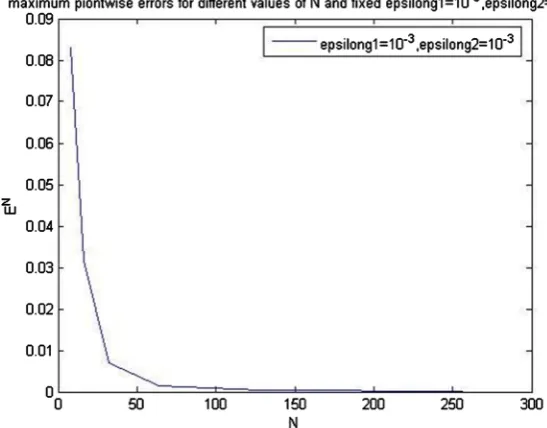
Figure 2. Relation of maximum point-wise errors and values of N.
where 2 2
1 1 1 16 1 2, 2 1 1 16 1 2
k = − + +
ε ε
k = + +ε ε
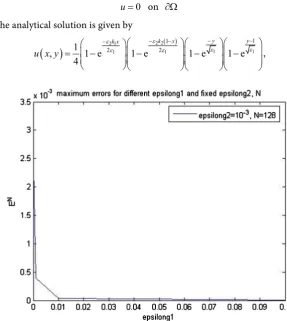
,Relation of maximum point-wise errors and values of ε and N is given in
Figure 1 and Figure 2. It observed that
1) when ε ∈1
(
0,0.01]
increases for fixed ε2 and N, the maximum point-wiseerrors decrease rapidly;
when ε ∈1
(
0.01,1)
increases for fixed ε2 and N, the maximum point-wiseerrors decreases slowly to 0;
2) when N<50 increase for fixed ε1 and ε2, the maximum point-wise
errors decreases rapidly;
when N>50 increase for fixed ε1 and ε2, the maximum point-wise
er-rors decreases slowly to 0;
4. Conclusion
The numerical results show clearly the effect of ε and N on the solution of an el-liptic singularly perturbed problem and the present method is relatively simple and it is applicable technique and approximates the exact solution very well.
Acknowledgements
The authors would like to thank the editor and the reviewers for their valuable comments and suggestions to improve the results of this paper.
This work was supported by the Natural Science Foundation of Guangdong (No. 2015A030313827) and the Key Subject Program of Lingnan Normal Uni-versity [No. 1171518004].
Conflicts of Interest
pa-DOI: 10.4236/jamp.2019.71014 171 Journal of Applied Mathematics and Physics per.
References
[1] Jain, P.C., Shankar, R. and Bhardwaj, D. (1997) Numerical Solution of the Korte-weg-Devries (KdV) Equation. Chaos, Solitons & Fractals, 8, 943-951.
[2] Schlichting, H. (1979) Boundary Layer Theory. 7th Edition, McGraw-Hill, New York.
[3] López, J.L., Sinusía, E.P. and Temme, N.M. (2006) First Order Approximation of an Elliptic 3D Singular Perturbation Problem. Studies in Applied Mathematics, 116, 303-319.
[4] Shih, S.D. (1996) A Novel Uniform Expansion for a Singularly Perturbed Parabolic Problem with Corner Singularity. Methods and Applications of Analysis, 3, 203- 227. https://doi.org/10.4310/MAA.1996.v3.n2.a3
[5] O’Riordan, E., Pickett, M.L. and Shishkin, G.I. (2006) Numerical Methods for Sin-gularly Perturbed Elliptic Problems Containing Two Perturbation Parameters. Ma-thematical Modelling and Analysis, 11, 199-212.