http://wrap.warwick.ac.uk
Original citation:Glebov, Roman, Králʼ, Daniel and Volec, Jan. (2015) A problem of Erdős and Sós on 3-graphs. Israel Journal of Mathematics.
Permanent WRAP url:
http://wrap.warwick.ac.uk/63371
Copyright and reuse:
The Warwick Research Archive Portal (WRAP) makes this work by researchers of the University of Warwick available open access under the following conditions. Copyright © and all moral rights to the version of the paper presented here belong to the individual author(s) and/or other copyright owners. To the extent reasonable and practicable the material made available in WRAP has been checked for eligibility before being made available.
Copies of full items can be used for personal research or study, educational, or not-for profit purposes without prior permission or charge. Provided that the authors, title and full bibliographic details are credited, a hyperlink and/or URL is given for the original metadata page and the content is not changed in any way.
Publisher’s statement:
“The final publication is available at Springer via http://dx.doi.org/10.1007/s11856-015-1267-4
A note on versions:
The version presented here may differ from the published version or, version of record, if you wish to cite this item you are advised to consult the publisher’s version. Please see the ‘permanent WRAP url’ above for details on accessing the published version and note that access may require a subscription.
ROMAN GLEBOV, DANIEL KR ´AL’, AND JAN VOLEC
Abstract. We show that for everyε >0 there exist δ >0 and n0 ∈Nsuch that every 3-uniform hypergraph onn≥n0vertices with the property that everyk-vertex subset, wherek≥δn, induces at least(1
4 +ε
) (k 3
)
edges, containsK4−as a subgraph, whereK4−is the 3-uniform hypergraph on 4 vertices with 3 edges. This question was originally raised by Erd˝os and S´os. The constant 1/4 is the best possible.
1. Introduction
One of the most influential results in the extremal graph theory is the celebrated theorem of Tur´an [31] that determines the largest possible number of edges in an n -vertex graph without a complete subgraph of a given size. Erd˝os, Simonovits, and Stone [11,13] generalized Tur´an’s theorem by showing that the extremal numberof an arbitrary graphF, defined as
ex(n, F) = max{|E(G)|: Gis a graph onn vertices with no copy ofF},
is asymptotically determined by its chromatic number. Specifically, for every graph F
with at least one edge,
ex(n, F) = (
χ(F)−2
χ(F)−1 +o(1) ) (
n
2 )
.
Note that this problem is dual to determining the minimum number of edges m(F) that guarantees that an n-vertex graphGwith at leastm(n, F) edges contains a copy ofF, sincem(n, F) = ex(n, F) + 1. Simonovits [28] showed the corresponding stability result, i.e., he proved that if a graph has almost the extremal number of edges and no copy of the forbidden graph F, then it is close to the appropriate Tur´an graph. Specifically, it consists of χ(F)−1 equal size nearly independent sets with almost all the edges between any pair of them.
In Ramsey-Tur´an type problems, which were introduced by S´os in [30], we are again interested in the largest possible number of edges of ann-vertex graph without a copy of F, but under the additional restriction that the graph has to be somewhat “far” from the Tur´an graph. Typically, such a restriction is expressed by requiring that the graph has only sublinear independence number. For more details on Ramsey-Tur´an theory, see the survey by Simonovits and S´os [29].
The work leading to this invention has received funding from the European Research Council under the European Union’s Seventh Framework Programme (FP7/2007-2013)/ERC grant agreement no. 259385. The first author was also supported by DFG within the research training group ”Methods for Discrete Structures”. The third author was also supported by the student grant GAUK 601812.
Here, we are dealing with an even stronger restriction; we require every linear-size subset of vertices not only to induce at least one edge, but actually to induce a positive proportion of all possible edges. We define theδ-linear density of a graphG to be the smallest density induced by a δ-fraction of vertices, i.e.,
d(G, δ) = min {
|E(G[A])|
(|A|
2
) : A⊆V(G),|A| ≥δ|V(G)|
}
.
Note that for any graphGthe functiond(G, δ) is a non-decreasing function ofδ taking values in [0,1].
However, requiring a positive δ-linear density immediately forces large graphs to behave similarly to random graphs in the sense that they contain every given graph as a subgraph.
Observation 1. For everyε >0and a fixed subgraph F, there existδ >0 andn0 ∈N
such that every graph G on at least n0 vertices with d(G, δ) ≥ ε contains F as an
subgraph.
A proof of this observation follows, e.g., from [25, Theorem 1].
The notion of theδ-linear density has a natural generalization to ak-uniform hyper-graph H, where we define
d(H, δ) = min {
|E(Hn[A])|
(|A|
k
) : A⊆V(H),|A| ≥δ|V(H)| }
.
From now on, we mostly focus on 3-uniform hypergraphs. Let K4 be the complete
3-uniform hypergraph on 4 vertices, andK4− the 3-uniform hypergraph on 4 vertices with 3 edges. Erd˝os and S´os [12, Problem 5] asked whether, analogously to Observation 1
for graphs, a sufficiently large hypergraph with positive δ-linear density contains a copy of K4, or at least a copy of K4−. However, F¨uredi observed that the following
construction of Erd˝os and Hajnal [10] shows that the situation in 3-uniform hypergraphs is completely different (hence giving a negative answer to the above question).
Example 2. Consider a random tournament Tn on n vertices. Let Hn be the
3-uniform hypergraph on the same vertex set consisting of exactly those triples that span an oriented cycle in Tn.
One can check that in every hypergraph obtained in this way, any four vertices span at most two edges, i.e., Hn does not contain K4− for every n. On the other hand, for
every δ > 0, the δ-linear density of Hn tends to 1/4 when n goes to infinity. For the
exact reference to the observation, we refer the reader to [18], where Frankl and R¨odl cite a personal communication with F¨uredi in 1983. Additional information about this problem and its history can be found in [29, Section 5]. It is also worth noting that in [25], R¨odl presented a sequence ofK4-free (but notK4−-free) 3-uniform hypergraphs
withδ-linear density tending to 1/2.
Theorem 3. For every ε >0 there exist δ >0 and n0∈N such that every 3-uniform
hypergraphH on at least n0 vertices withd(H, δ)≥1/4 +εcontainsK4−as a subgraph.
Our proof is based on the flag algebra calculus. However, unlike in the other proofs in the area, we apply the calculus to get one of the intermediate results only. We have to apply additional considerations to derive the desired statement. Further details can be found in Section 3, where we give the overview of the proof.
2. Flag Algebras
The main tool used for the proof of Theorem 3 is the framework of flag algebras. They were introduced by Razborov [21] as a general tool to approach problems from extremal combinatorics. The work of Razborov was inspired by the theory of dense graph limits of Borgset al.[6,7] and Lov´asz and Szegedy [19]. However, unlike for the more powerful Lov´asz-Szegedy theory, in order to create the theory of flag algebras for dense graphs, Razborov was able to avoid using any kind of regularity result. In the case of 3-uniform hypergraphs, flag algebras have already been successfully applied to various problems. These include progress on the celebrated Tur´an conjecture about the minimum edge-density that forces containing K4 as a subhypergraph [22,20,23,24],
several Tur´an-type problems for 3-uniform hypergraphs [3, 15, 16], and the so-called jumps in hypergraphs [2].
Let us now introduce the terminology related to flag algebras needed in this paper. Since we deal only with 3-uniform hypergraphs without a subhypergraph isomorphic to K4−, we restrict our attention only to this particular case. The central notions we are going to introduce are an algebra Aand algebrasAσ, whereσ is a fixed 3-uniform hypergraph not containing K4−. In order to precisely describe these algebras, we first need to introduce some additional notation.
LetF be the set of all non-isomorphic 3-uniform hypergraphs that does not contain
K4−. Next, for every ℓ ∈ N, let Fℓ ⊂ F be the set of ℓ-vertex hypergraphs from F.
We say that ℓ is the size of a hypergraph F ∈ Fℓ and denote it by |F|. For H ∈ Fℓ
and H′ ∈ Fℓ′, we setp(H, H′) to be the probability that a randomly chosen subset of
ℓvertices inH′ induces a subhypergraph isomorphic toH. Note thatp(H, H′) = 0 for
ℓ′ < ℓ. Let RF be the set of all formal linear combinations of elements of F with real coefficients. Furthermore, let K be the linear subspace of RF generated by all linear combinations of the form
H− ∑
H′∈F|H|+1
p(H, H′)·H′.
Finally, we defineA to be the spaceRF factorized by K.
The space A has naturally defined operations of addition and multiplication by a scalar (i.e., by a real number). We now introduce multiplication inside A. We start with defining it on the elements of F in the following way. For H1, H2 ∈ F, and
H ∈ F|H1|+|H2|, we define p(H1, H2;H) to be the probability that a randomly chosen
subset ofV(H) of size|H1|and its complement induce inHsubhypergraphs isomorphic
toH1 and H2, respectively. We set
H1×H2 =
∑
H∈F|H1|+|H2|
The multiplication onF has clearly the unique linear extension toRF, which gives rise to a well-defined multiplication also in the factor algebraA. A formal proof of this can be found in [21, Lemma 2.4].
Let us now move to the definition of an algebra Aσ, where σ∈ F is a fixed labelled hypergraph. It follows basically the same lines as the definition of A. Let Fσ be
the set of 3-uniform K4−-free hypergraphs H with a fixed embedding of σ, i.e., an injective mappingθfromV(σ) toV(H) such that Im(θ) induces inH a subhypergraph isomorphic to σ. The elements ofFσ are usually called σ-flags within the flag algebra framework, Im(θ) are referred to as the labelled vertices of the σ-flag, and the induced subhypergraph by the labelled vertices is called the type. Again, for every ℓ ∈N, we define Fℓσ ⊂ Fσ to be the set of the σ-flags from Fσ that have size ℓ(i.e., the σ-flags with the underlying hypergraphs havingℓvertices). Analogously to the case forA, for
H, H′ ∈ Fσ, we setp(H, H′) to be the following probability: a randomly chosen subset of|H|−|σ|vertices inV(H′)\θ′(V(σ)) together withθ′(V(σ)) induces a subhypergraph that is isomorphic to H through an isomorphism f that preserves the embedding of
σ. In other words, f(θ′) =θ. Let RFσ be the set of all formal linear combinations of elements ofFσ with real coefficients, and Kσ be the linear subspace ofRFσ generated by all the combinations of the form
H− ∑
H′∈Fσ
|H|+1
p(H, H′)·H′.
We defineAσ to be RFσ factorised byKσ. We now describe the multiplication onAσ. ForH1, H2 ∈ FσandH ∈ F|σH1+|H2|−|σ|, similarly to the multiplication forA, we define
p(H1, H2;H) to be the probability that a randomly chosen subset ofV(H)\θ(V(σ)) of
size|H1| − |σ|and a disjoint set fromV(H)\θ(V(σ)) of size|H2| − |σ|extendθ(V(σ))
inH to subhypergraphs isomorphic to H1 andH2, respectively. Again, by isomorphic
here we mean that there is an isomorphism that preserves the embedding of σ. This definition naturally extends to Aσ.
Consider an infinite increasing sequence (Hn)n∈N of hypergraphs from F. The
se-quence (Hn)n∈N is convergent if the probabilityp(G, Hn) has a limit for everyG∈ F.
A standard compactness argument (e.g., using Tychonoff’s theorem [32]) yields that every such infinite sequence has a convergent subsequence. All the following results pre-sented in the remainder of this section can be found in [21]. Fix a convergent increasing sequence (Hn)n∈N of hypergraphs. For every G∈ F, we setϕ(G) = limn→∞p(G, Hn)
and linearly extend ϕ to A. We usually refer to the mapping as to the limit of the sequence. The obtained mapping ϕ is a homomorphism from A to R. Moreover, for every F ∈ F, we obtain ϕ(F)≥0. Let Hom+(A,R) be the set of all homomorphisms
ϕbetween the algebraAandRthat satisfy ϕ(F)≥0 for everyF ∈ F. It is interesting to see that indeed this set is the set of all limits of convergent sequences from F.
For σ ∈ F and an embedding θ of σ in Hn, define pθn(G) = p(G, Hn) for every
G∈ Fσ. Pickingθat random gives rise to a probability distribution on mappings from Aσ to R, for each n ∈N. Since p(G, H
n) converges (as n tends to infinity) for every
G∈ Fσ, the sequence of these probability distributions on mappings fromAσ toRalso converges. In fact, ϕitself fully determines the random distributions of the mappings
Aσ to R based on this limit distribution. Any mapping ϕσ from the support of the
limit distribution is a homomorphism from Aσ toR.
The last notion we introduce is theaveraging (or downward) operatorJ·Kσ :Aσ → A.
For G ∈ Fσ, let G∅ be the (unlabeled) hypergraph in F corresponding to G. The operatorJ·Kσ is the linear operator defined on the elementsG∈ Fσ byJGKσ =pG·G∅,
wherepGis the probability that a random injective mapping fromV(σ) toV(G∅) is an
embedding ofσ inG∅ yieldingG. The key relation between ϕand ϕσ is the following:
∀G∈ Aσ, ϕ(JGKσ) =ϕ(JσKσ)·
∫
ϕσ(G),
where the integration is over the probability space given by the limit random distribu-tion on ϕσ. Therefore, ifϕσ(G)≥0 almost surely, then ϕ(JGKσ)≥0. In particular,
(1) ∀G∈ Aσ, ϕ(JG2Kσ
) ≥0.
3. Structure of the paper and sketch of the proof
In this section, we give a quick overview over the rest of the paper and we also introduce the remaining notation. Since we always deal with sequences of hypergraphs, it seems natural to define the lower density of an increasing sequence of hypergraphs (Hn)n∈N to be the smallest induced density of a linear-size subset and denote it by
λ((Hn)n∈N) := lim ε→0
{ lim inf
n→∞ d(Hn, ε)
}
.
A sequence (Hn)n∈Nof the random hypergraphs from Example2has lower density 1/4
with probability one.
Section 4 is devoted to the proof of Theorem 3, i.e., we show that the constant 1/4 is best possible. Our proof is partially computer assisted. However, it is worth pointing out here that we do not apply the Semidefinite method straightforwardly, since we essentially need to include the specific restricted structure of the considered graphs with positive lower density. We do so by first obtaining inequalities in the flag algebra language that hold for every potential counterexample. These inequalities are then used as part of the linear combination to prove that the density of some specific subhypergraph is zero. And this allows us to conclude a contradiction.
The proof is split into the following three steps:
• In Step 1, we deduce some structural properties of a sequence of 3-uniform hy-pergraphs with lower density at least 1/4. Namely, we prove that a specific collection of inequalities is satisfied by any such sequence. Two particular in-equalities from this collection will be used then in Step 2.
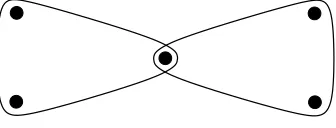
Figure 1. The butterfly
The rounded solution provides a proof that the induced densities of some specific flags of size 7, which we fully describe later, tend to zero in every se-quence with lower density at least 1/4. In this step, the flag algebra approach is essential.
• In Step 3, we first observe that, in particular, the main claim of Step 2 implies that the induced density of one specific flag of size 5 depicted in Figure1 tends to zero. Now suppose that Theorem 3 is false. Hence, there exists a sequence of 3-uniform hypergraphs withoutK4− and with lower density larger than 1/4. We sparsify each element of the sequence uniformly to obtain a sequence of hypergraphs with lower density exactly 1/4. Therefore, the induced density of the butterfly in the sparsified sequence still tends to zero. But this implies that the non-induced density of the butterfly in the original sequence tends to zero as well. However, from that claim it will immediately follow that the edge density of the original sequence tends to zero, which is impossible.
Finally, in Section5 we give some concluding remarks, leaving some open questions.
4. Proof of Theorem 3
Suppose to the contrary that there exists d > 1/4 and a sequence (Hn)n∈N of
3-uniform K4−-free hypergraphs of increasing sizes with lower densityd. Let us assume without loss of generality that (Hn)n∈Nconverges andϕC is the limit; We aim to show
that the edge density of ϕC is zero, contradicting the fact that it must be at least the
lower density of the sequence.
As already described in the introduction, the proof is split into three steps.
4.1. Deriving the inequalities. In this subsection, we derive a collection of inequali-ties that are valid for any convergent sequence of 3-uniform hypergraphs (Hn)n∈Nwith
lower density at least 1/4.
Let us first informally explain the main idea behind the inequalities. Consider an arbitrary type σ that has a positive density in the limit, and let F be a σ-flag with exactly one unlabelled vertex. Furthermore, assume thatnis sufficiently large. Now fix a copy S of σ inHn and consider the set U(S) of all vertices u∈V(Hn) that extends
S to a copy ofF. The following two outcomes can happen:
• The size of U(S) is small, i.e., o(n). But then, for this choice of S, both the probability that three random points belongs toU(S), and the probability that three random points belongs toU(S) and span an edge, are o(1).
U(S) and span an edge is asymptotically at least quarter of the probability that three random points belongs toU(S).
Analysis of these two outcomes is given in the following lemma.
Lemma 4. Let(Hn)n∈N be a convergent sequence of 3-uniform hypergraphs with lower
density at least1/4. Letϕbe its limit,σ a type, andF ∈ Fvσ(σ)+1 aσ-flag. In addition, let αG, for G ∈ Fvσ(σ)+3, be the coefficients such that F ×F ×F =
∑
G∈Fσ v(σ)+3
αG·G.
Furthermore, let
κ:= ∑
G∈Fσ v(σ)+3
αG·G and κ+:=
∑
G∈Fσ v(σ)+3
α+G·G,
where
α+G:= {
αG if the three non-labelled vertices ofG span an edge, and
0 otherwise.
It holds that
(2) ϕ(J4κ+−κKσ
) ≥0.
Note thatαG∈ {0,1} for everyG∈ Fvσ(σ)+3.
Proof First observe that if ϕ(σ∅)= 0, then all the terms in the left-hand side of (2) are equal to zero. For the rest of the proof, we assume ϕ(σ∅) >0. Our aim is to show that following holds when ϕσ is drawn from the distribution given by ϕ:
(3) P(ϕσ(4κ+−κ)≥0)= 1.
Since the inequality (2) is an immediate corollary of (3), it is enough to establish (3). Suppose for the contrary that (3) is not true, i.e.,P(ϕσ(4κ+−κ)≤ −ε)≥εfor some
ε >0. Then there exists n0 ∈ Nsuch that for every n≥n0 the graph Hn contains a
positive proportion of copies of σ with the following property. For every such copySn
of σ in Hn, the set U(Sn) = {v ∈ V(Hn)\V(Sn) : Hn[V(Sn)∪ {v}] ∼= F} has size
at least εn and the number of edges of Hn[U] is at most 14(1−ε)·
(|U|
3
)
. But this contradicts the fact thatλ(Hn)≥1/4.
Now we are ready to present the two inequalities we are going to use in the next step. Let κ1 beκ and letκ1+ beκ+ as in Lemma 4 forF being the edge with two labelled
vertices (hence σ is the unique type on 2 vertices; from now on we write just 2 when we use this type). The first line in Figure 2 shows this flag F and the corresponding linear combinations κ1 and κ+1. Next, let κ2 be κ and let κ+2 be κ+ for F being the
non-edge with two labelled vertices (again, σ is2). The second line in Figure 2shows the corresponding flagF and the combinationsκ2 and κ+2.
Lemma 4then implies that
(4) ϕ(J4κ+1 −κ1K2 )
≥0,
and
(5) ϕ(J4κ+2 −κ2K2 )
1 2 1 2 1 2
[image:9.612.161.449.99.313.2]1 2 1 2 1 2
Figure 2. The expressions used in inequalities (4) and (5): a solid line denotes a hyperedge, dotted line a non-hyperedge, and finally we sum over all the possible choices of triples where there is neither a dotted nor a solid line.
4.2. Applying the Semidefinite Method. Recall thatF7 is the set of all 3-uniform
K4−-free hypergraphs of size 7. It holds that |F7| = 8157. Let E7 be the set of all
hypergraphs fromF7that can possibly appear as induced subgraphs of the hypergraphs
from Example 2. It holds that |E7|= 247.
The main lemma of this part of the proof is the following.
Lemma 5. There exist rational numbers (αG)G∈F7, where αG = 0 for G ∈ E7, and
αG < 0 otherwise, such that the following holds. If ϕ is an element of Hom+(A,R)
that satisfies (4) and (5), then
ϕ
∑
G∈F7
αG·G
= 0.
Proof As we already mentioned, the proof was found with computer assistance. An instance of an SDP program was used to find positive rationals γ1 and γ2 and 8
symmetric positive semidefinite matrices A1, A2, . . . A8 with rational entries such that
the following holds:
ϕ
γ1·J4κ+1 −κ1K2+γ2·J4κ+2 −κ2K2+ ∑
i=1,...,8
JxTi AixiKσi
=ϕ
∑
G∈F7
αG·G
,
where
• the typeσ1 is the type with one vertex,
1 2
3 4 5
1
2
4 3
5
1 2
3 4 5
1 2
3 4 5
1 2
[image:10.612.111.510.77.312.2]3 4 5
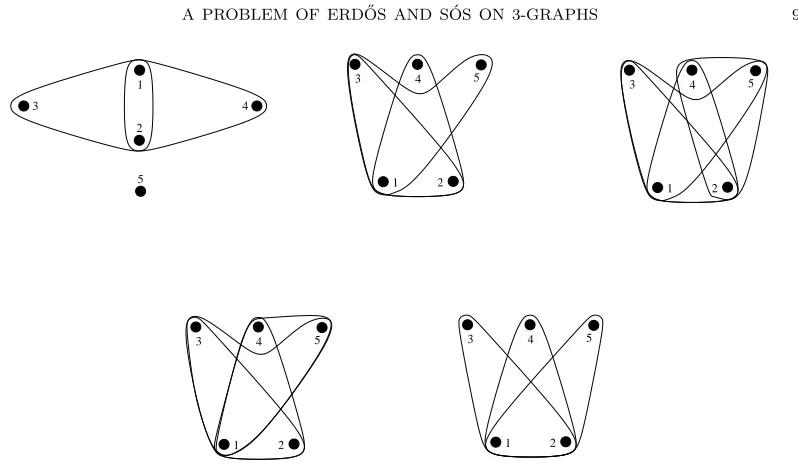
Figure 3. The types σ4 through σ8: solid lines denote edges, and a
triple without a solid line spans a non-edge.
• the typeσ3 is the type with three vertices and one edge,
• the typesσ4, . . . , σ8 are the five specific types on five vertices given in Figure3,
• the vectorx1 ∈(RF4σ1)|F
σ1
4 | is the vector whosej-th coordinate is equal to the
j-th element of the canonical base of RFσ1
4 ,
• fori = 2,3, the vectorxi ∈(RF5σi)|F
σi
5 | is the vector whose j-th coordinate is
equal to thej-th element of the canonical base ofRF5σi, • fori= 4,5, . . . ,8, each vector xi ∈(RF6σi)|F
σi
6 | is the vector whosej-th
coordi-nate is equal to thej-th element of the canonical base ofRF6σi, and • αG= 0 if G∈ E7, and αG<0 otherwise.
Since the left-hand side of the above equation is non-negative by (1), (4), and (5), it follows that
ϕ
∑
G∈F7
αG·G
≥0.
On the other hand, the values of αG are non-positive for every G ∈ F7, hence the
left-hand side of the last inequality is trivially also at most zero.
To illustrate the complexity of the proof, we note that the sizes ai of the sets
Fσ1
4 ,F
σ2
5 ,F
σ3
5 ,F
σ4
6 ,F
σ5
6 ,F
σ6
6 ,F
σ7
6 , and F
σ8
6 , which coincide with the order of the
ma-trices Ai, are 5,95,47,191,135,95,101, and 148, respectively. The numerical values of
Each matrixAi is not stored directly but as an appropriate number of vectorsvij ∈ Qai and positive rationalswj
i such that
Ai= ri
∑
j=1
wji ·vji ×
(
vij
)T
,
where r1 = 3, r2= 45, r3= 21, r4= 63, r5 = 60, r6 = 43, r7 = 31,andr8= 25.
In order to make an independent verification of our computations easier, we created a sage script called “verify.sage”, which is also available on the web page mentioned above. Instead of generating the lists of flags and computing all the probabilities involved in our computations, the verification program uses data from Flagmatic 1.5.1 [15, 16] applied to find an upper bound on the Tur´an density of K4−. However, we used these data only to simplify the verification part and they were not used in our computations to findγ1, γ2 and Ais (this was to decrease a chance of encountering a program-related
error).
Lemma 5immediately yields the following.
Corollary 6. Let F be a hypergraph of size at most 7 such that its induced density in the hypergraphs from Example 2 is zero, and letϕ be as in Lemma5. Then, ϕ(F) = 0.
4.3. The final step. LetBbe the butterfly hypergraph depicted in Figure1. Since the hypergraphs from Example 2 are B-free, Corollary 6 implies that ϕ(B) = 0 whenever a homomorphism ϕ∈ Hom+(A,R) satisfies (4) and (5). In particular, for the limit ϕ
of any convergent sequence of K4−-free hypergraphs with lower density at least 1/4, we have ϕ(B) = 0.
Recall that ϕC is the limit of a hypothetical convergent sequence (Hn)n∈N that is a
counterexample to Theorem3. Therefore,λ((Hn)n∈N
)
>1/4. Our aim is to show that the edge density of ϕC is equal to zero, which would contradictλ
(
(Hn)n∈N
)
>1/4. Instead of applying the claim directly toϕC, we first construct from (Hn)n∈Na new
sequence (Hn′)n∈N such that λ((Hn′)n∈N) = 1/4. This is done simply by a random sparsification of (Hn)n∈N, i.e., removing each edge of each Hn at random with the
appropriately chosen probability.
Observation 7. Let(Hn)n∈Nbe a sequence of3-uniformK4−-free hypergraphs withd:=
λ((Hn)n∈N
)
>1/4. Furthermore, for every n∈N, let Hn′ be a random subhypergraph ofHnobtained by removing every hyperedge ofHnindependently with probability1−41d.
Then
P(λ((Hn′)n∈N
) = 1/4
) = 1.
Let (Hn′)n∈N be the sequence of hypergraphs obtained from (Hn)n∈N. Letϕ′C be its
limit (the sequence (Hn′)n∈N must be convergent). Lemma4 implies that ϕ′C satisfies both (4) and (5). Hence, by Corollary 6, the induced density ofB in ϕ′C is equal to zero. But this implies thatϕC(F) = 0 for anyF ∈ F that containsB as a non-induced
subgraph. This holds because otherwise there would be some F ∈ F that contains a non-induced copy of B and ϕC(F)>0. However, a positive proportion of the induced
copies ofF fromϕC will be then turned, by a random sparsification, to induced copies
ϕC is equal to zero. In particular, any non-negative combination of the elements ofF5
that contain the butterfly as a non-induced subgraph must be zero inϕC.
We are now ready to derive that the edge density of ϕC is zero. Let ρ ∈ F3 be the
hypergraph on three (unlabelled) vertices that span an edge. Let ρ1 ∈ F31 be the flag
corresponding toρ with exactly one vertex labelled.
Observe that all elements of F51 with positive coefficient in ρ21 contain B as a sub-graph. So,ϕC
(
J(ρ1)2K1
)
= 0, which implies that
ϕC(ρ)2 =ϕC(Jρ1K1)2≤ϕC
(
J(ρ1)2K1
) = 0.
This completes the proof of Theorem 3.
5. Concluding remarks and open questions
In Theorem3, we proved that for 3-uniform hypergraphs, the threshold lower density for every four vertices to induce at most two edges is 1/4. We have recently learned [26] that one can prove the same result using hypergraph regularity under the assumption that all parts in the partitions are regular.
Recently, Falgas-Rarvy, Pikhurko and Vaughan [14] used the semidefinite method to prove that the value 1/4 is also the minimum co-degree threshold for containing a copy of K4−. Furthermore, they showed that the limit of the sequence of hypergraphs corresponding to cyclically oriented triangles in random tournaments is in fact the uniqueK4−-free homomorphism from Hom+(A,R), where the elements of the sequence have minimum co-degree equal to 1/4 +o(1). An adaptation of their approach to our problem yields the same uniqueness result as they showed for the co-degree condition.
Theorem 8. Let (Hn)n∈N be a convergent sequence of K4−-free 3-graphs so that
λ((Hn)) = 1/4, and let ϕ ∈ Hom+(A,R) be its limit. It holds that ϕ is equal to the
homomorphism ψ, which is the limit of the sequence of 3-graphs from Construction 2
with increasing orders.
A proof of this theorem can be found in the Ph.D. thesis of the third author [33]. Bhat and R¨odl [4] applied our Theorem 3 to show the following. A number α > 0 is a jump for r-uniform pseudorandom hypergraphs, if there exists δ > 0 such that every sequence of r-uniform pseudorandom hypergraphs of increasing sizes with limit density larger thanα contains subgraphs of increasing sizes with density at leastα+δ. Bhat and R¨odl showed that every number between 0 and 0.3192 is a jump for 3-uniform pseudorandom hypergraphs. Notice that, if Question 10 (given further) is answered positively for r = 4, then similarly to the proof of [4, Theorem 1.6] one can show that every number between 1/8 = 0.125 and 0.1262869 is a jump for 4-uniform pseudorandom hypergraphs.
A natural question is to seek an extension of our results for hypergraphs with larger uniformity. Frankl and R¨odl [18] mention a construction of Frankl and F¨uredi ([17, Example 3]) as a possible source of examples of r-uniform hypergraphs with lower density 1/2r−1 with no r+ 1 vertices spanning three edges. Here, we present a variant of this construction that was also independently obtained by them [26] which indeed gives such examples.
(r−2)-dimensional faces are either all oriented towards the inside or all towards the outside of the (r−1)-simplex.
Example 9. Consider n points in Rr−1 in general convex position. Orient (r− 2)-simplices spanned by these points uniformly at random (i.e., every of the two possible orientations has probability1/2). Letr points form an edge if the corresponding(r− 1)-simplex is compliant.
The lower density of r-uniform hypergraphs from Example 9 tends to 1/2r−1. The following argument shows that every r+ 1 vertices span at most two edges in every such r-uniform hypergraph. Let us fix r+ 1 vertices inRr−1 in general convex position and consider an orientation of the (r−2)-simplices formed by them.
• The intersection of two (r−1)-simplices is an (r−2)-simplex that is either part of the convex hull of ther+ 1 points or not.
• Two compliant (r −1)-simplices whose intersection is part of the convex hull have their (r−2)-dimensional faces either all oriented towards their insides or all towards the outside.
• Similarly, out of two compliant (r−1)-simplices whose intersection is not part of the convex hull, one has all its (r−2)-dimensional faces oriented towards its inside, and the other towards its outside.
• For every three (r−1)-simplices, there are two possibilities for the three (r− 2)-dimensional faces in their pairwise intersections: either none of them or exactly two of them are in the convex hull. So, not all three (r−1)-simplices can be compliant.
This leads us to the following question.
Question 10. Let (Hn)n∈N be a convergent sequence of Kr3+1-free r-uniform
hyper-graphs, where K3
r+1 is the r-uniform hypergraph onr+ 1 vertices with three edges. Is
it true that (Hn)n∈N has lower density at most1/2r−1?
Acknowledgments. The authors thank Oleg Pikhurko and Vojta R¨odl for fruitful discussions and helpful comments on the results contained in this paper. The authors also thank to the anonymous referee for carefully reading the manuscript and for their valuable comments, which greatly improved the presentation of the results.
References
[1] N. Alon, J. Spencer, The probabilistic method, 3rd Edition, Wiley, New York, 2008.
[2] R. Baber and J. Talbot, Hypergraphs do jump, Combinatorics, Probability and Computing 20
(2011), 161–171.
[3] R. Baber and J. Talbot, New Tur´an densities for 3-graphs, Electronic Journal of Combinatorics
19(2012), #P22.
[4] V. Bhat and V. R¨odl, Note on upper density of quasi-random hypergraphs, preprint.
[5] B. Borchers, CSDP, a C library for semidefinite programming, Optimization Methods and Software
11/12(1999), 613–623.
[6] C. Borgs, J. T. Chayes, L. Lov´asz, V. T. S´os, and K. Vesztergombi, Convergent sequences of dense graphs I: Subgraph frequencies, metric properties and testing, Advances in Mathematics
219(2008), 1801–1851.
[8] G. Elek and B. Szegedy, A measure theoretic approach to the theory of dense hypergraphs, preprint.
[9] P. Erd˝os, Problems and results on graphs and hypergraphs: Similarities and differences, In: J. J. Neˇsetˇril and V. R¨odl, editors,Mathematics of Ramsey Theory, Springer-Verlag, 1990, 223–233. [10] P. Erd˝os and A. Hajnal, On Ramsey like theorems. Problems and results, In Combinatorics:
being the proceedings of the Conference on Combinatorial Mathematics held at the Mathematical Institute, Oxford, 1972), Southend-on-Sea: Institute of Mathematics and Its Applications, 1972, 123–140.
[11] P. Erd˝os and M. Simonovits, An extremal graph problem,Acta Mathematica Academiae Scien-tiarum Hungaricae22(1971), 275–282.
[12] P. Erd˝os and V. T. S´os, On Ramsey-Tur´an type theorems for hypergraphs, Combinatorica 2
(1982), 289–295.
[13] P. Erd˝os and A. H. Stone, On the structure of linear graphs,Bulletin of the American Mathematical Society52(1946), 1089–1091.
[14] V. Falgas-Ravry, O. Pikhurko, and E. R. Vaughan, The codegree density ofK4−, in preparation. [15] V. Falgas-Ravry and E. R. Vaughan, Applications of the semi-definite method to the Tur´an density
problem for 3-graphs,Combinatorics, Probability and Computing22(2013), 21–54.
[16] V. Falgas-Ravry and E. R. Vaughan, Tur´anH-densities for 3-graphs,Electronic Journal of Com-binatorics19(2012), #P40.
[17] P. Frankl and Z. F¨uredi, An exact result for 3-graphs,Discrete Mathematics50(1984), 323–328. [18] P. Frankl and V. R¨odl, Some Ramsey-Tur´an type results for hypergraphs,Combinatorica8(1988),
323–332.
[19] L. Lov´asz and B. Szegedy, Limits of dense graph sequences, Journal of Combinatorial Theory, Series B96(2006), 933–957.
[20] O. Pikhurko, The minimum size of 3-graphs without a 4-set spanning no or exactly three edges,
European Journal of Combinatorics32(2011), 1142–1155.
[21] A. Razborov, Flag algebras,Journal of Symbolic Logic,72(2007), 1239–1282.
[22] A. Razborov, On 3-hypergraphs with forbidden 4-vertex configurations,SIAM Journal on Discrete Mathematics24(2010), 946–963.
[23] A. Razborov, On the Fon-der-Flaass interpretation of extremal examples for Tur´an’s (3, 4)-problem,Proceedings of the Steklov Institute of Mathematics274(2011), 247–266.
[24] A. Razborov, On Tur´an’s (3,4)-problem with forbidden configurations, preprint.
[25] V. R¨odl, On universality of graphs with uniformly distributed edges, Discrete Mathematics 59
(1986), 125–134.
[26] V. R¨odl, private communication, 2013.
[27] W.A. Stein et al., Sage Mathematics Software (Version 5.4.1), The Sage Development Team, 2012,
http://www.sagemath.org.
[28] M. Simonovits, A method for solving extremal problems in graph theory, stability problems, In
Theory of Graphs (Proceedings of the Colloquium held at Tihany, 1966), Academic Press, New York, 1968, 279–319.
[29] M. Simonovits and V.T. S´os, Ramsey-Tur´an theory,Discrete Mathematics229(2001), 293–340. [30] V.T. S´os, On extremal problems in graph theory, In Proceedings of the Calgary International
Conference on Combinatorial Structures and their Application, 1969, 407–410.
[31] P. Tur´an, Eine Extremalaufgabe aus der Graphentheorie (in Hungarian),Matematikai ´es Fizikai Lapok48(1941), 436–452, see also: On the theory of graphs,Colloquium Mathematicum3(1954), 19–30.
[32] A. Tychonoff, ¨Uber die topologische Erweiterung von R¨aumen (in German),Mathematische An-nalen102(1930), 544–561.
Department of Mathematics, ETH, 8092 Zurich, Switzerland. Previous affiliations: Mathematics Institute and DIMAP, University of Warwick, Coventry CV4 7AL, UK, and Institut f¨ur Mathematik, Freie Universit¨at Berlin, Arnimallee 3-5, D-14195 Berlin, Ger-many.
E-mail address:[email protected]
Mathematics Institute, DIMAP and Department of Computer Science, University of Warwick, Coventry CV4 7AL, UK. Previous affiliation: Computer Science Institute, Faculty of Mathematics and Physics, Charles University, Prague, Czech Republic.
E-mail address:[email protected]
Department of Mathematics, ETH, 8092 Zurich, Switzerland. Previous affiliations: Mathematics Institute and DIMAP, University of Warwick, Coventry CV4 7AL, and Computer Science Institute, Faculty of Mathematics and Physics, Charles University, Prague, Czech Republic.