Original citation:
Mackrill, J. B., Cain, Rebecca and Jennings, P. A. (Paul A.). (2016) Proposing a conceptual framework to develop the hospital soundscape through visual communication. Design Journal, 19 (3). pp. 491-509.
Permanent WRAP URL:
http://wrap.warwick.ac.uk/77816
Copyright and reuse:
The Warwick Research Archive Portal (WRAP) makes this work by researchers of the University of Warwick available open access under the following conditions. Copyright © and all moral rights to the version of the paper presented here belong to the individual author(s) and/or other copyright owners. To the extent reasonable and practicable the material made available in WRAP has been checked for eligibility before being made available.
Copies of full items can be used for personal research or study, educational, or not-for profit purposes without prior permission or charge. Provided that the authors, title and full
bibliographic details are credited, a hyperlink and/or URL is given for the original metadata page and the content is not changed in any way.
Publisher’s statement:
“This is an Accepted Manuscript of an article published by Taylor & Francis in Design Journal on 13/06/2016 available online: http://dx.doi.org/10.1080/14606925.2016.1149330
A note on versions:
The version presented here may differ from the published version or, version of record, if you wish to cite this item you are advised to consult the publisher’s version. Please see the ‘permanent WRAP URL’ above for details on accessing the published version and note that access may require a subscription.
Proposing a conceptual framework to develop
the hospital soundscape through visual
communication
Mackrill, J*., Cain, R^., Jennings, P.A^.Dyson School of Design Engineering,
Imperial College London, UK Corresponding author email:
WMG, University of Warwick, UK
ABSTRACT
Sound level measurement is used to assess sound within any environment, never more so than in hospitals. This is due to the negative effects that high sound level can have on patients and staff. However, other ways of exploring sound and the soundscape within the hospital context have been used: sound art has conveyed the experiences of heart transplant patients. Art may act as juxtaposition to objective sound level measurement but the two fundamentally attempt to depict attributes of the soundscape. Using theory from design and concepts from art a framework is presented for designing a positive soundscape experience. This is not through the addition of sound per-se but through creatively communicating the information contained within a soundscape to enable the everyday listener to interpret a cacophony of hospital sounds more positively. In representing visual communication of sound as a design object, a new way to explore sound may exist.
INTRODUCTION
Sound can be as defined pressure fluctuations in the air that stimulate the auditory systems (Plack, 2005). The main function of this system is to get information from the outside world into the brain where it can be used to plan future behaviour (Plack, 2005, p, 62). We often learn and interpret environmental sounds as direct or indirect meaningful events in order to guide this behavior (Keller and Stevens, 2004). Sound is sensory stimuli that is acted upon, be it physically or psychologically.
Many things create sound, from the wind in the trees through to products with a formally ‘designed’ sound such as a car. Acoustic metrics can be and are used to capture and analyze such sounds. Sound level and more specifically one of its measurements decibels (dB), is commonly used. A decibel is a unit of sound (Plack, 2005, p, 243) and can be analyzed with an A-weighted filter (dBA) to represent hearing response at low sound level, mainly below 60dB (Pierre and Maguire, 2004). Often it is the dB(A) level of space that is carefully considered to form a view as to the ‘correct’ acoustic environment. Reporting features such as dB(A) and perhaps moving on to psychoacoustic metrics can add objectivity to the human sense of hearing. However this may still miss the personal experience of the sound, the communication to the individual and subsequent meaning. For example, a sound level of 50dB(A) can represent both traffic sound and birdsong yet these sounds elicit different subjective reactions (Alvarsson et al., 2010).
SOUNDSCAPES
soundscape explains the collection of sources within an environment that combine to produce an ambient sonic environment within a given context. Expanding on this concept, Truax (1984, p, 32) explains that speech, music and a soundscape can be linked on the common basis of communication. As Plack (2005) reminds us, sound is about information to drive human behaviour. A soundscape is fundamentally an information/communication source. Treating sound as this communication deals with the transfer of information rather than the traditional acoustic position of energy. Doing so deals with our cognitive understanding of sound (Truax, 1984). The mental product and subjectivity to soundscapes can, arguably, be of great value for designers aiming to elicit a positive reaction through sound. Indeed, soundscape planners see sound as a resource, where depletion or degradation is to be avoided (Brown and Muhar, 2004).
DESIGNING SOUNDSCAPES FOR SUBJECTIVE RESPONSE
When designing artifacts we might broadly suggest that the aim is to create a positive response from those who consume the design. A good example is that of automotive sound quality. Özcan and Egmond (2012) remark that a red sports car with its aerodynamic shape, soft leather, hard steering wheel and roaring engine can cause high arousal and therefore is experienced as thrilling and sportive.
Desmet and Pohlmeyer (2013) comment that design should not concentrate on creating short term material wealth but should function as a resource that addresses meaningful goals within people. From this, design may contribute to user happiness and subsequently well-being.
The authors’ own work has begun to explore the qualitative and experiential elements of the hospital soundscape, through interviews, lab studies and in-situ questionnaires (Mackrill et al., 2013a,b,c). The work has described the notion that understanding sound is of value in enabling patients to habituate and accept a hospital ward soundscape. Importantly, through achieving this acceptance and habituation a more positive subjective response can be formed by patients in relation to the soundscape. Relating this to Desmet and Pohlmeyer (2013), the sound of the space becomes meaningful and an ‘object’ that is to be designed in order to improve the hospital experience. A concept and approach is needed for facilitating this.
AIM
Part A of this article describes the sound level measurement of a cardio-thoracic hospital ward soundscape and compares this to other reported sound levels. This demonstrates some of the limitations in relying on this single analysis method for improving the hospital soundscape. Part B discusses a framework for future investigation to consider how acoustic metrics are important in creating a basic soundscape but how visually communicating elements of the soundscape might hold much value in enhancing the experience of the space.
PART A: WHAT DOES A HOSPITAL WARD SOUND LIKE?
In order to describe the process outlined in Part B we first need an understanding of a hospital ward soundscape. Here we describe a cardio-thoracic (CT) ward soundscape at a large UK University Hospital during a one month period in summer 2010.
lasted a total 310 seconds to ensure that the broad character of the soundscape was captured and to increase the chance of obtaining the keynote (distinguishing) sounds (Truax, 1984).
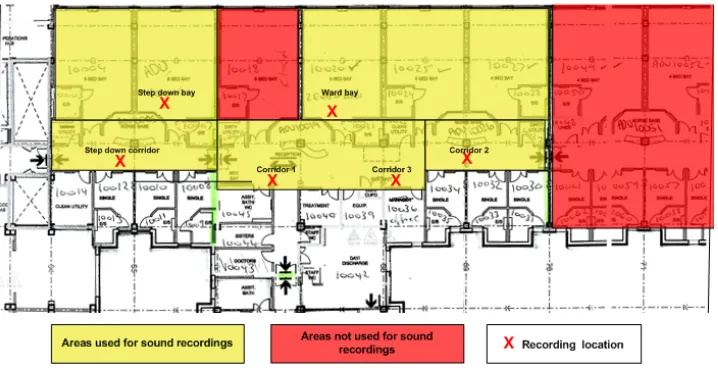
[image:6.595.75.434.243.427.2]Recordings were made within the main corridor, a male ward patient bay and male step-down intensive care patient bay (Figure 1). Fewer recordings were made within the ward bays in respect of patient privacy. All recordings were made between 10am and 2pm dictated by the access allowed to the ward.
Figure 1. Layout of ward with markings of recordings locations
ANALYSIS
Sound pressure level was analyzed using the Bruel and Kjaer SonoScout analysis software. All data was then converted to MS Excel format to enable further analysis. The continuous equivalent noise level (Leq) was calculated for each area corridor, ward patient bay and step down patient bay for the entire 310sec recording period. This was done using the equation below to describe the sound levels over the 310sec recording period in a single decibel value taking into account the total sound energy over the period.
Additionally frequency counts of sound sources were made to assess the predominant sound source features of the soundscape using the coding procedure of Poxon et al (2009). This categorized the sound sources for each recording at one second intervals by the researcher by listening to each recording to arrive at a comprehensive list of sound sources and frequency of occurrence.
RESULTS
THE SOUNDSCAPE OF THE HOSPITAL WARD
Table 1. Soundscape coding schedule and percentage contribution of all sources from corridor and bay locations
Source category Sub source Selection of descriptions
Percentage contribution of sound sources to the
soundscape
Human People
Patients
Talking background, Footsteps
Screaming, Coughing
42.2%
Occupational Bin
Cleaning Room Computer Curtains Door Draw Equipment File Floor Cleaner Phone Trolley Object Tap Wheel Chair Opening/closing Sterilizing machine Tapping Closing/opening
Slamming, opening, closing Opening/closing Hissing, Squeaking Clip closing Buffer Ringing Passing, Rattling Banging, Cups jingling, Dropping,
Running water Moving (squeaking)
46%
Other TV TV sounds 1%
Medical Monitors
Equipment
Beeping, Fast beep High pitch beep, ripping sound
10.2%
External sounds Car Alarm
Car Passing
Alarm ringing
Car passing hum 0.6%
"
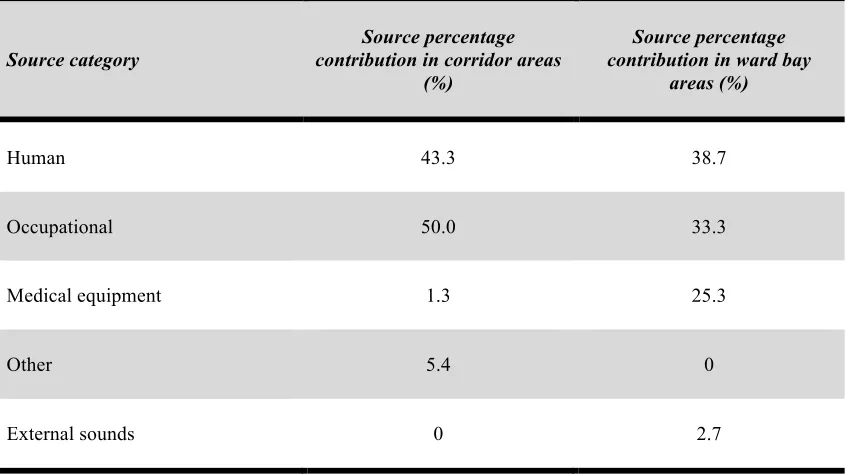
Table 2. Sound sources for corridor and ward bay areas.
Source category
Source percentage contribution in corridor areas
(%)
Source percentage contribution in ward bay
areas (%)
Human 43.3 38.7
Occupational 50.0 33.3
Medical equipment 1.3 25.3
Other 5.4 0
External sounds 0 2.7
Figure 3. Sound pressure level analysis for each recording location. Note, that the corridor and step down patient bay areas have very similar patterns in sound pressure level
DESCRIBING THE HOSPITAL WARD SOUNDSCAPE
hospital ward settings. A limitation is that this does not describe the character of sound. The data is useful to report on sound control within the setting. However, a potential danger of this type of assessment is that sound is seen as a by-product and dealt with as waste management (Brown and Muhar, 2004).
This is highlighted by Figure 4, which depicts the soundscape during the moment where a patient was screaming. During this period the sound pressure levels are reasonable in the setting of a hospital ward. Would this sound pressure level result in a negative response? Knowing that a patient is crying out may be perceived as either negative or positive depending on the context regardless of the measured sound pressure level.
[image:11.595.75.398.437.537.2]In this situation, understanding the meaning of and reason for hospital sounds may be of value. An opportunity therefore exists to consider this information, the communication embedded within the soundscape, as that of a design object. This might help the everyday listener to, as Fowler (2013) observes, characterize the presence and meaning of sound in terms of human experience, and sound as mediated language between the listener and the environment.
PART B: CONSIDERING THE SOUNDSCAPE AS A ‘DESIGNED’
OBJECT
Part A has demonstrated that measuring sound level, although important, may not help to improve the soundscape for positive experience. There is a need to develop and describe a design process to convey the information of sound in order for users to become accustomed to the potentially alarming sounds sampled in hospital wards (Hojlund and Kinch, 2014).
INTENT IN DESIGN AND SOUNDSCAPES
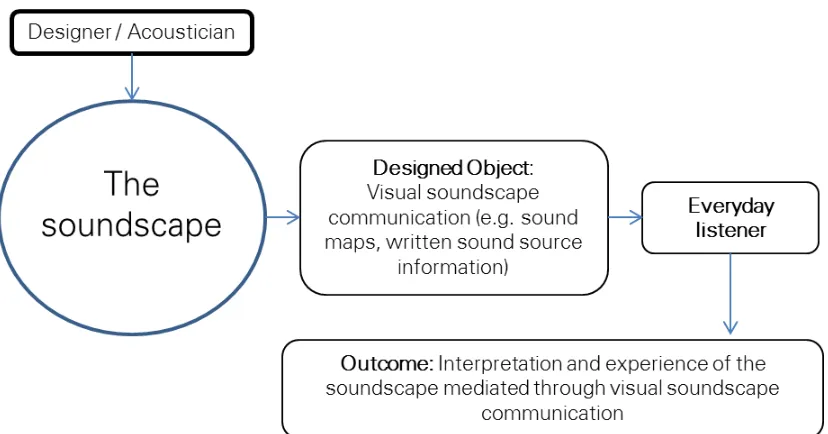
Communication in the soundscape can be likened to the communication a artifact has between the designer and the consumer. This communication has been explored and clarified in research by Crilly et al. (2008) who suggest that the relationship between how an artifact is intended to be experienced and how they are in reality is largely disconnected. Crilly et al (2008) depicts an interpersonal communication perspective between the designer and consumer and elaborates on how the artifact mediates between the designer and the consumer (Crilly et al., 2008, p, 22).
Although sound is intangible in comparison to a physical artifact such as a lamp or chair, the principles in the relationship between the soundscape/acoustic designer and the everyday listener (a patient exposed to the sounds of a hospital ward) are similar. Indeed, McGregor et al (2014), in a similar way to Crilly et al (2008), has shown the disconnect between what sound designers hear and what every day listeners hear with regard to different sound compositions within interactive technology and media. To examine the difference between listeners’ understanding three methods were used for each of the 10 sound clips;
classification, visualization and a survey. It was found that designers understanding of sound
are more broadband than that of the everyday listener. The sound designers possessed a more detailed understanding of sound noting specific qualities whereas the everyday listener had a limited understanding of sound. In a sound clip of flute music the designer identified 15 sound events along with a fuller description of it. Importantly, when these responses were visualized these sound events and descriptions were depicted more narrowly for the everyday
listeners. McGregor et al (2014) demonstrates the use of visual information as a means to
Previous work by the as has shown that understanding the information contained within the hospital soundscape provides the basis for a more positive experience of the soundscape (Mackrill et al., 2013a,b). Hojlund and Kinch, (2014) supports this through producing a set of furniture for children to use in order to explore the surroundings of a hospital ward whilst visiting a relative or friend in hospital. This was to “demystify” the unusual sounds of the ward and facilitate habituation towards the soundscape and situations as a whole. The authors conclude that the furniture was successful in enabling children to focus more on visiting the relative than the unusual hospital environment with faster habituation.
In relating this to Crilly et al. (2008) we suggest that accessing the information within a design may moderate the subsequent response to it: the disconnect between intent and experience is reduced. Information may be explicitly given to the consumer of the artifact (here the sound), making the meaning accessible.
As the acoustics parameters for hospital soundscapes are stringent due to regulation (see: WHO (Berglund et al., 2000) and UK Department of Health Health Technical
Memorandum 08-01: Acoustics (2008)) this limits creativity in the soundscape design.
However, using information to create knowledge within individuals exposed to the soundscape might provide an opportunity to overcome this.
LEARNING FROM SOUND ART
Sound art can be used to discuss a position that explores sound in a more abstract way than acoustics. Carlyle (2012) comments that sound art is art that takes as its subject sound and explores the relationship people have to the sounds that surround them. Likewise Cox’s (2009) description of sound art reports:
Just as objects fill visual space, noise is what fills the auditory field: the hum of fluorescent lights, the rustling of leaves or fabric, the sound of traffic, radio static – all of these combined. It is from this background that any signal comes to the fore,
temporarily drawing our attention to it and way from background noise. (p. 20).
What both these definitions provide is the sense that sound has a shaping influence on us and art can be used to create positive experiences through sound.
Contemporary sound art has not ignored the context of hospital spaces. New ways of improving hospital soundscapes are being explored which are moving away from sound control through a more artistic approach. Recently Brian Eno created generative music for the reception area of a new UK hospital along with a special soundtrack and light installation within a quiet room to enable patients, staff and visitors to escape (Sherwin, 2013).
In a 24 piece installation first displayed in 2008, Transplant created by Wainwright and Wynne (2008) represents the visual (photographic) and auditory experience of heart transplant surgery. The audio recordings of the environment, conversations and medical equipment provide a detailed auditory record of the soundscape. It is possible that through work like this, the soundscape of a hospital may be most accurately represented and detailed. In this example, art enables the listener to actively engage in the sounds of the space and consider meaning and information held within them.
VISUALLY COMMUNICATING THE HOSPITAL SOUNDSCAPE
[image:15.595.71.528.312.371.2]
Figure 5 depicts the level of engagement that different stakeholders have in the hospital soundscape. Acousticians are most interested in the acoustic performance of the space and how to meet legislation. Sound artists may be more interested in the meaning and detailed nuances of the soundscape. What both these stakeholders have is a state of ‘listening in search’ (Truax, 1984). That is, both are engaged in analytical listening to understand the soundscape. In the middle we position the everyday listeners of the soundscape (patients, staff, visitors), those that might be in a state of either ‘background listening’ (Truax, 1984) tuned out through reading or another activity, or ‘listening in readiness’ (Truax, 1984) where one is ready to respond to signals from the soundscape, a nurse attentive to alarms.
Figure 5. Adapted model from Jennings & Cain, 2013.
[image:15.595.75.534.502.658.2][image:16.595.75.526.165.276.2]
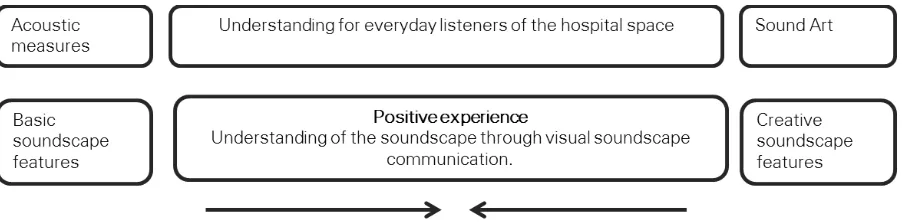
may not simply be because of acoustics but because of the increase in tacit knowledge which visual communication may facilitate (Figure 7).
Figure 7. Positive experience through designed information positioned between acoustics and art.
Acoustics can design the ‘basic’ requirements of the soundscape to eliminate ‘noise’ and comply with the guidelines and recommendation (Jennings & Cain, 2013). Notions from sound art can then be used to act as a creative influence to visually communicate the soundscape to the everyday listener. This fulfills Carlyle’s (2012) definition of sound art that it does not necessarily create sound itself but is a medium that relates to or represents the sounds around us. This is where we propose visual communication of the soundscape in-situ.
Fowler (2013) observes that although dB(A) and psychoacoustic measures are beneficial to scientists, how this information becomes manifested and disseminated through visual language of mappings or diagrams that are engaging to designers is a particular challenge. We suggest that this is also a challenge for everyday listeners exposed to the soundscapes of spaces, and a visual language to mediate understanding of a hospital soundscape is required. Visually communicating the soundscape would investigate “soundscape competence”, the tacit knowledge listeners have about the structure of environmental sound (Truax, 1984):
Exploring and designing this visual communication may help support people’s experience of the hospital soundscape and broadly the environment. For example, through illustrations and words presented on hospital walls or in a booklet, everyday listeners could engage with the soundscape information, yet at the times of background listening (talking to relative or reading) individuals may be able to ignore this additional feature of the soundscape. People may engage in the soundscape via information which may facilitate habituation and acceptance to the soundscape in an effort to derive more positive experiences. Indeed, simple sound source information regarding the CT ward soundscape has been shown to have an effect (Mackrill et al., 2013a). The challenge for design research is to understand how to design visual communication of sound within the healthcare setting for a more positive experience.
THE APPROACH
[image:17.595.74.488.480.697.2][image:18.595.74.525.372.595.2]
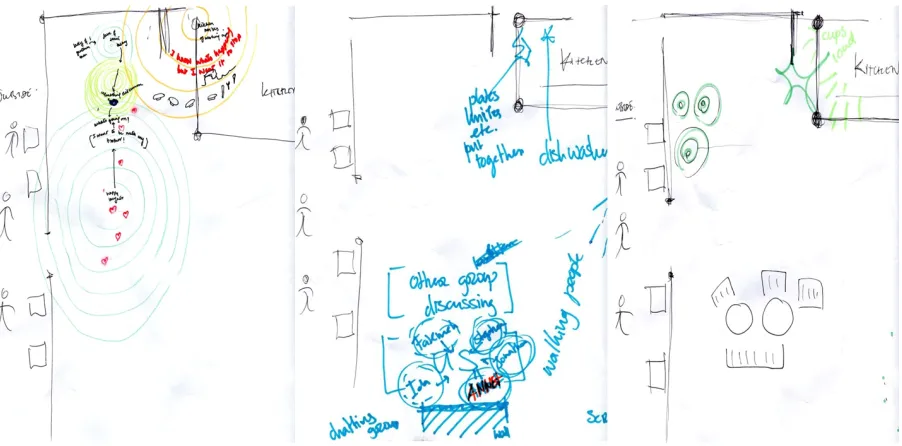
The mode of presentation needs to be considered. Fowler (2013) has recently written on the techniques used by design studios to consider the auditory landscape and describes a number of methods. Sensory mapping, whereby analytical methods track topography, surface texture and auditory features of an environment and note the location of sound marks and keynote sound. Similarly, sound diagrams or descriptions of sound might be used to highlight particular acoustic features (Fowler, 2013). Keynote sounds of each hospital ward could be presented on floor plans, thereby enhancing the relationship between the soundscape and the listener. This has begun to be explored by the authors at a design for behaviour change workshop where participants (n=13) in groups of three were asked in groups to draw on sketch plans, their perception of a café soundscape (Figure 9). By looking at these figures we suggest that readers of the article may build a mental image of the soundscape which would help them understand the soundscape before and during experiencing them.
Figure 9. Soundscape maps depicting the soundscape of a cafeteria during a workshop event
This moves sound from what is considered a negative environmental component to an feature that is understood.
We suggest that displaying the information and meaning of sound offers a means to
“enable, optimize, and facilitate wellbeing-promoting-thoughts and behaviour” (Desmet and
Pohlmeyer, 2013) in hospitals by creating a visual object with which people can understand their current situation. Using the example of the CT ward creative displays on the walls describing the different sound source categories of human, occupational, medical and external may help patients understand the sonic environment they are in. Further, doing so may enhance patient coping within hospital spaces, as highlighted earlier. Indeed it has already been shown that simple communication of sound features can be positive (Mackrill et al., 2013b). Empirical testing of visual communication of the soundscape will facilitate and develop the concept further. This is similar to the work Hojlund and Kinch, (2014) who state users should be given the opportunity to not only listen to differentiated sounds derived from the atmosphere (hi-fi soundscapes) but control them through embodied gestures and synchronize them with their own rhythm. However, to achieve this simple and demographic specific methods are needed that can be accessible to all patients and are cost effective to implement.
LIMITATIONS AND FUTURE WORK
Considering the information in sound and using that as a visual object with which to design, along with the acoustics of a space, may be a new step in the design of hospital spaces. This allows opportunities to explore visual communication design in the area of soundscapes. We acknowledge that using acoustics to get soundscapes ‘right’ is important. However it is learning from sound art and design that may enable a positive hospital soundscape to be achieved. This might not be through the addition of a sound per-se but through creatively communicating the information contained within the soundscape to enable the everyday listener to interpret a cacophony of hospital sounds more positively. As Hojlund and Kinch (2014) comment, articulation of a design strategy is needed that does not create a temporary distraction, but resonates with the user. Visual communication might be this medium.
ACKNOWLEDGEMENTS
The authors would like to thank University Hospital Coventry, UK, for their cooperation on this project. This work was funded as part of a PhD research project by the Engineering and Physical Sciences Research Council through the Innovative Manufacturing Research Centre at University of Warwick. The workshop was run by Dr Dan Lockton, Flora Bowden (Royal College of Art) and Anneli Selvefors (Chalmers University of Technology) as part of the Design Research Society Conference 2014, June 15th Umea, Sweden.
REFERENCES
Akansel, N. & Kaymakci, S. (2008). ‘Effects Of Intensive Care Unit Noise On Patients: A Study On Coronary Artery Bypass Graft Surgery Patients’. Journal Of Clinical Nursing, 17, 1581-1590.
Alvarsson, J. J., Wiens, S. & Nilsson, M. E. (2010). ‘Stress Recovery During Exposure To
Nature Sound And Environmental Noise’. International Journal Of Environmental Research
And Public Health,7, 1036-1046.
Berglund, B., Lindvall, T. & Schewela, D. (2000). ‘Guidelines For Community Noise’. Geneva, Switzerland: World Health Organisation.
Brown, A. L. & Muhar, A. (2004). ‘An Approach To The Acoustic Design Of Outdoor Space’. Journal Of Environmental Planning And Management,47, 827-842.
Busch-Vishniac, I. J., West, J. E., Barnhill, C., Hunter, T., Orellana, D. & Chivukula, R. (2005). ‘Noise Levels In Johns Hopkins Hospital’. Journal Of The Acoustical Society Of
America,118, 3629-3645.
Carlyle, A. (2012). ‘Angus Carlyle - Viso Come Territorio - Work Session #1 - Interview Part
1’ . Retreived 23 December 2013 from http://www.youtube.com/watch?V=X9ujzcmfviw
Cox, C. (2009). ‘Sound Art And The Sonic Unconscious’. Organised Sound,14, 19-26.
Crilly, N., Maier, A. & Clarkson, P. J. (2008). ‘Representing Artefacts As Media: Modelling The Relationship Between Designer Intent And Consumer Experience’. International Journal
of Design, 2(3), 15-27.
Department of Health Gateway Review, Estates and Facilities Division. 2008. ‘Health
Technical Memorandum 08-01: Acoustics’. Leeds:
Desmet, P. M. A. & Pohlmeyer, A. E. (2013). ‘Positive Design: An Introduction To Design For Subjective Well-Being’. International Journal of Design, 7(3), 5-18.
Folkman, S. (2008). ‘A Case For Positive Emotions In The Stress Process’. Anxiety, Stress, &
Coping: An International Journal,21, 3-14.
Højlund, M., & Kinch, S., (2014). Alarming atmospheres- embodied sound habituation as design strategy in a neuro-intensive care unit. Journal of Sonic Studies, 6 (1), url: http://journal.sonicstudies.org/vol06/nr01/a02
Irwin, A., Hall, D. A., Peters, A. & Plack, C. J. (2011). ‘Listening To Urban Soundscapes: Physiological Validity Of Perceptual Dimensions’. Psychophysiology,48, 258-268.
Jennings, P. & Cain, R. (2013). ‘A framework for improving urban soundscapes’. Applied Acoustics, 74(2), 293–299.
Juang, D. F., Lee, C. H., Yang, T. & Chang, M. C. (2010). ‘Noise Pollution And Its Effects
On Medical Care Workers And Patients In Hospitals’. International Journal Of
Environmental Science And Technology, 7, 705-716.
Keller, P. & Stevens, C. (2004). ‘Meaning From Environmental Sounds: Types Of Signal--Referent Relations And Their Effect On Recognizing Auditory Icons’. Journal Of
Experimental Psychology. Applied,10, 3-12.
Mackrill, J., Cain, R. & Jennings, P. (2013a). ‘Experiencing the hospital ward soundscape: Toward a model’. Journal of Environmental Psychology, 36, 1–8.
Mackrill, J., Jennings, P., Cain, R. &England, M. (2013b). ‘Sound source information to improve cardiothoracic patients’ comfort’. British Journal of Nursing, 22(7), 387–393.
Mackrill, J., Cain, R. & Jennings, P. (2014). ‘Exploring positive hospital ward soundscape interventions’. Applied Ergonomics, 45(6), 1454–1460.
McGregor, I., Turner, P., & Benyon, D. (2014). Using participatory visualization of soundscapes to compare designers’ and listeners’ experiences of sound designs. Journal of
Sonic Studies, 6(1), url:http://journal.sonicstudies.org/vol06/nr01/a08
Özcan, E. & Egmond, R. V. 2012. ‘Basic Semantics Of Product Sounds’. International
Journal of Design, 6(2), 41-54.
Pierre, R. S. & Maguire, D. J. (2004). ‘The impact of A-weighting Sound Pressure Level Measurements during the evaluation of Noise exposure’. Noise-Control, July 12-14th 2004. Baltimore, Maryland, USA
Plack, C. J. (2005). The Sense Of Hearing, Mahwah, N.J., Lawrence Erlbaum Associates.
Pope, D. (2010). ‘Decibel Levels And Noise Generators On Four Medical/Surgical Nursing Units’. Journal Of Clinical Nursing,19, 2463-2470.
Poxon, J., Jennings, P., and Cain, R. (2009). ‘Creation and use of a simple method for displaying and analysing soundscape recordings’. In Inter-noise, 23-26th August 2009. Ottawa, Canada.
Rousek, J. B. & Hallbeck, M. S. (2011). ‘Improving And Analyzing Signage Within A Healthcare Setting’. Applied Ergonomics,42, 771-784.
Schoormans, J., Eenhuizen-van den Berge, M., van der Laar, G., van den Berg-Weitzel, L. (2010). ‘Designing packages that communicate product attributes: An exploratory method’. The Design Journal. 13(1), 31-47.
Sherwin, A., (2013). From Roxy Music to the cure? Brian Eno composes soundscapes to treat hospital patients. The Independent.
url:http://www.independent.co.uk/arts- entertainment/art/news/from-roxy-music-to-the-cure-brian-eno-composes-soundscapes-to-treat-hospital-patients-8577179.html. Accessed 25th June 2014.
Truax, B. (1984). Acoustic Communication, Norwood, New Jersey, Ablex Publishing Corporation.