A Thesis Submitted for the Degree of PhD at the University of Warwick
Permanent WRAP URL:
http://wrap.warwick.ac.uk/81885
Copyright and reuse:
This thesis is made available online and is protected by original copyright.
Please scroll down to view the document itself.
Please refer to the repository record for this item for information to help you to cite it.
Our policy information is available from the repository home page.
M A
E
G
NS I
T A T MOLEM
U N
IV
ER
SITAS WARWICEN
SIS
Performance-oriented Service Management in
Clouds
by
Chao Chen
A thesis submitted to The University of Warwick
in partial fulfilment of the requirements
for admission to the degree of
Doctor of Philosophy
Department of Computer Science
The University of Warwick
Abstract
Cloud computing has provided the convenience for many IT-related and
tradi-tional industries to use feature-rich services to process complex requests. Various
services are deployed in the cloud and they interact with each other to deliver
the required results. How to effectively manage these services, the number of
which is ever increasing, within the cloud has unavoidably become a critical issue
for both tenants and service providers of the cloud. In this thesis, we develop
the novel resource provision frameworks to determine resources provision for
interactive services. Next, we propose the algorithms for mapping Virtual
Ma-chines (VMs) to Physical MaMa-chines (PMs) under different constraints, aiming to
achieve the desired Quality-of-Services (QoS) while optimizing the provisions in
both computing resources and communication bandwidth. Finally, job
schedul-ing may become a performance bottleneck itself in such a large scale cloud. In
order to address this issue, the distributed job scheduling framework has been
proposed in the literature. However, such distributed job scheduling may cause
resource conflict among distributed job schedulers due to the fact that individual
job schedulers make their job scheduling decisions independently. In this thesis,
we investigate the methods for reducing resource conflict. We apply the game
theoretical methodology to capture the behaviour of the distributed schedulers
in the cloud. The frameworks and methods developed in this thesis have been
evaluated with a simulated workload, a large-scale workload trace and a real
Acknowledgements
I am indebted to many people for the advice, support and friendship they have
provided over the past few years. It is my great pleasure to acknowledge them,
and their contribution to shaping the contents of this thesis, here.
First and foremost, I would like to express my heartfelt gratitude to my
supervisor, Dr. Ligang He. From supporting a foray into research as a master
working on my dissertation project, through to the very end of my time at
Warwick. In these past years, despite my ignorance and recklessness, Dr. Ligang
introduced me to the world of science, and taught me everything I know about
how to conduct scientific research. He constantly offered fruitful guidance and
strong support during all the time that I was in the Department of Computer
Science at the University of Warwick. I benefited greatly from his insightful
advice and continuous encouragement. I hope I can inherit some of his talent
in the research and many valuable qualities as a person.
The odyssey of my PhD research would much harder without my lab mates
and friends in and outside the University of Warwick. Many thanks go to:
Dr.Bo Gao, Huanzhou Zhu, Zhuoer Gu, Peng Jiang, Shenyuan Ren, Xufeng
Lin, Qiang Zhang, Bo Wang, Ning Jia, Dr.Xin Lu, Dr.Lei Shi, Dr.Wilson Tan,
Roberto Fernandez, Dr.Jasmine Desmond, Congrui Ji and Dr.Eric Yi Liu. Many
ideas of mine came from our stimulating discussions in the research and all
happy memories that we share. In addition, all staff in the Department of
Computer Science at the University of Warwick, in particular Dr.Phil
Tay-lor, Dr.Steven Wright, Dr.Roger Packwood, Jackie Pinks, Dr.Christine Leigh,
Dr.Adam Chester, Dr.Jane Sinclair, Dr.Mike Joy, Dr.Matthew Leeke, Dr.Arshad
Jhumka, Professor.Rob Procter and Professor.Chang-Tsun Li, I sincerely thank
them for constructive suggestions and technical support during my work as a
priceless memory for me.
I would like to thank the love of my life, my best friend and my wife
Yaoyao Yi, her patience, motivation and unwavering love have promoted me
pass through all my difficult times in my life.
Last but not the least, I want to express my eternal gratitude to my parents,
Zhendong Chen and Liyun Liu, who always give me unconditional love and
support through my life, and remind me that there are other important things
Declarations
This thesis is submitted to the University of Warwick in support of the authors
application for the degree of Doctor of Philosophy. It has been composed by the
author and has not been submitted in any previous application for any degree.
The work presented was carried out by the author except where acknowledged.
[25] C. Chen, L. He, B. Gao, C. Chang, K. Li, and K. Li. Modelling and
optimizing bandwidth provision for interacting cloud services. In
Service-Oriented Computing, pages 305–315. Springer, 2015
[24] C. Chen, L. He, H. Chen, J. Sun, B. Gao, and S. A. Jarvis. Developing
communication-aware service placement frameworks in the cloud economy.
InCluster Computing (CLUSTER), 2013 IEEE International Conference
on, pages 1–8. IEEE, 2013
[41] B. Gao, L. He, and C. Chen. Modelling the bandwidth allocation problem
in mobile service-oriented networks. InProceedings of the 18th ACM
In-ternational Conference on Modeling, Analysis and Simulation of Wireless
and Mobile Systems, pages 307–311. ACM, 2015
[55] L. He, D. Zou, Z. Zhang, C. Chen, H. Jin, and S. A. Jarvis. Developing
resource consolidation frameworks for moldable virtual machines in clouds.
Future Generation Computer Systems, 2013. ISSN 0167-739X. doi: http:
//dx.doi.org/10.1016/j.future.2012.05.015
In addition, the following works are under review:
• GRACES: Game-theoretical Cluster Scheduler with the Awareness of
Schedul-ing Conflict. This paper introduces game-theoretical method for
dis-tributed cluster schedulers processing their requests, and the work is
• Developing Communication-aware Service Placement Frameworks in the
Cloud Economy. This paper is an extension of [24, 25]. The combination
frameworks used in this paper forms the basis of that used in this thesis,
and the results of the experiments are presented in Section 4.3 of this
thesis.
• A Taxonomy and Survey on Cloud Network Management. This paper
gen-eralizes state of the art bandwidth management in the cloud data centres
Sponsorship and Grants
The research presented in this thesis was made possible by the support of the
following benefactors and sources:
• Department of Computer Science, The University of Warwick, UK:
Abbreviations
AA Application-specific IP address
AWS Amazon Web Services
AS Aggregation Switches
BL Baseline strategy
CAGA Communication-Aware Genetic Algorithm
CGA Communication-oriented Genetic Algorithm
CC Concurrent and Competitive
CIO Communication Input-Output
CDF Cumulative Distribution Function
EC2 Elastic Compute Cloud
IT Information Technology
IO Input-Output(Analysis Model)
LA Location-specific IP Address
M-1 Medium-1 strategy
M-2 Medium-2 strategy
M-3 Medium-3 strategy
MB 10242 Bytes
MX Max strategy
NS Nash Equilibrium strategy
N.E Nash Equilibrium
OS Operating System
PS Processor Sharing
PM Physical Machine
QoS Quality of Service
RC Resources Container
TOR Top-of-Rack
VPC Virtual Private Cloud
Contents
Abstract ii
Dedication iii
Acknowledgements iv
Declarations vi
Sponsorship and Grants viii
Abbreviations ix
List of Figures xvi
List of Tables xvii
1 Introduction 1
1.1 Resource Provision . . . 1
1.2 VM Placement . . . 4
1.3 Job Scheduling . . . 6
1.4 Contributions . . . 7
1.5 Thesis Overview . . . 8
2 Related work 10 2.1 Resource Allocation for VMs . . . 10
2.2 Bandwidth Provision in Clouds . . . 11
2.3 VMs-to-PMs Placement . . . 14
2.4 Analysis of Invocation Pattern among Services in Cloud . . . 16
2.5 Job Scheduling in Clouds . . . 17
2.7 Summary . . . 21
3 Computing Provision for Cloud Services 22 3.1 Workload and System Models . . . 24
3.2 Modelling Resource Demands of Cloud Services . . . 26
3.3 The Communication-aware VM Placement . . . 28
3.3.1 Formalizing the Problem . . . 29
3.3.2 Designing the Genetic Algorithm . . . 30
3.3.3 Designing the CGA . . . 32
3.4 Performance Evaluation on the Synthetic Workflow . . . 36
3.4.1 Impact of the Increase in External Demands . . . 39
3.4.2 Comparing CAGA with the Existing Placement Methods 41 3.4.3 Convergence of CAGA . . . 43
3.5 Performance Evaluation on the Bing Workflow . . . 44
3.5.1 Impact of the Increase in External Demands . . . 45
3.5.2 Comparing CAGA with the Existing Placement Methods 47 3.5.3 Convergence of CAGA . . . 50
3.5.4 Convergence of CGA . . . 50
3.6 Summary . . . 51
4 Bandwidth Provision for Cloud Services 54 4.1 Modelling Bandwidth Provision . . . 55
4.1.1 The Communication Input-Output Model . . . 55
4.1.2 Bandwidth Provision for VMs . . . 58
4.2 The Communication-oriented Simulated Annealing Algorithm . . 61
4.3 Performance Evaluation . . . 65
4.3.1 Accuracy of the CIO Model . . . 66
4.3.2 The Effectiveness of CSA . . . 68
4.3.3 The Efficiency of CSA . . . 71
4.3.4 CIO Model on a AWS Testbed . . . 73
4.3.6 AWS VM-to-PM Placement . . . 80
4.4 Summary . . . 84
5 Job Scheduling in the Cloud 85 5.1 Motivating Case for the Strategy . . . 87
5.1.1 Workload Character . . . 87
5.1.2 Performance Gains with Prices . . . 90
5.1.3 Game Strategy: Ideas and Challenges . . . 93
5.2 Design Issues in GRACES . . . 96
5.2.1 Scheduling Cost . . . 97
5.2.2 Servicing Cost . . . 104
5.2.3 Game-theoretic Solution for Shared Schedulers . . . 104
5.3 Performance Evaluation . . . 108
5.3.1 Comparing Strategies with Increasing Concurrent Jobs . . 111
5.3.2 Comparing Strategies with Multiple Schedulers . . . 114
5.3.3 Real Experiment on AWS . . . 116
5.4 Summary . . . 118
6 Conclusions and Future Work 120 6.1 Conclusions . . . 120
6.2 Discussion . . . 121
6.3 Directions for Future Work . . . 122
List of Figures
1.1 The workflow of interactive services . . . 3
1.2 The transformation of PM usage . . . 5
1.3 The overview of cloud architecture . . . 7
2.1 The overview of three-tier architecture . . . 12
2.2 The overview of Fat-tree architecture . . . 13
2.3 An example of the hose model, which guarantees the bandwidth demands of two services (blue for service 1 and red for service 2) with the mapping of their virtual networks to a physical network. 15 2.4 The overview of a shared cloud . . . 18
3.1 CGA Crossover . . . 35
3.2 Impact of the increase in external demands; a)computation-intensive workflow; b) general workflow; c) communication-intensive work-flow. . . 40
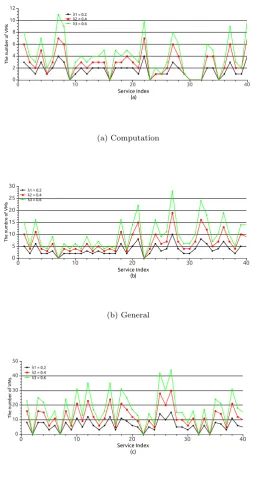
3.3 Impact of the increase in external demands by three types of workflow combined . . . 41
3.4 Comparing CAGA with Min-nodes and the round-robin heuristic in terms of communication cost; a)computation-intensive work-flow; b) general workwork-flow; c) communication-intensive workflow. . 42
3.5 Comparing CAGA with Min-nodes and the round-robin heuristic in terms of the number of used PMs . . . 43
3.6 Convergence speed of CAGA; a) computation-intensive workflow, b) general workflow, c) communication-intensive workflow . . . . 44
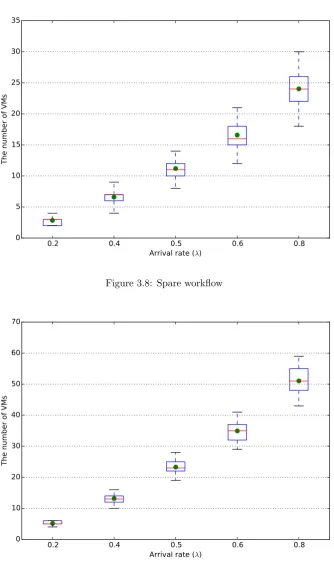
3.7 Communication patterns among services using on the Bing work-flow . . . 46
3.9 Median workflow . . . 48
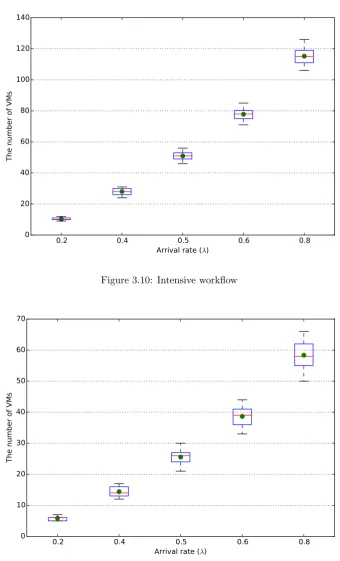
3.10 Intensive workflow . . . 49
3.11 Mixed workflow . . . 49
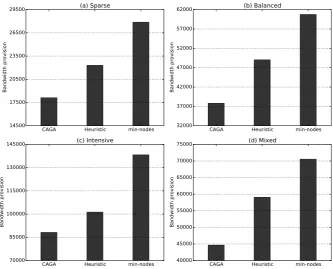
3.12 Comparing CAGA with different placement methods . . . 50
3.13 Convergence speed of CAGA; a) sparse workflow, b) median workflow, c) intensive workflow d) mixed workflow . . . 51
3.14 Convergence speed of CGA; a) Sparse workflow, b) Median work-flow, c) Intensive workflow d) Mixed workflow . . . 52
4.1 Accuracy of the CIO model using the Bing trace . . . 67
4.2 Accuracy of the CIO model using synthetic traces . . . 68
4.3 Comparing CSA with other existing algorithms using synthetic and Bing trace . . . 70
4.4 Convergence of CSA using the Bing trace . . . 72
4.5 Convergence time of CSA over a) the number of services and b) workflow arrival rate. The synethic trace is used . . . 72
4.6 Performance comparison with different configurations of EC2 in-stances . . . 75
4.7 The illustration of AWS testbed workflow . . . 78
4.8 The comparisons of AWS Configurations in Performance . . . 80
4.9 The comparisons of AWS Configurations in Resource Cost . . . . 81
4.10 VMs-to-Regions placements with requests (100 MB/s) . . . 83
4.11 VMs-to-Regions placements with increasing requests (200 MB/s) 83 5.1 Cumulative Distribution Function(CDF) of jobs duration for Bing, Facebook and Google traces . . . 88
5.2 Performance gains by increasing the scale of resource containers in the isolated cluster . . . 90
5.3 The impact of increasing resource scale on performance in the shared cluster . . . 91
5.5 The life cycle of submitted job in the shared cluster . . . 96
5.6 CDFs of memory and CPU for workloads . . . 110
5.7 Performance cost on offline jobs . . . 112
5.8 Performance cost on online jobs . . . 113
5.9 The average number of scheduling attempts . . . 114
5.10 The improvement of 4 schedulers with different strategies . . . . 115
5.11 The average makespan of AWS cluster schedulers with different strategies . . . 117
List of Tables
3.1 Notations for VM provision . . . 25
3.2 Experimental parameters . . . 38
4.1 Notations for bandwidth provision . . . 59
4.2 Percentage of Services comprising different numbers of VMs . . . 66
4.3 Amazon EC2 instance configurations-1 . . . 74
4.4 IO Model bandwidth configuration . . . 75
4.5 Amazon EC2 instance configuration-2 . . . 78
4.6 AWS EC2 bandwidth in public/private IP . . . 82
5.1 Job size distributions for Bing, Facebook and Google traces . . . 89
5.2 An exemplar three-players’ payoff matrix . . . 106
CHAPTER
1
Introduction
The growing Internet enriches our social activities and modern business in many
aspects, and the fundamental core supporting all those Internet-based
technolo-gies is defined as “cloud computing” [7]. This emerging technology has evolved
the IT industries, because it not only provides the convenience and flexibility
for individual developers or startup companies to build their products at a
min-imal cost, but also extends the commercial successes to the large enterprises by
leasing their infrastructure and services. Over the last few years, many
non-IT related industries, such as NASADQ and Lamborghini [99], have benefited
from the cloud in developing their products without the need of maintaining the
expensive IT infrastructures, whilst those IT enterprises which provides cloud
services, such Google, Amazon and Microsoft, have profited financially from the
cloud marketing at an unprecedented scale of over $20 billions [86].
Despite the rapid development of cloud computing, it rises the complexity
and challenges in academia and industry, especially on resources provision, VM
placement and scheduling in the cloud. Mastering these aspects with the
aware-ness of the different potential issues becomes one of the most critical research
topics in the further advance of cloud computing.
1.1
Resource Provision
In the cloud system, a number of services are often deployed in a collection
of VMs. Services interact with each other and the interaction patterns may
be dynamic, varying according to the system information at runtime. These
impose a challenge in determining the amount of resources required to deliver a
1. Introduction
budget waste on unnecessary resources or businesses penalty by breaking the
required QoS. The research of resources provision is important as it is directly
related to services deployment in the cloud.
Cloud tenants rent resource and services to build their IT platform for
pro-cessing their daily businesses. For example, British Gas [99] uses Amazon Web
Services Elastic Computing Cloud (AWS EC2), AWS Relation Database Service
and AWS Simple Storage Service to build their data centre infrastructures to
store their daily business data. AWS Auto Scaling automates the scaling of the
VM resources as the requests increase. AWS Elastic Load Balancing distributes
their daily traffic across VMs. Moreover, the deployed services within the cloud
are hosted by a collection of VMs, which are allocated across PMs in the data
centres. When the external requests arrive, the deployed services interact with
each other, which essentially forms a workflow, to deliver the final results.
Another example of interacting cloud services is NASDAQ QMX, the largest
stock exchange company in the world, has been developing their data analysis
services on AWS [101]. The data analysis services receive and analyse the
com-panies’ financial data submitted by the tenants, and reduce the analysis results
such as profit trends, investment risks and so on. The data analysis process may
not be completed by a single service, but may involve a collection of
interact-ing services, which are implemented through the standard services provided in
the Amazon cloud, such as Amazon simple Storage Service (S3), Amazon
Vir-tual Private Cluster (VPC), Amazon Elastic Compute (EC2), Amazon Direct
Connect (DC) and Amazon Elastic MapReduce (EMR), etc.. The invocation
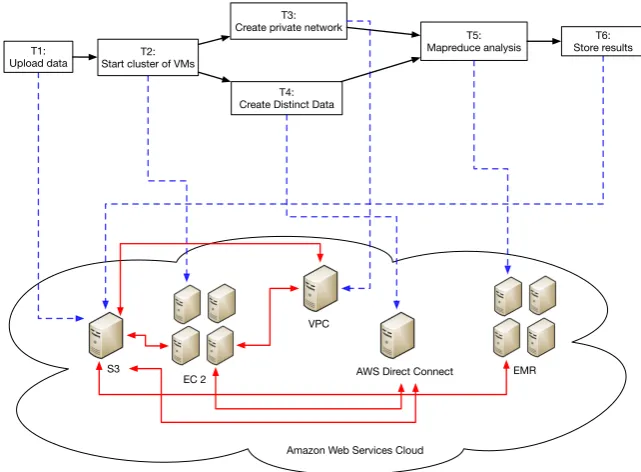
relations of these services are illustrated in Figure 1.1, in which a top part of
the figure shows a standard workflow of tasks that may be executed during
the data analysis process, and the bottom part shows the Amazon cloud and
the services deployed in the cloud. The green dash lines show which service a
task in the workflow invokes. When a tenant wants to analyze the data, it first
invokes the S3 service to upload the financial data to S3, which is task T1 in
1. Introduction
S3
EC 2
VPC
AWS Direct Connect EMR T1:
Upload data Start cluster of VMsT2:
T3: Create private network
T4: Create Distinct Data
T5:
Mapreduce analysis Store resultsT6:
[image:21.595.138.459.128.364.2]Amazon Web Services Cloud
Figure 1.1: The workflow of interactive services
Machines (VMs) to support the services required by the following tasks in the
workflow. AfterT2is finished, TaskT3invokes the VPC service to create an
iso-lated network for the VMs that support a particular service. In the meanwhile,
Task T4 calls the DC service to place the data from the tenant in a distinct
storage container (so that the data are separated from other tenants’ data) and
implement a dedicated network connection from the tenant to the data. After
T3 andT4are completed,T5 invokes the EMR service and uses the mapreduce
method to generate the analysis results. Finally,T6invokes the S3 service again
and stores the analysis results in S3.
Note that we call the above workflow a standard workflow of tasks. This is
because some tasks (and services) in the workflow may not be run depending
on dynamic system information/state at runtime. For example,T1 (and service
S3) may not be run if the data to be analyzed is already in S3 for the current
tenant who is initiating the data analysis process. AfterT2 is finished, whether
1. Introduction
Also whetherT4has to be performed may depends on whether the data contain
security-sensitive information or the current tenant conflicts with other tenants
in the system. Further, when the services interact with each other, data may
be communicated between them. The red line in Figure 1.1 represents the
communication relations amongst the services during the data analysis workflow
to create the separate networks for VMs. Also the data stored by the S3 service
needs to be sent to EMR service to perform the mapreduce operation. As can be
seen from the above discussions, we may not always know the actual invocation
workflows across multiple services in the cloud. Similar observations have also
been made in [16, 70].
In addition to the above data analysis requests spawning a workflow of the
service invocations, there may be other requests that are also invoking these
standard services in the Amazon cloud, either through a single invocation from
an external tenant (external requests) or through the invocations spawned by
other services inside the cloud (internal requests). For example, a request is sent
to the S3 service to upload the data for other purposes and is irrelevant to the
above data analysis process. Due to the dynamic interaction relation among the
services, which are demanded by the mix of the external and internal requests, it
is a non-trivial task to determine the suitable amount of resources for supporting
each service so as to deliver the desired QoS. This situation also exists in many
other application domains when their services are deployed in the cloud, such
as video transcoding [100], TV program production [27] and so on.
1.2
VM Placement
Virtualization is a core technology in cloud computing, which is the key for
providing the flexibility and isolation to cloud tenants in terms of using the
machine resources, such as CPU cores, memory, disk storage and bandwidth.
Virtualization implements the hypervisor to split the physical resources in a
1. Introduction
PMs can be leased to and utilized by different tenants to deploy their services
without interference. On the contrary, although multiple users and their services
can co-exist in the traditional architecture, i.e., a single Operating System (OS)
being installed in a PM, they are not running in isolated environments. Their
architectures are illustrated in Figure 1.2.
PM
OS OS OS
Hypervisor VM/
Container Service Service Service Service
Service Service
PM
PM PM
VM/
Container ContainerVM/
Figure 1.2: The transformation of PM usage
VMs in a PM can scale up their resource capacity and can also be
mi-grated into another PM to achieve resource consolidation. This ability cuts
the considerable cost by helping reduce the number of used PMs, and also
gives the cloud tenants and cloud providers the flexibility to dynamically adjust
their implementations based on various objectives. Based on this idea, different
types of virtualization have been developed. For example, QUEM [15],
Hyper-V [83] and KHyper-VM [72] utilize the full virtualization technique to virtualize the
full hardware for each VM, which make it easy to implement the guest OS in
a VM. On the other hand, Xen[11], which currently is the mainstream
virtu-alization technique in academia, adopts para-virtuvirtu-alization that virtualizes all
hardware resources for a main VM (domain 0), which isolates the CPUs and
memory resources for each hosting VM, but shares the bandwidth resources
with all VMs rather than virtualizing all hardware resource for each VM.
Al-though para-virtualization needs to slightly modify the VM’s OS to utilize the
hardware virtualized by domain 0, its performance can be significantly better
1. Introduction
even lighter emerges. [82] adopts the process-virtualization that uses the Linux
container process to isolate the predefined resources for the processes of
individ-ual users. This implicates that all users have to use the identical OS kernel, but
can have separated computing and bandwidth resources from each other.
Bet-ter performance can be achieved than other existing virtualization techniques.
Despite the advantages and disadvantages of different virtualization techniques,
they share similar principle aim, i.e., splitting the PM resources across multiple
users without interference. We thus regard each isolated resources unit as the
VM or the RC (Resource Container) (in chapter 5).
VM-to-PM placement is an important problem since different placements
lead to different performance and resource consumption, such as the number of
used PMs in total, the amount of communication traffic among services, and
so on. The resource capacity in PMs, such as the total number of CPU cores,
memory and storage capacity, and the communication patterns among services
complicate this performance optimization problem.
1.3
Job Scheduling
Cloud infrastructure is constructed with the support of virtualization in
indi-vidual PMs. Figure 1.3 shows the overview of a typical cloud infrastructure.
Such a cloud infrastructure can be seen in the modern open source cloud
plat-forms [85, 87, 96]. The cloud, actually is formed as one or a few of data centres,
each of which often comprising a few thousands of PMs connected with the
networking products such as switches. Normally, a central manager or
sched-uler handles all incoming requests demanding for resources or services from the
Internet, and allocates the requests to suitable PMs and commit required VMs
and other resources. The PM allocation and resource commitment of VMs can
be elastically adjusted according to the administration policies and the tenant
requirements. The “pay-as-you-go” model is adopted in cloud that only charges
1. Introduction
focus on the product development while the work of maintaining and expanding
the supporting IT infrastructures is considered by the cloud providers.
… VM
VM
VM VM
VM VM
VM VM
… …
Internet
Central scheduler
Switch
VM VM
VM VM
VM VM
VM VM
… … VMVM
VM VM
VM VM
VM VM …
Figure 1.3: The overview of cloud architecture
However, it has exposed limitation to adopt traditional centralized
sched-uler to handle service requests in large-scale clouds. Distributed job scheduling
frameworks have been proposed in the literature to maximize the scheduling
throughput and reduce the job pending time [18, 36, 69, 95]. However,
dis-tributed schedulers may cause the resource conflicts, i.e., different schedulers
attempt to schedule the jobs to the same resource so as to exceed the capacity
of the resource. Therefore, in such an emerging architecture, alleviating the
resource conflict plays a vital role in maintaining the desired performance.
1.4
Contributions
In order to address the above issues, the following work has been conducted in
this thesis.
•We develop a framework to determine the provision of computing resources
required for cloud services to deliver the desired level of QoS. The frameworks
capture the interaction relations among different services in the cloud.
1. Introduction
as to not only meet the external communication demand but also the internal
communication relations. And we evaluate it with simulations at the scalability
of a industrial level. A real world AWS cloud testbed with the framework has
been implemented to verify its efficiency and effectiveness.
• We develop two VM-to-PM placement algorithms under the constraints
on computing resources and communication cost.
• We propose the game-theoretical methodology for distributed job
sched-ulers to exploit the trade-off between resource conflicts and resource demand. In
this thesis, the parallel scheduling behaviour by distributed schedulers is
mod-elled as a non-cooperative game and the Nash Equilibrium point is solved for the
game, which represent the best scheduling behaviour of distributed schedulers.
•We conduct the experiments to evaluate the effectiveness of the proposed
methods for resource provision, VM placement and distributed scheduling. The
experiments are carried out with simulated workload, the workload trace from
a production cloud and the a cloud testbed.
1.5
Thesis Overview
The rest of this thesis is organized as follows. Chapter 2reviews the modern
cloud computing architecture, the existing methods of managing the computing
and communication resources in cloud systems and other existing work related
to this thesis.
Chapter 3presents the novel frameworks presented in this thesis for
mod-elling the demands for computing resources. These frameworks borrow the ideas
from the Input-Output model in economy and capture the interaction relation
among cloud services, which are different from the existing resource provision
work that focuses on individual single services. These frameworks can be used
by cloud providers or cloud tenants to model and plan their resource offering
or resource purchase. This chapter further presents the VM-to-PM placement
1. Introduction
work from the existing work in literature. The extensive experiments with
sim-ulated workload and real industrial workload trace have been conducted. The
real experiments have also been carried out on the AWS cloud platform to verify
the effectiveness of the efficiency of these methods.
The services are hosted in VM in clouds. After the provision for computing
resources is determined in chapter 3. Chapter 4further extends the framework
to model provision of communication resources.
Chapter 5proposes a game-theoretical methodology to regulate the
schedul-ing behaviour of distributed schedulers in cloud systems. The resource conflict
due to the independent scheduling decisions made by distributed schedulers
is quantitatively analysed. Experiments have been conducted to evaluate the
proposed methodology.
Finally,Chapter 6summarises the thesis. The conclusions are drawn and
CHAPTER
2
Related work
As listed in chapter 1, the key aspects that define the difficulties in the cloud
computing include: 1) resources allocation under dynamic services interactions;
2) bandwidth provision in different architectures; 3) VM-to-PM allocation with
different objectiveness; 4) job scheduling at the emerging architecture of
dis-tributed schedulers. Therefore, in this chapter we explore and investigate some
of existing techniques, to understand their methodologies and weaknesses in the
cloud computing.
2.1
Resource Allocation for VMs
Various methodologies have been proposed to construct the performance model,
i.e., to establish the relation between the performance of a VM (e.g.,
through-put, the time needed to complete a request) and the resource capability allocated
to the VM (e.g., CPU, memory and storage) [3, 13, 14, 16, 23, 68, 104]. For
instance, the work in [68] used layered queuing network to model the response
time of a request in a multi-tiered web service hosted in VM environments, while
hardware resources (e.g., CPU and disk) are modelled as processor sharing (PS)
queues. In particular, the work in [104] modelled the contention of visible
re-sources (e.g., CPU, memory, I/O) and invisible rere-sources (e.g., shared cache,
shared memory bandwidth) as well as the overheads of the VM hypervisor
im-plementation. In the simulation experiments, we use the queuing theory as the
exemplar technique to derive the performance model.
There is the work addressing resource allocation for a group of VMs with
communications among them [16, 63]. For example, [16] models the interacting
2. Related work
based on a sliding time window, and estimates the resource provision for services
based on the QoS requirements. The work in [63] can translate the performance
goals of the tasks submitted by tenants to the resource allocation in terms of
the combination of the number of VMs and the network bandwidth between the
VMs. Since different resource combinations may produce similar performance,
the work further proposes a method to select the resource combination that can
balance the resource utilization.
The work in [63] bears similarity with the work presented in this work.
The difference is that the work in [63] is job-oriented (or client-oriented), i.e.,
to calculate the resource allocation given the specific tasks submitted by the
tenants. However, as the service invocations (i.e., the tasks) may vary according
to the dynamic system information, and it may be difficult to know the full
picture of the tasks/workflows to be run in the cloud. The work in this thesis
is service-oriented, which does not focus on allocating resources for a set of
specific tasks or workflows, but aims to allocate resources based on the service
interaction patterns. This work does not even have to know the full information
of the tasks/workflows to be run.
2.2
Bandwidth Provision in Clouds
The network architecture of modern data centre is described as the network
topology, routing/switching devices, the used protocols and commodity-class
physical machines [12, 48]. Figure 2.1 shows a classic three-tier topology [56, 73]
of a data centre. The network elements are divided into three layers in terms
of:(1) access layer; (2) aggregation layer; (3) core layers. In the access layer, the
Top-of-Rack (TOR) switch provides the basic connection to each PM mounted
on to this data centre. Every Aggregation Switch (AS) in the aggregation layer
distributes data traffic from those ToRs to the core layer. Each ToR switch is
connected with more than one ASs for the redundancy and high availability.
2. Related work
between the Internet and inside the data centre. Since the three-tiers topology
is simple and easy to understand, it is the major choice for most data centres
first choice. … VM VM VM VM VM VM VM VM … … Internet Core Switch VM VM VM VM VM VM VM VM
… … VMVM
VM VM VM VM VM VM … Aggregation Switch
Top-of-Rack Top-of-Rack Top-of-Rack Top-of-Rack Top-of-Rack Top-of-Rack Central
scheduler
Access Layer Aggregation Layer
[image:30.595.128.467.188.409.2]Core Layer
Figure 2.1: The overview of three-tier architecture
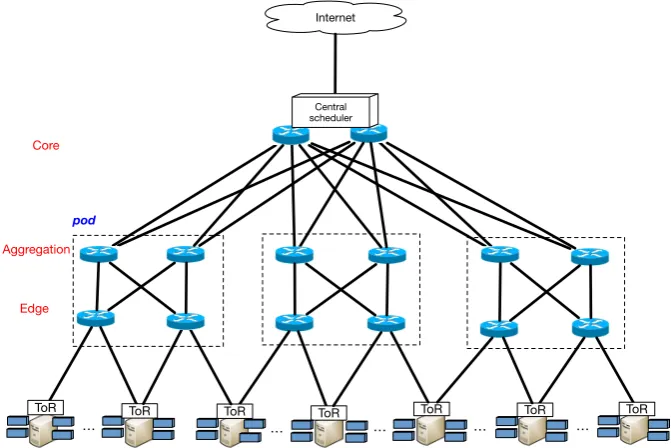
Fat-tree topology [77], as we illustrate in the Figure 2.2, is the topology
aim-ing to maximise the end-to-end bisection bandwidth. In the fat-tree topology,
although the hierarchical organization still exists in edge (access), aggregate
and core layers, the number of switches is much more than three-tiers topology.
Switches in ToRs and AS are formed as the the number ofk “pods” that each
pod consists of (k2)2 PMs, 2 layers of k
2k port switches. Each edge switch
con-nects to k2 PMs and (k2) aggregate switches, each the aggregate switch connects
(k2) edge and (k2) core switches, so that there are (k2)2 core switches connect
to k pod, which reduces the traffic load at the core layer. Fat-tree topology is
better bandwidth connections and highly cost effectively compared to the
three-tier counterpart, but the complex IP addressing scheme and multipath routing
algorithm are not easy to be implemented.
VL2 [45] is the hierarchical fat-tree based topology. VL2 uses a flat
2. Related work
…
Internet
… … …
ToR ToR ToR ToR ToR
Central scheduler
Edge Aggregation
Core
ToR ToR
[image:31.595.128.464.131.355.2]… pod
Figure 2.2: The overview of Fat-tree architecture
the data centre by two IP address families: Location-specific IP Address (LA)
for the PM within the network, and Application-specific IP address (AA) for
the application or VM. The LA is used to forward the packet in the physical
network whilst the AA keeps unchanged regardless of movements in a PM’s
location within the data centre. The sending PM encapsulates the AA
infor-mation in the LA packet header, but it is trapped and de-encapsulated by the
ToR switch associated with the receiver. This topology has provided more
flex-ibility to programmers within the cloud data centre to abstract and operate
the network bandwidth and services communication compared to other
topolo-gies. However, the virtual overlays and centralized management, such as VL2
Directory services, are even more expensive than others to implement.
There are also many others advanced network topologies for abstracting and
managing the data centre, such as [28, 48, 49, 52, 102]. Regardless of various
network topologies, the cloud network is virtualized and manager by the central
scheduler to assign different services. The work in [9, 10, 91, 92] implements
2. Related work
is used to host specific services. Those techniques are principally based on
the Hose model [38], which have the analogies with practical switch networks
that offers the abstraction to each VM for one service has a dedicated link of
guaranteed minimum bandwidth capacity to a non-blocking virtual switch as in
Figure 2.3. However, these studies do not consider the policies to determine the
appropriate bandwidth capacity for each service and its constituent VMs from a
holistic perspective. The work in [9] and [10] designed the centralized controller
to assign the bandwidth in order to achieve the required performance. On the
other hand, the work in [91, 92] distribute the ability of allocating the
band-width and develops sophisticated policies in the hypervisor and the switch to
compete the bandwidth for ensuring guaranteed communication. Although the
above studies developed the elaborate techniques to manage shared networks
and enforce the bandwidth allocation, they do not consider the policies to
de-termine the appropriate bandwidth capacity for each service and its constituent
VM from a holistic perspective.
The work in [108, 115] adopts the stochastic model to analyse the bandwidth
requirements for each service. [111] guides the bandwidth provision dynamically.
[51, 67] propose the routing policies within the data centres to exploit the
poten-tial bandwidth provision. Their works are solely based on “external” demands,
while our work not only satisfies the external demands, but also captures the
internal demands due to service interactions.
2.3
VMs-to-PMs Placement
The VM-to-PM placement problem mainly aims to consolidate resources and
improve resource utilization [20, 46, 57, 59, 112]. Various methods have been
proposed in literature to address the VM-to-PM placement problem,
includ-ing knapsack modellinclud-ing [57], mixed integer programminclud-ing [22, 90, 103], genetic
algorithms [55, 103, 112], ant colony optimization [39, 42] and heuristic
2. Related work
Hose Model Virtual Switch 1
Switch
Physical Layout
1 1 1 2 2 2
Switch Switch
2 2
1 1 1
2 2 2 2 2
Virtual Switch 2
B2 B2 B2 B2 B2
B1 B
1 B1
L1 L2 L3 L4
L5 L6
Figure 2.3: An example of the hose model, which guarantees the bandwidth demands of two services (blue for service 1 and red for service 2) with the mapping of their virtual networks to a physical network.
and release measures to dynamically redistribute the workloads in the cluster
according to the workload level on each individual node, so as to minimize
the usage of physical machines. The work in [57] develops a server
consoli-dation scheme, called Entropy. Entropy strives to find the minimal number
of nodes that can host a set of VMs, given the physical configurations of the
system and resource requirements of the VMs. The objective is formalized as
a multiple knapsack problem, which is then solved using a dynamic
program-ming approach. In the implementation, a one-minute time window is set for
the knapsack problem solver to find the solution. The solution obtained at the
end of the one-minute time space is the new state (i.e., the new VM-to-PM
placement). The work in [55] designed a genetic algorithm to find a VM-to-PM
placement that uses the minimal number of PMs. However, the above work is
used to tackle the placement of independent VMs (i.e., there are no
communi-cations among VMs), aiming to minimize the usage of physical machines. In
this thesis, we investigate the placement of the interacting VMs and focus on
finding the VM placement that can minimize the communication cost.
2. Related work
inter-VM communications, aiming to minimize the communication costs [50, 81].
The work in [50] models such a VM-to-PM placement as a min-cost network flow
problem and then uses the Breadth First Search to find the optimal placement
solution. The work in [81] uses the classical min-cut graph algorithm to obtain
the optimized placement solution. In order to model the placement problem as
the min-cost network flow problem or the min-cut graph problem, they need
to know the specific communication pattern between each pair of VMs. As we
have discussed, in some cases, we may not know the full picture of the
submit-ted workload, and therefore can not accurately determine the communication
pattern between each individual VM. In this thesis, we model the interactions
among the services, and treat a service (and the set of VMs supporting the
ser-vice) as a whole without the need to know the specific communication pattern
between each pair of VMs.
2.4
Analysis of Invocation Pattern among
Ser-vices in Cloud
There are a number of existing techniques to obtain the invocation patterns
of the services [8, 26, 110]. The work in [8] implements a multi-level
proba-bilistic model to infer the probability of a service calling another service. The
fundamental idea is to monitor the packets sent and received by a service, and
then compute the dependency probability between the services by leveraging
the observation that if accessing service B depends on service A, then packets
exchanged with A and B are likely to co-occur. The work in [26] then uses the
k-means clustering technique in data mining area to analyze the service trace
2. Related work
2.5
Job Scheduling in Clouds
Data centres nowadays have to process a large scale of jobs on a daily basis.
On one hand, the resource demand, along with the commercial success of cloud
computing, becomes the major driving force for the cloud providers to increase
the size of their data centres. On the other hand, in order to handle the jobs
efficiently, cloud giants, such as Google, Microsoft and Amazon, have
devel-oped various cluster management frameworks in their production clusters [107].
Among them, one conventional approach is to develop a centralized scheduler
in the cluster, which manages diverse types of job submitted to the cluster.
However, because of the large number of the jobs and the complexity of making
scheduling decisions for some types of job, the centralized schedulers become
the performance bottleneck for delivering resources and processing jobs timely.
A recent trend thus is to deploy multiple, independent schedulers in a cluster.
Different schedulers make scheduling decisions simultaneously for different types
of job, aiming to improve the throughput and cluster utilization. These
inde-pendently working schedulers in a cluster are termed distributed schedulers in
the literature [18, 88, 95].
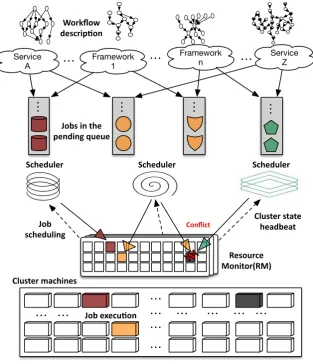
The scheduling procedure in the cloud with distributed schedulers is
illus-trated in Figure 2.4. When a request is submitted, it is compiled as a workflow
with resource requirements. The workflow is modelled by a directed acyclic
graph (DAG). In the graph, nodes represent jobs such as map, reduce or join
jobs, and edges represent dataflow. Each job consists of one or more identical
parallel tasks. Those jobs are allocated to individual pending queues
corre-sponding to their dependent services based on the job type, resource preference
or job size. Additionally, a distributed scheduler asynchronously scans 1 the
jobs in its pending queue, and finds its best matching machines and claim the
resources in these machines to launch the tasks. Different schedulers choose the
machines based on their preferences in various aspects. In summary, the role of
2. Related work
…
…
Jobs in the pending queue
Cluster machines
…
…
…
Resource Monitor(RM)
…
…
…
…
Scheduler Scheduler Scheduler
Service
A Framework1
Framework
n ServiceZ
Conflict Cluster state headbeat Job
scheduling
Job execu=on
…
…
…
… …
… …
Workflow descrip=on
[image:36.595.140.454.132.497.2]…
Figure 2.4: The overview of a shared cloud
a scheduler covers two parts: Scheduling andServicing.
InScheduling, the scheduler scores resources (machines) to decide the best
ones for its jobs. The resulting scores could be very different for different
sched-ulers. For example, the scheduler for Hadoop[113] or Spark[116] jobs chooses
its target machines based on the machine load and data locality, whilst the
scheduler for scheduling web server applications needs to perform some
com-plex optimization algorithms to consider the heterogeneity and performance
interference. In addition, there is a separate Resource Monitor (RM) that
2. Related work
machine state, and then aggregates the reports as the global cluster state for
all schedulers. Each scheduler thus keeps a copy of global cluster state to make
its own scheduling decision.
In Servicing, the scheduler claims the resources in the target machines to
initialize, start or cancel its jobs, such as fetch needed data and install the
required software packages. The time cost in initialization is not negligible in
most productive clusters [18, 107]. The median initialization cost is around 25
seconds [107]. Therefore, unlike the monolithic scheduler, such as Mesos [58]
and Fuxi [118], distributed schedulers do not have a central coordinator and
their scheduling attempts and job initialization might conflict with each other.
Once the conflict occurs, only one of the scheduling attempts is granted while
others are deemed failed and consequently these schedulers have to reschedule
the jobs in question.
We investigate the scheduling events in the production clusters at Google and
Microsoft, which have developed their distributed cluster schedulers, Omega and
Apollo, respectively. However, there exists a significant ratio of rescheduling in
their daily scheduling events. Especially in Google, the ratio of task reschedule
is up to 64% of total scheduling events [94].
Distributed schedulers for the large-scale cloud
The emerging trend of distributed schedulers firstly starts with Omega [95].
Since then, many similar products have been developed [18, 33, 36, 69].
Al-though these schedulers are aware of the scheduling conflicts, their focuses are
on resolving the conflicts after they occur rather than trying to reduce the
chance of conflict in the first place. In this thesis, we balance the size of
re-quested resources in this shared cloud environment by carefully analyzing the
scheduling cost, performance behaviour of the jobs and the level of competition
2. Related work
Game-theoretical scheduling
Game-theoretical scheduling is a classic scheduling problem in the cluster
man-agement [19, 31, 37, 43, 44, 71, 75, 89]. These approaches are based either on
the central scheduler architectures to achieve system-level load balance [89] or
resource allocation [19] between jobs and cluster machines, or on sidestepping
the non-cooperative game and making each participating computer to cooperate
together and achieve the global optimal performance [47, 75]. These approaches
cannot be applied in our scenario as distributed schedulers are selfish and strive
to maximize their own scheduling performance.
We thus model the scheduling scenario as a non-cooperative game and
de-velop a theoretically proven solution to reduce the conflict possibility.
Performance metrics in Clouds
It is not straightforward to determine the suitable performance metrics to
eval-uate the scheduling performance in Clouds since a variety of performance issues
may be examined. Recent research has focused on reducing the makespan
specif-ically on the off-line jobs [33, 69], allocation interferences [35] and the quality
of performance [34] for on-line jobs. Their solutions primarily target a
partic-ular type of jobs. The work [62, 117] proposes the performance concepts of
Application Normalized Performance (ANP) and System Normalized
Perfor-mance (SNP). The perforPerfor-mance cost adopted in our work shares the similarity
with these two metrics. But the difference is that based on them, we tailor the
utility function for distributed schedulers so that that it can be applied on both
on-line and off-line jobs.
2.6
Background of the IO model
In the IO model, the economy is divided into sectors. Each sector produces
goods except for the open sector, which only consumes goods. When a sector
2. Related work
consumption matrix C captures the consumption relations among sectors. An
element cij in C represents the amount of goods produced by sector i that
have to be consumed by sectorj in order for sectorj to produce one unit (e.g.,
in terms of US dollars) of goods. The consumption matrix C represents the
internal demands. Assume the column vector D contains the goods demand
from the open sector, which represents the external demand. The element di
inD represents the amount of goods from sectori required by the open sector.
Let the column vector X be the equilibrium levels of production output that
can satisfy both internal and external demands in the economy. The element
xi in X represents the equilibrium level of output by sector i. X must satisfy
Eq. 2.1, which may be solved forX by transforming it to Eq. 2.2.
X=C·X+D (2.1)
X= (I−C)−1·D (2.2)
2.7
Summary
This chapter has reviewed other related techniques adopted in the cloud
com-puting. We discussed difficulties and shortages of current approaches, especially
in a dynamic, complex and large scale of cloud environment. In particular, the
computing and bandwidth resource provision (Section 2.1 and Section 2.2) are
advanced in chapter 3 and chapter 4, respectively, which we implement in a
large scale of cloud services and a real cloud testbed with dynamic and
com-plex interactions. Moreover, two sophisticated VM-to-PM placement algorithms
have been designed and implemented in these two chapters, two of them are
de-signed for reducing the communication cost amongst services under different
constraints. In Section 2.5, we proposed a game-theoretical mechanism for the
CHAPTER
3
Computing Provision for Cloud Services
Numerous cloud services are deployed in the cloud. These services are often
not isolated. After a cloud tenant invokes a service, the service may request
further actions from other services during or after its execution. The interactions
among the services are not static and may vary according to dynamic system
information at runtime. To determine the amount of resources required for each
of these services that becomes critical in order to deliver a desired level of QoS.
The services in a cloud system are typically hosted in VMs. Therefore,
deter-mining the suitable resource quantity for the services comes down to determine
the resource capacities allocated to the VMs that host the services. There are
some existing works building the performance model for the processing
capac-ity of a VM. For instance, establishing the relation between a VM’s processing
capability and the amount of the resource capacities (such as CPU percentage,
memory size, network bandwidth) allocated to the VM [68, 104]. For example,
Amazon EC2 offers small, medium, large and extra large VMs [97]. The
per-formance model established in the existing work can calculate the processing
capability of these different types of VMs for a type of tasks.
The work in this chapter makes use of the performance model of a VM
es-tablished in the literature. Assuming that the processing capability of one VM
is known, this chapter presents a method to determine the sufficient number of
VMs for interacting services in a cloud system. The proposed method borrows
the ideas from the Leontief Input-Output Model in economy [78] (called the IO
model in this chapter). The IO model conducts the input-output analysis for
different industry sectors in an economy. It is able to capture the consumption
produc-3. Computing Provision for Cloud Services
tion for each sector, so as to satisfy both external demands from the open sector
(e.g., people) and internal demands due to the consumptions relations among
individual sectors in an economy. Moreover, the IO model is able to analyze
the impact of the increase in the external demand for a particular sector on the
production of all sectors in the economy.
The behaviours of the interacting services in a cloud system bear the
simi-larity with the behaviours of different industry sectors in an economy. A service
supplies resources, which are consumed by tenants and also by other services
due to service interactions. To the best of our knowledge, this chapter is the
first one in literature that applies the IO model in economy to formalize and
solve the resource demand problem in clouds.
Further, when the services interact with each other, data may be
communi-cated between them. If the VMs that host the services with frequent
commu-nications among themselves can be placed to the same PM, the communication
cost could be significantly reduced.
There is the existing work in literature investigating the VM-to-PM
place-ment problem [39, 50, 55, 57, 81]. However, the existing work either focuses
on consolidating the independent VMs (i.e., there are no interaction between
VMs) into resources, i.e., finding a VM-to-PM placement that can minimize
the number of PMs used to host the VMs, or requires to know the specific
communication patterns between individual VMs. Different methods have been
developed to model such a VM-to-PM placement problem. For example, the
placement problem has also been modelled as a knapsack problem [57], an ant
colony optimization problem [39], a mixed integer programming problem [90]
and a genetic algorithm [55]. Then the existing solvers and the bespoke
meth-ods were developed to solve the objective functions for the optimized placement
solutions. Heuristic algorithms have also been developed to find the placement
solutions [59].
This chapter develops a communication-aware strategy to place the VMs
3. Computing Provision for Cloud Services
communication costs incurred by the service interactions. A genetic algorithm
is then developed to find a VM-to-PM placement with significantly reduced
communication costs. Briefly, the main differences between our work and the
work in literature are that 1) this work aims to find a placement solution to
minimize the communication costs among services and 2) the approach adopted
in this work does not need to know the specific communication pattern between
individual VMs.
We have also conducted experiments to compare the framework proposed
in this chapter with two existing placement methods: one striving to use the
minimal number of PMs to host VMs, and the other applying the
heuris-tic approach to placing VMs. Our experimental results show that the
pro-posed communication-aware framework significantly outperforms the heuristic
approach in terms of both communication cost and the number of used PMs,
and that comparing with the method aiming to achieve the minimal number
of used PMs, our communication-aware approach is able to significantly reduce
the communication overhead in the cloud with only a tiny fraction of increase
in resource usage.
The remainder of this chapter is organized as follows. Section 3.1 presents
the workload and system models. Section 3.2 proposes the method of modelling
resource demands of services in a cloud economy. The communication-aware VM
placement framework is presented in Section 3.3. Section 3.4 and Section 3.5
evaluate the effectiveness of the proposed framework. Finally, we concluded in
Section 3.6.
3.1
Workload and System Models
LetS={s1, . . . , sM}denote a set ofM services deployed in a cloud. λi denotes
the arrival rate of the requests directly from the tenants for service si. pij
denotes the probability that after servicesi is invoked and executed, service si
3. Computing Provision for Cloud Services
cluster). Assume each VM that hosts the same service (i.e., each VM in a
virtual cluster) is allocated with the same resource capacity (e.g, the proportion
of CPU, memory size, etc..). This assumption is reasonable because this is
the normal practice when using a virtual cluster to host a service [9]. V Mi
denotes a VM that hosts service si. There may be multiple VMs on a PM.
We assume that PMs and network links are homogeneous, i.e, the PMs and the
network links connecting any two PMs in the cloud has the same performance.
This assumption is reasonable since homogeneous machines and communication
networks are typically used to construct a cloud system.
Given the arrival rate of the requests for servicesiand givenV Mi’s resource
capacity, there are a number of existing techniques in literature [68, 104] to
calculate the adequate number of V Mis that can satisfy the desired QoS in
terms of a particular performance metric (e.g., average waiting time of the
requests, throughput).
Table. 3.1 lists the notations used in the chapter.
Table 3.1: Notations for VM provision
notations Explanation
C consumption matrix
cij the amount of goods produced by sectorithat
have to be consumed by sectorj in order for sectorj to produce one unit of goods
S the number of services
si servicei
eij the amount of data that are sent when service si invokessj
pij the probability that one invocation ofsicauses
the invocation ofsj
ni physical machinei
V Mi a virtual machine hosting servicesi vik the number ofV Mis inni
pji the possibility that executingsj causes a
3. Computing Provision for Cloud Services
3.2
Modelling Resource Demands of Cloud
Ser-vices
This section applies the IO model to formalize and calculate the equilibrium
level of resource capacity demanded by the external tenants and the interacting
services in a cloud economy. The constructed model is called the cloud-IO model
in this chapter. In order to apply the IO model to formalize a cloud economy,
we have to use the entities in the IO model (i.e., sector and goods) to represent
the entities in cloud environments, such as service, request, VM, resource, etc..
In this chapter, a service in the cloud economy is regarded as a sector in the
IO model while the external tenants are regarded as the open sector, which is
straightforward. However, the challenge is to identify the entity in the cloud
economy that is suitable to be regarded as goods, and also determine the
con-sumption relations among services. We first attempted a straightforward option
and use the requests sent by the tenants or the services to represent goods. This
option seems to be intuitive, because a service processes (consumes) requests
from tenants and other services, and also generates (produces) requests to
in-voke other services. Then the problem comes down to how to determine the
resource capacity for services so that the requests can be processed in a way
that the desired QoS can be met. However, we later realize that it is not
appro-priate to treat the requests as goods. This is because the requests generated by
services are not going to be consumed by the tenants while the goods produced
in the IO model are consumed by the open sector. In this chapter, a group of
VMs hosting a service are regarded as goods produced by the service.
Now we present how to determine the consumption relations among services,
i.e, obtain the consumption matrix. Note thatcij in the consumption matrixC
represent the amount of goods produced by sector i that have to be consumed
by sectorjin order for sectorj to produce one unit of goods (e.g., in terms of US
dollars). Consider one VM (a unit of good) of servicesj. ψj denotes the arrival
3. Computing Provision for Cloud Services
to deliver the specified QoS. As discussed in Section 3.1, there are existing
techniques to calculate ψj, given the resource capacity allocated to the VM.
We use a functionf to represent such a technique, i.e., Eq. 3.1, where the first
parameter represents service index (i.e.,sj), the second parameterRjrepresents
the resource capacity allocated to each VM ofsj (we assume every VM in the
same service has the same resource capacity), and the third parameter represent
the number of VMs of the service.
ψj =f(j, Rj,1) (3.1)
Every time service sj is invoked, there is the possibility ofpji that sj will
send a request to further invoke si. Therefore, in a time unit one V Mj sends
ψj×pjirequests tosi. The number of VMs that need to be produced by sito
handle the requests with the arrival rate of ψj ×pji is then equivalent to the
goods produced by service si that have to be consumed by service sj in order
forsj to produce one unit of goods (i.e., one VM), which is actuallycij in the
IO model. Again, the existing techniques in literature can calculate cij based
on the arrival rate ofψj×pjiand the given resource capacity allocated to each
V Mi. We use a function g to represent such a technique, i.e., Eq. 3.2, where
the first and second parameters have the same meanings as those in Eq. 3.1,
and the third parameter represents the arrival rate of the requests.
cij=g(i, Ri, ψj×pji) (3.2)
In doing so, we have established the consumption matrix in the cloud-IO
model. Letλi be the rate at which the tenants (open sector) send the requests
to servicesi. Then we can use theg function in Eq. 3.2 to calculate the number
ofV Mi that have to be produced bysito process the requests with the arrival
rate ofλi, which isdi in the column vectorD in the IO model. Namely,dican
3. Computing Provision for Cloud Services
di=g(i, R, λi) (3.3)
By doing so, the external demand vectorDis obtained,X = [x1, ..., xi, ..., xM]T
denotes the column vector that represents the number of VMs required for each
ofM services in the cloud economy. X can be calculated by Eq. 2.2.
3.3
The Communication-aware VM Placement
Section 3.2 calculates the number of VMs required for each service in the cloud.
This section investigate the issues of mapping all the VMs obtained in Section 3.2
to PMs. The VM-to-PM mapping in literature often focuses on minimizing the
number of PMs used to accommodate the VMs, so as to minimize the resource
and/or energy consumption. However, in this chapter, there is the possibility
that after a service is run, it may send a request to another service for further
actions. Some data may be sent along with the request. If the VMs that host
the different services with frequent communications can be placed in the same
PM, then the communication cost could be reduced. This section develops a
framework to find the VM-to-PM mapping that minimizes the communication
cost in the cloud.
According to the cloud-IO model, cij represents the number of VMs that
need to be produced bysi to handle the requests send by one VM insj.
There-fore, if the ratio of the number of V Mis to the number of V Mj in PM n k,
denoted as αijk, is no less than to cij, then the requests (along with the data)
sent by theV Mjs can be handled by theV Mis in the same PM without
breach-ing the QoS of si, and therefore eliminates the necessity to send the requests
and data to theV Mi in a different PM. On the contrary, ifα
ijk is less thancij,
then a proportion of the requests sent by theV Mjs inn
k have to be processed
byV Mis in a different PM. The greater the difference betweenc
ij andαijk is,
a larger proportion of the requests and data sent by V Mjs in nk have to be
3. Computing Provision for Cloud Services
communication-aware service placement framework developed in this chapter is
based on this insight and aims to find a VM-to-PM mapping with the minimal
communication cost in the cloud.
3.3.1
Formalizing the Problem
This section models the total communication cost incurred by an arbitrary
VM-to-PM mapping in the cloud. As discussed above, whenαijkis less thancij, the
communication will occur between nk and another PM where there areV Mi.
vik denotes the number ofV Mis in nk, given a VM-to-PM mappingM. The
communication cost incurred by the mapping M, denoted as C(M), can be
calculated by Eq. 3.4 and Eq. 3.5. In Eq. 3.5, the term (f(j, Rj, vjk)×pji−
f(i, Ri, vik)) calculates that the amount of requests that are sent fromsj in PM
nk to si in a time unit, but cannot be handled by V Mis in nk (ifαijk < cij)
in order to maintain the QoS. Therefore, these requests have to be sent to be
processed by V Mis in a different PM. The number of these requests timese ji
is then the total amount of data that have to be communicated in the cloud
caused by the inadequate resource capacity ofsiin PMnk comparing with that
ofsj in the same PM. Since we assume that the communication network in the
cloud is homogeneous, we do not have to consider which PM these data will be
sent to. The communication cost is then the sum of all these data that have to
be sent out of the local PM by any service in the cloud, which is Eq. 3.4.
C(M) =
N X k=1 M X j=1 M X i=1
βijk (3.4)
βijk =
eji×(f(j, Rj, vjk)×pji−f(i, Ri, vik))
if αijk< cij
0 otherwise
(3.5)
The objective is to find a VM-to-PM mapping such thatC(M) is minimized,