warwick.ac.uk/lib-publications
A Thesis Submitted for the Degree of PhD at the University of Warwick
Permanent WRAP URL:
http://wrap.warwick.ac.uk/88861
Copyright and reuse:
This thesis is made available online and is protected by original copyright. Please scroll down to view the document itself.
Please refer to the repository record for this item for information to help you to cite it. Our policy information is available from the repository home page.
1
Working Hard or Hardly Working? Evaluating New
Labour’s Active Labour Market Policy
Written by
Peter Hill
Submitted to the
Department of Sociology
in fulfilment of the requirements for the award of
Ph.D. Social Policy
July 2016
2
Copyright notice
© Peter Hill
No part of this thesis may be reproduced without the permission of the
author.
I declare that this thesis is substantially my own original work and has
not been submitted in any form for an award at any other academic
institution. Where material has been drawn from other sources, this has
been fully acknowledged.
Signature: ………..……….
3
TABLE OF CONTENTS
Copyright notice ... 2
TABLE OF CONTENTS ... 3
TABLE OF FIGURES ... 8
ABSTRACT ... 11
ACKNOWLEDGEMENTS ... 13
KEY DEFINITIONS AND ABBREVIATIONS ... 14
CHAPTER 1 – INTRODUCTION ... 16
1.1. Current body of knowledge ... 18
1.2. Scope of this thesis ... 19
1.3. New Labour’s labour market policy agenda in historical context ... 21
1.4. Structure of this thesis ... 29
CHAPTER 2: LITERATURE REVIEW ... 30
2.1. Literature focusing on the roots of New Labour’s labour market reform agenda ... 30
2.1.1. International sources ... 31
2.1.2 Evolving ideology ... 35
2.1.3. Changing discourse ... 42
2.1.4. Electoral considerations ... 44
2.2 Literature evaluating New Labour’s labour market reform agenda ... 46
2.2.1. Positive evaluations ... 47
2.2.2. Potential criticisms ... 51
2.3 Summary and critique of the literature focusing on the roots of New Labour’s welfare reform agenda ... 64
2.3.1. Where are the tensions/issues? ... 64
2.3.2. Where do gaps in knowledge exist? ... 65
2.3.3. What does the research in this thesis add to current knowledge? ... 66
CHAPTER 3 – THEORY AND METHODS ... 67
3.1. Focal Theory ... 67
3.1.1. L’économie des conventions ... 68
3.2.5.2. The social construction of meaning within evaluations ... 71
4
3.1.1.2. Limitations of ‘The Economics of Conventions’ ... 75
3.1.2. Conventions of employment and unemployment ... 76
3.1.3. Economics of Conventions and Statistics... 78
3.2. Evaluation theory ... 80
3.2.1. Defining evaluation ... 80
3.2.2. The purpose of evaluation ... 81
3.2.3. Summative evaluation (Ex post evaluation) ... 85
3.2.4. Measures and indicators ... 86
3.2.5. Criticisms of evaluation ... 88
3.3. Research Design and Methodology ... 92
3.3.1. Data collection ... 92
3.3.2. Quantitative data analysis ... 94
3.3.3. Research ethics ... 97
3.4. The structure of this thesis ... 98
CHAPTER 4 – The UK labour market under New Labour ... 101
4.1. Introduction ... 101
4.2. Rates of ‘Unemployment’ ... 101
4.3. ILO Employment ... 110
4.4. Labour force participation (Rates of economic activity and inactivity) ... 113
4.5. The Importance of Economic Growth ... 115
4.5.1. Calculating Cyclical Employment: Time Series Decomposition ... 120
4.5.2. The impact of cyclical convergence ... 128
4.5.3. The impact of the European Union Employment Strategy ... 135
4.6. Chapter Conclusion ... 137
CHAPTER 5 – The impact on young people (The NDYP and NDfM) ... 142
5.1. Defining the ‘young people’ client group ... 142
5.2. The structure of The New Deal for Young People (NDYP) ... 144
5.2.1. The impact of the NDYP on young people ... 146
5.3. New Deal for Musicians (NDfM) ... 174
5.3.1. The impact of the NDfM ... 175
5.4. Chapter 5 Summary and Conclusions ... 178
5
6.1. Defining client groups ... 182
6.2. The New Deal 25+/New Deal for the Long Term Unemployed (ND25+/NDLTU) ... 183
6.2.1. Previous evaluations of the ND25+ ... 185
6.2.2. The Impact of the ND25+ ... 186
6.4. The Flexible New Deal (FND) ... 195
6.4.1 The effect of the Flexible New Deal ... 196
Chapter 6 Summary and Conclusion ... 198
CHAPTER 7 – The effect on those aged over 50 and the Disabled (ND50+ and NDDP) ... 199
7.1. Introduction ... 199
7.2. The broader context ... 200
7.3. Defining ‘disability’ ... 200
7.4. Disability and unemployment ... 203
7.5. Rates of Incapacity Benefit ... 204
7.6. Older workers and disability ... 209
7.6.1. The effect of pension eligibility on early retirement for disabled workers ... 211
7.7. The New Deal 50+ (ND50+) ... 213
7.7.1. Structure of the ND50+ ... 213
7.7.2. The effect of the ND50+ ... 214
7.8. The NDDP ... 217
7.8.1. Structure of The New Deal for Disabled People (NDDP) ... 217
7.8.2. The effect of The NDDP ... 218
7.9. Chapter 7 Conclusions ... 225
CHAPTER 8 – The effect on client groups defined by family structure: The New Deal and New Deal Plus for Lone Parents (NDLP, ND+fLP) and New Deal for Partners (NDP) ... 227
8.1. Introduction ... 227
8.2. The Lone Parent client group... 229
8.3. The Structure of the New Deal for Lone Parents (NDLP) and New Deal Plus for Lone Parents (ND+fLP) ... 230
8.4. The effect of the NDLP and ND+fLP ... 231
8.5. The Structure of The New Deal for Partners (NDP) ... 240
6
8.7. Chapter Conclusion ... 245
CHAPTER 9 – Making work pay ... 248
9.1. Introduction ... 248
9.2.1. The National Minimum Wage (NMW) ... 248
9.2.1.1. Introduction of the NMW ... 248
9.2.1.2. The effect of the NMW on firms ... 251
9.2.1.3. The effect of the NMW on individuals ... 253
9.3. Tax Credits ... 260
9.3.1. Tax Credits in the UK ... 260
9.3.2. Overview of Tax Credit Programmes under New Labour ... 261
9.3.3. The effect of Tax Credits (TC) ... 263
9.4. Self-employment and increasingly precarious work ... 280
9.5. Chapter Conclusion ... 285
CHAPTER 10 – CONCLUSIONS ... 288
10.1. The UK labour market ... 288
10.2. The New Deal Programmes... 292
10.3. Tax Credits and The National Minimum Wage ... 299
10.4. Policy Implications ... 300
Bibliography ... 304
A ... 304
B ... 305
C ... 311
D ... 316
E ... 322
F ... 323
G ... 326
H ... 330
I... 336
J ... 337
K ... 338
L... 339
M ... 344
7
O ... 350
P ... 353
Q ... 356
R ... 356
S ... 358
T ... 363
U ... 365
V ... 366
W ... 367
X ... 371
Y ... 371
8
TABLE OF FIGURES
Figure 1.1. The Flexible Firm ... 27
Table 2.1. Dimensions of the Third Way in social policy ... 38
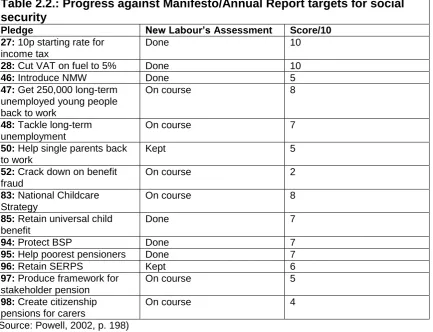
Table 2.2.: Progress against Manifesto/Annual Report targets for social security .... 49
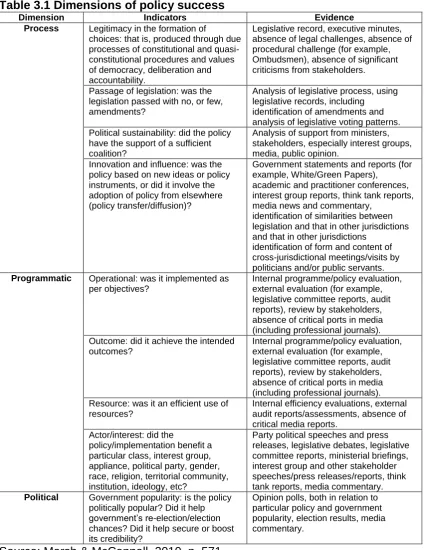
Table 3.1 Dimensions of policy success ... 73
Table 3.2. Critical choices to be made in assessing policy success ... 74
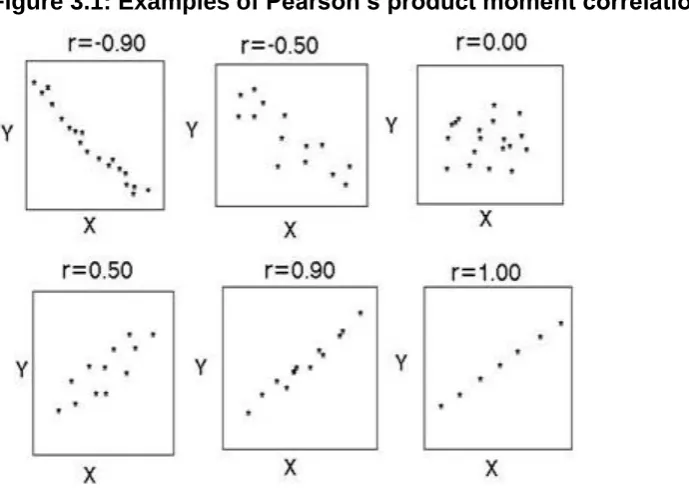
Figure 3.1: Examples of Pearson’s product moment correlation coefficient ... 95
Graph 4.1: Quarterly Claimant Count (Thousands) ... 103
Graph 4.2: Rates of unemployment and long-term unemployment in the United Kingdom 1997-2010 ... 109
Graph 4.3: ILO Employment and Unemployment, 1997-2010 ... 112
Graph 4.4: Rates of activity versus inactivity for those aged 16-64 years old: 1997-2010 ... 114
Graph 4.5: Gross Domestic Product Growth: Quarter on quarter previous year .... 116
Table 4.1: Other estimates of Okun’s Coefficient in the UK ... 118
Graph 4.6: Unemployment and GDP growth (Q2 1997-Q2 2010), quarterly rate (%) ... 119
Graph 4.7: Claimant Count Decomposition ... 122
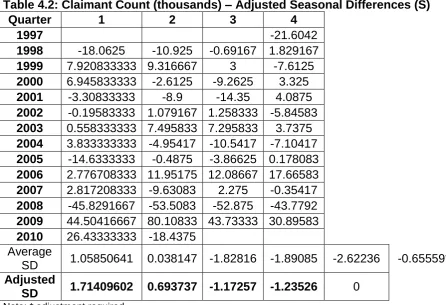
Table 4.2: Claimant Count (thousands) – Adjusted Seasonal Differences (S) ... 123
Graph 4.8: Cyclical + Residual Error (C+R) Components of Additive Time Series Decomposition ... 125
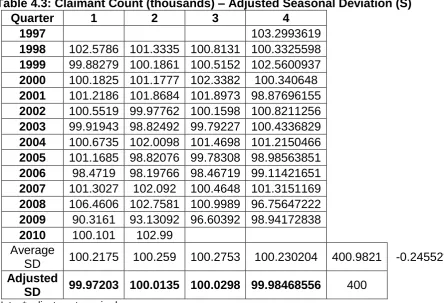
Table 4.3: Claimant Count (thousands) – Adjusted Seasonal Deviation (S) ... 126
Graph 4.9: Cyclical + Residual Error (C + R) Components of Multiplicative Time Series Decomposition ... 127
Graph 4.10: EU15 Annual % GDP Growth ... 130
Graph 4.11: EU15 Unemployment rate as % of total labour force ... 132
Graph 4.12: EU15 Employment rate as a % of labour force ... 134
Figure 4.1: The Love Economy. ... 139
Figure 5.1. A simplified flow diagram of the New Deal program. ... 146
Table 5.1. Labour market classification of participants on the New Deal for 18-24-year-olds ... 149
Graph 5.1: Youth Claimant Count (seasonally adjusted)... 153
Graph 5.2: Youth Long Term Unemployment (seasonally adjusted) (thousands) .. 154
Graph 5.3. ILO Youth Unemployment % rate 1997 - 2010 (not seasonally adjusted) ... 155
Graph 5.4: NDYP Leavers and Jobs Found (spells) (thousands) ... 159
Table 5.2. Stage of participation at the end of the month ... 160
Table 5.3. Number of people starting the New Deal for Young People, and the number of times they have joined the programme ... 161
Graph 5.5: NDYP Starters (individuals and spells) (thousands) ... 163
9
Table 5.4: Estimates of NDYP deadweight loss ... 169
Graph 5.7: % of NDYP leavers gaining employment ... 171
Graph 5.8: NDYP Starters (Spells) and Jobs Found (Spells) (thousands) ... 172
Table 5.5: Leavers Progressing into Employment 1999/2000 to December 2005 .. 176
Table 5.6: Recorded Destination* of leavers DEL & Jobcentre Plus ... 177
Table 5.7: First destination upon leaving NDfM ... 177
Table 5.8: Current Activity of NDfM Leavers ... 177
Graph 6.1: ND25+ Starters (individuals and spells) (thousands)... 187
Table 6.1. Number of people starting the New Deal for 25 Plus, and the number of times they have joined the programme ... 188
Table 6.2: Stage of participation at the end of the month ... 189
Graph 6.2: ND25+ Leavers (individuals and spells) (thousands) ... 192
Graph 6.3: ND25+ Starters (spells) and leavers (spells) (thousands) ... 193
Graph 6.4: ND25+ Leavers (spells) and Jobs Gained (spells) (thousands) ... 194
Graph 6.5. Ratio of FDN starts to short job outcomes ... 197
... 207
Graph 7.1: Incapacity Benefits Total Caseloads (thousands) ... 207
Graph 7.2.: Total claimants of Employment & Support Allowance and other incapacity benefits ... 208
Graph 7.3. Economic activity and inactivity of men by age (April to June 2008) .... 212
Graph 7.4: ND50+ Starters (individuals) and Jobs Gained (individuals) (thousands) ... 216
Graph 7.5: NDDP Job Broker Registrations (individuals and spells) (thousands) .. 220
Graph 7.6: NDDP Jobs Gained (individuals and spells) (thousands) ... 221
Graph 7.7: NDDP Leavers (individuals and spells) (thousands) ... 222
Graph 7.8: NDDP Job Broker Registrations (individuals) and Leavers (individuals) (thousands) ... 223
Graph 7.9: NDDP Jobs Gained (individuals) and Leavers (Individuals) (thousands) ... 224
Graph 8.1. UK Family structure 1996-2010 ... 228
Graph 8.2: NDLP Initial Interviews (Individuals and spells) (thousands) ... 234
Graph 8.3: NDLP Starters (individuals and spells) (thousands) ... 235
Graph 8.4: NDLP Jobs Gained (individuals and spells) (thousands) ... 236
Graph 8.5: NDLP Leavers (individuals and spells) (thousands) ... 237
Graph 8.6: NDLP Starters and Leavers (spells) (individuals) ... 238
Graph 8.7: NDLP Jobs Gained and Leavers (spells) (individuals) ... 239
Graph 8.7: New Deal for Partners Starters and Leavers (individuals) (thousands) 243 Graph 8.8: New Deal for Partners Jobs Gained and Leavers (individuals) (thousands) ... 244
Graph 8.9. Outcomes for lone parents potentially affected by LPO, Phase 1. ... 246
Graph 8.10. Outcomes for lone parents potentially affected by LPO, Phase 2. ... 246
Table 9.1: The historic rates for the NMW for when New Labour were in power .... 250
10 Graph 9.1: Increases in the Real and Relative Value of the Adult Minimum Wage,
UK, 1999-2010 ... 256
Table 9.3: Estimated full-time annual income for different rates of NMW against the prevailing tax-free allowance ... 257
Table 9.4. Support for non-pensioner households before and after April 2003 ... 262
Graph 9.2: Structure of Family Credit versus WFTC ... 264
Graph 9.3: Number of Working Families’ Tax Credit recipients, November 1999 to November 2002 ... 276
Graph 9.4: Number of families receiving WTC-only (working families with no children) ... 277
Graph 9.5: Number of families benefiting from the Childcare Element ... 278
Graph 9.6: Nominal Tax credits spending 1997-2010 ... 279
Graph 9.7: Total Self-employment March 1996-March 2015 ... 282
11
ABSTRACT
When New Labour were elected in 1997, the party’s leader, Tony Blair, claimed the
dawn of radical labour market reforms that would substantially reduce long-term unemployment and welfare dependency. This thesis is an evaluation of New Labour’s
active labour market policy (ALMP), and focuses on the three central components of that policy agenda: the New Deal programmes, Tax Credit programmes and the
National Minimum Wage. These reforms were targeted at key client groups such as the young (defined as those aged 18 to 25 year olds), the long-term unemployed, those aged over 50, the disabled and lone-parents. This thesis adopts Economics of
Conventions (EC) as its focal theory, and uses a range of quantitative methods to analyse official labour market data while drawing into question the trajectories of
improvement found in the official statistics. It also provides a systematic review of existing evaluative research including that conducted by the Department for Work and
Pensions, Low Pay Commission and HM Treasury.
This thesis found that rates of unemployment declined while New Labour were in power, arguably as a result of strong economic growth but potentially as a result of
their ALMP. Rates of economic activity and inactivity did not significantly change, even after the introduction of additional obligations on lone parents. However, due to the introduction of programmes like the New Deal for Young People, individuals were
re-categorised, drastically altering labour market statistics and trends. Indeed, when it comes to the justification and evaluation of their ALMP, New Labour made clear moral judgements about ‘the deserving poor’ and ‘the undeserving poor’ based on links
13
ACKNOWLEDGEMENTS
I would like to take this opportunity to express my sincere appreciation to Prof. Noel Whiteside, Dr. Jim Buller, Prof. Phil Mizen, and Prof. Mick Carpenter for their excellent supervision, advice, general guidance and support during the 7 years taken to prepare
this PhD thesis at both the University of York and the University of Warwick.
I would also like to add thanks to Dr Stephen Driver, Nicola Mullen of The Sunningdale Institute (The National School of Government), The People’s History Museum
(Manchester), The National Audit Office, and The Department for Work and Pensions
for their support. Also countless current and former colleagues who allowed me to bounce ideas off them and who provided much needed perspective.
And finally, I have to thank my wonderful and supportive wife Victoria, without whom I would have lost my sanity. Also my children, Joseph and Rosemary, my parents,
14
KEY DEFINITIONS AND ABBREVIATIONS
Active Labour Market Policy (ALMP): “benefit structures that give strong labour-market incentives, together with policies aimed at improving people’s labour-labour-market skills” (Barr, 2012. p. 21). Sometimes known as ‘welfare to work’. ALMP can also involve subsidising employment through Tax Credits and/or imposing a minimum hourly wage.
Effectiveness: “focuses on the relationship between the objectives of an activity and its actual outcomes” (Gregory & Lonti, 2008. p. 842).
Efficiency: “is a ratio of the outputs of an activity to the inputs used to produce them”
(Gregory & Lonti, 2008. p. 842).
Employability: ‘Employability’ is best defined as “the capability to move into and within labour markets and to realise potential through sustainable and accessible employment,” (DELNI, 2002).
Long term unemployment: The Organisation for Economic Co-operation and Development (OECD) has defined long-term unemployment (LTU) as “involving people out of work and looking for work for 12 months or more” (OECD, 1988). This definition is also the one used by the International Labour Organisation (ILO) and the Department for Work and Pensions (DWP), and will be that used in this thesis.
Public policy: Despite the wide range of definitions for public policy, it can effectively be defined as “how, why and to what effect governments pursue particular courses of action and inaction” (Heidenheimer et al., 1990, p. 3).
Recycling: ‘Recycling’, ‘re-tread’ or ‘churning’ is the situation where individuals repeatedly claim Job Seeker’s Allowance (the unemployment benefit paid in the UK to those actively seeking work) without finding sustained employment between claims (Carpenter, 2006).
15 Worklessness: “‘Worklessness’ is a term which encompasses more than just those
who are of working age and unemployed. It encompasses the entire inactive population – all those who are out of work and are either not actively seeking or not available for work – as well as the unemployed” (Balls, Grice & O’Donnell (eds.), 2004. pp. 175-176).
16
CHAPTER 1 – INTRODUCTION
“Welfare should become more focused on helping people to become independent, rather than locking them into dependency. It should be about ensuring that there is work for those who can, as well as providing security for those who cannot” (Department for Education and Employment, 1998. p.1).
The history of the UK labour market policy has been one of a continuous tension and cycle between expanding provision to help the working-poor and unemployed, and retrenchment to prevent the perceived threat of welfare dependency and reduce public spending (Pierson, 1997; Thompson, 2002; Hill, 2012). The active labour market policy (ALMP) implemented by New Labour upon their ascension to power in 1997 was arguably an attempt to find a more sustainable balance between the rights and responsibilities of those requiring welfare assistance from the state. A key New Labour intellectual, Anthony Giddens wrote at the time, “The welfare state, seen by most as the core of social democratic politics, today creates almost as many problems as it resolves,” (1998. p.16). This observation may demonstrate one of the many perceived policy problems confronting the New Labour government when it was first elected in 1997: the problem of a large and complex welfare system which was failing to tackle long-term unemployment (LTU), welfare dependency and associated social problems often termed ‘social exclusion’ (Levitas, 1996; 1999; Byrne, 2005).
17 These programmes were driven by moral judgements concerning what Daly (2010) described as the “‘deserving and undeserving’ fault line, which existed as far back as the New Poor Law of 1834” (p. 440). New Labour, like the governments which preceded it, made these moral judgements between the ‘deserving poor’ (the very young, the very old and the disabled) and the ‘undeserving poor’, described as “the indigent, the ‘passive’, those compelled or content to subject themselves to the beneficence of the state,” (Daly, 2010. p. 440). Such judgements are at the heart of classical liberal thinking. This is in stark contrast to alternative policies such as the universal ‘Basic Income’ advocated by the Green Party for the 2015 General Election. According to liberal thinking, the poor should always work for their income while those claiming benefits should be policed to avoid dependency, i.e. individuals should be ‘workers not shirkers’.
New Labour’s moral values had a range of influences; these included international sources, evolving ideology, changes in the underlying discourse of social policy and electoral considerations1. As this thesis will demonstrate, such moral judgements were not constant over New Labour’s time in office, for example, moral judgements of family structure and the expectations placed on lone parents evolved over time2. Such moral judgements underpin the social conventions of New Labour, for example, the treatment of female claimants is indicative of New Labour’s approach which is far less judgemental than the preceding Conservative government. These conventions determined how individuals were categorised into client groups, were counted by administrators and how the basis of their ‘treatment’ was designed. This thesis adopts Economics of Conventions as its focal theory to analyse these conventions, and is explored in greater depth in Chapter 3.
Conventions are collectively acceptable bases of social behaviour and embedded collectively-held moral values. They can be understood as ‘what we know and understand’, sometimes labelled ‘social norms’. They are, therefore, central to our understanding of the social world. What society understands as ‘employed’,
1 These are discussed in Chapter 2, the literature review.
2 This is discussed more in Chapter 8 which examines client groups defined by family structure. It
18 ‘unemployed’ and ‘economically inactive’ are all conventions. In the post-WW2 era labour markets were highly regularised and clear distinctions existed between these categories. However, as this thesis shows, the definitions used by policy makers have been increasingly challenged as the nature and structure of work changed.
This thesis brings together previous academic and administrative evaluations while analysing previously unscrutinised administrative data in an effort to evaluate the effect of New Deal programmes, the National Minimum Wage and the Tax Credit programmes on social dependency and labour markets. This work raises important questions regarding the continuing use of social statistics as a sole basis for social policy evaluation. This is in light of the categorisation process used to construct those statistics being driven by the under-recognised moral assumptions of policy makers and wider society.
1.1. Current body of knowledge
Despite there being a large body of work in the field of policy examining narrow sections of New Labour’s labour market policy, especially on the New Deal for Young People, there remain significant gaps in the current body of knowledge.
Although rates of unemployment fell and rates of employment rose during the majority of New Labour’s terms, it is not clear what caused this. Existing literature appears to present a self-evident link between New Labour’s labour market policy and changing labour market trends and behaviour (Toynbee & Walker, 2005; 2010; Giddens, 2007; Powell, 2000; 2002; 2008). It could be argued that these researchers fell into the fallacy of post hoc ergo propter hoc. This is rarely the case, and economic theory suggests a much more complex policy space. The present author did not find the existing literature convincing. Even a cursory glance at available data suggested a far more complicated labour market and range of possible processes at play that the existing research does not adequately explain.
19 they interacted together and the labour market effect they would have had as a result. Most importantly, no researcher has questioned how New Labour came to define those who were ‘unemployed’ and ‘employed’, reflecting moral judgements that are made of such individuals. The body of knowledge is critically reviewed in Chapter 2.
1.2. Scope of this thesis
To fill this important gap in the current body of knowledge, the scope of the thesis includes New Labour’s labour market reform agenda aimed at the working age population (defined at the time as those aged 16-64) between 1997 and 2010; from the ideological birth of New Labour and the development of this agenda, to its electoral demise. Labour market policies explicitly aimed at children and pensioners are not within the scope of this thesis.
This thesis analyses the prima facie statistical effect of reforms on the UK labour market. It then probes into the more complex labour market mechanisms occurring, and especially the effect of New Labour’s social policy conventions upon their policy choices and the effect this had on the statistical measures.
Although a range of possible avenues for research were available, a core research question was developed which attempts to address the critical gaps in knowledge identified above:
What were the effects of New Labour’s active labour market policy on
rates of social dependency in the working age population during their
time in office?
20 Although numerous ALMP projects/programmes existed, including the creation of the Jobcentre Plus network, the most central and important were the New Deal Programmes, Tax Credits and the National Minimum Wage. These programmes were designed as part of a strategy of ‘joined up government’ and intended to complement each other in achieving the policy goals stated in their 1997, 2001 and 2005 manifestos. Therefore, it was decided that these key programmes would form the scope of this thesis.
It is contended that this thesis makes an original contribution to knowledge in the following ways:
Although a limited range of holistic evaluations of New Labour’s record have been conducted (Toynbee & Walker, 2001; 2005; 2011; Powell, 2002, Diamond & Kenny (eds.), 2011), these evaluations failed to offer depth of critical analysis, were overly sympathetic and focused heavily on headline social statistics which they accepted at face value. This thesis seeks to correct what Booth, Colomb & Williams argue is a key driver of many research questions: “incomplete knowledge or flawed understanding,” (2003. p.59).
There are also many existing evaluations focusing on the impact of individual policies over a limited time period. This thesis differs in that it seeks to analyse the contribution of multiple policies to labour market change over a longer time period.
This thesis adopts Economics of Conventions (EC) as its focal theory. To my knowledge no previous author has adopted EC to evaluate New Labour’s ALMP. Therefore, this is a unique and original contribution.
21
1.3. New Labour’s labour market policy agenda in historical context
New Labour’s welfare reforms took place in the broader context of de-industrialisation, structural economic change and an aging population.
Over the course of the late 20th century, the UK economy underwent radical structural change. Bazen & Thirwall (1989) argue that de-industrialisation can be defined in one of two ways: A declining share of total employment in manufacturing, or, an absolute decline in employment in manufacturing. However, this definition is potentially limited as Brazen & Thirlwall’s definition relies on measures of unemployment which this thesis demonstrates as being socially constructed and subject to change. Wall (2001) similarly argues that ‘de-industrialisation’ refers to a shift in resources out of the manufacturing sector and into the service sector of the UK economy. It could also be argued that de-industrialisation can be defined as industry making up a declining proportion of GDP. As a result of de-industrialisation, the UK economy has also shifted geographically with service sector roles located away from formerly industrialised areas. Thus areas of formerly intensive industrial activity such as Lancashire, South Yorkshire, Tyneside, Clydeside, and South Wales amongst many others emerged as geographical pockets of high unemployment (Bartholomew, 2004).
22 for example, migration. Secondly, it implicitly assumes perfect occupational and geographical mobility, i.e. that workers made redundant in manufacturing can simply walk into a job in another sector without retraining or having to relocate geographically. Neither of these assumptions is very likely. It could, therefore, be argued that de-industrialisation will almost inevitably lead to an increase in unemployment3.
Some have argued that although there has been structural change in the UK economy, this is not de-industrialisation as such. Lipsey & Chrystal (2007) suggest that although the number of those employed by manufacturing declined from over 7 million in 1978 to 3.5 million in 2005, actual manufacturing output measured by volume was at an all-time high in the year 2000. Therefore “a key element of the UK manufacturing story is that the industry has achieved growing output with fewer and fewer employees” (Lipsey & Chrystal, 2007. p. 225.). Lipsey & Chrystal speculate that the cause of this change is due to increases in labour productivity, meaning that fewer workers are required. Real wages rose as a result. Alongside this the cost of capital equipment such as computers has dropped substantially4. Thus, Lipsey & Chrystal argue, companies chose to substitute cheaper capital for increasingly expensive labour. Routine tasks were also automated by computerised machinery/robotics further removing the need for large numbers of unskilled workers. Lipsey & Chrystal also suggest that globalisation has allowed UK companies to take advantage of cheaper labour costs abroad to support their supply chains5. Thus component parts can be imported while final assembly occurs in the UK, e.g. Jaguar Land Rover.
Additional explanations have also been given for the declining number of individuals recorded as working in manufacturing. One that chimes with the arguments advanced in this thesis is that significant numbers of workers have been re-classified from
3 The UK also has an ageing population due to declining birth rates. When focusing on older workers
placed in such a position, combined with industrial diseases and related health problems from a career in manufacturing or heavy industry it can quickly be seen that this particular client group is likely to face much higher levels of unemployment. Chapter 7 discusses active labour market policy aimed at the over-lapping client groups of older and disabled workers.
4 Technology such as Computer Aided Design and Manufacture (CAD/CAM) have also revolutionised
production processes, requiring considerably fewer but much higher skilled operators.
5Although there has been an emergence of newly industrialised countries such as Brazil, Russia,
India and China (BRIC) as a result of off-shoring, the USA, UK and other Western countries still have continued structural advantages (Cox, 2012). On the other hand BRIC countries, and China
23 working in the manufacturing to alternative sectors (Lipsey & Chrystal, 2007; Rowthorn & Coutts, 2012). This convincing argument says that, while in the past a large manufacturing company may have directly employed all of the services it needed, such as drivers, gardeners, cooks, cleaners, etc., over time there has been a movement towards outsourcing of these and other functions. The externalising of key functions such as marketing and finance through sub-contracting has also allowed firms to externalise risk as well as large numbers of individuals who would previously have been direct employees. Therefore, whereas these workers may previously have been counted as working in the manufacturing sector, they are now counted as service-sector workers. IT has also made this re-classification increasingly possible as workers can work remotely and on a consultancy basis. It can be said that in addition to anti-trade union legislation of the previous Conservative Government (for instance the Employment Act 1980, Employment Act 1982, Trade Union Act 1984, Public Order
Act 1986, Employment Act 1988, Employment Act 1989, Employment Act 1990, Trade
Union & Labour Relations (Consolidation) Act 1992, Trade Union Reform and
Employment Rights Act 1993 and the Employment Rights Act 1996),
de-industrialisation and worker re-classification also contributed to the decline of Union power and employment rights.
It is important to highlight that de-industrialisation in the UK did not occur in isolation, but within a wider context of globalisation. Dicken (2011) argues that we must distinguish between overlapping definitions of globalisations: “the structural changes that are occurring in the way the global economy is organised and integrated. The other meaning refers to the neo-liberal, free-market ideology of the ‘globalisation project’,” (p. 2). These structural shifts have been characterised in terms of a widening gap between skilled and unskilled workers:
de-24 industrialisation of employment in the North over the past few decades,” Wood (1994) cited in Dicken (2011. pp. 502-503).
Therefore, the breakdown in trade barriers which began with the General Agreement on Tariffs and Trade (GATT) in 1947 and which has evolved into the World Trade Organisation (WTO), has led to the shift in low-skilled industrial production from the industrialised North and the industrialising South, i.e. nations like China and India. The emergence of Neo-liberalism as the dominant political paradigm has meant that such dramatic structural change is seen as not only inevitable, but desirable. However, both this structural change and ideological dominance have undermined the power of nation states and their ability to continue classic welfare policy. It could, therefore, be argued that New Labour had little choice but to re-define the role of the welfare state in the face of a globalisation tide they could no hope of commanding. Neo-liberalism with its central belief in individual responsibility has further undermined the social values which underpinned universal benefits.
The UK’s ‘classic welfare state’ was also based on an industrial working class in permanent, structured employment whose welfare rested on sustained social insurance contributions designed to bridge any gaps between permanent full-time jobs. This was William Beveridge’s vision and promise, firmly located within a policy of full-employment. As a consequence of de-industrialisation, the relationship between benefits and contributions collapsed, in part due to flexible and self-employment that falls outside its remit. Consequently, conditionality and compulsion have replaced universality and social responsibility.
25 problem, but creates an over-reliance on financial services and stimulates a balance of payments deficit.
Despite the arguments for ‘positive de-industrialisation’ by writers such as Kitson & Michie (2014), all writers in this field acknowledge de-industrialisation has had an impact on the UK labour market. Geographical areas which had previously been dominated by heavy industry appear to have been particularly affected6 by de-industrialisation, for example, steel and cutlery making in South Yorkshire, shipbuilding on Tyneside, cotton weaving and coal mining in Lancashire, pottery making in Staffordshire, slate quarrying in North Wales and coal mining and steel in South Wales. Skills from these industries do not translate into the new industries such as IT and pharmaceuticals which have emerged. Geographical pockets of long-term structural unemployment have appeared as a result7. Within the context of fiscal retrenchment of the 1980s there had been pressure to reduce the cost of providing welfare payments to these new claimants (Grant, 2002). Consequently, in the UK and other European countries experiencing such labour market change active labour market policy (ALMP) emerged in response. Indeed, ALMP policies are central to the EU and its Employment Strategy which was introduced in 2000. ALMP seeks to encourage and help individuals into employment by supporting job-search activity, for example, by improving information on job vacancies or helping with CV writing, through training and through employment subsidies. However, issues have emerged with the ‘work-first’ agenda which tries to force workers into the first available job. It often encourages a mis-match between the skills of the worker and the role. This can lead to sporadic employment and an increasing incidence of recycling/re-tread between work and out-of-work benefits (see Carpenter, 2006 and Hill, 2012 for a thorough discussion of recycling).
It can be argued that New Labour’s labour market agenda was a perfect example of ALMP in practice. However, the changes of de-industrialisation have not been the
6 Although as this thesis will argue in Chapters 3, 4 and 9, the nature of wok has changed over time.
‘Unemployment’ as a classification for social policy makers emerged in the 1930s as a necessary component of Keynesian economic management. ‘Employment’ has also moved away from ‘9 to 5’, 6 day a week jobs to something more fluid.
7 With many older workers being pushed out of the Labour market. These are discussed in Chapter 7
26 only ones impacting the UK labour market prior to New Labour’s election in 1997. ‘Flexibility’ has emerged as an important strand of academic debate relevant to this thesis.
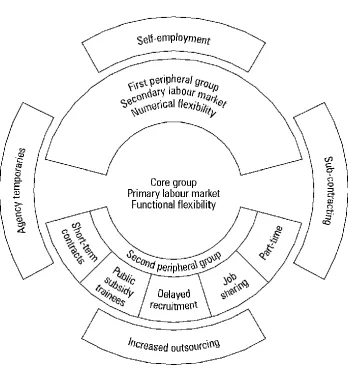
‘Flexibility’ as a key feature of the UK labour market arose long before New Labour’s time in office. As a result of the economic contraction and the collapse of trade union influence in the 1980s, the personnel management concept of flexibility materialised. This was noted in academic debate in the highly influential papers of Atkinson (1984; 1985). Atkinson observed that in increasingly uncertain economic conditions firms were becoming more flexible in their approaches to manpower/staffing. Atkinson identifies a range of types of flexibility which can be adopted: functional flexibility (matching skills to needs, multi-skilling), numerical flexibility (adjusting numbers employed according to current business requirements), temporal flexibility (variation in working hours, for example, zero hours contracts which do not guarantee an employee any hours, but where an employer has absolute flexibility with regards how many hours work they offer), financial flexibility (matching pay to performance) and behavioural flexibility (encouraging adaptability and versatility amongst staff). According to Atkinson’s ‘Flexible Firm’ model, shown in Figure 1.1. below, a company’s workforce is increasingly like the layers of an onion: a core group with functional flexibility, a first peripheral/variable group with functional but also increased numerical flexibility, i.e. part-time/flexitime workers, job-share, annualised hours contracts, fixed term and self-employed workers. This is followed by a secondary peripheral group who are part of the external labour market made up of freelancers, agency workers, the self-employed, sub-contractors and outsourced workers. Atkinson also argued that some of those on the periphery were closely associated with secondary labour market characteristics (low-skilled labour with limited training or career prospects, mostly undertaking tasks not seen as central to the organisation’s business) (Atkinson, 1985. cited in Hunter et al. 1993).
IT-27 based communication has also enabled the transformation of the structure of firms from hierarchies to networks.
Figure 1.1. The Flexible Firm
Source: Atkinson, 1984. p. 29.
As Atkinson’s ‘Flexible Firm’ model developed over time, it came to dominate discourse within the labour market focused academic disciplines from the 1980s onwards (MacInnes, 1988; Cordery, 1989; Guerrier & Lockwood, 1989; Hunter et al. 1993; Kelleberg, 2003; Cloonan, 2004; Bryson, 2004; Maggs, 2004; Watson, 2005; Schmidt, 2005; Conley, 2006; Gabriel et al. 2013).
28 2004; Watson, 2005; Schmidt, 2005; Conley, 2006; Standing, 2011; Gabriel et al. 2013).
Standing is under no illusions about what was really meant by ‘flexibility’:
“Flexibility had many dimensions: wage flexibility meant speeding up adjustments to change in demand, particularly downwards; employment flexibility meant easy and costless ability of firms to change employment levels, particularly downwards, implying a reduction in employment security and protection; job flexibility meant being able to move employees around inside the firm and to change job structures with minimal opposition or cost; skill flexibility meant being able to adjust workers’ skill easily.
In essence, the flexibility advocated by the brash neo-classical economists meant systematically making employees more insecure, claimed to be a necessary price for retaining investment and jobs. Each economic setback was attributed in part, fairly or not, to a lack of flexibility and to the lack of ‘structural reform’ of labour markets” (2011. p. 6).
Standing develops his argument further saying that in addition to other economic forces the flexibility agenda has led to the emergence of a new social class, the ‘precariat’. This class is characterised as:
“[…] younger and older individuals alike that flit between jobs, are unsure of their occupational status, possess little labour or work security, lack income security, experience a precariousness of residency (migrants) and often encounter “status” frustration whereby jobs do not fit their acquired skills and qualifications” (Orton, 2012. p. 121).
29 a minimal income just above the breadline. This is evidenced in Chapter 9 by a dramatically increasing rate of self-employment and underemployment.
1.4. Structure of this thesis
The first half of Chapter 2 of this thesis is a literature review exploring the roots of New Labour and its labour market reform agenda. The second half critically reviews previous evaluations of the same agenda and demonstrates where the gaps in existing knowledge lie. Chapter 3 explores evaluation studies and the limitations of current evaluative methods. It also outlines the theory and methodologies used in this thesis. Chapter 4 addresses the pertinent macro-economic and labour trends which were occurring both before and during New Labour’s time in office. The chapter attempts to untangle the effect New Labour’s reforms may have had on those trends.
Chapters 5 to 8 represent an intensification of focus towards key client groups, namely ‘the young’, the long-term unemployed, ‘the disabled’ and ‘older workers’, lone parents, and their partners by analysing ALMP designed to address their situations and the consequences for the client groups concerned.
30
CHAPTER 2: LITERATURE REVIEW
Tony Blair was elected as Leader of the Labour Party in July of 1994, heralding the birth of the political project which became known as ‘New Labour’. From this point onwards, New Labour came under intense academic and media scrutiny. This was particularly the case in the area of labour market policy, where New Labour adopted a range of labour market activation policies.
To explore the current state of knowledge in this area, this chapter is structured as follows:
2.1. A literature review of the roots of New Labour and its labour market reform agenda.
2.2. Literature evaluating New Labour’s labour market reform agenda 2.3. A summary and critique of this literature.
Section 2.3. seeks to address the important questions:
What debates are occurring in the discipline? Where are the tensions/issues?
Where do gaps in knowledge exist?, and
What does the research in this thesis add to current knowledge?
From this foundation, a research question and methodology were developed to explore this area more fully to make an original contribution to this debate. The literature is reviewed thematically following the strands of debate.
2.1. Literature focusing on the roots of New Labour’s labour market
reform agenda
31 of their policy ideas. Instead, the literature comprises various strands of debate, some contradictory, some over-lapping and mutually supportive. These strands attempt to explain what may have led to the emergence of what became known as New Labour.
2.1.1. International sources
Some academic commentators argue New Labour’s active labour market policy can trace its origins back to international sources. The key works in this strand of debate are Walker (1998), Deacon (2000), Dolowitz (2000), Ramsey (2002), Daguerre & Taylor-Gooby (2004), Hale, Leggett & Martell (2004), Page (2009) and Fergusson (2009). The central thrust of this argument is that an ‘Americanisation’ of British welfare reform occurred (Walker, 1998). Here, the thinking and language within UK public policy, especially in the area of welfare, were influenced by, and drawn from, the US.
To better support this strand of argument, attempts have been made by Dolowitz (2000) to create a theoretical framework for this Americanisation; the idea that ‘policy transfer’ can be applied across social policy in an increasingly globalised world. This could explain the influence of US policy on the changes in British public policy which occurred in the 1980s and 1990s. Under New Labour, policy transfer can best be seen in the decision to implement the Working Families Tax Credit (WFTC). This was very similar to the Earned Income Tax Credit (EITC) in the US. Policy transfer in this case is attributed to the rise of the New Right in both the UK and US and the strong personal relationships between Thatcher and Reagan. This also existed between Blair and Clinton leading to strong ideological and political similarities (Dolowitz, 2000).
The importance of these formal and informal policy networks between the UK and the US meant that:
32 Dolowitz cites Murray 1984; Mead 1986; 1997; Katz 1989; and Pierson, P. 1994; 1996 as examples of influential New Liberal ideological rhetoric. It could be argued that locations of policy transfer could include Anglo-American think tanks such as the American Enterprise Institute, the Heritage Foundation, the Hoover Institute, the Institute of Economic Affairs, The Cato Institute, The Centre for Policy Studies and the Adam Smith Institute. These organisations, and others, are important, since they maintain strong informal policy networks through influential policy thinkers, for example, Dr Madsen Pirie of the Adam Smith Institute who advocated the privatisation of British Railways in the years prior to its implementation in 1994.
Policy transfer is occurring on a more frequent basis thanks to globalisation and the development of international policy networks linking politicians, academics, policy wonks and advisors (allowing for the faster exchange of knowledge and ideas) (Dolowitz, 2000). The breaking down of social and economic barriers has also allowed for cultural exchange, e.g. educational schemes such as Fulbright Scholarships and
EU Erasmus Mundus programme. Linked to this is the importance of the English
language as the language of business. However, while policy transfer occurs, Dolowitz argues, the reasons are not always rational, nor are they always successful (ibid).
Both Deacon and Dolowitz argue that not only did New Labour draw on US experience but also “the design and delivery of the so-called New Deal for the unemployed owes much to the experience of active labour market policies in both Europe (especially Sweden, Denmark and Holland who have been at the forefront of Active Labour Market Policies (ALMP) due to their higher developed (large and expensive) welfare states. See also Bonoli (2010) regarding influence of Sweden on other OECD countries) and Australia [...] however [...] these other influences have been much less marked in respect of the wider issues of welfare reform” (Deacon, 2000, p. 6). Therefore, the Americanisation of welfare reform remains central to this strand of debate, despite other influences.
33 reform: the French model of social inclusion, the Nordic model of activation policies and the US workfare model. Daguerre & Taylor-Gooby claim that the American model was the most influential due to an absence of policy networks between Continental Europe and Britain. There were, however, some imports from Europe in terms of an emphasis on rights and responsibilities. It has been argued that this was an oscillation between US inspired intellectual emphasis on “fighting a dependency culture with an emphasis on mutual obligations between the state and welfare recipients” and the European emphasis on “solving the problem of social exclusion” (Annesley, 2003; Trickey, 2000 cited in Daguerre & Taylor-Gooby, 2004. p.29). Furthermore they argue, the lack of networking between British and European officials meant that British officials were inclined to look to American social experimentation for inspiration. They argue this was partly due to the ‘Special Relationship’ which had been especially strengthened under Reagan and Thatcher and was later developed further under Clinton and Blair. It is not clear why Daguerre & Taylor-Gooby completely overlook the European Union, the European Commission, other trans-European institutions and the increasingly important role they play in European social policy.
The wider Americanisation of social democratic politics has been linked to ‘The Third Way’, an ideology that claims to be a compromise between Neo-Liberal and traditional Socialist politics (Hale, Leggett & Martell, 2004). The Third Way originated in the Clinton administration, first elected in 1992. It was then drawn upon by Blair’s New Labour Government in what has been dubbed the ‘Clintonisation’ of Labour (Powell, 2000). These arguments have also been echoed by a number of writers including King & Wickham Jones (1999); Holmwood (2000); Drive (2004) and Page (2009). As New Labour drew on the lessons of various US ‘Workfare’ programmes, work became central to the Third Way under the slogan ‘Making work pay’ (Hale, Leggett & Martell, 2004). According to Hale, Leggett & Martell, New Labour sought to promote work, education, training, life-long learning, and employability through active labour market policy.
34 “While significantly more broadly based and service-rich than
US-style ‘work first’ programmes, the New Deal for 18-24 year-old unemployed people nevertheless places overriding emphasis on assisting transitions into paid employment.’ This reinforces what they see as the neo-liberal policy orthodoxy on flexible labour markets, and it erodes, not builds, the stock of human capital [...]. The implication, then, is that the Labour Government’s New Deal becomes orientated more around ‘work first’, its ‘progressiveness’ declines because it re-enforces existing labour market inequalities” (Theodore & Peck, 2000. cited in Hale, Leggett & Martells, 2004. p. 136).
In summary, the arguments advanced by the majority of writers are that New Labour’s labour market policy originated from international sources are highly convincing, presenting strong evidence of US (and to a lesser extent European) influence on the ideology and agenda of New Labour before and during their time in office. However, Powell summarises this strand thus:
“There is little agreement on the international roots of the Third Way. While commentators such as Driver and Martells (1998) and Jordan (1998) argue for a transatlantic route, Blair (1998a) and Giddens (1998) point to links across the Channel towards European social democracy” (1999. p.13).
There does appear to be an intellectual and political convergence in the late 1970s and 1980s between Thatcherites and Reaganites, and the increasing prevalence of the ideas and language of Charles Murray and Lawrence Mead in the UK press. For instance Charles Murray and the Underclass: The Developing Debate by Charles Murray (1996) was a publication by the IEA Health and Welfare Unit in association with the Sunday Times which included commentary by Frank Field MP. This work suggests an influence by Mead not only on the Conservative party during the 1980s but a continuing influence on the welfare reform debate and New Labour in the run up to 1997.
35 It could be argued that the strength of the trans-Atlantic relationship, cultural links and common history may also have played a role. UK think tanks such as the Adam Smith Institute regularly draw on ideas from centre-right US think tanks such as the Heritage Foundation and the Cato Institute. The work of the Adam Smith Institute has then been regularly drawn upon by the both the Conservative and Labour parties, such as in the case of the railways and other privatisations during the 1980s and thereafter.
Although this evidence demonstrates a self-evident connection between welfare reform in countries such as the US and New Labour’s own welfare reforms, there is by no means a consensus over these alleged international roots.
2.1.2 Evolving ideology
The second strand of debate is the influence of evolving ideology within the Labour party. The key works in this strand are Hutton (1996), Levitas (1996; 1999); Deacon (2000); O’Brien (2000); Giddens (2000); Powell (2000); Hale, Leggett & Martell (2004); McDowell (2004); Byrne (2005); Wiggan (2007) and Corry (2011). The central thrust of this strand of debate is that the shift in Labour’s thinking around welfare reform was influenced by evolving ideology, i.e. a shift to the political right.
36 where specific examples can be found, raising questions regarding the validity of these claims.
Although the changes in the use of language were important, others have emphasised the evolution of socialist philosophy towards the centre and the resulting Third Way in response to “specific dilemmas conceived largely in terms associated with the New Right,” (O’Brien, 2000. p. 403), and that as a result, New Labour sought to create what they defined as an ‘enabling’ welfare state that promoted ‘social and economic inclusion’. O’Brien argues that New Labour borrowed the philosophy that was an amalgamation of recent communitarian and stakeholder research from thinkers such as Etzioni (1995; 1997), Giddens (1994; 1998), and Hutton (1995). O’Brien further argues that Blair’s belief in an active society upheld by reciprocal rights and duties drew heavily from traditional socialist belief in individual freedom accessed through communities and within communities (Blair, 1996. cited in O’Brien, 2000). Thus “the roots of New Labour [...] extend far beyond either the New Right or thinkers such as Giddens, Etzioni and Hutton,” (O’Brien, 2000. p. 408).
However, Giddens’ contribution to the evolving ideology of the Labour party is still noteworthy. For example, he argued that welfare reform was a key part of the Third Way for three reasons: firstly, the dynamics of inequality have changed; secondly, in at least some aspects the welfare state has become unsustainable, and can undermine social solidarity, and; thirdly, the welfare state has its own limitations and contradictions (Giddens, 2000). Key elements of the Third Way approach to welfare reform are therefore tackling social exclusion and the mechanisms that produce or sustain deprivation. There also should be investment in human capital and a new social contract appropriate to an age of globalisation and individualism that stresses both the rights and responsibilities of citizens. It could be argued that this, as well as his previous works, exerted a strong influence on New Labour, especially during the development of their New Deal programmes. Giddens’ language of rights and responsibilities also appears regularly in New Labour discourse (Blair, 1996; Labour, 1997) suggesting a strong influence.
37 from earlier strategies, as had been argued by Blair (Labour Party, 1997. cited in Powell, 2000). Powell claims that New Labour had an unmistakably different and unique approach when compared with Old Labour. ‘Old Labour’ was the name given to the more Social Democratic Labour Party before the election of Tony Blair. It was characterised by a discourse of rights, equality and market failure, values of equality of outcome and security, policy goals of full employment through state finance and universal delivery based on redistributive taxation (Hale, Leggett & Martell, 2004).
However, there were some clear trends of policy convergence between New Labour and the Conservatives. Nowhere was this truer than in the areas of public expenditure, the mixed economy of welfare and welfare-to-work. Powell (2000) claims that old linguistic battle lines were abandoned for new, less sharply defined positions. The Third Way can be seen not as a coherent concept but as “a poorly specified, pick and mix strategy, largely defined by what it is not. Neither does it appear to be new: arguably some of its key components such as the centrality of work and civil society have their historical roots in the New Poor Law and in the writings of New Liberals such as Beveridge,” (Powell, 2000. p.57). Powell raises the question of the newness of ‘New’ Labour, i.e. can it be defined as something radically different from the past, moving beyond ideology to an almost scientific use of evidence to support policy making?
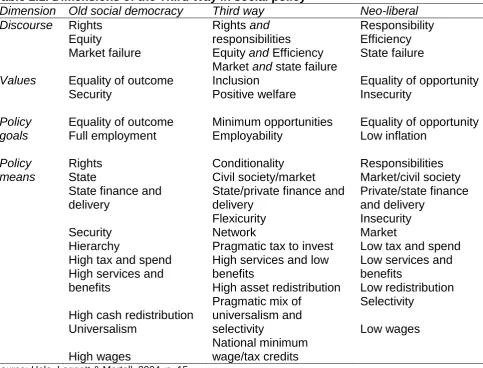
38 The Third Way could arguably demonstrate a convergence between neo-liberal and traditional social-democratic (‘Old Labour’) ideology rather than a marked change in ideology. The following table demonstrates how the ‘Third Way’ summarises the language and ideology of this convergence.
Table 2.1. Dimensions of the Third Way in social policy
Dimension Old social democracy Third way Neo-liberal
Discourse Rights
Equity
Market failure
Rights and responsibilities Equity and Efficiency Market and state failure
Responsibility Efficiency State failure
Values Equality of outcome
Security
Inclusion
Positive welfare
Equality of opportunity Insecurity
Policy goals
Equality of outcome Full employment
Minimum opportunities Employability
Equality of opportunity Low inflation
Policy means
Rights State
State finance and delivery
Security Hierarchy
High tax and spend High services and benefits
High cash redistribution Universalism
High wages
Conditionality Civil society/market State/private finance and delivery
Flexicurity Network
Pragmatic tax to invest High services and low benefits
High asset redistribution Pragmatic mix of
universalism and selectivity National minimum wage/tax credits Responsibilities Market/civil society Private/state finance and delivery Insecurity Market
Low tax and spend Low services and benefits
Low redistribution Selectivity
Low wages
Source: Hale, Leggett & Martell, 2004. p. 15.
This use of convergent language can be seen clearly in Blair (1996) and Labour (1997) with much of this vocabulary being seen in both.
39 through market-based choice. The election in 2010 of a Conservative and Liberal Democrat coalition government has since seen the continuation of Third Way thinking and language usage in their welfare reforms along similar lines, i.e. increasing responsibility, conditionality and reducing eligibility.
As well as arguments against a fixed ideology, it has also been argued that New Labour was heavily influenced by emergent macro-economic theories such as endogenous growth theory. New Labour’s claim to a Third Way, independent of Keynesian social democracy and Conservative Neo-Liberalism, rests on an endogenous growth-inspired strategy. Many claim it was this strategy that informed New Labour’s introduction of new governance and performance frameworks for social security administration, specifically the creation of Jobcentre Plus and the Department for Work and Pensions (Wiggan, 2007; Dolowitz, 2004a; 2004b and Buckler & Dolowitz, 2004). However, it should be noted that the previous Conservative government had also commissioned private providers of job search/placement services, for example, under their Youth Training (YT) scheme (1989-1995). Influential members of New Labour within the Treasury, such as Ed Balls and Gordon Brown, favoured policy strongly influenced by endogenous growth theory and adapted this to Labour’s political traditions and priorities (Wiggan, 2007). The beliefs of these influential people at the heart of New Labour had important implications for the development and implementation of welfare reform policy before and during the party’s time in office.
middle-40 income households. This and other related tax policy did little to reduce the growing gulf of post-tax income inequality that had occurred since 1977 (ibid). These issues are discussed in greater depth in Chapter 8 which examines the New Deal for Lone Parents and the New Deal for Partners. Perhaps the most scathing criticism of Neo-liberalism’s influence comes from Corry (2011) who claims that Labour made a ‘Faustian pact’ with the City and capitalism more generally. Smith (2009) made a similar argument highlighting that New Labour would do little to help trade unions, collective bargaining or workers’ rights. Corry concedes that it would have been difficult for New Labour to have done otherwise: “As social democrats operating in a world where options are significantly constrained – from mobile capital to tax-resistant voters – Labour will always to have make tough choices” (2011, p. 137). Others such as Heffernan (2011) similarly argue that the Thatcherite economic settlement was perhaps too strong a tide to challenge and only incremental change was possible.
In preparation for the 1997 General Election, measures were taken to modernise the Labour party. Blair and other senior intellectuals within the Labour Party sought to redefine the ideology of the party (for instance Blair (1996) and Mandelson & Liddle (1996)). Mandelson & Liddle proposed the principles that would underpin New Labour’s welfare reforms, and ultimately fed into the 1997 election manifesto, especially the commitments to reducing long-term and youth unemployment (Labour, 1997).
41 he wrote in this book went on to be developed and clearly informed the 1997 Labour party manifesto.
42
2.1.3. Changing discourse
Strongly related to the rightward shifts in New Labour ideology is that of a rightward shift in wider political discourse. It has been argued that this shifting discourse was an important influence on New Labour, especially the increasing use of the vocabulary of welfare reform and ‘workfare’. US academics Murray & Mead (1987) were the first to explicitly introduce the concepts and language of ‘welfare dependency’ and ‘underclass’ to UK political debate. This phenomenon became known in the early 1990s as ‘Moral Underclass Discourse’ (MUD) (Levitas, 1996; 1999). The strength of Murray & Mead’s contribution is claimed to be such that “their ideas [...] had a profound impact upon all points of the party political spectrum in Britain. They all but furnished some members of the Conservative government with a new vocabulary,” and as a result, “more than anyone else it was the American dependency theorists who pushed onto the agenda issues which had been neglected, indeed all but suppressed, by the then dominant academic tradition” (Deacon, 2000. p.8). This influence came to define the terms of the debate surrounding welfare reform for all UK political parties.
Murray & Mead appear instrumental in the move away from Titmuss’ dominant paradigm of universal welfare which formed part of the post-WWII political consensus, and the move towards the language of dependency. Titmuss advocated a universal, unconditional, non-judgmental welfare state and the importance of altruism rather than self-interest in understanding human behaviour and motivation. His work was also characterised by a denial of agency and almost total emphasis on structural factors (Welshman, 2004). Deacon argues that the movement away from Titmuss occurred within academic circles and even the highest echelons of British government. He concludes that “the importance of the Americanisation of the British welfare debate [...] lies primarily in the contribution which it has made to the shift in the focus of New Labour thinking from the problem of inequality to the problem of dependency” (Deacon, 2000. pp.16-17).
43 1999; Byrne, 2005)8. Walker & Walker define social exclusion as “the dynamic process of being shut out [...] from any of the social, economic, political and cultural systems which determine the social integration of a person in society” (1997. p. 8). The term ‘Social exclusion’ is actually derived from a French concept to describe those unable to find work, who as a consequence, lose their right to elect representatives to local social security administration (and other political activities). It is therefore a deeper idea than just poverty and subsistence, but is about an individual’s ability to participate in the customary life of society (Levitas, 1999). This is not to say there are not ‘weak’ and ‘strong’ versions of this discourse. The weak version argues that:
“[…] the solutions lie in altering these excluded peoples’ handicapping characteristics and enhancing their integration into dominant society. ‘Stronger’ forms of this discourse also emphasise the role of those who are doing the excluding and therefore aim for solutions which reduce the powers of exclusion” (Veit-Wilson, 1998. p. 45).
Levitas (1999) was highly critical of New Labour’s approach to social exclusion, especially the limited progress of the Social Exclusion Unit, the lack of clarity of causal processes that lead to social exclusion, and the politicisation of indicators and targets so that ‘success’ can be claimed. Although this is a common criticism of the evaluation process9, Levitas strongly argues that there is a failure to address the fundamental issues of poverty and inequality affecting wider society. It is, of course, possible that evaluation processes designed to measure the ‘social problem’ to be solved can so easily be manipulated or ‘spun’ to maximise positive media coverage of a government’s work.
The New Labour thinker Hutton (1996) similarly strongly argued for the importance of social exclusion due to its costs to firms and government alike. Hutton advocated a ‘stakeholder society’ response to the problem of social exclusion. This would have involved radical changes to British banking to foster a more German-style of co-operative capitalism between finance, industry and (organised) labour. Alongside many other changes, he advocated strong active labour market intervention after 18 months of unemployment: “Either it would train those out of work, or provide them with
8 Social exclusion is discussed with reference to ‘young people’ and the New Deal for Young People
in Chapter 5.