warwick.ac.uk/lib-publications
Manuscript version: Author’s Accepted Manuscript
The version presented in WRAP is the author’s accepted manuscript and may differ from the
published version or Version of Record.
Persistent WRAP URL:
http://wrap.warwick.ac.uk/112099
How to cite:
Please refer to published version for the most recent bibliographic citation information.
If a published version is known of, the repository item page linked to above, will contain
details on accessing it.
Copyright and reuse:
The Warwick Research Archive Portal (WRAP) makes this work by researchers of the
University of Warwick available open access under the following conditions.
Copyright © and all moral rights to the version of the paper presented here belong to the
individual author(s) and/or other copyright owners. To the extent reasonable and
practicable the material made available in WRAP has been checked for eligibility before
being made available.
Copies of full items can be used for personal research or study, educational, or not-for-profit
purposes without prior permission or charge. Provided that the authors, title and full
bibliographic details are credited, a hyperlink and/or URL is given for the original metadata
page and the content is not changed in any way.
Publisher’s statement:
Please refer to the repository item page, publisher’s statement section, for further
information.
Patrick McCorry1, Malte M¨oser2, Siamak F. Shahandasti1, and Feng Hao1
1 School of Computing Science, Newcastle University, UK
2
Department of Information Systems, University of M¨unster, Germany
Abstract. Bitcoin as deployed today does not scale. Scalability research has focused on two directions: 1) redesigning the Blockchain protocol, and 2) facilitating ‘off-chain transactions’ and only consulting the Blockchain if an adjudicator is required. In this paper we focus on the latter and provide an overview of Bitcoin payment networks. These consist of two components: payment channels to facilitate off-chain transactions between two parties, and the capability to fairly exchange bitcoins across multiple channels. We compare Duplex Micropayment Channels and Lightning Channels, before discussing Hashed Time-Locked Contracts which enable Bitcoin-based payment networks. Finally, we highlight challenges for route discovery in these networks.
1
Introduction
The Bitcoin community fears that Bitcoin [11], the ‘Money for the Internet’ and currently the most popular cryptocurrency, cannot scale to meet future demand. Today, the network can process 3.3–7 tps (transactions per second) due to an artificial cap of 1 MB blocks and recent research [5] highlights that 90 % of the network can only achieve an effective throughput of up to 27 tps. This is dwarfed by established payment providers such as Visa, which facilitates about 2,000 tps, with a peak capacity of 56,000 tps [21].
Bitcoin’s capacity limitations are increasingly felt by users in the form of delayed transaction processing and rising transaction fees. Users currently pay about 3 to 7 US cents per transaction (independent of the amount transferred). The costs of sending a transaction could continue to rise as competition for space in the Blockchain increases and the protocol’s monetary policy continually reduces the minting of new coins that rewards ‘miners’ for securing the network. A simple short-term fix to increase Bitcoin’s capacity would be to increase the maximum block size, allowing more transactions to be included in each block. While multiple such proposals exist [1, 8, 12], none have actively been adopted as the community cannot agree if the size of blocks should be increased at all, incrementally, dynamically or whether an artificial cap is required at all.
Long-term research has focused on two directions to improve scalability:
1. Redesigning the underlying Blockchain protocol to support more transactions per second [2, 7, 9, 18], and
This paper explores the latter direction and investigates payment networks that facilitate off-chain transactions, using the Blockchain only as a settlement system. Payment networks are attractive as they require only two transactions to be committed to the Blockchain in order to represent all intermediary transac-tions, they allow bitcoins to be routed across a series of Payment Service Providers (PSPs) without any trust-assumptions, and they provide double-spending pre-vention as any payment requires the recipients cooperation. Most importantly, depositors using payment networks are guaranteed to receive their fair share of a channel’s balance at any point in time.
Payment networks can be split into two major components: payment channels that sends bitcoins between two parties off-chain and the capability to fairly exchange bitcoins across two or more of such channels. In this paper, we first present important concepts of Bitcoin and its underlying lock time rules that enable simple unidirectional and bidirectional payment channels (Section 2). Then, we explore and compare more complex payment channel constructions such as Duplex Micropayment Channels and Lightning Channels (Section 3). After that, we discuss Hashed Time-Locked Contracts that guarantee the fair exchange of bitcoins across two or more channels (Section 4) and highlight challenges for route discovery in these payment networks (Section 4.3).
2
Background
We first introduce the necessary background about Bitcoin and its transaction lock time rules used by payment networks. Then, we present how to establish and send bitcoins in basic payment channels with an untrusted counterparty.
2.1 Bitcoin
Bitcoin is a decentralized transaction system, based on a peer-to-peer network and a probabilistic consensus mechanism [11]. In Bitcoin, addresses are the equivalent of accounts in traditional payment systems, used to send and receive funds. An address is a cryptographic hash of a public key, and the corresponding private key is used to spend coins by digitally signing transactions. Addresses provide users with a degree of anonymity and it is recommended practice not to reuse them when receiving bitcoins to preserve the user’s privacy. Technically, bitcoins are not strictly sent to a Bitcoin address. Instead, bitcoins are associated with redemption criteria specified in a Forth-like script language. Authorising a transfer of coins requires satisfying these criteria. The two most popular script programs are the ‘Pay to public key hash’ that requires a signature corresponding to an address, and the ‘Pay to script hash’ that, among others, enables multi-signature addresses which require a threshold ofmsignatures fromnpublic keys.
the output’s spending conditions. Transactions cannot send more bitcoins than provided in the inputs, and there are no rules on how the bitcoins are split amongst the outputs. Also, transaction signers can choose to include a fee that is deducted from the available bitcoins to spend.
Transactions are serialized in blocks that form a public ledger called the Blockchain. Bitcoin’s blockchain is updated approximately every ten minutes, each update corresponding to a new block that contains recent transactions. For a block to be valid, it must be cryptographically linked with a previous block and provide a solution to a computationally difficult ‘puzzle’. Miners are rewarded for each block with a fixed amount of bitcoins and all transaction fees paid by transactions in the block. The chain of blocks that solves the most computationally difficult puzzles is accepted by the network as the genuine Blockchain and the position of a block in this chain is called ‘height’. Due to the lottery process of solving the puzzle, more than one block can be found at the same time, leading to uncertainty at the tip of the chain. A transaction is therefore regarded as ‘confirmed’ once the block that includes it has achieved a depth of at least six blocks from the tip of the chain [11].
The time dimension given by the block heights and timestamps enables two lock time rules that are fundamental to payment channels:
Absolute Lock Time ensures an entire transaction3or a child transaction that
is spending an output of a parent transaction4 cannot be accepted into the
Blockchain until a specified absolute block heightk(or time) in the future,
Relative Lock Time ensures a child transaction that is spending an output of a parent transaction cannot be accepted into the Blockchain until the parent transaction has achieved a relative depth ofλblocks5.
2.2 Payment Channel Establishment
A payment channel allows two parties to send numerous payments to each other. Instead of settling all transactions directly on the Blockchain, a payment channel only requires two transactions: one to open the channel, and one to close it and settle the final balance. The cornerstone of payment channels is depositing bitcoins into a multi-signature address controlled by both parties and having the guarantee that all bitcoins are eventually refunded at a mutually agreed time if the channel expires.
Spilman [19] proposed the first payment channel establishment protocol with-out the need to trust the counterparty. This protocol has aFunding Transaction
that stores the depositor’s bitcoins and requires the authorisation of both parties to spend, and aRefund Transaction that returns the funds to the depositor if no payments have been authorized or the counterparty abandons the protocol. The lock time on the refund determines the lifetime of the payment channel. To
3
ThenLockTimefield of the transaction
4 The output’s script contains theOP CHECKLOCKTIMEVERIFYopcode.
5
establish the channel, theFunding Transaction is created by the depositor and re-mains unpublished until she received valid signatures for theRefund Transaction
from the counterparty.
Another possibility to realise refunds is through Non-Interactive Time-Locked Refunds, that recently became available in Bitcoin with the activation of BIP 65 [20].Non-Interactive Time-Locked Refunds account for the channel timeout directly in the multi-signature output of theFunding Transaction, which means that dedicated refund transactions are no longer necessary. Once the
Absolute Lock Time specified in the output’s script has expired, the refund con-dition can be redeemed without the cooperation of the counterparty. While the output can only refund a single party, refunding multiple parties is possible with dedicated multi-signature outputs representing each participant’s deposit.
In practice, the use of payment channel protocols is currently hindered by the problem of transaction malleability and the infeasibility to build upon unsigned transactions. Transaction malleability allows a co-signer or an external third party to change the identification hash of a transaction before it is accepted into the Blockchain. This is a problem for contracts that sign child transactions before the parent transaction, whose outputs are being spent, is included in the Blockchain. If a modified parent transaction is accepted into the Blockchain, then all pre-signed child transactions become invalid. Furthermore, it is impossible to build upon unsigned transactions as adding signatures to a transaction changes its identification hash. BIP 66 [22] has been deployed to prevent third-party signature malleability, but co-signer and other types of malleability remain. BIP 141 [10], however, solves these malleability issues and allows to build upon unsigned transactions, and is likely to be deployed soon.
2.3 Basic Payment Channels
We introduce unidirectional and bidirectional channels that leverage theFunding Transaction’s multi-signature output. The establishment protocol in Section 2.2 is used to set up both channels. Bitcoins are sent using subsequent Payment Transactions that have two outputs to send each party their respective bitcoins.
Unidirectional channelswere first implemented by Corallo in Bitcoinj [3] to allow a customer to send incremental payments to a merchant. Each payment has two outputs: the first increases the amount of bitcoins sent to the merchant, and the second returns change to the customer. This introduces theReplace by Incentive rule as the merchant only signs and broadcasts the latest Payment Transaction that sends them the most bitcoins. Payments can be made until the
channel expires or the whole deposit has been transferred to the merchant.
Bidirectional channelsrequire thePayment Transaction to be associated with anAbsolute Lock Time. Each incremental payment decrements the lock time by a safety margin ∆ that represents the expected time for transactions to be accepted into the Blockchain. This introduces the Replace by Timelock
Funding K=100
K=99
K=100
K=100
K=99
K=99 K=100 K=100 K=100
CAB
CBA CAB
CBA CAB
CBA CAB
CBA Setup Invalidation Tree, K is Absolute Time Lock
Unidirectional Channels
Signed by both parties
K
CAB
[image:6.595.172.447.116.296.2]Transaction with an Absolute Lock Time Unidirectional Channel (Payment Transaction) Notation Legend
Fig. 1: Duplex Micropayment Channels. AFunding Transaction is stored in the Blockchain. All payments occur in the unidirectional channels. If either channel becomes exhausted, then a new branch is created in theInvalidation Tree with a smallerAbsolute Time Lock k. This invalidates all previous branches, and resets the balance of both unidirectional channels. For illustration∆= 1.
3
Proposed Payment Channel Protocols
In this section, we outline two proposals for payment channels. The first one is called Duplex Micropayment Channels, due to Decker and Wattenhofer [6]. It extends the number of transactions that can occur within the lifetime of a bidirectional channel. The second one is called Lightning Channels, proposed by Poon and Dryja [14], and allows the channel to remain open indefinitely.
3.1 Duplex Micropayment Channels
Decker and Wattenhofer propose Duplex Micropayment Channels which enable bidirectional payment channels with a finite lifetime [6]. Their scheme builds upon an initial Funding Transaction with deposits from two parties A and B. It consists of two Unidirectional channels CAB, CBA that together allow bidirectional payments, and anInvalidation Tree that sets the minimum lifetime of the channel and is responsible for resetting the bitcoins available to spend in both channelsCAB, CBA. This reset is necessary as Alice may receive 1 BTC from Bob in the unidirectional channelCBA, but her unidirectional channel to Bob CAB has exhausted its supply of bitcoins. To continue bidirectional payments it is necessary to refreshCAB with Alice’s 1 BTC.
edge corresponds to the spending of the previous node’s output and is signed by both parties. Each transactionTd,k has a depthdin the tree and is associated with anAbsolute Lock Time k. Nodes in the active branch (T1,k, T2,k, ..., Td,k) have Absolute Lock Times that are less than previously authorised branches. This guarantees that the active branch is accepted into the Blockchain before previously authorised branches.
The leaf nodeTd,k on the active branch has two outputs to represent each unidirectional channelCAB andCBA. Each output can be spent if either of the following conditions is satisfied:
1. The first condition requires the signature of both parties to authorise a
Payment Transaction.
2. The second condition requires the signature of the depositor and that the current Blockchain height is greater than anAbsolute Lock Timekmax. This
lock time kmax is the maximum waiting time before the bitcoins can be
returned to the depositor using aRefund Transaction.
Payments are sent in the unidirectional channelsCAB, CBAas the sender signs subsequentPayment Transactions that have two outputs: the first sends bitcoins to the receiver, while the second returns change to the sender. TheReplace by Incentive rule implies that the receiver will only sign thePayment Transaction
that sends them the most bitcoins. If the receiver is unresponsive, the depositor is guaranteed to have their bitcoins refunded once the maximum lifetime of the channel kmax expires. It is possible to reset the balance of both unidirectional
channels once a channel has exhausted its supply of bitcoins. Resetting the channels requires replacing the current active branch in the Invalidation Tree
with a new branch whose leaf node Td,k acts as an anchor for a new set of unidirectional channels.
In the following, we explain how to establish the channel, send bidirectional payments, reset the balance of both Unidirectional channels and finally settle the payment channel on the Blockchain.
Channel Establishment First, both parties combine their funds in an unsignedFunding Transaction. Then, they build the first branch (T1,k, T2,k, . . . , Td,k) of theInvalidation Tree and exchange signatures for the branch and the
Payment Transactions that represent the unidirectional channels CAB, CBA. Finally, both parties sign and broadcast theFunding Transaction.
TheAbsolute Lock Time kmax of theRefund Transaction should exceed the Absolute Lock Time of the leaf node Td,k by at least a safety margin∆. This ensures that the unidirectional channels have enough time to be accepted into the Blockchain before theRefund Transactions become available to spend.
Send a PaymentEach payment requires the sender to sign a newPayment Transaction. The receiver only signs the transaction that sends them the most bitcoins if they want to settle a dispute on the Blockchain. If either unidirectional channel has exhausted its supply of bitcoins, then both parties must cooperate to reset the balance of both channels before further payments can be made.
demonstrates several branch replacements. An example includes the current active branch (T1,99, T2,99, T3,99) replacing the previous branch (T1,99, T2,99, T3,100).
First, both parties find the first node Tα,k closest to the leaves that has a greater Absolute Lock Time than it’s parent node by a safety margin of∆, otherwise the root node T1,k is chosen.
Second, a new branch is created, starting with the chosen node whoseAbsolute Lock Time is decremented by the safety margin∆(i.e. Tα,k−∆). Each child node in this new branch is given anAbsolute Lock Time greater thank−∆(e. g., the maximum value initially chosen when the tree was established). As lock times are transitive, the reduced lock time of the parent transaction automatically invalidates all previously authorised branches. Note, that when the lock time of the root nodeT1,k−∆ is decremented, then the channel’s minimum lifetime kmin
is also reduced.
Third, both parties exchange signatures for the new active branch. The signatures for the node Tα,k−∆ are only exchanged once both parties have successfully exchanged signatures for thePayment Transactions that represent the unidirectional channels CAB, CBAand all of its child nodes (Tα+1,k, ..., Td,k).
Settle ChannelBoth parties cooperate to sign and broadcast a transaction that has noAbsolute Lock Time and has two outputs to send each party their respective final balance. If both parties cannot cooperate, then either party can broadcast the current active branch for inclusion into the Blockchain once the
Absolute Lock Times expire. If the receiver in a unidirectional channel does not broadcast thePayment Transaction that sends them the most bitcoins, then the depositor waits untilkmax to broadcast theRefund Transaction.
3.2 Lightning Channels
Poon and Dryja propose bidirectional payment channels called Lightning Channels that can remain open indefinitely [14]. Sending a payment requires the cooperation of both parties to authorise a new channel state that represents each party’s new balance, before revoking the channel’s current state. The revocation mechanism requires both parties to check the Blockchain periodically to detect if a previously revoked channel state has been submitted. If a revoked state is detected, the counterparty that did not broadcast the revoked state can issue a penalty to claim all bitcoins in the channel. Initially, this revocation was performed by exchanging signatures for the penalty transaction. An improvement proposed by Back is outlined in [16] to use the pre-imageS of a revocation hashH(S). This revocation hash is used in our description of Lightning Channels.
A, 0.5 BTC
B, .
or H(SB), A,
0.5 BTC Input Output
A, 0.5 BTC Input Output
B, 0.5 BTC Input Output
B, 0.5 BTC Input Output
A, 0.5 BTC Input Output
Funding
B, 0.5 BTC
A, . or H(SA), B, 0.5 BTC Input Output
A C j T~ ,
A RD j T ,,
B C j T~ ,
B D j T , A D j T , Revocable Delivery Delivery Revocable Delivery B RD j T , , Delivery Commitment Commitment B, 0.5 BTC Input Output
B BR j T , Breach Remedy A, 0.5 BTC Input Output
A BR j T , Breach Remedy Broadcast by: Alice Bob 50 , A B 50 , B A A B S ,
B A S ,
[image:9.595.139.491.119.369.2] B A , B A ,
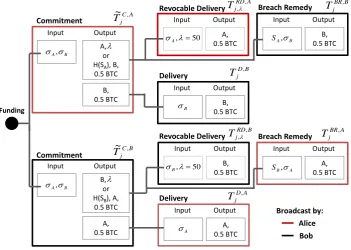
Fig. 2: Lightning Channels. Each party has aCommitment Transaction that only they can broadcast. To settle a dispute on the Blockchain, either party can broadcast theirCommitment Transaction and Revocable Delivery Transaction
to claim their share of bitcoins. In response, the counterparty broadcasts their
Delivery Transaction to receive their share of bitcoins. If aCommitment Trans-actions has previously been revoked, the counterparty can broadcast theBreach Remedy Transaction to steal all bitcoins in the channel.
Figure 2 presents the underlying transaction structure of Lightning Channels. The channel relies upon an initial Funding Transaction T˜F that is signed by both parties and deposits bitcoins into a multi-signature address. The symmetric structure of the scheme provides each party with the following transactions:
TheCommitment Transaction T˜jC,X spends the multi-signature output and therefore requires signatures from both parties. Each party receives the counter-party’s signature in advance. The first output sends bitcoins to the broadcaster, while the second outputs sends bitcoins to the counterparty. Spending the second output only requires the counterparty’s signature, but spending the first output is only possible if either of the following two conditions is fulfilled:
1. The first condition requires a signature from the broadcaster and has a
Relative Lock Time such that theCommitment Transaction T˜jC,X needs to achieve a depth ofλbefore the output is spendable.
Channel Establishment:
A→B: Revocation hashhA,j and her transaction inputπ
B→A: Unsigned ˜TF, signatureσCB,jforT C,A
j , revocation hashhB,j
A→B: SignatureσA,jC forT C,B
j , signatureσ
F A forT
F
B→N: Broadcast ˜TF to the Bitcoin network.
Send a Payment:
A→B: New revocation hashhA,j+1
B→A: SignatureσB,jC +1 for newT C,A
j+1, new revocation hashhB,j+1
A→B: SignatureσA,jC +1for newT C,B
j+1, pre-imageSA,j of previous revocation hashhA,j
[image:10.595.136.497.98.247.2]B→A: Pre-imageSB,j of previous revocation hashhB,j
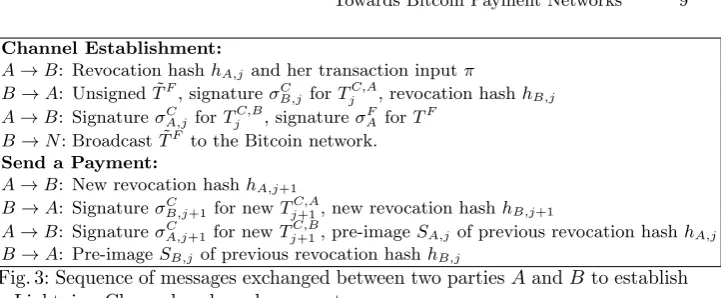
Fig. 3: Sequence of messages exchanged between two partiesAandB to establish a Lightning Channel and send payments.
These conditions allowCommitment Transactions to be revoked by revealing the pre-imageSX,j to the counterparty. The normal payout to the broadcaster is delayed by a Relative Lock Time λ to allow the counterparty to claim the funds if the transaction has previously been revoked. Revoking aCommitment Transaction allows both parties to update the channels while ensuring that no
revoked transaction will ever be published.
The Revocable Delivery Transaction Tj,λRD,X requires the signature of the broadcaster, and sends bitcoins to the broadcaster. It can only be broadcast once the broadcaster’s Commitment Transaction has achieved a depth ofλin Bitcoin’s blockchain.
TheDelivery Transaction Tj,λD,X requires the signature of the counterparty that did not broadcast theCommitment Transaction and immediately sends the counterparty their share of bitcoins.
TheBreach Remedy TransactionTjBR,X requires the signature of the coun-terparty that has not broadcast the revokedCommitment Transaction and the pre-imageSX,j of theCommitment Transaction’s revocation hash. It can only be broadcast once a revokedCommitment Transaction has been accepted into the Blockchain. No Relative Lock Time is associated with this transaction to allow the counterparty to issue the penalty immediately.
In the following and in Figure 3, we explain how to establish the channel, send bidirectional payments, and finally settle the payment channel on the Blockchain.
Channel Establishment Alice sends Bob her revocation hash hA,j and a transaction input πA for the Funding Transaction T˜F. Bob responds with an unsigned Funding Transaction T˜F that includes inputs of both parties, a signature σC
B,j for Alice’s Commitment Transaction T C,A
j and his revocation hashhB,j. Then, Alice sends a signatureσA,jC for Bob’sCommitment Transaction
TjC,B and a signature σF
A for the Funding Transaction TF. Finally, Bob signs and broadcasts theFunding Transaction T˜F to the network.
Alice sends Bob a new revocation hashhA,j+1. Bob responds with a signature
σC
B,j+1 for Alice’s newCommitment Transaction T
C,A
j+1, and his new revocation
hash hB,j+1. Alice checks that the bitcoins are correctly distributed to each
party inTjC,A+1 before sending her signatureσC
A,j+1 for Bob’s new Commitment TransactionTjC,B+1. Bob then also checks that the bitcoins are correctly distributed to each party. Once the channel’s new state has been authorised, Alice sends the pre-image SA,j of her revocation hash to Bob, and this pre-image revokes her currentCommitment Transaction TjC,A. Bob checks if the pre-image correctly revokes Alice’s currentCommitment Transaction before sending Alice the pre-imageSB,j for his revocation hash hB,j. Finally, Alice checks if this pre-image revokes Bob’s currentCommitment Transaction TjC,B.
Settle channelTo settle the channel, both parties cooperate to sign and broadcast a transaction that sends each party their share of bitcoins. If either party does not cooperate, then the dispute is settled on the Blockchain. In a dispute, either party broadcasts their most recent Commitment Transaction
˜
TjC,A andRevocable Delivery Transaction Tj,λRD,A. The counterparty must then
broadcast theirDelivery Transaction TjD,Bto receive their share of the coins.
3.3 Comparison of Duplex Micropayment and Lightning Channels
This section provides a comparison of Duplex Micropayment Channels and Lightning Channels. We focus on the computation, storage and network access required for both schemes before highlighting if resource-limited participants can outsource responsibility to a trusted third party. Finally, we discuss the total number of transactions that can be facilitated.
Blockchain privacy. A new pair of addressesA1, B1 is generated by both
parties for theFunding Transaction’s multi-signature output. If both channels are closed cooperatively, thenA1, B1can be reused in the closing transaction that
sends each party their final balance. In terms of privacy, an external Blockchain observer can see the number of bitcoins each address received, but not identify which receiving addressA1, B1 corresponds to which depositing addressA0, B0.
Throughout the lifetime of both schemes, A1, B1 can be reused in each
intermediary transaction to minimise computing addresses. If a dispute is settled on the Blockchain, then a Duplex Micropayment Channel achieves the same privacy as using a single transaction to close the channel. While Lightning Channels also provide these privacy guarantees, they allow to identify which addressA1, B1raised the dispute by identifying the address that received bitcoins
in theRevocable Delivery Transaction.
In Duplex Micropayment Channels, both parties can have a different pair of addresses for each unidirectional channel. By inspecting the outputs of both
Table 1: The number of signatures required for each step in Duplex Micropayment Channels and Lightning Channels. Also,drepresents each node in theInvalidation Tree andαis the number of replaced nodes in theInvalidation Tree.
Set up Payment Reset Settle (Co-op) Settle (Dispute)
Duplex (d+ 2)×2 1 (α+ 1)×2 1×2 1×2
Lightning 2×2 1×2 0 1×2 3
either A1 or B1, and the second output sends bitcoins to B2. Her Revocable Delivery Transaction sends bitcoins toA2 and Bob’sDelivery Transaction sends
bitcoins toB3. Here, it is still possible to determine which addresses raised the
dispute and also the final share of bitcoins each set of addresses received.
The number of signaturesrequired in each payment channel is shown in Table 1. To establish the channel, both schemes require each party to sign a
Funding Transaction. In Duplex Micropayment Channels each party must also signdnodes in theInvalidation Tree and aPayment Transactionrepresenting the unidirectional channel, whereas Lightning Channels require each party to sign an additionalCommitment Transaction.
To send a new payment, the Duplex Micropayment Channels require a single signature from the sender. If either unidirectional channel has exhausted its supply of bitcoins, then both parties cooperate to reset the balance of both channels. This reset requires each party to signαreplacement transactions in the
Invalidation Tree and an additional signature for the newPayment Transactions
that represent the unidirectional channels. Lightning Channels always require a single signature from both parties to authorise a new pair of Commitment Transactions. This has implications for popular hubs as Duplex Micropayment Channels do not require the hub’s involvement to receive bitcoins (except to perform a reset), while the hub must sign every payment in Lightning Channels.
In both schemes parties can cooperatively close the channel by signing a transaction that settles the final balance. However, they must sign the remain-ing intermediary transactions if the channel is not closed cooperatively. The unsigned transactions in Duplex Micropayment Channels include thePayment Transaction, or a Refund Transaction if the counterparty does not sign their
Payment Transaction. In Lightning Channels, either party can broadcast their
Commitment Transaction and sign aRevocable Delivery Transaction to claim their bitcoins. In response, the counterparty must sign the Delivery Transaction
to receive their share of bitcoins. If the Commitment Transaction was previously revoked, then the counterparty must instead sign a Breach Remedy Transaction.
Local storage requirements. In Duplex Micropayment Channels, both parties stored+ 1 transactions which include the current active branch in the
stored pre-images, parties should also store a mapping between each pre-image and corresponding revocation hash.
Storage in the Blockchain.When both parties cooperate, both schemes only require 2 transactions, the Funding Transaction and aSettlement Transac-tion, to be committed to the Blockchain. In the worst case, when parties do not cooperate, Duplex Micropayment Channels require 1 +d+ 2 transactions. Thed transactions represent theInvalidation Tree’s active branch, plus theFunding Transaction and 2 additional transactions representing eitherPayment Trans-actions for the unidirectional channels or theirRefund Transactions. Lightning Channels always require 4 transactions. Besides theFunding Transaction, this includes aCommitment Transaction, the correspondingDelivery Transaction
and either aBreach Remedy Transaction or aRevocable Delivery Transaction.
Frequency of access to the Blockchain.Duplex Micropayment Channels rely on theReplace by Timelock rule to ensure that only the latest authorised branch in theInvalidation Tree is accepted into the Blockchain. Therefore, after establishing the channel, neither party needs to access the Blockchain until the channel has expired. Then, however, it is important to push thedtransaction in the latest branch and the Payment Transaction that sends the party their bitcoins as soon as they become valid. Lightning Channels require both parties to periodically scan the Blockchain for previously revoked transactions. The frequency of monitoring is based on the mutually agreedRelative Lock Timethat delays theRevocable Delivery Transaction’s acceptance into the Blockchain.
Outsourcing responsibilities is possible in both schemes to reduce the burden for resource-limited parties. In Duplex Micropayment Channels, a trusted third party can be responsible for broadcasting the active branch of the Invalida-tion Tree and thePayment Transaction that sends the party their bitcoins once the channel has expired. The branch must be broadcast within the safety-margin ∆ time span, otherwise previously authorised branches become spendable. In Lightning Channels, the trusted third party is provided with signed Breach Remedy Transactions, pre-images of revocation hashes and the identification hash of previously revokedCommitment Transactions. It is then responsible for monitoring the Blockchain for the previously revokedCommitment Transactions
and broadcasting the correspondingBreach Remedy Transactions.
The total number of transactionsthat can occur in Duplex Micropayment Channels is based on the number of bitcoins sent, the frequency of resets to replenish the unidirectional channels, the depth of the tree, and the Absolute Lock Time associated with each node. In comparison, the only limitation for Lightning Channels is the bidirectional activity between both parties.
4
Routing Payments
Dave Caroline Bob
Alice
3 ), (
= K
R H
2 ), (R K= H
1 ), (
=
K R H
) (R H
(a) Setting up HTLC
Dave Caroline Bob
Alice
R
R
R
(b) Synchronizing HTLC balances
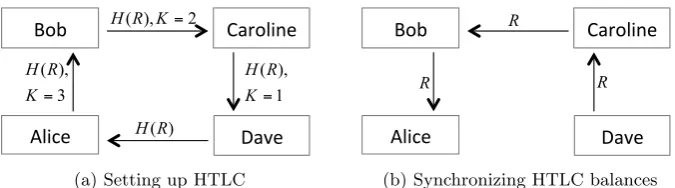
Fig. 4: (a) The final receiver provides the initial sender with the HTLC hash H(R). This is shared along the HTLC route and the HTLC transfer’sAbsolute Lock Time kis decremented for each hop. (b) Outlines how the pre-imageR is revealed in the reverse order for each hop to claim their bitcoins once the final receiver is givenH(R). For illustration the decrement time isω= 1.
4.1 Hashed Time-Locked Contract (HTLC)
Hashed Time-Locked Contracts fairly exchange bitcoins across several payment channels. They allow two parties to open channels with separate Payment Service Providers (PSP), and then construct a route of payment channels that connects both channels. If we have three channels, Alice→Bob, Bob→Caroline and Caroline→Dave, then Alice can send bitcoins to Dave, via Bob and Caroline. This fair exchange guarantees that intermediary hops receive their bitcoins, once they have sent their bitcoins to the next hop.
Figure 4 outlines the exchange of messages required to fairly exchange bitcoins across all intermediary channels. Once a route has been selected, the final receiver (Dave) provides the initial sender (Alice) with an HTLC hashH(R). The initial sender commits bitcoins in a payment channel shared with their PSP under the condition that the pre-imageRis revealed within kblocks. Each intermediary along the route decrements the lock timekand repeats this commitment with the next hop. The lock time kis decremented byω to provide the intermediary a timespan for their bitcoins to be sent to the next hop and to allow them to claim their bitcoins from the previous hop. The last hop is the final receiver, who receives the payment amount contingent upon providingR.
The final receiver can claim the bitcoins by creating a transaction that reveals R and spends the HTLC output. RevealingRthen allows the next party to also claim the bitcoins from their previous hop. However, it is not necessary to claim the outputs using Bitcoin’s blockchain. Instead, both parties may simply agree to update their shared channel to reflect the new balance. This can be done along the route: every pair of participants updates their channels until the initial sender’s bitcoins are taken.
[image:14.595.137.475.126.220.2]Funding
𝜎𝐴, 𝜎𝐵
Input HTLC Output
Active Branch in the Invalidation Tree
Leaf Node
𝐴1, 𝐵
or
𝐴2, 𝐵, 𝐻 𝑅
0.5 BTC
HTLC Refund
𝜎𝐴1, 𝜎𝐵, 𝐾refund = 100 𝐴, 0.5 BTC
HTLC Forfeiture
𝜎𝐴1, 𝜎𝐵, 𝐾forfeit = 0 𝐴, 0.5 BTC
Broadcast by: Alice Bob Both
k d T ,
HTLC Settlement
[image:15.595.136.519.119.216.2]𝜎𝐴2, 𝜎𝐵, 𝑅, 𝐾settle = 95 𝐵, 0.5 BTC
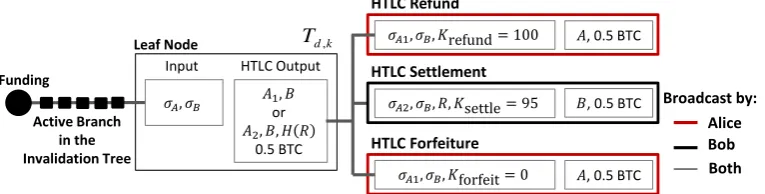
Fig. 5: The HTLC is attached as an additional output to theInvalidation Tree’s leaf node. We have omitted unidirectional channels for space. TheHTLC Refund Transactionguarantees that the bitcoins are returned to the sender if Ris not revealed by blockkrefund, theHTLC Settlement Transaction sends bitcoins to
the receiver if the pre-image R of the HTLC hash is revealed by blockksettle,
and theHTLC Forfeiture Transaction can later be signed to cancel the transfer.
1. The first condition requires a signature from both parties.
2. The second condition requires a signature from both parties6 and the
pre-imageRof the HTLC hashH(R).
This HTLC output can be spent using either of the following three transactions. The HTLC Refund Transaction guarantees that the bitcoins are returned to the sender bykrefund and satisfies the first condition of the HTLC output. The HTLC Settlement Transaction requires the pre-imageRof the HTLC hash and sends bitcoins to the counterparty. This transaction has anAbsolute Lock Time ksettleto delay the receiver claiming the bitcoins to ensure that the HTLC output
can later be cancelled if both parties agree. This transaction spends the second condition of the HTLC output. TheHTLC Forfeiture Transaction has no lock time and is signed by both parties to cancel the HTLC transfer. It spends the first condition of the HTLC output and guarantees that the bitcoins are returned to the sender, even if the pre-imageR of the HTLC hash is revealed.
It is the responsibility of the initial sender to compute the lock timekrefund for
each hop along the route. The sender needs to ensure that each hop’skrefund is
greater than the hop’s chosenksettle (i.e.krefund> ksettle). Both lock times must
also be greater than the hop’s leaf nodeTd,k lock timekleaf (i.e.ksettle> kleaf).
This is required as a refund or settlement cannot happen until the leaf nodeTd,k is included in Bitcoin’s blockchain. Also, a timespan between the leaf node’s lock timekleaf, and the settlement lock time ksettle is required to allow the hop to
cancel the HTLC transfer using a HTLC Forfeiture Transaction. This means that the bitcoins are potentially locked for the entire lifetime of the channel.
The initial sender’skrefund is passed to the next hop on the route, who should
decrementkrefund byω for use in their channel. This repeats as each hop passes
theirkrefund to the next hop. The initial sender’skrefund must therefore take into
6 The sender must have a different Bitcoin address for each condition in the HTLC
𝜎𝐴, 𝜎𝐵
Input HTLC Output
Funding
𝜎𝐴, 𝜎𝐵
Input HTLC Output
Commitment (Sender)
Commitment (Receiver) 𝐵, 𝐻 𝑅
or
𝐴, 𝜆, 𝐾refund
or
𝐵, 𝐻(𝑆𝐴)
0.5 BTC
𝐵, 𝐻 𝑅 , 𝜆
or
𝐴, 𝐾refund
or A, 𝐻(𝑆𝐵)
0.5 BTC Broadcast by: Alice Bob A C j T~ ,
B C j T~ ,
HTLC Refund Transaction
𝜎𝐴, 𝜆 = 5, 𝐾refund = 100 𝐴, 0.5 BTC
HTLC Delivery
𝜎𝐵, 𝑅 𝐵, 0.5 BTC
HTLC Breach Remedy
𝜎𝐵, 𝑆𝐴 𝐵, 0.5 BTC
HTLC Refund Transaction
𝜎𝐴, 𝐾refund = 100 𝐴, 0.5 BTC
HTLC Delivery
𝐵, 0.5 BTC
HTLC Breach Remedy
𝜎𝐴, 𝑆𝐵 𝐴, 0.5 BTC
B HD j T , A HR k j T , , , B HBR j T , B HD j T , A HR k j T , , , A HBR j T ,
[image:16.595.138.489.109.340.2]𝜎𝐵, 𝑅, 𝜆=5
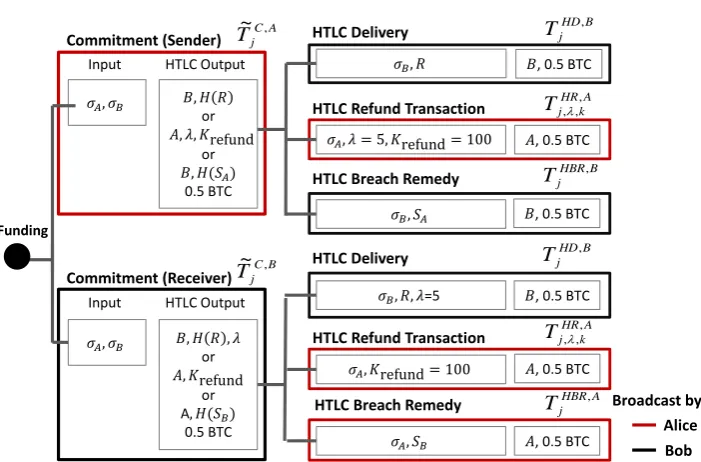
Fig. 6: The HTLC is an additional output in bothCommitment Transactions
and we have omitted the other outputs for space. The delivery sends bitcoins to the receiver if they knowR, the refund guarantees that the bitcoins are returned to the sender, and the breach remedy sends bitcoins to the counterparty whom did not broadcast a revokedCommitment Transaction.
account the largest leaf node’s lock timekleaf in the route. In the worst case, if
the largestkleaf is associated with the final receiver’s channel, then the lock time
krefund for all hops along the route must also be larger than the largestkleaf.
Finally, the hashH(R) and the pre-imageRcan be discarded once the HTLC transfer has been forfeited or a new active branch in the Invalidation Tree is mutually agreed to cancel the HTLC transfer.
In Lightning Channels, a new HTLC output is associated with both
Commitment Transactions in a new channel state (cf. Figure 6). The broadcaster of aCommitment Transaction is restrained by aRelative Lock Timeλbefore she can claim the bitcoins in the HTLC output. This provides the counterparty an opportunity to claim the bitcoins. We explain the role ofλonce the commonality of the HTLC output’s redemption criteria for each Commitment Transaction
has been presented. The bitcoins can be claimed if either of the following three conditions is satisfied:
1. The first condition requires a signature from the receiver and the pre-image Rof the HTLC hashH(R).
3. The third condition requires a signature from the counterparty that did not broadcast the revokedCommitment Transaction, and the pre-imageS of the broadcaster’s revocation hashH(S).
The broadcaster of a Commitment Transaction must consider both the
Absolute Lock Timekrefundthat dictates when the HTLC transfer expires, and the Relative Lock Time λwhich requires the broadcaster’sCommitment Transaction
to achieve a depth ofλblocks in the Blockchain before the broadcaster can claim their bitcoins. To illustrate the additional burden ofλfor either party’s redemption criteria, we consider the sender’s and receiver’sCommitment Transactionin turn.
The sender only broadcasts theirCommitment Transaction to claim a refund using the HTLC Refund Transaction if the HTLC transfer expires, satisfying the second condition. To take the delay caused byλinto account, the sender’s
Commitment Transaction must be accepted into the Blockchain at block height krefund−λfor theHTLC Refund Transaction to become spendable at the correct
time. If the refund is not claimed at the correct time, then R might be later revealed, and the sender is not guaranteed to receive the bitcoins from the previous hop. Thisλprovides a timespan for the counterparty to claim the bitcoins using the pre-imageR of the HTLC hashH(R), satisfying the first condition, or with the pre-imageSA of the revocation hashH(SA), satisfying the third condition. The receiver only broadcasts theirCommitment Transaction if they know the pre-image Rof the HTLC hash. The bitcoins are redeemed using theHTLC Delivery Transaction that satisfies the first condition. To take the delay caused byλinto account, the receiver’sCommitment Transaction must be accepted into Bitcoin’s blockchain at block height krefund−λ−∆. This makes certain that
the HTLC Delivery Transaction has a safety margin∆ timespan to be accepted into Bitcoin’s blockchain before the HTLC transfer expires. Thisλprovides a timespan for the counterparty to claim the bitcoins if the transfer has expired or if the pre-image SB of the receiver’s revocation hashH(SB) has been revealed. The initial sender is responsible for computing the lock timekrefundin advance
for each hop. Thiskrefund is passed along the route, and each hop decrements
krefund byω for use in their channel. However, the initial sender’skrefund must
take into account the hop with the largestRelative Lock Timeλ. In the worst case, if the largestλis associated with the final receiver’s channel, then the lock time krefund for all channels must also include the largestλ. This potentially locks the
bitcoins for a long period of time as resource-limited parties may require a large λas it dictates the frequency in which each party must monitor the Blockchain. Also, the pre-imageRcan be discarded once both parties have exchanged the pre-imagesSA, SB of the revocation hashesH(SA), H(SB).
4.2 Routing Interruptions
the HTLC transfer, and if the intermediary returns, the initial sender’s bitcoins are refunded using the second route. This rollback is only performed if the final receiver has not revealed the first route’s pre-imageR1of the HTLC hashH(R1).
To perform the rollback, the initial sender provides the final receiver with a new HTLC hash H(R2) and an Absolute Lock Time kexpire that represents
the expiry time for the initial sender’s HTLC transfer with their immediate hop in the first route. The final hop in the second route sends the initial sender the refunded bitcoins and must have an expiry timekrefund that is greater than
kexpire. This provides a timespan for the initial sender’s bitcoins to be claimed in
the first route, and for them to receive the refund in the second route.
Finally, the receiver commits bitcoins to the next hop under the condition that the pre-images of the first route’s HTLC hashH(R1) and the sender’s HTLC
hashH(R2) are revealed. Each hop decrements the lock timekmax by ω, and
commits bitcoins to the next hop if R1, R2 are revealed. The final hop is the
sender who has knowledge ofR2, but can only claim the bitcoins ifR1is revealed
from the first HTLC transfer.
4.3 Challenges for Route Discovery
We now discuss the challenges that payment networks face for route discovery. These challenges include the type of connections available for routing bitcoins, the topology of the network, the difficulty in building reputation systems to help assess the risk of other nodes and the financial incentives for routing bitcoins.
Node connectionson the network rely on the user’s role. End users might exclusively connect to PSPs who are responsible for establishing channels with other PSPs to find routes on the network. How these channels are funded will also differ as end users might fund the channel with the PSP, while the PSP to PSP channels are mutually funded. Also, the total number of bitcoins in a channel restricts the bitcoins an end user can receive. For example, if the user and PSP share a channelU ↔P in which the PSP has a balance ofxbitcoins, then the user can only receive up toxbitcoins without establishing a new channel. The receiver must send bitcoins to the PSP to receive further payments.
Route planningmethods include source-routing in which the sender pre-determines the payment route, and per-hop routing where only the final destina-tion is given to the network and each hop finds the best route.
The former approach simplifies calculating the fee and lock time for the transfer. It is compatible with onion-routing which only reveals the previous and next hop, and allows the sender to enforce the order in which each node is visited. However, this does not prevent a node using intermediaries to route the bitcoins to the next hop. It might also be possible to identify that the next hop is the final recipient using the remaining fee and lock time.
routing, estimating the total fee and maximum lock time is difficult as the route is not known in advance, and mechanisms must be put into place that prevent nodes from taking excessive fees.
The topologyof the network hinges on the ease of becoming a PSP and the potential regulation as money transmitters.
A straightforward approach is a hub-and-spoke model [17] with thousands of well-connected hubs who share route-finding information amongst themselves. In this model, end users open channels with hubs, and it is the hub’s responsibility to find a route to the receiver’s hub. These hubs are expected to be reliable and fast which potentially results in negligible HTLC transfer halts. This is important for Duplex Micropayment Channels as bitcoins can be locked for the channel’s remaining lifetime if a transfer halt occurs. Also, the usage of Duplex Micropayment Channels reduces the computational overhead for hubs as they are only required to sign HTLC transfers while sending bitcoins, and not to receive them. In this model, end-users may not be responsible for computing or revealing the pre-imageRof the HTLC hash as it would allow them to halt transfers.
The fundamental issue with the hub-and-spoke model is that it may lack Bitcoin’s open-membership property. Instead, the community’s vision for a payment network is to allow anyone to become a PSP which requires a mesh network and gossip protocol to advertise PSP services. Poon has proposed that Bitcoin’s blockchain can aid route discovery as the user can identify which PSPs share channels [17]. If a route has been found, there is no guarantee that the PSPs are reliable due to the nature of open-membership. Lightning Channels are more suitable for unreliable transfers as a failure only temporarily locks the bitcoins. However, the computation overhead increases as PSPs must sign both sending and receiving HTLC transfers.
To prevent routing failures naturally leads to a reputation system to assess the risk of using a PSP. However, in the event of a failure, it is arguably a non-trivial problem to determine the reason behind the halt due to the private nature of routing and the inability to inspect other payment channels. For example, if the hopC→D settles on the Blockchain, it is not possible to determine if Dave had knowledge of the pre-imageR, refused to disclose it, or simply raised a dispute to tarnish the reputation of Caroline [15]. Also, it might not be possible to identify which hop halted the transfer when disputes are not settled on the Blockchain. Furthermore, revealing the internal channel state of intermediaries cannot always reveal the reason behind a halt. For example, it is not possible to identify the duration of time beforeRwas disclosed.
Routing feesneed to cover the costs for a PSP to operate a secure node. These costs potentially include a ‘risk’ charge based on the number of bitcoins maintained in their hot wallet7 to facilitate transfers. The PSP might charge if
they are required to deposit bitcoins into the channel for end-users (i.e. merchants) who expect to mostly receive bitcoins. Also, negotiating a fee for routing is not straightforward as some PSPs may fluctuate fees to move funds in a maxed-out channel in a certain direction [4]. How fees are negotiated depends on the topology
7
of the network as PSPs might have direct connections with each hop in the route or rely on fees advertised via a gossip protocol. Finally, the fee structure for end-users can be regular installments or on a per-transfer basis.
5
Conclusion
In this paper we presented an overview of Blockchain-based payment networks, a potential scaling solution for Bitcoin. We compared two prominent proposals, Duplex Micropayment Channels and Lightning Channels before discussing how to fairly exchange bitcoins across two or more channels using Hashed Time-Locked Contracts. Finally, we highlighted challenges for route discovery in payment networks. It is our hope that this paper will motivate other researchers to begin tackling the open problems associated with Blockchain-based payment networks.
Acknowledgements We thank Christian Decker, Joseph Poon and Rusty Russell for reviewing this paper. We also thank the participants of the lightning-dev mailing list for their insightful discussions. This work is supported in part by the European Research Council (ERC) Starting Grant (No. 306994) and the German Bundesministerium f¨ur Bildung und Forschung (BMBF) under grant agreement No. 13N13505.
Bibliography
[1] G. Andresen. BIP 101: Increase maximum block size. 2015. url:https: / / github . com / bitcoin / bips / blob / master / bip - 0101 . mediawiki (visited on 2016-04-19).
[2] A. Back, M. Corallo, L. Dashjr, M. Friedenbach, G. Maxwell, A. Miller, A. Poelstra, J. Tim´on, and P. Wuille.Enabling Blockchain Innovations with Pegged Sidechains. 2014.
[3] bitcoinj.url:https://bitcoinj.github.io/(visited on 2016-04-19). [4] CJP. Routing on the lightning network? 2015. url: http : / / lists .
linuxfoundation.org/pipermail/lightning-dev/2015-July/000031. html (visited on 2016-04-19).
[5] K. Croman, C. Decker, I. Eyal, A. E. Gencer, A. Juels, A. Kosba, A. Miller, P. Saxena, E. Shi, E. G. Sirer, D. Song, and R. Wattenhofer. “On Scaling Decentralized Blockchains”. In: 3rd Workshop on Bitcoin and Blockchain Research. 2016.
[6] C. Decker and R. Wattenhofer. “A Fast and Scalable Payment Network with Bitcoin Duplex Micropayment Channels”. In:Stabilization, Safety, and Security of Distributed Systems. Ed. by A. Pelc and A. A. Schwarzmann. Vol. 9212. Lecture Notes in Computer Science. Springer International Publishing, 2015, pp. 3–18.
[8] J. Garzik. BIP 100: Making Decentralized Economic Policy. 2015. url: http://gtf.org/garzik/bitcoin/BIP100-blocksizechangeproposal. pdf(visited on 2016-04-19).
[9] Y. Lewenberg, Y. Sompolinsky, and A. Zohar. “Inclusive Block Chain Protocols”. In:Financial Cryptography and Data Security. Ed. by R. B¨ohme and T. Okamoto. Vol. 8975. Lecture Notes in Computer Science. Springer Berlin Heidelberg, 2015, pp. 528–547.
[10] E. Lombrozo, J. Lau, and P. Wuille. BIP 141: Segregated Witness. 2015.
url: https : / / github . com / bitcoin / bips / blob / master / bip - 0141 .
mediawiki(visited on 2016-04-19).
[11] S. Nakamoto.Bitcoin: A Peer-to-Peer Electronic Cash System. 2008. [12] S. Pair.A Simple, Adaptive Block Size Limit. 2016.url:https://medium.
com / @spair / a - simple - adaptive - block - size - limit - 748f7cbcfb75 (visited on 2016-04-19).
[13] J. Poon.Payment Re-routing. 2015.url:http://lists.linuxfoundation.
org/pipermail/lightning- dev/2015- July/000018.html (visited on
2016-04-19).
[14] J. Poon and T. Dryja.The Bitcoin Lightning Network: Scalable Off-Chain Instant Payments. 2016.url:
https://lightning.network/lightning-network-paper.pdf(visited on 2016-04-19).
[15] R. Russell. Loop attack with onion routing.. 2015. url: http://lists. linuxfoundation.org/pipermail/lightning-dev/2015-August/000153. html (visited on 2016-04-19).
[16] R. Russell.Reaching The Ground With Lightning (draft 0.2). 2015.url: https://github.com/ElementsProject/lightning/blob/master/doc/
deployable-lightning.pdf(visited on 2016-04-19).
[17] R. Russell. Routing on the lightning network? 2015.url:http://lists. linuxfoundation.org/pipermail/lightning-dev/2015-July/000019. html (visited on 2016-04-19).
[18] Y. Sompolinsky and A. Zohar. “Secure High-Rate Transaction Processing in Bitcoin”. In: Financial Cryptography and Data Security. Ed. by R. B¨ohme and T. Okamoto. Vol. 8975. Lecture Notes in Computer Science. Springer Berlin Heidelberg, 2015, pp. 507–527.
[19] J. Spilman. Anti DoS for tx replacement. 2013. url: https : / / lists . linuxfoundation.org/pipermail/bitcoin- dev/2013- April/002433. html (visited on 2016-04-19).
[20] P. Todd. OP CHECKLOCKTIMEVERIFY. 2014. url:https://github.
com / bitcoin / bips / blob / master / bip - 0065 . mediawiki (visited on
2016-04-19).
[21] M. Trillo. Put to the Stress Test. 2014.url: http://visatechmatters. tumblr.com/post/96025603185/put- to- the- stress- test-
visanet-gets-pushed-to-the (visited on 2016-04-19).
[22] P. Wuille. BIP 66: Strict DER signatures. 2015.url: https://github.
com / bitcoin / bips / blob / master / bip - 0066 . mediawiki (visited on