Journal of Engineering and Applied Sciences 15 (3): 795-802, 2020 ISSN: 1816-949X
© Medwell Journals, 2020
Central Composite Design Foroptimizing Katemfe Seed Extracts as Green
Inhibitor on Galvanized Steel in 0.5 M HCL Acidic Media
1
O. Olawale,
2B.T. Ogunsemi,
1J.O. Bello,
3B. Akinyemi,
1S.J. Ogundipe,
1T.S, Abayomi and
4B.O. Ajiboye
1
Department of Chemical Engineering, College of Science and Engineering,
Landmark University, Omu-Aran, Kwara State, Nigeria
2
Department of Mechanical Engineering, College of Science and Engineering,
Landmark University, Omu-Aran, Kwara State, Nigeria
3
Department of Agricultural and Bio-systems Engineering,
College of Science and Engineering, Landmark University,
Omu-Aran, Kwara State
4
Department of Agricultural Economics, College of Agricultural Science,
Landmark University, Omu-Aran, Kwara State
Abstract: The effect of Katemfe Seed Extract as inhibitor for Galvanized steel in 1M HCl acidic media was investigated in this study. The combination of the concentration of inhibitor (0.2-1.0 g lG1), time (1-5 h) and
temperature (30 ) on corrosion rate was investigated using optimization. The optimum conditions obtained were temperature 54.55; time 2.28 h and inhibitor concentration of 0.20 g LG1. The obtained optimal value of 85.9%
predicted agreed closely with the 86.5% obtained from the experiment. The micrographs result of Scanning Electron Micrographs analysis showed that the passive layer of film was formed on the surface. This study showed that Katemfe seed extract is a good inhibitor for Galvanized steel in 0.5 M HCl.
Key words: Corrosion, inhibitor, katemfe seed extract, response surface methodology (RSM), weight loss
INTRODUCTION
The investigation of metallic corrosion is a subject of immense conceptual and practical concern and has thus received a substantial amount of interest. Furthermore, oil well acidizing operations, industrial acid cleaning, pickling, descaling and acid solutions are widely employed on metal substrates to achieve the intended purpose (Ajayi et al., 2011). It is thus essential that these metallic structures are protected. The cost implication of corrosion has not yet been surveyed in Nigeria; however, the Central Intelligence Agency, stated that it was estimated at 3.2 billion USD annually (Omotosho, 2016). He stated that the increase in corrosion control measures is required in every area of human life and industry. Several means are available for preventing or protecting metallic structures in service. The major methods for combating corrosion of metals are: Materials selection, coatings, cathodic/anodic protection and use of corrosion inhibitors has grown in popularity over the years. There exist two major types of inhibitors; which are organic and inorganic/chemical inhibitors. The inorganic inhibitors contaminate the environment after use and cause a lot of
problems like the disposal and destruction of plant and animal life. Restrictions have been on the use of chemical inhibitors because of their toxicity. Furthermore, according to Rani and Basu, (2012), research had been tailored to the use of plants being environmentally friendly. However, extracts of plants also known as green inhibitors on metals in various acidic media. Mango bark and leaves extract (Loto, 2001); Spirulina platensis (Kamal and Sethiraman, 2012); Cola Acuminata and Camellia Sinensis (Loto et al., 2013), Neolamarckiacadamba alkaloids (Raja et al., 2013), Vernonia Amygdalina (Loto et al., 2013), Litchi Chinensis peels, Jatropha stem (Olamide et al., 2016), Orange peels extract, Orange Seed (Olawale et al., 2018), Groundnut husk (Olawale et al., 2018), Pterolobiumhexapetalum and Celosia argentea plant extracts (Kumar and Mohana, 2013), leaves and stem extracts of Sidaacuta (Eduok et al., 2012) had been worked on as inhibitors. The Katemfe leave is diagonal in shape and has a dark red/brown colour when matured. Itsfruit contains three black, extremely hard seeds. The seeds are covered with a sticky thin, pale yellow basal aril which contains the sweetening protein,
J. Eng. Applied Sci., 15 (3): 795-802, 2020
thaumatin. Katemfe leaves are used as covering for: Beans pudding (moi-moi); beans (adalu), locust beans (iru), ofada rice (Wiersema and Leon, 1999). Katemfeseed back extract as an eco-friendly corrosion inhibitor for Galvanised steel in 0.5 M HCl solution was investigated in this research.
MATERIALS AND METHODS
Materials: Materials used for the study was Galvanized Steel Coupons and Katemfe seed back Extract which was collected from Ekiti State, Nigeria.
Experimental design and data analysis: The Design Expert Software (version 8.0.7.1) was used for the statistical design of experiments and data analysis. In this study, Central Composite Design (CCD) and RSM was applied to optimize the three operating variables which were; Time (3-5 days), Concentration of Kafemfe extract (0.2-1.0 g lG1) and Temperature (30-60EC), respectively.
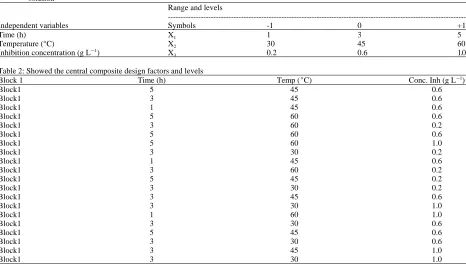
The experimental range of the variables is as shown in Table 1; while the Central Composite Design factors and levels is shown in Table 2.
Preparation of metal specimen: Experiments were performed using Galvanized steel coupons. Coupons’ surface area of 2×2×2 cm were obtained and hole was drilled in the middle with the 0.2cm diameter to enable
hanging of the coupons in the corrosion media that was prepared. These coupons were further treated to expose shining surface using emery paper. The coupons were then, washed using distilled water and cleansed with acetone and later stored in the desiccator.
Phytochemical analysis: Katemfe Seed Back Extract (KSE) was subjected to phytochemical analysis to determine the bioactive constituents such as tannin; alkaloids, flavonoids and saponin that might be present in it. This was to ascertain the suitability of the KSE as a corrosion inhibitor.
Corrosion medium: The corrosion medium of 0.5 M HCl was used throughout the experiments. Different concentrations of the extracts were prepared to range from 0.2-1.0 g LG1 in the 0.5 M HCl solution.
Weight loss measurements: Weight loss measurements were conducted under total immersion using 250 mL capacity beakers containing the various concentration of test solution at a temperature range of 30-60EC in 100 mL test solutions. Weight loss Experiment was carried out by weighing the specimens before and after immersion in 0.5M HCl in the presence and absence of inhibitor. The experimental readings were determined using the equations:
[image:2.612.74.540.448.714.2]Δwu = Wu-Wi (1)
Table 1: Experimental range of the independent variables, with factor levels for the inhibition of KatemefeSeed Extract on Galvanized steel in HCl solution
Range and levels
---Independent variables Symbols -1 0 +1
Time (h) X1 1 3 5
Temperature (°C) X2 30 45 60
Inhibition concentration (g LG1
) X3 0.2 0.6 1.0
Table 2: Showed the central composite design factors and levels
Block 1 Time (h) Temp (EC) Conc. Inh (g LG1
)
Block1 5 45 0.6
Block1 3 45 0.6
Block1 1 45 0.6
Block1 5 60 0.6
Block1 3 60 0.2
Block1 5 60 0.6
Block1 5 60 1.0
Block1 3 30 0.2
Block1 1 45 0.6
Block1 3 60 0.2
Block1 5 45 0.2
Block1 3 30 0.2
Block1 3 45 0.6
Block1 3 30 1.0
Block1 1 60 1.0
Block1 3 30 0.6
Block1 5 45 0.6
Block1 3 30 0.6
Block1 3 45 1.0
J. Eng. Applied Sci., 15 (3): 795-802, 2020
(2)
W
R u Wi
t C
A
Where:
Δw = The weight loss Wu = Initial weight Wi = Final weight CR = Corrosion rate
RESULTS AND DISCUSSION
Phytochemical analysis: The qualitative analysis result of the Katemfe seed extract was done to investigate the different phytochemical in the seed. The results as shown in Table 3 which showed active organic constituents that made the Katemfe seed extract a good green inhibitor.
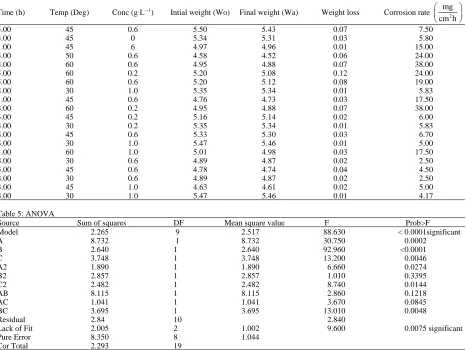
Regression model for the corrosion rate: Weight loss and corrosion rate is as shown in Table 4.
The Design Expert Software derived a polynomial quadratic regression equation of the form:
Y = B0+B1X1+B2X2+B3X3+B4X12+B5X2 2
+B6X3 2
+B7X1X2+B8X1X3+B9X2X3
The model in terms of the coded values of the process parameters is given by:
Y = +0.0129.79A+0.012B5.33C+3.44A2 3.30B2+8.19C2+8.21AB+3.61AC-3.77BC
Table 5 presented the analysis of variance (ANOVA). The p-value is less than 0.05, implied that the
Table 3: Phytochemical component result of KSE
Test Reagent Color change Confirmation
Alkaloids Wager Brown precipitate (PPT) +++positive
Tannin FeCl3 Greenish PPT ++positive
Flavonoid NaOH+AlCL3+ H2SO4 Yellow PPT ++positive
Saponins Distilled water Formed a persistent foam +++positive
Steroid Acetic anhydride and 2 mL Conc.H2SO4 Reddish brown ++positive
+++: Highly present, ++: Moderately present
Table 4: Process variables with weight loss and corrosion rate
Time (h) Temp (Deg) Conc (g LG1
) Intial weight (Wo) Final weight (Wa) Weight loss Corrosion rate mg2 cm h
5.00 45 0.6 5.50 5.43 0.07 7.50
3.00 45 0 5.34 5.31 0.03 5.80
1.00 45 6 4.97 4.96 0.01 15.00
5.00 50 0.6 4.58 4.52 0.06 24.00
3.00 60 0.6 4.95 4.88 0.07 38.00
5.00 60 0.2 5.20 5.08 0.12 24.00
5.00 60 0.6 5.20 5.12 0.08 19.00
3.00 30 1.0 5.35 5.34 0.01 5.83
1.00 45 0.6 4.76 4.73 0.03 17.50
3.00 60 0.2 4.95 4.88 0.07 38.00
5.00 45 0.2 5.16 5.14 0.02 6.00
3.00 30 0.2 5.35 5.34 0.01 5.83
3.00 45 0.6 5.33 5.30 0.03 6.70
3.00 30 1.0 5.47 5.46 0.01 5.00
1.00 60 1.0 5.01 4.98 0.03 17.50
3.00 30 0.6 4.89 4.87 0.02 2.50
5.00 45 0.6 4.78 4.74 0.04 4.50
3.00 30 0.6 4.89 4.87 0.02 2.50
3.00 45 1.0 4.63 4.61 0.02 5.00
[image:3.612.75.541.373.723.2]3.00 30 1.0 5.47 5.46 0.01 4.17
Table 5: ANOVA
Source Sum of squares DF Mean square value F Prob>F
Model 2.265 9 2.517 88.630 < 0.0001significant
A 8.732 1 8.732 30.750 0.0002
B 2.640 1 2.640 92.960 <0.0001
C 3.748 1 3.748 13.200 0.0046
A2 1.890 1 1.890 6.660 0.0274
B2 2.857 1 2.857 1.010 0.3395
C2 2.482 1 2.482 8.740 0.0144
AB 8.115 1 8.115 2.860 0.1218
AC 1.041 1 1.041 3.670 0.0845
BC 3.695 1 3.695 13.010 0.0048
Residual 2.84 10 2.840
Lack of Fit 2.005 2 1.002 9.600 0.0075 significant
Pure Error 8.350 8 1.044
Cor Total 2.293 19
J. Eng. Applied Sci., 15 (3): 795-802, 2020
model is significant and that the quadratic model is suitable to analyze the experimental data. The Model F-value of 88.63 implied the model is significant. “Pred R-Squared” of 0.8623; in reasonable agreement with “Adj R-Squared” of 0.9765. The significant model terms from the ANOVA Table were: A B, C, A2, C2, BC, respectively
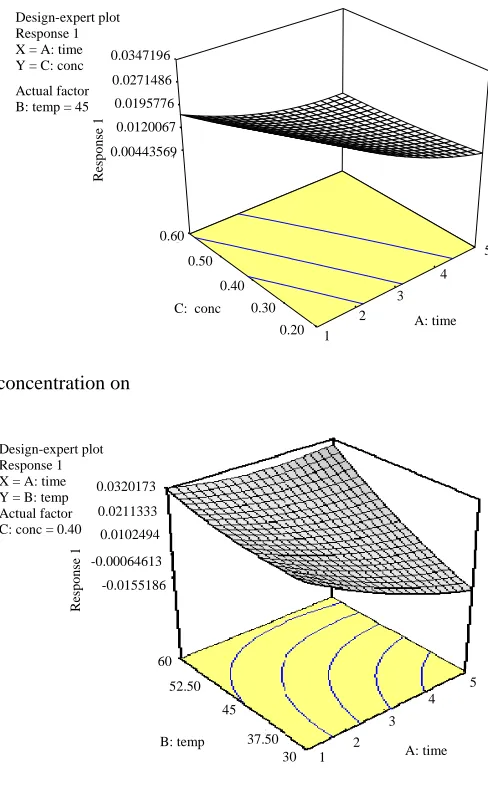
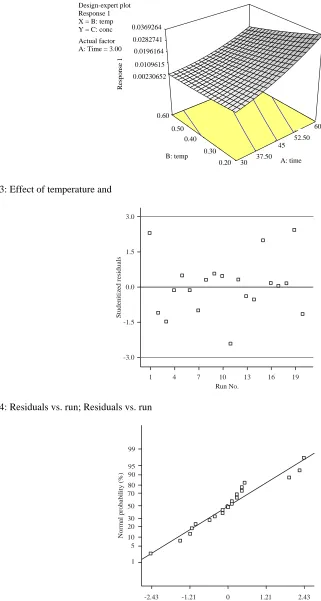
Results on 3D surface plots: The 3D curves are shown in Fig. 1-3. Fig 1showed that corrosion rate decreased with an increase in inhibitor concentration and also increases with an increase in time, Fig. 2; showed that corrosion rate increased with an increase in temperature and also increased with increase with time. Furthermore, Fig. 3; corrosion rate decreases with an increase in inhibitor concentration. This assumed physical adsorption. Figure 4 showed the plot of Residuals
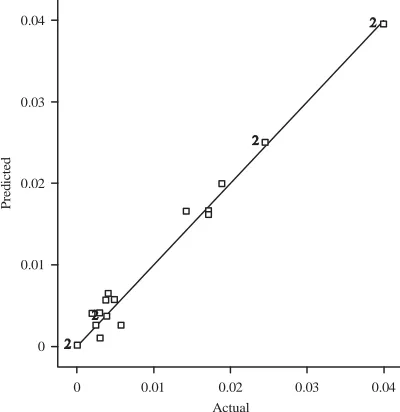
versus normal runs while Fig. 5 showed Normal probability versus studenitized residuals. Figure 6 showed predicted versus actual.
Experimental validation: The Optimum conditions predicted with the Design Expert Software were: Inhibitor concentration (0.20 g LG1), Temperature (54.55EC) and
Time (2.88); furthermore, the optimum corrosion rate at this optimum condition was predicted to be 85.9%. Experiment was carried out at these optimum conditions to validate the predicted optimum values. The experimental value of 86.4% agreed closely with the predicted corrosion rate.
[image:4.612.177.421.309.704.2]Result on surface analysis: The galvanized steel surface immersed in the absence of inhibitor observed
Fig. 1: Effect of time and concentration on
Fig. 2: Effect of time and temperature on corrosion rate corrosion rate 9
1 00 2.00
3.00 4.00
5.
0 20 0.30 0.40 0.50 0
A: Time C : C onc
Design-expert plot Response 1 X = A: time Y = B: temp Actual factor C: conc = 0.40
0.0320173
0.0211333
0.0102494
-0.0155186 -0.00064613
Resp
ons
e 1
60
52.50
45
37.50 30
5 4
2
1 A: time
B: temp
3 Design-expert plot
Response 1 X = A: time Y = C: conc
Actual factor B: temp = 45
0.0347196
0.0271486
0.0195776
0.00443569 0.0120067
Resp
ons
e 1
0.60
0.50
0.40
0.30
0.20
5
4
2
1
J. Eng. Applied Sci., 15 (3): 795-802, 2020
3.0
1.5
0.0
-1.5
-3.0
S
tu
d
e
ni
ti
ze
d
r
esi
d
ual
s
1 4 7 10 13 16 19
Run No.
99 95 90 80 70 50 30 20 10
N
or
m
al
p
ro
b
ab
ili
ty
(
%
)
5 1
2.43 Studentized residuals
1.21 0
-1.21 -2.43
[image:5.612.91.412.99.700.2]Fig. 3: Effect of temperature and
Fig. 4: Residuals vs. run; Residuals vs. run
Fig. 5: Normal plot vs. studentized residuals; Normal plot of residuals
2 5 4
30 00 37.50
45.00 52.50
60
0 20 0.30 0.40 0.50 60
B: Temp C : C onc
Design-expert plot Response 1 X = B: temp Y = C: conc
Actual factor A: Time = 3.00
0.0369264
0.0282741
0.0196164
0.00230652 0.0109615
Resp
ons
e 1
0.60
0.50 0.40
0.30
0.20
60
52.50
37.50 30 A: time
45
J. Eng. Applied Sci., 15 (3): 795-802, 2020
0.04
0.03
0.02
0.01
0
Actual 0
P
red
ic
te
d
[image:6.612.205.405.97.303.2]0.01 0.02 0.03 0.04
Fig. 6: Plot of predicted vs. actual
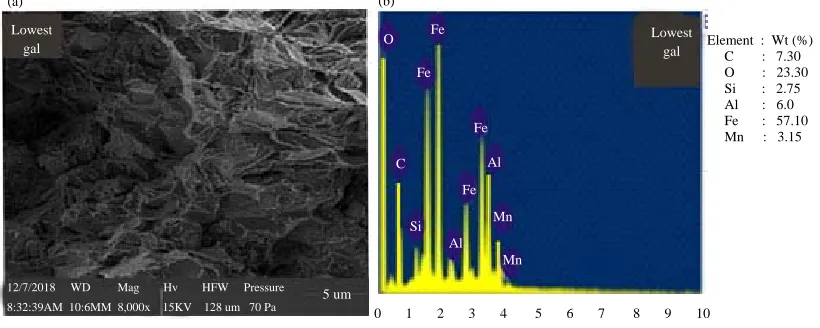
Fig. 7(a-b): (a) SEM and (b) EDX of blank galvanized coupon clear corrosion pits on the surface. Moreover, the corrosion did not occur on Fig. 9b because it had the lowest corrosion rate as observed from the result obtained from the Design of the experiment. The shield layer is more prominent form the result of the SEM obtained from the predicted optimum level as shown in Fig. 8a.
Mechanism of inhibition: Figure 7a showed the SEM result of the blank coupon and the EDX is as shown in Fig 7b. The protective film formed was due to the
adsorption of the inhibitor constituents on the galvanized steel. Furthermore, Fig 8a, showed more film that were formed due to the optimum predicted level from the software and its EDX is shown in Fig. 8b. The protective film formed on 9a; confirmed what was reported by Olawale et al. (2018), that it acted as a barrier which reduces the metal atoms participating in the electrochemical process and consequently increases the corrosion effectiveness. The EDX is as shown in Fig 9b, respectively. The inhibition of the galvanized steel is mainly due to the presence of heteroatoms of organic
Blank gal
12/7/2018 WD Mag Hv HFW Pressure 8:14:30AM 10:4MM 8,000x 15KV 124 um 70 Pa 5 um
(a)
O
C
C Si
Fe Al Fe Fe
Mn Mn
Blank gal (b)
0 1 2 3 4 5 6 7 8 9 10
[image:6.612.96.524.337.568.2]J. Eng. Applied Sci., 15 (3): 795-802, 2020
Fig. 8(a-b): (a) SEM and (b) EDX of optimum predicted level
Fig. 9(a-b): (a) SEM and (b) EDX of lowest corrosion rate chemical constituents of the KSE. The Katemfe seed extract consisted of mixtures of chemical compounds as shown form the results of the phytochemical analysis.
CONCLUSION
Katemfe Seed Extract proved to be a good inhibitor on galvanized steel in 0.5M HCl acidic medium. An optimal operating condition for corrosion rate of 85.9% was observed. The corrosion rate increased as temperature increases. The validity of the model was carried out at the optimal process conditions; time: 2.28 h, temperature: 54.55°C and inhibitor concentration: 0.20 g lG1 to validate
the predicted optimum value. The experimental value of 86.4% agreed closely to that getting from the Response Surface Methodology. The inhibitive ability of the Katemfe Seed Extract occurred because of the protective oxide layer formed on the mild steel by adsorption of alkaloids, tannins and steroids.
REFERENCES
Ajayi, O.O., O.A. Omotosho and V.O. Ifepe, 2011. Acid failure of mild steel in 2 M sulphuric acid in the presence of Vernonia amygdalina. J. Mater. Environ. Sci., 2: 186-195.
Eduok, U.M., S.A. Umoren and A.P. Udoh, 2012. Synergistic inhibition effects between leaves and stem extracts of Sida acuta and iodide ion for mild steel corrosion in 1 M H2SO4 solutions. Arabian J. Chem., 5: 325-337.
Kamal, C. and M.G. Sethuraman, 2012. Spirulina platensis-A novel green inhibitor for acid corrosion of mild steel. Arabian J. Chem., 5: 155-161.
Kumar, C.P. and K.N. Mohana, 2013. Adsorption and thermodynamic characteristics of Plumeria rubra
plant extracts on mild steel corrosion in industrial water medium. Intl. Res. J. Pure Appl. Chem., 3: 330-346.
(a)
Lowest gal
12/7/2018 WD Mag Hv HFW Pressure 8:32:39AM 10:6MM 8,000x 15KV 128 um 70 Pa
5 um O
C
Si Fe
Al Fe
Mn
0 1 2 3 4 5 6 7 8 9 10
Element : Wt (%) C : 7.30 O : 23.30 Si : 2.75 Al : 6.0 Fe : 57.10 Mn : 3.15
(a) (b)
Fe
Fe
Al
Lowest gal
Mn Optimum
gal
12/7/2018 WD Mag Hv HFW Pressure
8:24:10AM 10:6MM 9,000x 15KV 128 um 70 Pa 10 um
O
C Si
Fe
Al Fe Fe
Mn (b)
0 1 2 3 4 5 6 7 8 9 10
Element : Wt (%) C : 7.10 Mn : 2.10 O : 21.40 Si : 2.77 Al : 5.98 Fe : 60.25
(a) (b)
Fe
Fe
Al
[image:7.612.96.506.104.260.2] [image:7.612.93.503.314.478.2]J. Eng. Applied Sci., 15 (3): 795-802, 2020
Loto, C.A., 2001. The effect of mango bark and leaf extract solution additives on the corrosion inhibition of mild steel in dilute sulphuric acid-Part 1. Corros. Prev. Control, 48: 38-41.
Loto, C.A., O.O. Joseph and R.T. Loto, 2013. Inhibition effect of Vernonia amygdalina extract on the corrosion of mild steel reinforcement in concrete in 3.5 M NaCl environment. Intl. J. Electrochem. Sci., 8: 11087-11100.
Olamide, O., O.F. Adekunle and A.A. Adesoji, 2016. Corrosion inhibition of mild steel in seawater using Jatropha stem. Fascicula de Inginerie, 23: 228-238.
Olawale, O, B.T. Ogunsemi, O.O. Agboola, M.B. Ake and G.O. Jawando, 2018. Inhibition effect of orange seed extract on Aluminium Corrosion in 1M Hydrochloric Acid solution. Intl. J. Mech. Eng. Techol., 9: 282-287.
Olawale, O, C.K. Idefoh, B.T. Ogunsemi and J.O. Bello, 2018. Evaluation of groundnut leaves extract as corrosion inhibitor on mild steel in 1M Sulphuric acid using Response Surface Methodology (RSM). Intl. J. Mech. Eng. Technol., 9: 829-841.
Omotosho, O.A., 2016. Inhibition evaluation of chemical and plant extracts on the corrosion of metallic alloys in acidic environment. Ph.D Thesis, Covenant University, Nigeria, Ota, Nigeria.
Raja, P.B., A.K. Qureshi, A. Abdul Rahim, H. Osman and K. Awang, 2013. Neolamarckia cadamba
alkaloids as eco-friendly corrosion inhibitors for mild steel in 1 M HCl media. Corrosion Sci., 69: 292-301. Rani, B.E.A. and B.B.J. Basu, 2012. Green inhibitors for corrosion protection of metals and alloys: An overview. Intl. J. Corros., 2012: 1-15.