Influence of the isolation method of the soapstockfatty
component on its characteristics
Y.I. Prokof’ev
1, T.N. Poyarkova
2, A.R. Bykov
1, A.S. Shestakov
2,
V.A. Kuznetsov
2, O.G. Androsova
11
Department of Physics,
Faculty of Physics and Mathematics, Bunin Yelets State University,
Elets, Russian Federation
2
Department of High Molecular Compounds and Colloids, Faculty of Chemistry,
Voronezh State University, Voronezh, Russian Federation
Abstract
Prokof’ev Y.I., Poyarkova T.N., Bykov A.R., Shestakov A.S., Kuznetsov V.A., Androsova O.G. (2015): Influ-ence of the isolation method of the soapstock fatty component on its characteristics. Res. Agr. Eng., 61: 111–115.
From soapstock, which is a waste product of sunflower oil production, the fatty component was isolated using isopro-pyl alcohol, toluene, fusel oil and a mixture of common salt and nonionic surfactants. With the help of the Langmuir film balance the molecular areas of isolated fats were found and the degree of hydrophobization in comparison with the original soapstock was evaluated. It was found that the strongest compression of the monolayer is observed when using fusel oil. The surface active properties of emulsifiers, synthesized by alkaline hydrolysis method on the basis of the obtained fat extracts and original soapstock, were studied. These results are consistent with measurements on the Langmuir balance.
Keywords: vegetable oils; surfactants; food waste; emulsifiers, renewable materials
Recently petrochemicals appreciably displaced traditional sources of raw material (natural fats and oils) which are used for the production of sur-factants. However, the rise in prices of petroleum products due to the shortage of many oil products drew the attention of manufacturers. They again turned to the vegetable raw materials (castor, rape-seed, sunflower, olive, cotton, palm oils, as well as to by-products and wastes of their production). Soapstock, the waste of vegetable oil production at the refining stage, can be one of the most promising
sources of renewable natural raw materials for the production of fatty acids and their salts.
Soapstock is a direct emulsion with the concen-tration of 15–20% which contains glycerides, salts of fatty acids, free fatty acids, phosphatides and to-copherols, carotenoids etc. (Arutyunyan 2004). The isolation of the fat-and-oil component of soap-stock to increase its concentration is an urgent task which reduces to the destruction of the normal emulsion, as the total content of fat (on demand of consumer) should not be less than 30%.
Supported by the Ministry of Education and Science of the Russian Federation, task “The study of physicochemical properties of surfactants and polymers of different nature” and the task for institutions of higher education in the field of scientific activity, Project No. 1296.
This goal can be achieved in various ways. In indus-try there are several methods of the division of soap-stocks. They are: its decomposition with concentrated sulphuric acid and sodium chloride, concentrating by evaporation and centrifugation. The existing meth-ods of waste processing have several disadvantages, the main of which can be considered as a low yield of fat components. It was proposed by our previous research that there is a method connected with the use of additives of nonionic surfactant in the presence of NaCl electrolyte by heating for the destruction of emulsions of soapstock (Poyarkova et al. 2013). However, the use of a rather expensive preparation – non-ionic surfactant – is the factor which limits the application of this method.
The method described in the U.S. Patent (Re-aney, Martin 2002) can be the alternative. It is based on the treatment of soapstock with isopro-pyl alcohol in the presence of sulfuric acid at pH from 0 to 5, and heating the mixture for 2 min at 60°C, which leads to the quantitative regeneration of the fatty component of soapstock. The process is accompanied by phase division into layers, one of which is an aqueous phase (at the bottom) and the other one is the alcoholic solution of extracted fat (at the top). This method, according to the authors, allows isolating the fatty component from soap-stock almost completely.
The aim of this work is to study the influence of the isolation method of the fatty component of soapstock on its efficiency and the change of fatty-acid composition in order to reduce the content of unsaturated acids in it, which is positive for the synthesis of surfactant.
To obtain the necessary data two approaches were used: the detection of a number of parameters of monolayers formed by the isolated fatty samples with the help of the Langmuir film balance, and the study of the surface-active properties of surfactants synthe-sized by alkaline hydrolysis method on their basis.
MATERIAL AND METHODS
The object of the research was the soapstock gen-erated at the oil-extracting workshop while treating sunflower oil (the group of companies EFCO, Alek-seevka, Russian Federation), which was character-ized by the indices presented in Table 1.
In the laboratory the fatty component of soapstock using several methods (for comparison): by a
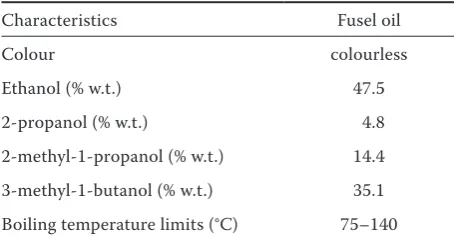
mix-ture of non-ionic surfactant and NaCl (SOAP-1), with isopropyl alcohol according to this method (Reaney, Martin 2002) (SOAP-2), with fusel oil (SOAP-3) and classical extractant of toluene (SOAP-4) were isolated. Composition and proper-ties of fusel oil are shown in Table 2.
To assess the degree of hydrophobicity of isolated fats, the condition of their monolayers was studied by the Langmuir method with the registration of two-dimensional pressure on the Wilhelmy balance (Binks 1991). On the surface of the water phase that fills the Langmuir bathtub a certain amount of soapstock dissolved in chloroform (99.9%; Vekton, Penfield, USA) was applied with a Hamilton mi-crosyringe. The solution was allowed to spread for 10 min on the interface of the water-air phase, and the monolayer was compressed at a constant speed. As a result the compression isotherms (the depend-ence of the surface tension π on the area S) of mon-olayers were obtained with the help of KSV Mini trough 2 (Biolin Scientific, Stockholm, Sweden) for 4 samples of soapstock (Table 3).The water used in the Langmuir method is prepared using a water pu-rification system Simplicity (EMD Millipore, Billeri-ca, USA). To control temperature of water phase the heating circulation ED-5 (Julabo, Seelbach, Baden-Württemberg, Germany) was used.
[image:2.595.305.532.114.200.2]From the singled out research objects, as well as from the original soapstock (SOAP-5) 5 samples of Table 1. Soapstock (SOAP-5) characteristics
Composition Mass value (%) Solid residual 23.60 Total fat content 19.86 Fatty acids content 4.50 Neutral fat content 15.36
Table 2. Composition and properties of fusel oil
Characteristics Fusel oil
Colour colourless
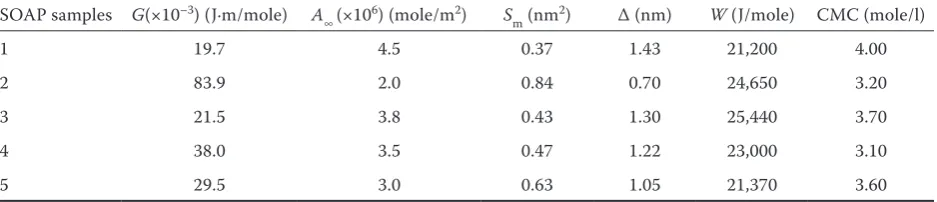
[image:2.595.304.533.636.755.2]mixtures emulsifiers were synthesized by alkaline hydrolysis method (OSOAP). For them tension isotherms were taken and their main adsorptive characteristics were found. They are the critical micelle concentration (CMC), the max. adsorp-tion (A∞), the value of the molecular area (Sm), the thickness of the adsorptive layer (Δ), the work of adsorption (W) (Table 4). The determination of the surface tension of emulsifiers was conducted by a semi-staticstalagmometric method (drop-counting method) (Verezhnikov 1984).
The Langmuir method (Binks 1991) is one of the approaches for assessing the nature of structuring of surfactants at the interface of water/air phase. On the basis of isotherms of monolayers compres-sion obtained during the experiment, this method allows to calculate the area occupied by one mol-ecule of the surfactant in the monolayer (Sm), the surface pressure π0 when the film transforms into a three-dimensional structure (the state of monolay-er collapse or the beginning of intensive formation of micelles on the surface followed by the transition of the latter into the aqueous phase). In addition, it is possible to calculate the isothermal coefficient of the surface monolayer compression:
β=– 1S 0
∂S ∂π ⎛ ⎝⎜ ⎞⎠⎟T
where:
π – surface tension of the monolayer (mN/m) S – area of the monolayer (cm2)
S0 – initial area of the monolayer (determined by the Langmuir bath design) (243 cm2)
T – temperature (°C)
RESULTS AND DISCUSSION
[image:3.595.61.533.144.244.2]In papers of Poyarkova et al. (2012a,b, 2013) the compression isotherms of the monolayer of the initial soapstock SOAP-5 and SOAP-1 (at 20 and 40°C) were obtained.It was evident from them that for these samples there were three typical areas of different phase state of the layer: sparse adsorptive layer, condensed film and the area of the metastable state (the third state). In the conditions of the latter state there can be the formation of duplex structures by the second layer, accompanied by the formation of micelles with their subsequent irreversible transi-tion into the aqueous phase (Zadymova 2006). Table 3. Dependence of the coefficient of the isothermal surface compression (β) of monolayers, the critical surface pressure (π0) in monolayer, at which the formation of bilayer structures begins, and the average molecular area (Sm) on the temperature of collecting down the isotherm and the method of isolating fatty component
Soapstock fat sisolated by various ways (SOAP)
1 2 3 4
Isotherm temperature (°С) 20 40 28 45 28 45 28 45 β (m/N) 16.2 16.8 21.0 25.2 16.6 18.1 15.3 20.3
Sm (nm2) 0.86 1.00 0.80 0.77 0.77 0.54 0.71 0.78
π0 (mN/m) 29 25 19.0 17.2 19.7 18.9 19.6 18.6
Table 4. Adsorptive characteristics of surfactant: surface activity (G), maximum adsorption (A∞), value of the molec-ular area (Sm), thickness of the adsorptive layer (Δ), work of adsorption (W) and the critical micelle concentration (CMC)
SOAP samples G(×10–3) (J·m/mole) А
∞ (×106) (mole/m2) Sm (nm2) Δ (nm) W (J/mole) CMC (mole/l)
1 19.7 4.5 0.37 1.43 21,200 4.00
2 83.9 2.0 0.84 0.70 24,650 3.20
3 21.5 3.8 0.43 1.30 25,440 3.70
4 38.0 3.5 0.47 1.22 23,000 3.10
5 29.5 3.0 0.63 1.05 21,370 3.60
[image:3.595.64.533.656.757.2]In this paper, a preliminary assessment of the effec-tiveness of extracting action of additives of various alcohols (isobutyl, isoamyl, isopropyl, hexyl, ethyl, methyl etc.) was done according to the description (Reaney, Martin 2002). Best results of the division were obtained by the action of isopropyl alcohol at pH 4. However, the use of expensive volatile extract-ant, significant power-intensity of its regeneration, and the fire hazard of the process are the negative sides of this method. To reduce the cost of the iso-lation process of soapstock, to reduce pollution of the environment with waste of edible alcohol pro-duction and for their utilization, fusel oils were used while extracting, which are a mixture of alcohols of the composition shown in Table 2.
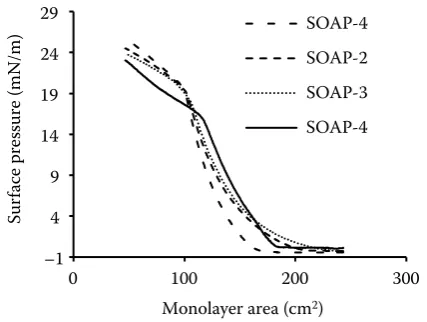
[image:4.595.66.280.105.266.2]Fig. 1 shows isotherms of the Langmuir monolayers obtained for samples 2, 3 and SOAP-4. They belong to the same type as the isotherm for the initial soapstock SOAP-5 and SOAP-1 (Poyar-kova et al. 2012). To demonstrate the effect of tem-perature on the state of the monolayers, compression isotherms were also obtained at 45°C. At 45°C most of the components of soapstock are at a temperature above their melting point. For the quantitative assess-ment of the influence of isolation method of the fatty component of soapstock on the structure of mono-layers of the studied samples,values of molecular ar-eas, the average coefficient of the isothermal surface compression β of the monolayer (the averaging was conducted for the areas identified as condensed film) and the critical surface pressure π0 in the monolayer were determined (Table 3).
Table 3 shows that the isolation with fusel oil leads to the acquisition of the smallest value of molecular area at 45°C, which is a positive factor in assessing the fatty-acid composition of soapstock and shows the most pronounced hydrophobization of fats.
As to the critical surface pressure π0 in the mono-layer of isolated fats, this parameter is practically the same for different methods of soapstock treat-ment in the test temperature range. However π0 for monolayers of treated soapstock is about 15–20% lower in comparison withdata for the original soap-stock (Poyarkova et al. 2012) which also shows the hydrophobization of fats as a result of the soap-stock treatment.
The average isothermal coefficient of surface compression β of the monolayer increases with the increase of temperatures for each sample. It is ex-plained by the increase of the intensity of the mi-celle formation process which leads to a decrease in mass of the monolayer itself.
For studying the influence of the isolation method of the fatty component of soapstock on the change of its fatty-acid composition it is possible to take the detection of surface active characteristics of surfac-tants synthesized by alkaline hydrolysis method on their basis. For five received emulsifiers isotherms of surface tension were collected and they were treated to find their adsorptive characteristics.
Fig. 2 shows the surface tension π and concentra-tion C curve for the sample OSOAP-4 (based on the fat isolated by toluene), the form of which is typical for all surfactants under study. Judging by this curve, it can be concluded that all obtained surfactants belong to the micelle-formative class. It has a positive effect on the properties of all five Fig. 1. Dependence of the surface pressure on the area of
[image:4.595.314.521.573.703.2]the monolayer. Compression isotherms of monolayers formed by samples SOAP-4, SOAP-2, SOAP-3 at 28°C and SOAP-4 at 45°C
Fig. 2. Dependence of the surface pressure on the con-centration of the emulsifier synthesized by the soapstock isolated with toluene (OSOAP-4).
–1 4 9 14 19 24 290 100 200 300
Sur
fac
e pr
essur
e (mN/m)
Monolayer area (cm2)
SOAP-4 SOAP-2 SOAP-3 SOAP-4
-1 4 9 14 19 24 290 100 200 300
Sur
fac
e pr
essur
e (mN/m)
Monolayer area (cm2)
SOAP-4 SOAP-2 SOAP-3 SOAP-4 40 °С
30 35 40 45 50 55 60 65 70 75
0 10 20 30 40
Sur
fac
e t
ension (mN/m)
Emulsifier concentration (mmol/l)
emulsifiers – they show more pronounced disper-sive, detergent, solubilizing and foaming properties compared to non-micelle-formative emulsifiers (Pletnev 2002). For quantitative assessment of the surface-active properties of emulsifiers their main characteristics were calculated (Table 4).
According to the data presented in Table 4 sur-factants on the basis of soapstock treated with tolu-ene and isopropyl alcohol have the lowest values of CMC. They also have the highest surface activity which is one of the most important indicators for a surfactant. However, taking into account that for the studied surfactants of different classes there may be deviations in values of CMC by three or-ders of magnitude (Pletnev 2002), in our case, these differences are negligible (less than 30%). The size of the molecular area and the thickness of the adsorption layer, also characterizing the de-gree of hydrophobicity of the surfactant, support OSOAP-1 and OSOAP-3 synthesized on the basis of soapstock purified using mixtures of non-ionic surfactant with electrolyte and fusel oil.
Hence, the summarized data for the surface-ac-tive properties of synthesized surfactants show a decrease in the degree of unsaturation of soap sam-ple synthesized on the basis of soapstock, treated with fusel oil. Taking into account the cheapness of the fusel oil and the positive effect of recycling of this waste, this method of isolation of the fatty component of soapstockcan be recommend, espe-cially in cases when the purity of surfactant synthe-sized from it does not play the dominant role.
CONCLUSION
– The fatty component of soapstock was isolated under laboratory conditions using different methods: by a mixture of nonionic surfactant and NaCl, with isopropyl alcohol, fusel oil and classical extractant– toluene.
– By the Langmuir method for obtaining samples the values of molecular areas, the average coef-ficient of isothermal surface compression of the
monolayer and the critical surface pressure π0 were determined. The strongest compression of the monolayer is observed in the case of using fusel oil, which indicates the oleofilization of the fatty system.
– Main adsorptive characteristics of emulsifiers synthesized on the basis of isolated fat support the soapstock purified using a nonionic sur-factant mixture with electrolyte and fusel oil.
References
Arutyunyan N.S. (2004): Laboratornyi praktikum pokhimi-izhirov. Saint-Petersburg, Giord.
Binks B.P. (1991): Insoluble monolayers of weakly ionising low molar mass materials and their deposition to form Langmuir-Blodgett multilayers. Advances in Colloid and Interface Science, 34: 343–348.
Pletnev Y.M. (2002): Poverkhnostno-aktivnye veshchestva i kompozitsii. Spravochnik. Moscow, Klovel’.
Poyarkova T.N., Kudrina G.V., Prokof’ev Y.I. (2012): Effect of inorganic electrolytes and nonionogenic surfactants on the stability of soapstock emulsion. Russian Journal of Applied Chemistry, 85: 651–655.
Poyarkov T.N., Tarasova A.V., Kudrina G.V., Sotnikova E.V., Prokof’ev Y.I. (2012): Influence of temperature, pH, and time of base hydrolysis on variation of the fatty acid compo-sition of soapstock. Russian Journal of Applied Chemistry, 9: 1399–1403.
Poyarkova T.N., Prokof’ev Y.I., Shestakov A.S., Kudrina G.V., Tarasova A.V., Sotnikova E.V. (2013): Dependence of the stability of a soapstock emulsion on the combined effect of sodium chloride and nonionogenic surfactant additives. Russian Journal of Applied Chemistry, 2: 200–205. Reaney M.J.T. (2002): Method for soap stoсk acidulation.
Patent No.: US 6.399.802.
Verezhnikov V.N. (1984): Praktikum pokolloidnoikhimi-ipoverkhnostno-aktivnykhveshchestv. Voronezh, VGU. Zadymova N.M., Yampol’skaya G.P., Filatova L.Y. (2006):
Interaction of bovine serum albumin with nonionic sur-factant TWEEN 80 in aqueous solutions: complexation and association. Colloid Journal, 2: 187–192.
Received for publication July 6, 2014 Accepted after corrections November 26, 2014
Corresponding author:
Yurij Igorevich Prokof’ev, Bunin Yelets State University, Faculty of Physics and Mathematics, Department of Physics, Kommunarov’s str. 28, Elets, Russian Federation
phone: + 79 10 356 83 43; e-mail: [email protected]