Environmentally Benign Fabricating Process of Magnesium Alloy
by Cyclical Plastic Working in Solid-State
Katsuyoshi Kondoh
1and Tatsuhiko Aizawa
2 1Research Center for Advanced Science and Technology, The University of Tokyo, Tokyo 153-8904, Japan 2Center for Collaborative Research, The University of Tokyo, Tokyo 153-8904, Japan
Solid-state processing via cyclically plastic working to output the green compact has been developed to fabricate magnesium alloys with fine microstructures. The relationship between the energy consumption during the plastic working and the characteristics of hot extruded magnesium alloys was evaluated from the viewpoint of the environmentally benign process. The cyclical plastic working marks a significant advance in refining microstructures, such as matrix grain and silicon particles added to synthesize Mg2Si via solid-state reaction with
magnesium. For example, the grain size of hot extruded AZ31 alloy is 3–15mm, which is remarkably smaller than that with 20–80mmin employing the cold compact without using such a plastic working. As a result of the grain refinement, AZ31 alloys reveal higher UTS of 330– 355 MPa than the conventional alloys of 270 MPa. The energy consumption of the cyclical plastic working with 200 cycles is 10 kJg1to
fabricate the billet consolidated by hot extrusion, when using a high-speed screw-driven press machine. This is less than 10% of the energy consumed by the conventional recycling process in re-melting wasted magnesium alloys (126 kJg1). This process is highly capable of
producing high performance magnesium alloys with a small energy consumption and is environment-friendly.
(Received February 18, 2003; Accepted April 28, 2003)
Keywords: Repeated plastic working, magnesium alloys, solid-state processing, grain refinement, energy consumption, screw-driven press
1. Introduction
The melting process of raw materials, including not only
metals (ex.iron, aluminum, and magnesium), but also
non-metals such as glass and organic materials, generally contribute significantly to environmental problems, such as, the discharge of air pollutants (CO2, NOxand SOx) and both
high energy consumption and high heat waste in burning fuel oil. For example, the discharge of CO2gas is 0.28 ton/ton in
re-melting 1 ton glass.1)On the other hand, a light metal such as aluminum or magnesium alloy, is one of the environmen-tally benign materials, because it reduces the fuel consump-tion and air pollutant when applied to automotives in operation due to its weight reduction effects. In particular, magnesium alloys, being lightest of the industrial metals, can be employed widely to structural parts or components because of their higher specific strength than the conven-tional aluminum alloys. They are commercialized as the housings or casings of mobile phones, laptop PC and personal digital assistant (PDA). The conventional magnesium alloys are produced mainly by casting or thixomoulding. However, the recently developed solid-state processes of magnesium or aluminum alloys fabricate the strengthened alloys by employing plastic workings, such as equal cannel angular extrusion (ECAE)2,3) and reciprocating extrusion.4) This is because of the easy plastic deformation of light alloys, compared to steel or iron. The solid-state processing features a negligible discharge of air pollutants and low energy consumption without melting process, that is, without causing harm to the environment. It is also employed as an efficient recycling process.5–7)The wastes, such as machined magnesium chips or crushed in-house magnesium scraps, can be used as input raw materials by the direct hot extruding process. It is reported that solid recycled AZ31 magnesium alloy shows UTS of 268 MPa and 14% elongation, which are
the same as those of the virgin extruded alloy.8) From the
viewpoint of protection to the environment, the solid-state
processing with plastic working fabricates high performance magnesium alloys under low energy consumption.
Previously, bulk mechanical alloying (BMA), which consists of cyclical compaction and extrusion in a closed die at room temperature, has been developed as a solid-state fabricating process.9,10)It directly produces green compacts with refined microstructures from magnesium powder or chips as input raw materials. For example, hot forged AZ91D magnesium alloy consolidated from its chips shows a UTS of 280 MPa, which is remarkably higher than the conventional
wrought AZ91D.11,12) This process also highly capable of
producing copper,10) aluminum13,14) and magnesium alloys
without causing harm to the environment. In applying this process to the mass production process in industries, however, high productive efficiency is required. That is, the modification or optimization of the solid-state process is necessary to reduce energy consumption during production.
In this study, the effect of energy consumption during the cyclical plastic working on the microstructure refinement and mechanical properties of the hot extruded magnesium alloy has been evaluated, in employing AZ31 alloy powder and elemental powder mixtures of AZ31 and silicon as input raw materials. The comparison of the static and dynamic deformation during cyclical plastic working was also examined by employing hydraulic and high-speed screw driven presses. Finally, the possibility of apply this process to the mass production was discussed, in particular of producing large green packs and industrial components via cyclical plastic working.
2. Solid-state Cyclically Plastic Workings for Green Compact
2.1 Bulk mechanical alloying (BMA)
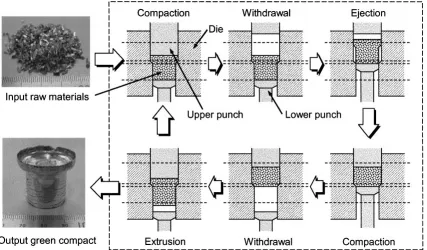
The motion of the upper and lower punches during BMA is schematized in Fig. 1, which also shows the appearance of the green compact. The punches, going down with 20 mm/s,
Special Issue on Growth of Ecomaterials as a Key to Eco-Society
are computer operated automatically by a 700 kN hydraulic press machine. After an appropriate number of cycles, the green compact with prominence is output. The 1 cycle BMA process consists of two compactions and once forward extrusion at room temperature, and takes about 9 seconds.
The diameter of the upper and lower die is 24mm and
20mm, respectively, that is, the extrusion ratio of this
equipment is 1.44. The mechanically imposed energy in BMA is estimated by the in-process measurement on changes in both the applied load to raw materials and the traveling
displacement of punches.11) Based on the previous works,
about 45–50%14) of the total energy consumption is
em-ployed for plastic work to raw materials. The remainder is used for the motion of the heavy die-set, and the friction and heat loss during BMA in the present equipment. From the viewpoint of not only the energy consumption, but also the microstructural control of the green compacts, the number of cycles in BMA,N, is an important factor.11)In applying the BMA process to the refinement of AZ91D chips including networked Mg17Al12 intermetallics and lamellar chips, the
input raw chips show a micro-hardness of 77 Hv at the matrix. After 500 cycles of BMA, it reaches 139 Hv. SEM observation of the BMAed AZ91D green compact indicates that networked intermetallics are fractured into fine particles less than 1mm, and uniformly distributed in the matrix. The grain size is also reduced to 7–10mmduring repeated plastic deformation. That is, high mechanical properties of BMAed AZ91D alloys are attributed to the control of the micro-structures to promote the grain refinement or fine dispersion strengthening effects. After BMA is performed an appro-priate number of cycles, the green compact, having a relative density of 80–85%, is consolidated into full density by hot plastic working such as the forging or extrusion process.
2.2 Repeated plastic working (RPW)
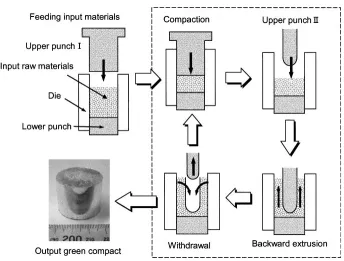
The RPW process, schematically shown in Fig. 2, is operated by using two types of upper punches installed in a 1000 kN screw driven press machine. The upper punch I and II are inserted alternately into the die at room temperature, for cold compaction of the raw powder mixture by punch I and backward extrusion of the green compact by punch II. The
inner diameter of the die and the punch II is 30mm and
20mm, respectively. The relative density of the green
compact is 80–90%, and the backward extrusion is effective to both mixing the raw powder and refinement of the microstructures. One cycle RPW requires about 18 seconds, when employing the punch speed of 150 mm/s and 177 mm/s in compaction and extrusion, respectively. As shown in Fig. 2, the bottom of the green compact in the die is ‘‘dead area’’, causing heterogeneous structures, because there is moderate plastic deformation of the compact or a rearrangement of the raw materials. To resolve such problem in the compact quality, the green pack is automatically inverted outside the die every 10 cycles, and the RPW starts again after inserting the compact into the die. It allows the formation of uniformly mixed and refined microstructures. From the viewpoint of reducing non-effective energy consumed by the plastic work, the heavy die-set and lower punch are rigid. The mechani-cally imposed energy depends on the kinetic energy of the rotating fly wheel set at the top of the press machine. That is, it is proportional to the square of the upper punch speed of insertion into the die. The relationship between the energy consumption in RPW and upper punch speed is shown in Fig. 3, in employing the mechanical efficiency of 60% in this press machine. The imposed energy can be controlled by the inserted upper punch speed by computer. The RPW process also outputs the columnar green compact as shown in Fig. 2, which is a convenient shape for the consolidation by hot forging or extrusion.
[image:2.595.87.514.72.322.2]3. Experimental Procedure
One of the raw materials used in this study was AZ31 magnesium alloy chips with a 4 mm mean length, commer-cialized as input material of the thixomoulding process. Another was the elemental powder mixture of AZ31 and silicon particles. AZ31 powder was prepared by grinding the chips bya the vibration ball milling equipment. The mean
particle size of AZ31 alloy and silicon was 178mm and
22mm, respectively. The silicon content was 2.5 and
5 mass%. Silicon particles were employed to form Mg2Si
intermetallics by the solid-state reaction15)with magnesium during the pre-heating of the green compact after the BMA or RPW process. Therefore, when using the latter raw material,
magnesium composite alloys reinforced with fine Mg2Si
dispersoids were fabricated by this reaction process.16) Input raw materials of 13 g and 25 g were fed into the die
installed in the BMA and RPW press machine, respectively. The number of cycles in both processes was 50, 100 and 200. That is, the plastic working time was 450, 900 and 1800 s for BMA, and 900, 1800 and 3600 s for RPW, respectively. The energy per gram essentially consumed in each plastic working can be easily estimated by using the input energy monitored by computer as described above. In the RPW process, the green compact was automatically inversed every 10 cycles.
The green compact after cyclical plastic working was pre-heated by a gold image furnace, and immediately consoli-dated by hot extrusion. The pre-heating temperature of the compacts was 793 K and 723–753 K, for AZ31 chips and elemental powder mixture of AZ31, and silicon particles, respectively. The die temperature was 673 K, and the extrusion pressure of 55–69 MPa was employed in this equipment. In using a 37 extrusion ratio, the extruded bar with 6.8 mm diameter was produced.
Optical microstructures, micro-hardness and tensile prop-erties (ultimate tensile strength, yield stress and elongation) of the hot extruded materials were evaluated at room temperature. The image analysis of microstructures was applied to estimate the matrix grain size and mean particle size of Mg2Si dispersoids. In using silicon particles to form
Mg2Si, X-ray diffraction (XRD) was applied to the analysis
on the magnesium composite alloys.
4. Results and Discussion
4.1 Energy consumption via cyclical plastic working
It is presumed that the energy consumption depends on not only the plastic working process, but also the compositions of the employed input raw materials. As shown in Fig. 4, the energy consumption is almost proportional to the number of cycles in both processes. The melting process of wasted
Fig. 2 Schematic of upper punch motion during repeated plastic working.
[image:3.595.127.471.66.327.2] [image:3.595.62.276.364.533.2]magnesium alloys to form the billet used for hot extrusion
consumes the energy of 126 kJg1.17) It is considerably
higher than that via the RPW or BMA non-melting processes to output the green compact, in considering even the energy consumption by grinding AZ31 chips to powder. The BMA process, however, consumes significantly higher energy to
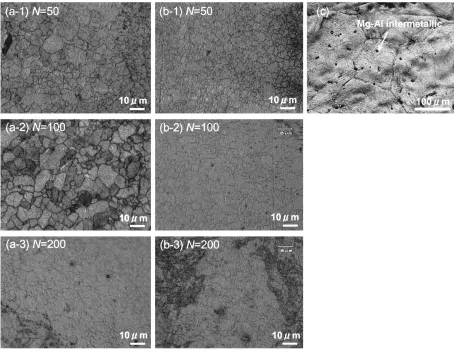
materials. After 50 cycles of RPW or BMA, the grain size of
the hot extruded AZ31 alloys is 10–20mm, which is
extremely small compared to that in employing cold compaction without such cyclical plastic workings. The AZ31 alloy also becomes finer with the increase in the number of cycles in both the BMA and RPW processes. As shown in Fig. 5(c), Mg–Al intermetallic compounds are observed in the matrix. However, they can not be detected obviously in the cyclical plastic worked AZ31 alloys because of their fine dispersoids. Figure 6 shows the dependences of
Fig. 4 Dependence of energy consumption during RPW and BMA on number of cycles in employing AZ31 chips and elemental powder mixture of AZ31 and silicon as input raw materials.
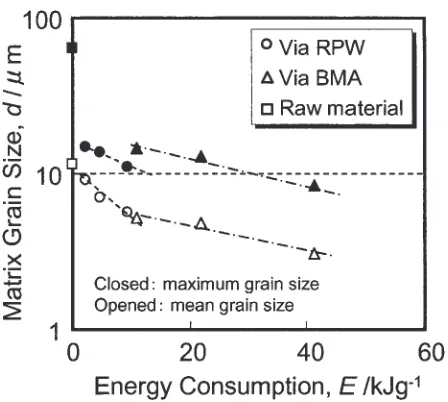
[image:4.595.57.283.70.255.2] [image:4.595.70.524.409.761.2]the matrix grain size on the energy consumption during the RPW or BMA process. The maximum and mean grain sizes gradually decrease with the increase of energy consumption. In particular, the plastic working causes a markedly effective refinement of the relatively large matrix grains. That is, the grain refinement occurs at the initial stage during cyclical plastic working. As a result of comparing the gradient of both dependences, it is clarified that RPW has a higher efficiency than the BMA process in the refining the magnesium matrix grains.
Figure 7 reveals dependences of the tensile strength of hot extruded AZ31 alloys on the energy consumption during each cyclical plastic working. Compared to the cold compact which is shown as ‘‘0 energy consumption’’, the application of RPW or BMA causes a significant increase in tensile strength. For example, the ultimate tensile strength (UTS) of 330–350 MPa is remarkably higher than that of 270 MPa in using a cold compact. In both of the cyclical plastic working processes, the UTS and yield stress (Y.S.) increase
propor-tionally to the energy consumption. This corresponds to the grain size dependence shown in Fig. 6. Grain refinement is one of the effectively strengthening factors in using cyclical plastic working. The RPW process, however, shows tensile strength dependences of an essentially steep gradient com-pared to BMA. In other words, it contributes to the effective improvement of mechanical properties of AZ31 alloys by the grain refinement in solid-state. As shown in Fig. 8, hot extruded AZ31 alloys via the cyclical plastic working process
recognizes the Hall-Petch relationship between UTS () and
the matrix grain size (d0:5). It also shows that the effective
strengthening mechanism of the magnesium alloys, which are produced via different cyclical plastic workings, strongly depends on the grain refinement of the AZ31 matrix, because the grain boundaries act as a barrier to obstruct slips of dislocations.
4.3 In employing elemental AZ31 and silicon powder mixtures
The increase of the number of cycles in BMA progresses to refine silicon particles and embed them into the AZ31 matrix. As a result of the refinement, the ignition temperature to
synthesize Mg2Si from magnesium and silicon, being
accompanied by exothermic heat, shifts to the extremely
low range of 423–473 K.16) Therefore, the pre-heating of
green compacts via RPW or BMA at 723–753 K is sufficient
to form Mg2Si particles in solid-state, in employing the
elemental AZ31 and silicon powder mixtures. Figure 9 shows XRD patterns of hot extruded AZ31 composite alloys via (a) RPW and (b) BMA, when adding 2.5 mass% silicon particles
into AZ31 powder. The obvious diffraction peaks of Mg2Si,
as opposed to silicon, are detected. That is, silicon particles
completely react with magnesium to synthesize Mg2Si in
solid-state, even in using the cold compact (N¼0) without cyclically plastic working. This means that the temperature of pre-heating each green compact determined by the ignition for the exothermic heat of the DSC thermogram is suitable for the solid-state formation of Mg2Si intermetallics. Figure
10 reveals optical microstructures of hot extruded AZ31 alloys reinforced with Mg2Si particles via (a) RPW, (b) BMA
Fig. 6 Grain size dependence on energy consumption of hot extruded AZ31 alloys.
Fig. 7 Dependence of UTS and Y.S. of hot extruded AZ31 alloys on energy consumption during RPW and BMA.
[image:5.595.57.281.68.269.2] [image:5.595.314.541.74.262.2] [image:5.595.56.281.571.758.2]Fig. 9 XRD patterns of hot extruded AZ31 alloys with synthesized Mg2Si particles via (a) RPW and (b) BMA in employing AZ31 with
[image:6.595.89.505.74.261.2]2.5 mass%Si powder mixture.
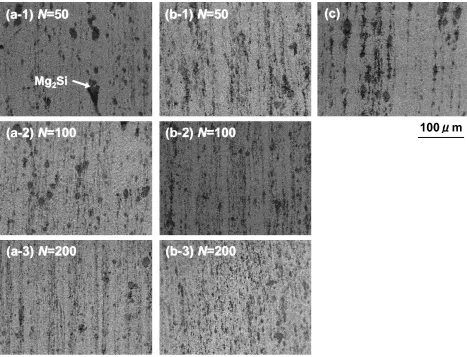
[image:6.595.63.530.348.705.2]and (c) cold compact, in employing the elemental AZ31-5 mass%Si powder mixture. The number of cycles in RPW and BMA is 50, 100 and 200. Compared to the AZ31
composite via cold compaction, Mg2Si particles, existing
along the extrusion direction, of the magnesium alloys via RPW or BMA are extremely fine. They become finer, and are also distributed more uniformly in the matrix with the increase in the number of cycles. Both magnesium composite alloys via the cyclical plastic working process reveal a minimum particle size of less than 5mm.
Figure 11 shows a dependence of the maximum and mean particle size of Mg2Si dispersoids on the energy consumption
during RPW or BMA, where the opened and closed marks correspond to the maximum and mean values, respectively,
when adding (a) 2.5 mass%Si and (b) 5 mass%Si. Mg2Si
particle size is reduced remarkably by applying the cyclical plastic working, and the refinement of coarse particles in particular occurs remarkably at the initial stage, for example N<50 cycles. When considering that the Mg2Si particle
size is almost the same as that of silicon because of the minimal coarsening during the solid-state synthesis of
Mg2Si, RPW and BMA act to fracture the brittle silicon
particles effectively. In the case of the addition of 5 mass%
silicon, Mg2Si particles are coarser than those in adding
2.5 mass% silicon powder, because the input energy con-sumed to fracture each silicon particle is theoretically half of that applied to materials with a 2.5 mass% silicon content. In comparing RPW and BMA, the former shows a steeper gradient of a dependence on the energy consumption than the BMA process. It corresponds well to changes in the refinement of matrix grains with the increase in the energy consumption shown in Fig. 6. These results mean that, from the viewpoint of the refinement of the matrix grain and Mg2Si
particles, RPW possesses a higher efficiency in refining microstructures than the BMA process. This is because of both a large extrusion ratio and impact loading during cyclical plastic working by applying a screw-driven press machine. Concerning the former factor, RPW is accompanied by an extrusion ratio,r, of 2.25 and 40% volume transfer of the green compact in a die during backward extrusion. On the
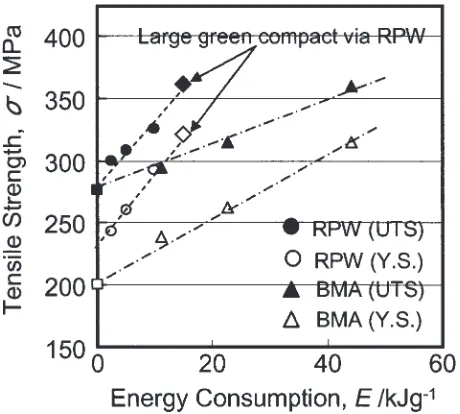
[image:7.595.86.513.72.264.2]other hand, the forward extrusion in BMA possesses a 1.44 extrusion ratio and 18% volume transfer. This means that severer plastic deformation of raw materials by RPW is advantageous in refining the matrix grain and silicon particles. With regard to the effect of loading to raw materials on the refinement of microstructures, impact energy is suitable for the fragmentation of brittle silicon particles compared to static loading by the hydraulic press machine used for the BMA process. Figure 12 shows the tensile strength dependences of hot extruded composites on the energy consumption, in employing the elemental AZ31 and 2.5 mass% silicon powder mixture as input raw materials. The magnesium composites are also strengthened by the cyclical plastic working, and UTS and Y.S. increas with the increase in the energy consumption. However, UTS and Y.S. of the composite via RPW is higher than those in applying BMA. It is the same as in the case of the hot extruded AZ31 alloys shown in Fig. 7. The strengthening effects of the
Fig. 11 Comparison of efficiency in refining Mg2Si particles of hot extruded AZ31 alloys via RPW and BMA processes, in employing
[image:7.595.312.542.551.758.2]AZ31 powder with (a) 2.5 mass% and (b) 5 mass% silicon particles.
Fig. 12 Dependence of UTS and Y.S. of hot extruded Mg2Si/AZ31
with a35mm diameter for forward extrusion, installed in the industrial plant. The columnar green compact of 80 mm50 mmsize is formed after 200 cycles of RPW, in employing the elemental AZ31 and 2.5 mass% silicon powder mixture, which are the same raw materials used in the laboratory experiment. The same pre-heating and extrusion conditions are also applied to consolidate the green compact via solid-state synthesis of Mg2Si particles. Additionally, no
air pollution occurs through this process of forming hot
extruded magnesium alloys. An Mg2Si/AZ31 composite bar,
having a6mm diameter, reveals a UTS of 358 MPa and a
Y.S. of 324 MPa. The relationship between UTS/Y.S. and energy consumption in using a large green pack via the RPW process is also given in Fig. 12. It corresponds well to the tensile strength dependence on the energy consumption measured in the laboratory experiments. That is, RPW having
a high efficiency in refining the grain size and Mg2Si
dispersoids can be applied as an environmentally benign process to the microstructure control of magnesium alloys and their composites in the manufacturing process.
5. Conclusionse
The cyclical plastic working to output the green compact achieves significant advances in refining microstructures, such as matrix grains and Mg2Si particles. The hot extruded
AZ31 alloys via the plastic working reveal a grain size of 3–
15mm, which is remarkably smaller than that ofh 20–80mm
in employing the cold compact. As a result of the grain refinement, AZ31 alloys reveal a higher UTS of 330– 355 MPa than the conventional alloys of 270 MPa. Concern-ing the energy consumption to fabricate the billet
consoli-Technology in Japan.
REFERENCES
1) URL: http://www.nsg.co.jp/nsg/menu/environ/2002 (Environment re-port 2002, Nippon Sheet Glass Co., Ltd).
2) Y. Iwahashi, J. T. Wang, Z. Horita and T. G. Langdon: Scr. Mater.35
(1996) 143.
3) K. Nakashima, Z. Hirota, M. Nemoto and T. G. Langdon: Acta Mater.
46(1997) 1589.
4) J. W. Yeh, S. Y. Yuan and C. H. Peng: Mater. Sci. Eng. A252(1998) 212.
5) M. Mabuchi, K. Kubota and K. Higashi: Mater. Trans.36(1995) 1249. 6) Y. Chino, K. Kishihara, K. Shimojima, Y. Yamada, C. E. Wen, H.
Iwasaki and M. Mabuchi: J. Japan. Inst. Metals65(2001) 621. 7) Y. Chino, K. Kishihara, K. Shimojima, H. Hosokawa, Y. Yamada, C. E.
Wen, H. Iwasaki and M. Mabuchi: Mater. Trans.43(2002) 2437. 8) Y. Chino, A. Yamamoto, H. Iwasaki, M. Mabuchi and H. Tsubakino:
Magnesium Alloys 2003, The conference on Platform Science and Technology for Advanced Magnesium Alloys, ed. by Y. Kojima,et al., (Trans Tech Publications, Switzerland, 2003) pp. 671–676.
9) O. Kobayashi, T. Aizawa and J. Kihara: Mater. Trans.37(1996) 1497. 10) T. Aizawa, J. Kihara and D. J. Benson: Mater. Trans.36(1995) 138. 11) K. Kondoh, T. Luangvaranunt and T. Aizawa: Mater. Trans.42(2001)
1254.
12) K. Kondoh, T. Luangvaranunt and T. Aizawa: Mater. Trans.43(2002) 322.
13) T. Aizawa, T. Luangvaranunt and K. Kondoh: J. Japan. Inst. Metals65
(2001) 581.
14) T. Aizawa, T. Luangvaranunt and K. Kondoh: Mater. Trans.43(2002) 315.
15) K. Kondoh, H. Oginuma, E. Yuasa and T. Aizawa: Mater. Trans.42
(2001) 1293.
16) K. Kondoh, H. Oginuma, A. Kimura, S. Matsukawa and T. Aizawa: Mater. Trans.44(2003) 981.