JOURNAL OF FOREST SCIENCE, 49, 2003 (8): 349–358
Search for ecological criteria for decisions on forests to be left to spontaneous development in specially pro-tected areas is based on the knowledge of regularities of autochthonous or natural forests, particularly on the evaluation of their basic traits and characteristics. They involve relative constancy of the species composition of communities, relative all-agedness, relative equability of growing stock and relatively small areas of particular developmental phases and stages.
Their result will be the maintenance of ecological au-tonomy and equability. In our climatic conditions a forest is the only plant formation that is able to sustain itself by its internal forces and life processes provided that the site and stand conditions do not change substantially (cf. JENÍK 1979; KORPEĽ 1989; VACEK 2003). Autochthonous and natural forests are model objects for research on eco-logical autonomy and equability. In the conditions of this country these are national nature preserves (NNP), nature reserves (NR), zones I of national parks (NP) and pro-tected landscape areas (PLA). Especially autochthonous forests maintain their dynamic equilibrium through their species composition, specific spatial and age structure. Natural forest communities as the complexes of living organisms on the highest hierarchic level of open sys-tems markedly tend towards homeostasis (JENÍK 1979; ZLATNÍK 1970; REJMÁNEK 1979; PRŮŠA 1985). This state readily responds to disturbing environmental fac-tors by the specific constellation of conditions, traits and
components that guarantee a further existence of autoch-thonous forest continually following with the present state of ecosystems (VACEK 2000).
Ecologically based decisions on the methods of differ-entiated management in specially protected areas (SPA) aimed to ensure their ecological stability and biodiversity, i.e. ecological persistence, are a very complicated task. To achieve the maximum possible level of objectification of this process it is necessary to parametrize or to quantify many partial ecological and economic criteria.
Sometimes near-natural management or measures in SPA can bring higher costs or some restrictions for own-ers. Therefore a multi-criterion analysis should be carried out before decisions on forests to be left to spontaneous processes in SPA. Determination of so called minimum range, i.e. minimum area and shape of a forest ecosystem capable of autoregulation, is the most important of the ecological criteria. In economic terms, it is a minimum area of forest stands where potential restrictions will be imposed on the owner.
Determination of ecological criteria for decisions on forests to be left to spontaneous development in SPA was focused on selected national nature preserves, nature reserves, zones I of NP and PLA in different ecological conditions of the CR.
The objective of this paper was to develop applicable methodology for the determination of minimum ranges of forest ecosystems capable of spontaneous development in
Minimum area of forests left to spontaneous development
in protected areas
S. V
ACEKForestry and Game Management Research Institute, Research Station Opočno, Czech Republic
ABSTRACT: Search for ecological criteria for decisions on forests to be left to spontaneous development in specially protected areas is based on the knowledge of regularities of autochthonous or natural forests. They are mainly relative constancy of the species composition of communities, relative all-agedness, relative equability of growing stock and relatively small areas of the particular developmental phases and stages. They will lead to the maintenance of ecological autonomy and equability of natural forest; their basic condition is to determine a minimum range (area) of forest stand when the populations are still maintained by autoregulation. The output of this study is applicable methodology and tests of its applicability in 36 localities in spruce woods, beech woods, mi-xed stands, scree forests, oak woods, floodplain forests and pine woods [in Šumava National Park (ŠNP), Krkonoše National Park (KNP), Protected Landscape Area (PLA) Broumovsko, PLA Český kras, PLA Jizerské hory Mts., in nature reserves at the foothills of the Orlické hory Mts. and in Polabí Lowland]. The objective was to define minimum ranges for natural environmental conditions and for two situations under the existing air pollution environmental conditions.
selected SPA and to test its applicability in relation to dif-ferent plant formations, sites and stand conditions.
PROBLEM ANALYSIS
Developmental regularities of natural forests As an autochthonous biocenosis natural forest is the culmination of natural ecosystem whose components influence each other through metabolic processes in a very long term. It is a typically complex system with all distinctive traits. In the given area it is the most advanced and complicated ecosystem that can ever originate and sustain itself there. But it is not the termination of forest development, it is its permanent continuation on the basis of internal and external antagonisms resulting in general regularities.
From the aspect of theory of cognition natural forest is an important notional group because the planned and purpose-oriented regulation and use of forest are based on reliable knowledge of tree species characteristics, natural dynamics of a structure, regularities of the growth and development of forest communities in different site conditions. To respect a scientific approach, biology and silviculture, which are the basic effective tools of wood production and ecological and environmental functions of forest, must employ the knowledge of the regularities of natural forest growth, development and regeneration in the given area (PRŮŠA 1985; KORPEĽ 1989; JAWORSKI 1998). This general statement is basically applicable in the areas with increased interest in nature conservation.
Climax tree species are determinative for the structure and dynamics of changes in natural forest. The persist-ence of species composition and site conditions deter-mine dynamic changes in the other traits of the structure [maintenance of ecological autonomy and equability, all-agedness, spatial structure, persistence of growing stock, tolerance (stability)], growth (zero increment) and development processes (natural regeneration), of which production and regeneration abilities are most important (cf. KORPEĽ 1989; POZNAŃSKI, JAWORSKI 2002).
Within the study of the persistence of communities, stand climate and soil conditions KORPEĽ (1989) dem-onstrated that the area of natural forest is a very important trait. Most authors (e.g. GROSSER et al. 1967; ZLATNÍK 1970; SEIBERT, HAGEN 1974; KORPEĽ 1989) consider 10–50 ha of approximately square or circular shape as the minimum size of the area for undisturbed development of natural forest community.
In natural forest its particular components adapt themselves to the environment according to the internal regularities, they change qualitatively and quantitatively in shorter or longer time segments, come into existence, grow, develop and decline. Growth, stage, ecological and cenotic differentiation take place that seems to be random at a glance but when the individuals are studied and ana-lyzed in detail as the components of a whole, it is obvious that it takes place as a part of continuous development. It
is the integrated cyclic development within which a series of interconnected cycles can be identified: at first nutrient cycle and water cycle that are connected with the mass conservation cycle and energy flow, etc. The equability of these relations enables the natural forest to exist even on very poor mountain soils.
The present identification of developmental stages of natural forests is mostly based on the classification ac-cording to LEIBUNDGUT (1959). These are growing-up, optimum and disintegration stages. In the framework of these developmental stages some authors (ZUKRIGEL et al. 1963; MAYER 1972; KORPEĽ 1989; JAWORSKI 1998, etc.) distinguish another two phases – e.g. initial phase of disintegration, advanced phase of disintegration, etc.
Air pollution environmental stresses with their immense negative influence and subsequent insect outbreaks mainly in mountain forests are a serious hazard for the conserva-tion of natural forests in the CR. These negative air pol-lution environmental impacts evoke several times higher requirements e.g. for the size of the forest ecosystem capable of spontaneous development. Therefore the eco-logical stability of forest ecosystem should be understood as the ability to persist in a given state for a concrete stress period and, after a divergence from the equilibrium, to return to this state again. So it is necessary to distinguish three types of ecological stability at least (cf. REJMÁNEK 1979): resistance (tolerance, ability to resist stress), resil-ience (elasticity, the ability to recover after divergence) and persistence (the ability of the system to persist in the beforehand defined limits for a stress period).
Minimum size of forest ecosystem capable of spontaneous development
Examinations of the constancy of communities, forest stand meso- and microclimate and soil conditions have indicated that the surface area and shape of natural forest are crucial factors for its further development. The eco-logical and developmental autonomy of forest ecosystem including the fulfillment of forest functions is guaranteed by at least the limit values of its minimum area.
Minimum areas of forest ecosystem vary markedly in relation to the geographic area, type of natural forest and environmental stress (KORPEĽ 1989). A too small area of these stands implies a great potential risk of its further re-striction by an increasing negative impact of the environs with changed site and stand conditions. A change in the climate usually has the greatest impacts especially if ex-tensive clearcuts have originated in the environs of small SPA. Area-restricted fragments of natural forests in small SPA in the complex of commercial forests also gradually undergo different degradation stages that are manifested by quantitative and qualitative changes in vegetation and finally in the soil environment. ZLATNÍK (1968) believed that sooner or later the development of small residues of natural forests must proceed to a change in the original climax community.
To maintain its developmental autonomy and dynamic equilibrium of vegetation and soil processes the natural forest must have such an area that its internal dialectic conditionality of both the components and phenomena, or of its natural energy, will be larger than the impact of the anthropically influenced environment. To determine ecological criteria for decisions on forests left to spon-taneous processes in SPA the adjacent forest stands were investigated and classified to several groups (according to degrees of damage and rate of divergence from the natural species and spatial composition). On the contrary, if the area of natural forests left to spontaneous development e.g. in NNP is large, they can tend towards their gradual expansion by autoregulation (cf. KORPEĽ 1989).
According to ZLATNÍK (1968), if the area of forest reserve is chosen, a minimum range for the main sy-nusia of tree species should be determined because the autochthonous forest on a smaller area cannot ensure its persistence nor can it meet the requirements for research on forest biocenosis. If possible, it is advisable to include self-contained segments of biocenosis in the reserve. Therefore the choice of the location and area of forest reserves should not represent only one typological unit but their complex, i.e. biocenological complex. From this aspect a smaller number of larger forest reserves is recom-mendable (ZLATNÍK 1968).
The minimum size of forest ecosystem capable of spon-taneous development should not form only an island
seg-ment of forests in the geobiocenosis but it must preserve a specific forest phytoclimate on which forest plants and animals are fully dependent. On the segment edges there will arise a zone of edge communities (ecotone) with their own characteristic species that do not have suitable conditions for their existence in the forest phytoclimate. In the beginnings, the ecotone environment temporarily provides for the relatively great species richness of small forest segments. But too small or too narrow segments are reduced to ecotones and the forest communities of plants and animals cannot persist there for a long time.
Area requirements of the particular species of forest fauna are differentiated according to the size categories of organisms (HEYDEMANN 1981) while the viability of minimum populations on the given areas cannot be gua-ranteed in the case of permanent isolation. Table 1 shows minimum ranges for the particular types of fauna.
If forests in SPA were to ensure the living conditions for the complete species spectrum of animals including large birds and mammals, the area of minimum range would be very large. But it is not possible in the conditions of Central Europe both for economic and ecological reasons. First of all, so extensive areas of natural forests do not exist in these conditions.
The complete species combination of higher plants is clearly differentiated according to forest vegetation zones (FVZ) and ecological series (AMBROS 1988). The number of taxa in the units defined in this way ranges from a mini-mum of 36 taxa (of them 5–7 tree species) in the oligotroph-ic series of the 2nd–4th FVZ to a maximum of 160 species (of them 34–37 tree species) in the basiphilic series of the 1st FVZ with a high proportion of steppe species. The above-mentioned total numbers need not be filled in small segments of natural forests isolated for a long-time. If a characteristic species combination of higher plants in the geobiocenosis of the given type is disturbed, a judgement on its anthropogenic vegetation dynamics will be appli-cable, particularly if its number of species decreases. The evaluation of territorial conditions of cenotic equability of the tree species component of natural forests should consider not only their area but also the state of their sur-roundings.
[image:3.595.64.536.625.756.2]Although many researches have been carried out, the requirements for a minimum and optimum size of SPA on
Table 1. Minimum ranges of particular types of fauna
Type of organism Subgroup Minimum range (ha)
Microfauna (< 0.3 mm) – 1
Mesofauna (0.3–10 mm) – 1–5
Macrofauna (10–50 mm) Sedentary species 5–10
Migratory species 10–20
Flying species 50–100
Megafauna Small mammals 10–20
forest lands have not been unified yet, either from the as-pect of natural creative forces or from the asas-pect of natural objects for the monitoring of undisturbed development of forest communities. Some authors consider 10–20 ha as a sufficiently large area of primeval forest reserve ( NIE-MENN 1968; ZLATNÍK 1968; SEIBERT, HAGEN 1974). ZLATNÍK was convinced that 10 ha were a sufficient area only if a large complex of natural forests was preserved that maintained similar site and stand conditions in the surroundings like in the reserve itself. Others considered 20–30 ha as a satisfactory area (SCAMONI 1953; GROSSER et al. 1967).
Some authors gave 5 ha as a minimum size of the reserve area provided that the locality had homogene-ous site conditions and typologically homogenehomogene-ous communities (GROSSER et al. 1967; NIEMANN 1968; SEIBERT, HAGEN 1974). LEIBUNDGUT (1970) reported that many times forest reserves of smaller area (2–4 ha) were a good substitute for primeval forests not existing any longer. ZLATNÍK (1968) admitted the existence of a biocenological reserve smaller than 5 ha only if the last fragments of the community were preserved with adjacent markedly changed forests in the given region. If the area of the preserved community is larger, we cannot be satisfied with such a small area.
KORPEĽ (1989) considered as a sufficient area of prime-val forest reserve the area on which the respective commu-nity of natural forest can be taken as a biologically (in terms of growth and development) autonomous, permanently dy-namically balanced unit of autochthonous primeval forest. The area proportion of basic developmental stages, aver-age growing stock and current increment are approximately identical with this area for a long time. A permanent nutrient cycle is guaranteed there while the essence and the form of primeval forest are roughly identical. In the course of 40-years’ research on primeval forests in Slovakia Korpeľ drew a conclusion that more than 30 ha are a sufficiently large area for developmental autonomy and guaranteed per-sistence in natural environmental conditions. He considered the area above 50 ha as optimum for the development and persistence of primeval forest (KORPEĽ 1989). Similar conclusions were also drawn by JAWORSKI (1998); but he stated that this area should be increased several times in the anthropogenic environmental conditions, especially under a marked influence of air pollution.
ŠINDELÁŘ (1984) claimed that the minimum area of gene-pool reserves of forest tree species should be 100 ha at least because in forest parts of smaller area there is a risk of the origination of new partial populations of intraspecific hybrids by pollination of the tree species of autochthonous ecotypes with adjacent often genetically unsuitable forest stands. Gene-pool reserves are often the elements of small SPA; outside them they can also pro-tect forest stands and the whole geobiocenoses. So they become more efficient tools of the protection of autoch-thonous species compared to vary small reserves.
MACKŮ and MÍCHAL (1990) reported in their paper that the minimum area of biological centers of regional and
higher importance was between 7 and 70 ha in relation to different input assumptions, particularly to the natural species composition corresponding to the site and whether it was a commercial or special-purpose forest. Their rec-ommendations concerning the framework minimum areas of biological centers of regional importance: 30 ± 10 ha in the 1st and 2nd FVZ (oak and oak with beech FVZ), 20 ± 5 ha in the 3rd and 4th FVZ (oak with beech and beech FVZ), 25 ± 5 ha in the 5th, 6th and 7th FVZ (beech with fir, beech with spruce and spruce with beech FVZ) and 40 ± 10 ha in the 8th FVZ (spruce FVZ). If the preserved stand complexes are situated in several forest vegetation zones, it is necessary to sum the minimum areas for FVZ to determine the area of one regionally important biologi-cal center. These authors considered a nucleus territory of SPA surrounded by a special-purpose forest having the status of a tree species gene-pool reserve of the area 100 ha at least as the optimum spatial organization of biological centers of regional and higher importance.
In the current anthropogenic environmental conditions of Central-European landscape the sufficient area of natural forests capable of spontaneous development in small SPA is crucially dependent on the type and state of stands in the reserve and adjacent stands, on air pol-lution stress and geographic conditions. If the primeval forest reserve is surrounded by stands with natural species composition that are managed under a selection system, the area of the reserve left to spontaneous development can be considerably smaller compared to the reserve sur-rounded by markedly changed and damaged stands with a high proportion of allochthonous species. If the reserve is situated on lands exposed to heavy air pollution, either its area should be increased or a sufficiently wide protection belt should be established (KORPEĽ 1989). But the areas of primeval forest reserves cannot be increased without grounds beyond the limit of their minimum to optimum because it would bring a marked restriction of ownership rights and a reduction in the area of forests used for the production of ecologically friendly raw material.
The above overview obviously indicates the theoretical and practical importance of critical quantitative or semi-quantitative determination of a minimum range of natural forests capable of autoregulation in SPA. It is important for management planning in SPA forests. The interests of forest protection, management of tree species gene resources and species protection of phyto- and zooce-nosis, interests of the protection of natural ecosystems and landscape management meet at this point, sometimes overlapping each other; so they should result in the adop-tion of a coordinated joint approach aimed at the landscape ecological stability and biodiversity.
METHOD Methodical background
forest stands) in different natural and regional conditions of national nature preserves taking up 26,435 ha in the CR, nature reserves (25,675 ha) and zones I of national parks (16,610 ha), namely in the Krkonoše, Šumava, Jizerské hory and Orlické hory Mts., in Sudetské mezihoří Hills, at the foothills of the Orlické hory Mts., in Polabí lowland and in the Český kras Hills (KOS, MARŠÁKOVÁ 1997).
In the course of the analysis of ecological criteria for decisions on forests to be left to spontaneous processes the knowledge of the parameters of natural forest ecosys-tems that maintain or can maintain time unlimited viability under definite conditions was acquired. Our attention was focused on the eco-stabilization function of forest ecosys-tems that consists in their ability to resist to the effects of harmful factors, to reduce the effects of harmful factors in their environs and to balance potential ecological distur-bances. The eco-stabilization effects of forest ecosystems are based on the completeness, integrity and size of forest ecosystems, i.e. on the species, ecotype, age and spatial composition and area of the given type of forest ecosystem in relation to its adjacent environs.
To solve the problem we applied general findings of island biogeography and exact data on the minimum size, structure and development of natural forest ecosystems capable of autoregulation.
Research in stands
A dendroecological analysis was carried out to acquire the knowledge of the state of selected forest ecosystems in SPA, of natural processes taking place in them or of disturbances and changes in the relationships inside the tree species component of the ecosystem, on which it is based. Many of these relationships are not defined analytically in a satisfactory way for natural spruce stands that develop without external disturbing influ-ences. Though of basic importance, such investigations are marginal with respect to the paper subject, and frequently unfeasible. Due to the excessive time con-sumption quantitative criteria often had to be replaced by semi-quantitative ones that describe the reactions between the individuals in the populations.
Field analyses were aimed at dendroecological reactions of the particular tree species within the stand texture. In the course of basic dendrometric analyses these traits were measured in all tree species individuals in selected localities: stem diameter at breast height of 1.3 m in two radii perpendicular to each other, to the nearest 1 mm; tree height was measured with hypsometer to the nearest 0.5 m (only in the individuals selected according to tree classes). Mean diameter and length were measured on lying dead trees using the same procedure. To study the age structure Pressler’s auger was used to take increment cores in selected trees. Increment cores were analyzed on an annual ring analyzer.
Basic methodology of semi-quantitative evaluation of other structural and morphological traits (cenotic posi-tion, foliage, degree of crown liberaposi-tion, parameters
of regeneration, etc.) relied on the perfection of their estimation.
For the purposes of plot differentiation forest site type, degree of forest stand naturalness and degree of stand damage were evaluated.
Methods of determination of a minimum range of natural forests
The minimum size of forest ecosystem capable of spon-taneous development was derived and verified on the basis of these methods:
– zero increment, – developmental stages,
– indexes of tree species layer diversity, – maximum age of tree species survival,
– considerably prolonged rotation in the forest with nor-mal age classes.
Zero increment method is based on the fact that biomass increment in natural forests with autoregulation develop-ment approximately equals the amount of dead wood. Standard control methods were used to determine wood biomass. The increment was calculated as final living standing volume – initial living standing volume – dead wood (V = Vf – Vi – Vd). If the area of stands is sufficiently large and if dead wood is not removed, the increment should be “zero”.
Developmental stage method assumes that all develop-mental stages (growing-up, optimum, decline) should be represented in natural forests with autoregulation develop-ment. According to the empirical findings of Prof. Jawor-ski (oral commun. 1999) the Carpathian natural forests have the ability of spontaneous development when the particular developmental stages are represented minimally 20 times there (optimally 30 times).
Method of indexes of tree species layer diversity em-ploys the knowledge that the structure of serally developed forest depends on the light requirements of tree species participating in its specific structure. It is reflected in: – structural diversity of stand (in the number of layers
and individuals in particular layers),
– species diversity of stand (in the number of tree species permanently participating in the stand structure). The viable population of a tree species needs a larger area if:
– the number of layers in the stand is higher (with the identical light requirements of tree species the number of individuals in each layer necessarily decreases), – the number of tree species is higher (the number of
individuals of each species in a mixed stand per unit area decreases).
A shade-bearing tree species forming pure multi-lay-ered stands will have minimum area requirements for the population viability.
number of tree species Species diversity, ISpD = ––––––––––––––––––––––––
stem number per 1 ha at the √ end of optimum stage
These values are used as a comparative basis to calcu-late the minimum range of forest ecosystem capable of autoregulation.
Method of maximum age of tree species survival as-sumes that by its representation of developmental stages the minimum range of uneven-aged natural forest should be an analogy to the normal shelterwood management group of forest with “cutting age” corresponding to the maximum average age of survival of the main tree spe-cies. A condition must be fulfilled that the particular stages of the stand participate in the reserve structure by areas proportional to their duration in the whole developmental cycle of the main tree species.
Calculation of the theoretical minimum range with rep-resentation of all age classes: the area taken up by 100 to 300 trees at the end of optimum stage (i.e. ca. maximum area of disintegration stage) is multiplied by the assumed number of age classes of the complete developmental cycle (the resultant value multiplied by 1–3 in relation to environmental conditions).
Method of considerably prolonged rotation in a for-est with normal distribution of age classes is based on the idea that the areas of the minimum range capable of
spontaneous development can be derived for forest site type groups or for forest site types of normal forest as the sum of tree species areas of natural composition (PRŮŠA 1986):
– tree species area = number of age classes × group size × tree species representation in tenths of the area propor-tion,
– area of minimum range = sum of tree species areas in a forest with natural composition.
The application of one method did not often give a real result due to the specific conditions in forests of SPA in this country, so it was necessary to use various combina-tions of the above methods.
Optimization of structural parameters of natural forest ecosystems
[image:6.595.63.537.410.729.2]Standard methods were used to solve the problem of optimization of structural parameters of forest ecosys-tems that should have the ability of spontaneous devel-opment. The natural species composition was evaluated according to PRŮŠA (1986); current knowledge of forest typology and historical survey were applied for its po-tential specification within natural forest areas (NFA). Stand texture was evaluated by aggregation coefficients (CLARK, EVANS 1954) and by texture criteria described by MAYER (1976).
Table 2. Derived areas of minimum range for the particular types of forest ecosystems
Plant formation Number of
localities
Minimum range (ha)*
Natural environmental conditions
Air pollution environmental conditions functional stands in SPA
environs nonfunctional stands in SPA environs limits average limits average limits average
Spruce woods
below upper forest
limit 2 29–62 46 58–124 91 88–185 137
at extremely
unfavorable sites 4 37–44 41 73–87 82 110–131 122
Mixed
spruce-beech stands acidophilicherb-rich 11 2828 2828 5656 5656 8584 8485 Mixed fir-beech
stands
acidophilic 4 30–32 31 59–64 62 89–96 94
herb-rich 2 25–27 26 51–56 54 76–83 80
Beech woods acidophilic 4 23–46 32 47–92 65 70–138 97
herb-rich 5 12–20 17 24–40 33 36–60 50
Scree forests 3 19–27 24 39–54 48 58–80 71
Oak woods acidophilic 1 10 10 21 21 31 31
pine 1 19 19 38 38 58 58
Alder wood with oak 1 16 16 33 33 49 49
Oak wood with hornbeam 2 12–20 16 24–40 32 37–59 48
Floodplain forests 3 14–20 17 29–39 34 43–59 51
Relict pine
woods ravine 2 22–48 35 44–96 70 60–144 105
RESULTS
The extensive field surveys in Šumava National Park, Krkonoše National Park, PLA Broumovsko, PLA Jizerské hory, PLA Orlické hory, PLA Český kras, at the foothills of the Orlické hory Mts. and in Polabí lowland indicated that none of the above described methods was applicable in its original version for many reasons in the conditions of the present state of protected areas. These methods were elaborated for forest ecosystems in natural environ-mental conditions or for primeval forests (especially in the Carpathians), some of them were not experimentally tested in practice, so they provided inadequate results. The application of these methods is problematic due to the insufficient size of a majority of the existing SPA with more or less marked divergences from their natural spe-cies, age and spatial composition, due to the decreased resistance potential of these stands and inappropriate management methods (long-time disturbance of sponta-neous processes).
Therefore we tried to find procedures how to tackle this methodically difficult task of determining the minimum range of forest ecosystems. After many consultations with prominent experts in the structure and development of natural forest ecosystems (particularly with Prof. Korpeľ and Prof. Jaworski) a method based on the representa-tion of age classes was chosen. This considerarepresenta-tion was applied:
– area of minimum range = sum of the areas of the par-ticular tree species of natural composition,
– tree species area = number of age classes × optimum (the largest if possible) size of a group in the age class (reduced by the representation of a given tree species) × necessary number of replications to provide ecological stability (3× replication was chosen by field testing for degree 1 of forest stand naturalness, 4× replication for degree 2).
The number of replications of developmental stages or phases that will provide for functional equability and eco-logical stability was determined from the results of testing the resistance potential in the given site and stand condi-tions, especially from the level of anthropogenic load.
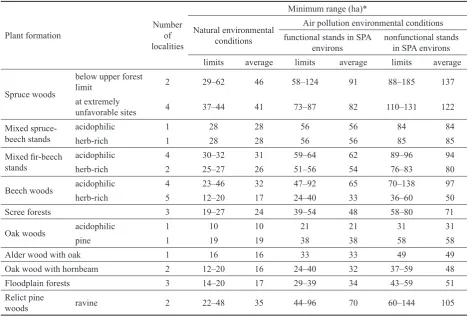
The area of minimum range is markedly different for natural environmental conditions and for various air pol-lution environmental and stand conditions. In Table 2 it is given for:
– natural environmental conditions,
– existing air pollution environmental conditions with relatively functional stands in the environs of evaluated SPA that are not a serious hazard for them (the area of minimum range = the area of minimum range for natural conditions multiplied by 2),
– existing air pollution environmental conditions with minimally ecologically functional stands in the envi-rons of evaluated SPA, e.g. as a result of: high occur-rence of clearcuts, expansion of insect pests, etc. (the area of minimum range = the area of minimum range for the existing air pollution environmental conditions
with relatively functional stands in the environs of evaluated SPA multiplied by 1.5).
Table 2 shows the areas of minimum ranges calculated on the basis of field surveys for NP, PLA and NFA and plant formations.
Minimum ranges were derived for lands of approxi-mately circular, square and rectangular shape (side ratio max. 1:3). The area of minimum range for the given envi-ronmental conditions should be enlarged in a band-shaped territory (ca. 1.5 times at a side ratio 1:4–6; ca. twice at a ratio 1:7–10; the shapes with side ratio higher than 1:10 are not suitable for forests left to spontaneous develop-ment due to great ecotonal effects).
CONCLUSION
The proposed method of determining a minimum range of forest stands capable of spontaneous development, which was verified in selected stands of SPA within research, seems to be one of the possible methodical approaches to solve this methodically difficult task. In relatively natural conditions minimum ranges for SPA of compact shapes are from 10 to 62 ha, in the existing environmental conditions with relatively functional stands in the environs of evalu-ated SPA from 21 to 124 ha and in the existing air pollution environmental conditions with relatively non-functional stands in the environs of studied SPA from 31 to 185 ha. In spruce woods the areas of minimum ranges in relation to the environmental conditions are on average between 41 and 137 ha, in mixed spruce-beech and fir-beech stands between 28 and 94 ha, in beech woods between 17 and 97 ha, in oak woods 10–58 ha, in oak woods with hornbeam 16 – 48 ha, in floodplain forests between 17 and 51 ha and in relict pine woods 35 – 105 ha. The framework results of the derived minimum ranges from 36 localities, differentiated according to plant formations, site and stand conditions of the environment, should be verified and extended in a larger spectrum of SPA in different NFA.
References
AMBROS Z., 1988. Vybrané kapitoly pro Uživatelskou příručku registru biogeografie ISÚ. Praha, Terplan.
CLARK P., EVANS F.C., 1954. Distance to nearest neighbour as a measure of spatial relationship in populations. Ecology, 35: 445–453.
GROSSER K.H., FISCHER W., MANSIK K.H., 1967. Vegeta-tionskundliche Grundlagen für die Erschliessung und Pflege eines Systems von Waldreservaten Naturschutzarbeit in Berlin und Brandenburg. Beiheft 3, Postdam: 97.
HEYDEMANN B., 1981. Zur Frage der Flächengrössen von Biotopbeständen für den Artenschutz und Ökosystemschutz. Jb. Naturschutz und Landschaftspflege, 31: 21–51.
JENÍK J., 1979. Ecological meaning of stability. In: Stability of spruce forest ecosystems. Symposium MAB, Brno: 7–15. KORPEĽ Š., 1989. Pralesy Slovenska. Bratislava, Veda: 328. KOS J., MARŠÁKOVÁ M., 1997. Chráněná území České
republiky. Praha, AOPK ČR: 191.
LEIBUNDGUT H.,1959. Über Zweck und Methodik der Struktur und Zuwachsanalyse von Urwäldern. Schweiz. Z. Forstwes., 110 (3): 111–124.
MACKŮ J., MÍCHAL I., 1990. Minimální velikost lesních biocenter. Lesnictví, 36: 707–717.
MAYER H., 1972. Der Urwaldrest Neuwald beim Lahnsattel. Cbl. Ges. Forstwes., 89 (3): 147–190.
MAYER H., 1976. Gebirgswaldbau-Schutzwaldpflege. Stuttgart, GFV: 436.
NIEMENN E., 1968. Gedanken zur Problematik von Totalre-servaten in Wäldern. Arch. Naturschutz Landsch.-Forsch., 8 (4): 213–224.
PRŮŠA E., 1985. Die böhmischen und mährischen Urwälder. Vegetace ČSSR, A15. Praha, Academia: 577.
PRŮŠA E., 1986. Návod pro plánování obnovy lesa v chráněných územích. Praha, SÚPPOP: 88.
POZNAŃSKI R., JAWORSKI A., 2002. Nowoczesné metody gospodarowania w lasach gorskich. Warszawa, Centrum in-formacyjne Lasow panstwowych: 228.
REJMÁNEK M., 1979. Stability and complexity in biotic communities: theoretical and empirical approach. In:
Fifth Intern. Symp. Probl. Ecol. Land. Res., Bratislava: 65–72.
SCAMONI A., 1953. Naturwaldzellen. Natur u. Heimat, 62 (6): 176.
SEIBERT P., HAGEN J., 1974. Zur Auswahl von Waldreservaten in Bayern. Forstwiss. Cbl., 95 (5): 274–284.
ŠINDELÁŘ J., 1984. Opatření k záchraně a reprodukci geno-fondu lesních dřevin v lesním hospodářství ČSR. Jíloviště--Strnady, VÚLHM, Lesn. Prův., 2: 94.
VACEK S., 2000. Struktura, vývoj a management lesních eko-systémů Krkonoš. [Doktorská disertační práce.] VÚLHM, VS Opočno: 684.
VACEK S. et al., 2003. Mountain forests of the Czech Republic. Praha, MZe: 320.
ZLATNÍK A., 1968. Teoretická kritéria pro výběr a rozlohu chrá-něných území. Českoslov. Ochr. Prír., Bratislava: 31–42. ZLATNÍK A., 1970. Chráněná území, zvláště rezervace a jejich
hospodářské a společenské funkce v krajině. Lesnictví, 16: 857–867.
ZUKRIGEL K., ECKHART G., NATHER J., 1963. Standort-skundliche und waldbauliche Untersuchungen in Urwaldresten der niederösterreichischen kalkalpen. Mitt. FBVA – Marian-brunn, 62: 244.
Received for publication April 22, 2003 Accepted after corrections May 16, 2003
Minimální výměra lesů v chráněných územích pro ponechání samovolnému vývoji
S. VACEK
Výzkumný ústav lesního hospodářství a myslivosti, Výzkumná stanice Opočno, Česká republika
ABSTRAKT: Řešení problematiky ekologických kritérií pro rozhodování o ponechání lesů ve zvláště chráněných územích spontánním procesům vychází z poznání přírodních zákonitostí původních či přírodních lesů. Jedná se především o relativní stálost druhového složení společenstev, relativní různověkost, relativní vyrovnanost dřevní zásoby a relativní maloplošnost jednotlivých vývojových fází a stadií. Jejich výsledkem je udržení ekologické samostatnosti a vyrovnanosti přírodního lesa, pro něž je základní podmínkou stanovení minimálního areálu (výměry) porostu, při které se populace ještě udržují autoregulací. Vlastním výstupem práce bylo vytvoření aplikovatelné metodiky a prověření její použitelnosti na 36 lokalitách ve smrčinách, bučinách, smíšených porostech, suťových lesích, doubravách, lužních lesích a borech (v NPŠ, KRNAP, CHKO Broumovsko, CHKO Český kras, CHKO Jizerské hory, v přírodních rezervacích v Podorlicku a Polabí). Jednalo se přitom zejména o tvorbu minimálních areálů pro přirozené podmínky prostředí a pro dvě situace v současných imisně ekologických poměrech.
Klíčová slova: chráněná území; přírodní lesy; spontánní procesy; autoregulace; minimální areál
Řešení problematiky ekologických kritérií pro rozho-dování o ponechání lesů ve zvláště chráněných územích spontánním procesům vychází z poznání zákonitostí původních či přírodních lesů, zejména pak z posouzení jejich základních znaků a vlastností. Jedná se především o relativní stálost druhového složení společenstev,
relativ-ní různověkost, relativrelativ-ní vyrovnanost dřevrelativ-ní zásoby a rela-tivní maloplošnost jednotlivých vývojových fází a stadií.
život-ními procesy za předpokladu, že se výrazně nezmění stanovištní a porostní podmínky (JENÍK 1979; KORPEĽ 1989; VACEK 2003). Modelovým objektem pro výzkum ekologické samostatnosti a vyrovnanosti jsou původní a přírodní lesy. V našich podmínkách se jedná především o NPR, PR, I. zóny NP a CHKO. Zejména původní lesy se v dynamické rovnováze udržují svým druhovým slo-žením, specifickou prostorovou a věkovou strukturou. Přírodní lesní společenstva jako ucelený komplex živých organismů na nejvyšší hierarchické úrovni otevřených systémů mají totiž výraznou tendenci k homeostázi (JENÍK 1979; ZLATNÍK 1970; REJMÁNEK 1979; PRŮŠA 1985). Ta poměrně pohotově reaguje na rušivé vlivy prostředí vytvořením specifické konstelace podmínek, znaků a složek, které jsou zárukou další existence pů-vodního lesa, kontinuálně navazujícího na současný stav ekosystémů (VACEK 2000).
Přírodě blízké způsoby managementu či péče o ZCHÚ v některých případech mohou znamenat vyšší náklady či určité omezení vlastníka. Proto při rozhodování o po- nechání lesů ve ZCHÚ spontánním procesům je třeba vycházet z vícekriteriální analýzy. Z ekologických krité-rií je přitom nejvýznamnější stanovení tzv. minimálního areálu, tj. minimální výměry a tvaru lesního ekosystému schopného autoregulace. Z ekonomického hlediska se jedná o minimální výměru lesních porostů, kde bude vlastník potenciálně omezován.
Cílem práce bylo vytvoření aplikovatelné metodiky pro stanovení minimálních areálů lesních ekosystémů schopných samovolného vývoje ve vybraných ZCHÚ a ověření její použitelnosti diferencovaně podle rostlin-ných formací a stanovištních a porostních podmínek.
Řešení bylo zaměřeno zejména na reprezentativní lesní ekosystémy (prvního, popř. i druhého stupně přirozenos-ti lesních porostů) v různých přírodních a regionálních podmínkách národních přírodních rezervací, zaujímají-cích v ČR 26 435 ha, přírodních rezervací (25 675 ha) a I. zón národních parků (16 610 ha), a to zejména v Kr-konoších, na Šumavě, v Jizerských horách, v Orlických horách, v Sudetském mezihoří, v předhoří Orlických hor, v Polabí a v Českém krasu.
Při analýze ekologických kritérií pro rozhodování o ponechání lesů spontánním procesům byly získávány poznatky o parametrech přirozených lesních ekosys-témů, které si udržují nebo si za určitých podmínek mohou udržovat časově neomezenou životaschopnost. V centru naší pozornosti bylo zejména ekostabilizační působení lesních ekosystémů, jež spočívá i v jejich schopnosti odolávat účinkům škodlivých činitelů, tlu-mit vlivy škodlivých činitelů ve svém okolí a vyrovná-vat vzniklé ekologické poruchy. Ekostabilizační účinky lesních ekosystémů jsou dány především úplností, nena-rušeností a velikostí lesních ekosystémů, tj. druhovou, ekotypovou, věkovou a prostorovou skladbou i plochou daného typu lesního systému v závislosti na jeho okol-ním prostředí.
Terénní analýzy vycházely z dendroekologických re-akcí jednotlivých druhů dřevin v rámci textury porostů.
V rámci základních dendrometrických rozborů na vy-braných plochách byly u všech individuí dřevin měřeny: tloušťka kmenů ve výši 1,3 m, ve dvou poloměrech na sebe kolmých s přesností na 1 mm, výška stromů výš-koměrem s přesností 0,5 m (pouze u vybraných jedinců podle stromových tříd). U ležících odumřelých stromů byla podle stejných zásad měřena jejich střední tloušťka a délka. Pro studium věkové struktury byly u vybraných jedinců odebrány vývrty Presslerovým nebozezem. Vý-vrty byly analyzovány na letokruhovém analyzátoru.
Zásadní metodický způsob semikvantitativního hodno-cení dalších strukturních a morfologických znaků (ceno-tické postavení, olistění, stupeň uvolnění koruny, paramet-ry zmlazení apod.) spočíval v dokonalosti jejich odhadu.
Pro vlastní diferenciaci ploch byl dále posouzen lesní typ, stupeň přirozenosti lesních porostů a stupeň poško-zení porostu.
Minimální velikost lesního ekosystému schopného samovolného vývoje byla odvozována a ověřována na základě následujících metod:
– nulového přírůstu, – vývojových stadií,
– indexů diverzity dřevinného patra, – maximálního věku dožití dřevin,
– značně prodlouženého obmýtí v lese normálních věkových stupňů.
Při rozsáhlých terénních šetřeních bylo zjištěno, že žádná z popsaných metodik není z mnoha příčin v podmínkách současného stavu našich chráněných území v původní verzi použitelná. Tyto metodiky byly vypracovány zejména pro lesní ekosystémy v přiroze-ných podmínkách prostředí, resp. pro pralesy (zejména v Karpatech), některé z nich nebyly experimentálně ověřeny v praxi a tedy poskytovaly neadekvátní vý-sledky. Problematická použitelnost těchto metodik je dána zejména nedostatečnou velikostí většiny stáva-jících ZCHÚ s víceméně výraznými odchylkami od jejich přirozené druhové, věkové i prostorové skladby, sníženým odolnostním potenciálem těchto porostů a ne-přiměřenými způsoby obhospodařování v nich (často se jedná či jednalo i o dlouhodobé narušování spontánních procesů).
Proto byly hledány postupy, jak zajistit tento meto-dicky velmi náročný úkol stanovení minimálního areálu lesních ekosystémů. Po konzultacích s předními odbor-níky na strukturu a vývoj přírodních lesních ekosystémů (zejména pak s prof. Korpeľem a prof. Jaworským) byla zvolena metodika vycházející ze zastoupení věkových stupňů. Vycházela z následující úvahy:
– plocha minimálního areálu = suma ploch jednotlivých dřevin přirozené skladby,
Plocha minimálního areálu se značně liší pro přirozené podmínky prostředí a pro různé imisně ekologické a po-rostní podmínky. V tab. 2 je proto uvedena pro:
– přirozené podmínky prostředí,
– současné imisně ekologické podmínky prostředí s relativně funkčními porosty v okolí posuzovaného ZCHÚ, které neposkytují vážné riziko jejich ohrožení (plocha minimálního areálu se v tomto případě = ploše minimálního areálu pro přirozené podmínky prostředí × 2),
– současné imisně ekologické podmínky prostředí s minimálně ekologicky funkčními porosty v okolí posuzovaného ZCHÚ, a to např. z důvodu: značného výskytu holin, expanze hmyzích škůdců apod. (plocha minimálního areálu se v tomto případě = ploše mi-nimálního areálu pro stávající imisně ekologické pod-mínky prostředí s relativně funkčními porosty v okolí posuzovaného ZCHÚ × 1,5).
Minimální areály byly odvozeny pro plochy s při-bližně kruhovým, čtvercovým a obdélníkovým (poměr stran max. 1 : 3) tvarem. U území s charakterem pruhu je třeba plochu minimálního areálu pro dané podmín-ky prostředí dále zvětšit (při poměru stran 1 : 4–6 ca 1,5krát; při poměru 1 : 7–10 ca 2krát; tvary s poměrem stran vyšším než 1 : 10 nejsou vhodné pro ponechání
lesů samovolnému vývoji z důvodu značného podílu ekotonálních efektů).
Navržená a výzkumně ve vybraných porostech ZCHÚ ověřovaná metodika stanovení minimálního areálu porostů schopných samovolného vývoje se jeví jedním z možných metodických přístupů k řešení to-hoto metodicky velmi náročného úkolu. Pro relativně přirozené podmínky prostředí se minimální areály pro ZCHÚ semknutých tvarů pohybují v rozmezí 10–62 ha, pro současné ekologické podmínky prostředí s relativně funkčními porosty v okolí posuzovaných ZCHÚ v roz-mezí 21–124 ha a pro dosavadní imisně ekologické pod-mínky prostředí s relativně nefunkčními porosty v okolí studovaných ZCHÚ v rozmezí 31–185 ha. Ve smrčinách se plochy minimálních areálů v závislosti na podmín-kách prostředí pohybují v průměru mezi 41–137 ha, ve smíšených smrkobukových a jedlobukových porostech mezi 28–94 ha, v bučinách mezi 17–97 ha, v doubravách mezi 10–58 ha, v habrových doubravách mezi 16 až 48 ha, v lužních lesích mezi 17–51 ha a v reliktních borech mezi 35–105 ha. Získané rámcové výsledky od-vozených minimálních areálů z 36 lokalit, diferencovaně podle rostlinných formací, stanovištních a porostních podmínek prostředí, je potřebné dále ověřit a doplnit na větším spektru ZCHÚ v různých PLO.
Corresponding author:
Doc. RNDr. STANISLAV VACEK, DrSc., Výzkumný ústav lesního hospodářství a myslivosti, Výzkumná stanice Opočno, Na Olivě 550, 517 73 Opočno, Česká republika