ON THE CONSTRUCTION OF DECENTRALISED
SERVICE-ORIENTED ORCHESTRATION SYSTEMS
Ward Jaradat
A Thesis Submitted for the Degree of PhD at the
University of St Andrews
2016
Full metadata for this item is available in Research@StAndrews:FullText
at:
http://research-repository.st-andrews.ac.uk/
Please use this identifier to cite or link to this item: http://hdl.handle.net/10023/8036
On the Construction of Decentralised
Service-oriented Orchestration Systems
Ward Jaradat
This thesis is submitted in partial fulfilment for the degree of
Doctor of Philosophy
Abstract
Modern science relies on workflow technology to capture, process, and analyse data
ob-tained from scientific instruments. Scientific workflows are precise descriptions of
exper-iments in which multiple computational tasks are coordinated based on the dataflows
be-tween them. Orchestrating scientific workflows presents a significant research challenge:
they are typically executed in a manner such that all data pass through a centralised
com-pute server known as the engine, which causes unnecessary network traffic that leads to a
performance bottleneck. These workflows are commonly composed of services that
per-form computation over geographically distributed resources, and involve the management
of dataflows between them. Centralised orchestration is clearly not a scalable approach for
coordinating services dispersed across distant geographical locations. This thesis presents a
scalable decentralised service-oriented orchestration system that relies on a high-level data
coordination language for the specification and execution of workflows. This system’s
ar-chitecture consists of distributed engines, each of which is responsible for executing part
of the overall workflow. It exploits parallelism in the workflow by decomposing it into
smaller sub workflows, and determines the most appropriate engines to execute them using
computation placement analysis. This permits the workflow logic to be distributed closer
to the services providing the data for execution, which reduces the overall data transfer in
the workflow and improves its execution time. This thesis provides an evaluation of the
presented system which concludes that decentralised orchestration provides scalability
ben-efits over centralised orchestration, and improves the overall performance of executing a
Acknowledgements
I would like to express my sincere gratitude to my supervisor, Dr. Adam Barker, for his
constant patience and continuous guidance throughout my doctoral studies. I am also
espe-cially indebted to Prof. Alan Dearle, who taught me a great deal about being a true computer
scientist. This thesis would not have seen the light without their invaluable advice and
ex-cellent knowledge.
During my time at the School of Computer Science, I have had the pleasure to work
along-side remarkable academics in a challenging research environment. Thanks to all the people
who inspired, supported, and encouraged me in St Andrews, the beautiful town I have
con-sidered my home for the past few years. These years have been profoundly rewarding and
have changed me, hopefully, to a better person.
Of course, I am deeply grateful to my family. I would not be the person I am without
the love of my parents, my greatest teachers. They deserve more respect and praise than
I can express in a few short words. Special thanks to Shaden, my brother and source of
Declarations
I, Ward Jaradat, hereby certify that this thesis, which is approximately 61,500 words in
length, has been written by me, and that it is the record of work carried out by me, and that
it has not been submitted in any previous application for a higher degree. I was admitted as
a research student and as a candidate for the degree of Doctor of Philosophy in May 2011;
the higher study for which this is a record was carried out in the University of St Andrews
between 2011 and 2015.
Date: Signature of candidate:
I hereby certify that the candidate has fulfilled the conditions of the Resolution and
Reg-ulations appropriate for the degree of Doctor of Philosophy in the University of St Andrews
and that the candidate is qualified to submit this thesis in application for that degree.
Permission for Electronic Publication
In submitting this thesis to the University of St Andrews I understand that I am giving
permission for it to be made available for use in accordance with the regulations of the
Uni-versity Library for the time being in force, subject to any copyright vested in the work not
being affected thereby. I also understand that the title and the abstract will be published,
and that a copy of the work may be made and supplied to any bona fide library or research
worker, that my thesis will be electronically accessible for personal or research use unless
exempt by award of an embargo as requested below, and that the library has the right to
migrate my thesis into new electronic forms as required to ensure continued access to the
thesis. I have obtained any third-party copyright permissions that may be required in order
to allow such access and migration, or have requested the appropriate embargo below.
The following is an agreed request by candidate and supervisor regarding the publication of
this thesis:Access to printed and electronic publication of this thesis through the University
of St Andrews.
Date: Signature of candidate:
Publications
Some of the ideas presented in this thesis have been published in academic journal,
confer-ence and workshop articles. These articles are listed as follows:
• Ward Jaradat, Alan Dearle, and Adam Barker. Towards an autonomous decentralised
orchestration system. Concurrency and Computation: Practice and Experience (2015).
• Ward Jaradat, Alan Dearle and Adam Barker. Workflow Partitioning and Deployment
on the Cloud using Orchestra. In Proceedings of the 7th IEEE/ACM International
Conference on Utility and Cloud Computing(UCC 2014), pages 251-260, IEEE
Com-puter Society, 2014.
• Ward Jaradat, Alan Dearle and Adam Barker. A Dataflow Language for Decentralised
Orchestration of Web Service Workflows. In Proceedings of the IEEE Ninth World
Congress in Services(SERVICES 2013), pages 13-20, IEEE Computer Society, June
2013.
• Ward Jaradat, Alan Dearle and Adam Barker. An Architecture for Decentralised
Or-chestration of Web Service Workflows. In Proceedings of IEEE 20th International
Conference on Web Services(ICWS 2013), pages 603-604, IEEE Computer Society,
Table of Contents
Abstract iii
Acknowledgements v
Declarations vii
Permission for Electronic Publication ix
Publications xi
Table of Contents xv
List of Figures xxi
List of Tables xxv
1 Introduction 1
1.1 Research Statement . . . 10
1.2 Research Challenges . . . 11
1.2.1 Design Challenges . . . 11
1.2.2 Decentralised Service Orchestration Challenges . . . 12
1.2.3 Global Computation Challenges . . . 12
1.3 Research Hypothesis . . . 14
1.4 Research Contributions . . . 15
1.4.1 Primary Contributions . . . 15
1.4.2 Secondary Contributions . . . 16
1.4.3 Tertiary Contributions . . . 17
1.5 Preview of Research Solution . . . 17
1.6 Glossary of Terms . . . 20
xvi Table of Contents
1.8 Conclusion . . . 23
2 Literature Review 25 2.1 Introduction . . . 25
2.2 Service Computing . . . 26
2.2.1 Web Services . . . 28
2.2.2 Web Service Model and Related Standards . . . 33
2.2.3 Central Limitations of the Web Service Model . . . 37
2.2.4 Web Service Specifications . . . 38
2.3 Workflows . . . 39
2.3.1 Scientific Workflows . . . 40
2.3.2 Design Patterns of Scientific Workflows . . . 41
2.3.3 Lifecycle of Scientific Workflows . . . 44
2.3.4 Workflow Management Systems . . . 48
2.4 Service Orchestration . . . 50
2.4.1 Centralised Service Orchestration System Architectures . . . 50
2.4.2 Decentralised Service Orchestration System Architecture . . . 53
2.5 Service Orchestration Cost Models . . . 54
2.5.1 Mathematical Notation . . . 54
2.5.2 Preliminaries . . . 55
2.5.3 Cost Model for Centralised Service Orchestration . . . 56
2.5.4 Cost Model for Decentralised Service Orchestration . . . 60
2.6 Review of Workflow Technologies . . . 64
2.6.1 Workflow Management Systems . . . 64
2.6.2 Workflow Languages . . . 73
2.6.3 Dataflow Optimisation System Architectures . . . 82
2.6.4 Workflow Scheduling . . . 84
2.6.5 Related Surveys . . . 86
2.7 Requirements Analysis . . . 88
2.7.1 Global Scientific Collaboration . . . 88
2.7.2 Usability Support . . . 89
2.7.3 Service Interoperability Support . . . 90
2.7.4 Parallelism Support . . . 90
2.7.5 Scalability Support . . . 91
2.7.6 Deployment and Optimisation Support . . . 92
2.7.7 Reusability Support . . . 93
Table of Contents xvii
2.7.9 Dynamic Reconfiguration Support . . . 94
2.8 General Discussion . . . 95
2.9 Conclusion . . . 97
3 TheWeb Service OrchestraLanguage 99 3.1 Introduction . . . 99
3.1.1 Language Overview . . . 100
3.1.2 General Syntax . . . 104
3.2 Design of theOrchestraLanguage . . . 108
3.2.1 Guiding Principles . . . 108
3.2.2 Design Methodology . . . 109
3.2.3 Language Grammatical Rules . . . 110
3.2.4 Dataflow Computation Model . . . 113
3.3 Service Composition . . . 116
3.3.1 Pipeline Pattern Specification . . . 116
3.3.2 Data Aggregation Pattern Specification . . . 117
3.3.3 Data Distribution Pattern Specification . . . 119
3.4 Distributed Computation . . . 121
3.5 Type System and Data Structures . . . 122
3.5.1 Base Types and Scalars . . . 123
3.5.2 Data Structures . . . 123
3.6 Conclusion . . . 127
4 System Architecture Design 129 4.1 Introduction . . . 129
4.1.1 Architecture Overview . . . 130
4.1.2 Interactions and Configuration of Components . . . 132
4.2 Engine Design . . . 134
4.2.1 Description of the Engine’s Internal Modules . . . 134
4.2.2 Interactions of the Engine’s Internal Modules . . . 137
4.3 Decentralised Orchestration Stages . . . 138
4.3.1 Compilation . . . 139
4.3.2 Partitioning . . . 139
4.3.3 Network Resource Monitoring . . . 142
4.3.4 Placement Analysis . . . 144
4.3.5 Deployment and Execution . . . 147
xviii Table of Contents
4.4 Decentralised Service Orchestration Scenario . . . 149
4.4.1 Workflow Specification Example . . . 150
4.4.2 Workflow Orchestration Example . . . 152
4.5 Conclusion . . . 163
5 Reference Implementation 165 5.1 Introduction . . . 165
5.2 Engine Interface . . . 166
5.3 Engine States . . . 169
5.4 Construction of Engine Modules . . . 174
5.4.1 Compiler Module . . . 174
5.4.2 Partitioner Module . . . 189
5.4.3 Network Resource Monitoring Module . . . 195
5.4.4 Placement Analysis Module . . . 199
5.4.5 Deployment Module . . . 201
5.4.6 Execution Module . . . 203
5.4.7 Datastore Module . . . 203
5.5 Conclusion . . . 204
6 Evaluation 205 6.1 Introduction . . . 205
6.2 Examination of Hypothesis . . . 206
6.2.1 Scope . . . 206
6.2.2 Rationale . . . 207
6.2.3 Scalability Dimensions . . . 208
6.3 Experimental Apparatus . . . 211
6.3.1 Experimental Environment . . . 212
6.3.2 Hardware Specifications . . . 215
6.3.3 Software Specifications . . . 216
6.3.4 Experimental Environment Setup . . . 217
6.4 Experimental Methodology . . . 220
6.5 Experiments . . . 222
6.5.1 Experimental Configuration . . . 223
6.5.2 Effect of Engine Locality . . . 224
6.5.3 Pipeline Pattern Evaluation . . . 227
6.5.4 Data Aggregation Pattern Experiments . . . 229
Table of Contents xix
6.5.6 End-to-end Workflow Experiment . . . 234
6.5.7 Measurement of Compilation and Partitioning Times . . . 236
6.6 General Discussion . . . 237
6.6.1 Summary of Experimental Results . . . 238
6.6.2 Environmental and Network Factors . . . 240
6.6.3 Evaluation Limitations . . . 244
6.7 Conclusion . . . 248
7 Conclusion and Future Research 251 7.1 Introduction . . . 251
7.2 Thesis Motivation . . . 252
7.3 Thesis Hypothesis . . . 253
7.4 Thesis Summary . . . 254
7.5 Review of Contributions . . . 254
7.6 Future Research Directions . . . 257
7.6.1 Further Evaluation . . . 257
7.6.2 Dynamic Optimisation . . . 258
7.6.3 Real-time Distributed Monitoring of Network Resources . . . 259
7.6.4 Constraint-based Partitioning and Deployment . . . 260
7.6.5 Failure Handling and Recovery . . . 261
7.7 Concluding Remarks . . . 261
List of Figures
1.1 Example of a smallEpigenomicsworkflow. . . 4
1.2 Example of a smallMontageworkflow. . . 5
1.3 Example of a small inspiral analysis workflow. . . 6
1.4 Example of a smallCyberShakeworkflow. . . 7
1.5 High-level preview of the research solution. . . 19
2.1 A web service consuming, analysing, and producing messages. . . 28
2.2 The publish-find-bind web service architecture model. . . 33
2.3 UML diagram of the service description document based on WSDL. . . 35
2.4 Sequence diagrams of Message Exchange Patterns (MEPs). . . 36
2.5 The process pattern. . . 42
2.6 The pipeline pattern. . . 43
2.7 The data aggregation pattern. . . 43
2.8 The data distribution pattern. . . 44
2.9 Scientific workflow lifecycle adapted from Deelman et al. [121]. . . 46
2.10 Generic workflow management system. . . 49
2.11 Sequence diagrams of service invocations. . . 56
2.12 Sequence diagram of the pipeline pattern based on centralised orchestration. 57
2.13 Sequence diagram of the data aggregation pattern based on centralised
or-chestration. . . 58
2.14 Sequence diagram of the data distribution pattern based on centralised
or-chestration. . . 59
2.15 Sequence diagram of the pipeline pattern based on decentralised orchestration. 61
2.16 Sequence diagram of the data aggregation pattern based on decentralised
orchestration. . . 62
2.17 Sequence diagram of the data distribution pattern based on decentralised
xxii List of Figures
3.1 Dataflow graph of a simple service invocation. . . 104
3.3 UML diagram of the service description document used in Listing 3.1. . . . 106
3.5 Dataflow graph of services composed in a serial manner. . . 116
3.7 Dataflow graph of services composed using the aggregation pattern. . . 118
3.9 Dataflow graph of services composed using the distribution pattern. . . 120
4.1 Decentralised orchestration architecture. . . 131
4.2 The execution engine’s internal modules and their interactions. . . 135
4.3 Workflow partitioning algorithm. . . 141
4.4 Placement analysis algorithm. . . 145
4.5 Placement analysis example. . . 146
4.6 A Directed Acyclic Graph (DAG) workflow. . . 149
4.8 Orchestration of the workflow specification provided in Listing 4.7. . . 153
4.9 Sub workflows after decomposing the workflow shown in Figure 4.6. . . 156
4.10 Composite workflow that corresponds to partition (P1) in Figure 4.8. . . 158
4.11 Composite workflow that is corresponds to partition (P2) in Figure 4.8. . . . 158
4.12 Composite workflow that corresponds to partition (P3) in Figure 4.8. . . 159
5.2 Finite-state machine diagram of the engine states and their transitions. . . . 170
5.3 Class diagram showing the main classes and packages used to implement
the compiler. . . 176
5.4 Dataflow graph structure based on the workflow example in Figure 4.6. . . 180
5.5 Class diagrams showing the classes of the symbol table package. . . 181
5.6 Class diagram showing classes of the symbols package. . . 183
5.7 Class diagram showing the classes of simple and record data type
represen-tations package. . . 184
5.8 Class diagram showing the classes of service-based type representations
package. . . 186
5.9 Class diagram showing the classes of error registry package. . . 189
5.10 Dataflow graphs based on the sub workflows in Figure 4.9. . . 192
5.11 Dataflow graph that represents the workflow in Figure 4.10. 193
5.12 Dataflow graph that represents the workflow shown in Figure 4.11. 194
List of Figures xxiii
5.14 Class diagram showing the workflow partitioning and placement analysis
classes. . . 202
6.1 Geographic network regions ofAmazon Elastic Compute Cloud(EC2). . . 213
6.2 Round-trip times for invoking a service in N.Virginia. . . 225
6.3 Network latency and bandwidth readings. . . 226
6.4 Orchestration of pipeline pattern workflows. . . 228
6.5 Orchestration of data aggregation pattern workflows. . . 231
6.6 Orchestration of data distribution pattern workflows. . . 234
6.7 Structure of an end-to-end workflow application. . . 235
6.8 Experimental results for orchestrating an end-to-end workflow that
List of Tables
2.1 Elements of a service description document. . . 35
4.1 Placement of sub workflows shown in Figure 4.9 onto candidate engines. . 157
4.2 Composition of sub workflows shown in Figure 4.9. . . 157
5.1 Mapping of XML schema built-in data types toOrchestra. . . 188
6.1 Summary of virtual machine types used in the experiments. . . 216
6.2 Summary of network metrics between the engines and the service in N.
Virginia. . . 226
6.3 Configuration of services used in pipeline pattern workflows. . . 227
6.4 Summary of average speedup for orchestrating pipeline pattern workflows. . 229
6.5 Configuration of services used in data aggregation pattern workflows. . . . 230
6.6 Summary of average speedup for orchestrating data aggregation workflows. 232
6.7 Configuration of services used in data distribution pattern workflows. . . 233
6.8 Summary of average speedup for orchestrating data distribution workflows. 233
6.9 Summary of the average compilation and partitioning times for some
Chapter 1
Introduction
Since ancient times scientists have attempted to reshape the conceptual landscape through
which they comprehend the world. Early empirical scientists such as Newton, Galileo,
Hooke and others were not only considered polymaths but also craftsmen of instruments
with which scientific discoveries are made. Such instruments were not only used in
conduct-ing research but also helped in establishconduct-ing new scientific frontiers by exposconduct-ing unknown
phenomena or revealing bizarre observations that contradict with existing theories. It is
therefore safe to argue that the examination of such instruments, their engineering and
con-struction is valuable to the progression of science. In the 21stcentury, modern science relies
on software instruments or tools to complement theory and experiment through capturing,
curating and analysing data that comes in different forms covering scientific observations
and experimental results. For example, computer simulations have become essential for
scientists to explore domains that are inaccessible to theory and experiment such as the
evolution of the universe, and predicting climate change according to Bell et al. [1].
Sci-entific data may be captured and processed along with computer-generated information that
is most likely to reside in a curated state for continuous experimentation, and analysis over
a period of time. However, some scientific areas are facing a rapid expansion of data
ob-tained from instruments (e.g. satellites, telescopes, sensor networks, and supercomputers),
and generated from experimental simulations [2]. Simulations in the field of astronomy may
2 Introduction
ever more data, afourth paradigm is emerging, consisting of techniques and technologies
needed to perform data-centric science. Scientific experiments must be managed easily
us-ing scalable data processus-ing methods that may be beyond the skill set of many scientists
(e.g. astronomers, bioinformaticians, and chemists).
Modern scientific experiments are typically specified as a set of computational tasks in
a precise order known as aworkflow. Each task represents the execution of a process that
accepts an input data set and produces a result that may be consumed by subsequent tasks.
The principal objective of using workflows is to liberate scientists from the laborious
rou-tine of processing and analysing data so they can focus on scientific research and discovery.
There are a number of benefits of using workflows. Firstly, a workflow provides a
system-atic method of conducting analysis across diverse datasets and applications. Secondly, a
workflow provides the ability to gather datasets captured from scientific instruments from
low-cost sensors to supercomputers, and employs resources to perform computational tasks
over gathered data. Thirdly, a workflow captures the steps of an experiment and its
asso-ciated results. This permits scientists to use pre-cooked workflows to conduct experiments
repeatedly and reproduce results as needed using the latest data sources when required.
Finally, workflows permit the integration of independent computation and data resources
from different providers. They are becoming essential for enabling science and facilitating
the collaboration between scientists over shared data and computation resources on a global
scale, and extracting computational knowledge.
Goble and De Roure argue that applying computational workflow technology to
data-centric scientific research is crucial [4]. This is because workflow technology provides
systematic and automated means of conducting analysis over data and across different
ap-plications, and permits the scientific process (e.g. experiment) to be captured and executed
repeatedly to reproduce results. This helps scientists to review the experimental results,
and refine the experiment by introducing modifications to the workflow as necessary. The
same workflow technology used in executing experiments and capturing their results have
resulted in an unprecedented explosion of data that is commonly known as thedata deluge.
3
the data deluge. Callaghan et al. [6] discuss how the growth of data increases the
complex-ity of managing the execution of scientific workflow applications. There are many examples
of large-scale scientific projects that rely on workflows. For example, the Panoramic
Sur-vey Telescope and Rapid Response System(Pan-STARRS) [7] project focuses on detecting
potentially hazardous objects in the solar system using telescope technology that captures
terabytes of images per year which are processed using the Trident [8] workflow
manage-ment system. The Low Frequency Array for Radio Astronomy (LOFAR) [9] is another
project example that permits scientists to detect coronal mass ejections from the Sun, and
produce maps of the solar winds. Such information is crucial to predict geomagnetic storms
and their effect on Earth. This project relies on interferometric array of radio telescopes
based on thousands of small antennas distributed across Europe. It involves processing data
captured in real-time from different stations connected through a wide-area network using
the IBM Blue Gene/P supercomputer [10]. The Collaborative Adaptive Sensing of the
At-mosphere (CASA), and the Linked Environments for Atmospheric Discovery (LEAD) are
complementary projects that aim to study weather phenomena such as storms and tornados
[11]. The CASA project provides a distributed, collaborative, sensor network of low-power,
and high-resolution radars, whereas the LEAD project provides a service-oriented workflow
management system that is designed to support on-demand analysis of data obtained from
the sensor network. The projects described above employ large-scale workflows that involve
capturing, processing, analysing and generating data. Gordon et al. [1] argue that there is
no generic data-centric solution that is readily available to cope with workflows of this kind
of complexity which may involve this amount of experimental data.
Scientific workflows are typically modelled asDirected Acyclic Graph(DAG) in which
the vertices are tasks with directed edges between them as data dependencies that indicate
the data movement in and out of tasks. Bharathi et al. [12] provides a set of scientific
workflows that are taken from thePegasus[13] project. This thesis describes the structure of
these workflows which are composed of common dataflow patterns that include the pipeline,
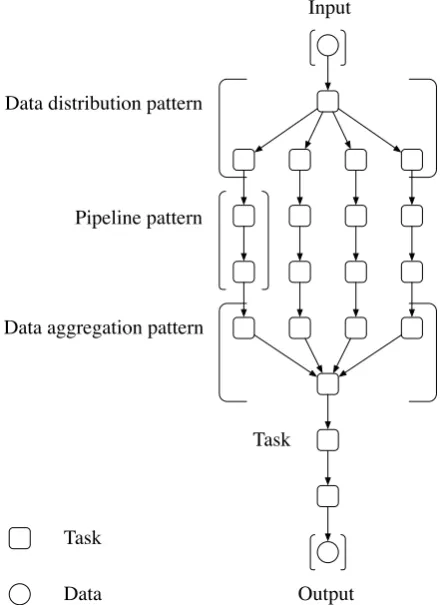
data aggregation and distribution patterns. The pipeline pattern is used to compose workflow
4 Introduction
The data aggregation pattern is used for collecting outputs from different tasks, and passing
them all as inputs to a single task that acts as a data sink. The data distribution pattern
is used for distributing the output of a single task that acts as a data source to multiple
subsequent tasks as an input. This thesis provides a detailed discussion of these patterns in
Section 2.3.2. It is essential to note that the workflow examples provided below are only
used to describe the general structure of scientific workflows, and they are not used as use
case studies for evaluation purposes in this thesis.
• Biology: Geneticists use workflows to perform genetic sequencing, which represents
a process that determines the precise order of nucleotides within a genetic molecule.
Epigenomicsis an example of such workflows, which is used to automate the
execu-tion of various gene sequencing operaexecu-tions [12]. Figure 1.1 shows the structure of a
smallEpigenomicsworkflow as depicted in [12]. In this workflow, a generated dataset
Input
Data distribution pattern
Data Task
Output Data aggregation pattern
Pipeline pattern
[image:31.595.182.403.406.709.2]Task
5
by a genetic analyser component is split into parts that can be processed in parallel.
Each part is then converted into an appropriate format for processing in a series of
tasks that include filtering out erroneous sequences, mapping sequences into the
cor-rect location in a reference genome, generating a global map and then determining the
sequence density at each position in the genome.
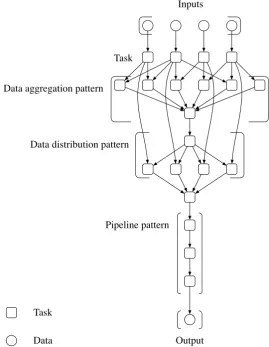
• Astronomy: Modern astronomers use workflows to generate sky mosaics from
im-ages collected using infrared telescopes to examine celestial objects [14]. Montage
represents an example of such workflows which consists of tasks that process,
anal-yse and manipulate input images to produce a single mosaic image. Figure 1.2 shows
a relatively small Montage workflow as depicted in [12]. During the production of
Inputs
Output Pipeline pattern
Data distribution pattern Data aggregation pattern
Task
[image:32.595.170.440.362.710.2]Data Task
6 Introduction
the mosaic image, its geometry is calculated from the geometry of the input images.
These input images are then re-projected to be of the same spatial scale and rotated
appropriately. Then, the background emissions (e.g. noise) in the images are then
modified in a manner such that level of these emissions is the same in all images.
Fi-nally, the re-projected images are combined to form the final mosaic image.Montage
is executed in grid environments [15], and can be highly data-intensive. For example,
it can be used to produce a mosaic of the galactic plane [16] from input images
pro-vided byNASA’s Telescope Missions(e.g. Spitzer). This involves 15.5 million tasks
and produces results of approximately 86 Terabytes.
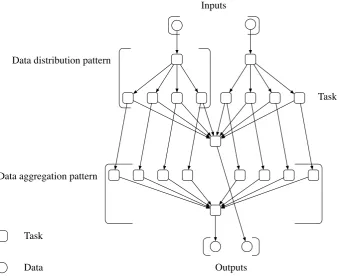
• Gravitational physics: Physicists use the Laser Interferometer Gravitational Wave
Observatory(LIGO) inspiral analysis workflow [17] shown in Figure 1.3 as depicted
in [12] to detect gravitational waves produced by certain cosmic events. These
gravi-tational waves were first predicted by Einstein’s general theory of relativity at a time
when the technology needed for their detection did not exist. For example, binary
sys-Data Task
Output Data aggregation pattern
Pipeline pattern
Inputs
[image:33.595.165.414.449.709.2]Data distribution pattern
7
tems (e.g. binary neutron stars) slowly inspiral as gravitational waves carry away
en-ergy and momentum, and consequently merge together forming bursts of short gamma
rays. This workflow takes a dataset obtained from the coalescing of binary systems
and splits it into smaller parts, where each part is analysed to generate data that
repre-sents waveforms belonging to a certain parameter space. During the workflow, several
tests may be performed over the data to detect a true inspiral.
• Seismology: Seismologists employ workflows to characterise earthquake hazards in a
specific geographic region using probabilistic techniques. CyberShakeis an example
of such workflows which produces synthetic seismograms from analysing data
col-lected by scientific instruments. Figure 1.4 shows the structure of a relatively small
CyberShake workflow as depicted in [12]. Once the data is analysed from the
scien-tific instruments, spectral acceleration and probabilistic hazard curves are generated.
This workflow commonly involves thousands of individual tasks that are typically
executed in a grid-based environment [18].
Inputs
Data distribution pattern
Task
Data Task
[image:34.595.136.476.436.713.2]Outputs Data aggregation pattern
8 Introduction
Service computing provides an approach to constructing and managing workflows by
composing loosely-coupled services together and orchestrating their work. Services are the
manifestations of integrated software components that can be exposed to a network by
logi-cal interfaces, which permit services to interact with their clients by exchanging messages in
a standard format. Creating a service involves describing the operations it supports, defining
the communication protocol used to invoke those operations and give results, and operating
a server machine to process incoming requests to the service. Service-oriented technology
can be beneficial to scientific applications. It is gaining wide acceptance in the industrial
domain, and therefore different services exist which may be distributed across many
ser-vice providers and hosted in different geographic locations. There are many commercial
and open-source tools for creating, deploying and operating services. Therefore, different
service implementations can exist and may be distributed across many providers, which
permits a scientist to select candidate services to fulfil the workflow tasks.
Parastatidis [19] discusses the potential of using service-oriented architectures in
es-tablishing a global knowledge-driven infrastructure that improves the process of scientific
research. This infrastructure must provide the right set of services to not only enable
sci-entists to access research data but also to expose computational services which operate on
that data. Scientists would be able to synthesise experiments using existing computational
services and data provided by this infrastructure. This infrastructure should also enable
scientists to ask questions related to their domain expertise, which may be answered by
other scientists or service-oriented knowledge engines. The myExperiment [20] project is
an example of a service-oriented infrastructure that demonstrates the benefits of capturing
and sharing scientific workflows, in addition to information about how these workflows are
used. However, an explicit limitation of using services is that their execution is bound to
the resource machines hosting them. This means that workflows must be mapped onto
ser-vices statically. Serser-vices are also agnostic of the existence of other serser-vices. This does not
permit services to collaborate with each other automatically. Hence, service-oriented
work-flows must be composed from a high-level design perspective that supports the interactions
9
Scientists commonly compose workflows using aworkflow languagethat provides a set
of abstractions for describing the workflow tasks (e.g. jobs) and the dependencies between
them (e.g. control and data flows). The result of this composition is aworkflow
specifica-tion that provides a logical model (e.g. abstract workflow) which defines structured tasks
to be executed in a specific order [21], [22], [23]. This workflow specification does not
include information about the physical resources used in the execution of the workflow, and
therefore it is processed and analysed using a tool that generates an execution plan (e.g.
concrete workflow), which maps each task in the workflow onto a computation service for
execution [21], [24], [25]. Such an execution plan describes the data transfer amongst the
services to support their collaboration. This thesis refers to the execution and management
of a workflow specification asservice orchestration, which relies typically on a centralised
compute server known as the workflow engine. The centralised workflow engine overseas
the interactions between services, provides control over the workflow, supports process
au-tomation, and encapsulates the workflow logic at a single location according to Erl [26]. It
exploits connectivity to the services by invoking their functionality using input data, and
collecting the invocation results. Furthermore, the engine is responsible for composing the
services participating in the workflow by routing data from one service to another based on
the workflow specification.
The remainder of this chapter is organised as follows: Section 1.1 presents the research
statement which describes the central research problem in centralised service orchestration,
and states the research question that is covered in this thesis. Section 1.2 identifies a set
of research challenges that this thesis attempts to address. Section 1.3 proposes a research
hypothesis that describes a possible solution based on a decentralised service orchestration
approach. Section 1.4 describes the research contributions presented in this thesis to the
body of knowledge in the area of service computing generally, and service orchestration
specifically. This section classifies the research contributions into primary and secondary
contributions. Section 1.5 provides a preview of the decentralised service orchestration
approach presented in this thesis. Section 1.6 provides the glossary of terms. Section 1.7
10 Introduction
1.1
Research Statement
This thesis attempts to address a research problem that focuses on a number of issues: the
design of scientific service-oriented workflows, and the scalability and optimisation of their
orchestration. These concepts are discussed as follows:
1. Scientists must be able to design (e.g. model) a service-oriented workflow easily.
There are a plethora of workflow languages for the specification of workflow tasks
(e.g. jobs) but most of which are focused on business-oriented workflows that are ill
suited to compose scientific workflows, and may require previous knowledge of how
the workflow is executed.
2. Most existing workflow management systems are based on a centralised orchestration
model to execute workflows. Centralised orchestration presents a significant
scalabil-ity problem as the workflow engine may become a performance bottleneck. During
the workflow’s execution, all data going to or coming from the services pass through
the engine. This leads to unnecessary network traffic that can consume the engine and
consequently disable it. For example, the engine may invoke a service that produces
a large data set which may be required by other services to perform further
computa-tional tasks. Such data will be received by the engine, which neglects the data after
forwarding it to the services that require it. This causes unnecessary network traffic,
and introduces additional load on the engine that leads to a single point of failure as the
number of services and data in the workflow increase. Hence, a scalable decentralised
solution is required to address the limitations of centralised service orchestration.
Based on the issues described above, an alternative approach must be discovered for
the specification, execution, and optimisation of service-oriented workflows. This thesis
investigates if it is possible to address the research problem by creating a high-level language
that permits service-oriented workflows to be specified easily, and a scalable system for
1.2 Research Challenges 11
1.2
Research Challenges
Jim Gray laid out a vision for afourth paradigmof science that is concerned with the
con-struction of new technology needed to perform data-intensive research as discussed in Hey
et al. [3]. This paradigm’s principal objective is to create a data-driven world in which
scientists can collaborate to solve research challenges using global computing and data
re-sources. Despite the huge potential of data-intensive science, it has been progressing slowly
due to the general lack of understanding of the essential means needed for its realisation by
the research community. This has motivated the author of this thesis to rethink the design
and construction of service orchestration systems by considering a set of challenges that are
classified as follows:
1. Challenges in designing scientific service-oriented workflows easily.
2. Challenges in decentralised service-oriented orchestration.
3. Challenges in global computation involving geographically distributed services.
1.2.1
Design Challenges
Ludäscher et al. argues that the principal objective of using workflows is to enable scientists
to compose and orchestrate workflows easily by reducing the effort required to construct
them [27]. Designing service-oriented workflows requires expertise that is often beyond
the skills of many researchers, which include programming knowledge, understanding of
service behaviour, the execution mechanism of the workflow. For example, researchers are
typically forced to use scripting languages to compose functionality provided by
indepen-dent software modules to perform tasks in a workflow context. Such modules may be written
in different programming languages, and this forces the researcher to think how these
mod-ules need to be interfaced instead of describing what functionality needs to be executed.
Due to this rigid programming approach, workflows may need to be written entirely from
scratch or modified when the implementation of the independent modules changes.
12 Introduction
control-flow structures. This increases the difficulty of composing large-scale workflows as
the researcher will be more concerned with the application-specific behaviour of the tasks
to be executed instead of describing the data flow dependencies required to execute the
tasks. Hence, workflow languages must provide high-level abstractions that permit
scien-tists to compose and orchestrate workflows easily without knowledge of how the workflow
is executed.
1.2.2
Decentralised Service Orchestration Challenges
Decentralisation is inherently more complicated to implement than centralised service
or-chestration due to the interactions between many distributed, asynchronous, and concurrent
service processes as according to Barker et al. [28]. For example, it presents a set of
re-search challenges that include partitioning a centralised workflow specification into smaller
executable sub workflows, mapping and deploying these sub workflows onto appropriate
engines, executing these sub workflows and monitoring the overall workflow execution.
These challenges require analysing the workflow to detect its intricate data dependencies,
and decomposing it in a manner such that the data transfer is minimised between the
ser-vices and engines while parallelism is maximised amongst the engines. Placement analysis
is required to determine the most appropriate engines onto which the sub workflows are
de-ployed, but selecting a candidate engine to execute a particular sub workflow is challenging
as the engine instance is typically determined at run-time. Furthermore, a mechanism is
required to manage the order in which the sub workflows are executed and coordinate the
data movement between the engines. These challenges need to be addressed properly to
exploit the full potential of decentralisation.
1.2.3
Global Computation Challenges
Service-oriented architectures can be used to create new technology that enables the linkage
of data and computing resources around the globe. Service computing infrastructures (e.g.
1.2 Research Challenges 13
and managed due to their support for processing and storing research data. It is certainly
appealing to compose and orchestrate workflow application that can exploit such global
network infrastructures. Unfortunately, such infrastructures present significant challenges
that undermine common assumptions about the behaviour and performance of workflows
executed in local networks. These challenges are described as follows:
1. Workflow tasks may be executed on heterogeneous machines that may be physically
or virtually present at network locations in different geographic regions [29]. This
may influence the overall speed of transmitting information from one network
loca-tion to another across different administrative domains. Such physical limitaloca-tion has
drastic consequences for distributed applications relying on global resources.
2. Network latency and bandwidth suddenly become direct factors that limit the overall
performance of such applications regardless of processing power and storage capacity
as argued by Cardelli [30]. The condition of a global network infrastructure is
suscep-tible to change due to unpredictable congestion (e.g. competing traffic), which results
in temporary fluctuations of bandwidth that may create performance bottlenecks.
3. Both service failures and long delays become indistinguishable in a global network
environment according to Cardelli [31]. Services may fail suddenly (e.g. become
unavailable) and therefore cannot be reached (e.g. accessed or invoked), and the
net-work latency can affect the speed in transmitting data between different endpoints.
Such behaviour may be frequent and unpredictable.
Therefore adequate measures must be taken to control the distribution of computation
over the locality of data, and react to the uncertainty of the network to avoid
underperfor-mance issues. This thesis presents a research solution that determines the most appropriate
network locations at which to execute the workflow based on Quality of Service (QoS)
metrics collected from the execution environment (e.g. network latency and bandwidth)
to optimise the performance of the workflow. However, the issue of dealing with service
failures during the workflow execution could not be addressed due to time constraints and
14 Introduction
1.3
Research Hypothesis
This thesis argues that centralised orchestration is inadequate to support large-scale
service-oriented workflows as it relies on a single coordination and so under-performs. Therefore,
this thesis offers the following hypothesis:
“Decentralisation provides a solution that addresses some of the scalability and
performance limitations of centralised service orchestration. It can be achieved
by decomposing the workflow logic into smaller parts that may be distributed
across multiple execution engines at appropriate locations with short network
distance to the services providing the data. This reduces the overall data transfer
in the workflow and improves its execution time.”
This research hypothesis is based on a number of tenets or beliefs which are described
as follows:
• Lack of a centralised coordinator supports scalability: The research hypothesis
suggests that decentralised orchestration can overcome the scalability limitations of a
completely centralised orchestration approach. This is because there is no centralised
engine acting as a “middle-man” to coordinate the data movement between the
ser-vices. This can help in avoiding performance bottlenecks and can potentially improve
scalability as the number of services participating in the workflow increases.
• Distribution of the specification of the workflow logic supports parallelism: The
distribution of the specification of the workflow logic supports parallelism, and
per-mits the workflow partitions (e.g. specifications of sub workflows) to be executed
independently by multiple engines at network locations nearer to the services
provid-ing the data. This can improve the overall service response time (e.g. round-trip times
between the services and engines) and the overall throughput.
• Distribution of the intermediate data improves the overall performance: the
1.4 Research Contributions 15
traffic and the overall time of data transfer in the workflow. This is because the
inter-mediate data in the workflow is forwarded directly by the engines to network locations
where the data is required, without passing through a centralised engine.
The scope of this research hypothesis covers service-oriented workflows and takes into
consideration the study of the scalability and performance benefits of a decentralised service
orchestration approach over completely centralised service orchestration approach only.
This research hypothesis is examined in Section 6.2 which describes the thesis scope,
ratio-nale, and scalability dimensions in detail.
1.4
Research Contributions
This thesis addresses the research hypothesis and challenges discussed in Section 1.2 by
providing a set of contributions in the area of service computing in general, and service
orchestration specifically. These contributions are classified into primary, secondary, and
tertiary contributions.
1.4.1
Primary Contributions
The primary contributions of this thesis include a high-level, functional, data coordination
language for the specification of workflows, and a decentralised service-oriented
orchestra-tion system architecture for the execuorchestra-tion of workflows.
• High-level data coordination language: This thesis presents a high-level, functional
data coordination language calledOrchestrafor the specification of service-oriented
workflows. This language separates the workflow logic from its execution, supports
parallelism, determinism, and data-driven execution. It provides simple abstractions
for defining a set of services, composing them, and regulating the data movement
between them.
• Decentralised service-oriented orchestration system architecture: This thesis presents
16 Introduction
Orchestralanguage using multiple compute servers called workflow engines. Each
engine is responsible for analysing and executing part of the overall workflow logic
by exploiting connectivity to the services, and forwarding the intermediate data
di-rectly to locations where it is required.
1.4.2
Secondary Contributions
The secondary contributions of this thesis include a workflow partitioning approach for
de-composing the workflow into smaller parts that may be executed in parallel, a placement
analysis mechanism that determines the most appropriate network locations at which to
execute the workflow parts, and experimental evaluation of the presented decentralised
so-lution.
• Workflow partitioning approach: This thesis presents a novel approach that
de-centralises a workflow by transforming its specification into smaller partitions, each
represents an independent sub workflow. These partitions can be executed in parallel
to improve the overall workflow performance. This approach analyses the data
de-pendencies in a workflow to detect its intricate parallel parts that can be isolated, and
relies on placement heuristics to determine a set of appropriate workflow engines to
execute these parts.
• Placement analysis mechanism: This thesis presents a computation placement
anal-ysis mechanism that is responsible for determining a candidate engine to execute a
particular workflow partition. It relies onQuality of Service(QoS) metrics such as the
network latency and bandwidth between the services and the engines. These metrics
are used to select the nearest engine to a group of services for executing a relevant
workflow partition. Consequently, all workflow partitions are deployed onto a set of
designated workflow engines for execution, and their deployment activity is
trans-parent to the user. Following deployment, real-time distributed monitoring is used to
watch the workflow execution to address emergent run-time issues such as unexpected
1.5 Preview of Research Solution 17
• Experimental evaluation: This thesis evaluates the solution implementation in terms
of scalability and performance by orchestrating experimental workflows over
Infras-tructure as a Service(IaaS) clouds across several geographical locations.
1.4.3
Tertiary Contributions
The tertiary contributions of this thesis includes a literature survey that explores the area of
workflows and related technologies, a concrete set of requirements needed for composing
and orchestrating scientific workflows based on the limitations of existing workflow
tech-nologies, and future research directions in this area.
• Literature review: This thesis presents a comprehensive study of workflows and
related management approaches in grid-based and service-oriented computing. By
analysing these approaches this thesis has been able to highlight the limitations of
existing works, and identify the research challenges in composing and orchestrating
workflows.
• Decentralised service orchestration requirements: This thesis defines a set of
con-crete requirements for composing services and their orchestration in a decentralised
manner. These requirements are not satisfied by existing workflow specification
lan-guages and execution architectures.
• Future research directions identification: This thesis identifies future research
di-rections based on the current state-of-art in workflow management approaches, and
the evaluation results of the proposed decentralised orchestration solution.
1.5
Preview of Research Solution
This thesis presents a novel decentralised service-oriented orchestration system architecture
that relies on a high-level, data coordination language called Orchestra for the execution
18 Introduction
invoke or compose services. Therefore, a scientist can focus on composing a workflow
with-out knowledge of how it is executed, and pass the responsibility of executing the workflow
to a decentralised orchestration system. Decentralised orchestration is achieved through
decomposing a workflow specified based on Orchestra into smaller partitions (e.g. sub
workflows) that may be executed in parallel, and determining the most appropriate engines
at which these partitions may be executed efficiently based on placement analysis. This
permits the workflow logic to be moved towards the services providing the data in the
work-flow. For example, each workflow partition is executed by an engine that maintains short
network distance (e.g. latency) and high bandwidth with a group of services participating
in the workflow. This can reduce the round-trip time required for the engine to invoke the
services, and receive the invocation results, which improves the overall execution time of
the workflow. Multiple engines can collaborate with each other by transferring data relating
to the workflow execution directly to locations where they are required. This thesis provides
an evaluation of the presented approach, which concludes that decentralised orchestration
improves the overall execution time of a workflow, and provides scalability over centralised
orchestration.
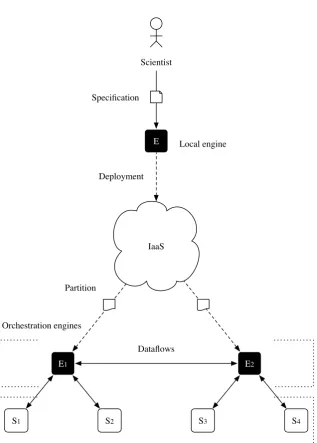
Figure 1.5 shows a preview of the presented approach. Based on this diagram, a scientist
provides a workflow specification to an initial engine (E). This engine is usually running on
the scientist’s local machine, and it is responsible for processing and analysing the
work-flow to ensure its correctness. It uses a workwork-flow partitioning approach that decomposes the
workflow logic into smaller partitions that can be executed in parallel, and performs
place-ment analysis to determine the most appropriate engines onto which these partitions may be
deployed for execution. Typically, placement analysis relies on gatheringQuality of Service
(QoS) metrics such as the network latency and bandwidth, which indicate the geographical
distance between the services and the engines. This helps in determining a set of candidate
engines hosted “closer” to the services to execute the workflow. Before the deployment
process, each partition is encoded in a form that is suitable for network transmission. The
initial engine (E) deploys the workflow partitions by transmitting them to engines (E1) and
1.5 Preview of Research Solution 19
engine (E1) invokes services (S1) and (S2), whereas engine (E2) invokes services (S3) and
(S4). Engines (E1) and (E2) may collaborate with each other by exchanging data segments
needed to execute the workflow partitions.
Scientist
IaaS
E2
S1
E1
S3 S4
S2
Specification
Deployment
Orchestration engines
Dataflows
Computation and data services
E Local engine
[image:46.595.148.466.240.684.2]Partition
20 Introduction
1.6
Glossary of Terms
Researchers often use different terminology to describe the same concepts, and to avoid
ambiguity the terminology introduced here is used consistently throughout this thesis.
• Grid: This term refers to a network of computing resources that are hosted on the
Internet by different providers.
• Resource: This term refers to hardware that is used to host software components and
services.
• Service: This term refers to a software component that can be exposed to a network
using a standard interface, which describes a set of functionality compliant with the
web service architectural model defined by theW3C Web Services Architecture
Work-ing Group[32].
• Interface: This term refers to a named set of operations that characterise the
be-haviour of a software component or a service.
• Service-oriented computing: This term refers to the use of loosely-coupled web
services to construct and execute large-scale distributed applications.
• Task: This term refers to a computational step in a business-oriented or scientific
process, and many steps can be composed together to construct workflows.
• Workflow: This term refers to a distributed application that is composed of a sequence
of tasks that are structured based on their data dependencies.
• Partition: This term refers to part of an overall workflow (e.g. sub workflow) that is
composed of a sequence of tasks organised according to data dependencies.
• Orchestration: This term refers to a design pattern authored by Erl and Loesgen1 that is dedicated the effective maintenance and execution of business process logic.
1.6 Glossary of Terms 21
• Service orchestration: Service orchestration refers to the enactment or execution of
a workflow and its management in a distributed system, which involves coordinating
the data movement across a set of computing services to support their collaboration.
• Execution engine: This term refers to a compute server that is responsible for
exe-cuting a workflow or part of it. It provides capabilities for invoking a set of services
participating in a workflow, collecting and storing the invocation results, and
coordi-nating the data movement between them.
• Data deluge: This term was first coined by Hey and Trefethen [5] that represents the
unprecedented explosion of data resulting from conducting scientific experiments.
• Data-intensive: This term is an adjectival phrase which denotes that a particular item
to which the term is applied requires attention to the data and the manner in which the
data is handled.
• Dataflow patterns: This term refers to a set of design patterns that can be used to
organise a workflow as adataflow graph, which is aDirected Acyclic Graph(DAG)
that consists of vertices as workflow tasks with the edges between them as data
de-pendencies.
• Data coordination languages: This term refers to a type of functional languages that
are based on a model of coordination or communication among several primitives
(e.g. tasks or processes) that operate over data objects based on some type system.
• Decentralised system architecture: This term refers to a type of software system
ar-chitecture that involves peer-to-peer collaboration between its components, and
con-stitutes equality between them as explained by Taylor and Harrison [33].
• Network region: This term refers to a distinct geographic area in the world where
22 Introduction
1.7
Thesis Organisation
The rest of this thesis is organised as follows:
• Chapter 2: This chapter presents a general background of service computing,
service-oriented architecture, web services and related standards. It provides an overview of
scientific workflows, discusses the design patterns used for composing them, presents
the lifecycle of scientific workflows, highlights the common features of scientific
workflow management systems, describes service orchestration in general and
ex-plains the execution models of service-oriented scientific workflows based on
cen-tralised and decencen-tralised orchestration approaches. Furthermore, it provides a
com-prehensive survey of workflow technologies including workflow languages,
manage-ment systems, dataflow optimisation system architectures, and workflow scheduling
heuristics.
• Chapter 3: This chapter presents a high-level, functional data coordination language
for the specification and execution of service-oriented workflows calledOrchestra. It
presents the features of this language, describes the general syntax of the language,
provides its design specification, introduces a set of examples that demonstrate the
language ability to compose services using common dataflow patterns, discusses the
language support for distributed computation, and its type system.
• Chapter 4: This chapter presents the architectural design of a decentralised
service-oriented orchestration system that is responsible for executing workflows based on
theOrchestralanguage. It describes the interactions between the distributed
compo-nents of the system architecture such as execution engines and services, discusses the
design of the execution engines and their internal modules, and presents the steps of
decentralised orchestration from the compilation of a workflow specification to the
deployment of workflow partitions and their execution. Furthermore, it provides an
1.8 Conclusion 23
• Chapter 5: This chapter discusses the implementation of the presented orchestration
system architecture. It presents the implementation of an execution engine’s interface,
discusses the computational states that an execution engine can exhibit before, during,
and after the workflow execution, and discuss the construction of the engine’s internal
modules.
• Chapter 6: This chapter provides an evaluation of the presented decentralised
service-oriented orchestration architecture to test the hypothesis proposed in the thesis
intro-duction.
• Chapter 7: This chapter finally concludes this thesis by summarising the work and
presenting future research directions to extend the work covered in this thesis.
1.8
Conclusion
This thesis focuses on the construction of a decentralised service-oriented orchestration
sys-tem that permits the execution of scientific workflows based on a simple data coordination
language. This chapter has presented a general introduction to workflows, described the
significance of workflows in scientific research, and provided examples of scientific
work-flows. It provided a research statement that discussed the central research question that has
guided this research. Furthermore, it discussed some of the research challenges addressed
in this thesis, presented the research hypothesis and explained its rationale. This chapter
has also listed the research contributions of this thesis, and provided a preview of the
re-search solution which is a decentralised service-oriented orchestration system that relies on
Chapter 2
Literature Review
2.1
Introduction
This chapter establishes general understanding of the subject matter, and focuses at the
as-pects that led to the realisation of this thesis. It begins with Section 2.2 which provides
an overview of the service computing paradigm, and describes Service-oriented
Architec-ture (SOA) and its fundamental concepts. This section also describes what constitutes a
web service, and discusses the course of evolution that led to the creation and
standard-isation of web service technology. Then it presents the web service architecture model
and associated standards, the central limitations of this model and describes the efforts of
the research community and industrial organisations to address these limitations using web
service specifications. Section 2.3 describes what constitutes a workflow in general and
dis-cusses scientific workflows specifically. It describes concepts that relate to the construction
and enactment of workflows including the workflow lifecycle, service composition.
Sec-tion 2.4 defines service-oriented orchestraSec-tion and describes centralised and decentralised
service-oriented orchestration system architectures, whereas Section 2.5 provides the
exe-cution cost model of these architectures. Section 2.6 provides a comprehensive review of
existing workflow management systems, workflow languages, dataflow optimisation
sys-tem architectures, workflow scheduling techniques used for mapping distributed workflows
26 Literature Review
2.7 analyses and states the requirements that need to be addressed by modern workflow
man-agement systems and workflow languages. Section 2.8 provides a general discussion and
identifies the limitations of existing workflow technologies. Section 2.9 finally concludes
this chapter by summarising the presented work.
2.2
Service Computing
Service computing is a paradigm for the assembly of application components into networks
of loosely-coupled services to create flexible, dynamic business processes, and agile
appli-cations that span organisations and computing platforms as defined by Papazoglou et al.
in [34]. It can be realised through Service Oriented Architecture (SOA) which is defined
by theOrganisation for the Advancement of Structured Information Standards(OASIS) as
follows:
“Service Oriented Architecture(SOA) is an architectural approach for
organis-ing and utilisorganis-ing distributed capabilities that may be under the control of
differ-ent organisational domains.” [35]
From a software engineering perspective, this approach represents a design pattern for
separating concerns. This means that the computation logic required to solve a particular
problem can be managed easily when decomposed into a set of smaller components, where
each component addresses a particular concern (e.g. part of the problem). Service-oriented
architecture is distinguished by the manner in which it achieves this separation. It enables
the application logic of distinct pieces of software to be encapsulated within loosely-coupled
web servicesas explained by Papazoglou et al. in [34]. However, there is no precise
defi-nition of the term “loose-coupling”, and many researchers have attempted to determine the
degree (e.g. level) of coupling needed within a software system such as Kaye [36],
Chatter-jee and Webber [37], Pautasso and Wilde [38]. For matters of simplicity, this thesis adopts
2.2 Service Computing 27
“the phrase loosely coupled describes enterprise services’ characteristic of
in-teracting in well-defined ways without needing to know each other’s inner
work-ings. This means that the service’s functionality can change without affecting
the services that use it, as long as the behaviour described in its interface
re-mains the same – that is, as long as it continues providing the functionality it
provides.”
This thesis describes the fundamental concepts embodied in theFour Tenets of Service
Orientation provided by Don Box [29] to explain service-orientation more clearly. These
fundamental concepts include the following:
• Boundaries are explicit: Services may be hosted on heterogeneous machines across
many geographic locations, and managed by different providers. Such physical
bound-aries are difficult to cross in terms of performance. Hence, inter-service
communica-tion must be distinguished from local method invocacommunica-tions by making these boundaries
explicit. For example, the service endpoint location must be publicly accessible to be
identified by client applications and remote services. Furthermore, the origin of
mes-sages communicated to and from a particular service must be indicated in the content
of these messages clearly. This can be useful in implementing message correlation
mechanisms for distributed models of computation that involve multiple services.
• Services are autonomous: Services are autonomous software components that can
control the computation logic they encapsulate. This supports execution transparency
as the knowledge of the internal workings of a particular service and its underlying
resources is not required to access its functionality.
• Services share schemas and contracts, not classes: Services do not share classes
publicly but service contracts instead. These contracts are based on structured schemas
that describe the service behaviour, its functionality and supported data types.
Ser-vice providers can advertise these contracts to describe the structure of messages their
services can send or receive, and the organisation in which the messages are
28 Literature Review
modified without introducing changes to its public contract being shared with other
entities (e.g. client applications and remote services).
• Compatibility is determined based on policy: Services may have specific
require-ments, conditions or guarantees (e.g. assertions) that must be true before their
op-erations are executed. Such conditions can be specified in a machine-readable form
called a policy, which extends the public service contract. For example, a policy
may describe service compatibility in terms of the messages and message exchange
sequences it supports. This permits a service functionality to be accessed and
exe-cuted based on simple propositional logic that determines the service compatibility
for certain requirements or conditions.
2.2.1
Web Services
A web service is a platform-independent software component that encapsulates
computa-tional logic, and provides funccomputa-tionality that can be exposed to a network by a logical
in-terface. This interface can be specified and published by the service provider to enable
consumers (e.g. client applications and other services) to discover the service, and interact
with it. Service interaction is based on standards that define communication protocols, and
the format of messages communicated to and from the service. Figure 2.1 shows a generic
Web Service
Resource Computation Logic
Message Passing
Input Message Output Message
[image:55.595.124.462.538.712.2]Interface