1,*
Nikhil, U.,
2Nikhil Chandra
Department of Computer Science Jain University Jakkasandara Post Kanakpura, Karnataka
ARTICLE INFO ABSTRACT
The objective of this project is to build an air traffic prediction system. The air traffic prediction plays a key role in the air traffic flow management system. The air traffic information in each control center is not integrated together in order to utilize complete data stored at each of them. Large collection of data is stored, but there is no effort made to extract useful information from the database to help in the estimation of flight
applied to data mining with various objectives. This project employs statistical analysis of historical data to forecast the air traffic. This project will use these methods to de
traffic.
Copyright © 2018, Nikhil et al. This is an open access distribution, and reproduction in any medium, provided
INTRODUCTION
Aviation is the fastest growing mode of passenger transportation globally. Global air travel growth has averaged approximately 5% per year over the past 30 years, and forecasts for future also become important. While growth in air transportation has significant economic benefits, it also has negative consequences, including increasing flight delays and environmental impacts at both the local level (e.g., air quality and noise) and global scale (e.g., climate change), as reported by the International Panel on Climate Change. These positive and negative consequences of aviation must be traded policy makers in the development of policy. To make policy trade-offs, it is critical that good forecasts of fu
air traffic exist, as well as good forecasts of how airlines are likely to serve this demand. This is particularly important given the long timescales associated with airport capacity expansion, especially in many developed economies where there is significant resistance to airport development. Good forecasts of future demand are also critical for airlines and airport authorities, which must plan their operations accordingly and often, need to order equipment well before it is required. Good forecasting requires a solid understanding of the most important drivers of supply and demand. Consequently, not only do historical trends in air transportation need to be studied,
*Corresponding author: Nikhil, U.
Department of Computer Science Jain University Jakkasandara Post Kanakpura, Karnataka 562112, India.
ISSN: 0975-833X
Article History:
Received 27th January, 2018
Received in revised form 05th February, 2018
Accepted 28th March, 2018
Published online 30th April, 2018
Citation: Nikhil, U., Nikhil Chandra, P., Akash Jain and Oshin Sharma
(04), 67618-67622.
Key words:
Airtraffic, analytics, forecast, system, visualization.
RESEARCH ARTICLE
AIR TRAFFIC FORECASTING
Nikhil Chandra, P.,
3Akash Jain and
4Oshin Sharma
Department of Computer Science Jain University Jakkasandara Post Kanakpura, Karnataka
ABSTRACT
The objective of this project is to build an air traffic prediction system. The air traffic prediction plays a key role in the air traffic flow management system. The air traffic information in each control center is not integrated together in order to utilize complete data stored at each of them. Large collection of data is stored, but there is no effort made to extract useful information from the database to help in the estimation of flight delays, air traffic in any particular sector, etc. Statistics is frequently applied to data mining with various objectives. This project employs statistical analysis of historical data to forecast the air traffic. This project will use these methods to de
traffic.
access article distributed under the Creative Commons Attribution License, the original work is properly cited.
Aviation is the fastest growing mode of passenger transportation globally. Global air travel growth has averaged approximately 5% per year over the past 30 years, and While growth in air transportation has significant economic benefits, it also has negative consequences, including increasing flight delays and environmental impacts at both the local level (e.g., air quality te change), as reported by the International Panel on Climate Change. These positive and negative consequences of aviation must be traded-off by policy makers in the development of policy. To make policy offs, it is critical that good forecasts of future demand for air traffic exist, as well as good forecasts of how airlines are likely to serve this demand. This is particularly important given the long timescales associated with airport capacity expansion, especially in many developed economies where there is significant resistance to airport development. Good forecasts of future demand are also critical for airlines and airport authorities, which must plan their operations accordingly and often, need to order equipment well before it forecasting requires a solid understanding of the most important drivers of supply and demand. Consequently, not only do historical trends in air transportation
Department of Computer Science Jain University Jakkasandara Post
but the intrinsic drivers underlying passenger and airline behavior must also be understood
1998).Aviation stakeholders tend to g
travel forecasts and forecasting methodologies. While a diversity of methodologies exist, econometric, gravity and time-series models prevail. Most of these models are based on correlating aviation growth and socio
are characterized by their relative simplicity
Aviation is an interesting system in which data mining can be applied since it is a large and complex system that involves the generation of a large scale and mixture of data in various dat formats. Data mining aims to transform these datasets into applied knowledge. From the application of data mining techniques in air transportation data, several benefits can be obtained. This includes improved revenue management, advances in safety within the air transportation system as well as improving on existing air travel demand forecasts
Schaefer, 1995). Data mining provides us with a variety of computational methods to analyze relationships that exist within large datasets, identifying do
outcomes, predicting the probability of new outcomes, and determining anomalous behavior. The application of data mining techniques in air traffic forecasting constitutes a recent trend started in the last decade (
Literature Survey
Swan, W. M., Chief Economist Airline Planning group identifies three common methods of forecasting passenger demand for air travel: trends; gravity models; and
International Journal of Current Research
Vol. 10, Issue, 04, pp.67618-67622, April, 2018
Nikhil, U., Nikhil Chandra, P., Akash Jain and Oshin Sharma, 2018. “Air traffic forecasting”, International Journal of Current Research
Oshin Sharma
Department of Computer Science Jain University Jakkasandara Post Kanakpura, Karnataka 562112, India
The objective of this project is to build an air traffic prediction system. The air traffic prediction plays a key role in the air traffic flow management system. The air traffic information in each regional control center is not integrated together in order to utilize complete data stored at each of them. Large collection of data is stored, but there is no effort made to extract useful information from the database delays, air traffic in any particular sector, etc. Statistics is frequently applied to data mining with various objectives. This project employs statistical analysis of historical data to forecast the air traffic. This project will use these methods to deduce optimal prediction of air
License, which permits unrestricted use,
but the intrinsic drivers underlying passenger and airline behavior must also be understood (Pindyck and Rubinfeld, .Aviation stakeholders tend to generate their own air travel forecasts and forecasting methodologies. While a diversity of methodologies exist, econometric, gravity and series models prevail. Most of these models are based on correlating aviation growth and socio-economic growth, and are characterized by their relative simplicity (Kotegawa, 2012). Aviation is an interesting system in which data mining can be applied since it is a large and complex system that involves the generation of a large scale and mixture of data in various data formats. Data mining aims to transform these datasets into applied knowledge. From the application of data mining techniques in air transportation data, several benefits can be obtained. This includes improved revenue management, n the air transportation system as well as improving on existing air travel demand forecasts (Nam and Data mining provides us with a variety of computational methods to analyze relationships that exist within large datasets, identifying dominant drivers of important outcomes, predicting the probability of new outcomes, and determining anomalous behavior. The application of data mining techniques in air traffic forecasting constitutes a recent
(Yi Cao et al., 2013).
Swan, W. M., Chief Economist Airline Planning group identifies three common methods of forecasting passenger : trends; gravity models; and simulation
INTERNATIONAL JOURNAL OF CURRENT RESEARCH
models, which forecast the increase in traffic from estimated changes in fares and service levels(Department for Transport, 2014). Historical trends are the most common forecasting technique used to predict air travel demand. This involves the use of econometric equations in which passenger and freight demand is regressed against economic activity over historical time periods. In the case of Boeing, future air travel demand, measured in Revenue Passenger Kilometer (RPK), is estimated through an equation that compares air travel growth mainly
against economic growth measured in GDP (Jiang Chunshui et
al., 2012). Some of the forecasting methodologies are
combined with qualitative techniques such as surveys and questionnaires. These are based on intuition and subjective evaluation including expert opinion. For example, UK aviation forecasts, produced by the Department for Transport (DfT), are mainly based on econometric models (Pindyck and Rubinfeld, 1998). In contrast, Eurocontrol’s medium-term forecasts are produced by combining regression techniques and time series analysis. This combination is most appropriate for producing short and medium term forecasts and is mainly based on analyzing historical data and trends (Coldren and Koppelman, 2005). The FAA’s Terminal Area Forecast (TAF) is based upon historical local and national measures that influence aviation activity as well as those drivers within the industry itself. In this manner, passenger demand at a particular airport is derived independently of the ability of that airport and its supporting air traffic control system to furnish the capacity required for meeting that specific demand.
The FAA’s air traffic forecasting process is split into two stages. The first stage consists in modeling the true-origin ultimate-destination (O-D) passenger demand flows using econometrics models. These are based on regression analysis using historical segment-pair air traffic data. The second stage consists in combining the TAF results, which account for the estimates in traffic change at individual airports, with the most recent airline schedules obtained from T-100 segment data. The allocation process is performed by the application of the Fratar algorithm. This is a type of trip distribution algorithm based on a growth factor method, by which the connectivity between an airport and city pair is evaluated (Kotegawa, 2012). The agent-based modeling and discrete choice modeling combines a gravity model of passenger O-D demand with an agent-based model of airline decision-making, simulating airline frequency competition using a myopic best response game, in order to model the airlines operational responses to environmental constraints. The key difference between this work and the econometric, gravity and time series models described above is that it attempts to model the airline decision making process explicitly, instead of estimating model parameters based on historical data. Results obtained show that airline response to any type of capacity constraint and competition between airlines is important when trying to understand the underlying principles behind the evolution of the air transportation system (Nam and Schaefer, 1995). Two-stage Nash best-response game to evaluate the most appropriate hub-and-spoke network for an airline to develop in a competitive environment. Given three different settings, the study examines when equilibrium in the air transportation industry would occur. Results obtained show that demand plays an important role in the solution outcome (Dr. Tulinda Larsen, 2013). 3-level weighted nested logit model to predict airline ridership at the itinerary level and help carriers in medium and long term decision-making.
This model is applied at an aggregate level and variables included are chosen to capture the inter-itinerary competition dynamic along three dimensions: time of the day, carrier and level of service. Results obtained suggest that itineraries sharing the same time show a moderate level of competition while those sharing time and carrier or level of service show a
high level of competition (Loris Belcastro et al., 2014). The
neural networks enhanced forecasting accuracy and went beyond the capabilities of the more conventional statistical analysis used at the time. A hybrid model of neural network and statistical analysis was developed in order to forecast air traffic flow at fixes on a 30-min aggregation level within China’s air traffic network. For this study, the decision variables were a combination of information provided by radar data and historical airline flight schedule data (Fucheng Qiu and Yi Li, 2014). Support Vector Machine (SVM) techniques are used to develop a model that improves on the simple time series approach to air traffic forecasting. This technique has several advantages over traditional econometric models proving that potential benefits can be obtained when applying
data mining techniques in air traffic forecasting (Yi Cao et al.,
2013). The modern approach uses complex network theory quantitative parameters as explanatory variables in the input dataset, and trains logistic regressions and neural networks to predict the likelihood of previously un-connected airport-pairs being connected in the future, and the likelihood of connected airport-pairs becoming un-connected. The main objective of this study was to improve on the FAA TAF assumption of a static routing network, which was done by adding an initial step that models US network evolution. The accuracy of the results was between 20% and 40%, leaving room for improvement. In addition, the work done did not improve on the current FAA methodology for forecasting air traffic levels on existing routes(Jiang Chunshui and Yu Haiyang, 2012).
Limitations of Current work
There are three common methods for forecasting air travel: trends, gravity models, and simulation. All suffer when dealing with newly deregulated markets. Trends do not recognize changing conditions, gravity models fail to establish reasonable nominal demand, and simulation suffers from inadequate historical data, missing forecasts of future conditions, and inappropriate calibration (Department for Transport, 2014). The calculation of future air travel demand using RPK by Boeing uses few demographic variables and not
detailed explanatory variables (Jiang Chunshui et al., 2012).
the existing research is in line with the industry’s use of econometric models, time series and gravity models as the dominant quantitative approaches to estimate future air traffic demand and supply (Nam and Schaefer, 1995). Although the results from the 3-level weighted nested log it model are promising, they are computational intensive, limiting their application to relatively small network sets. The ability of some of the models to reproduce existing air traffic is also limited and further model refinement and verification is still required to better capture passenger choice effects (Loris
Belcastro et al., 2014). By implementing neural networks in
the field of air traffic forecasting, the decision variables used in the study include eleven dummy variables defining the monthly seasonality and one time variable reflecting the trend effect (Fucheng Qiu and Yi Li, 2014). By adopting SVM techniques it becomes tricky and difficult to choose a kernel required and the process becomes cumbersome which in turn leads to larger requirement of memory as different models are
required for different classes (Yi Cao et al., 2013).The main
objective of the modern approach was to improve on the FAA TAF assumption of a static routing network but the accuracy of the results was between 20% and 40%, leaving room for improvement. In addition, the work done did not improve on the current FAA methodology for forecasting air traffic levels on existing routes (Jiang Chunshui and Yu Haiyang, 2012).
MATERIALS AND METHODS
Agile Principals will be followed. Each identified module will be considered for their corresponding sprints. The final outcome at the end of all sprints will be the prediction system for Air Traffic Management. We solve the above problem by making use of the data mining, data analytics and data visualization
System Architecture
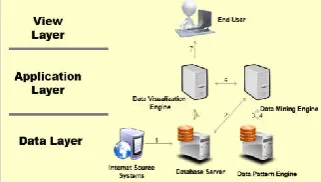
Fig. 1. Represents the system architecture used in proposed model. The data is obtained from the website and stored on to the local database. The end user uses the data mining engine and several data visualization techniques to perform the analytics.
Fig. 1. System architecture
Data Source
The air traffic data is obtained from the Australian domestic airports website. The obtained data set is a historic data which ranges from the year 1986 to 2017.
Data Flow
R engine is used to perform the predictions. The user loads the data into the R engine. Data pre-processing algorithms are used to filter out the data. Data Visualization is performed to generate the graphs which gives a better understanding.
[image:3.595.332.539.92.235.2]Prediction algorithms are applied on the data models constructed.
Fig. 2. Data Flow Diagram
Busiest Route
[image:3.595.314.554.314.448.2]The busiest route based on the data is generated. It is represented through a bar graph.
Fig. 3. Busiest routes
To determine the busiest routes in a specific year, a graph of passenger trips is plotted against the City pairs. In Fig. 3. The city pairs are constructed on the y axis and the number of passengers is constructed on the x axis.The value of the passenger trips in that specific year is represented using horizontal bars.
Increase in flights
Fig 4 clearly shows that there has been an increase in the number of flights over the years. The x axis represents the year while the y axis represents the number of passengers.
[image:3.595.83.244.539.630.2] [image:3.595.325.540.600.772.2]Predicting the future Air Traffic
The future air traffic is determined by constructing a linear regression model. The linear regression model uses a response variable and a predictor variable.
Fig. 5. Graph comparing Predicted and actual value
[image:4.595.312.561.49.208.2]In Fig 5 the month number is plotted on the x axis and the aircraft trips is plotted on the y axis. Aircraft trips is taken as the response variable, month number is taken as the predictor variable. The prediction of future aircraft trips is performed. Aircraft trips of 2017 are predicted based on the aircraft trips of 2016. To compare the original and the predicted values a graph is plotted.
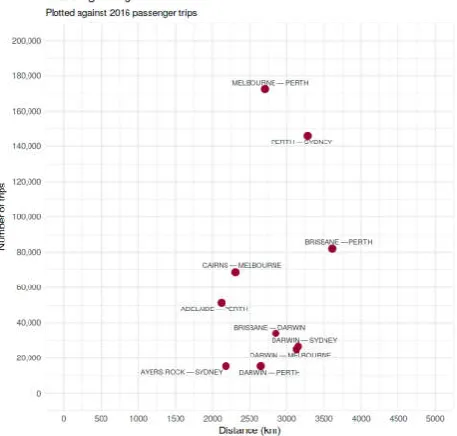
Fig. 6. Longest flights
Analysis of the longest route
To determine the top longest flights in a specific year a graph of passenger trips is constructed against distance is plotted. In Fig 6 number of trips is plotted on the y axis; distance is plotted on the x axis. The graph is plotted as points and each point represents a city pair.The city pair having the maximum distance can be determined.
Route generating the highest revenue
The route which is generating the highest revenue is determined.
Fig. 7. Maximum revenue generated routes
Fig 7 helpsus to determine the route which generates the maximum revenue. Revenue is plotted on the x axis and the city pairs are plotted on the y axis.
Conclusion
Data Analysis transforms operational and commercial problems by using datasets. There is a rich portfolio of available information that can feed aviation data analytics. Flight’s data warehouse and analysis methods provide a valuable example for others attempting to solve cloud based analytics of aviation data sets. Flight’s method is well suited for airline performance review, competitive benchmarking, airport operations and schedule design, and has demonstrated value in addressing real-world problems in airline and airport operations as well asgovernment applications. The Model helps us to determine future Air Traffic. It can help in air traffic control and management. The flights can be optimized to maximize the profit. The model is scalable and can be used for the future needs. Similar Models can be designed for land and water ways while the underlying Principle remains the same.
REFERENCES
Adler N, “Hub-Spoke Network Choice Under Competition with an Application to Western Europe,” Transportation Science, V. 39, 2005.
Bao, Y., Xiong, T., and Zhongyi, H., “Forecasting Air Passenger Traffic by Support Vector Machines with EnsembleEmpirical Mode Decomposition and Slope-Based Method,” Discrete Dynamics in Nature and Society, Vol. 2012, 2012.
Coldren, G. M., and Koppelman, F. S., “Modeling the competition among air-travel itinerary shares: GEV model development”; Transportation Research Part A: Policy and Practice 39.4 (2005).
Demand Modeling to Predict Future Commercial Flight Schedules in the NAS," 11th AIAA/ISSMO
Department for Transport (DfT), “UK Aviation Forecasts,” January 2013.
Eurocontrol, “Challenges of rowth 2013: Task 4: European Air Traffic in 2035,” 2013.
Evans, A. D., and Schäfer, A. W., “Simulating airline operational responses to airport capacity constraints,” Transport Policy, vol. 34, 2014, pp. 5-13.
Jiang Chunshui and Yu Haiyang Yu Haiyang and Anwar Zubair, “On the ICAO system of air traffic forecasting”, 978-1- 4673-0390- 3/12/$31.00 ©2012 IEEE.
[image:4.595.38.289.128.269.2] [image:4.595.50.279.403.621.2]Judit G. Busquets, Dr. Eduardo Alonso and Dr. Antony D. Evans., “Application of Data Mining in Air Traffic Forecasting”.
Multidisciplinary Analysis and Optimization Conference, Virginia, 2006.
Swan, W. M., “Forecasting Air Travel with Open Skies,” Chief Economist Airline Planning Group, 2008.
Viken, J , Dollyhigh, S., Smith, J., Trani, A., Baik, H., Hinze, N., and Ashiabor, S., “Utilizing Traveler