DELAY PRESENTATION OF BREAST CANCER: A STUDY AMONG SOUTH
Akanbi, O. O., Oguntola, A. S.,
*Adeoti
Department of Surgery Ladoke Akintola University of Technology
ARTICLE INFO ABSTRACT
Delay presentation of breast cancer is most common form of presentation of breast cancer in our environment. This prospective study was done in Ladoke Akintola University of Technology Teaching Hospital Ogbomoso, to determine extent, reasons and factors as
presentation of breast cancer in south western Nigeria. A total of 120 consented patients were recruited into the study. The mean duration of symptom was 68 weeks (± 53.92). One hundred and three (85.83%) of our patients suffered delay
present early claimed to have previous knowledge about breast diseases (p <0.001 O R 12.5 CI 3.338 46.8086). Fear of mastectomy and social stigmatization were the main reasons for delay presentation in 32 (31.06 %%) patients. Fifteen (83.23%) of early presenter perceived their first symptom to be serious as compared to 18 (17.47%) of 103 patients among late presenter (p<0.001, O R 34.41). patients perceived bleeding and wound as serious symptoms and co
presentation among all the patients. Educational level, marital status and social class did not affect pattern of presentation Fear of mastectomy and social stigmatization were the main reasons for delay presentation couple w
information and education dispensing the myths about breast diseases and cancer will help reduce the burden of delay presentation in our women.
Copyright © 2015 Akanbi et al.,. This is an open access article distributed under the Creative Commons Att distribution, and reproduction in any medium, provided the original work is properly cited.
INTRODUCTION
Breast cancer is the most common malignancy affecting women and is the leading cause of cancer related death among women and is potentially curable cancer if diagnosed and treated early. The prognosis of this dreadful malignancy is often influenced by the stage of the disease at the time presentation, histological grade of the tumor and available treatment modalities. Recent improvement in outcome of breast cancer results from combination of breast cancer screening programs, early diagnosis and improved tre modalities. Thus early presentation and diagnosis remains the main way of improving the outcome in a poor resource community, as modern high technological screening facilities and better treatment modalities may be out of reach of the general populace; making early presentation, diagnosis and prompt treatment to remain the major modifiable factor that can influence the prognosis, outcome and the survival, as delay in presentation is associated with advanced tumour, poorer prognosis and survival (Ramirez 2006).
*Corresponding author: Adeoti, M.L.,
Department of Surgery Ladoke Akintola University of Technology Teaching Hospital, Ogbomoso, Oyo State Nigeria
ISSN: 0975-833X
Article History:
Received 05th May, 2015
Received in revised form
16th June, 2015
Accepted 06th July, 2015
Published online 21st August,2015
Key words:
Breast Cancer, Delay,
Presentation and Nigeria
Citation:Akanbi, O.O., Oguntola, A.S., Adeoti, M.L., Aderounmu, A.O.A., Idris, O.L. and Abayomi, O.O. breast cancer: A study among south western Nigerian
RESEARCH ARTICLE
DELAY PRESENTATION OF BREAST CANCER: A STUDY AMONG SOUTH
WESTERN NIGERIAN WOMEN
Adeoti, M. L., Aderounmu, A. O. A., Idris, O
Ladoke Akintola University of Technology Teaching Hospital, Ogbomoso,
Oyo State Nigeria
ABSTRACT
Delay presentation of breast cancer is most common form of presentation of breast cancer in our environment. This prospective study was done in Ladoke Akintola University of Technology Teaching Hospital Ogbomoso, to determine extent, reasons and factors as
presentation of breast cancer in south western Nigeria. A total of 120 consented patients were recruited into the study. The mean duration of symptom was 68 weeks (± 53.92). One hundred and three (85.83%) of our patients suffered delay presentation. Fourteen (82.35%) of 17 patients that present early claimed to have previous knowledge about breast diseases (p <0.001 O R 12.5 CI 3.338 46.8086). Fear of mastectomy and social stigmatization were the main reasons for delay presentation
(31.06 %%) patients. Fifteen (83.23%) of early presenter perceived their first symptom to be serious as compared to 18 (17.47%) of 103 patients among late presenter (p<0.001, O R 34.41). patients perceived bleeding and wound as serious symptoms and co
presentation among all the patients. Educational level, marital status and social class did not affect pattern of presentation Fear of mastectomy and social stigmatization were the main reasons for delay presentation couple with poor knowledge about breast diseases. A well channeled appropriate, information and education dispensing the myths about breast diseases and cancer will help reduce the burden of delay presentation in our women.
is an open access article distributed under the Creative Commons Attribution License, which distribution, and reproduction in any medium, provided the original work is properly cited.
Breast cancer is the most common malignancy affecting women and is the leading cause of cancer related death among and is potentially curable cancer if diagnosed and treated early. The prognosis of this dreadful malignancy is stage of the disease at the time presentation, histological grade of the tumor and available treatment modalities. Recent improvement in outcome of breast cancer results from combination of breast cancer screening programs, early diagnosis and improved treatment modalities. Thus early presentation and diagnosis remains the main way of improving the outcome in a poor resource community, as modern high technological screening facilities and better treatment modalities may be out of reach of the ce; making early presentation, diagnosis and prompt treatment to remain the major modifiable factor that can influence the prognosis, outcome and the survival, as delay in presentation is associated with advanced tumour, poorer
Ladoke Akintola University of Technology .
However, in most developing African countries most patients present with late diseases when only palliative care remain the only option of management, resulting from delay presentation, (Anyanwu 2006, Parkin et al.,
coupled with delay initiation of definitive treatment worsen patients’ prognosis and outcomes.
been identified; patients’ delay (the time period between first symptom and medical consultation) and system delay (the time period between medical consultation and initiation of treatment). System delay can take the form of delay i investigation processes, diagnosis and waiting time, most often than not associated with limited health care resources in terms of poor diagnostic facilities and man power.
Delay presentation defined as delay of greater than three months (Burgess CC 1998), apart from health effect, it also has a greater economic impact on health scarce resources as it more costly to evaluate and treat late diseases (Yau 2013). This study thus aim to identify the extent, determinant factors associated with patien
suggest possible ways of minimizing some of these factors poor resource community.
International Journal of Current Research
Vol. 7, Issue, 08, pp.19035-19039, August, 2015
Adeoti, M.L., Aderounmu, A.O.A., Idris, O.L. and Abayomi, O.O. Nigerian women”, International Journal of Current Research,
DELAY PRESENTATION OF BREAST CANCER: A STUDY AMONG SOUTH
O. L. and Abayomi, O. O.
Teaching Hospital, Ogbomoso,
Delay presentation of breast cancer is most common form of presentation of breast cancer in our environment. This prospective study was done in Ladoke Akintola University of Technology Teaching Hospital Ogbomoso, to determine extent, reasons and factors associated with delay presentation of breast cancer in south western Nigeria. A total of 120 consented patients were recruited into the study. The mean duration of symptom was 68 weeks (± 53.92). One hundred and presentation. Fourteen (82.35%) of 17 patients that present early claimed to have previous knowledge about breast diseases (p <0.001 O R 12.5 CI 3.338-46.8086). Fear of mastectomy and social stigmatization were the main reasons for delay presentation
(31.06 %%) patients. Fifteen (83.23%) of early presenter perceived their first symptom to be serious as compared to 18 (17.47%) of 103 patients among late presenter (p<0.001, O R 34.41).All patients perceived bleeding and wound as serious symptoms and constituted 43.68% of reason for presentation among all the patients. Educational level, marital status and social class did not affect pattern of presentation Fear of mastectomy and social stigmatization were the main reasons for delay ith poor knowledge about breast diseases. A well channeled appropriate, information and education dispensing the myths about breast diseases and cancer will help reduce the
ribution License, which permits unrestricted use,
However, in most developing African countries most patients when only palliative care remain the only option of management, resulting from delay presentation,
et al., 2007, Adeoti et al., 2008) this
coupled with delay initiation of definitive treatment worsen patients’ prognosis and outcomes. Two forms of delay have been identified; patients’ delay (the time period between first symptom and medical consultation) and system delay (the time period between medical consultation and initiation of treatment). System delay can take the form of delay in investigation processes, diagnosis and waiting time, most often than not associated with limited health care resources in terms of poor diagnostic facilities and man power.
Delay presentation defined as delay of greater than three 98), apart from health effect, it also has a greater economic impact on health scarce resources as it more costly to evaluate and treat late diseases (Yau et al.,
2013). This study thus aim to identify the extent, determinant factors associated with patients’ delay, system delay and suggest possible ways of minimizing some of these factors in a OF CURRENT RESEARCH
MATERIALS AND METHODS
The study was a prospective study that recruited all newly diagnosed patients with breast cancer between January 2012 and December 2014 who consented to participate in the study following appropriate counseling and verbal consent. Patients were interviewed by the authors during the second clinic visit and a week following initiation of treatment using a pre formed open ended structured questionnaire.
The data collected include patients’ demographic characteristics, patients’ symptoms, signs, reason (s) for presentation, reason (s) for delay in presentation, time interval between presentation and commencement of definitive treatment, symptoms perception, symptom knowledge etc. The data were analyzed using Microsoft excel and SPSS version 16 and chi square and t- test were used for test of significance with p value set below 0.05 for significant difference.
RESULTS
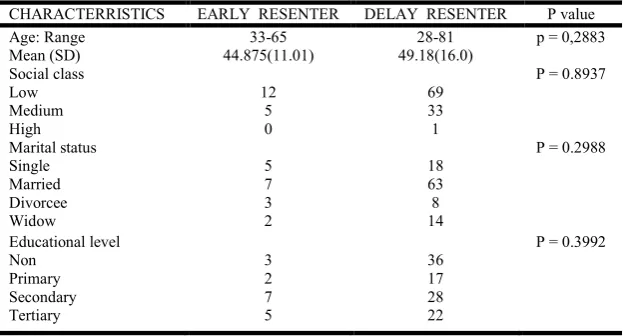
A total of 133 patients were recruited into the study with 13 patients dropped out from the study due failure to adequately stage some patients’ disease and loss to follow up questions. Table 1. showing the socio demographic characteristics of our patients.
When marital status were analyzed no statistical significant
difference between married and other marital status (p = 0.1994) with tendency to present early.
Forty two (35%) of our patients first sought attention from an orthodox setting, while 49 (40.83%), 17 (14.1a6%), 5 (4.16%), and 7 (5.8%) patients respectively considered alternative healer, faith home, allied medical workers and other sources as point of first call. Only seventeen (14.16%) of our patients present within three months from the time of first symptom. Duration of symptoms rages from 1 week to 72 months (mean 68 weeks, SD 53.92).
Fourteen of 17 patients (82.35%) that present early claim previous knowledge of breast cancer while only 28 of 103 (27.18%) claim similar knowledge among the late presenter which is statistically significant (p <0.001 O R 12.5 CI 3.338-46.8086) Figure 1. About 88% of early presenter perceived their first symptom to be serious as compared to about 18% of late presenters (p <0.001, OR 35.41 CI 7.43-168.64) Figure 1.
Also noted is that all patients at the time of presentation irrespective of stage of the disease and duration of symptoms considered bleeding and pain as a serious symptom that require medical attention. No statistical significant differences noted among other variables analyzed including educational level, marital status and social class for patients’ delay. Forty five (37.5%) of our patients present with ulcerative lesion and uncontrolled bleeding and constitute the major reason(s) for presentation as shown in Figure 2.
[image:2.595.138.450.394.562.2]Most of our patients claim to present late as a result of fear of losing the breast and possible social stigmatization Table 2. One hundred and two (85.0%) of our patients present with late disease.
Table 1. Showing the socio demographic characteristics of our patients
CHARACTERRISTICS EARLY RESENTER DELAY RESENTER P value
Age: Range Mean (SD)
33-65 44.875(11.01)
28-81 49.18(16.0)
p = 0,2883
Social class Low Medium High
12 5 0
69 33 1
P = 0.8937
Marital status Single Married Divorcee Widow
5 7 3 2
18 63 8 14
P = 0.2988
Educational level Non
Primary Secondary Tertiary
3 2 7 5
36 17 28 22
[image:2.595.157.429.587.704.2]P = 0.3992
Table 2. Reasons for delay before presentation
S/NO Reasons Frequency Percentages
1 Fear of losing breast 32 31.06
2 Fear of death after surgery 13 12.62
3 Belief the disease is spiritual attack 8 7.76
4 Don’t know it is serious 3 2.91
5 Because is not painful 7 6.79
6 Poor financial status 4 3.88
7 Fear of divorce /marital disharmony 3 2.91
8 Advised not to go to hospital by relatives 6 5.82
9 Thought it is not curable 10 9.70
10 Fear of inability to breast feed again 7 6.79
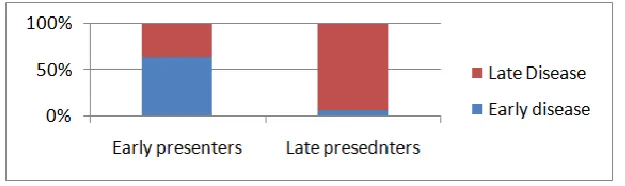
There is statistically significant difference between stage of disease at presentation and duration of delay as late diseases were seen more in those with delay greater than three months (p <0.001 O R 25.14 CI 7.158-33.97) Figure 3. A total of 95 (79.16%) patients suffered system delay ranges from 1 week to 6 months with mean duration of 6.34 weeks. Financial incapability constitutes the major reason for system delay followed by logistic problems within the system. Seventy two (88.88%) of 81 patients in low socio economic class experienced system delay from financial incapability while 23 (60.52%) of 38 patients in medium class experienced system delay from financial incapability and the only 1 patient in high socio economic class did not experienced such system delay for financial reason this shows a statistical significant difference between the social classes (X 11.045 p <0.001).low class versus medium and high classes (X 16.4476, p <0.003) However, no statistically significant difference noted in terms of patient delay between the social classes (X 5.77 p 0.0559). low class versus medium and high classes (X 0.0365 p 0.8485) Institutional factors in system delay accounted for 19 (26.02 %) of system delay for various reasons.
DISCUSSION
This study also confirms the findings from other similar studies that delay presentation constitute the major form of presentation of breast cancer (Adeoti et al., 2008, Thongusksai
et al., 2000), this is a cause for concern, as 85.83 % of patients
with breast lesion had delay greater than three months prior to presentation this is similar to 85% from Enugu, Nigeria (Ezeome 2010). The proportion of patients with delay presentation in our study is far higher compared to similar studies from developed countries quoting 34% in united State (Facione et al., 2002) and 32% in United Kingdom (Richard
et al., 1999). The reason for higher proportion of delay
[image:3.595.147.459.61.175.2]presentation in our study may be due to poor knowledge or awareness of breast cancer. It must also be noted that this is not necessarily related to level of neither educational background nor social class the patients belong to. Though this was quite different from Chinese study whose figure similar to that of other developed countries quoting 29% despite low awareness about cancer (Chua et al., 2005), the disparity seen in our study and that of Chinese population despite similar
[image:3.595.76.526.208.353.2]Figure 1. Relative frequency in percentages the effect of previous knowledge of breast cancer (PK) and Perception of breast symptoms seriousness (SS) between the early and late presenters
Figure 2. The frequency for various reasons for presentation among the early and late presenters
[image:3.595.146.459.388.481.2]low level of awareness about breast cancer in the two populations may suggest the possibilities of role of other factors associated with patients delay such as sociocultural factors and access to proper health care facilities among others (Facione et al., 2010). The major determinant factors for early presentation as observed from this study from this study include previous knowledge of breast cancer and patient perception of the symptoms, Bleeding was noted to be the major reason of presentation among the late presenter this is not unusual as bleeding was perceived by most people as a sinister symptom. This is quite disastrous as the symptoms that prompt most patients to seek medical consultation are most often than not, are late symptoms. The effect of symptoms perception on timing of presentation has also been noted in other wide range of diseases (Cornford 1998, Cameron et al.,
1993 Crosland and Jones 1995). Following the recognition of the significance of their diseases among the patients that suffered delay presentation the major factor associated with delay presentation is fear of the medical intervention vis-a vis mastectomy and loss of breast, a symbol of womanhood and associated social stigmatization from society, a reason comparable from to other study (Guohao Chang et al., 2011). This also support the evidence from a previous study that some women who present lately actually understood the importance of their condition but kept it under survailiiance and monitor it until the symptom become uncontrollable such as bleeding , uncontrollable pain or offensive odour from the fungating tumours (Green, 1974, Wool, 1986). A study on angina has identified fear of hospitals, operation and medical test as major barrier to help seeking (Gardner, 1999). Previous studies showed that marital status as a significant predictor of delayed presentation (Thongusksai, et al., 2000, Neale, et al., 1993, Lannin, et al., 1998), however, this still remains an area of debate among different investigators (Adeoti, et al., 2008, Lannin, et al., 1998), as this was the case in our study as no significant difference was noted in pattern of presentation among different marital status groups a similar conclusion reported from another study (Montella, et al., 2001). Though this may be difficult to assess in our study as most of our patients kept their disease away even from their spouse for so long (Adeoti et al., 2011).
This study has further highlighted the evidence of poor knowledge about breast cancer among our patient a reflection of our populace as noted in a similar study in south western Nigeria (Aderounmu et al., 2006). A personal non documented communication experience of one of the authors with female undergraduate students visiting our hospital for various reasons surprisingly demonstrate their paucity of knowledge about breast diseases with some of them quoting phrases like “breast cancer is nemesis for promiscuous female, breast pain is the hall mark of breast cancer, is a disease of large breasted female, is an incurable disease and all sort of ignoramus expressions.” Even those with previous knowledge about breast cancer were not adequately informed as our present health talk on breast diseases often focus on symptoms recognition and need for early presentation without emphasis on implications and benefit of early diagnosis and treatment vis-a –vis better outcome, less financial implication and possibilities of surgical modalities that may not involved total removal of the breast tissue, benefit of breast reconstruction
prophylactic mastectomy, and advances in cancer chemotherapy and methods of reducing side effects need to be included in the part of knowledge requirement of our populace. Thus for this knowledge to be adequately encompassing and effective more data will be needed about different socio cultural belief and attitude towards breast cancer, thus opening an area of further research for studies a conclusion from a similar study (Caroline Burgess et al.,
2001).
About 80% of our patientsexperienced a system delay ranging from 1 week to 5 months with mean duration of 6.34 weeks a figure similar to Enugu study (Ezeome, 2010) as compared to 6-16% of patients that experienced a similar system delay of more than 3 months in Britain (Malik, and Gopalan, 2003). The major identifiable factor associated with system delay include patients financial status, a reflection of social class. As the result of the study showed significant difference in duration of system delay between patients in high and low social classes, this could be explained by lack of funds from patients in low socio economic class to do investigations and early initiation of definitive treatment. Nineteen of our patients also experienced system delay as a result of institutional factors from various reasons such; as epileptic access to investigative facilities, industrial action by members of health care teams and prolong waiting time for surgeries from various systemic reasons. Availability of National Health Insurance Scheme which is presently enjoyed mostly by federal staffs should be expanded to all, as this will nullify the negative effect of social economic status and possibly some factors associated with institutional delay. Also proper reorganization of health facilities and health provisions to Nigerians will help in alleviating this problem. While, motivation staffs through prompt payment of remuneration and further training will enhance their effectiveness.
Conclusion
In conclusion most of our patients suffered delay presentation, a form of presentation associated with advanced tumour, a very important prognostic factor. Though several factors interwoven for delay presentation. However, our study identified previous knowledge about breast diseases, symptoms perception and interpretation coupled with various reasons associated with system delay. We suggest the need for well channeled appropriate, information and education about breast diseases and cancer for our populace, through a mass media program, family planning clinic and perhaps incorporation of breast related education in our school curriculum, all will go a long way to improve our populace based knowledge and demystified some previous misconceptions about breast cancer.
REFERENCES
Adeoti, M., Agodirin, O., Odu, O., Oguntola, A., Bello, T. and Aderounmu, A. 2011. The role of men in early detection of their spouses’ breast lump/cancer. Nigeria Journal of
General Practice, 9(2):38-41.
Aderounmu, A.O.A. Egbewale, B.E. and Ojofeitimi, E.O. et al., 2006. Knowledge, attitudes and practices of the educated and non educated women to cancer of the Breast in semi-urban and rural area of southwest, Nigeria. The
Nigeria Postgraduate Medical Journal, 13(3):182-188.
Anyanwu, S.N.C. 2006. Temporal Trends in Breast Cancer Presentation in the Third World. UICC World Cancer Congress. Washington DC.
Burgess C.C., Ramirez A.J., Richard M.A. and Loves S.B. 1998. Who and what influences delay presentation in breast cancer? Br. J. Cancer, 77(8):1343-1348.
Cameron, L., leventhal, E. and Leventhal, H. 1993. Symptoms representations and effect as determinants of care seeking in a community dwelling, adult sample population. Health
Psychol., 12(3):171-179.
Caroline Burgess, Myra S Hunter and Amanda J Ramirez 2001. A qualitative study of delay among women reporting symptoms of breast cancer. British Journal of General
Practice, 51: 967-971
Chua, M.S., Mok, T.S., Kwan, W.H., Yeo, W., Zee, B. 2005. Knowledge, perceptions, and attitude of Hong Kong Chinese women on screening mammography and early breast cancer management. Breast J., 11:52-6.
Cornford, C.S. 1998. Why patients consult when they cough: a comparison of consulting and non consulting patients. Br J
Gen Prac., 48:1751-1754.
Crosland, A., Jones, R. 1995. Rectal bleeding: prevalence and consultation behaviour. BMJ, 311: 486-488.
Ezeome, E.R. 2010. Delays in presentation and treatment of breast cancer in Enugu, Nigeria. Nigeria journal of Clinical
Practice, 13(3):311-316.
Facione, N.C., Miaskowski, C., Dodd, M.J. and Paul, S.M. 2002. The self reported likelihood of patient delay in breast cancer: new thought for early detection. Prev Med.,
34:397-407.
Gardner, K.C.1999. A barrier to referral in patients with angina: qualitative study. BMJ 319:418-421.
Greers, S. 1974. Psychological aspects: delay in treatment of breast cancer. Proc R Soc. Med., 67:470-473
Guohao Chang, Ching Wan Chan and Mikael Hartman 2011. A commentary on delay presentation of breast cancer in Singapore. Asian Pacific Journal of Cancer Prevention, 12:1635-1639.
Lannin, D.R., Mathew, H.F., Mitchell, J., Swanson, M.S., Swanson, F.H. and Edward, M.S. 1998. Influence of socioeconomic and cultural factors on racial difference in late stage presentation of breast cancer. JAMA, 279:1801-1807.
Malik, I.A. and Gopalan, S. 2003. Use of CAM results in delay in seeking medical advice for breast cancer. European
Journal of Epidemiology, 18:817-822, 2003.
Montella, M., Crispo, A., D’Aioto, G., De Marco, De Bellis G and Fabbrocini G. et al., 2001. Determinant factors for diagnostic delay in operable breast cancer patients. Eur J
cancer Prev., 10:53-59.
Neale, A.V., Tilley, B.C. and Vermon, S.W. 1993. Marital status, delay in seeking treatment and survival from breast
cancer Soc Sc and Medicine, 36:1521-1534.
Parkin, D.M., Sitas, F., Chinrenje, M., Stein, I., Abratt, R., et al.,. 2007. Part 1: Cancer in indigenous Africans-burden, distribution and trends. Lancet Oncol., 9:683-692.
Ramirez, A.J., Westcombe, A.M., Burgess, C.C., Sutton, S., Little john, P. and Richards, M.A. 1999. Factors predicting delayed presentation of symptomatic breast cancer: a systemic review. Lancet, 353:1127-1131.
Richard, M.A., Smith, P., Ramirez, A.J., Fentiman, I.S. and Rubens, R.D. 1999. The influence on survival of delay in presentation and treatment of symptomatic breast cancer: a systematic review. Br J. Cancer, 79:858-64.
Thongsuksai, P., Chongsuvivatwong, V. and Sriplung, H. 2000. Delay in breast cancer care: a study in Thai women. Medical Care, 38:08-114.
Wool, M. 1986. Extreme denial in breast cancer patients and capacity for object relations psychother psychosom. 46:196-204.
Yau, T.K. Choi, C.W. Esther, N.G., Rebecca Yeung, Inda S Soong and Anne WM lee 2013. Delayed presentation of symptomatic breast cancers in Hong Kong: experience in a public cancer centre. Hong Kong Med J., 16(5):373-377.