Effect of Storage Conditions on the Sensory
Quality, Colour and Texture of Fresh-Cut
Minimally Processed Cabbage with the Addition of
Ascorbic Acid, Citric Acid and Calcium Chloride
Eleni Manolopoulou1, Theodoros Varzakas2*
1Department of Plant Production, School of Agricultural Technology, Higher Institute of Kalamata, Kalamata, Greece; 2Department
of Food Technology, School of Agricultural Technology, Higher Institute of Kalamata, Kalamata, Greece. Email: *[email protected]
Received July 20th, 2011; revised August 23rd, 2011; accepted August 30th, 2011.
ABSTRACT
The aim of this study was to investigate the effect of storage conditions on the sensory quality, colour and texture of fresh-cut cabbage during the addition of ascorbic acid, citric acid and calcium chloride. Ascorbic acid maintained the overall quality for 14 days at 0˚C and 7 days at 5˚C; no difference, however, was observed regarding browning of cut surface compared to the control sample at both storage temperatures. Calcium chloride maintained the overall quality and cut surface browning for 14 days at both storage temperatures. It was also found that citric acid 1% can be used for minimally processed cabbage. Soaking with citric acid helped retain the color and increased the overall acceptance and organoleptic quality of fresh cut cabbage; it reduced browning of the cut surface and protected against formation of black specks. Citric acid treatment combined with low temperature storage (0˚C) prolonged the shelf life of mini-mally processed cabbage for 22 days, time sufficient for acceptable marketing of the product. The lightness of mini-mally processed cabbage decreased linearly from 70.94 ± 6 to 63.8 ± 8.5 - 61.3 ± 8 units for the chemical treatments during 22 days of storage at 0˚C. Hue angle values during storage time were also significantly influenced by chemical treatments mainly at 0˚C.
Keywords: Storage, Sensory Quality, Colour, Texture, Fresh-Cut Minimally Processed Cabbage, Ascorbic Acid, Citric Acid, Calcium Chloride
1. Introduction
Minimally processed vegetables have become widely ac-cepted in restaurants, catering services, salad bars and con-sumer packs for home use.
The primary quality attributes of a fresh-cut vegetable include colour, texture, flavour and odour [1].
Minimally processing operations such as peeling, cor-ing and cuttcor-ing damage the tissue integrity resultcor-ing in cellular decompartmentation. Contact of enzymes and sub- strates lead to biochemical injuries such as browning, off-flavours and texture breakdown. Enzymatic browning and textural defects reduce product quality and shelf-life [2,3].
Degree of browning depends on phenol content, poly-phenol oxidase (PPO) activity [4] and oxygen concentra-tions.
Brown discolorations in foods are complex because of the large number of secondary reactions that may occur [5].
Various approaches are now applied to limit enzymatic browning such as modified atmosphere [6], chemicals inhibitors and gaseous chlorine dioxide [7,8] or novel de- contamination methods such as neutral electrolysed oxi-dising water [9]. Chemicals exhibit different modes of action on preventing enzymatic browning; the following groups may be used: reducing agents, chelating agents, inorganic salts.
Citric acid is the best known chelating agent for use in fruits and vegetables [11,12] and is a phenolase Cu-che- lating agent. The inhibition of polyphenol oxides (PPO) was attributed to the chelating action [13]. Citric acid is usually used in combination with other anti-browning agents [14].
Salts of calcium have been tested as anti-browning agents. Van Rensburg and Engelbrecht [15] studied the effect of calcium salts on susceptibility to browning of avocados. Varella et al. [16] proposed the use of
mini-mally processed apples “Fuji” in a treatment with 1% CaCl2 for 16 days storage at 8˚C - 10˚C. Kim and Klieber [17] reported that calcium chloride reduce browning in minimally processed Chinese cabbage.
Cabbage is an important member of cruciferous vege-tables being also an important dietary vegetable con-sumed as fresh cut salad or cooked. Recently it was wi- dely marketed as a minimally processed product. Bra- ssica vegetables (cabbage, cauliflower, broccoli, Brussels sprouts, Kale) possess antioxidant and anticarcinogenic properties [18] and a large group of glycosinolates. Their hydrolysis products can protect against cancer [19].
Finally Rinaldi et al. [20] studied the shelf life of mi-
nimally processed cabbage stored under controlled at-mospehere (CA) and found that CA did not prolong the shelf life of 10 days at 5˚C. Rinaldi et al. [21] also
re-ported that LDPE packaging was more adequate for fresh-cut cabbage storage.
The objective of this study was to investigate the po-tential of ascorbic acid, citric acid and calcium chloride, individually, to extend the shelf life and maintain the quality of fresh-cut cabbage.
2. Materials and Methods
2.1. Raw Material and Treatments
White Cabbage (Brassica oleracea L. var. capitata) var.
Bunner harvested in March and April from a farm lo-cated in Messinia (Peloponnese, Greece) was minimally processed using the best preparation techniques. The leaves were cut into quarters and then sliced into 3 cm wide strips with a sharp stainless steel knife sterilized in ethanol. The shredded cabbage was washed for 4 min in
chlorinated (100 ppm NaOCl) water at 5˚C (at a solid/
liquid ratio of 1:3) to remove released nutrients. Then the cabbage was rinsed with tap water for 4 min and centri-fuged for 1 min at a speed of 500 rpm.
The treatments were conducted in parallel and pre-pared for the same batch of product. To minimize prod-uct heterogeneity, processed cabbage was pooled, mixed and subsequently divided in four equal parts. The first part was imbibed in distilled water and was used as a
control. The second, third and fourth parts were imbibed in ascorbic acid, citric acid and calcium chloride solution, respectively.
Imbibition treatments with solutions of ascorbic acid (Serva, Germany), citric acid (Merck, Germany) and cal- cium chloride (Carlo Erba, Italy) were applied separately for 3 min, after draining. All dipping solutions were made with distilled water at 5˚C and the concentrations were 1% (w/v) at all cases.
100 ± 2 g cabbage slices treated with ascorbic acid, citric acid, calcium chloride or distilled water (control) were placed in clear polystyrene trays (15.5 × 22.5 × 3
cm) covered with PVC film (13 μm) and stored at 0˚C
and 5˚C and 90% E.R.H. in darkness.
Mass loss, instrumental texture, instrumental colour, total soluble solids (TSS), visual quality were evaluated at days 0, 7, 14 and 22. Six packs (replicates) were pre-pared for each sampling date and treatment. For mass loss ten packs per treatment were prepared.
Mass loss (%) was calculated as percentage of the ini-tial mass of each sample using an electronic scale with an accuracy of ±0.01 g. Weighing was carried out in air conditioned area to avoid package condensation.
2.2. Texture Analysis
Firmness was evaluated using a Texture Analyser TA- XT2i (SMS, UK) with a 100 N load cell attached. A Kramer shear cell with a five probe attached to the in-strument was used. The speed of the probe was set to 1
mm·s−1. Firmness was evaluated in terms of maximum
force (rupture force in N) recorded in a typical force- distance diagram.
2.3. Colour
Colour was measured with a Minolta CR-300 chroma-meter (Minolta Corp. Japan) on CIE L*, a*, b* chromatic space. The degree of browning was analysed in terms of changes in L*, and hue angle values (h˚).
Total soluble solids (TSS) was measured using a digi-tal refractometer (SR-400) in a 10 g homogeneous and filtered cabbage pulp sample.
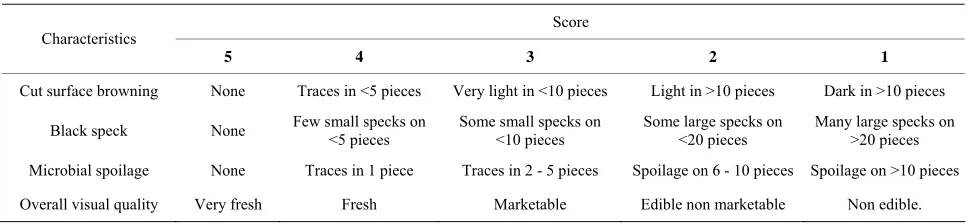
Quality changes (cut surface browning, black speck, microbial spoilage and overall visual acceptance) were evaluated in 6 packs per treatment, by sensory evaluation performed by 6 semi trained panellists using a score sys-tem from 1 to 5 (Table 1) with the score of 3 as the cut
off for marketing.
2.4. Statistical Analysis
Table 1. Estimation of visual quality characteristics of minimally processed cabbage (Adapted from Kim and Klieber, 1997).
Score Characteristics
5 4 3 2 1
Cut surface browning None Traces in <5 pieces Very light in <10 pieces Light in >10 pieces Dark in >10 pieces
Black speck None Few small specks on <5 pieces Some small specks on <10 pieces Some large specks on <20 pieces Many large specks on >20 pieces
Microbial spoilage None Traces in 1 piece Traces in 2 - 5 pieces Spoilage on 6 - 10 pieces Spoilage on >10 pieces
Overall visual quality Very fresh Fresh Marketable Edible non marketable Non edible.
Plus 5.1 (Statpoint Technologies, Inc, VA, USA) statis-tical software. Mean values were subjected to Fisher’s Least Significant Difference test (LSD) at p = 0.05. This
statistical test is liberal with respect to the comparison wise error rate, however, it is powerful for detecting true difference [22]. Data shown in the figures and tables are the mean values of two experimental series since no sig-nificant difference between the series was found.
3. Results and Discussion
3.1. Weight Loss
The multifactor ANOVA indicated that storage tempe- rature, chemical treatments and storage time affected (p =
0.05) weight loss. After 22 days at 0˚C in air, weight loss (Table 2) was similar for the control and the treatments
with ascorbic acid and calcium chloride (2.28% - 2.81%). The treatment with citric acid showed significantly higher weight loss (3.17%). Similar results were
pre-sented at 5˚C. A linear correlation was found between
weight loss and storage time (R2 = 0.985 - 0.995).
Leafy vegetables are particularly vulnerable to rapid water loss [23]. The loss in moisture results in a reduc-tion of fresh weight accompanied by the loss of freshness, appearance and texture. The maximum acceptable weight loss of cabbage is 7% [23,24]. In the present study, weight loss was below 7% at both storage temperatures (0˚C, 5˚C).
3.2. Texture
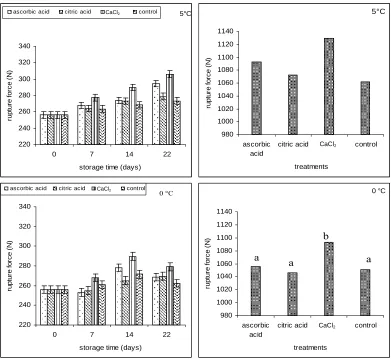
Firmness changes of minimal processed cabbage during storage at 0˚C and 5˚C depend upon the soaking solution and the time of storage (Figure 1).
The rupture values for minimally processed cabbage treated with different chemicals as well as these of con-trol increased over the 22 days storage period. This
in-crease varied between 2.2% - 5% at 0˚C for the control
[image:3.595.56.540.111.223.2]and the treatments with ascorbic and citric acid. At 5˚C the increase varied between 6% - 8% for the control and treatment with citric acid and 13% for the treatment with ascorbic acid. Calcium chloride had a greater firming
Table 2. Weight loss of minimal processing cabbage treated with different chemicals after 22 days of storage at 0˚C and 5˚C.
Temperature Ascorbic acid Citric acid Calcium chloride control
0˚C 2.45Aa 3.17Ab 2.28Aa 2.81Aa
5˚C 3.63Ba 4.2Bb 3.35Ba 3.22Ba
Values followed by different superscript lowercase letters in the same row show statistically significant differences. p = 0.05; Different superscript uppercase letters show statistically significant differences in the same col-umn (among temperatures). p = 0.05; Mean values. N = 2 repetitions × 10 samples per repetition = 20.
effect (p = 0.05) at both storage temperatures compared
to other treatments. This was due to cross-linking of both cell wall and middle-lamella pectin by calcium ions [25]. The texture of a plant food is affected by the genetic background, morphology, cell turgor, water content, bio- chemical components and growing conditions [26,27]. Treatments with ascorbic and citric acid did not result in tissue softening, results not agreeable to those reported by Gil et al. [28]. Cocci etal. [29] showed a structural
breakdown with consequent softening in apple tissue.
3.3. Colour
The L* colour value and hue angle (h˚) were selected as the most suitable parameters to measure the colour change of cut surface of minimally processed cabbage. When the colour became darker, a decrease in L* and
hue angle (h˚) was observed. The hue value represents
true colour which is effective for visualizing the colour appearance of food products [30]. The storage time and the interaction between storage time and temperature had significant effect on L*. Among the parameters which were studied (temperature, chemical treatments, storage time and their interactions) only temperature did not have a significant effect (p = 0.05) on hue values.
The lightness of minimally processed cabbage de-creased linearly (Figure 2) from 70.94 ± 6 to 63.8 ± 8.5
[image:3.595.309.537.273.329.2]5°C
220 240 260 280 300 320 340
0 7 14 22
storage time (days)
rupt
ur
e f
or
c
e (
N
)
ascorbic acid citric acid CaCl2 control 5°C
980 1000 1020 1040 1060 1080 1100 1120 1140
ascorbic acid
citric acid CaCl2 control
treatments
rupt
ur
e f
or
c
e (
N
)
220 240 260 280 300 320 340
0 7 14 22
storage time (days)
rupt
u
re f
o
rc
e
(N
)
ascorbic acid citric acid CaCl2 control 0 °C
980 1000 1020 1040 1060 1080 1100 1120 1140
ascorbic acid
citric acid CaCl2 control
treatments
ru
pt
ur
e f
or
c
e (
N)
0 °C
a a a
b
CaCl2
CaCl2
CaCl2
[image:4.595.102.493.96.455.2]CaCl2
Figure 1. Effects of treatment with chemicals on the firmness of minimal processed cabbage stored at 0˚C and 5˚C. Data ob-served on the left set of histograms show the changes during the 22 days of storage (Mean values. N = 2 repetitions × 6 sam-ples = 12). Vertical bars represent LSD at the 5% level. The data observed in the right set of histograms are the mean of all times.
56 58 60 62 64 66 68 70 72 74
0 5 10 15 20 25
storage time (days)
L*
v
a
lu
e
ascorbic acid citric acid
CaCl2 control 0ºC
CaCl2
56 58 60 62 64 66 68 70 72 74
0 5 10 15 20 25
storage time (days)
L*
v
al
ue
ascorbic acid citric acid
CaCl2 control
5ºC
CaCl2
[image:4.595.96.503.521.693.2]storage at 0˚C. The control sample presented a decrease of L* values to 59.4 ± 5.4.
At 5˚C the lightness decreased from 70.94 ± 6 to 63.6 ± 7.9 - 62.07 ± 8.2 at all cases during 22 days of storage. By day 22, at 0˚C the L* value was lower in non treated cabbage (control) than in treated cabbage with chemicals. Among the chemical treatments citric acid was the best inhibitor showing the least change in lightness. At 5˚C, no significant difference in L* values between the con-trol and treated samples was observed after 22 days of storage.
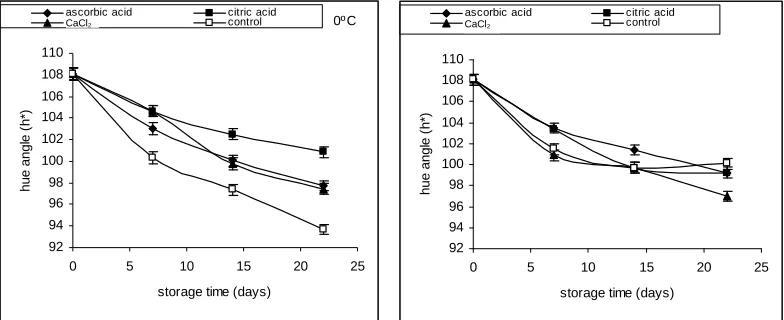
Hue angle values (Figure 3) during storage time were
significantly affected by chemical treatments mainly at 0˚C.
Hue angle values of control decreased rapidly at 0˚C. Among the chemical treatments, citric acid retained bet-ter the color of fresh-cut cabbage. Citric acid has been reported extensively for its inhibitory activity on poly-phenol oxidase, PPO [31] and its antibrowning activity in minimally processed fruits and vegetables [32]. Our re-sults come in agreement with Kim and Klieber [17] who worked on minimally processed Chinese cabbage and Kaur and Kapoor [33] working on minimally processed
Indian cabbage. Ascorbic acid and calcium chloride are intermediate inhibitors as seen in their hue angle (h˚) values (Figure 3). This result was similar to results of
other researchers [16,34] working on banana slices and minimally processed apples. Ascorbic acid is a reducing agent widely used as an antibrowning agent for process-ing of fruits and vegetables. Reductants are irreversibly oxidized during the reaction, which means that the pro-tection they confer is only temporary since they are con-sumed in the reaction [34]. The action of calcium chlo-ride might be due to the PPO inhibition by chlochlo-ride ions [35].
3.4. Soluble Solids Contents (SSC)
The soluble solids content in minimally processed cab-bage during storage at 0˚C and 5˚C are presented in Ta-ble 3.
At 0˚C the control exhibited higher SSC and the cab-bage treated with calcium chloride showed the smallest. At 5˚C the treatments with ascorbic acid and citric acid exhibited the highest SSC. Similar results were reported
by Jiang et al. [36] in Chinese water chestnut.
Gon-zalez-Aguilar et al. [37] reported an appreciable increase
92 94 96 98 100 102 104 106 108 110
0 5 10 15 20 25
storage time (days)
hu
e angl
e (
h
*)
ascorbic acid citric acid
CaCl2 control 0º C
CaCl2
92 94 96 98 100 102 104 106 108 110
0 5 10 15 20 25
storage time (days)
hue angl
e (
h*
)
ascorbic acid citric acid
CaCl2 control
[image:5.595.102.494.382.542.2]CaCl2
[image:5.595.58.541.609.694.2]Figure 3. Hue angle changes of minimal processing cabbage stored at 0˚C and 5˚C for 22 days. Vertical bars represent LSD at the 5% level (Mean values. N = 2 repetitions × 10 samples = 20).
Table 3. Soluble solids content of minimal processed cabbage treated with different chemicals after 22 days of storage at 0˚C and 5˚C.
Time of storage (days) Temperature (˚C)
0 day 22 days
Ascorbic acid Citric acid Calcium chloride control
0 5.88 4.5aA 4.4aA 4.0 bA 4.9cA
5 5.88 4.8aB 4.4aA 3.8bA 3.9bB
in fructose and glucose in fresh-cut mangoes treated with antibrowning agents and stored at 10˚C.
3.5. Overall Organoleptic Quality
Organoleptic quality evaluation was carried out by hu-man volunteers in conjunction with quantifiable physical and chemical measurements to determine if a shelf-life extension treatment has merit.
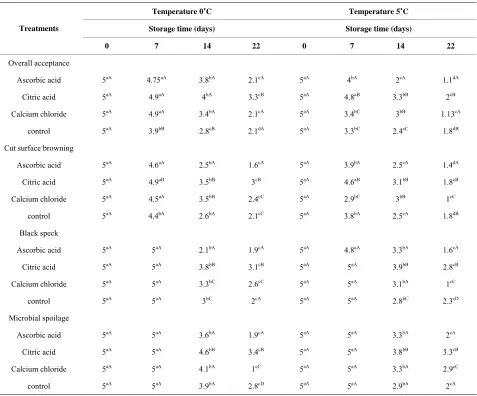
Overall acceptance together with cut surface browning determined the shelf life of control samples which was 7 days at both storage temperatures (Table 4) using a score
of 3 as the limit. Treatment with citric acid extended the shelf life of shredded cabbage stored at 0˚C up to 22 days.
During marketing the predominant temperature is 5˚C
and at this temperature treatment with citric acid ex-tended the shelf life from 7 days (control) to 14 days. Ascorbic acid maintained the overall quality for 14 days
at 0˚C and 7 days at 5˚C, however, no difference was
[image:6.595.62.539.298.694.2]observed regarding cut surface browning compared to the control sample at both storage temperatures. Similar re-sults were reported by Rosen and Kader [38] working with pear slices. Calcium chloride maintained the overall quality and cut surface browning for 14 days at both storage temperatures. Similar results in apples were re-ported by Drake and Spayed [39]. However, Bolin and Huxoll [40] reported that calcium chloride is not effect- tive in preventing browning in peaches. Therefore, 1% citric acid can be used for minimally processed cabbage.
Table 4. Changes in organoleptic quality properties of minimally processed cabbage with different chemical treatments dur-ing storage at 0˚C and 5˚C.
Temperature 0˚C Temperature 5˚C
Storage time (days) Storage time (days)
Treatments
0 7 14 22 0 7 14 22
Overall acceptance
Ascorbic acid 5aA 4.75aA 3.8bA 2.1cA 5aA 4bA 2cA 1.1dA
Citric acid 5aA 4.9aA 4bA 3.3cB 5aA 4.8aB 3.3bB 2cB
Calcium chloride 5aA 4.9aA 3.4bA 2.1cA 5aA 3.4bC 3bB 1.13cA
control 5aA 3.9bB 2.8cB 2.1dA 5aA 3.3bC 2.4cC 1.8dB
Cut surface browning
Ascorbic acid 5aA 4.6aA 2.5bA 1.6cA 5aA 3.9bA 2.5cA 1.4dA
Citric acid 5aA 4.9aB 3.5bB 3cB 5aA 4.6aB 3.1bB 1.8cB
Calcium chloride 5aA 4.5aA 3.5bB 2.4cC 5aA 2.9bC 3bB 1cC
control 5aA 4.4bA 2.6bA 2.1cC 5aA 3.8bA 2.5cA 1.8dB
Black speck
Ascorbic acid 5aA 5aA 2.1bA 1.9cA 5aA 4.8aA 3.3bA 1.6cA
Citric acid 5aA 5aA 3.8bB 3.1cB 5aA 5aA 3.9bB 2.8cB
Calcium chloride 5aA 5aA 3.3bC 2.6cC 5aA 5aA 3.1bA 1cC
control 5aA 5aA 3bC 2cA 5aA 5aA 2.8bC 2.3cD
Microbial spoilage
Ascorbic acid 5aA 5aA 3.6bA 1.9cA 5aA 5aA 3.3bA 2cA
Citric acid 5aA 5aA 4.6bB 3.4cB 5aA 5aA 3.8bB 3.3cB
Calcium chloride 5aA 5aA 4.1bA 1cC 5aA 5aA 3.3bA 2.9cC
control 5aA 5aA 3.9bA 2.8cD 5aA 5aA 2.9bA 2cA
Citric acid is the most commonly used acidifier in com-bination with other types of antibrowning agents to con-trol browning in fruits and vegetables.
During storage, the quality of minimally processed cabbage was affected by black speck. Black speck is a non-pathogenic disorder appearing during storage. It con- sists of very small to moderate size discolored lesions on the midrib and veins of the leaves [41]. At 0˚C citric acid reduced the effects of black speck at the end of shelf-life (22 days) resulting in a better quality. Citric acid may reduce black speck through its inhibitory effect on poly-phenoloxidase by lowering the pH and resulting in the chelation of copper at the active site of the enzyme [42]. At 5˚C the chemical treatments affected black speck and reduced the incidence at the end of shelf-life (14 days).
Citric acid at 0˚C and all chemical treatments at 5˚C prevented microbial spoilage at the end of shelf-life (22 and 14 days, respectively).
4. Conclusions
The results presented indicate that soaking with citric acid better retains the color and the overall acceptance and organoleptic quality of fresh cut cabbage. It can re-duce the cut surface browning and protect from black speck. Citric acid treatment combined with low tempera-ture storage (0˚C) prolonged the shelf life of minimally processed cabbage for 22 days, time sufficient for ac-ceptable marketing.
REFERENCES
[1] E. Watada and L. Qi, “Quality of Fresh-Cut Produce,”
Postharvest Biology and Technology, Vol. 15, No. 3, 1999,
pp. 201-205.doi:10.1016/S0925-5214(98)00085-4
[2] D. King and H. R. Bolin, “Physiological and Microbio- logical Storage Stability of Minimally Processed Fruits and Vegetables,” Food Technology, Vol. 43, No. 2, 1989,
pp. 132-139.
[3] J. K. Brecht, “Physiology of Lightly Processed Fruits and Vegetables,” Horticultural Science, Vol. 30, No. 1, 1995,
pp. 18-22.
[4] J. Zawistowshy, C. G. Biliaderis and N. A. M. Eskin, “Polyphenol Oxidase,” In: D. S. Robinson and N. A. M. Eskin, Eds., Oxidative Enzymes in Foods, Elsevier, Lon-
don, 1991, pp. 217-273.
[5] G. M. Sapers, “Browning of Foods: Control by Sulfites. Antioxidants and Other Means,” Food Technology, Vol.
47, No. 10, 1993, pp. 75-84.
[6] M. E. Pirovani, D. R. Güemes, A. M. Piagentini and J. H Di Pentina, “Storage Quality of Minimally Processed Ca- bbage Packaged in Plastic Films,” Journal of Food Qua- lity, Vol. 20, No. 5, 1997, pp. 381-389.
doi:10.1111/j.1745-4557.1997.tb00481.x
[7] M. Friedman, “Food Browning and Its Prevention—A Review,” Journal of Agricultural and Food Chemistry,
Vol.44, No. 3, 1996, pp. 631-653.doi:10.1021/jf950394r
[8] V. M. Gomez-Lopez, P. Ragaert, V. Jeyachchandran, J. Debevere and F. Devlieghere, “Shelf-Life of Minimally Processed Lettuce and Cabbage Treated with Gaseous Chlorine Dioxide and Cysteine,” International Journal of
Food Microbiology, Vol. 121, No. 1, 2008, pp. 74-83.
doi:10.1016/j.ijfoodmicro.2007.11.036
[9] V. M. Gomez-Lopez, P. Ragaert, J. Ryckeboer, V. Jeya- chchandran, J. Debevere and F. Devlieghere, “Shelf-Life of Minimally Processed Cabbage Treated with Neutral Electrolysed Oxidizing Water and Stored under Equi- librium Modified Atmosphere,” International Journal of
Food Microbiology Vol. 117, No. 1, 2007, pp. 91-98.
doi:10.1016/j.ijfoodmicro.2007.02.016
[10] L. D. Alvarez and A. Chiralt, “Color of Minimally Processed Fruits and Vegetables as Affected by Some Chemical and Biochemical Changes,” In: S. M. Alzamora, M. S. Tapia and A. Lopez-Malo Eds., Minimally Pro-
cessed Fruits and Vegetables, Aspen Publishers, Fre-
derick, 2000, pp. 111-126.
[11] F. Pizzocaro, D. Torreggiani and G. Gilardi, “Inhibition of Apple Polyphenol Oxidase by Ascorbic Acid, Citric Acid and Sodium Chloride,” Journal of Food Processing
and Preservation Vol. 17, No. 1, 1993, pp. 21-30.
doi:10.1111/j.1745-4549.1993.tb00223.x
[12] M. A. Rojas-Graü, Solina-Fortuny and O. Martin-Belloso, “Effect of Natural Antibrowning Agents on Color and Related Enzymes in Fresh-Cut ‘Fuji’ Apples as an Al- ternative to the Use Ascorbic Acid,” Journal of Food
Science, Vol. 73, 2008, pp. 267-272.
[13] Y. M. Fu, J. R. Jiang, G. Zanberman and Y. Fuchs, “Purification of Polyphenol Oxidase and the Browning Control of Litchi Fruit by Glutathiose and Citric Acid,”
Journal of the Science of Food and Agriculture, Vol. 79,
No. 7, 1999, pp. 950-954.
[14] H. E. Moline, J. G. Buta and I. M. Newman, “Prevention of Browning of Banana Slices Using Natural Produce and Their Derivatives,” Journal of Food Quality,Vol. 22, No.
5, 1999, pp. 499-511.
doi:10.1111/j.1745-4557.1999.tb00181.x
[15] E. Van Rensburg and A. H. P. Engelbrecht, “Effect of Calcium Salts on Susceptibility to Browning of Avocados Fruit,” Journal of Food Science, Vol. 51, No. 4, 1986, pp.
1067-1068.doi:10.1111/j.1365-2621.1986.tb11235.x
[16] P. Varela, A. Salvador and S. M. Fiszman, “The Use of Calcium Chloride in Minimally Processed Apples,” Euro-
pean Food Research and Technology, Vol. 224, No. 4,
2007, pp. 461-467.doi:10.1007/s00217-006-0344-7
[17] S. Kim and A. Klieber, “Quality Maintenance of Mini- mally Processed Chinese Cabbage with Low Temperature and Citric Acid Dip,” Journal of the Science of Food and
Agriculture, Vol. 75, No. 1, 1997, pp. 31-36.
[18] Y. F. Chu, J. Sun, X. Wu and R. H. Liu, “Antioxidant and Anti Proliferative Activities of Common Vegetables,”
Journal of Agricultural and Food Chemistry, Vol. 50, No.
23, 2002, pp. 6910-6916.doi:10.1021/jf020665f
[19] Y. S. Keum, W. S. Jeong and A. N. T. Kong, “Chemopre- vention by Isothiocyanates and Their Underlying Mole- cular Signalling Mechanisms,” Mutation Research, Vol.
555, No. 1-2, 2004, pp. 191-202.
doi:10.1016/j.mrfmmm.2004.05.024
[20] M. M. Rinaldi, B. C. Benedetti and C. L. Moretti, “Respiration Rate, Ethylene Production and Shelf Life of Minimally Processed Cabbage under Controlled Atmo- sphere,” Acta Horticulturae, Vol. 876, 2010a, pp. 279- 286.
[21] M. M. Rinaldi, C. I. G. L. Sarantopoulos, B. C. Benedetti and C. L. Moretti, “Storage of Minimally Processed Cab- bage in Different Packaging Systems,” Acta Horticul-
turae, Vol. 877, 2010b, pp. 597-602.
[22] M. C. Gacula and J. Singh, “Statistical Methods in Food and Consumer Research,” Academic Press Inc., New York, 1984.
[23] S. J. Kays, “Postharvest Physiology of Perishable Plant Products,” AVI Publisher, New York, 1991, pp. 356-357. [24] H. M. Kang, K. W. Park and M. E. Saltveit, “Elevated
Growing Temperatures during the Day Improve the Post- harvest Chilling Tolerance of Greenhouse—Grown Cu- cumber,” Postharvest Biology and Technology Vol. 24, 2002, pp. 49-57.doi:10.1016/S0925-5214(01)00129-6
[25] W. Poovaich, “Role of Calcium in Prolonging Storage Life of Fruits and Vegetables,” Food Technology, Vol. 40,
No. 5, 1986, pp. 86-89.
[26] F. R. Harker, R. J. Redgwell, I. C Hallet and S. H. Murray, “Texture of Fresh Fruit,” Horticultural Reviews, Vol. 20,
1997, pp. 121-224.
[27] E. Sams, “Preharvest Factors Affecting Postharvest Tex- ture,” Postharvest Biology and Technology, Vol. 15, No.
3, 1999, pp. 249-254.
doi:10.1016/S0925-5214(98)00098-2
[28] M. I. Gil, J. R. Gorny and A. A. Kader, “Responses of ‘Fuji’ Apple Slices to Ascorbic Acid Treatments and Low Oxygen Atmospheres,” Horticultural Science, Vol. 33,
No. 2, 1998, pp. 305-309.
[29] Cocci, P. Rocculi, S. Romani and M. Dalla Rosa, “Chan- ges in Nutritional Properties of Minimally Processed Apples during Storage,” Postharvest Biology and Tech-
nology, Vol. 39, No. 3, 2006, pp. 265-271.
doi:10.1016/j.postharvbio.2005.12.001
[30] R. G. Mcguire, “Reporting of Objective Colour Measure- ments,” Horticultural Science, Vol. 27, No. 12, 1992, pp.
1254-1255.
[31] T. T. Langdon, “Preventing of Browning in Fresh Pre-
pared Potatoes without the Use of Sulfiting Agents,”
Food Technology, Vol. 41, No. 64, 1987, pp. 66-67.
[32] R. Ahvenainen, “New Approaches in Improving the Shelf Life of Minimally Processed Fruit and Vegetables,”.
Trends in Food Science and Technology, Vol. 7, No. 6,
1996, pp. 179-187.doi:10.1016/0924-2244(96)10022-4
[33] C. Kaur and H. C. Kapoor, “Antioxidant Activity and Quality of Minimally Processed Indian Cabbage (Bras-
sica Oleracea var. Capitata),” Journal of Food Pro-
cessing and Preservation, Vol. 25, No. 5, 2001, pp.
367-380.doi:10.1111/j.1745-4549.2001.tb00467.x
[34] M. Apintanapong, K. Cheachumluang, P. Suansawan and N. Thongpraset, “Effect of Antibrowning Agents on Ba- nana Slices and Vacuum-Fried Slices,” Journal of Food
Agriculture and Environment, Vol. 5, No. 3-4, 2007, pp.
151-157.
[35] Garcia and D. M. Barette, “Preservation Treatments for Fresh Cut Fruits and Vegetables,” In: O. Lamikanra, Ed.,
Fresh Cut Fruits and Vegetables: Science, Technology
and Market, CRC Press, Boca Raton, 2002, pp. 267-303.
[36] Y. M. Jiang, L. T. Peng and J. R. Li, “Use of Citric Acid for Shelf Life and Quality Maintenance of Fresh-Cut Chinese Water Chestnut,” Journal of Food Engineering,
Vol. 63, No. 3, 2004, pp. 325-328.
doi:10.1016/j.jfoodeng.2003.08.004
[37] A. Gonzalez-Aguilar, C. Y. Wang and J. C. Buta, “Main- taining Quality of Fresh-Cut Mangoes Using Antibrow- ning Agents and Modified Atmosphere Packaging,” Jour-
nal of Agricultural and Food Chemistry, Vol. 48, No. 9,
2000, pp. 4204-4208.doi:10.1021/jf991384j
[38] J. C. Rosen and A. A. Kader, “Postharvest Physiology and Quality Maintenance of Sliced Pear and Strawberry Fruits,” Journal of Food Science, Vol. 54, No. 3, 1989, pp.
656-659.doi:10.1111/j.1365-2621.1989.tb04675.x
[39] S. R. Drake and S. E. Spayed, “Influence of Calcium Treatment on ‘Golden Delicious’ Apple Quality,” Journal
of Food Science, Vol. 48, No. 2, 1983, pp. 403-405.
doi:10.1111/j.1365-2621.1983.tb10752.x
[40] R. Bolin and C. C Huxoll, “Storage Stability of Mini- mally Processed Fruits,” Journal of Food Processing and
Preservation, Vol. 31, No. 4, 1989, pp. 281-292.
doi:10.1111/j.1745-4549.1989.tb00107.x
[41] R. Walsh, E. C. Lougheed and P. M. A. Toivenon, “The Effect of Benomyl. Sodium Hypochlorite and Controlled Atmospheres upon the Incidence of Black Speck of Stored Cabbage,” Journal of American Society of Horticultural
Sciences, Vol. 108, No. 4, 1983, pp. 533-536.
[42] R. Lyengar and A. J. Mcevily, “Anti-Browning Agents: Alternatives to the Use of Sulfites in Foods,” Trends in
Food Science and Technology, Vol. 3, 1992, pp. 60-64.