ISSN Online: 2160-0384 ISSN Print: 2160-0368
DOI: 10.4236/apm.2019.92004 Feb. 14, 2019 53 Advances in Pure Mathematics
Numerical Solution of Two-Dimensional
Nonlinear Stochastic Itô-Volterra Integral
Equations by Applying Block Pulse Functions
Guo Jiang, Xiaoyan Sang
*, Jieheng Wu, Biwen Li
School of Mathematics and Statistics, Hubei Normal University, Huangshi, China
Abstract
This paper investigates the numerical solution of two-dimensional nonlinear stochastic Itô-Volterra integral equations based on block pulse functions. The nonlinear stochastic integral equation is transformed into a set of algebraic equations by operational matrix of block pulse functions. Then, we give error analysis and prove that the rate of convergence of this method is efficient. Lastly, a numerical example is given to confirm the method.
Keywords
Block Pulse Functions, Integration Operational Matrix, Stochastic Itô-Volterra Integral Equations
1. Introduction
Two-dimensional stochastic Itô-Volterra integral equations arise from many phenomena in physics and engineering fields [1]. Some different orthogonal ba-sis functions, polynomials and wavelets are used to approximate the solution of two-dimensional Volterra integral equations. For example, block pulse functions, triangular functions, modification of hat functions, Legender polynomials and Haar wavelet and the like (see [2] [3] [4] [5] [6]).
Especially, Fallahpour et al. [3] introduced the following two-dimensional li-near stochastic Volterra integral equation by Haar wavelet
(
)
(
)
(
) (
)
(
) (
) ( ) ( )
2 1
2 1
1 2 1 2 0 0 1 2 1 2 1 2 1 2
1 2 1 2 1 2 1 2
0 0
, , , , , , d d
ˆ , , , , d d ,
t t
t t
x t t f t t k t t s s x s s s s k t t s s x s s B s B s
= +
+
∫ ∫
∫ ∫
(1)
where x t t
(
1 2,)
is unknown and called the solution of the Equation (1),How to cite this paper: Jiang, G., Sang, X.Y., Wu, J.H. and Li, B.W. (2019) Numer-ical Solution of Two-Dimensional Nonli-near Stochastic Itô-Volterra Integral Equa-tions by Applying Block Pulse FuncEqua-tions. Advances in Pure Mathematics, 9, 53-66. https://doi.org/10.4236/apm.2019.92004 Received: January 15, 2019
Accepted: February 11, 2019 Published: February 14, 2019 Copyright © 2019 by author(s) and Scientific Research Publishing Inc. This work is licensed under the Creative Commons Attribution International License (CC BY 4.0).
http://creativecommons.org/licenses/by/4.0/
DOI: 10.4236/apm.2019.92004 54 Advances in Pure Mathematics
(
1 2, , ,1 2)
k t t s s , k t t s sˆ , , ,
(
1 2 1 2)
and f t t(
1 2,)
are known functions(
t t1 2,)
∈[
0,T1)
×[
0,T2)
, s t s1≤ 1, 2≤t2. B s( )
1 and B s( )
2 are twoindepen-dent Brownian motions and 2 1
(
) (
) ( ) ( )
1 2 1 2 1 2 1 2
0 0 ˆ , , , , d d
t t
k t t s s x s s B s B s
∫ ∫
is thedouble Itô integral. The authors transformed stochastic Volterra integral equa-tions to algebra equaequa-tions by Haar wavelet and gave the numerical soluequa-tions to the equations. Similarly, Fallahpour et al. [7] obtained a numerical method for two-dimensional linear stochastic Volterra integral equations by block pulse functions.
For nonlinear determinate Volterra integral equations, Maleknejad et al. [8] and Nemati et al. [6] used two-dimensional block pulse functions and Legendre polynomials to solve those respectively. Both Babolian et al. [2] and Maleknejad
et al. [9] employed triangular functions to get the numerical solutions. Mirzaee
et al. [5] [10] applied modified two-dimensional block pulse functions to ap-proximate the following determinate equation
(
)
1 2(
) (
)
(
)
[
)
[
)
1 2, 0 0 1 2, , ,1 2 1, 2 d d , ,2 1 1 2 0, 1 0, 2 ,
t t n
f t t =
∫ ∫
k t t s s x s s s s t t ∈ T × T (2)where nonlinear term
(
1, 2)
nx s s
is power function and x s s
(
1, 2)
isun-known, n is a positive integer. k t t s s
(
1 2, , ,1 2)
is determinate kernel function1 1 1 2 2 2
0≤ ≤ ≤s t T,0≤s ≤ ≤t T . The authors revealed the accuracy and efficiency
of the proposed method by some examples and gave the rate of convergence to the numerical solution.
However, as far as we known, there are hardly any papers about the numerical solution of two-dimensional nonlinear stochastic Itô-Volterra integral equations. Inspired by the above literatures, we introduce an efficient numerical method for the following nonlinear stochastic integral equation based on block pulse func-tions.
(
)
(
)
(
)
(
(
)
)
(
)
(
(
)
)
( ) ( )
2 1
2 1
1 2 0 1 2 0 0 1 2 1 2 1 2 1 2
1 2 1 2 1 2 1 2
0 0
, , , , , , d d
ˆ , , , , d d ,
t t
t t
x t t x t t k t t s s x s s s s k t t s s g x s s B s B s
σ
= +
+
∫ ∫
∫ ∫
(3)
where x t t
(
1 2,)
is unknown function and is called the solution of the Equation(3) defined on district D=
[ ) [ )
0,1 × 0,1 . x t t0(
1 2,)
is known determinate func-tion. k t t s s(
1 2, , ,1 2)
and k t t s sˆ , , ,(
1 2 1 2)
are determinate kernel functions.(
)
(
(
)
)
( ) ( )
2 1
1 2 1 2 1 2 1 2
0 0 ˆ , , , , d d
t t
k t t s s g x s s B s B s
∫ ∫
is the double Itô integral. B s( )
1and B s
( )
2 are two independent Brownian motions.σ
and g are analyticalfunctions.
DOI: 10.4236/apm.2019.92004 55 Advances in Pure Mathematics
7, we give a numerical example to illustrate the validity of the method. In the fi-nal Section 8, we make some conclusions and look ahead to further work.
2. Two-Dimensional Block Pulse Functions
One dimensional block pulse functions (BPFs) have been widely studied and ap-plied to solve different problems. For example, the article [12] and their relative references give a detailed description. A m m1 2-set of two-dimensional block pulse functions (2D-BPFs) φa a1 2,
(
t t1 2,)
in the region of D=[ ) [ )
0,1 × 0,1 are defined as:(
)
(
)
(
)
1 2
1 1 1 1 1 2 2 2 2 2
, 1 2
1 1 , 1
,
0 otherwise,
a a
a h t a h a h t a h
t t
φ = − ≤ < − ≤ <
where ai=1,2, , mi, i 1 i
h m
= , 2n
i
m = , mi and n are arbitrary positive in-tegers and i=1,2.
Similar to the one-dimensional case [12]. There are some elementary proper-ties for 2D-BPFs as follows:
1) Disjointness:
(
)
(
)
1 2(
)
1 2 1 2
, 1 2 1 1 2 2
, 1 2 , 1 2
, if ,
, ,
0 otherwise,
a a
a a b b
t t a b a b
t t t t
φ
φ
φ
= = = (4)
where a bi, i =1,2, , mi, i=1,2. 2) Orthogonality:
(
)
(
)
1 2 1 2
1 1 1 2 1 1 2 2
, 1 2 , 1 2 1 2 0 0
if ,
, , d d
0 otherwise.
a a b b
h h a b a b
t t t t t t
φ
φ
= = =
∫ ∫
(5)3) Completeness: for every f ∈
(
L D2( )
)
, when 1m and m2 approach to the infinity, Parseval’s identity holds:
(
)
1 2 1 2(
)
1 2
2
1 1 2 2
1 2 1 2 , , 1 2
0 0
1 1
, d d a a a a , ,
a a
f t t t t ∞ ∞ f φ t t
= =
=
∑ ∑
∫ ∫
(6)where
(
)
(
)
1 2 1 2
1 1
, 0 0 1 2 , 1 2 1 2
1 2
1 , , d d .
a a a a
f f t t t t t t
h h φ
=
∫ ∫
The set of 2D-BPFs may be written as a vector Φ
(
t t1 2,)
of dimension(
m m1 2)
:(
)
(
(
)
(
)
(
)
(
)
)
1 2 2 1 1 2
T 1 2, 1,1 1 2, , , 1, 1 2, , , ,1 1 2, , , , 1 2, ,
m m t t φ t t φ m t t φm t t φm m t t
Φ = (7)
where
(
t t1 2,)
∈D.From the above representation and disjointness property, it follows that:
(
)
(
)
(
)
(
)
(
)
1 2 1 2
1 2 1 2 1 2
1,1 1 2
1,2 1 2 T
1 2 1 2
, 1 2
, 0 0
0 , 0
, , ,
0 0 ,
m m m m
m m m m m m
t t
t t
t t t t
t t φ
φ
φ
×
Φ Φ =
(8)
(
)
(
)
1 2 1 2
T
1 2, 1 2, 1, m m t t m m t t
DOI: 10.4236/apm.2019.92004 56 Advances in Pure Mathematics
(
)
(
)
(
)
1 2 1 2 1 2
T
1 2, 1 2, 1 2, , m m t t m m t t G G m m t t
Φ Φ = Φ (9)
where G is a
(
m m1 2)
-vector and the matrix G=diag G( )
. Moreover, it is easyto conclude that for every
(
m m1 2) (
× m m1 2)
matrix A(
)
(
)
(
)
1 2 1 2 1 2
T T
1 2, 1 2, ˆ 1 2, ,
m m t t m m t t A m m t t
Φ AΦ = Φ (10)
where Aˆ is a
(
m m1 2)
-vector with elements equal to the diagonal entries ofmatrix A.
Any function x t t
(
1 2,)
which is square integrable in the interval D can beexpanded in terms of BPFs as
(
)
(
)
1 2(
)
( )
1 2 1 2 1 2 1 2 1 2
1 2
T
1 2 1 2 , , 1 2
1 1
, m m , m m a a a a , m m m m ,
a a
x t t x t t x
φ
t t X t= =
=
∑ ∑
= Φ (11)
where xm m1 2
(
t t1 2,)
is m m1 2 approximations of 2D-BPFs of x t t(
1 2,)
,(
)
1 2 1 2,
m m
x t t is a coefficient
(
m m1 2)
-vector, i.e.(
)
1 2 2 1 1 2
T 1,1, , 1, , , ,1, , , ,
m m m m m m
X = x x x x (12)
where the block pulse coefficients xa a1 2, are obtained as
( ) ( )
(
)
2 2 1 1
1 2, 2 1 2 11 1 1 2 1 2 1 2
1 a h a h , d d .
a a a h a h
x x t t t t
h h − −
=
∫
∫
Similarly, a function of four variables k t t s s
(
1 2, , ,1 2)
on L D D2(
×)
may beapproximated with respect to 2D-BPFs such as
(
)
1 2(
)
T 1 2(
)
1 2, , ,1 2 m m 1 2, m m 1, 2 ,
k t t s s Φ t t KΦ s s
where Φm m1 2
(
t t1 2,)
is a 2D-BPFs vector of dimension(
m m1 2)
, K is the(
m m1 2) (
× m m1 2)
two-dimensional block pulse coefficient matrix in the follow-ing form(
a b1 1)
m m1×1, a b1 1(
ka a b b1 2 1 2)
m m2× 2,= =
K K K
, 1, , , 1,2
i i i
a b = m i= and two-dimensional block pulse coefficients 1 2 1 2
a a b b k are given by
(
)
(
)
(
)
1 2 1 2 1 2 1 2
1 1 1 1
1 2 1 2 , 1 2 , 1 2 1 2 1 2 2 2 0 0 0 0
1 2
1 , , , , , d d d d .
a a b b b b a a
k k t t s s t t s s t t s s
h h φ φ
=
∫ ∫ ∫ ∫
(13)The more details can also reference to [7].
3. Operational Matrix of Integration
Let
( )
1 2
ij M M
ξ ×
=
M and
( )
1 2
ij N N
η ×
=
N be matrices. M Nl, l are positive integers, l=1,2. We have
(
)
2
2
1 1 1 2 1 1 2 2
11 12 1
21 22 2
1 2
,
M
M ij
M M M M M N M N
ξ ξ ξ
ξ ξ ξ
ξ
ξ ξ ξ
×
⊗ = =
N N N
N N N
M N N
N N N
DOI: 10.4236/apm.2019.92004 57 Advances in Pure Mathematics
where ⊗ denotes the Kronecker product defined as [13]. Each
ξ
ijN is a block of size N N1× 2, M N⊗ is of size M N M N1 1× 2 2.Then the vector Φm m1 2
(
t t1 2,)
can be showed as following(
)
( )
( )
( ) ( )
( )
(
)
(
( ) ( )
( )
)
( ) ( )
( ) ( )
( ) ( )
( ) ( )
(
)
1 2 1 2 1 22 1 1 2
1 2
1 2
T T
1 1 2 1 1 1 2 2 2 2
T
1 1 1 2 1 1 2 1 1 2 1 2
, , , , , , , , , , , , , m m m m m m
m m m m
t t
t t
t t t t t t
t t t t t t t t
φ φ φ φ φ φ
φ φ φ φ φ φ φ φ
Φ
= Φ ⊗ Φ
= ⊗
=
where φai
( )
ti are one dimensional BPFs, Φmi( )
ti are vectors of one dimen-sional BPFs, ai =1,2, , , m ii =1,2.The integration of the vector Φm m1 2
(
t t1 2,)
defined in (7) can beapprox-imately obtained as following
(
)
( )
( )
( )
( )
( )
( )
(
)
(
)
(
)
2 1 2 1
1 2 1 2
1 2
1 2
1 2
1 2
1 2
1 2 1 2 1 2 1 2
0 0 0 0
1 1 2 2
0 0
1 1 2 2
1 2 1 2
1 2
, d d d d
d d
, , ,
t t t t
m m m m
t t
m m
m m
m m
m m
s s s s s s s s
s s s s
t t
t t t t
Φ = Φ ⊗ Φ
= Φ ⊗ Φ
Φ ⊗ Φ
= ⊗ Φ
= Φ
∫ ∫
∫ ∫
∫
∫
P P P P P (14)
where t1∈
[ )
0,1 ,t2∈[ )
0,1 , P is the(
m m1 2) (
× m m1 2)
operational matrix ofintegration for 2D-BPFs and Pi,
(
i=1,2)
are the operational matrix of one-dimensional BPFs [12] defined over[ )
0,1 as following.( )
1 2 2 2
0 1 2 2
.
0 0 1 2
2
0 0 0 1
i i i m m h × = P
For details, see [7], so
(
)
(
)
(
)
2 1 2 1
1 2 1 2
1 2 1 2
1 2 1 2 1 2 1 2
0 0 0 0
1 2
, d d , d d
, .
t t t t T
m m m m T
m m m m
x s s s s X s s s s
X t t
Φ = Φ
∫ ∫
∫ ∫
P (15)4. Stochastic Integration Operational Matrix
Similarly, we obtain the stochastic integration of the vector Φm m1 2
(
t t1 2,)
de-fined in (7) as following(
) ( ) ( )
( )
( ) ( ) ( )
( ) ( )
( ) ( )
( )
( )
(
)
(
)
(
)
2 1 1 2 2 1 1 2 1 2 1 21 1 2 2
1 2 1 2 1 2
1 2 1 2
0 0
1 2 1 2
0 0
1 1 2 2
0 0
1 2
1 2 1 2
, d d
d d d d , , , t t m m t t m m t t m m
s m s m
s s m m s m m
s s B s B s
s s B s B s
s B s s B s
t t
t t t t
Φ
= Φ ⊗ Φ
= Φ ⊗ Φ
Φ ⊗ Φ
= ⊗ Φ = Φ
∫ ∫
∫ ∫
∫
∫
P P
P P P
DOI: 10.4236/apm.2019.92004 58 Advances in Pure Mathematics
where t1∈
[ )
0,1 ,t2∈[ )
0,1 , Ps is the(
m m1 2) (
× m m1 2)
stochastic operationalmatrix of integration for 2D-BPFs and Psi,
(
i=1,2)
are the stochastic opera-tional matrix of one-dimensional BPFs [12] defined over[ )
0,1 as following.( )
( )
( )
( )
( )
( )
( )
( )
( )
( )
( )
(
)
(
(
)
)
2 30 2 2
2
5 .
0 0 5 3 2
2
2 1
0 0 0 1
2
i
i i
i
i i i
i
i i i i i
i s
i i i
i i
i i
m m h
B B h B h B h
h
B B h B h B h B h B h
h
B B h B h B h
m h
B B m h
× − − − = − − − − − P (17)
For details, see [7]. Therefore,
(
) ( ) ( )
(
) ( ) ( )
(
)
2 1 2 1
1 2 1 2
1 2 1 2
T
1 2 1 2 1 2 1 2
0 0 0 0
T
1 2
, d d , d d
, .
t t t t
m m m m
m m s m m
x s s B s B s X s s B s B s
X t t
Φ = Φ
∫ ∫
∫ ∫
P (18)5. Numerical Method
In this section, we first provide a useful result for solving two-dimensional non-linear stochastic Itô-Volterra integral Equation (3).
Lemma 1. Let
( )
jj
t a t
σ =
∑
,( )
jj
g t =
∑
b t be the analytic functions forpositive integer j∈
(
0,∞)
, then(
)
(
1 2)
T(
1 2)
1 2(
)
1 2, 1 2, ,
m m m m m m
x t t X t t
σ =σ Φ
(
)
(
1 2)
T(
1 2)
1 2(
)
1 2, 1 2, ,
m m m m m m
g x t t =g X Φ t t
where Φm m1 2
(
t t1 2,)
and Xm m1 2 are derived in (7) and (12),(
1 2)
(
( )
( )
2( )
1(
1 2)
)
T
1,1 , , 1, , , ,1 , , , ,
m m m m m m
X x x x x
σ = σ σ σ σ
(
1 2)
(
( )
( )
2( )
1(
1 2)
)
T
1,1 , , 1, , , ,1 , , , .
m m m m m m
g X = g x g x g x g x
Proof. By virtue of the known conditions and the disjointness properties of 2D-BPFs defined in (4), we can get
(
)
(
)
(
(
)
)
(
)
(
)
(
)
(
)
(
)
(
)
(
)
1 21 2 1 2 1 2 1 2
1 2
2 2 1 1
1 2 1 2
2 1 1 2 1 2
1
1 2 1 2 , , 1 2
1 1
1,1 1,1 1 2 1, 1, 1 2 ,1 ,1 1 2 , , 1 2
1,1 1, ,1 , 1 2
T , , , , , , , , , , , , , , j m m j
m m j m m j a a a a
a a
j m m m m
j m m m m
j j j j
j m m m m m m
m m
x t t a x t t a x t t
a x t t x t t x t t
x t t
a x x x x t t
X
σ φ
φ φ φ
φ σ = = = = = + + + + + + = Φ =
∑
∑ ∑ ∑
∑
∑
(
2)
Φm m1 2(
t t1 2, ,)
thus,(
)
(
1 2)
T(
1 2)
1 2(
)
T1 2(
)
(
1 2)
1 2, 1 2, 1 2, ,
m m m m m m m m m m
x t t X t t t t X
DOI: 10.4236/apm.2019.92004 59 Advances in Pure Mathematics
(
)
(
1 2)
T(
1 2)
1 2(
)
T1 2(
)
(
1 2)
1 2, 1 2, 1 2, .
m m m m m m m m m m
g x t t =g X Φ t t = Φ t t g X (20)
The proof is completed. □
Now we suppose x t t
(
1 2,)
, x t t0(
1 2,)
,σ
(
x t t(
1 2,)
)
, g x t t(
(
1 2,)
)
,(
1 2, , ,1 2)
k t t s s and k t t s sˆ , , ,
(
1 2 1 2)
can be approximated in terms of 2D-BPFs.(
)
1 2(
)
1 2 1 2(
)
1 2(
)
1 2T T
1 2, m m 1 2, m m m m 1 2, m m 1 2, m m ,
x t t x t t =X Φ t t = Φ t t X (21)
(
)
1 2(
)
T1 2 1 2(
)
T1 2(
)
1 20 1 2, 0m m 1 2, 0m m m m 1 2, m m 1 2, 0m m ,
x t t x t t =X Φ t t = Φ t t X (22)
(
)
(
)
(
1 2(
)
)
T(
1 2)
1 2(
)
T1 2(
)
(
1 2)
1 2, m m 1 2, m m m m 1 2, m m 1 2, m m ,x t t x t t X t t t t X
σ σ =σ Φ = Φ σ (23)
(
)
(
)
(
1 2(
)
)
T(
1 2)
1 2(
)
T1 2(
)
(
1 2)
1 2, m m 1 2, m m m m 1 2, m m 1 2, m m ,g x t t g x t t =g X Φ t t = Φ t t g X (24)
(
)
1 2(
)
T1 2(
)
1 2(
)
1 2, , ,1 2 m m 1 2, , ,1 2 m m 1 2, 1 m m 1, 2 ,
k t t s s k t t s s = Φ t t KΦ s s (25)
(
)
1 2(
)
1 2(
)
1 2(
)
T
1 2 1 2 1 2 1 2 1 2 2 1 2
ˆ , , , ˆm m , , , m m , m m , ,
k t t s s k t t s s = Φ t t K Φ s s (26) where Xm m1 2, X0m m1 2, σ
(
Xm m1 2)
and g X(
m m1 2)
are two-dimensional blockpulse coefficient vectors. K1 and K2 are two-dimensional block pulse coeffi-cient matrices.
Now, by (21)-(26), we approximate the Equation (3)
(
)
(
)
(
)
(
)
(
)
(
)
(
)
(
)
(
)
(
)
( ) ( )
1 2 1 2
1 2 1 2
2 1
1 2 1 2 1 2 1 2
2 1
1 2 1 2 1 2 1 2
T
1 2 T
0 1 2
T T
1 2 1 1 2 1 2 1 2
0 0
T T
1 2 2 1 2 1 2 1 2
0 0
, ,
, , , d d
, , , d d
m m
m m m m
m m t t
m m m m m m m m
t t
m m m m m m m m
X t t
X t t
t t s s s s X s s
t t s s s s g X B s B s
σ Φ
= Φ
+ Φ Φ Φ
+ Φ Φ Φ
∫ ∫
∫ ∫
K K(
)
(
)
(
)
(
)
(
)
(
)
(
)
(
)
(
)
( ) ( )
1 2 1 2 2 11 2 1 2 1 2 1 2
2 1
1 2 1 2 1 2 1 2
T
0 1 2
T T
1 2 1 0 0 1 2 1 2 1 2
T T
1 2 2 0 0 1 2 1 2 1 2
,
, , , d d
, , , d d
m m m m
t t
m m m m m m m m
t t
m m m m m m m m
X t t
t t s s s s X s s
t t s s s s g X B s B s
σ
= Φ
+ Φ Φ Φ
+ Φ Φ Φ
∫ ∫
∫ ∫
K K(
)
(
)
(
)
(
)
(
)
(
)
(
) ( ) ( )
1 2 1 2 2 11 2 1 2 1 2
2 1
1 2 1 2 1 2
T
0 1 2
T
1 2 1 0 0 1 2 1 2
T
1 2 2 0 0 1 2 1 2
,
, , d d
, , d d
m m m m
t t
m m m m m m
t t
m m m m m m
X t t
t t X s s s s
t t g X s s B s B s
σ
= Φ
+ Φ Φ
+ Φ Φ
∫ ∫
∫ ∫
K K (
)
(
)
(
)
(
)
(
)
(
)
(
) ( ) ( )
1 2 1 2 2 11 2 1 2 1 2
2 1
1 2 1 2 1 2
T
0 1 2
T
1 2 1 0 0 1 2 1 2
T
1 2 2 0 0 1 2 1 2
,
, , d d
, , d d ,
m m m m
t t
m m m m m m
t t
m m m m m m
X t t
t t X t t s s
t t g X t t B s B s
σ
= Φ
+ Φ Φ
+ Φ Φ
∫ ∫
∫ ∫
K K by (15) and (18), we have
(
)
(
)
(
)
(
)
(
)
(
)
(
)
(
)
1 2 1 2
1 2 1 2 1 2 1 2
1 2
1 2 1 2 1 2
T
1 2
T T
0 1 2 1 2 1 1 2
T
1 2 2 1 2
,
, , ,
, , ,
m m
m m m m
m m m m m m m m
m m m m s m m
X t t
X t t t t X t t
t t g X t t
σ
Φ
= Φ + Φ Φ
+ Φ Φ
K P
K P
DOI: 10.4236/apm.2019.92004 60 Advances in Pure Mathematics
matrices. By (10), we have
(
)
(
)
(
)
(
)
1 2 1 2 1 2 1 2 1 2 1 2
T T T T
1 2, 0m m 1 2, ˆ 1 2, ˆ 1 2, ,
m m m m m m m m s m m
X Φ t t = X Φ t t +Q Φ t t +Q Φ t t
where Qˆ and Qˆs are
(
m m1 2)
-vectors with elements equal to the diagonalen-tries of matrices Q and Qs. Then
1 2 1 2
T T T T
0m m ˆ ˆ .
m m s
X =X +Q +Q (27)
There are various methods to solve the nonlinear system of Equation (27) of
1 2
m m
X . In this paper, we will use the int () function provided by Matlab 2015b [14] to solve it. According to the coefficient vector Xm m1 2, we obtain that the approximation solution of Equation (3) 1 2
(
)
1 2 1 2(
)
T
1 2, 1 2,
m m m m m m
x t t =X Φ t t .
6. Error Analysis
In this section, for convenience, we assume m m1= 2 =m and prove that the approximation solution is convergent of order O h h
( )
, 1m = .
Lemma 2. Let v s s
(
1, 2)
be an arbitrary bounded function on D=[ ) [ )
0,1 × 0,1 and emm(
s s1, 2)
=v s s(
1, 2)
−vmm(
s s1, 2)
, which vmm(
s s1, 2)
is m2 approximationsof 2D-BPFs of v s s
(
1, 2)
, then( )
(
)
( )
2
1 1
2 2 2
1 2 1 2
0 0 mm , d d .
L D
e =
∫ ∫
e s s s s ≤O h (28)Proof. Similar to [15] [16]. □
Lemma 3. Let v t t s s
(
1 2, , ,1 2)
be an arbitrary bounded function on D D×and eˆmm
(
t t s s1 2, , ,1 2)
=v t t s s(
1 2, , ,1 2)
−vmm(
t t s s1 2, , ,1 2)
, which vmm(
t t s s1 2, , ,1 2)
is m2 approximations of 2D-BPFs of
(
)
1 2, , ,1 2
v t t s s , then
( )
(
)
( )
2
1 1 1 1
2 2 2
1 2 1 2 1 2 1 2 0 0 0 0
ˆ L D D ˆmm , , , d d d d .
e × =
∫ ∫ ∫ ∫
e t t s s s s t t ≤O h (29)Proof. Similar to [15] [16]. □
Next, let
(
)
(
)
(
)
(
)
(
)
(
)
(
(
)
)
(
)
(
(
)
)
(
)
(
(
)
)
(
)
(
(
)
)
( ) ( )
2 1
2 1
1 2 1 2 1 2
0 1 2 0 1 2 0 0 1 2 1 2 1 2
1 2 1 2 1 2 1 2
1 2 1 2 1 2 0 0
1 2 1 2 1 2 1 2
, , ,
, , , , , ,
, , , , d d
ˆ , , , ,
ˆ , , , , d d .
mm
mm mm
t t
mm mm
t t
mm mm
e t t x t t x t t
x t t x t t k t t s s x s s
k t t s s x s s s s
k t t s s g x s s
k t t s s g x s s B s B s σ σ
= −
= − +
−
+
−
∫ ∫
∫ ∫
(30)
where xmm
(
t t1 2,)
is the approximation solution of x t t(
1 2,)
defined in (3),(
)
0mm 1 2,
x t t , kmm
(
t t s s1 2, , ,1 2)
and kˆmm(
t t s s1 2, , ,1 2)
are m2 approximations of 2D-BPFs of x t t k t t s s0(
1 2, ,) (
1 2, , ,1 2)
and k t t s sˆ , , ,(
1 2 1 2)
, respectively.Theorem 1. For analytic functions
σ
and g, there are constant numbers sa-tisfy the following conditions:DOI: 10.4236/apm.2019.92004 61 Advances in Pure Mathematics
where x y R, ∈ and let k t t s s
(
1 2, , ,1 2)
≤l k t t s s5, ˆ(
1 2, , ,1 2)
≤l6 be determinate bounded kernel functions, where li, i=1,2, ,6 are constant numbers. Then,(
)
(
)
(
)
(
)
(
)
( )
[
)
2
1 2 1 2
0 0
2 2
1 2 1 2 1 2
0 0
, d d
, , d d , 0,1 .
T T mm
T T
mm
e t t t t
x t t x t t t t O h T
= − ≤ ∈
∫ ∫
∫ ∫
Proof. For (30), we have
(
)
(
)
(
(
)
(
)
)
(
)
(
(
)
)
(
(
)
(
(
)
)
(
)
(
(
)
)
(
(
)
(
(
)
)
( ) ( )
2 1 2 1 2 21 2 0 1 2 0 1 2
1 2 1 2 1 2 0 0
2
1 2 1 2 1 2 1 2
1 2 1 2 1 2 0 0
2
1 2 1 2 1 2 1 2
, 3 , ,
, , , ,
, , , , d d
ˆ , , , ,
ˆ , , , , d d .
mm mm t t mm mm t t mm mm
e t t x t t x t t
k t t s s x s s
k t t s s x s s s s
k t t s s g x s s
k t t s s g x s s B s B s σ σ ≤ − + − + −
∫ ∫
∫ ∫
According to Itô isometry, Cauchy-Schwartz inequality and Lipschitz condi-tions, we can write
(
)
(
)
(
)
(
)
(
)
(
)
(
(
)
)
(
)
(
(
)
)
(
)
(
)
(
(
)
)
(
)
(
(
)
)
2 1 2 1 2 1 2 2 0 1 2 0 1 22
1 2 1 2 1 2 1 2 1 2 1 2 1 2
0 0
2
1 2 1 2 1 2 1 2 1 2 1 2 1 2
0 0
,
3 , ,
, , , , , , , , d d
ˆ , , , , ˆ , , , , d d
mm mm t t mm mm t t mm mm
e t t
x t t x t t
k t t s s x s s k t t s s x s s s s
k t t s s g x s s k t t s s g x s s s s
σ σ ≤ − + − + −
∫ ∫
∫ ∫
(
)
(
)
(
)
(
)
(
(
)
)
(
(
)
)
(
(
)
(
)
(
)
(
)
(
)
(
(
)
)
(
(
)
)
(
(
)
(
)
(
)
2 1 2 1 20 1 2 0 1 2
1 2 1 2 1 2 1 2
0 0
2
1 2 1 2 1 2 1 2 1 2 1 2
1 2 1 2 1 2 1 2
0 0
1 2 1 2 1 2 1 2
3 , ,
, , , , ,
, , , , , , , d d
ˆ , , , , ,
ˆ ˆ , , , , , , mm t t mm mm mm t t mm mm mm
x t t x t t
k t t s s x s s x s s
x s s k t t s s k t t s s s s
k t t s s g x s s g x s s
g x s s k t t s s k t t s
σ σ σ = − + − + − + − + −
∫ ∫
∫ ∫
(
1,s2)
2d ds s1 2
(
)
(
)
(
)
(
)
(
)
(
)
(
)
(
)
(
)
(
)
2 1 2 1 2 1 2 1 2 0 1 2 0 1 22 2 2
1 5 0 0 1 2 1 2
2 2
2 0 0 1 2 1 2 1 2 1 2 1 2 2
2 2
3 6 0 0 1 2 1 2
2 2
4 0 0 1 2 1 2 1 2 1 2 1 2
3 , ,
2 , d d
2 , , , , , , d d
2 , d d
ˆ ˆ
2 , , , , , , d d .
mm t t mm t t mm t t mm t t mm
x t t x t t
l l e s s s s
l k t t s s k t t s s s s
l l e s s s s
l k t t s s k t t s s s s ≤ − + + − + + −
∫ ∫
∫ ∫
∫ ∫
∫ ∫
DOI: 10.4236/apm.2019.92004 62 Advances in Pure Mathematics
(
)
(
2)
(
)
2 1(
(
)
2)
1 2, 1 2, 0 0 1, 2 d d ,1 2
t t
mm mm
e t t ≤β t t +α
∫ ∫
e s s s s
where,
(
2 2 2 2)
1 5 3 6
6 l l l l .
α
= +(
)
(
)
(
)
(
)
(
)
(
)
(
)
2 1 2 1 21 2 0 1 2 0 1 2
2 2
2 0 0 1 2 1 2 1 2 1 2 1 2 2 2
4 0 0 1 2 1 2 1 2 1 2 1 2
, 3 , ,
2 , , , , , , d d
ˆ ˆ
2 , , , , , , d d .
mm
t t
mm
t t
mm
t t x t t x t t
l k t t s s k t t s s s s l k t t s s k t t s s s s
β = −
+ − + −
∫ ∫
∫ ∫
Let f t t
(
1 2,)
=(
emm(
t t1 2,)
2)
, we get(
)
(
)
2 1(
)
[
)
[
)
1 2, 1 2, 0 0 1, 2 d d ,1 2 1 0, ,1 2 0, 2 .
t t
f t t ≤β t t +α
∫ ∫
f τ τ τ τ τ ∈ t τ ∈ tBy Gronwall’s inequality, we have
(
)
(
)
2 1 2 1 1 2(
)
[ )
0 0 d d
1 2, 1 2, 0 0e 1, 2 d d ,1 2 1 2, 0,1 .
t t s s
f t t ≤β t t +α
∫ ∫
∫ ∫τ τα β τ τ τ τ t t ∈Then, for T∈
[ )
0,1(
)
(
)
(
)
(
)
(
)
(
)
(
)
(
)
(
)
2 1 2 1 0 0 1 22 1 2 1 0 0 1 2
2
1 2 1 2 0 0
2 1 2 1 2 0 0
d d
1 2 1 2 1 2 1 2
0 0 0 0
d d
1 2 1 2 1 2 1 2 1 2
0 0 0 0 0 0
1 2 1 2
0 0 0 0 0
, d d
, d d
, e , d d d d
, d d e , d d d d
, d d e
T T
T T mm
T T t t s s
T T T T t t s s
T T T T T t
f t t t t
e t t t t
t t t t
t t t t t t
t t t t
τ τ
τ τ
α
α α
β α β τ τ τ τ
β α β τ τ τ τ
β α ∫ ∫ ∫ ∫ = ≤ + = + ≤ +
∫ ∫
∫ ∫
∫ ∫
∫ ∫
∫ ∫
∫ ∫ ∫ ∫
∫ ∫
∫ ∫
(
)
2 11 2 1 2 1 2
0 , d d d d
t
t t
β τ τ τ τ
∫ ∫
(
)
(
)
(
)
(
)
(
)
(
)
(
)
(
)
2 1 2 12 2 1
2 0 1 2 0 1 2 1 2 0 0
2 2
2 0 0 0 0 1 2 1 2 1 2 1 2 1 2 1 2 2
2
4 0 0 0 0 1 2 1 2 1 2 1 2 1 2 1 2 2
0 1 2 0 1 2 1 2
0 0 0 0
3 , , d d
6 , , , , , , d d d d
ˆ ˆ
6 , , , , , , d d d d
e 3 , , d d d
mm
mm
T T
T T t t
mm T T t t
mm
T T t t T
x t t x t t t t
l k t t s s k t t s s s s t t
l k t t s s k t t s s s s t t
x x
α
α τ τ τ τ τ τ
= − + − + − + −
∫ ∫
∫ ∫ ∫ ∫
∫ ∫ ∫ ∫
∫ ∫ ∫ ∫
1d2
t t
(
)
(
)
(
)
(
)
2 1 2 1
2 1 2 1
2
2 2
2 0 0 0 0 0 0 1 2 1 2 1 2 1 2 1 2 1 2 1 2
2 2
4 0 0 0 0 0 0 1 2 1 2 1 2 1 2 1 2 1 2 1 2
2 2 2 2
1 2 2 4 3 4 2 5 4 6
6 , , , , , , d d d d d d
ˆ ˆ
6 , , , , , , d d d d d d
= 3 6 6 e 3 6 6 ,
T T t t
mm
T T t t
mm
T
l k s s k s s s s t t
l k s s k s s s s t t
I l I l I I l I l I
τ τ τ τ
α
τ τ τ τ τ τ
τ τ τ τ τ τ
α + − + − + + + + +
∫ ∫ ∫ ∫ ∫ ∫
∫ ∫ ∫ ∫ ∫ ∫
by using (28) (29), the integrals
2, 1,2, ,6,
i i
I ≤c h i=
the last equation can be converted into
(
)
(
)
2(
)
( )
2 1 2 1 2 0 0
2 2 2 2 2 2
1 2 2 4 3 4 2 5 4 6
, d d
3 6 6 e 3 6 6 .
T T mm
T
e t t t t
c l c l c α α c l c l c h O h
≤ + + + + + ≤
∫ ∫
DOI: 10.4236/apm.2019.92004 63 Advances in Pure Mathematics
The proof is completed. □
7. Numerical Examples
In the last section, we give a numerical example which illustrates the feasibility of the above method. The approximation solutions and mean solutions of the equations are shown in Figures 1-4.
Example 1. Consider the following two-dimensional nonlinear stochastic Itô-Volterra integral equation (one-dimensional case can reference to Example 1 in [17]).
(
)
(
)
(
(
)
)
(
)
(
)
( ) ( )
2 1
2 1
2
2
1 2 0 0 1 2 1 2 1 2
2
1 2 1 2
0 0
1 1
, , 1 , d d
10 30
1 1 , d d .
30
t t
t t
x t t x s s x s s s s
x s s B s B s
= − −
+ −
∫ ∫
∫ ∫
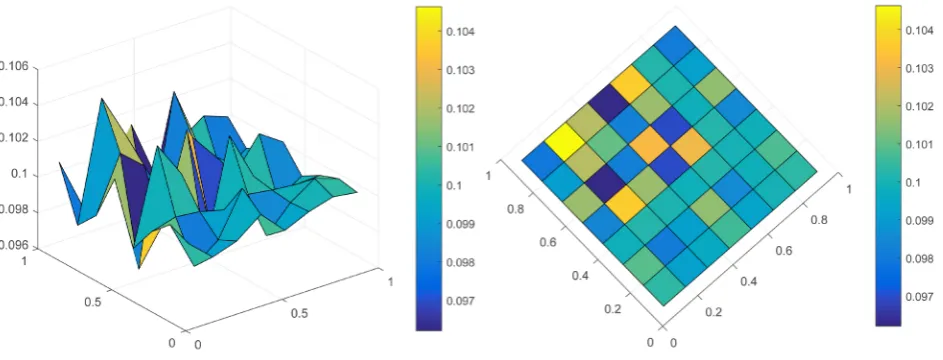
The front view and the top view of the approximation solutions of the Exam-ple 1 for m = 8 are given in Figure 1.
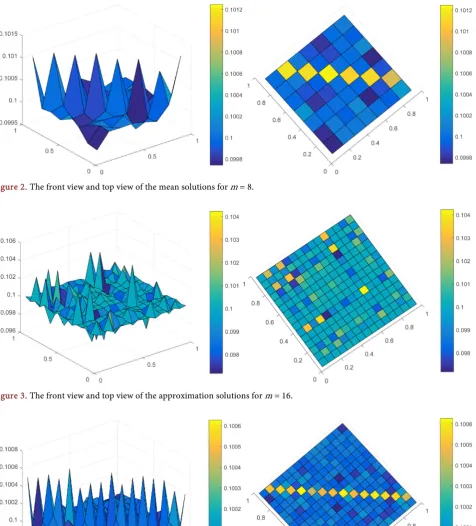
The front view and the top view of the mean solutions of the Example 1 for m
= 8 are given in Figure 2.
The front view and the top view of the approximation solutions of the Exam-ple 1 for m = 16 are given in Figure 3.
The front view and the top view of the mean solutions of the Example 1 for m
= 16 are given in Figure 4.
From these figures, we find the general trends of the solutions are similar for different m, and the absolute error of mean solution is very small. This method is efficient and the accuracy is credible.
8. Conclusion
[image:11.595.67.539.530.710.2]For some stochastic Volterra integral equations, exact solutions cannot be ex-pressed. But, the numerical solution can be conveniently obtained based on dif-ferent stochastic numerical methods. As the complexity of the system, we use
DOI: 10.4236/apm.2019.92004 64 Advances in Pure Mathematics
[image:12.595.64.541.69.596.2]Figure 2. The front view and top view of the mean solutions for m = 8.
[image:12.595.62.538.483.661.2]Figure 3. The front view and top view of the approximation solutions for m = 16.
Figure 4. The front view and top view of the mean solutions for m = 16.
DOI: 10.4236/apm.2019.92004 65 Advances in Pure Mathematics
future, we will try to extend it to n-dimensional space and solve more problems.
Acknowledgements
We thank the Editors and the Reviewers for their helps and comments. This ar-ticle is funded by NSF Grants 11471105 of China, NSF Grants 2016CFB526 of Hubei Province, Innovation Team of the Educational Department of Hubei Province T201412, and Innovation Items of Hubei Normal University 2018032 and 2018105. These supports are greatly appreciated.
Conflicts of Interest
The authors declare no conflicts of interest regarding the publication of this pa-per.
References
[1] Hanson, R. and Phillips, J. (1978) Numerical Solution of Two-Dimensional Integral Equations Using Linear Elements. SIAM Journal on Numerical Analysis, 15, 113-121. https://doi.org/10.1137/0715007
[2] Babolian, E., Maleknejad, K. and Roodaki, M. (2010) Two-Dimensional Triangular Functions and Their Applications to Nonlinear 2D Volterra Fredholm Integral Eq-uations. Computers & Mathematics with Applications, 60, 1711-1722.
https://doi.org/10.1016/j.camwa.2010.07.002
[3] Fallahpour, M., Khodabin, M. and Maleknejad, K. (2015) Approximation Solution of Two-Dimensional Linear Stochastic Volterra Integral Equations by Applying the Haar Wavelets. International Journal of Mathematical Modelling and Computations (IJM2C), 5, 361-372.
[4] Jiang, Z.H. and Schaufelberger, W. (1992) Block Pulse Functions and Their Appli-cations in Control Systems. Spriger-Verlag, Berlin.
[5] Mirzaee, F. and Hadadiyan, E. (2014) Using Modified Two-Dimensional Block-Pulse Functions for the Numerical Solution of Nonlinear Two-Dimensional Volterra Integral Equations. Journal of Hyperstructures, 3, 68-80.
[6] Nemati, S., Lima, P.M. and Ordokhani, Y. (2013) Numerical Solution of a Class of Two-Dimensional Nonlinear Volterra Integral Equations Using Legendre Polyno-mials. Journal of Computational and Applied Mathematics, 242, 53-69.
https://doi.org/10.1016/j.cam.2012.10.021
[7] Fallahpour, M., Khodabin, M. and Maleknejad, K. (2016) Approximation Solution of Two-Dimensional Linear Stochastic Volterra-Fredholm Integral Equation via Two-Dimensional Block-Pulse Functions. International Journal of Industrial Ma-thematics, 8, Article ID: IJIM-00774.
[8] Maleknejad, K., Sohrabi, S. and Baranji, B. (2010) Application of 2D-BPFs to Non-linear Integral Equations. Communications in Nonlinear Science and Numerical Simulation, 15, 527-535. https://doi.org/10.1016/j.cnsns.2009.04.011
[9] Maleknejad, K. and Jafaribehbahani, Z. (2012) Applications of Two-Dimensional Triangular Functions for Solving Nonlinear Class of Mixed Volterra-Fredholm Integral Equations. Mathematical and Computer Modelling, 55, 1833-1844. https://doi.org/10.1016/j.mcm.2011.11.041
DOI: 10.4236/apm.2019.92004 66 Advances in Pure Mathematics
Journal of the Association of Arab Universities for Basic and Applied Sciences, 12, 65-73. https://doi.org/10.1016/j.jaubas.2012.05.001
[11] Aleknejad, K., Khodabin, M. and Shekarabi, F.H. (2014) Modified Block Pulse Functions for Numerical Solution of Stochastic Volterra Integral Equations. Journal of Applied Mathematics, 2014, Article ID: 469308.
[12] Maleknejad, K., Khodabin, M. and Rostami, M. (2012) Numerical Solution of Sto-chastic Volterra Integral Equation by a StoSto-chastic Operational Matrix Based on Block Pulse Function. Mathematical and Computer Modelling, 55, 791-800. https://doi.org/10.1016/j.mcm.2011.08.053
[13] Langville, A.N. and Stewart, W.J. (2004) The Kronecker product and Stochastic Automata Networks. Journal of Computational and Applied Mathematics, 167, 429-447. https://doi.org/10.1016/j.cam.2003.10.010
[14] Moler, C.B. (2006) Numerical Computing with MATLAB. China Machine Press, Beijing.
[15] Ezzati, R., Khodabin, M. and Sadati, Z. (2014) Numerical Implementation of Sto-chastic Operational Matrix Driven by a Fractional Brownian Motion for Solving a Stochastic Differential Equation. Abstract and Applied Analysis, 2014, Article ID: 523163.
[16] Maleknejad, K., Khodabin, M. and Rostami, M. (2012) A Numerical Method for Solving m-Dimensional Stochastic Itô-Volterra Integral Equations by Stochastic Operational Matrix. Computers & Mathematics with Applications, 63, 133-143. https://doi.org/10.1016/j.camwa.2011.10.079
[17] Mirzaee, F. and Samadyar, N. (2018) Numerical Solution of Nonlinear Stochastic Itô-Volterra Integral Equations Driven by Fractional Brownian Motion. Mathemat-ical Methods in the Applied Sciences, 14, 1410-1423.