J. Software Engineering & Applications, 2011, 4, 579-584
doi:10.4236/jsea.2011.410067 Published Online October 2011 (http://www.SciRP.org/journal/jsea)
579
Paraconsistent Algorithm Extractor of
Contradiction Effects
―
ParaExtr
ctr
João Inácio Da Silva Filho1, Germano Lambert-Torres2, Luiz Fernando Pompeo Ferrara1,
Maurício Conceição Mário1, Marcos Rosa dos Santos3, Alexandre Shozo Onuki1,
José de Melo Camargo3, Alexandre Rocco1
1Santa Cecilia University, Santos City, Brazil; 2Itajuba Federal University, Itajuba, Brazil; 3Eletropaulo Metropolitano
Eletricidade de Sao Paulo S.A., São Paulo City, Brazil.
Email: [email protected]
Received August 27th, 2011; revised September 20th, 2011; accepted October 15th, 2011.
ABSTRACT
Nowadays networks of analyses based in non-classic logics are used with success in the treatment of uncertainties. The characteristic of accepting the contradiction in his structure is the main cause of the methodologies based in Paracon-sistent Logic is ideals for applications in systems of analyses and decision making. In this work we presented an algo-rithm based in Paraconsistent logic capable to extract in a gradual way the effects of the contradiction in originated signals of information of uncertain knowledge database. The Algorithm Paraconsistent Extractor of Contradiction ef-fects―ParaExtrctr is formed with base in fundamental concepts of the Paraconsistent Annotated Logic with annotation of two values (PAL2v) it can be applied in filters of networks of analyses of signal information where uncertain and contradictory signals can be present. The process of extraction of the effect of the contradiction is always begun by the largest inconsistency degree among two signals that belong to the group that is in analysis. In the end of the analysis it is found a consensus value. In this work we presented numeric example and one example of application of the ParaExtrctr in Load Profile Forecast used in support to decision of the operation in an Electric Power System, but his application potentiality is demonstrated in several fields of the Artificial Intelligence.
Keywords: Algorithm, Non-Classic Logic, Paraconsistent Annotated Logic
1. Introduction
The contradictions or inconsistencies are common when we described parts of the real world; however most of the Expert systems for decision making are based in the bi- nary classic logic. In spite of the classic logic to be the base of the whole current technology, it is limited by rigid binary laws and their algorithms present difficulties to treat complex systems conveniently where the signals of information are just constituted of evidences [1-3]. Acting in a faithful way the existent limits in the real world the signals constitutes evidences arrivals of several sources, that bring joined several situations ambiguous, or contradictory that they are unable of be accepted by the classic logic [4,5]. To solve problems, and to give appropriate form of treatment front the situations no rec- ognized by the classic logic, every day has been used new methods for applications of logics denominated non- classic, among them, the paraconsistent logics [6,7]. In-that work we presented an algorithm built from a special
type of logic denominated Paraconsistent Annotated Lo- gic (PAL) and whose main foundations will be descri- bed to proceed.
2. The Paraconsistent Logic
fects―ParaExtrctruses the methods of uncertainty treat- ment based in an extension of the Paraconsistent Logic denominated of Paraconsistent Annotated Logic with annotation of two values (PAL2v) [3,13].
2.1. The Lattice Associated to the Paraconsistent Annotated Logic
In the Paraconsistent Annotated Logic (PAL) the pro- positional formulas come accompanied of annotations [3,10,12]. Each annotation, belonging to a Lattice finite
attributes values to his correspondent propositional for- mula. To obtain a larger representation a Lattice associ- ated at LPA is used (Figure 1).
The representation of paraconsistent logical state is formed by pairs orderly, such that:
, , 0,1
R .
An operator is considered ~: ||, where the operator ~ it constitutes the “meaning” of the logical negation symbol of the system that will be analyzed [3,9,11].
If P is a basic formula, then the operator ~: ||, it is de- fined as:
,
,
were, ,
0,1
R.
1
It is considered then: (, λ) an Annotation of P.
The orderly pair’s first element represents the Evi- dence Degree that is favorable to the proposition P, and the second element represents the Evidence Degree that is unfavorable or contrary to the same proposition [3]. This way, the intuitive idea of the association of an an- notation to a proposition P(,λ) means that the evidence degree favorable to P is , while the evidence degree unfavorable or contrary to P is λ.
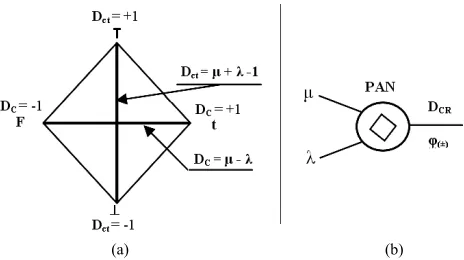
Through the methods presented in [3], a system using the Paraconsistent Annotated Logic receives signals of information in the form of degrees of evidence with val- ues that vary from 0 to 1. These values can be placed in two representing axes of finite lattice (Figure 2(a)) were calculating the Certainty Degree (DC) and the Contradic- tion Degree (Dct) through the equations:
ct
D (1) and
C
D (2) The Contradiction Degree value (Dct) is an indicative of the inconsistency measure and the certainty degree value (DC) is considered as the result of the analysis.
3. The Paraconsistent Analysis Nodes—PAN
The element capable of treating a signal that is composed of one degree of favorable evidence and another of unfa- vorable evidence (μ1a, μ2a), and provide in its output a
[image:2.595.307.534.85.191.2]Resulting Evidence Degree, is called basic Paraconsistent
Figure 1. Finite lattice of the PAL2v four states with values.
(a) (b)
Figure 2. Finite lattice of PAL2v and symbol of the para-consistent analyzer node—PAN.
Analysis Node (PANb). Figure 2(b) shows the represent- tation of a PANb with two inputs of evidence degree:
μ1 = favorable Evidence Degree of information source 1.
λ = unfavorable Evidence Degree. where: λ = 1 – μ2
μ2 is a favorable Evidence Degree of information source 2.
A lattice description uses the values obtained by the equation results in the Paraconsistent Analyzer Node Algorithm [3,13,14] that can be written in a reduced form, as follows:
1) Enter with the input values.
μ*/ favorable evidence Degree 0 ≤μ≤ 1 λ*/ unfavorable evidence Degree 0 ≤λ≤ 1 2) Calculate the Contradiction Degree.
Dct 1 3) Calculate the Certainty Degree.
DC
4) Calculate the distance d of the Paraconsistent logical state into Lattice.
2 2C c
1 D D
d t 5) Compute the output signal.
If d 1 Then do S1= 0.5 and
S2 = φ: Indefinite logical state andgo to the steep10
[image:2.595.307.539.218.348.2]Paraconsistent Algorithm Extractor of Contradiction Effects—Paraextrctr 581
6) Calculate the real Certainty Degree.
If DC > 0 DCR = (1 – d ) If DC < 0 DCR= (d – 1) 7) Present the output.
Do S1 = DCR
8) Calculate the real Evidence Degree.
CR ER
D 1
2
9) Present the output.
Do S1 = μER and S2 = Dct 10) End.
The Systems with the Paraconsistent Analysis Nodes (PAN) deal with the received signals through algorithms, and present the signals with a Certainty Degree value and a Contradiction Degree value in the output [3].
4. The Paraconsistent Algorithm Extractor
of Contradiction Effects
―
ParaExtr
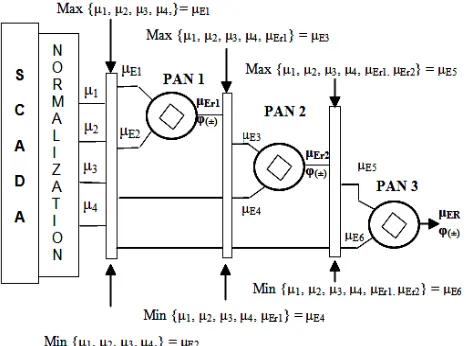
ctrThe Paraconsistent Algorithm Extractor of Contradiction effects (ParaExtrctr) is composed by connections among PANs. This configuration forms a Paraconsistent Analyze Network capable to extract the effects of the contradict- tion in gradual way of the signals of information that come from Uncertain Knowledge Database. The hypo- thesis of extraction of the effects of the contradiction has as principle that; if the first treated signals are the most contradictory, then the result of the paraconsistent analy- sis will converge for a consensual value. In his typical operation the ParaExtrctr receives a group of signals of information represented by Degrees of Evidence (μE) the regarding certain proposition P and, independently of other external information, it makes paraconsistent analysis in their values where, gradually, it is going extracting the effects from the contradiction to remain as output a single resulting Real Evidence Degree μER.
The μER is the representative value of the group of in- put signals after the process of extraction of the effects of the contradiction. The Figure 3 shows the representation of the algorithm Extractor of Contradiction effects that uses a network of three PANs.
The description of the ParaExtrctr Algorithm is shown to proceed.
1) Present n values of Evidence Degrees that it com-poses the group in study.
Gμ= (μA, μB, μC, ···, μn ) */Evidence Degrees 0 ≤μ≤ 1*/
2) Select the largest value among the Evidence De- grees of the group in study.
μmaxA = max (μA,μB,μC, ···, μn) 3) Consider the largest value among the Evidence De-grees of the group in study in favorable Evidence Degree.
[image:3.595.307.540.86.259.2]μmaxA = μsel
Figure 3. Paraconsistent algorithm extractor of contradic-tion effects (ParaExtrctr).
4) Consider the smallest value among the Evidence Degrees of the group in study in favorable Evidence De-gree.
μminA = min (μA,μB,μC, ···, μn)
5) Transform the smallest value among the Evidence Degrees of the group in study in unfavorable Evidence Degree.
1 – μminA =λsel
6) Make the Paraconsistent analysis among the se- lected values:
μR1 = μsel λsel */where is a paraconsistent action of the PAN */
7) Increase the obtained value μR1 in the group in study, excluding of this the two values μmax and μmin, selected previously.
Gμ= (μA,μB, μC, ···, μn, μR1) – (μmaxA, μminA)
8) Return to the item 2 until that the Group in study has only 1 element resulting from the analyses.
Go to item 2 until Gμ = (μER)
5. Application forms of the
ParaExtr
ctrAlgorithm
For the paraconsistent analysis that it uses the ParaExtrctr
5.2. The ParaExtrctr Algorithm Applied in Forecast of Load Profile of Electric Power Systems
by the ParaExtrctr Algorithm the Resulting Evidence De-gree will be the real representative of the group com-posed by n Degrees of Evidence applied in the inputs. With the value of the Resulting Evidence Degree a proc-ess of undo normalization can be made to recover it re-sulting as measure of the analyzed greatness. The Figure 4 presents the flow of signals in the paraconsistent analy-sis with ParaExtrctr Algorithm.
[image:4.595.306.538.166.259.2]The innovative form of doing treatment of signals allows
Table 1. Measured different values in four monitored points.
Monitored points A B C D
Measurement instants t1 t2 t3 t4
7.800 7.900 6.800 8.300
7.956 8.900 7.200 7.300
6.960 8.100 7.100 9.300 Measured values
(Kw)
7.750 7.180 8.100 8.700 5.1. Explanatory Example of Use of the
ParaExtrctrAlgorithm
We presented to follow an example of application of the
[image:4.595.101.534.306.703.2]ParaExtrctr Algorithm treating contradictory values ob-tained in a Database of an Electric Power System [15,16]. Consider that a Database presents values of the greatness electric of potency in the form of measurements obtained in quilowatts (Kw). An example of different measure-ments in the monitored points is shown in the Table 1.
Table 2. Evidence Degrees in four monitored points and the Resultant Evidence Degree after extract the effects of con-tradiction.
The monitored points are obtained of different type of measuring devices. These measurement devices should bring measures of same values and, in some cases, dif-ferent values. This happen by several reasons, as differ-ences of quality of the measure devices, flaws in the ob-taining of the values and mistakes of readings. In this process, in certain instant can happen that contradictory values exist in the t1 time, or in t2, or in t3 and in t4.
Monitored points A B C D
Measurement instants t1 t2 t3 t4
0.7000 0.7250 0.4500 0.8250
0.7390 0.9750 0.5500 05750
0.4900 0.7750 0.5250 1.0000
Evidence Degrees
μn
Universe Discourse 5.0 Kw → 9.0 Kw Lineal variation
0.6895 0.5450 0.7750 0.9250
ParaExtrctr Algorithm action
μER1 μER2 μER3 μER4
Resultant Evidence Degrees to each instant t
0.6648 0.7235 0.5508 0.8018
Resultant Evidence Degrees in four instants:
t1, t2, t3 and t4
0.67531313 The definition of the Universe of Discourse and the
variation of the greatness in the interval will be important for the generation of the Evidence Degrees.
For that explanatory example we will consider a Uni-verse of Discourse of 5.0 up to 9.0 Kw with linear varia-tion. The Table 2 shows the result of the application of the ParaExtrctr Algorithm in the extraction of the contra-diction effects in the four signals in each one of the time t
and in four times t1, t2, t3 and t4.
Paraconsistent Algorithm Extractor of Contradiction Effects—Paraextrctr 583
that the ParaExtrctr Algorithm can be applied in several fields where it is necessary the use of Artificial Intelli-gence techniques. As a real application in AI systems it is mentioned as example, a forecast accomplished in the Substation ETD Pattern 40/60 MVA of the Power Elec-tric System of concessionary of ElecElec-tric power that acts in Brazil [2,15].
In this study, as source of information for the forecast, is used a historic database where are considered the val-ues of load that are related to the secondary windings of the two input transformers.
The four signals, that bring the values regarding to the three phases (RST), receive the paraconsistent logical treatment by the ParaExtrctr Algorithm in the beginning forecast.
Once obtained the values of the load, these are
nor-malized and they will be inside of the closed interval [0,1] in the set of the real numbers. In that way, the data will be ready for the treatment according to the PAL2v foun-dations.
The extraction of the contradiction effect in three phases (RST), are shown in the graph on the Figure 5.
The normalized values of the three phases are applied in the module of the ParaExtrctr Algorithm and, after the paraconsistent treatment logical results in an only value of Evidence Degree of the load profile. In this way the graphic scenery of the electric load Profile is created ac-cording to shown in Figure 6.
Several tests were made comparing the values of the historic database with the values obtained through the
[image:5.595.124.472.289.488.2]ParaExtrctr Algorithm, showing a great approach of the real results. Now this Load Profile Forecast System is
Figure 5. Values graphs of three signals that received treatment of the ParaExtrctr algorithm and they will serve as reference
for the elaboration of forecast of profiles loads in the Power Electric System.
Figure 6. Result graph of the load profile forecast using the ParaExtrctr algorithm where the curve is made with values of
[image:5.595.127.473.532.694.2]being used for training and support to the operation of Power Electric System in Eletropaulo Company―Brazil.
6. Conclusions
In this work we presented the ParaExtrctr Algorithm that is capable to extract contradiction effects in groups of evi- dence signals the regarding certain Proposition through basic concepts of the Paraconsistent Logic. In the end of the analysis, the ParaExtrctr Algorithm presents as result a Real Evidence Degree representative of the Evidence Degree group. In that process of Paraconsistent analysis the ParaExtrctr Algorithm uses the denominated PAN- Paraconsistent Analysis Nodes. In a gradual way the PANs filter the effects of the contradiction in the signals of information until that it is found the Degree of Evi-dence resulting from the group. The results demonstrate that the ParaExtrctr algorithm has capacity to remove of database the values tuneless or contradictory.
The extraction process reduces the effects of the in-consistencies and it presents as answer a closer represen-tative value of the reality. In that way, with the Para- Extrctr Algorithm new structures and different configura-tions of networks of analyses can be formed for treatment of Uncertainties.
The methods used in this work are based in a special Paraconsistent logic denominated of PAL2v and they have been applied with success in the determination of patterns, and in making decision systems, as well as in different areas of the knowledge where are necessary the performance of Intelligent Systems.
REFERENCES
[1] International Council on Large Electric Systems, “Practi-cal Use of Expert Systems in Planning and Operation of Power Systems,” TF 38.06.03, Électra, No. 146, February 1993, pp. 30-67.
[2] J. I. Da Silva Filho, A. Rocco, M. C. Mario and L. F. P. Ferrara, “Annotated Paraconsistent Logic Applied to an Expert System Dedicated for Supporting in an Electric Power Transmission Systems Re-Establishment,” IEEE PES-PSC 2006 Power System Conference and Exposition, Atlanta, 29 October-1 November 2006, pp. 2212-2220. [3] J. I. Da Silva Fiho, G. Lambert-Torres and J. M. Abe,
“Uncertainty Treatment Using Paraconsistent Logic: In-troducing Paraconsistent Artificial Neural Networks,” IOS Press, Amsterdam, 2010, p. 328.
[4] J. M. Abe and J. I. Da Silva Filho,, “Inconsistency and Electronic Circuits,” In: E. Alpaydin, Ed., Proceedings of EIS’98 International ICSC Symposium on Engineering of Intelligent Systems, Vol. 3, Artificial Intelligence, ICSC
Academic Press, Rochester, 1998, pp. 191-197.
[5] H. A. Blair and V. S. Subrahmanian, “Paraconsistent Logic Programming,” 7th Conference on Foundations of Soft-ware Technology and Theoretical Computer Science, Pune, 17-19 December 1987.
[6] N. C. A. Da Costa, V. S. Subrahmanian and C. Vago, “The Paraconsistent Logic PJ,” Mathematical Logic Quarterly, Vol. 37, No. 9-12, 1991, pp. 139-148.
doi:10.1002/malq.19910370903
[7] S. Jaśkowski, “Propositional Calculus for Contradictory Deductive Systems,” Studia Logica, Vol. 24, No. 1, 1969, pp. 143-157. doi:10.1007/BF02134311
[8] N. C. A. Da Costa and D. Marconi, “An Overview of Para- consistent Logic in the 80’s,” The Journal of Non-Clas-sical Logic, Vol. 6, No. 1, 1989, pp. 5-32.
[9] N. C. A. Da Costa, “On the Theory of Inconsistent Formal Systems,” Notre Dame Journal of Formal Logic, Vol. 15, No. 4, 1974, pp. 497-510. doi:10.1305/ndjfl/1093891487
[10] N. C. A. Da Costa, J. M. Abe and V. S. Subrahmanian, “Remarks on Annotated Logic,” Zeitschrift für Mathema-tische Logik und Grundlagen der Mathematik, Vol. 37, 1991, pp. 561-570.
[11] V. S. Subrahmanian, “On the Semantics of Quantitative Logic Programs,” Proceedings of the 4th IEEE Sympo-sium on Logic Programming,San Francisco, 31 August-4 September 1987, pp. 173-182.
[12] J. M. Abe and J. I. Da Silva Filho, “Simulating Inconsis-tencies in a Paraconsistent Logic Controller,” Interna-tional Journal of Computing Anticipatory Systems, Vol. 12, 2002, pp. 315-323.
[13] J. I. Da Silva Filho, A. Rocco, M. C. Mario and L. F. P. Ferrara, “PES-Paraconsistent Expert System: A Computa-tional Program for Support in Re-Establishment of The Electric Transmission Systems,” Proceedings of LAP-TEC2007: VI Congress of Logic Applied to Technology, Santos, 21-23 November 2007, p. 217.
[14] J. I. Da Silva Filho, A. Rocco, A. S. Onuki, L. F. P. Ferra- ra and J. M. Camargo, “Electric Power Systems Contin-gencies Analysis by Paraconsistent Logic Application,” Proceedings of ISAP2007: 14th International Conference on Intelligent System Applications to Power Systems, Kaohsiung, November 2007, pp. 112-117.
[15] J. I. Da Silva Filho and A. Rocco, “Power Systems Out-age Possibilities Analysis by Paraconsistent Logic,” Power and Energy Society General Meeting: Conversion and Delivery of Electrical Energy in the 21st Century, Pitts-burgh, 20-24 July 2008, pp. 1-6.