doi:10.4236/ajor.2011.13011 Published Online September 2011 (http://www.SciRP.org/journal/ajor)
Higher Order Iteration Schemes for Unconstrained
Optimization
Yangyang Shi1, Pingqi Pan2 1
Faculty of Electrical Engineering, Mathematics and Computer Science, Delft University of Technology,
Delft, The Netherlands 2
Department of Mathematics, Southeast University, Nanjing, China E-mail: shiyang1983@gmail.com, [email protected]
Received August 3, 2011; revised August 20, 2011; accepted September 19, 2011
Abstract
Using a predictor-corrector tactic, this paper derives new iteration schemes for unconstrained optimization. It yields a point (predictor) by some line search from the current point; then with the two points it constructs a quadratic interpolation curve to approximate some ODE trajectory; it finally determines a new point (correc-tor) by searching along the quadratic curve. In particular, this paper gives a global convergence analysis for schemes associated with the quasi-Newton updates. In our computational experiments, the new schemes us-ing DFP and BFGS updates outperformed their conventional counterparts on a set of standard test problems.
Keywords:Unconstrained Optimization, Iteration Scheme, ODE Method, Quasi-Newton Update, Convergence Analysis
1. Introduction
Consider the unconstrained optimization problem
min f x xRn, (1) where f R: n R is twice continuously differentiable.
Let xk be the k-th iteration point. We will denote
values of f x( ) and its gradient at xk by fk and fk,
respectively.
Optimization problems are usually solved by iteration methods. The line search widely used in unconstrained optimization is a kind of iteration scheme for updating iterates. Such a scheme, by which one obtains the next iterate xk1 from a current iterate xk, is of the
follow-ing form:
1=
k k k,
x x p (2) where pk and are termed search direction and step-
size, respectively. k is usually determined as a descent
direction with respect to the objective p
( )
f x , and by exact or inexact line searches, so that the objective value decreases after the iteration.
For instance, the famous Newton method uses the scheme with search direction
2
1= ,
k k
p f fk
where 2fk is the Hessian matrix of f x( ) at xk, and
stepsize = 1.
The quasi-Newton methods are reliable and efficient in solving the unconstrained optimization problems. Saving explicit calculations of the second order deriva-tives and solution of a system of linear equations, quasi-Newton methods achieved a great degree of popu-larity since the first paper of Davidon [1,2]. He used
= ,
k k
p H fk
where Hk is some approximation to the inverse
Hes-sian matrix
2fk
1
.
The next approximate inverse Hessian matrix Hk1,
is obtained by updating Hk by rank-one or rank-two
matrix. To this end, all quasi-Newton updates require
1
k
H for satisfying the so-called quasi-Newton
equa-tion:
1 = ,
k k k
H y s (3)
where yk =fk1 fk and sk =xk1xk.
asso-74 Y. Y. SHI ET AL.
ciated k is a descent direction, and the objective
de-creases if p
is determined by some line search. There are other iteration schemes that appear differ-ently from the conventional ones. The so-called ODE methods use the following initial value problem:
0 d= d d 0 =
x p x t x
(4)
Assume that satisfies certain conditions, and
hence the preceding defines a trajectory.
( )
p x
Arrow, Huwicz and Uzawa [9] used p x( ) =f x( )
and . The associated
trajec-tories might be called steepest descent curve and Newton curve respectively [10]. In this way, in fact, one could obtain many curves corresponding to existing uncon-strained optimization methods.
12
( ) ( )
f x f x
( )
p x =
Pan [11-13] generalized the steepest descent curve and Newton curve by setting ( ) =p x ( ) ( )x A x , where
( )x
is called ratio factor and A x( ) direction matrix. He suggested some concrete ratio factors and direction matrices, and showed that under certain conditions, the objective value decreases strictly along the associated trajectory, the limit point of which is just an optimum.
ODE methods treat the optimization problem in the view of trajectory. They use numerical methods to ap-proximately calculate associated trajectory, and finally approach the limit point of the trajectory. When Euler's approach is applied in the ODE method, standard itera-tion schemes are obtained. In fact the standard iteraitera-tion schemes are originally derived in the direction of de-creasing the objective function value instead of trajectory. Euler's approach is only of the first order precision. So it is possible to apply higher order approach to mimic the trajectory to get higher order iteration scheme than the standard one.
In this paper, we derive new iteration schemes along this line. In view of the importance of DFP and BFGS methods, we will focus on iteration schemes with respect to these methods.
The paper is organized as follows. Section 2 derives new iteration schemes. Section 3 offers the convergence analysis. Section 4 reports encouraging computational results with a set of problems.
2. Higher Order Iteration Scheme
Assume that xk is the current iterate. The next iterate
1
k
x will be determined by approximately following the
trajectory, defined by (4). Let xk1 be a predictor.
In-troduce notation
, 1
1
.k k k k k
p p x p p x
We construct a quadratic interpolation curve, locally approximating the trajectory as follows:
2= k k k,
x t a t b tc (5)
where a b ck, k, k satisfy the following conditions: 2
=
k k k k k k
a t b t c x ,
,
(6a)
2a tk kbk = pk (6b)
2
1 1 =
k k k k k k
a t b t c x1,
1.
(6c)
1
2a tk k bk = pk (6d)
Set tk1= 0, so x(0) =xk1 1
=
k k
b p
. From (6a)-(6d), it is eas-ily to draw that , ck =xk1 and
1
1
= 2
k k
k k k
p p
t x x
, (7a)
1 = 2 k k k k p p
a t .
(7b)
Pre-multiplying the both sides of (7a) by ,
we obtain an approximate k 1, furthermore, have an
approximate solution of (6a)-(6d).
1
T k k x x t
1 1 2 1 = , 4 Tk k k k k k
k
k k
p p x x p p
a x x 1 1, (8) 1 = , =
k k k k
b p c x (9)
where
xkxk1
denotes 2-norm of the vector
xkxk1
.The unconstrained optimization problem (1) can get a approximate solution by solving the following one-di-mension minimization problem:
2
min t = f a tk b tk ck , 0.t (10)
To solve such problem, we apply the inexact line search rule, furthermore, we modify the sufficient decent condition
k k
k Tk k,f x tp f x tp f (11)
in this way:
2
,
T
k k k k k k
f a t b tc f c tb f c (12)
where (0,1).
2.1. Modified Inexact Line Search Algorithm
The conventional backtracking inexact line search [14]
operates in this way. At the beginning we set . The
algorithm will stop if t satisfies the sufficient decent condition. Otherwise, the algorithm will continue with
ˆ =
t t
tt.
was obtained by applying the expression (12) as the suf-ficient decent condition in backtracking line search algo-rithm.
Subalgorithm 2.1 modified backtracking inexact line search
Step 0. Given tˆ, , (0,1), ; set t=tˆ.
T
Step 1. Set ak = 0 if aTkfk >cbkfk, where
con-stant 1
ˆ
c t
.
Step 2. If
2
T
,k k k k k k
f a t b tc f c tb f c (13)
go to step 4; otherwise, go to step 3. Step 3. tt and go to step 2. Step 4. Terminate with tk =t.
2.2. Higher Order Iteration Schemes
The higher order iteration schemes, firstly obtain the pre- dictor xk1 from the current point xk by inexact line
search rule following the direction k. Then construct
the quadratic interpolation curve by the relevant
infor-mation of k
p
x and xk1, and calculate xk1 satisfying
modified inexact line search rule (12). The overall steps of the higher order iteration schemes are organized as follows.
Algorithm 2.1 Higher order iteration schemes Step 0. Given initial point x0, , (0,1) and , set
:=
k 0;
Step 1. If fk <, stop. Step 2. compute the predictor
Call backtracking inexact line search algorithm to ob-tain tk.
Compute xk1=xkt pk k
.Step 3. If f xk1 <
Step 4. Compute a new iteration point.
, stop.
Compute a b ck, k, k by (8) and (9). Call subalgorithm 2.1 to get tk1.
Compute 2
1 = 1 1
k k k k k k
x a t b t
:= 1
k k
c
.
Step 5. Set and go to step 1.
2.3. An Extension of the Higher Order Iteration Scheme
The higher order iteration schemes vary with different . In this paper we extend the higher order iteration
schemes to BFGS method, and set k. We
get the predictor k 1
( )
p x
=
k k
p H f x from xk, satisfying the
back-tracking inexact line search rule, in the direction .
From k
k p x and xk1, we compute 1 k1 k1. Then by searching along the curve, we obtain the new point
=
k
p H f
1
k
x . The overall steps of the variant of the
itera-tion schemes are organized as follows.
Algorithm 2.2 higher order iteration schemes using BFGS update
Step 0. Given initial point x0; set k:= 0, , (0,1), N, H0=I, and ;
Step 1. Compute the predictor.
Call backtracking inexact line search algorithm to ob-tain tk.
Compute xk1=xkt Hk kfk and fk1= f x
k1
.Step 2. If f x
k1
<, stop.Step 3. Compute Hk1.
If y s Tk k then Hk1=I; otherwise
1= 1
T T T
k k k k k k k k k k k
k k T T T
k k k k k k
y H y s s s y H H y s
H H
s y s y s y
, T (14) where yk =fk1 fk, sk =t Hk kfk.
Step 4. Compute the new iteration point.
Compute a b ck, k, k by (8) and (9). Call subalgorithm 2.1 to get tk1.
Compute 2
1= 1 1
k k k k k k
x a t b t c . Step 5. If fk1 <
Step 6. Update
, stop.
k H .
If k1(modN)= 0 or T k k
y s then Hk1=I;
oth-erwise
1= 1
T T T
k k k k k k k k k k k
k k T T T
k k k k k k
y H y s s s y H H y s
H H
s y s y s y
, T f (15) where yk =fk1 k, sk =xk1xk.
If 1 1 1
1 1 1
<
T
k k k
k k k
f H f
f H f
or
1 1 1 < T k k k f H f
, then
set Hk1=I.
Step 7. Set k:=k1 and go to step 1. Note:
1) In this paper, I denotes identity matrix.
2) In step 3, we adopt a strategy to make sure that the curvature condition T >
k k
y s is hold. So Hk1 is posi-tive and Fk1 is a decent direction.
3) In step 4, we call the subalgorithm (2.1), in which
we set the parameter c=1 .
4) In step 6, we adopt a restart technique that if k1 is the integral multiple of the N or T
k k
y s , we restart with Hk1=I. Clearly, the BFGS method is a kind of
conjugate direction method, so the restart technique can reduce the accumulation of the roundoff errors.
76 Y. Y. SHI ET AL.
updating formula in step 3 and step 6.
3. The Global Convergence of the Higher
Order Iteration Schemes
Definition 3.1 [11] Curve x t( ) where t(0, ) , if for any
> 0
, t(0, ) , x t( ) is contained in the domain of and is strictly monotone decreasing in
( )
f x
(0, ) ( ( ))
f x t ,
then x t( ) is a decent trajectory of f x( ) at x(0) =x0. And if lim ( )
t x t is exist and equal the minimization point of f x( ), then the curve x t( ) is normal decent trajectory of f x( ) at x0.
Pan proved the global convergence of the ODE meth-ods with ratio factor and direction matrix [11]. In this paper we only consider the situation that ratio factor is 1 and direction matrix is identity matrix. So we draw the theorem as follows,
Theorem 3.1 [11] Given 0
n
x , assume the level set
0= x x: n,f x f x
is bounded close set, and is twice continuously
differentiable in the set and 0 , then the
right segment trajectory of the the ordinary equations (4)
is the decent curve of at 0
( )
f x
)
( ) 0
f x
(
f x x and the limit point
of the trajectory is the stationery point of f x( ). If is convex, then the right segment trajectory is
normal decent curve of at
( )
f x
( )
f x x0.
We use the quadratic interpolation curve (5) to
ap-proximate the trajectory. However, when ,
the iteration scheme may not be decent in the local re-gion of the predictor k 1
> 0
T k k
a f
x . So we apply the strategy of step 1 in subalgorithm (2.1) to keep the iteration decent.
Theorem 3.2Given constant tˆ and 1
ˆ
c t
. In
subal-gorithm (2.1), if bk is decent direction satisfying
0,
T k k
b f
then for any 0 <t 1 c
, the condition
2
0,
T
k k k
a t b t f
is hold.
Proof. If T 0, clearly, the conclusion holds.
k k
a f
> 0
T
a f
Otherwise k k , from algorithm (2.1) step 1, if
> ,
T T
k k k k
a f cb f
then set ak = 0, so the conclusion holds. If
,
T T
k k k k
a f cb f
then
2
10.
T T
k k k k k k
a t b t f t a b f
c
□
Theorem 3.3Consider the algorithm (2.1), where k and k are decent direction, and k satisfying the con- dition
p
p p
1 T k k k k p f c p f
(16)
and
2
k
p c fk (17) where c1> 0 and c2> 0 are constants. Suppose that
( )
f x is bounded below and continuously differentiable in the level set
0
= x x: n,f x f x
, (18)
where x0 is the starting point. And the gradient f is
Lipschitz continuous on ; namely, there exists L such that
.f x f y L x y
(19)
Then for some k, fk = 0 is hold, otherwise,
lim k = 0.
k f (20)
Proof. Consider the situation that for all k, fk 0. Then from the algorithm (2.1), we have that
1 ,
T
k k k k k
f f t p f (21)
and
1 1 1 1 1 ,
T
k k k k k k 1
f f t p f f (22)
By (21) and (22), we have
1 ,
T
k k k k k
f f t p f (23)
and
1 1 0.
k k
f f (24)
With (23) and (24) , we obtain
1 .
T
k k k k k
f f t p f (25)
By summing this expression over all indices less than or equal to k, we obtain
0 1
=0
.
k T
k k k
j
k
f f
t p f (26)Since f is bounded below, we have that f0 fk1 is
. =0
<
T k k k j
t p f
(27)In standard inexact line search algorithem, we know that if the initiate trial tˆ does not satisfy the condition
(11), then tk
violate the condition. So
> T .
k k
k k k k
t t
k
f x p f p f
(28)
By the Lipschitz condition (37), we have
1 0 2 0 2 2 2 = = d d 1 = 2 2 1, for all 0 <
k k k k k k
tk T
T
k k k k k k k
tk T
k k k k
T
k k k k k
T k k T
k k k k
k
f f f x t p f
t p f f x sp f p s
t p f sL p s
t p f Lt p
p f
t p f t
L p
(29)It follows from (28) and (29) that
2 2 1 > T k k k k p f t L p . (30)
If initiate trial satisfy the condition (11), then . Furthermore, from (16) and (17), we have
ˆ
t t=tˆ
2
2 1
ˆ
min , > 0.
T k k k k p f t L p
t (31)
It follows from (27) that
22 =0
2 1 | |
ˆ
min , <
T
k k T
k k j k p f tp f L p
(32)It follows from (16) and (17)
2 2 21 1 2
=0
2 1
ˆ
min k , k <
j
c p tc c f L
(33)By (33), we obtain that
2 =0 < k j f
. (34)This implies that
= 0.
lim k
k f
(35)
The theorem (3.3) analyzes the global convergence of the iteration scheme based on ODE, similarly, we obtain the global convergence of the variant iteration scheme using BFGS update formula.
Theorem 3.4 Consider the algorithm (2.2), suppose that f is bounded below in and continuously differ-entiable in the level set
n
0
= x f x f x
, (36)
where x0 is the starting point. And the gradient f is
Lipschitz continuous on ; namely, there exists L such that
.f x f y L x y
(37)
Then for some k, fk = 0 is hold, otherwise,
= 0.
lim k
k f
(38)
Proof. Consider the situation that for all k, fk 0. Then from the algorithm (2.2), we have that
1 1 1 1
T
k k k k k 1
f f t H f f
k (39) and
1 . Tk k k k
f f t H f f (40)
The step 3 implies that
1 1
1> 0T
k k k
H f f (41)
By combining the condition (39), (40) and (41), we have
1 .
T
k k k k k
f f t H f f (42)
From the step 8 in the algorithm (2.2), we have that
1 1 1
1 1 1
,
T
k k k
k k k
f H f
f H f
(43)
and 1 1 1 . T k k k f H f
(44)
From the theorem (3.3), we conclude that
= 0.
lim k
k
f
(45)
is hold. □
4. Computational Results
Y. Y. SHI ET AL. 78
4.1. Test Codes 4.2. Result for 20 Small Scale Functions
In this section, the following four codes are tested: The first set of test problems included the 20 problems.
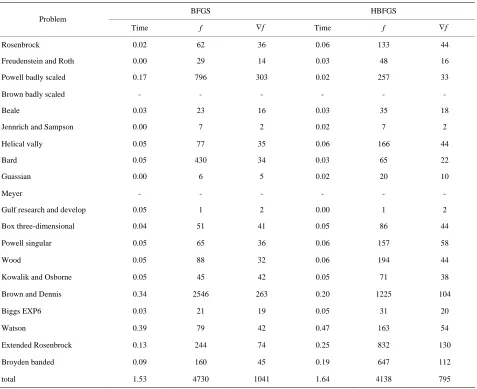
Numerical results obtained are listed in Table 1, where numbers of function value computation and gradient computation are listed in columns labeled “f ” and “f ”, respectively. And CUP-time required for solving each problem are listed in columns labeled ‘Time’ and its unit is second. “-” denotes that the algorithm does not get a correct solution in upper bound iteration number.
DFP: the DFP method.
BFGS: the BFGS method.
HDFP: the higher order iteration schemes using DFP
update.
HBFGS: the higher order iteration schemes using BFGS update.
To have the competitions fair and easy, all the codes were implemented with the same parameters: = 104,
= 0.5
, N= 15, H0=I , ,
6 = 10
12
= 10
and ; The detail results of the BFGS and HBFGS are showed below. And the performance of DFP and HDFP are only demonstrated in the overall results table.
ˆ = 1
t
[image:6.595.62.539.333.722.2]Compiled using Matlab 7.0.4, the four codes operated under a Windows XP system Home Edition Version 2002 on an Asus PC with Genuine Intel(R) Centrino- Duo T2300 processor 1.66 GHz and 1.00 GB memory.
Table 1 serves as an comparison between the BFGS and HBFGS. It shows that the computation numbers of function value andgradient vectors of HBFGS are fewer than that of BFGS. However, the HBFGS costs 0.11 seconds more than the BFGS, because the HBFGS has to
compute k. Although the computation of k is much
less compare with that of function value, it affects the CPU-time, especially, for small scale problems. So the HBFGS is competitive with BFGS on the 20 small scale
a a
Table 1. Statistics of first 20 functions.
BFGS HBFGS Problem
Time f f Time f f
Rosenbrock 0.02 62 36 0.06 133 44 Freudenstein and Roth 0.00 29 14 0.03 48 16
Powell badly scaled 0.17 796 303 0.02 257 33
Brown badly scaled - - -
Beale 0.03 23 16 0.03 35 18
Jennrich and Sampson 0.00 7 2 0.02 7 2
Helical vally 0.05 77 35 0.06 166 44
Bard 0.05 430 34 0.03 65 22
Guassian 0.00 6 5 0.02 20 10
Meyer - - -
Gulf research and develop 0.05 1 2 0.00 1 2
Box three-dimensional 0.04 51 41 0.05 86 44 Powell singular 0.05 65 36 0.06 157 58
Wood 0.05 88 32 0.06 194 44
Kowalik and Osborne 0.05 45 42 0.05 71 38 Brown and Dennis 0.34 2546 263 0.20 1225 104
Biggs EXP6 0.03 21 19 0.05 31 20 Watson 0.39 79 42 0.47 163 54 Extended Rosenbrock 0.13 244 74 0.25 832 130
Broyden banded 0.09 160 45 0.19 647 112
total 1.53 4730 1041 1.64 4138 795
problems.
4.3. Result for 50 Middle Scale Functions
[image:7.595.59.538.407.720.2]The second test set of 50 problems consist of 43 functions with 100 variables, 3 functions with 200 variables and 4 functions with 300 variables. The problems with “*” have 300 independent variables, and with “**” have 200 independent variables.
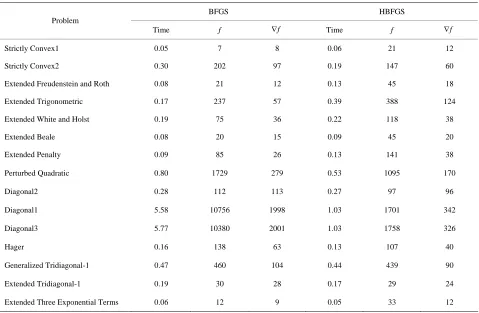
Table 2 shows that compared with BFGS, the compu-tation of the function value and the gradient vectors and CPU-time of HBFGS decrease by 52.65%, 52.08% and 36.01%, respectively. In summary the HBFGS method are faster and have less computation than the BFGS method.
4.4. Result for 50 Large Scale Functions
The second test set of 50 problems consist of 46 func-tions with 500 variables, 4 funcfunc-tions with 300 variables. The problems with “*” have 300 independent variables.
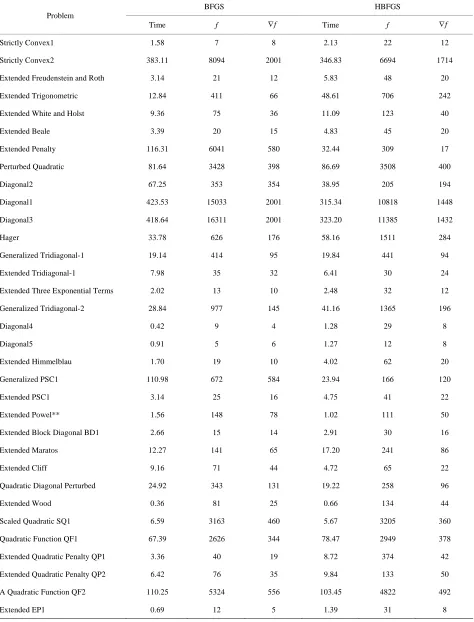
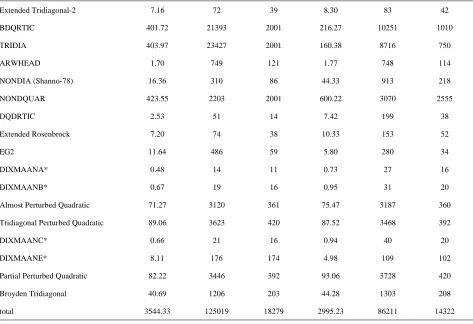
Table 3 shows that the HBFGS’s CPU-time, computa-tion numbers of funccomputa-tion value and gradient vectors are less than the BFGS by 949.10 seconds, 38808 and 3957, respectively.
4.5. Statistics of the Ratio
The Table 4 gives overall comparison of HDFP, HBFGS
and DFP, BFGS. In Table 4, “Time” denotes the run
time ratio, “f ” denotes function value computation num-ber ratio and “f ” denotes gradient computation num-ber ratio.
Table 4 shows that the HDFP outperforms the DFP with the average CPU-time ratio 1.58, function computa-tion ratio 1.67 and gradient computacomputa-tion ratio 1.71. And the HBFGS defeats the BFGS with the average CPU- time ratio 1.23, function computation ratio 1.57 and gra-dient computation ratio 1.56.
4.6. Summary of the Tests
As the tests show, although the higher order iteration schemes add the computation of k, it has less
compu-tation of function value and gradient vector. For large
scale problems, the computation of is much less
than that of function value.
a
k
a
5. Concluding Remarks
We gave a new iteration scheme based on ODE, proved
Table 2. Statistics of middle scale 50 functions.
BFGS HBFGS Problem
Time f f Time f f
Strictly Convex1 0.05 7 8 0.06 21 12 Strictly Convex2 0.30 202 97 0.19 147 60
Extended Freudenstein and Roth 0.08 21 12 0.13 45 18 Extended Trigonometric 0.17 237 57 0.39 388 124
Extended White and Holst 0.19 75 36 0.22 118 38 Extended Beale 0.08 20 15 0.09 45 20
Extended Penalty 0.09 85 26 0.13 141 38
Perturbed Quadratic 0.80 1729 279 0.53 1095 170
Diagonal2 0.28 112 113 0.27 97 96
Diagonal1 5.58 10756 1998 1.03 1701 342
Diagonal3 5.77 10380 2001 1.03 1758 326
Hager 0.16 138 63 0.13 107 40
Generalized Tridiagonal-1 0.47 460 104 0.44 439 90
Extended Tridiagonal-1 0.19 30 28 0.17 29 24
80 Y. Y. SHI ET AL.
Generalized Tridiagonal-2 0.67 1261 189 0.77 1340 192
Diagonal4 0.03 9 4 0.03 28 6
Diagonal5 0.03 5 6 0.03 12 8
Extended Himmelblau 0.06 19 10 0.06 56 18
Generalized PSC1 0.73 369 313 0.28 137 104
Extended PSC1 0.06 22 15 0.09 41 22 Extended Powell** 1.45 148 78 0.98 111 50
Extended Block Diagonal BD1 0.05 14 13 0.06 30 16 Extended Maratos 0.19 146 67 0.25 264 90
Extended Cliff 0.17 71 44 0.09 65 22
Quadratic Diagonal Perturbed 0.11 57 40 0.13 65 42 Extended Wood** 0.34 81 25 0.64 134 44
Scaled Quadratic SQ1** 6.61 3163 460 5.70 3205 360 Quadratic Function QF1 0.52 1015 193 0.42 784 140
Extended Quadratic Penalty QP1 0.06 41 21 0.06 45 16 Extended Quadratic Penalty QP2 0.08 49 26 0.11 82 34
A Quadratic Function QF2 0.92 2352 324 0.58 1377 186
Extended EP1 0.03 12 5 0.05 31 8 Extended Tridiagonal-2 0.11 75 40 0.11 83 38
BDQRTIC 1.70 5044 560 0.69 1619 206 TRIDIA 1.75 5288 570 0.88 2336 258
ARWHEAD 1.69 749 121 1.81 748 114
NONDIA (Shanno-78) 0.06 88 19 0.19 378 58
NONDQUAR 5.25 2170 1999 2.86 1207 1040
DQDRTIC 0.05 49 13 0.14 234 42
Extended Rosenbrock 0.13 74 38 0.16 153 52
EG2 0.05 21 12 0.08 57 24
DIXMAANA* 0.48 14 11 0.75 27 16
DIXMAANB* 0.69 19 16 0.94 31 20
Almost Perturbed Quadratic 0.80 1744 280 0.47 963 148 Tridiagonal Perturbed Quadratic 1.25 1686 267 0.83 1088 168
DIXMAANC* 0.67 21 16 0.98 40 20 DIXMAANE* 8.31 176 174 4.93 109 102
Partial Perturbed Quadratic 0.97 1618 260 0.64 1019 158
Broyden Tridiagonal 0.64 1030 174 0.66 1015 160
Table 3. Statistics of large scale 50 functions on BFGS and HBFGS.
BFGS HBFGS Problem
Time f f Time f f
Strictly Convex1 1.58 7 8 2.13 22 12
Strictly Convex2 383.11 8094 2001 346.83 6694 1714
Extended Freudenstein and Roth 3.14 21 12 5.83 48 20 Extended Trigonometric 12.84 411 66 48.61 706 242
Extended White and Holst 9.36 75 36 11.09 123 40
Extended Beale 3.39 20 15 4.83 45 20
Extended Penalty 116.31 6041 580 32.44 309 17
Perturbed Quadratic 81.64 3428 398 86.69 3508 400 Diagonal2 67.25 353 354 38.95 205 194
Diagonal1 423.53 15033 2001 315.34 10818 1448 Diagonal3 418.64 16311 2001 323.20 11385 1432
Hager 33.78 626 176 58.16 1511 284
Generalized Tridiagonal-1 19.14 414 95 19.84 441 94 Extended Tridiagonal-1 7.98 35 32 6.41 30 24
Extended Three Exponential Terms 2.02 13 10 2.48 32 12 Generalized Tridiagonal-2 28.84 977 145 41.16 1365 196
Diagonal4 0.42 9 4 1.28 29 8
Diagonal5 0.91 5 6 1.27 12 8
Extended Himmelblau 1.70 19 10 4.02 62 20
Generalized PSC1 110.98 672 584 23.94 166 120 Extended PSC1 3.14 25 16 4.75 41 22
Extended Powel** 1.56 148 78 1.02 111 50 Extended Block Diagonal BD1 2.66 15 14 2.91 30 16
Extended Maratos 12.27 141 65 17.20 241 86
Extended Cliff 9.16 71 44 4.72 65 22 Quadratic Diagonal Perturbed 24.92 343 131 19.22 258 96
Extended Wood 0.36 81 25 0.66 134 44 Scaled Quadratic SQ1 6.59 3163 460 5.67 3205 360
Quadratic Function QF1 67.39 2626 344 78.47 2949 378
Extended Quadratic Penalty QP1 3.36 40 19 8.72 374 42 Extended Quadratic Penalty QP2 6.42 76 35 9.84 133 50
A Quadratic Function QF2 110.25 5324 556 103.45 4822 492
Y. Y. SHI ET AL. 82
Extended Tridiagonal-2 7.16 72 39 8.30 83 42 BDQRTIC 401.72 21393 2001 216.27 10251 1010
TRIDIA 403.97 23427 2001 160.38 8716 750 ARWHEAD 1.70 749 121 1.77 748 114
NONDIA (Shanno-78) 16.36 310 86 44.33 913 218
NONDQUAR 423.55 2203 2001 600.22 3070 2555
DQDRTIC 2.53 51 14 7.42 199 38
Extended Rosenbrock 7.20 74 38 10.33 153 52
EG2 11.64 486 59 5.80 280 34
DIXMAANA* 0.48 14 11 0.73 27 16
DIXMAANB* 0.67 19 16 0.95 31 20 Almost Perturbed Quadratic 71.27 3120 361 75.47 3187 360
Tridiagonal Perturbed Quadratic 89.06 3623 420 87.52 3468 392
DIXMAANC* 0.66 21 16 0.94 40 20
DIXMAANE* 8.11 176 174 4.98 109 102 Partial Perturbed Quadratic 82.22 3446 392 93.06 3728 420
Broyden Tridiagonal 40.69 1206 203 44.28 1303 208
[image:10.595.64.537.78.402.2]total 3544.33 125019 18279 2995.23 86211 14322
Table 4. Statistics of the ratio.
DFP/HDFP BFGS/HBFGS Problem
Time f f Time f f
small 20 functions 2.49 2.66 2.63 0.93 1.14 1.31
middle 50 functions 1.03 1.29 1.23 1.58 2.11 2.09
large scale 50 functions 1.23 1.07 1.27 1.18 1.45 1.28
average 1.58 1.67 1.71 1.23 1.57 1.56
the global convergence of this scheme and variant method using DFP and BFGS update formula. In particular, this iteration has a class of variant methods using different directions as the right-hand side vectors of (4). From our experiments, we can safely conclude that this iteration scheme improved the BFGS and DFP method on the test data sets.
6. References
[1] W. C. Davidon, “Variable Metric Method for Minimiza-tion,” Technical Report ANLC5990 (Revised), Argonne National Laboratory, Argonne, 1959.
[2] W. C. Davidon, “Variable Metric Method for
Minimiza-tion,” SIAM Journal on Optimization, Vol. 1, No. 1, 1991, pp. 1-17. doi:10.1137/0801001
[3] R. Fletcher and M. J. D. Powell, “A Rapidly Convergent Descent Method for Minimization,” The Computer Jour-nal, Vol. 6, No. 2, 1963, pp. 163-168.
[4] C. G. Broyden, “The Convergence of a Class of Double Rank Minimization Algorithms 2. The New Algorithms,”
IMA Journal of Applied Mathematics, Vol. 6, No. 3, 1970, pp. 222-231. doi:10.1093/imamat/6.3.222
[5] R. Fletcher, “A New Approach to Variable Matric Algo-rithm,” The Computer Journal, Vol. 13, No. 3, 1970, pp. 317-322. doi:10.1093/comjnl/13.3.317
1970, pp. 76-90. doi:10.1093/imamat/6.1.76
[7] D. Goldfarb, “A Family of Variable Metric Methods De-rived by Variational Means,” Mathematics of Computa-tion, Vol. 24, No. 109, 1970, pp. 23-26.
doi:10.1090/S0025-5718-1970-0258249-6
[8] D. F. Shanno, “Conditioning of Quasi-Newton Methods for Function on Minimization,” Mathematics of Compu-tation, Vol. 24, No. 111, 1970, pp. 647-656.
doi:10.1090/S0025-5718-1970-0274029-X
[9] K. J. Arrow, L. Hurwicz and H. Uzawa, “Studies in Lin-ear and NonlinLin-ear Programming,” Stanford University Press, Palo Alto, 1958.
[10] F. H. Branin and S. K. Hoo, “A Method for Finding Mul-tiple Extreme of a Function of n Variables,” In: F. A. Lootsman, Ed., Numerical Method for Nonlinear Opti-mization, Academic Press, Cambridge, 1972.
[11] P. Q. Pan, “Differential Equation Methods for Uncon-strained Optimization,” Nanjing University Journal of
Computational Mathematics, in Chinese, Vol. 4, 1982, pp. 338-349.
[12] P. Q. Pan, “New ODE Methods of Equality Constrained Optimization (1): Equations,” Journal of Computational Mathematics, Vol. 10, No. 1, 1992, pp. 77-92.
[13] P. Q. Pan, “New ODE Methods for Equality Constrained Optimization (2): Algorithm,” Journal of Computational Mathematics, Vol. 10, No. 2, 1992, pp. 129-146.
[14] J. Nocedal and S. J. Wright, “Numerical Optimization,” Science Press, Beijing, 2006.
[15] J. J. More, B. S. Garbow and K. E. Hillstrome, “Testing Unconstrained Optimization Software,” ACM Transac-tions on Mathematical Software, Vol. 7, No. 1, 1981, pp. 17-41. doi:10.1145/355934.355936
[16] N. Andrei, “Unconstrained Optimization Test Function,”