doi:10.4236/wjcmp.2011.14025 Published Online November 2011 (http://www.SciRP.org/journal/wjcmp)
Study of Molecular Polarizabilities and
Orientational Order Parameter in the Nematic
Phase of 6.O12O.6 and 7.O12O.7
D. Bhuyan1, P. Pardhasaradhi2, K. N. Singh1, D. Madhavi Latha3, P. V. Datta Prasad2, Parameswara Rao Alapati1*, V. G. K. M. Pisipati3
1Department of Physics, North Eastern Regional Institute of Science and Technology, Itanagar, India; 2Department of Physics, The
Hindu College, Machilipatnam, India; 3ECE Department, Liquid Crystal Research Centre (LCRC), K. L. University, Vaddeswaram,
India.
Email: *[email protected]
Received October 19th, 2011; revised September 26th, 2011; accepted October 9th, 2011.
ABSTRACT
As a part of our systematic study of the physical properties of the compounds of symmetric liquid crystal dimer ho- mologous series,α,ω-bis-(4-n-alkylaniline benzylidene-4’-oxy) alkanes (m.OnO.m), we report here an optical study of two nematogenic compounds of this series viz.,6.O12O.6 and 7.O12O.7 by carrying out the measurement of extraordi- nary and ordinary refractive indices using modified spectrometer. The molecular polarizability anisotropies are evalu- ated using Lippincott δ-function model, the molecular vibration method, Haller’s extrapolation method and scaling factor method. The molecular polrizabilities,αe and αo are calculated using Vuks’ isotropic field model and Neuge-
bauer’s anisotropic field model. The orientational order parameter, S, is estimated by using the molecular polarizabil- ity values calculated from refractive index and denstity data as well as polarizability anisotropy values calculated as a function of temperature in the nematic phase of both of the dimers. These values are discussed with reference to the order parameter values obtained directly from the optical birefringence,Δn, data without assuming any internal field. A comparison of the order parameter values from all of these methods was carried out in the light of available literature data.
Keywords: Symmetric Liquid Crystal Dimers, Refractive Index, Orientational Order Parameter, Molecular Polarizability
1. Introduction
In liquid crystals, the molecular polarizabilities and their anisotropy are considered to be important characteristic inherent molecular properties because the intermolecular interaction energies, according to different theoretical models are dependent on them. The liquid crystal display technology is a major area which requires complete know- ledge on the liquid crystalline materials, their response to electric fields and the study regarding optical anisotro- pies. Hence, it is important to gain knowledge of the tem- perature dependence of refractive indices, optical anisot- ropies, molecular polarizabilities and the order parameter of the liquid crystalline materials.
In recent years, liquid crystal dimers, which are pre-pared by joining two mesogenic units through a flexible alkyl spacer, are attracting much interest because of their
[5]. In addition the entropy change at the nematic-isot- ropic transition for dimers with odd spacers is compara-ble to that of monomers while for even spacers the trans-lational entropy is typically three times larger. The be-havior of the translational entropy suggest that the orien-tational order for even spacer dimer should be signifi-cantly greater than that for odd spacer dimers. Further, in case of non-symmetric liquid crystal dimers, the thermal stability of the smectic phase shows different behavior with long and short terminal alkyl chains. This surprising observation was rationalized by proposing a novel inter-calated structure for the smectic. A phase exhibited by short chain lengths and the conventional interdigitated structure for long chain lengths. The driving force for the intercalated structure was considered to be mixed me- sogenic unit-mesogenic unit interaction, while for the in- terdigitated phase, the driving force for association was thought to be electrostatic interaction between polar and polarizable cyanobiphenyl groups and the smectic phase resulted from the molecular inhomogenity produced by the long terminal alkyl chains [3]. As a part of our sys-tematic study of the physical properties of the homo-logues of Schiff base symmetric liquid crystal dimers viz.,
α,ω-bis-(4-n-alkylaniline benzylidene-4’-oxy) alkanes (m.OnO.m), in this paper, optical anisotropy as a func-tion of temperature in the nematic phase of two dimers, 6.O12O.6 and 7.O12O.7, using a modified spectrometer was measured. Further, the molecular polarizability ani-sotropies were evaluated using Lippincott δ-function mo- del, the molecular vibration method, Haller’s extrapola- tion method and scaling factor method. Also, orienta- tional order parameter was evaluated using different me- thods have been discussed in the nematic phase of these two compounds.
2. Experimental
The compounds 6.O12O.6 and 7.O12O.7 were synthe-sized following a standard method available in literature [1]. Differential Scanning Calorimetry measurements were carried out using Shimadju DSC-60. The refractive indices of the liquid crystals were measured with a wedge shaped glass cell, similar to the one used to obtain birefringence by Haller et al. [6] using a modified spec-trometer. The liquid crystal sample was sandwiched be-tween two optically flat rectangular glass plates (50 mm × 25 mm) made into a wedge shape by inserting a thin glass plate (0.40 mm) at one edge which acts as a wedge spacer. The optical flats were uniformly rubbed along the short edge to achieve the alignment of the liquid crystal molecules. After filling the liquid crystal sample the cell acts as a uniaxial crystal with its optic axis parallel to the edge of the spacer glass plate. The temperature of the hea- ting block used was measured to an accuracy of ±0.1˚C.
The accuracy in the measurement of refractive indices was ±0.0005. The extraordinary and ordinary refractive indices, ne and no, were measured using a source of wave
length 589.3 nm.
3. Results and Discussion
The general molecular structure of the compounds is shown below.
H2m+1Cm N=CH O(CH2)nO CH=N CmH2m+1
6.O12O.6:m = 6 and n = 12 7.O12O.6:m = 7 and n = 12
The transition temperatures observed for these com-pounds were measured using DSC and polarizing thermal microscopy and found that they are in good agreement with those reported in literature [1]. The observed transi-tion temperatures are shown in the Table 1.
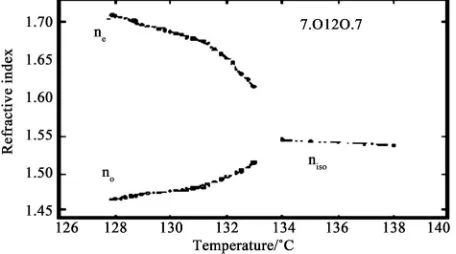
The variation of refractive index with temperature in 6.O12O.6 and 7.O12O.7 are shown in Figures 1 and 2. It can be observed that while cooling the sample from iso-tropic phase, the value of refractive index in isoiso-tropic phase (niso) is constant in both of the compounds. At the
I-N transition the isotropic refractive index value splits into two, extraordinary refractive index (ne > niso) and or-
dinary refractive index (no < niso). This splitting is clearly
[image:2.595.307.541.453.696.2]observed in the telescope of the modified spectrometer at the position of angle of minimum deviation at the I-N
Table 1. Transition temperatures of the phase transitions exhibited by 6.O12O.6 and 7.O12O.7.
Compound Cr-N (˚C) N-I (˚C)
6.O12O.6 129.1 132.2
7.O12O.7 127.0 133.0
Figure 1. Variation of refractive indices ne and no with
Figure 2. Variation of refractive indices ne and no with
tem-perature in the compound 7.O12O.7.
transition. When the temperature is further decreased, the value of ne increases while the value of no decreases
slightly; and when the temperature is further decreased, deep in the nematic phase, the values of both components of refractive index saturates. The I-N temperatures obser- ved in the birefringence measurements are in good agree- ment with those observed in DSC and density measure- ments [7,8].Also, the density data reported in these ref- erences was used for calculating the molecular polariza- bility values, αe and αo.
3.1. Estimation of Order Parameter
3.1.1. Estimation of Molecular Polarizability Anisotropy from Lippincott δ-Function Model and the Molecular Vibrational Methods
The principal molecular polarizability anisotropy and the mean polarizability are evaluated for the compounds 6.O12O.6 and 7.O12O.7 using the Lippincott δ-function model [9,10] and the molecular vibration method [11]. The principal molecular polarizability components as well as mean polarizabilities for the compounds 6.O12O.6 and 7.O12O.7 using these two methods are given in Table 2.
3.1.2. Estimation of molecular polarizabilities from Refractive Indices and Densities Employing Vuks and Neugebaur Methods
3.1.2.1. Vuks Method
This model was first applied to liquid crystal molecules by Chandrasekhar et al.[12]in whichthe internal field is assumed to be isotropic even in anisotropic crystal. These assumptions lead to the following equations
2
2
2 e e
2 o o
n 1 3
4πN n 2
n 1 3
4πN n 2
(1)
where N is the number of molecules per unit volume, ne
and no are the extraordinary and ordinary refractive indi-
Table 2. Principal parallel, perpendicular components and mean polarizabilities of (×10–24 cm3) 6.O12O.6 and 7.O12O.7.
Polarizabilities by Lippincott
δ-function model (10–24 cm2) Method (10Vibrational –24 cm2) Compound
α|| 2α *αn αM αM
6.O12O.6 180.82 112.10 1.3844 97.64 95.64
7.O12O.7 188.58 116.86 1.3844 101.71 100.09
*The values given for α are included in α||.
ces of the LC molecule,
2 2 2
e o
n 2n
3
n
and N = NA/M where NA is the Avogadro number, is
the density and M is the molecular weight. 3.1.2.2. Neugebauer Method
Saupe and Maier[12] and Subramanyam et al.[13] ap-plied this method to liquid crystal molecule in which the internal field is assumed to be anisotropic. According to this method the molecular polarizabilities are
2
e AB 3 (AB 3) 4AB 2A
(2)
2
o AB 3 (AB 3) 16AB 4A
(3) where
2 2
e o
2 2
e o e o
n 2 2(n 2)
1 2 4πN
A
3 n 1 n 1
(4)
2 2
|| e o
i
B 2 2
9 n 1 4πN n 2 3
(5)
and Ni is the number of molecules per unit volume in the
isotropic phase.
Using the two models the molecular polarizabilities (αe
and αo) and the polarizability anisotropy (e – o) in
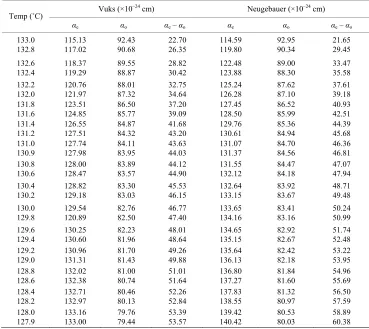
nematic phase of the compounds 6.O12O.6 and 7.O12O.7 were calculated at different temperatures and the values are presented in Tables 3 and 4, respectively.
From these two tables following observations can be made: the calculated values of αe, αo and (αe – αo) using
[image:3.595.325.542.369.513.2]Table 3. The molecular polariziabilities and the polarizability anisotropy (αe – αo) in 6.O12O.6.
internal field in a crystal [13] which was applied to liquid crystals [11,12].
Vuks (×10–24 cm) Neugebauer (×10–24 cm) Temp (˚C)
αe αo αe – αo αe αo αe – αo
132.0 10 4 8 10 9 8
131.9 131.8 8.1 108.66 109.22 9.55 88.93 88.35 18.59 19.73 20.87 9.0 111.40 111.19 9.44 88.28 87.39 19.65 23.12 25.80 131.7 131.6 109.87 110.53 87.84 87.34 22.03 23.18 114.40 115.47 86.78 86.24 27.62 29.23 131.5 131.4 111.21 112.31 86.86 86.21 24.34 26.10 116.45 117.49 85.76 85.24 30.69 32.25 131.3 131.2 113.09 113.74 85.73 85.34 27.36 28.40 118.28 118.91 84.84 84.53 33.44 34.38 131.1 131.0 114.25 114.88 85.04 84.69 29.21 30.18 119.36 119.87 84.30 84.04 35.06 35.83 130.9 130.8 130.7 115.01 115.26 115.74 84.57 84.40 84.11 30.44 30.86 31.62 120.14 120.46 120.89 83.91 83.75 83.53 36.23 36.71 37.36 130.6 130.5 116.20 116.80 83.85 83.51 32.35 33.29 121.32 121.81 83.32 83.08 38.00 38.73 130.4 130.3 117.35 118.09 83.20 82.80 34.15 35.29 122.27 122.84 82.84 82.56 39.43 40.28
Table 4. The molecular polarizabilities and the polarizability anisotropy (αe – αo) in 7.O12O.7.
Vuks (×10 cm) –24 Neugebauer (×10–24 cm) Temp (˚C)
αe αo αe – αo αe αo αe – αo
133.0 11 3 11 9 9
132.8 5.1 117.02 92.43 90.68 22.70 26.35 4.5 119.80 2.95 90.34 21.65 29.45 132.6 132.4 118.37 119.29 89.55 88.87 28.82 30.42 122.48 123.88 89.00 88.30 33.47 35.58 132.2 132.0 120.76 121.97 88.01 87.32 32.75 34.64 125.24 126.28 87.62 87.10 37.61 39.18 131.8 131.6 123.51 124.85 86.50 85.77 37.20 39.09 127.45 128.50 86.52 85.99 40.93 42.51 131.4 131.2 126.55 127.51 84.87 84.32 41.68 43.20 129.76 130.61 85.36 84.94 44.39 45.68 131.0 130.9 127.74 127.98 84.11 83.95 43.63 44.03 131.07 131.37 84.70 84.56 46.36 46.81 130.8 130.6 128.00 128.47 83.89 83.57 44.12 44.90 131.55 132.12 84.47 84.18 47.07 47.94 130.4 130.2 128.82 129.18 83.30 83.03 45.53 46.15 132.64 133.15 83.92 83.67 48.71 49.48 130.0 129.8 129.54 120.89 82.76 82.50 46.77 47.40 133.65 134.16 83.41 83.16 50.24 50.99 129.6 129.4 130.25 130.60 82.23 81.96 48.01 48.64 134.65 135.15 82.92 82.67 51.74 52.48 129.2 129.0 130.96 131.31 81.70 81.43 49.26 49.88 135.64 136.13 82.42 82.18 53.22 53.95 128.8 128.6 132.02 132.38 81.00 80.74 51.01 51.64 136.80 137.27 81.84 81.60 54.96 55.69 128.4 128.2 132.71 132.97 80.46 80.13 52.26 52.84 137.83 138.55 81.32 80.97 56.50 57.59 128.0
127.9 133.00 79.44 53.57 140.42 80.03 60.38
[image:4.595.112.481.389.718.2]However, the ules sumed oint p riza-bilities dist anis lly in . Also, th
bility Anisotropies and
In uni and
ordina onding to the elec-molec are as as p o-la ributed otropica space if
e small difference in the length of these two molecules is considered, the molecular polarizability values appears to be almost same in the nematic phase of both of these two compounds. The anisotropy in the molecular pola- rizabilities calculated using both Vuks and Neugebauer models increases with decrease of temperature in both 6.O12O.6 and 7.O12O.7. This could be explained as fol- lows: at molecular level, if the motion of different parts of a molecule are considered viz., the possible free rota- tion about the single bonds of the methylene units present in both spacer as well as end groups, the hindered rota- tion due to the presence of bulk groups or double bonds as well as non-coplanarity of benzene rings reducing the conjugation effects are possible in liquid crystalline phase. The number of molecules in which such motions take place and decrease of the amplitudes of such mo- tions with decreasing temperature are possible leading to the increase of polarizability anisotropy as the tempera-ture is decreased. Finally, the calculated values of αe and αo in the nematic phase of both 6.O12O.6 and 7.O12O.7
are nearly 2.5 times to those observed for the compounds of n.Om series viz., 6O.4, 6O.2 and 7O.1 [15] which are the precursors of these dimers with slightly different end chain lengths and those of other monomers (nO.Om) re- ported recently [16,17].
3.1.3. Estimation of Order Parameter, S, from Molecular Polariza
Mean Polarizabilities in Different Ways from Different Methods
axial liquid crystal phase the extraordinary (e)
ry (o) polarizabilities corresp
tric vector parallel and perpendicular to the optic axis are given as
|| ||
2 S 3
S 3
e
o
(6)
where S is the order parameter || and are principal
polarizabilities of the molecule parallel and perpendicu-uid
lar to the long molecular axis of the liq crystal mole- cule. The average molecular polarizability is given as
e 2 o
3
|| 2
3 (7) Combining the above two equations the or
ter, S, is
der
parame-
e o
S (8) The principal polarizabilities || and
using different methods and the S is estimated for both ca
obtain ncipal abilities are Lippincott -func- tion m [8,9], m ar vibrational method [10], Hal-
are estimated
ses viz., Vuks and Neugebauer. The methods used for
ler [17]extrapolation method and scaling factor method. Therefore, the order parameter, S, using Vuks and Neu- gebauer methods is obtained in different ways employing the four different principle polarizabilities for both of the compounds, 6.O12O.6 and 7.O12O.7.
In the Vuks method the order parameter is given by [18,19]
ing pri polariz ethod olecul
2 2 e o
n n
2 ||
S
n 2
where
(9)
2 2
2
e o
n 2n n
3
e Neugebauer method the order parameter S [18] is given by
In th
||
S f B
(10)
where
9 2 10 1 2 B 1f B B B 1
4B 3 3
and
2 2
2
e o
2 2 2
e o
n 2 n 2 n 1
B 2
n 1 n 1 n 1
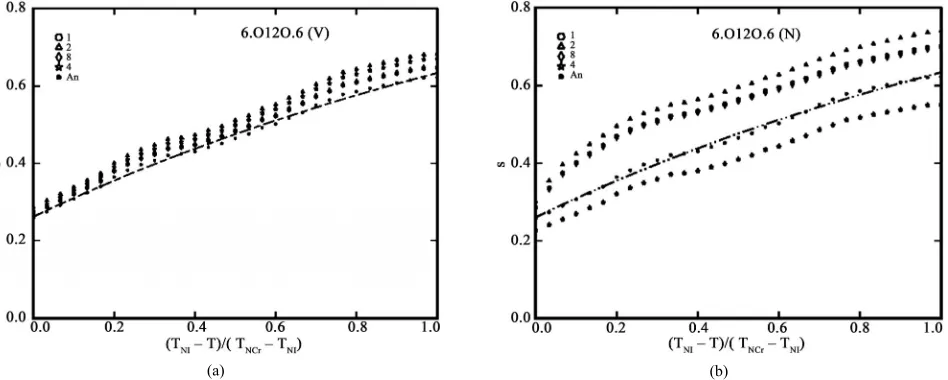
The scaling factors for the determination of order pa-rameter are obtained in both the cases by plotting log- log plots between
2 2 e 0
n n
2
n 1
Neugebauer methods respectively against the reduced and f(B) in Vuks and
/( TNI – T
and nema peratures, respectively) .
temperature (TNI – T) NI/NCr) (where TNI and TNCr
(a) (b)
Figure 3. (a) Variation of order parameter, S versus the n ed nematic range for the compound 6.O12O.6 using Vuk model; (b) Variation of order parameter, S versus the normalized nematic range for the comormaliz pound 6.O12O.6 using Neuge-s bauer model.
[image:6.595.64.538.85.275.2](a) (b)
Figure 4. Variation of order parameter, S versus the normalized nematic range for the compound 7.O12O.7 using (a) Vuk model and (b) Neugebauer model.
alues calculated using Vuks and Neugebauer models us
[image:6.595.66.538.322.506.2]mated assuming the two field models and using different s
Table 5 shows the percentage of deviation of the S Table 5. Prcentage of deviation of order parameter, S
esti-v
ing all methods from that calculated directly from op-tical anisotropy values, Δn, the birefringence in perfect order [20-24]. The values are underlined if the deviation is less than or equal to 10% which are considered in agreement with S calculated from Δn and is within the experimental error (which is be between –5% to +5%). From the Figures 3 and 4 as well as from Table 5, fol-lowing conclusions can be drawn: The S values obtained from Vuks model using the polarizability anisotropies calculated from Lippincott δ-function model, vibrational method, Haller extrapolation method and from scaling factor method are slightly larger than those calculated directly from optical birefringence (Δn) in both 6.O12O.6
methods from that obtained using ∆n, the birerefringence in perfact order in the two dimeric compounds.
Vuks Neugebauer Compound
Lip. Vib. Hal. Sc. Lip. Vib. Hal. Sc.
6.O12O.6 4.32 10.25 4.60 7.67 20.73 27.58 19.91 12.22
7.O12O.7 7.84 14.10 7.25 11.16 16.60 23.40 13.75 8.24
an .7
with a lated fro
in b ,
e S values calculated from scaling factor method are d 7.O12O
with S v as
lues well as
calcu
in reason m
ably
Δn di good rectly
agree . Whe
[image:6.595.307.537.588.661.2]cial support. The authors D. . Pisipati express their f K. L. University,
Vaddes-id Crystals. The Preparatio Properties of α,ω-Bis-(4-N-alkylaniline benzylidene-4’-oxy
Alkanes,” Liqid 1992, pp.
203-slightly smaller than those calculated from Δn values directly and S values calculated from all other methods are slightly larger than those obtained from Δn values for both of the compounds. Also, the percent of deviation observed is rather large, except in case of the values ob-tained from scaling factor method for 6.O12O.6 and Haller’s extrapolation and scaling factor methods in case of 7.O12O.7. From all the methods employed, it can be seen that the largest value of S attained in N phase of 7.O12O.7 is slightly higher compared with that for 6.O12O.6. From this analysis a good agreement can be observed in the S values obtained from Δn directly with S values obtained from other methods using Vuks model in the N phase of both of the compounds studied. Whereas this kind of agreement is rather poor in case of the calcu-lated S values Using Neugebauer method with those ob-tained from Δn values directly except in case of S values obtained from scaling factor method. Our results show that the application of Vuks model for calculating mo-lecular polarizabilities and order parameter gives good results in these two dimers than the Neugebauer model which indicates that the assumption of isotropic model even in the anisotropic environment in these dimers is giving better results of S values than the assumption of anisotropic environment.
4. Acknowledgements
P. R. Alapati expresses his gratitude to CSIR, New Delhi, India for providing finan
Madhavi Latha and V. G. K. M thanks to the management o
waram, India as well as financial support from DST, New Delhi, India. Authors P. V. Datta Prasad and P. Pardhasaradhi express their gratitude to the management of The Hindu College, Machilipatnam, India for provid-ing computational facilities.
REFERENCES
[1] R. W. Date, C. T. Imrie, G. R. Luckhurst and J. M. Seddon,
“Smectogenic Dimeric Liqu n and
)
Crystals, Vol. 12, No. 2, 235.
doi:10.1080/02678299208030393
[2] S. K. Heeks and G. R. Luckhurst, “On the Molecular Or- ganization within the Nematic Phase of Liquid Crystal Di- mmers,” Journal of the Chemical Society, Faraday Tran- sctions, Vol. 89, 1993, pp. 3289-3296.
doi:10.1039/ft9938903289
[3] G. S. Attard, R. W. Date, C. T. Imrie, G. R. Luckhurst, S. J. Roskilly, J. M. Seddon and L. Taylor, “Non-Symmetric Dimeric Liquid Crystals. The Preparation and Properties of α-(4-Cyanobiphenyl-4’-oxy) Alkanes,” Liqid Crystals, Vol. 16, No. 4, 1994, pp. 529-551.
doi:10.1080/02678299408036531
[4] R. W. Date, G. R. Luckhurst, M. Schuman and J. M. Sed- don, “Novel Modulated Hexatic Phases in Symmetric Li- quid Crystal Dimmers,” Journal of de Physique II, Vol. 5, No. 4, 1995, pp. 587-605. doi:10.1051/jp2:1995151
. Nordio and S. J. Ros- [5] A. Ferrarini, G. R. Luckhurst, P. L
killy, “Understanding the Unusual Transitional Behaviour of Liquid Crystal Dimmers,” Chemical Physics Letters, Vol. 214, No. 1-4, 1993, pp. 409-417.
doi:10.1016/0009-2614(93)85658-B
[6] I. Haller, H. A. Huggins, H. R. Lilienthal and T. R. Mc- Guire, “Order-Related Properties of Some Nematic Liq- uids,” Chemical Physics Letters, Vol. 77, No. 7, 1973, pp. 950-954. doi:10.1021/j100626a020
[7] D. Bhuyan, P. Pardhasaradhi, B. Gogoi, P. V. Datta Pra-
212.
sad, P. R. Alapati and V. G. K. M. Pisipati, “Phase Tran- sition Studies of 6.O12O.6 and 7.O6O.7 by Using Den- sity Measurements,” Molecular Crystals and Liquid Cry- stals, Vol. 540, No. 1, 2011, pp.
205-doi:10.1080/15421406.2011.568882
[8] D. Bhuyan and P. R. Alapati, “The Title of the Article,”
The Name of Journal, (Unpublished results).
[9] E. R. Lippincott and M. O. Dayhoff, “Delta-Function Mo- del of Chemical Binding,” Spectrochimica
No. 1, 1960, pp. 807-834.
Acta, Vol. 16,
emical Bin- [10] E. R. Lippincott, G. Nagarajan and J. M. Stutman, “Po-
larizabilities from the δ-Function Model of Ch
ding II. Molecules with Polar Bonds,” The Journal Phy- sical Chemistry, Vol. 70, No. 1, 1966, pp. 78-84.
doi:10.1021/j100873a012
[11] Y. N. Muthi, V. R. Murthi and R. N. V. Ranga Reddy, “Molecular Vibration Approach to Polarizability of Me- thyl Cinnamate Liquid Crystal Compounds,” Acta Physi- ca Polonica A, Vol. 91, 1997, pp. 1069-1079.
[12] S. Chandrasekhar and N. V. Madhusudhana, “Orientatio-
ticle,” Zei-
ol. 22, nal Order in p-Azoxyanisole, p-Azoxyphenetole and Their Mixtures in Nematic Phase,” Journal of de PhysiqueCol- loques, Vol. 30, Supplement 11, 1969, pp. 24-27. [13] A. Saupe and W. Maier, “The Title of the Ar
tschrift fur Naturforschung, Vol. 16a, No. , 1961, p. 816. [14] H. S. Subrahmanyam and D. Krishnamurthi, “Polariza-
tion Field and Molecular Order in Nematic Liquid Crys- tals,” Molecular Crystals and Liquid Crystals, V No. 3-4, 1973, pp. 239-248.
doi:10.1080/15421407308083347
[15] H. E. J. Neugebauer, “Clausius-Mosotti Equation for Cer- tain Types of Anisotropic Crystals,” Canadian Journal of Physics, Vol. 32, No. 1, 1954, pp. 1-8.
doi:10.1139/p54-001
[16] N. V. S. Rao, V. G. K. M. Pisipati, P. V. Datta Prasad and
. 1-21.
608079523
P. R. Alapati, “Order Parameter and Molecular Polariza- bilities in 6O.4, 6O.2 and 7O.1,” Molecular Crystals and Liquid Crystals, Vol. 132, No. 1-2, 1986, pp
doi:10.1080/00268948
No. 1-2, 2009, pp. 121-132.
doi:10.1080/15421400903053644
[18] J. L. Kumari and V. G. K. M. Pisipati, “The Title of the Article,” The Name of Journal, (Unpublished results). [19] I. Haller, H. A. Huggins and M. J. Freisner, “On the Mea-
surement of Indices of Refraction of Nematic Liq
tals,” Molecular Crystals and Liquid Crystals, Vol. 16, uid Crys- No. 1-2, 1972, pp. 53-59.
doi:10.1080/15421407208083579
[20] R. G. Horn, “Refractive Indices and Order Parameters of Two Liquid Crystals,” Journal of Physics, Vol. 39, No. 1, 1978, pp. 105-109. doi:10.1051/jphys:01978003901010500
[21] P. G. de Gennes and J Prost, “The Physics of Liquid Crys- tals,” Oxford University Press, New York, 1993.
[22] W. H. de Jeu, “Physical Properties of Liquid Crystalline Materials,” Gordon and Breach Publishers, New York,
EE Transactions, Vol. 8, No. , 2001, p. 512.
Liq-1980.
[23] B. J. Zywucki and W. Kuczynski, “The Title of the Arti-cle,” IE
[24] W. Kuczyncki, B. J. Zywucki and J. Malecki, “Determi-nation of Orientational Order Parameter in Various uid Crystalline Phases,” Molecular Crystals and Liquid Crystals, Vol. 381, No. 1, 2002, pp. 1-19.