POTENTIAL ALTERNATIVE
*Ashika
Department of General
ARTICLE INFO ABSTRACT
Aim: regular Materials the tissue nitrite Background exists they can broad state”. give taste study water. concentrations. we chose Conclusion: nitrite
Copyright©2017, Ashika Rachael Samuel and Dr. Gheena
permits unrestricted use, distribution, and reproduction in any medium, provided the original work is properly cited.
INTRODUCTION
Histology is a microscopic study in which tissue animals and humans are studied. The main histology is due to its ability to contribute accurate in forensic sciences, autopsy, diagnosis and 2012). The histological staining procedure includes fixation ,processing, embedding ,sectioning (Titford, 2009). Among these steps, the first aims at preserving the tissue structure and cell degradation. This occurs due to the cross linking the fixatives. (Young, 2010). The most common is Formalin (Black, 2012). It has been noticed may be oxidised in the prescence of oxygen formation of Formic acid. This may interfere blood rich tissue specimens and form "formalin (Lillie, 1947 and Walker, 1964). The other known neutral buffered formalin (NBF), paraffin fixative etc. (Musumeci, 2014 and Lillie, 1947).
*Corresponsding author: Ashika Rachael Samuel Department of General Pathology, Saveetha Dental Hospitals
ISSN: 0975-833X
Vol.
Article History:
Received 20th November, 2016
Received in revised form
16th December, 2016
Accepted 02nd January, 2017
Published online 28th February,2017
Citation: Ashika Rachael Samuel and Dr. Gheena
Research, 9, (02), 46795-46799.
Key words:
Sodium nitrite, Tissue fixation.
RESEARCH ARTICLE
ALTERNATIVE TO FORMALDEHYDE FIXATIVES
Ashika Rachael Samuel and Dr. Gheena
General Pathology, Saveetha Dental College and Hospitals
ABSTRACT
The aim of this study is to find a potential alternative regular fixatives.
Materials and Method: In this study, we will use sodium nitrite tissue overlying the extracted teeth will be used. 30g, 35g
were the concentrations.
Background: Fixation is the foundation step behind the study to prevent the autolysis and degradation of the tissue can be observed both anatomically and microscopically objective of tissue fixation is to preserve cells and tissue state”. Sodium nitrite has been found to inhibit growth of disease
taste and color to the meat; and inhibit lipid oxidation was carried out in 2016 using 40g, 50g, 60g and 80g r. 40g sodium nitrite showed the best fixation concentrations. Even 60g showed significant results. However
chose concenterations around 40g.
Conclusion: An innovative Method to detect the effectiven as a fixative in place of the usual toxic Formalin.
Ashika Rachael Samuel and Dr. Gheena. This is an open access article distributed under the Creative Commons Att use, distribution, and reproduction in any medium, provided the original work is properly cited.
tissue samples from main purpose of accurate information education (Black, includes five steps, ,sectioning and staining first step FIXATION cell integration from linking proteins of common fixative used noticed that formalin oxygen leading to the interfere while fixing the "formalin pigment ". known fixatives are paraffin-formalin, Bouin
1947).
Ashika Rachael Samuel
Dental College and
However the major drawback lead to the denaturation of the rendering them dysfunctional ( the need to identify an alternative similar function to formalin but produce high efficiency results. nitrite can serve for this purpose. used in curing of meat. This curing becoming rancid (Bryan, 2015). botulinum toxin and preserves nitrates have the capacity to preserve the food, its application in the studied. Thus sodium nitrate has understand its fixative strength.
MATERIALS AND METHOD
For the study , sodium nitrite powder distilled water in varying (30g,35g,40g,45g and 50g) and These concentration values had pilot study (2016) of sodium International Journal of Current ResearchVol. 9, Issue, 02, pp.46795-46799, February, 2017
INTERNATIONAL
OF CURRENT RESEARCH
Gheena. 2017. “Potential alternative to formaldehyde fixatives - A study
FIXATIVES - A STUDY
Hospitals
that can be used in place of the
nitrite as a fixative. 5 samples of 35g, 40g, 45g and 50g of sodium
study of pathology and essentially and tissue components such that microscopically following sectioning. The tissue components in a “life-like disease-causing microorganisms; oxidation that leads to rancidity. The 80g of sodium nitrite in 100 ml of properties among the other However in the experimental study
effectiveness of a new salt like sodium
is an open access article distributed under the Creative Commons Attribution License, which
noticed is that, these fixatives the proteins in the sample tissue (Young, 2010). Thus here arises alternative fixative that can perform but eliminate its drawback and results. It's has been found that sodium purpose. Nitrites have commonly been curing will prevent the meat from 2015). It also protects food against preserves its form (Nigam, 2010), As preserve the form and structure of the field of histology has been has been experimented with to .
METHODS
powder was mixed in 100 ml of concentrations ranging from and stored in uricol containers. had been chosen following the nitrite solution with soft tissue
INTERNATIONAL JOURNAL OF CURRENT RESEARCH
for 48 hours was conducted with concentrations 40g 50g,60 g and 80 g. It was observed that the 40 and 60g concentration was the most suitable concentration for the study. Concentrations of 30g, 35g, 40g, 45g and 50 g were selected. Mucosal tissue samples were collected from the extracted teeth. The size of each tissue was approximately 5*5 mm. One sample had been stored in the standard fixative solution – formalin. Previously in 2016, the first pilot study was based on an experimental study done with meat chunks kept under observation for 48 hours in sodium nitrite solution dissolved in 100 ml of distilled water. The concentrations chosen were 10 g, 30g, 45g , 60 g and 80 g. From these concentrations it was seen that the container with 10 g concentration showed the least fixation. The meat appeared very soft. It was observed that the container with the maximum concentration (80g) showed excellent fixation property. The specimen appeared normal in consistency and had not much change in its structure. Thus choosing this concentration, the study has been carried out with a few other experimental values to attain maximum accuracy in the result. The tissue samples were collected from the extracted teeth.
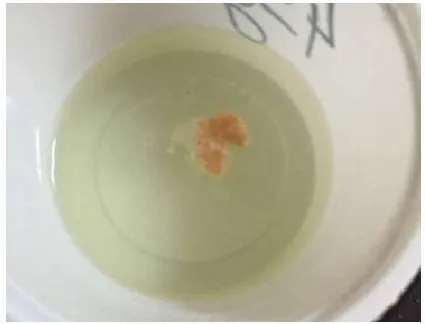
Fig. 1. Pilot study with meat chunk in 45 g concentration of sodium nitrite in distilled water
RESULTS
From the pilot study we proved that sodium nitrite has good fixative properties, particularly the 40 and 60 g concentrations. The effectiveness of the fixative also depends on the size of the tissue to be fixed. However the consequent study show that the fixation was best appreciated with 45g.
DISCUSSION
The primary objective of fixation is to prevent all the degenerative processes that occur once the tissue is deprived of the blood supply. The tissue ingestion that occurs due to the release of micro organisms due to rupture of outer membrane leads to autolysis. This phenomenon is greatly reduced by the properties of fixation. Further more, the other steps in histochemical procedure where the tissue is subjected to various chemicals and waxes need to be protected against any form of damage. Fixation aids in this aspect and protects the tissue (Drury, 1980 and Eltoum, 2001). Despite all the advantages, it is also noted that the fixative can cause some preliminary changes to the tissue like shrinkage, swelling, hardening etc when subjected to an aqueous environment. Even during processing, there may be some morphological changes in the non aqueous environment (Eltoum, 2001).
There are two main types of Fixation - chemical and physical means. Physical fixation includes heating , microwaving and cryo- preservation. Heat fixation is now replaced by micro wave techniques. Cryo - preservation refers to freeze drying and it is not applicable to the diagnostic tissue specimens (Eltoum, 2011). The chemical methods include perfusion and immersion techniques. In general, a fixative is a single agent dissolved in a particular solvent or it may be due to the combination of one or more agents (Leong, 1994). The most widely accepted fixatives are formalin. It is prepared by diluting one part of formalin in nine parts of water as a buffer. It is accepted that washing of the tissue specimens with formalin can reverse some reactions however the cross links will still remain the same (Eltoum, 2001). Another main advantage of formalin is its ability to preserve the peptide in the cellular proteins (NTP, 2011).
The formalin also reacts with lysine , tyrosine, threonine, serine, glutamine and others to form a cross links. These cross links are responsible for maintenance of the tissue in it normal physiological state (Eltoum, 2001). Though formalin serves to be so advantageous , it is highly hazardous to man. It's entry into the body through the eye , skin or respiratory tract can be very harmful to man. It may cause irritation, corrosion or allergy to man. Many studies have proved formalin to be carcinogenic to man kind. Common cancers caused are nasopharyngeal cancer, sinonasalcancer, myeloidleukaemia (Rolls, 1994). Some undesired effects are also seen with the fixation. The formalin may undergo oxidation reaction and form Formic acid resulting in fall in pH. This Formic acid will react with the haemoglobin and form a new compound, acid formaldehyde haemoglobin. This is a brown black granular pigment which gets deposited on the blood rich tissues. It is often misinterpreted as a micro organism or pigment (Rolls, 1994). Thus due to the above reasons ,alternatives to formalin have come into use. Mostly used alternatives are gluteraldehyde and genipin. Gluteraldehydeposses equivalent functions as formalin. The cross linking of gluteraldehyde are highly irreversible (Bozzola, 1992). The gluteraldehyde slowly degrades to glutaricacid which enables the conversion of a cyclic compound to an oligomeric compound. When this fixative is used for electron microscopy as a primary fixator , a secondary fixation is done with osmium tetroxide (Bozzola, 1992). Genipin is a naturallyoccuring fixative. It acts with the amino acids and converts it into a blue compound. It is believed that the use of this fixative on tissue builds its resistance collagenase degradation.
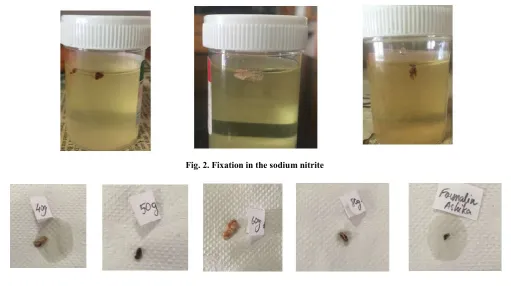
Fig. 2. Fixation in the sodium nitrite
[image:3.595.39.561.577.796.2]Fig. 3. Tissue sample after processing
Fig. 4. Block preparation before sectioning
Scoring Ease cutting
Block stability
and storage
General appearance
Morphological appearance of
nuclei
Morphological appearance of cytoplasm of epithelial cells
Morphological appearance of connective tissue
Artefacts
0 Very difficult Very poor Distortion of the
general architecture , improper orientation
and staining
Not clearly visible Hazy and distorted
Not clearly distinguished , hazy
Artefacts are numerous
1 Difficult Poor Orientation is proper
with definition of a few structures and improper staining
Distorted appearance
Clearly visible and large number
of vacuoles . Improper staining
Semblance of connective tissue observed , improper
staining
Artefacts restricted to those elicited due to fixation of tissue
processing . Improper staining
2 Very easy ( too
soft )
Medium Structures are visible in proper orientation , margins not distinct , improper staining
Distinct in appearance , nucleoli is not
visible
Distinct , less number of vacuoles . Staining not
uniform
Collagen fibres are distinct in few areas and hazy in others . Improper staining
Less artefacts
3 Normal Good All structures are
distinct in proper orientation to each
other and exhibit proper staining .
Distinct nuclear memebrane and
nucleoli
Clearly seen, distinct , homogeneous, no vacuoles , uniform
staining
Individual Collagen fibres can be made out distinctly with a distinct nucleus . Staining is proper .
Fig. 5. Histopatholoigical slide a)formalin (40X ),b) 80g(10X),c) 60g (40X),d) 50g (40X) and e)40g (40X) respectively
Concentration Ease Of
cutting
Block stability on storage
General appearance
Morphology of nuclei
Morphology of cytoplasm
Morphology of connective tissue
Artefacts
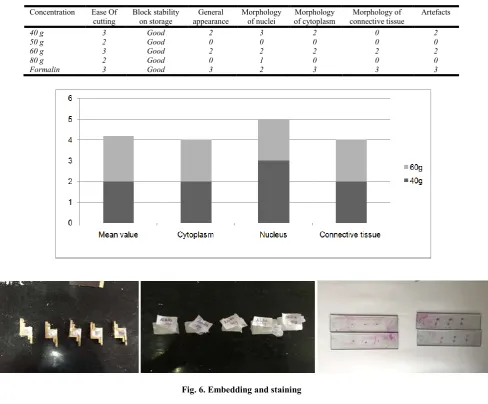
40 g 3 Good 2 3 2 0 2
50 g 2 Good 0 0 0 0 0
60 g 3 Good 2 2 2 2 2
80 g 2 Good 0 1 0 0 0
[image:4.595.57.546.193.597.2]Formalin 3 Good 3 2 3 3 3
Fig. 6. Embedding and staining
Concentration Ease Of
cutting
Block stability on storage
General appearance
Morphology of nuclei
Morphology of cytoplasm
Morphology of connective tissue
Artefacts
30 g 2 Good 0 0 0 0 1
35 g 2 Good 0 0 0 0 0
40 g 3 Good 0 0 0 0 0
45 g 2 Good 2 1 2 2 2
50g 0 Good 0 0 0 0 0
The sectioned components were now eligible for staining and slide preparation. This was the scoring criteria for the various slide prepartions. In the last step, using heamatoxylin and eosin stain, the tissue was stained and viewed under a microscope. The scoring was done based on the above mentione criteria and it was graded. The slides demonstrated excellent staining and most of the cellular components were clearly visible. The grading was done and it was noticed that the concentration of 40 g and 60g showed the best fixation properties. In comparing these two, the most suitable fixative concentration found was 40g . Thus its proved from the study that sodium nitrite can be used as an alternative fixative. Care should be taken that the size of the tissue used must be a little larger in order to attain maximum success rate with this compound. The consequent study with concentrations 30,35,40,45 and 50 was done in the same way. The results from this part showed that only 45g had fixed the tissue effectively. The other samples obtained showed poor fixation as their morphological structures werent visible under the microscope. Only the 45g slide was clearly visible under thye microscope and this was the only tissue available for scoring. The histopathological slideof 45g reveals the microscopic structures to an extent.
Conclusion
The need for discovering a potential alternative for formaldehyde was highly essential due to its hazardous affects to man. And it was proven in this study, that the experimental sodium nitrite solution could be used as an alternative to formaldehyde. However, we are still continuing the study to obtain more results about the efficacy of this compound with concenteration around 60g and determine the accuracy of its fixing properties.
REFERENCES
Black, J. 2012. Microbiology: Principles and exploration (8th ed.). John Wiley& Sons. p. 68.
Bozzola, J.J., Russell, L.D. 1992. Electron microscopy: principles and techniques for biologists. Boston: Jones and Bartlett.
Bryan, N. and Ivy, J., 2015. Inorganic nitrite and nitrate: evidence to support consideration as dietary nutrients. Nutrition Research, 35, 643-654.
Drury, R.A.B., Wallington, E.A. 1980. Carleton's histological technique. 5th ed. New York: Churchill Livingstone.
Eltoum, I., Fredenburgh, J., Grizzle, W.E. 2001. Advanced concepts in fixation: 1. Effects of fixation on immunohistochemistry, reversibility of fixation and recovery of proteins, nucleic acids, and other molecules from fixed and processed tissues. 2. Developmental methods of fixation. J Histotechnol., 24;201-210.
Eltoum, I., Fredenburgh, J., Myers, R.B., Grizzle, W.E. 2001. Introduction to the theory and practice of fixation of tissues. J Histotechnol., 24;173 -190.
Iyiola, S. and Avwioro, O. G. 2011. Alum haematoxylin stain for the demonstration of nuclear and extra nuclear substances. Journal of Pharmacy and Clinical Sciences. Leong, A.S.Y. 1994. Fixation and fixatives. In Woods AE and Ellis RC eds. Laboratory histopathology. New York: Churchill Livingstone, 4.1-1 - 4.1-26.
Lillie, R.D., Hershberger, L.R. 1947. The genesis of acid formaldehyde hematin ("formalin pigment") and the influence of fixation on hemosiderins. Bull IntAssoc Med
Mus., 29:136, 1947.
Musumeci, G. 2014. Past, present and future: overview on Histology and histopathology. J HistolHistopathol, 1, 5. http://dx.doi.org/10.7243/2055-091X-1-5
Nigam, P. K. and Nigam, A. 2010. BOTULINUM TOXIN.
Indian Journal of Dermatology, 55(1), 8–14.
NTP. Report on carcinogens, Twelfth Edition. National Toxicology Program, USA Department of Health and Human Services, 2011; http://ntp.niehs.nih.gov/ntp/roc/ twelfth/roc12.pdf November 7, 2011
Rolls, G.O., Farmer, N.J., Hall, J.B. 1994. Artefacts in histological and cytological preparations. In Woods A and Ellis R eds. Laboratory histopathology. New York: Churchill Livingstone, 5.3-1 - 5.3-29.
Sung, H.W., Chang, Y., Liang, I.L., Chang, W.H., Chen, Y.C. 2000. Fixation of biological tissues with a naturally occurring crosslinking agent: fixation rate and effects of pH, temperature, and initial fixative concentration. J
Biomed Mater Res 2000.
Titford, M. 2009. Progress in the development of microscopical techniques for diagnostic pathology. J Histotechnol. 32:9-19. http://dx.doi.org/10.1179/his. 2009.32.1.9
Walker, J.F. 1964. Formaldehyde, 3rd ed. Am Chem Soc Monograph Series. Reinhold, New York..
Young, B., O'Dowd, G. and Stewart, W. 2010. Wheater's Basic Pathology: A Text, Atlas and Review of Histopathology (5th Ed.).