Faculty of Behavioral Management and
Social Sciences (BMS)
Supervisors:
Prof. dr. J.H. Kerstholt Dr. Ir. P.W. de Vries
Master thesis
Predictive Policing: the Influence of
System-Based Predictions on Advice
Taking
Astrid Herpers Student number 1766805
2
Abstract
The development of technology provides the chance to use fast amounts of data to do work more effectively and efficiently. This also applies for the police and the field of predictive policing, they use vast amounts of data to better predict crime. To be able to work with the data, they use a system called Crime Anticipation System (CAS) to analyse all the data. However, little is known about the interaction between police officers and the system CAS. This study is a quantitative study of the effect of intuition and explanation on level of trust and level of advice taking. By using a questionnaire which contained a fictional scenario police officers were asked about their trust and attitude regarding advice provided by CAS. In total 63 participants between the age of 21 and 65 participated in this study, they were
3 Table of content
1. Introduction ... 4
2. Theoretical framework ... 6
2.1 Advice taking ... 6
2.2 Trust ... 6
2.3 Intuition ... 7
2.4 Explanation ... 8
2.5 Current research ... 9
3. Method ... 11
3.1 Participants ... 11
3.2 Design ... 11
3.3 Instruments ... 11
3.3.1 Scenarios. ... 11
3.3.2 Questionnaire ... 13
3.4 Procedure ... 13
4. Results ... 15
4.1 Additional analysis ... 17
5. Conclusion and Discussion ... 21
5.1 Advice taking ... 21
5.2 Level of trust ... 22
5.3 limitations and strengths. ... 23
5.4 Overall conclusion ... 23
4 1. Introduction
We are surrounded by technology and interact with it on a daily basis, whether this is our mobile phone or the interaction with systems to execute our work. The application of technology in decision aids is evolving. Automation used to be there to relieve human
operators from their manual work, nowadays there are systems that are used to support people to make better decisions, for example, by providing an advice on the best course of action or giving an indication on the chance of a certain crime occurring. Decision aids took over some tasks and improved them, they were able to improve because a system can analyse more information than humans can. However, due to the fact that a system uses large amounts of data in their analysis, it is not clear how the decision aids generate their advice.
The vast amount of information used by decision aids to make a prediction is called big data. There are several different definitions for big data, for the purpose of this research big data is defined as a large amount of quantity and diversity of data, which can only be analysed using a software program (Waller & Fawcett, 2013). As a consequence of this vast amount of data people have difficulty understanding how the system works and how it generates its advice. When it comes to advice taking, people do not tend to take advice from other people or systems at face value. Understanding how the advice is generated is therefore an important factor when it comes to the acceptance of advice.
Decision aids which generate advice are also used by the police, in the form of predictive policing. Predictive policing can be defined in many different ways. Perry, McInnes, Price, Smith and Hollywood (2013) define predictive policing as the application of analytical (quantitative) techniques, to identify likely targets for police interventions and to prevent crime. Pearsall (2010) explains predictive policing as taking data from different sources, analyse this data and use the results of the analysis to anticipate, prevent and respond more effectively to future crime. Hence, predictive policing contains three elements namely information that is analysed to better anticipate to the future. Predictive policing (systems) allow the police to deploy their officers more effectively and efficiently (Willems &
Doeleman, 2014). The use of predictive policing systems reduces the level of subjectivity in these kinds of decision-making processes and improves the quality of the decision (Camacho-Collados & Liberatore, 2015).
5
There are several variables that influences advice taking from a system like CAS. This study focuses on the variables trust, explanation and intuition. Trust is an important factor when it comes to advice taking (Van Swol & Sniezek, 2005), when people have more trust in a system they have a higher level of advice taking (Bonaccio & Dalal, 2006). Trust is
influenced by different factors such as explanation. When it is explained to people how a system works and how it derives its information they tend to have more trust in the system (Miller, 2017). Furthermore, intuition is important when it comes to police work (Rienks, 2015), it is tacit knowledge that a police officers uses during a shift and it affects the level of advice taking.
6 2. Theoretical framework
2.1 Advice taking
When it comes to decision making in general, when advice is of good quality the utilization of advice leads to more accurate decisions. The combination of multiple recommendations leads to less random error in the advice than when a decision is based on the advice of one person (Önkal, Goodwin, Thomson, Gönül, & Pollock, 2009). So, one would think that people tend to take advice into account even if the advice is generated by a system, because it will benefit them.
However, advice provided by others or systems are not always accepted at face value. Research shows that the utilization of advice depends on different factors. For example, when people are provided with advice from someone else they tend to value their own opinion more (Bonaccio & Dalal, 2006). Tzioti, Wierenga, and van Osselaer, (2014) discovered that by whom advice is provided, to whom advice is given, and the content of the advice influences the utilization of advice. When looking at the three factors and the three different variables (i.e. trust, intuition and explanation), the variables can be related to the three factors. They can be linked as followed. By whom the advice is provided relates to trust, the source of the provided advice influences the level of trust in the advice and therefore the level of advice taking. To whom it is advised is related to intuition, if a police officer has more working experience, their intuition is further developed and they might be reluctant to take advice. The content of the advice relates to explanation, adding an explanation regarding the process the system used to come to the advice leads to a higher level of advice taking. The three variables and how they relate to the factors will be discussed in the following paragraphs.
2.2 Trust
Trust can be defined in several different ways. A basic definition of trust is the attitude that an agent will help achieve an individual’s goals in a situation characterized by uncertainty and vulnerability (Lee & See, 2004). A more specific definition is given by de Vries, van den Berg and Midden (2015), they define trust in a system as a user’s expectation about the
system, that it will perform a certain task that is beneficial to the user, in a situation in which a lack of sufficient evidence causes the actual outcome of the task to be uncertain. Both
7
Several researchers identify trust as a factor that influences the interaction with technology (de Vries et al., 2015), it is an important factor when it comes to the acceptance of advice (Van Swol & Sniezek, 2005). Furthermore, research shows that trust is associated with automation reliance, users who have a higher level of trust in the automation rely more on it (Merritt, Heimbaugh, LaChapell, & Lee, 2013). Previous experience with systems has, to some degree, influence on the trust that people have in the system (Lee & See, 2004; de Vries et al., 2015). More specifically trust influences the acceptance of advice (Bonaccio & Dalal, 2006). When the user trusts that the system will help to achieve the goal or task at hand it leads to more acceptance of the system (Stowers et al., 2017).
However, pre-existing attitudes and expectations can alter the trust the user has in the system (Hoff & Bashir, 2015). Negative pre-existing attitudes and expectations of users towards the system lead to lower level of trust in the system and therefore lower level of advice taking. Level of trust can also be influence by the dispositional trust, this is the
individual’s overall tendency to trust automation, independent of context or a specific system (Hoff & Bashir, 2015). If police officers do not trust CAS to begin with, without having any experience with the system, it will lead to lower levels of trust in the system. Which, in turn, will influence the level of advice taking.
When it comes to trust not only the attitude police officers have towards the system influence their trust level, but also their dispositional trust influences the trust they have. We therefore predicted that police officers with a positive attitude towards CAS have a higher level of trust and a higher level of advice taking.
2.3 Intuition
Defining intuition is difficult because it mainly concerns tacit knowledge (Okoli, Weller, & Watt, 2016). Cambridge Dictionary defines intuition as the ability to understand or know something immediately based on your feelings rather than facts (“Intuition in the English Dictonary,” n.d.). The building of intuition develops over time with a lot of exercise (Tzioti et al., 2014). Intuition of police officers is a fundamental part of police work
(Camacho-Collados & Liberatore, 2015). They rely a lot on their intuition during their work, they develop their intuition overtime during their shifts (Rienks, 2015). Thus, a more experienced police officer has a further developed intuition, than the novice police officer.
8
intuitively people have less trust in systems like CAS and therefore have a lower level of advice taking.
Not only the intuition that police officers build over time is important for trust, previous experience police officers have with CAS is also important. It affects the trust a police officer has regarding a system like CAS and also affects the level of knowledge regarding the system. The development of this knowledge about the system is called learned trust, previous
experience with an automated system influences the learned trust users have. Experience can enhance the understanding of the automation and the purpose and process of the system (Hoff & Bashir, 2015). For example, a novice police officer is likely to have a lower level of
knowledge regarding crime rates and the frequency with which they occur, the intuition is not as well developed as a more senior police officer. Therefore, it is more likely that they rely more on predictions provided by CAS, than a more senior police officer would.
As mentioned before, intuition plays an important role in the daily activities of a police officer (Camacho-Collados & Liberatore, 2015; Rienks, 2015). However, CAS provides advice to make these decisions easier. It can be that the advice that is provided by CAS contradicts with the intuition of the police officer. We therefore predict that when the advice is in line with the police officer’s intuition the level of trust and the level of advice taking is higher.
Also, we predict that police officers who have previous experience with CAS, and are familiar with the system have a higher level of trust and a higher level of advice taking than police officers who are unfamiliar with CAS.
2.4 Explanation
As mentioned before, an explanation that provides insight in the reasoning behind an advice is an important factor that influences the level of advice taking and the level of trust (Langley, Meadows, & Sridharan, 2017). The term explanation can cause some ambiguity when it is used in relation to advice taking. On one hand, the terms explanation and justification are used in the literature, which both refer to an intuitive explaining why someone gives the provided advice. This explanation is based on a gut feeling, and a clear explanation cannot always be provided. In this context the term explanation refers to the intuitive reasoning one had behind the advice that was provided (Tzioti et al., 2014). On the other hand, there is literature that uses the term explanation to refer to the process behind the advice that is provided. The term refers to how a system works and how it got to the advice that is provided (Dzindolet,
9
information is used by the system and how it is incorporated in the system to come to the provided advice. In this research the term explanation refers to the aforementioned process the system uses to come to the provided advice.
Research shows that when people make a decision, they rely more on their own assessment than on advice provided by others (Tzioti et al., 2014; Önkal et al., 2009; Van Swol &
Sniezek, 2005; Yaniv & Kleinberger, 2000). This is because they have access to their own reasoning that led to the decision, while they do not have access to the reasoning behind the advice that is provided by others.
In line with this explanation, when people have insight in the process that the system uses to come to an advice, uncertainty regarding the advice is reduced and they are more willing to rely on the system’s advice (de Vries et al., 2015; Dzindolet et al., 2003). Adding an
explanation regarding how the provided advice is generated by the system, gives users a better understanding of the system, which leads to more trust in the system (Miller, 2017; Tzioti et al., 2014). Furthermore, Hoff and Bashir (2015) conducted a systematic review of empirical research into trust in automation. They found that if the operators lack the knowledge about the purpose of the system or how it functions, they have more difficulty aligning their trust to the system’s real-time reliability.
Due to the fact that CAS is a system that works with big data, the users have limited insight in how CAS generates its advice. This affects the trust users have in CAS. We
therefore predict that adding an explanation on how CAS generates advice, understanding and trust is increased, resulting in a higher level of advice taking.
2.5 Current research
[image:9.595.75.519.605.732.2]This research focuses on the above-mentioned variables. Figure 1 gives an overview of the relations between the different variables.
10
The current study examines if explanation and intuition influence the police officer in its trust and the level of advice taking provided by CAS.
This leads to the following hypotheses:
Hypothesis 1: The presence of an explanation regarding the process underlying the advice increases the level of advice taking.
Hypothesis 2: When provided advice of CAS is in line with intuition, the level of advice taking is higher.
Hypothesis 3: The presence of an explanation regarding the process underlying the advice increases the level of advice taking, through trust.
11 3. Method
3.1 Participants
Participants for this study were selected via convenience sampling. An e-mail containing a re-useable link was sent to the project leaders of the predictive policing unit, they on their turn send the link to the police officers in their project group.
In total 104 respondents participated in the survey. 41 respondents were excluded, 19 because they did not finish the whole survey, and 22 were excluded because they indicated that they were not familiar with CAS.
20 (32%) women and 43 (68%) man participated. The participants’ age ranged between 21 and 65 years (M = 46.97; SD = 12.28).
Participants were randomly assigned to four different scenarios, 16 participants were assigned to scenario one, 18 participants were assigned to scenario two, 14 participants were assigned to scenario three, and 15 participants were assigned to scenario four.
3.2 Design
This is a 2 (Intuition: yes vs. no) X 2 (Explanation: yes vs. no) between participants design.
3.3 Instruments
An online questionnaire was developed and distributed using Qualtrics. The survey consisted of 10 questions, five statements regarding the use, experience and acceptance of CAS, where they had to indicate the degree to which they agreed to the statement on a five point-scale which ranged from totally disagree to totally agree. And five general questions were asked (i.e. age, gender).
[image:11.595.69.524.669.755.2]3.3.1 Scenarios. Respondents were provided with one of the four scenarios, which differed with regard to being in line with intuition and having an explanation about CAS as a system. Table 1 shows the conditions and the different scenarios.
Table 1
Conditions and Scenario’s
No explanation provided Explanation provided Not in line with own
intuition
Scenario 1 Scenario 2
12
The scenarios started with a general description of the situation, which was the same for all four scenarios’
‘During the briefing at the start of your shift attention is payed to a prediction
provided by the Criminal Anticipation System (CAS). CAS gives an indication for an increased chance for a domestic burglary, between 8 and 12 in the morning, for a specific area in your work area.’
This was followed by an explanation about how CAS works, for scenario two and scenario four. Scenario one and three were not provided with this information.
‘The Crime Anticipation System divides the area into boxes of 125 by 125 meters.
Areas where the chance of an incident is very low to begin with, such as meadows and open water, are deleted. For the remaining areas a vast amount of information is collected: criminal history, distance to known suspect, distance to closest access to a highway, kind and number of known businesses to the police, and also demographic and socio-economic data provided by the Central Bureau of Statistics. CAS uses algorithms (Artificial Intelligence), which are able to learn how to recognize patterns. CAS provides a prediction regarding crime, based on recognition of patterns in the data.
CAS uses data to recognize patterns and bases its predictions of crime on this. CAS provides a prediction for a selected safety theme, for example for domestic burglaries. CAS uses time frames of four hours, in total there are six time frames. The predictions that are provided by CAS are valid for a specific four hour time frame, and for a specific area.’
The scenario description ended for scenario one and two that the prediction was not in line with their intuition. For scenario three and four it ended with the statement that the prediction was in line with their intuition.
‘This prediction is not in line/in line with your own intuitive estimation. You think that this increased chance for this particular area isn’t/is quite logic. You also did not/did
notice, that in the past few weeks, that there have been domestic burglaries in this area.’
13 3.3.2 Questionnaire. There are two concepts advice taking and trust which were measured on three different aspects. As mentioned in the theoretical framework, trust consist not only of dispositional trust but also of attitude. Therefore, the concept trust was split into trust and attitude.
The questions of the questionnaire partly derived from the proposed questionnaire developed by Jian et al., (2010).
3.3.2.1 Advice taking. There was one question regarding advice taking. This question measured the level of advice taking. ‘I focus my actions on the area indicated by CAS.’.
3.3.2.2 Trust. There were three questions regarding trust, these questions measured the level of trust respondents had regarding the provided advice. ‘I trust the predictions provided by CAS’, ‘I have more faith in my own intuition than in CAS.’, ‘I have more faith in
historical data such as Blue Spot Monitor than in CAS.’. The scale was found to be reliable (α=.69).
3.3.2.3 Attitude. There were six questions regarding the attitude, the questions measured the attitude respondents had towards the system. ‘CAS allows me to better focus my attention during my work.’, ‘CAS gives me a better prediction where crime will take place.’,
‘Experience is more predictive for crimes than CAS’, ‘I find CAS misleading.’, ‘CAS is a good addition to all the other systems that we use.’, ‘I know exactly on what information CAS based its predictions.’ The scale was found to be reliable (α=.73).
3.3.2.3 General questions. There were some additional question these were: ‘In my team
we use CAS’, ‘What is your role within the police?’, ‘How many years have you been working for the police?’, ‘What is your gender?’, ‘What is your age?’.
3.4 Procedure
At the beginning of the questionnaire participants had to confirm that they agreed with the terms and conditions of the questionnaire, if not, the questionnaire was ended. The following question was if they were familiar with CAS, if they indicated to not be familiar with the system the questionnaire was ended as well.
14
work for a “basic team”, but for a district or unit. Participants got the same follow up questions but the wording differed.
Participants were then randomly assigned to one of the four fictional scenarios. After reading the scenario participants were asked to indicate to what extent they agreed with the presented statements. After the statements some general questions were asked, these included, age, gender, their function within the police, and the number of years they worked with the police.
15 4. Results
[image:15.595.72.525.251.500.2]The descriptive statistics for the concepts advice taking, trust, attitude and the questions regarding experience with CAS and working experience were calculated. They showed a significant correlation for the concept’s advice taking, trust and attitude and a correlation for working experience and CAS experience. Table 2 shows the means, standard deviations and correlations.
Table 2
Means, Standard Deviations and Correlations M (SD) Advice taking
Trust Attitude CAS experience Advice
taking
3.13 (SD 0.99)
Trust 2.8 (SD 0.79) .49**
Attitude 3.10 (SD 0.67) .54** .72**
CAS experience 1.57 (SD 1.58) -.04 .20 .12
Working experience
26 (SD 13) -.05 .24 .01 .26*
**Correlation is significant at the 0.01 level. * Correlation is significant at the 0.05 level.
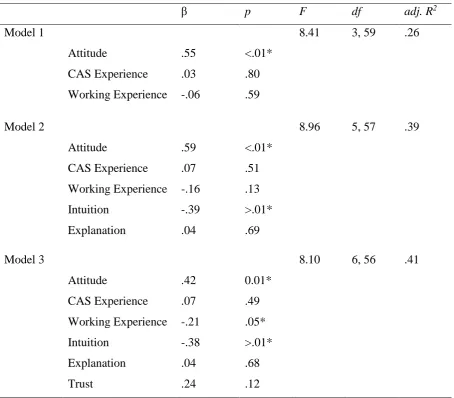
A hierarchical linear regression was calculated using advice taking as dependent variable and Trust, Attitude, CAS Experience, Working Experience, Intuition and Explanation as predictors. Model one consists of the predictors Attitude, CAS Experience and Working Experience. Model two consists of the predictors Attitude, CAS Experience, Working Experience, Intuition and Explanation. Model three consist of the predictors Attitude, CAS Experience, Working Experience, Intuition, Explanation and Trust. All three models explained a significant proportion of variance in the advice taking scores. Table 3 shows an overview of the coefficients, significance level of the predictors and the F-value, df and adjusted R2 of the models in relation to the dependent variable advice taking. As can be seen
16
[image:16.595.72.527.171.569.2]more inclined to accept an advice when they had a positive attitude towards CAS and when the advice of CAS was in line with their own intuition.
Table 3
Hierarchical Linear Regression Advice Taking
β p F df adj. R2
Model 1 8.41 3, 59 .26
Attitude .55 <.01* CAS Experience .03 .80 Working Experience -.06 .59
Model 2 8.96 5, 57 .39
Attitude .59 <.01* CAS Experience .07 .51 Working Experience -.16 .13 Intuition -.39 >.01* Explanation .04 .69
Model 3 8.10 6, 56 .41
Attitude .42 0.01* CAS Experience .07 .49 Working Experience -.21 .05* Intuition -.38 >.01* Explanation .04 .68 Trust .24 .12 *Predictor is significant at the level of 0.05
17
[image:17.595.80.527.174.416.2]variable trust. There are two significant predictors, meaning that participant with a more positive attitude towards CAS and more working experience had more trust in CAS.
Table 4
Hierarchical Linear Regression Trust
β p F df adj. R2
Model 1 26.49 3, 59 .55
Attitude .72 <.001* CAS Experience -.009 .92 Working Experience .23 .01*
Model 2 15.41 5, 57 .54
Attitude .72 <.001* CAS Experience -.006 .95 Working Experience .22 .02* Intuition -.03 .74 Explanation -.003 .98 *Predictor is significant at the level of 0.05
To test if trust functions as a mediation variable there needs to be a significant effect of intuition and explanation on trust and a significant effect of trust on advice taking. Table 3 shows only a significant effect of intuition on advice taking. There is no significant effect of explanation or intuition on trust and no significant effect of trust on advice taking. Therefore, trust cannot be a mediating variable and no mediation analysis was calculated.
4.1 Additional analysis
Table 2 shows a high correlation between trust and attitude. However, the regression analysis shows no significant effect of trust. To make sure that this lack of significant effect of trust in the regressions was not due to the classifications of the trust and attitude questions, additional analysis was performed.
18
The trust scale consists of the following questions. ‘I have more faith in my own intuition than in CAS.’, ‘I have more faith in historical data such as Blue Spot Monitor than in CAS.’, ‘Experience is more predictive for crimes than CAS’, ‘I find CAS misleading.’. The scale was found to be reliable (α = .79).
The attitude scale consists of the following questions. ‘I trust the predictions provided by CAS’, ‘CAS allows me to better focus my attention during my work.’, ‘CAS gives me a better prediction where crime will take place.’, ‘CAS is a good addition to all the other systems that we use.’, ‘I know exactly on what information CAS based its predictions.’. The scale was found to be reliable (α= .83).
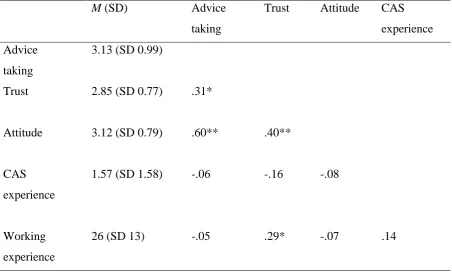
[image:18.595.73.526.402.674.2]The means, standard deviations and correlations for the concepts advice taking, trust, attitude and the questions regarding experience with CAS and working experience with the police were calculated. Table 5 shows the means, standard deviations and correlations of the concepts.
Table 5
Means, Standard Deviations and Correlations M (SD) Advice taking
Trust Attitude CAS experience Advice
taking
3.13 (SD 0.99)
Trust 2.85 (SD 0.77) .31*
Attitude 3.12 (SD 0.79) .60** .40**
CAS experience
1.57 (SD 1.58) -.06 -.16 -.08
Working experience
26 (SD 13) -.05 .29* -.07 .14
**Correlation is significant at the 0.01 level. * Correlation is significant at the 0.05 level.
19
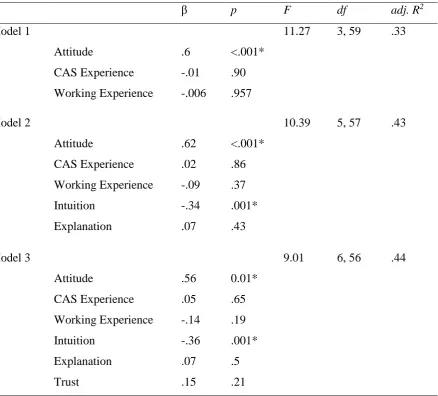
predictors. Model one consists of the predictors Attitude, CAS Experience and Working Experience. Model two consists of the predictors Attitude, CAS Experience, Working Experience, Intuition and Explanation. Model three consists of the predictors Attitude, CAS Experience, Working Experience, Intuition, Explanation and Trust. All three models
[image:19.595.86.525.338.734.2]explained a significant proportion of variance in the advice taking scores. Table 6 shows an overview of the coefficients, significance level of the predictors and the F-value, df and adjusted R2 of the models in relation to the dependent variable advice taking. As can be seen there are two significant predictors: attitude and intuition. This means that participants were more inclined to accept an advice when they had a positive attitude towards CAS and when the advice of CAS was in in line with their own intuition.
Table 6
Hierarchical Linear Regression Advice Taking
β p F df adj. R2
Model 1 11.27 3, 59 .33
Attitude .6 <.001* CAS Experience -.01 .90 Working Experience -.006 .957
Model 2 10.39 5, 57 .43
Attitude .62 <.001* CAS Experience .02 .86 Working Experience -.09 .37 Intuition -.34 .001* Explanation .07 .43
Model 3 9.01 6, 56 .44
20
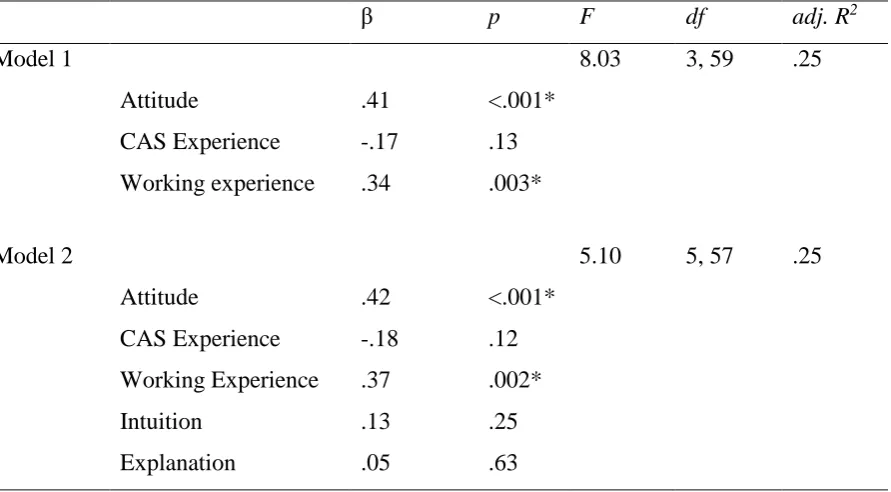
[image:20.595.80.526.319.565.2]A hierarchical linear regression was calculated using Trust as dependent variable and Attitude, CAS Experience, Working Experience, Intuition and Explanation as predictors. Model one consists of the predictors Attitude, CAS Experience and Working Experience. Model two consist of the predictors Attitude, CAS Experience, Working Experience, Intuition and Explanation. The two models explained a significant proportion of variance in the trust score. Table 7 shows an overview of the coefficients, significance level of the predictors and the F-value, df and adjusted R2 of the models in relation to the dependent variable trust. There are two significant predictors: attitude and working experience, meaning that participant with a more positive attitude towards CAS and more working experience had more trust in CAS.
Table 7
Hierarchical Linear Regression Trust
β p F df adj. R2
Model 1 8.03 3, 59 .25
Attitude .41 <.001* CAS Experience -.17 .13 Working experience .34 .003*
Model 2 5.10 5, 57 .25
Attitude .42 <.001* CAS Experience -.18 .12 Working Experience .37 .002* Intuition .13 .25 Explanation .05 .63 *Predictor is significant at the level of 0.05
21 5. Conclusion and Discussion
The present study examined the influence of intuition and explanation on the level of trust and advice taking. Additionally it was examined if trust mediated the relationship between
intuition, explanation and advice taking.
Additional analysis was conducted to see if a different classification of questions for the variables trust and attitude would give different results. This was not the case, the additional analysis did show a higher reliability for the new classification of the questions for the concepts. In both classification attitude turned out to be an important predictor for advice taking and trust.
One thing that stood out regarding the additional analysis and the new classification of questions for attitude. The question ‘I trust the predictions provided by CAS.’ was classified as an attitude question. This is notable because the question asks directly about trust, so one would expect it to be classified as a trust question and not an attitude question. However, a possible explanation for this can be that the new classification of attitude contains all the questions that specifically ask about the predictions regarding CAS.
5.1 Advice taking
Looking at advice taking, there are two significant predictors namely attitude and intuition. The results showed that when the advice was more in line with the intuition of the police officer, the tendency to accept the advice was higher. This finding is in line with findings of Tzioti et al. (2014), they found that advised that is in line with the intuition of the decision maker, influences the level of acceptance of the advice. As noted by Camacho-Collados and Liberatore, (2015) and Rienks (2015), intuition plays an important role in the work of police officers. So, when advice provided by CAS is in line with the intuition there is no conflict for the police officer and therefore will not doubt the prediction provided by CAS which leads to a higher level of advice taking.
22
between trust and attitude was lower. Because of the correlation between the attitude and trust they can be used interchangeably.
In contrast with previous research that showed that people who have insight in the process of how advice is generated, are more willing to rely on the advice (de Vries et al., 2015; Dzindolet et al., 2003), explanation did not have an effect on advice taking or trust. A possible reason for this is that the explanation that was provided to the police officers was general information about the system and not information about how CAS came to this particular advice. Possibly the explanation would have had more effect if it was related to the specific advice, so officers would better understand how the advice was linked to their specific local situation.
5.2 Level of trust
With trust as the dependent variable there were two significant predictors namely attitude and working experience. Police officers with a more positive attitude towards CAS and with more working experience also had a higher level of trust in CAS.
Rienks (2015), noted that police officers develop their intuition over time, as they work more their intuition is formed. Therefore, we predicted that experienced police officers might be more reluctant to trust predictions from CAS, due to the fact that their intuition is better developed and they trust their intuition more than a predictions from CAS. This is not what we found. The results showed that more experienced police officers had a higher level of trust. This can be explained by the fact that during their shifts they are confronted with different sorts of crime and over time they will get more insight in the different times and places a crime can occur. For a more experienced police officer it becomes easier to recognize the different possibilities in time and place regarding a certain crime and are therefore less inclined to dismiss advice provided by CAS when this is not in line with their intuition. The results showed no significant effect of explanation on trust, which is in contrast with previous research done by Miller, (2017) and Tzioti et al., (2014), these studies showed that insight in the process of the provided advice leads to better understanding the system and consequently more trust in the system. Again, the lack of significant effect of explanation on trust can be due to the fact that the explanation was not tailored to the specific crime.
23 5.3 limitations and strengths.
Even though we did use experienced police officers as participants, which increases the validity of the results, some limitation and strengths can be mentioned. First, as mentioned above, the descriptions of the scenarios that were used were general and might therefore not have been as accurate as the real-life conditions. However, these general descriptions of the scenarios were chosen so the scenarios could be used across various police teams.
Second, the study had a limited number of participants, and after the exclusion criteria 63 participants were left. This low number of participants can be explained by the fact that not all police teams use CAS, which was an inclusion criterion. However, the participants were police officers and had experience in their field, which makes their participation valuable, then when research is done with a greater number of participants, but participants are for example students.
5.4 Overall conclusion
The results show that attitude is an important predictor when it comes to the level of acceptance of advice provided by CAS as well as level of trust. This could imply that it is important to ensure that users have a positive attitude towards CAS. It is recommended to create a positive attitude towards CAS to improve use. To create a positive attitude users need to understand the added value of working with the system, what they can expect from the system and how it will be implemented in their daily work.
This study explored the human – system interaction regarding advice taking, in the domain of predictive policing. In general more research is still needed in this field. Especially
regarding the effect of attitude on advice taking and how this can be used to improve advice taking and implementation of systems like CAS.
24 References
Bonaccio, S., & Dalal, R. S. (2006). Advice taking and decision-making: An integrative literature review, and implications for the organizational sciences. Organizational Behavior and Human Decision Processes, 101(2), 127–151.
https://doi.org/10.1016/j.obhdp.2006.07.001
Camacho-Collados, M., & Liberatore, F. (2015). A Decision Support System for predictive police patrolling. Decision Support Systems, 75, 25–37.
https://doi.org/10.1016/j.dss.2015.04.012
de Vries, P. W., van den Berg, S. M., & Midden, C. (2015). Assessing Technology in the Absence of Proof: Trust Based on the Interplay of Others Opinions and the Interaction Process. Human Factors, 57(8), 1378–1402. https://doi.org/10.1177/0018720815598604 Dzindolet, M. T., Peterson, S. A., Pomranky, R. A., Pierce, L. G., & Beck, H. P. (2003). The
role of trust in automation reliance. International Journal of Human Computer Studies, 58(6), 697–718. https://doi.org/10.1016/S1071-5819(03)00038-7
Hoff, K. A., & Bashir, M. (2015). Trust in automation: Integrating empirical evidence on factors that influence trust. Human Factors, 57(3), 407–434.
https://doi.org/10.1177/0018720814547570
Intuition in the English Dictonary. (n.d.). Retrieved November 19, 2018, from https://dictionary.cambridge.org/dictionary/english/intuition
Jian, J., Bisantz, A. M., Drury, C. G., Jian, J., Bisantz, A. M., & Drury, C. G. (2010). Foundations for an Empirically Determined Scale of Trust in Automated Systems, (January 2015), 37–41. https://doi.org/10.1207/S15327566IJCE0401
Langley, P., Meadows, B., & Sridharan, M. (2017). Explainable Agency for Intelligent Autonomous Systems. Proceedings of the 31th Conference on Artificial Intelligence (AAAI 2017), 4762–4763.
Lee, J. D., & See, K. A. (2004). Trust in Automation: Designing for Appropriate Reliance. Human Factors and Ergonomics Society, 46(1), 50–80.
Merritt, S. M., Heimbaugh, H., LaChapell, J., & Lee, D. (2013). I Trust It, but I Don’t Know Why. Human Factors: The Journal of the Human Factors and Ergonomics Society, 55(3), 520–534. https://doi.org/10.1177/0018720812465081
Miller, T. (2017). Explanation in Artificial Intelligence: Insights from the Social Sciences. https://doi.org/arXiv:1706.07269v1
decision-25
making on the fireground: towards a model of expert intuition. Cognition, Technology and Work, 18(1), 89–103. https://doi.org/10.1007/s10111-015-0348-9
Önkal, D., Goodwin, P., Thomson, M., Gönül, S., & Pollock, A. (2009). The relative
influence of advice from human experts and statistical methods on forecast adjustments. Journal of Behavioral Decision Making, 22(4), 390–409.
https://doi.org/10.1002/bdm.637
Pearsall, B. (2010). Predictive Policing: The Future of Law Enforcement. National Institute of Justice Journal, (266), 16–19. https://doi.org/10.1037/e596372010-007
Perry, W. L., McInnes, B., Price, C. C., Smith, S. C., & Hollywood, J. S. (2013). Predictive Policing: The Role of Crime Forecasting in Law Enforcement Operations.
https://doi.org/10.1214/07-EJS057
Rienks, R. (2015). Predictive Policing: Kansen voor een veiligere toekomst (Politieaca). Barendrecht: De Bondt. https://doi.org/10.1016/j.futures.2013.01.007
Stowers, K., Oglesby, J., Sonesh, S., Leyva, K., Iwig, C., & Salas, E. (2017). A framework to guide the assessment of human-machine systems. Human Factors, 59(2), 172–188. https://doi.org/10.1177/0018720817695077
Tzioti, S. C., Wierenga, B., & van Osselaer, S. M. J. (2014). The Effect of Intuitive Advice Justification on Advice Taking. Journal of Behavioral Decision Making, 27(1), 66–77. https://doi.org/10.1002/bdm.1790
Van Swol, L. M., & Sniezek, J. A. (2005). Factors affecting the acceptance of expert advice. British Journal of Social Psychology, 44(3), 443–461.
https://doi.org/10.1348/014466604X17092
Waller, M. A., & Fawcett, S. E. (2013). Data science, predictive analytics, and big data: A revolution that will transform supply chain design and management. Journal of Business Logistics, 34(2), 77–84. https://doi.org/10.1111/jbl.12010
Willems, D., & Doeleman, R. (2014). Predictive Policing – wens of werkelijkheid? Het Tijdschrift Voor de Politie, 76(4), 39–42.
Yaniv, I., & Kleinberger, E. (2000). Advice Taking in Decision Making: Egocentric