ISSN (Online): 2320-9364, ISSN (Print): 2320-9356
www.ijres.org Volume 3 Issue 6 ǁ June 2015 ǁ PP.22-27
Application of thermal error in machine tools based on Dynamic
Bayesian Network
Xu Yang
,
Mao Jian
College of Mechanical Engineering, Shanghai University of Engineering Science, 333 Long Teng Road, Shanghai
201620, China
Correspondence should be addressed to Jian Mao; [email protected]
Abstract
: In recent years, the growing interest toward complex manufacturing on machine tools and the machining accuracy have solicited new efforts in the area of modeling and analysis of machine tools machining errors. Therefore, the mathematical model study on the relationship between temperature field and thermal error is the core content, which can improve the precision of parts processing and the thermal stability, also predict and compensate machining errors of CNC machine tools. It is critical to obtain the thermal errors of a precision machine tools in real-time. In this paper, based on Dynamic Bayesian Network (DBN), a pioneering modeling method applied in thermal error research is presented. The dependence of thermal error and temperature field is clearly described by graph theory, and the fuzzy classification method is proposed to reduce the computational complexity, then forming a new method for thermal error modeling of machine tools.Keywords
: machine tools; thermal error; DBN; fuzzy classification; modeling;I.
Introduction
Artificial intelligence techniques have been used for many years now in the field of thermal error modeling in machine tools. The thermal model forms one of the most critical elements in machine tools. In the prediction of thermal error, most research has focused on the principle of regression [1,2]. Chen [3] used a three-layer Artificial Neural Network (ANN) with a supervised back-propagation training algorithm and the ‘sigmoid’ activation function to map the calibrated thermal errors to the temperature measurements. Zhejiang University in 2002 with the improved BP neural network on three-dimensional noncontact measurement system is analyzed in thermal error modeling [4]. Hong Yang and Jun Ni [5] proposed a fuzzy model adaptation method is used to update in the thermal error model under different processing conditions. The traditional thermal error model cannot handle abnormal situations, and the structure and the choice of the type too dependent on experience. Research on the application of the Bayesian Network in thermal error modeling of CNC machine tools on the thermal error has opened up a new way, in order to better solve the complexity and defect of thermal error modeling [6]. R. Ramesh[7] applied Hybrid Bayesian network to solve thermal error measurement and modeling problems in machine tools. A brief explanation of the theory of Bayesian Network is presented as following:
The Bayesian Network (BN) is a graphical model consisting of nodes representing causes and effects in real-world situations and a set of edges each of which connects two nodes, it has been used in medical diagnostic system, software testing, web intelligent navigation, power system fault diagnosis, etc. A Bayesian network for a
set of variables
x
x x
1,
2,
x
N
, the joint probability distribution forx
is given by 1 21
(
,
,
)
(
i(
i))
N N
i
p x x
x
p x pa x
(1)Where i
x
denotes the variable andpa x
(
i)
denotes the parents of node ix
. From the chain rule of probability,1 2 1 1
1
(
,
,
)
(
i,
,
)
N
N i
i
p x x
x
p x x
x
(2)reflect updates to the model. This paper seeks to address the issue of developing a thermal error model that account for a variety of operating conditions while yet generating accurate prediction. So it will propose fuzzy classification and Dynamic Bayesian Network to build a thermal machine error model, a better solution of dynamic thermal error modeling problems.
II.
Fuzzy Dynamic Bayesian Network
Dynamic Bayesian Network (DBN) is a type of BN that can model time-series data to capture the fact that time flows forward, which coupled with the time constraints on the properties of the original network structure. It has the advantage both of model-based and data-based methods. And with the introduction of time factor, the data on the state of the formation of different time, reflects the development change rule represented by the variable, and its intuitive, high precision and adaptive for thermal error modeling of machine tools.
The actual processing for precision CNC machine tools, the thermal error generated by many factors and there are many uncertain factors, also the relations among these factors are perplexing, so the requirements of thermal error prediction model should not only be a strong inclusive of many complex factors, but also the structure of flexible function. In order to account for the particularity of thermal error, we present the DBN thermal error model herein is therefore very essential.
2.1 Dynamic Model
Although the pattern of heat transfer in machine tools is very complex, these are plausible cause and effect relationships that might exist between the various elements of the machine when subjected to varying operating conditions. Therefore, in order to carry out the research of complex system and model should be simplified [8]:
1. The assumption of conditional probability in a finite time change process for all t is smooth. 2. To solve the problems of thermal error in this study, assuming an environment with Markov nature, that every state heat distortion temperature and sampling points are related to the time of sampling points on temperature and thermal deformation states. Bayesian network structure inference process, making inferences and decisions based on prior
probabilities. 3. Assuming that the conditional probability of adjacent time process is steady, which
p x
(
t1x
t)
has nothing to do with the timet
, you can easily get the transition probabilityp x
(
t1x
t)
in different time. Based on the above assumptions, the establishment of DBN should be considered
B B
1,
: the priori netB
1,the transfer netB
,the limited time in practical application stage 1,2,…T,then we can get:
1 2
1
1
1
1
,
,
T
T B B t t
t
p x x
x
p
x
p
x
x
(3)If we use
p x x
t t1
to represent the probability of the current state occurs when any previous time state isvariable.
x
ti represents the value of the variablei
in timet
,pa x
ti denotes the parents of nodex
ti. So, joint probability distribution of DBN can be calculated for any node as the following shown:
1
1:
1: 1 1
1 2 1
N T N
N i i i i
T B B t t
i t i
p x
p
x pa x
p
x pa x
(4)The research of thermal error on precision machine tools showed us the parameters of sampling point temperature and thermal deformation data had discrete features. In the experiment, the decision variable is always discrete, and certain temperature observation is continuous, to solve such problems in pure discrete Dynamic Bayesian Network have some difficulties. In this regard, this paper choose the calculation method of discrete fuzzy DBN that fuzzy classification techniques combined with the discrete DBN [9]to solve these problems. It will not only make full use of the advantages of discrete DBN which has relatively faster inference speed compared with continuous DBN, but also can achieve qualitative reasoning under continuous observation without loss of information provided.
2.2 Fuzzy Classification
In the fuzzy theory, an element x is the degree of
A
X
belongs to the set A, this degree means membership. The element x must also exit in certain membership with other sets, when0
A( )
A
1
. Fuzzy
(
A i, )
iA
A i
A
x
x
N
x
N
(5)First, the fuzzy classification process is divided the sample space into several subsets, which is a subset of fuzzy sets. Fuzzy sets is the corresponding discrete DBN node status. Then defines membership function according to actual condition, that membership of fuzzy classification is the characteristics of the response variable, not a specific numerical size[10]. Discrete BN with N hidden points and M observation points, along with
the time development can get the discrete DBN with T time slices, if the observed value is only one combination of state, so this observation distribution of hidden variables are:
1 2 1 2 1 1 1
1 2 1 2 1 2 1 2
1 1 1 1 1 1
, ,
, ,
, , , , , ,
,
,
,
,
,
,
,
,
,
,
,
,
1,
, ;
1,
,
;
1,
,
N N
T T T
N N M M
T T T T T T
j j k k
t t t t
t j t k
j j k k
t t t t
t j t k
x x x x x x
p x x
x
x x
x
y y
y
y
y
y
p y pa y
p x pa x
p y pa y
p x pa x
t
T j
M k
N
(6)In this formula,
x
tkrepresents a value ofX
tk,value ofy
tj for observation variableY
tj,pa y
(
tj)
denotes the parents of notey
tj. As according to get fuzzy DBN inference formula is:
1 2 1 11 2 1 2
1 1 1
1 2 1 2 1 2 1 2
1 1 1 1 1 1
, , , , , , , , , , , , , , , , , , , , , , , , ( )
1, , ; 1, , ; M
T
N N
T T T
N N M M
T T T T T T
j j k k
t t t t
t j t k j j
t t tj
y y y j j k k
t t t t
t j t k
x x x x x x
p x x x x x x Y Y Y Y Y Y
p y pa y p x pa x
p Y y
p y pa y p x pa x
t T j M k
1,,N
(7)
Where
p Y
(
tj
y
tj)
is the value ofY
tjmembership in continuous observation that belongs to each states.III.
Development of DBN Model on Thermal Error
Optimization of temperature sensor location
Stage Ⅰ:Temperature points development
Analysis of thermal dynamic process
Determine the location of temperature sensor
Optimization of temperature sensor location
Develop temperature points
Optimization of temperature sensor location
Stage Ⅱ:DBN development
Node determination
Develop structure
Determinate parameters
Parameters learning with condition monitoring data
Stage Ⅲ:DBN applied in thermal error
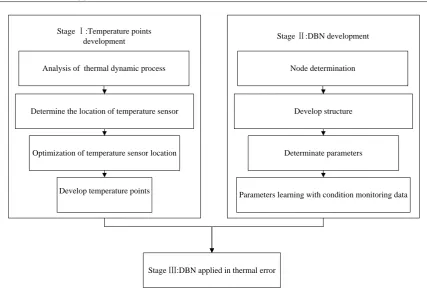
Figure 1. DBN framework of thermal error research
3.1 Temperature Points Development
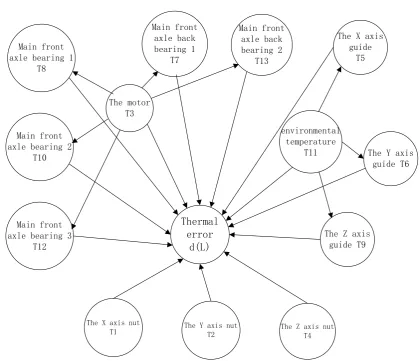
A number of studies on domestic and international machine tools show that: one of the primary factors that influence machine tool accuracy is the rise in temperature of the critical elements of the machine. The data available from the machine on a real-time basis is the temperature values as measured by the thermal sensors mounted at critical locations on the machine. Comprehensive expertise this paper establishes a model of 14 nodes
[11], respectively: X,Y and Z axle nuts and rail temperatures, motor temperature, main shaft bearing temperature,
Thermal
error
d(L)
The X axis nut
T1 The Y axis nutT2 The Z axis nut T4
Main front axle bearing 3
T12 Main front axle bearing 2
T10 Main front axle bearing 1
T8
The motor T3
Main front axle back bearing 1
T7
Main front axle back bearing 2
T13
The X axis guide
T5
The Z axis guide T9
The Y axis guide T6 environmental
temperature T11
Figure 2. DBN model structure for thermal error of precision CNC
3.2 DBN Applied in Thermal Error
The above model and the discrete DBN inference algorithms, constitutes the thermal error of DBN. DBN in addition to the network structure, also need to define the parameters. For discrete DBN, the conditional probability is an expert knowledge which reacts experts views of the causal relationship among the connected nodes in the network. State transition probability between two time slices is random probability that changes over time[12].
The specific calculation model can be expressed according to the conditional probability between expertise and nodes. The transition probabilities of DBN can be acquired by the priori knowledge of experts. Using fuzzy classification to divide the experimental measurements of state parameter domain, in this paper respectively divided into five states {1, 2, 3, 4, 5}.
According to the formula (7), to calculate probabilities:
p d L T T
1,
2,
T
13
which means we can obtain conditional probability at the correspondingd L
( )
of different states whenT i
i(
1, 2,
,13)
take any state. Through the judgment of valuesp p p p p
1,
2,
3,
4,
5to decide the state of thermal error area, then finally predict thermal error value.IV.
Conclusions
(1) DBN structure is different from the other fitting modeling theory, it comes from the probability of data, and combined with the specific language of graph theory clearly express the dependent relationships between the various factors affecting the thermal error. And applied the fuzzy classification and membership the concept of the measurement data and other scientific probability distribution, reducing the computational complexity, concluding the probability distributions , making the numerical prediction and modeling has the high-precision thermal deformation characteristics;
error.
(3) Thermal error model based on DBN takes full use of the prior knowledge and sample data, and can dynamically predict thermal error according to the time of machine tools, and with the increase of sample to obtain data updated. It can reflect the change of working condition of machine tools in the process of reasoning, to make it better meet the needs of real-time compensation.
In summary, this paper use DBN structure for thermal error of machine tools to make a series of useful analysis and exploration, get the corresponding conclusions. Based on DBN structure in the study of thermal error is novelty, this paper is for further study on the experimental data and model combination.
Acknowledgements
We would like to acknowledge the support of the National Natural Science Foundation of the People’s Republic of China (No. 51175322).
References
[1] R. Ramesh, M.A. Mannan, A.N. Poo. Error compensation in machine tools—a review. Part I: Geometric, cutting-force induced and fixture dependent errors. International Journal of Machine Tools and Manufacture 40 (2000) 1235–1256.
[2] R. Ramesh, M.A. Mannan, A.N. Poo. Error compensation in machine tools—a review: Part II: Thermal errors. International Journal of Machine Tools and Manufacture 40 (2000) 1257–1284.
[3] J.S. Chen. Fast calibration and modeling of thermally induced machine tool errors in real machining. International Journal of Machine Tools and Manufacture 37 (2) (1997) 159–169.
[4] Fu Longzhu, Chen Yaliang, Di Ruikun .BP neural networks compensation dimensional surface non-contact measurement system thermal deformation error research [J]. Electrical and Mechanical Engineering, 2002,19 (4): 55-58.
[5] Hong Yang, Jun Ni. A daptive model estimation of machine tool thermal errors based on recursive dynamic modeling strategy[J]. International Journal of Machine Tools&Manufacture,45(2005):1-11.
[6] Bai Fuyou. Thermal error of CNC machine tools based on Bayesian Network modeling research [D]. Master degree thesis of Zhejiang University, 2008.
[7] R. Ramesh, M.A. Mannan, A.N. Poo, S.S. Keerthi. Thermal error measurement and modeling in machine tools. Part II. Hybrid Bayesian Network—support vector machine model. International Journal of Machine Tools & Manufacture 43 (2003) 405–419. [8] Xiao Qinku, Gao Song. Bayesian Network in the application of intelligent information processing [M]. Beijing: National Defense
industry press, 2012.
[9] Shi Jianguo, Gao Xiaoguang. Dynamic Bayesian Network and its application in autonomous intelligence operations [M]. Beijing: The Publishing House of Ordnance Industry, 2008.12.
[10] Chen Haiyang, Nie Hongying, Pan Jinbo. Traffic light autonomous intelligence decision based on Dynamic Bayesian Network [J]. Journal of Xi'an Polytechnic University, 2014,28 (4): 474-479.
[11] Yang Jianguo. Integrated CNC machine tools error compensation technology and its application [D]. Shanghai Jiao Tong University doctoral thesis, 1998.