UNIVERSITÀ DEGLI STUDI
DI TRENTO
Department of Information Engineering and Computer Science
Master’s Degree in Computer Science
Final Dissertation
A QBDI-based Fuzzer Targeting
Magic Bytes Comparisons
Supervisor
Student
Prof. Fabio Massacci
Elia Geretto
Acknowledgements
I would first like to thank my supervisor at Quarkslab, C´edric Tessier, whose invaluable guidance and instructive chats allowed me to overcome all the bumps on the road towards the results presented in this document.
My gratitude goes also to the other members of my team, who bore my endless babbling about my problems and were always able to provide valuable suggestions.
I would also like to thank my friend Filippo Bigarella, who helped in smoothing all the rough edges of my writing.
Contents
1 Background 8
1.1 Fuzzing . . . 8
1.1.1 Historical overview . . . 8
1.1.2 Classification . . . 9
1.1.3 Binary targets . . . 10
1.2 Implementation details of AFL . . . 10
1.2.1 Execution trace . . . 10
1.2.2 Input handling . . . 11
1.2.3 Mutation operators . . . 11
1.3 Instrumentation . . . 12
1.3.1 Source instrumentation . . . 12
1.3.2 Static binary instrumentation . . . 12
1.3.3 Dynamic binary instrumentation . . . 13
1.4 QBDI . . . 14
1.4.1 Overview . . . 14
1.4.2 Execution cycle . . . 14
1.4.3 Architecture . . . 15
2 Problem statement 16 2.1 Challenges in fuzzing . . . 16
2.2 Proposed solutions . . . 17
3 Steelix approach 19 3.1 Approach overview . . . 19
3.2 Limitations . . . 21
3.2.1 Static binary instrumentation . . . 21
3.2.2 Static analysis . . . 21
3.2.3 Taint analysis . . . 22
3.2.4 Function return values . . . 22
4 Implementation 23 4.1 Pre-existing tool . . . 23
4.1.1 Instrumentation technique . . . 23
4.1.2 Library targets . . . 23
4.1.3 Architecture . . . 24
4.1.4 Comparison unrolling . . . 24
4.2 Steelix integration . . . 25
4.2.1 Comparison progress reporting . . . 25
4.2.2 Queue handling . . . 25
4.2.3 Steelix mutation operator . . . 26
4.3 Other improvements . . . 26
4.3.1 Support for executables . . . 26
5 Evaluation 30
5.1 Target binaries . . . 30
5.1.1 LAVA-M . . . 30
5.1.2 ImageIO framework . . . 31
5.2 Evaluation setup . . . 31
5.2.1 LAVA-M . . . 32
5.2.2 ImageIO . . . 32
5.3 LAVA-M Evaluation . . . 33
5.3.1 Steelix comparison . . . 33
5.3.2 Bloom filter size comparison . . . 35
5.3.3 Skip probability comparison . . . 39
5.4 ImageIO evaluation . . . 40
5.4.1 Heuristic evaluation . . . 40
5.4.2 Bloom filter size comparison . . . 42
5.4.3 Skip probability comparison . . . 44
Summary
Context
In recent times, the automated software testing technique that has enjoyed the most widespread success is probably fuzzing. Indeed, despite the fact that its first application dates back to 1989, its modern variations have been integrated in the software development process of various large companies [10] and open source projects [1].
In addition, fuzzing was also able to gain widespread adoption in the information security com-munity thanks to its good scalability and low requirements regarding the knowledge of the target software. In this context, one of the most influential projects is American Fuzzy Lop [25], which also drove the adoption of grey-box fuzzers. These tools employ lightweight instrumentation in order to obtain information on the executions of the program under test. This information is then used to guide the fuzzer towards a precise goal, which is usually obtaining the highest possible coverage, but it can also be reaching a specific point in the program.
However, fuzzing has significant limitations that might hinder its effectiveness. The most important one is that, while trying to explore a program, fuzzers might not be able to reach portions of code that are protected by conditions which have a low probability of being guessed randomly. This is commonly due to the fact that, without applying specific modifications, these tools generate the test cases that are fed to the target program using only random or deterministic mutation operators; these, however, do not take into account the structure of the code.
The problem of reaching code protected by complex conditions translates into a variety of less abstract limitations; one of the most common ones is that of matching magic byte sequences and tokens, which will be treated as one and the same for the rest of this document. These conditions are commonly found in parsers and are constituted as follows: they require that a sequence of adjacent input bytes matches a specific sequence of values in order to access a given code branch.
Goal and approach
The goal of the work presented in this document was to improve the coverage obtained by a specific grey-box fuzzer, called AFL/QBDI, when exploring code containing magic bytes conditions without sacrificing performance.
The important aspect of this particular tool is that it is the first, and currently the only one, to use a dynamic binary instrumentation framework called QBDI to perform the instrumentation of the target code. This is relevant since dynamic binary instrumentation provides advantages in terms of the accuracy of the callback placement, but has a considerable performance impact and thus imposes different speed constraints on the instrumentation code.
In the literature, several solutions were proposed in order to solve the issue of branch conditions that are difficult to solve for fuzzers. Most of them can be reduced to solve the problem of magic byte conditions but, as in the case of Driller [24] and T-Fuzz [20], they employ techniques that are unnecessarily computationally expensive for this particular problem. The tools that provide solutions specifically designed to overcome magic byte comparisons are three: AFL-lafintel [2], VUzzer [22] and Steelix [16].
Figure 1: Scheme of the fuzzing process in AFL/QBDI
multiple bytes so that it appears to the fuzzer as a sequence of single byte comparisons, which can be more easily matched with random mutations. In addition, the matching is accelerated through a heuristic that deduces which is the next input byte that is being compared and mutates it exhaustively. The implementation outlined by the authors of Steelix relies on modifying the program under test through static binary instrumentation, with the aid of a static analysis procedure. While this choice might bring several limitations with regard to the accuracy of the instrumentation, it has the advan-tage of providing better performance than an approach based on dynamic binary instrumentation. Therefore, one of the goals of the implementation was to adapt the heuristic in order to preserve the original performance as much as possible, despite the lower execution speeds imposed by the use of a different instrumentation technique.
Implementation and results
The implementation of the heuristic was performed in two parts: at first, new instrumentation call-backs were added in order to unroll all the comparisons performed by CMP and TEST instructions as required by Steelix; secondly, the heuristic that deduces the next byte to mutate was added to the fuzzer. In order to improve its efficiency at lower speeds, the algorithm proposed by Steelix was mod-ified to separate the test cases that improve the coverage from the ones that generate new progress in an unrolled comparison. The latter were assigned a higher priority of being fuzzed since the Steelix heuristic makes them faster to process.
The structure of the fuzzing process in the final implementation is shown in Figure 1 and evolves as follows:
1. A test case is selected from the comparison progress queue or from the additional coverage queue; higher priority is given to the former.
2. If the test case comes from the coverage queue, it is mutated using all the operators available; if instead it comes from the comparison queue, it is mutated using the exhaustive byte mutation operator introduced by Steelix. In both cases, a series of new test cases is produced.
4. If the test case does not generate any of these events, it is discarded; otherwise, it is appended to the appropriate queue.
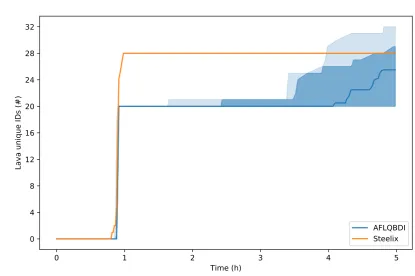
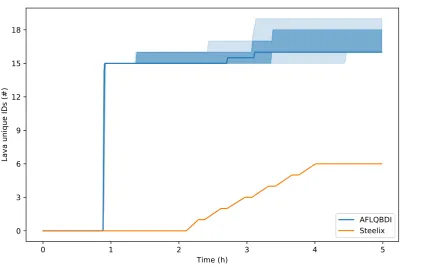
The results obtained when comparing the original Steelix implementation to AFL/QBDI show that, despite the lower execution speeds achievable using a dynamic binary instrumentation framework, it is still possible to obtain comparable performance. In addition, the overhead introduced by the instrumentation code is acceptable for longer runs since the heuristic is able to produce additional coverage that compensates for the time delay.
Outline and contribution
The rest of this document is structured as follows:
Chapter 1 begins with a section that provides an overview of fuzzing focusing on its application in
the security context. It continues with a thorough description of American Fuzzy Lop, which was used as the basis for AFL/QBDI. The next section provides instead an analysis of the three main instrumentation techniques, their advantages and disadvantages. The chapter ends with a description of QBDI in order to clarify why it can provide better performance than other DBI frameworks when fuzzing.
Chapter 2 examines the main limitations of fuzzing, subdividing them in several categories. It then
provides an overview of the literature on grey-box fuzzers, associating each tool with the issue it tries to solve.
Chapter 3 contains a complete explanation of the heuristic proposed by Steelix providing additional
details on the algorithm. In addition, it examines the limitations to this approach that were found during the development phase.
Chapter 4 begins with a description of the pre-existing tool which was then improved as a result of
this work. The rest of the chapter provides a thorough explanation of the implementation of the Steelix heuristic and the additional modifications that were performed in order to simplify the evaluation process. These include the ability to fuzz standalone binaries, removing the requirement of writing a library wrapper, and the re-implementation of the Dislocator library in order to integrate it with QBDI.
Chapter 5 presents the results obtained on the two selected targets, LAVA-M and ImageIO. The
chapter begins with a description of the two pieces of software and of the experimental setting; it then continues with the examination of the results obtained, considering also the possibility of changing some parameters of the implementation.
Chapter 1
Background
1.1
Fuzzing
This section is meant to provide an overview of fuzzing both from a historical and a theoretical point of view.
1.1.1 Historical overview
Fuzzing is an automated software testing technique which was first introduced in 1989. The study [18] that first applied it was meant to assess the reliability of UNIX utilities against possibly corrupted inputs. Examining its most primitive form, this technique consists in providing randomly generated inputs to the target software hoping to trigger errors like, for example, memory corruptions.
Over the course of time, the basic technique presented in that initial study was improved in several different directions and, nowadays, fuzzing has become probably the most used automated software testing technique. Indeed, many of the major software vendors are currently testing their products using fuzzing: one of the most famous examples is Microsoft SAGE, which reportedly found one third of all the bugs corrected during the development of Windows 7. [10] Another illustrious example is the Google OSS-Fuzz initiative [1], which provides continuous fuzzing for open source software, thanks to which more than 7000 bugs were found and fixed in software that is used every day by a considerable portion of the world population.
The success fuzzing has enjoyed in the recent years, as compared to other competing techniques, like symbolic execution, is probably due to the following characteristics: firstly, fuzzing is probably one of the easiest automatic testing methods to use, since it usually requires only a recompilation of the software under test and, in some cases, the writing of a simple library wrapper. Secondly, it is a very scalable technique, allowing to conduct successful testing campaigns even with limited resources. Lastly, since it is based on real executions of the software being tested, using concrete inputs, it does not produce false positives and it allows for the easy reproduction of the issues it has found, thus making the debugging process easier.
Moreover, additional success has been brought by the fact that the IT security community has taken a particular interest in this technique. The reason for this is that some of its characteristics adapt very well to the security evaluation setting: these are, among all others, simplicity of the setup and scalability. The motivation behind the first claim is that the possibility of being able to test software without having to understand it in depth and without being forced to write a large amount of code make fuzzing cost-effective. The motivation behind the second is that the possibility of conducting successful fuzzing campaigns even on small server machines or personal computers contributes to the resource requirement asymmetry that attackers can take advantage of when targeting a particular software.
requiring several compromises to be made [27]. In detail, the path explosion problem is generated by the fact that the number of possible paths in a program grows exponentially with the program size requiring an exponentially growing amount of resources to keep track of all the possible paths.
1.1.2 Classification
Given the success of fuzzing as a testing technique, the amount of different enhancements that have been introduced in order to increase its efficiency is considerable. As a consequence, it is useful to express the canonical classification [7] which subdivides fuzzers in smaller subgroups; this classification is based on three orthogonal directions.
Input reuse The first direction is relative to the method with which new inputs are generated. If
the fuzzer always creates inputs from scratch, then it is considered to be generation-based; if instead it creates new inputs starting from existing ones, it is considered to be mutation-based.
This difference, as a consequence, changes also the way in which the fuzzing campaign is set up: indeed, in the case of mutation-based fuzzers only, some working sample inputs need to be provided by the user. It is important to notice that these initial inputs greatly influence the success of the campaign.
Input structure awareness The second direction deals with the knowledge the fuzzer has of the
internal structure of the inputs it is generating. When the fuzzer is provided with a grammar or a protocol specification that describes how the input is composed, it is defined as smart; in the case in which no specification is provided, the fuzzer is instead defined as dumb.
While the awareness of the input structure may always seem superior to the blindness of a dumb fuzzer, it is important to notice that this first approach also has strong limitations. The issue, in the case of smart fuzzers, lies in how to interpret the grammar in such a way that allows the fuzzer to violate it: it is often the case that crashing inputs are malformed from a specification perspective, but are nonetheless interesting from a security one.
Program structure awareness The third, and last, direction considers instead the amount of
knowledge the fuzzer has relatively to the internal structure of the program being tested. In this case, three categories have been specified:
Black-box This category contains fuzzers which do not have any particular knowledge about the
internal structure of the target program and, indeed, treat it as a black-box. This is the most simple approach and it is usually employed when external observation is not possible, for example when targeting a program running on a proprietary appliance through a network connection.
White-box Fuzzers falling in this category rely on powerful program analysis techniques, as symbolic
execution, in order to improve both the mutation and the input scheduling process. They can usually explore deeper paths within the program, but present the risk of introducing a significant execution overhead. In particular, the overhead may slow the fuzzing process to such a great extent that the use of a simple black-box fuzzer, which grants extremely high execution speed, may provide better results.
Grey-box This category falls in between the previous two since it comprehends fuzzers that have less
insight on the internals of the target, but grant higher execution speeds. In order to achieve these results, grey-box fuzzers employ instrumentation techniques instead of the program analysis ones implemented in white-box fuzzers.
The strongest points that can be made in favour of this approach are the following: firstly, mutation-based dumb fuzzers make the set up of the fuzzing campaign easier, since they do not require the user to express an input grammar and thus to be completely aware of all the inputs the target program can handle. Secondly, the grey-box approach has proven to be a good middle ground between the heaviness of program analysis and the limits imposed by an agnostic observation.
1.1.3 Binary targets
In addition to what was stated in the previous subsection, which holds in every scenario, there are some considerations that need to be made from an IT security perspective. The most important thing to be noted is that relying on the assumption that the source code for the target software is available can be considered reasonable only when a developer is testing his own software; unfortunately, when conducting an independent evaluation, this is likely not to be the case. As a consequence, approaches that allow the efficient fuzzing of closed source binaries are way more valuable in the security community as compared to those that require source code.
Most of the techniques used to aid fuzzing can usually be implemented both relying on source code or on the assembled binary, but their efficiency and accuracy can vary greatly between the two scenarios. This is the case, for example, for techniques that rely on instrumentation: when possessing the source code, it can be inserted through a compiler pass and thus optimized but, when targeting binary, it can be inserted either statically or dynamically but it always provides worse performance as compared to the compiled version.
For this reason, from a security perspective, it is more interesting to evaluate the quality of a certain technique targeting binary instead of source code so that the trade-offs in this first scenario are immediately clear.
1.2
Implementation details of AFL
This section is meant to give an overview of the implementation details of AFL that are significant in order to understand how the project presented in this document changed the upstream version. For this reason, some important parts of the original design, for example the algorithms used to evaluate and prioritize the test cases in the queue, will not be examined in depth since they were left untouched. A complete overview can be obtained reading the documentation available online. [26]
1.2.1 Execution trace
The first aspect of AFL that should be examined in depth in order to comprehend the rest of this document is the technique used to provide the fuzzer with information regarding the execution trace. This information is necessary since AFL is using genetic algorithms in order to maximize the edge coverage of the target software and thus it uses the information about the CFG edges that have been traversed as a quality metric for a generated test case.
The solution implemented in AFL to collect this information from the fuzzed program is based on a shared memory area, which is used as a bloom filter to record the edges traversed during the execution. When the target process starts, the shared memory area, already allocated and zeroed by AFL, is retrieved and then, each time an edge is encountered, the value in the corresponding cell is incremented by one.
Listing 1.1: AFL basic block instrumentation 1 c u r _ l o c a t i o n = < B A S I C _ B L O C K _ I D >;
2 s h a r e d _ m e m [ c u r _ l o c a t i o n ^ p r e v _ l o c a t i o n ] + + ; 3 p r e v _ l o c a t i o n = c u r _ l o c a t i o n > > 1;
is defined with a special logarithmic heuristic. Using this information, the fuzzer decides whether the test case is useful or it should be discarded.
As stated before, the main advantage of this implementation is that it grants good performance; its main drawback, instead, is that it can produce false negatives. In particular, multiple edges of the CFG can be mapped to the same bloom filter position, creating the possibility for a known edge to mask a new one, making it invisible to the fuzzer. In order to provide a good trade-off between performance and false negatives, the size of the bloom filter is set to 64 KB, hoping for its used part to fit in the processor cache.
1.2.2 Input handling
The second important feature of AFL that will be examined is the way in which the generated test cases are handled during the execution of the fuzzer.
Given that AFL is a mutation-based fuzzer, an initial set of valid inputs is provided by the user. These inputs are evaluated and then added to the test case queue. During the fuzzing process, generated test cases that produce additional coverage are also added to that same queue. In addition to storing significant test cases, the queue also collects a small group of them in what is called the preferred set. This set comprehends all the test cases that are likely to produce additional coverage when fuzzed while also providing the best performance according to metrics based on execution time and size.
When the fuzzer decides to start mutating a new test case, it selects the current head of the preferred set with a very high probability, even if selecting a non preferred one is still allowed. It is important to notice that, when a test case has been fuzzed or skipped, it is not removed from the queue, it is kept to be fuzzed in the next queue cycle, which starts when all the test cases in the queue have been examined; this means that the longer the queue is, the longer a single cycle will last.
1.2.3 Mutation operators
The third feature that is necessary to examine is how the fuzzer mutates the test cases in the queue to generate new ones.
Once the next test case to be fuzzed is selected from the queue, it is mutated exploiting a series of operators, which can be divided in two categories: deterministic and non-deterministic. The obvious difference is that the deterministic ones applied to the same test case produce always the same results, while the non-deterministic ones produce different results each time; a consequence of this is that deterministic operators are run on a certain test case only the first time it is fuzzed, while non-deterministic ones are run during every queue cycle.
The deterministic operators implemented in AFL are the following:
Bitflips This operator flips bits in groups of 1, 2, 4 or 8 in every position within the test case. It also
collects information regarding markers that can be part of the file format, as “IHDR” for PNG.
Arithmetic operations This operator increments or decrements groups of 8, 16 and 32 bits
inter-preting them as integer values. These operations are repeated in every position of the input buffer.
Interesting values This operator replaces bytes in the input buffer with a series of predefined
Dictionary operations This operator exploits a list of values specified by the user that are either used to overwrite portions of the input buffer or inserted in it; these values should be markers commonly found in the target format. The list is also expanded while fuzzing through a heuristic that extracts markers during the bitflip step.
The non-deterministic operators are instead only two, but they produce more extensive modifica-tions:
Havoc This operator combines several of the deterministic operations presented before to produce
a single test case, modifying the input buffer quite extensively. The positions in which the deterministic operations are applied are selected randomly and even the choice of the operations itself is random, despite the fact that some have a higher probability of being selected. Apart from those presented before, this operator performs also the insertion of random bytes at randomly selected positions and the deletion of random portions of the input buffer; these operations are needed to support the genetic-based approach to input generation.
Splicing The last operator listed, which is the last one needed to support the statement that AFL
uses genetic algorithms in order to generate new inputs, is the one that splices together two of them. At a randomly selected location, two test cases are split and then the initial portion of the first is combined with the final portion of the other, effectively producing the result of a crossover operation.
1.3
Instrumentation
Given that the project described in this document relies on instrumentation, this section is meant to provide an overview of the three main instrumentation techniques stating their advantages and disadvantages.
1.3.1 Source instrumentation
The first option to instrument a binary is to use a source instrumentation technique. These techniques, as the name suggests, rely on the presence of source code and are normally implemented through a modification of the behavior of the compiler so that it produces additional assembly code at specific locations. This usually implies writing a compiler plug-in or, in the worst case, writing an assembly patcher.
In the case of AFL, both options are available: the project was launched with an assembly patcher which simply added code modifying the assembly source generated by GCC and Clang. As a later addition, an LLVM pass was added to the project so that the instrumentation process could happen inside the compiler. The advantage of this second approach is that optimization passes can be run after the instrumentation is inserted, thus obtaining faster instrumented code, as reported in the official documentation. [25]
1.3.2 Static binary instrumentation
Considering instead the case in which the source code is not available, one of the viable options is static binary instrumentation. This procedure involves the rewrite of some instructions in the binary file in order to make the program jump to the inserted code and then jump back. It is important to notice that this procedure is performed offline, before the execution, bringing both advantages and disadvantages.
The most important advantage is that the performance of the execution, even if not equal to that obtained with source instrumentation, is at least comparable. This is due to the fact that the overhead introduced by the instrumentation is almost only due to the callbacks themselves, no additional code is required apart from some jump instructions.
Listing 1.2: Branch instruction that cannot be instrumented 1 mov rax , [ rip + rbx ]
2 jmp rax
but it is less reliable when considering instrumentation based on program structure, for example for every basic block or function: in this case, indeed, static analysis is subject to false positives and false negatives. An example of this are functions called only through indirect jumps that are notoriously difficult to identify statically.
An additional drawback is that it is not always possible to inject code in every position of the executable since some specific constructs, present in all binaries, prevent such an injection or make it really difficult to perform correctly. An example of this is presented in Listing 1.2, which shows that it is not possible to insert an instrumentation callback between line 1 and line 2 since therip-relative memory access prevents the instruction from being moved around without patching its content. This kind of code is particularly common for switch statements in position independent executables.
An example of a framework that allows this kind of modification is Dyninst [5], which provides an API that allows to parse a binary and instrument it at specified locations with arbitrary code that has been previously compiled.
1.3.3 Dynamic binary instrumentation
The last alternative to instrument an executable is dynamic binary instrumentation. This technique, as suggested by its name, is able to target compiled binaries, as it happens for static binary instru-mentation, but it grants higher reliability at the expense of execution speed.
The main difference when compared with static instrumentation is that no patching is required before the execution and thus no modification of the original binary is necessary. A DBI framework controls the execution of the program through the following procedure: first, it disassembles the next basic block, starting from the current position, and then it assembles the patched version in memory just-in-time. The patching includes the insertion of the callbacks requested by the user, the modifications necessary to make the control of the execution return to the framework and other fixes required by the relocation. After that, the state of the execution of the target program is restored and the assembled block is executed; when the control is returned to the framework, the execution state is saved and the cycle restarts.
This mechanism grants a precise view on the direction the execution is taking, making it easy to distinguish, for example, the next basic block that will be executed, even through an indirect call or jump. As a consequence, while the patching by instruction type is as reliable as the one for static instrumentation, the instrumentation based on layout of the CFG is significantly more reliable. In addition, a DBI framework will never incur in the problem presented with Listing 1.2, since assembling just-in-time allows to insert instrumentation at truly arbitrary locations without using excessively complex heuristics. One last advantage is that DBI frameworks can instrument every piece of code that is loaded in the executable memory, including shared libraries; in the case of static binary instrumentation, each shared library would have to be patched singularly.
The price to pay for this added precision in the instrumentation is worse performance, which is mostly due to the fact that every new basic block requires a context switch between the target program and the DBI framework; this is a costly operation since it requires to back up all the CPU registers in memory including AVX and floating point registers, which are slow to manipulate.
The most used, and best performing, DBI framework is probably PIN [17], developed by Intel and currently supporting only x86 and x86 64 architectures. Other famous examples are Valgrind [19], which probably supports the largest number of architectures, and DynamoRIO [4], which grants better performance than Valgrind, but only allows assembly level manipulation; DynamoRIO, as compared to PIN, also supports ARM.
1.4
QBDI
The purpose of this section is to thoroughly examine the dynamic binary instrumentation framework that was used for the implementation of this project. This analysis is needed in order to give a clear overview of the foundations the project relies on, thus helping to understand why certain design choices were made. Most of the information presented is taken from the presentation [12] the authors of QBDI gave in occasion of the first public release of the software.
1.4.1 Overview
As already discussed in Section 1.3, statically inserting code in a binary file can be dangerous since it is not always possible, not always complete and it can lead to a corruption of the original code. The only solution to these problems is to insert the instrumentation at runtime, modifying the code while it is being executed.
In concrete, code is examined only until the end of the next basic block to be executed, thus until the first branching instruction starting from the current instruction pointer. As a consequence, a DBI framework modifies only one basic block at a time, alternating the execution of the guest program with the operations needed to instrument the binary code. This method gives the certainty that all the basic blocks that will be executed are recognized correctly.
Given that most of the problems related to static binary instrumentation are generated by the fact that patches are inserted in place, modifying the original code, in DBIs another approach is taken: each basic block is moved to a different position in memory, where it can be easily modified. It is important to note that this process, defined as relocation, requires extensive modifications to the basic blocks: all the relative references to code and data need to be corrected and the control of the execution needs to be returned to the DBI framework at the end of each basic block.
1.4.2 Execution cycle
Going further in detail in the implementation of QBDI, a precise cycle can be established when a basic block that has never been observed before is encountered. It is important to note that, for every step in this cycle, it is evident how the goal of building a multi-architecture framework strongly influenced the whole design of the project.
The first step is to disassemble the binary code until the first branch instruction in order to retrieve and decode the whole basic block. QBDI completes this step relying on the LLVM framework [15], which provides an intermediate representation for instructions, called MC. This representation is architecture independent and can be easily reassembled once modified as desired. In this way, QBDI offloads the task of assembling and disassembling to an external and extremely stable library that already offers support for multiple architectures.
The second step is to patch the MC representation in order to allow the relocation of the code. This task can be considerably complex and, more importantly, it tends to be dependent on the architecture that is being used. In order to avoid duplicating patches, QBDI implements a component, called patch engine, that interprets a special domain specific language which, in turn, allows to write architecture independent patches, when possible. The patching process also allows for the insertion of calls to the callbacks registered by the user, allowing it to get control of the execution at any location within the binary.
The third step is to assemble the MC representation that was patched in the previous step. In order to do this, as stated before, QBDI relies again on LLVM, which provides a JIT assembler that is able to assemble, in memory, the instructions expressed in the MC intermediate representation. This allows, again, to offload a difficult task to an external library allowing QBDI to support a large number of architectures with reduced effort.
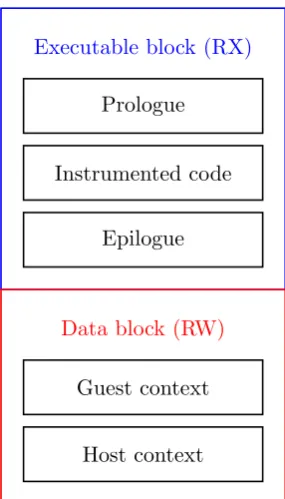
Prologue
Instrumented code
Epilogue
Executable block (RX)
Guest context
Host context
[image:15.595.240.383.53.303.2]Data block (RW)
Figure 1.1: ExecBlock structure used in QBDI
As a variation on this loop, QBDI also gives the possibility to the user to specify a series of address ranges that should not be run through the DBI, but instead natively on the original code. This is quite useful if only a particular area of the binary is being targeted and the performance of the execution is critical. The control of the execution is usually recovered through heuristics, such as substituting, on the stack, the return address of the function that is not being instrumented with the entry point of the DBI.
1.4.3 Architecture
From an architectural point of view, it is worth examining how QBDI manages the assembled code in order to keep the execution control activities as transparent as possible for the guest program.
First of all, it is important to note that the DBI framework, also named host, and the guest program are supposed to run in two different contexts; this is necessary since the guest should be unaware of the code relocation process and the host should be able to manage the guest without damaging its state. These two contexts, however, both reside within the same process and thus there is no feature in the kernel or in the CPU that helps separating them. It is thus necessary to manually switch between them.
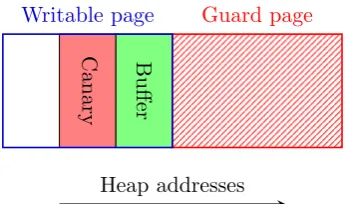
In order to perform this context switch, QBDI exploits a structure called ExecBlock, shown in Figure 1.1, which is composed by two pages: the first one has read and execution permissions, while the second one has read and write permissions. The first page is used to contain the assembled code, while the second one is used to backup the state of the host during the execution of the guest and to store host data necessary to handle the instrumentation code. In order to save space, a single ExecBlock can be used to store several basic blocks and the relative data; the multiplexing between these blocks is then managed through a common prologue and a common epilogue that run the appropriate code through a selector, specified by the host.
Chapter 2
Problem statement
2.1
Challenges in fuzzing
As every other automated testing technique, fuzzing is also affected by some intrinsic limitations, which are difficult to overcome without precise techniques targeting them.
In order to illustrate such limitations, it is useful to refer to the model presented in the paper about Driller [4] which describes software as a set of communicating “compartments”: the authors argue that branch conditions that check for a very restricted set of values in a specific input split the application into two different compartments. As an example, checking for a specific byte sequence in a header positions the code that is run when the sequence is matched in a different compartment as compared to the one that is run when the sequence is not matched.
This model is useful to describe the kind of exploration fuzzing is capable of: it is able to thoroughly explore the code within the same compartment, covering all the branches protected by conditions that are easy to guess providing random inputs; this is the case, for example, of parsing code, which translates the input in a set of data structures that is then used by the rest of the program.
The point in which fuzzing struggles the most, however, is making the execution flow from one compartment to another. This is simply due to the fact that conditions that have a large search space and a really small accepted range are nearly impossible to guess only randomly mutating the input test case. In the case of generation-based fuzzers, this difficulty can be overcome if those same branch conditions are embedded in the grammar definition but, in the case of mutation-based fuzzers, the only way to explore a certain container is to provide a seed input that traverses it; containers that are not touched by the seed inputs are really unlikely to be explored after.
Examining in detail the branch conditions that usually block grey-box fuzzing, it is possible to group them in different categories and try to define why each one of them represents an obstacle to the exploration process.
Magic bytes The first, narrow, category that can be identified is related to magic byte sequences.
This particular category is quite relevant in the context of fuzzing since it is the main problem that this method faces while testing parsers, one of the targets it is most commonly used for.
In detail, these branch conditions check that a series of adjacent bytes in the input corresponds to a precise sequence and, if this is not the case, make the program take another path. This extends to both sequences that are required to be present in a certain position and to sequences that can be placed anywhere in the input, which are commonly defined as tokens.
Common grey-box fuzzers, like AFL, are unable to overcome this kind of condition since they do not have any notion of what is composing a particular branch condition, they receive feedback only regarding whether it is met or not. In the case of white-box fuzzers, however, conditions themselves may be observable and thus a mutation of the input can be used to satisfy them quite easily.
Complex conditions The second, and probably largest, category comprehends instead conditions
of the input. Having such conditions in the program does not constitute a problem in itself, but it becomes an issue when the search space is large and the accepted range is really small.
As for the previous case, grey-box fuzzers have no clue regarding how to satisfy the condition and can only keep generating random samples hoping to hit the accepted range. Also in this case, white-box fuzzers may be able to mutate the input to satisfy the conditions, but only in the case they are easy enough to be solved with a SMT solver.
Unsolvable conditions The last category comprehends instead all the pathological conditions that
are impossible to solve with a SMT solver and are really difficult to guess just through random generation. Concrete examples are conditions that construct complex non-linear relations between the input bytes; an extreme case is a branch condition requiring that the cryptographic hash of the input is equal to a precise value.
In this case, not even white-box fuzzers can do anything to solve the condition, the only hope to explore those branches is that the user is providing a sample already satisfying them and that the related bytes are not modified during the mutations.
2.2
Proposed solutions
Several attempts have been made in order to solve the challenges related to difficult branch conditions for grey-box fuzzers described in Section 2.1. Being able to solve these issues would allow to enjoy the advantages of white-box fuzzing, illustrated in Section 1.1, while obtaining higher execution speeds and better scalability.
Within the literature, there are several examples of grey-box fuzzers that have been integrated using a technique, or a heuristic, aimed at overcoming one or more of the challenges presented before. These projects are going to be presented in the following paragraphs, roughly in chronological order. The fuzzer which is the most relevant for this study, Steelix [16], will be dealt with in Chapter 3, and thus is not reported in this list.
Driller This tool was developed with the purpose of being used in the Cyber Grand Challenge
competition created by DARPA to push the development of automated detection and automated patching tools for software. The goal of the developers was to combine the benefits of two automated testing techniques, symbolic execution and fuzzing, in order to get the best of both worlds.
The main idea behind the tool is to employ a normal grey-box fuzzer, plain AFL in this case, and use it to explore the program until it cannot find any new basic blocks. The common reason for the exploration to be blocked in this phase is that difficult branch conditions protect the remaining part of the program. At this point, a symbolic execution engine is used to create new test cases: it first examines the queue and records all the branches that have never been explored during the fuzzing phase; after that, it generates new inputs simply by negating the conditions protecting those branches. This heuristic allows Driller to overcome branch conditions that fall in the first and the second category of challenges. However, it has the significant problem that the use of a symbolic execution engine is quite expensive in terms of resources since it is subject to the path explosion problem. [24]
VUzzer This tool was developed with the goal of trying to prove that, through the use of heuristics,
it is possible to overcome a good part of the problems for which symbolic execution was previously employed. This substitution should help improving the overall performance of a fuzzer due to the lower amount of resources required.
may be positioned at different offsets in the input: for every cmpinstruction that compares a certain sequence of input bytes with an immediate, VUzzer places that immediate at the offset which tainted the register operand of the target instruction during the following mutations.
These two heuristics help to solve the first challenge presented, the one related to magic bytes. However, the first heuristic relies on the fact that the user will provide a diverse enough set of inputs, possibly introducing false positives, and the second one does not work when only register operands are used, so the problem is not completely solved. [22]
T-Fuzz This tool takes a completely different approach when compared to the ones that were
pre-sented up to now. Instead of trying to overcome difficult branch conditions through heuristics or improvements to its fuzzer component, it patches them in the binary.
In detail, the tool is composed by two components: a grey-box fuzzer, which is just plain AFL, and a program transformer, which is able to analyze and patch the program. When the fuzzer gets stuck, the program transformer examines its queue and isolates all the branches that it was not possible to take. At that point, it patches their conditions one by one, creating several different patched programs, and then it restarts the fuzzer.
Such a procedure allows this fuzzer to virtually overcome all the types of challenges previously illustrated without recurring to heavyweight techniques, but it introduces several drawbacks. First of all, it breaks the reproducibility guarantee that fuzzers usually have since it is not possible, in the general case, to produce an input that is able to reach the location of a crash; the authors proposed a symbolic execution based technique in order to do so, but it does not always work. In addition, producing several different programs which need to be fuzzed again introduces a problem similar to path explosion in symbolic execution, which was reported in the paper. [20]
Angora This tool introduces several improvements, some of which change the architecture of the
fuzzer itself, like the queue based on target branches and not on inputs to be fuzzed. However, considering the challenges previously presented, the most important heuristic introduced is the one that cracks branch conditions combining byte-level taint tracking and the gradient descendent technique.
In detail, Angora is able to keep track of all the bytes that contribute to the value of an operand in a certain branch condition. Using that information, it treats the condition as a black-box and uses the gradient descendent technique to solve it; when several different conditions are present for the same branch, Angora is able to separate them.
Chapter 3
Steelix approach
3.1
Approach overview
The project presented in this document heavily relies on the ideas that supported the development of Steelix [16]. For this reason, this section is meant to give an overview of the approach the authors of that tool took for the development of their heuristic.
The main goal targeted by Steelix is to create a fuzzer that is able to overcome the problem of magic byte sequences and, at the same time, keep the execution speeds as high as possible.
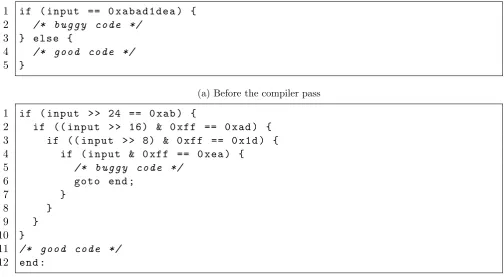
In order to reach this goal, the basic idea is to transform each condition involving magic byte sequences into a series of conditions involving single bytes, effectively unrolling the comparison. This technique, which was first presented by the authors of AFL-lafintel [2], transforms a single condition with 28·l possibilities and 1 accepted value intolconditions with 28 possibilities and 1 accepted value, where l is the size of the magic sequence in bytes. Since the fuzzer can keep track of each matched comparison, it can crack the general condition byte by byte; this process is easier since the search space is reduced. An example of this code modification is presented in Figure 3.1.
In addition to this, Steelix introduces a form of guided mutation meant to speed up the process of cracking magic byte sequences: it uses a heuristic to understand which is supposed to be the next input byte to be matched in the targeted comparison and, based on that, it executes a complete mutation, exploring all the possible 256 values, of that byte.
In order to avoid compromising the performance of the fuzzer, the individuation of the next byte to mutate is not made through dynamic taint analysis, as one would expect. It is instead achieved simply supposing that the next byte to be matched is either the one following, or the one preceding, the byte that was last modified when the last comparison progress was reported. This information is already available to the fuzzer, so no complex communication is needed in order to report comparison progresses, it is sufficient to report that one occurred. A more thorough description of the implementation is present in Section 4.2 and a complete example that explains how the heuristic works can be found in the original paper. [16]
The original implementation subdivides the fuzzing process in three main steps, which are illus-trated in detail in the following paragraphs.
Static analysis The first step is based completely on static analysis which is performed using
IDAPython [11] as an analysis framework.
As far as the Steelix heuristic is concerned, all the comparison instructions present in the binary, in particular all the variations of cmpand test, are located and recorded together with information about their operands. The recorded locations are then used as instrumentation targets in the next step.
The authors introduce also two arbitrary heuristics in order to discard some of the instrumentation locations and thus improve the overall performance of the binary. The first rule forbids the instrumen-tation of single byte comparisons, while the second one forbids the instrumeninstrumen-tation of comparisons on function return values.
1 if ( i n p u t == 0 x a b a d 1 d e a ) { 2 /* b u g g y c o d e */
3 } e l s e {
4 /* g o o d c o d e */
5 }
(a) Before the compiler pass
1 if ( i n p u t > > 24 == 0 xab ) {
2 if (( i n p u t > > 16) & 0 xff == 0 xad ) { 3 if (( i n p u t > > 8) & 0 xff == 0 x1d ) { 4 if ( i n p u t & 0 xff == 0 xea ) {
5 /* b u g g y c o d e */
6 g o t o end ;
7 }
8 }
9 } 10 }
11 /* g o o d c o d e */
12 end :
[image:20.595.24.529.52.329.2](b) After the compiler pass
Figure 3.1: AFL-lafintel comparison unrolling
instructions is also collected in this step. This is necessary since, in order to produce the AFL-style execution trace that is necessary for the fuzzer to work, those locations need to be instrumented as well.
Instrumentation The second step consists in the instrumentation of the target binary, exploiting
Dyninst [5] as an instrumentation framework.
The instrumentation is performed on the locations selected during the static analysis step and consists of AFL-style instrumentation for branch instructions and unrolling instrumentation for com-parison instructions.
In detail, the unrolling instrumentation reports to the fuzzer how many bytes were matched within the target comparison, using the same shared memory area that is used to report the AFL execution trace. The unrolling always starts from one side of the operands and taints a new byte in the shared memory area for each byte that is equal for both of them. Unfortunately, no further information is provided regarding how the comparison information is reported to the fuzzer within the memory area. The instrumentation for branch instructions is instead exactly the same as the one performed by AFL in QEMU mode, exploiting the same mechanism based on basic block identifiers, as described in Section 1.2.
Fuzzing loop The last step in processing a target binary is, as one would expect, the execution of
the fuzzer. In the case of Steelix, this piece of software is a modified version of AFL, which has been patched to support the heuristic.
In particular, the patches allow the fuzzer to distinguish between comparison progresses and branch hits reported by the instrumentation which was generated in the previous steps. In both cases, the sample is appended to the fuzzing queue but, when dealing with a comparison progress, the last mutated byte is also recorded in order to be used in the mutation phase.
mutators available in AFL; this, instead, is done only if the local exhaustive mutation fails in generating any kind of additional progress. Moreover, the queue handling is also modified so that comparison progress test cases are eliminated from the queue when they generate additional progresses.
Both the fact that comparison progress test cases are fuzzed using all the mutators only when necessary and the fact that they are removed from the queue once they generate additional progress helps in mitigating one of the largest problems present in AFL-lafintel, defined as queue flooding. This problem consists in the fact that comparison progress test cases that are inserted in the queue and never removed will quickly become a considerable proportion of the whole queue, delaying the processing of test cases with additional coverage; these are instead likely to produce results that are more useful to the general process. In addition to that, the fact that comparison progress test cases undergo a full fuzzing cycle, while instead their sole purpose is to help cracking a single comparison instruction, makes the fuzzer unnecessarily waste a considerable amount of time on them. Both these problems are addressed through the patches that have been added to AFL.
3.2
Limitations
Both while reading the paper and while creating the alternative implementation of the Steelix heuristic presented in this document, several limitations of this technique became evident. Since these limi-tations guided the design of the reimplementation and of the improvements that were made on the original version, they are analyzed one by one in this section.
3.2.1 Static binary instrumentation
As already discussed in Section 1.3, static binary instrumentation has one main intrinsic limitation: it does not always allow to instrument every location and, if the instrumentation is performed even when not possible, it can break the binary that is being instrumented. In concrete, this can reflect into a corrupted binary that may behave differently from the original. In the worst case scenario, the binary can even be corrupted in such a way that it does not crash and thus the user cannot realize that the behavior is not consistent.
The only way around this problem is to use dynamic binary instrumentation instead of the static version, so that callbacks can be inserted in every position. Indeed, no actual modification of the original code is performed: the framework that is managing the execution will take care of executing the callbacks on its own.
The only drawback brought along with this change is in terms of execution speed, which may be degraded; understanding the magnitude of this degradation, and thus the feasibility of this change, was also one of the goals of this study.
3.2.2 Static analysis
In addition to the previous limitation, the position of the instrumentation, when patching statically, has to be necessarily determined before the execution of the binary; this means that static analysis has to be used, introducing a new limitation.
Static analysis, given that it cannot execute the binary, may produce incomplete results when trying to extract specific features of the code, such as a complete CFG. It is sufficient for the analysis to encounter an indirect jump whose target is computed at runtime, as it happens for C++ virtual methods, for it to fail. This is a well known problem and, while it never happens targeting single instructions, it is common when trying to isolate all the basic blocks in a program, as it is required by AFL-style instrumentation.
3.2.3 Taint analysis
The previous issues were generated mostly by how the authors decided to implement the heuristic, more than by the heuristic itself. This issue, instead, is created by how taint analysis is implemented to make the Steelix heuristic work.
In particular, no canonical taint tracking mechanism is put in place since the authors argue that every other solution present in the literature is too heavyweight for a fuzzer. As a consequence, they simulate the result of taint tracking making the following assumption: when a comparison progress is reported, they suppose that the byte that was last modified in the input generated it and that its neighbors are candidates to be part of the same comparison.
As it is evident, this taint tracking heuristic relies on the concept of last modified byte. However, despite the fact that the fuzzer is always the one mutating the input, it may be impossible to keep track of which byte is the last modified one. This is unfortunately the case for all the mutation operators that modify more than one byte at a time, since it is impossible to know which is the one that generated the comparison progress. Even worse, when using operators based on genetic algorithms, such as those that insert or delete bytes, it is not possible to make any assumption on the origin of the comparison progress, since a large part of the buffer is shifted. The authors of Steelix do not deal with this problem in the paper and thus it is unclear which is the behavior of their implementation when a comparison progress is reported after a multibyte mutator was run.
When patching AFL, this issue is significantly disruptive since it breaks all the non-deterministic operators listed in Section 1.2 and it does not allow to import test cases between different instances. There are two possible solutions to this problem: one of them is to use actual dynamic taint tracking, but it would go against the assumptions made by the authors regarding execution speed, while the other is to disable the heuristic for unsupported operators. In the reimplementation presented in this document, the second option was selected since shifting to dynamic taint tracking just to crack magic byte sequences would have probably been unwise in terms of performance.
3.2.4 Function return values
This issue is related to one of the rules used to prohibit instrumentation for certain comparisons in order to limit the amount of instrumented locations. The problematic rule is the one prohibiting instrumentation of comparisons on function return values. This rule, while making sense in the context of the example presented in the paper, introduces one main issue: it breaks simple parsing functions, such asatoi, and completely prevents the heuristic from working on LAVA-M binaries, since the input is always parsed using the lava getfunction, as explained in Section 5.1.1.
Chapter 4
Implementation
4.1
Pre-existing tool
This section is meant to describe the structure of the pre-existing project, called AFL/QBDI, on which the work described in this document is built.
The original version of AFL/QBDI is really similar to the AFL project: in fact, it uses the upstream version of that software for the fuzzer executable, the only difference is in how the instrumentation is inserted in the binary. As a consequence of this similarity, the following paragraphs will only deal with the differences regarding the instrumentation process, the rest of the fuzzer can be assumed to be exactly the same as AFL, which was already described in Section 1.2.
4.1.1 Instrumentation technique
The most important difference that distinguishes AFL/QBDI from AFL consists in how the instru-mentation is performed: AFL can perform source instruinstru-mentation, when the source code is available, or instrument binaries through a patched version of QEMU; AFL/QBDI, instead, exploits QBDI [21], a dynamic binary instrumentation framework, in order to achieve the same result. Despite this differ-ence, however, the behavior of the instrumentation is fully compatible with AFL.
The consequence of this design choice is already discussed thoroughly in Section 1.3, but an additional note has to be made. While the performance obtained using QBDI is quite distant from what can be obtained with source instrumentation, it represents a good improvement when comparing it with what is obtainable with QEMU. This is possible thanks to the fact that, while QBDI has a structure that is similar to PIN, and thus faster than QEMU on a single run, it also supports the same pre-caching mechanism that was added to QEMU by the authors of AFL; this allows to get the best of both approaches. The pre-caching mechanism will be described in detail later in this section.
4.1.2 Library targets
The second important difference is that, from a user interface perspective, AFL/QBDI was developed to target library functions instead of complete binary programs. This observation stems from the fact that, in order to insert the instrumentation required, it is necessary to write a small library wrapper that takes care of setting up the environment: in particular, it starts the dynamic binary instrumentation framework and handles the translation of the input provided by the fuzzer into the arguments that the target function is supposed to receive.
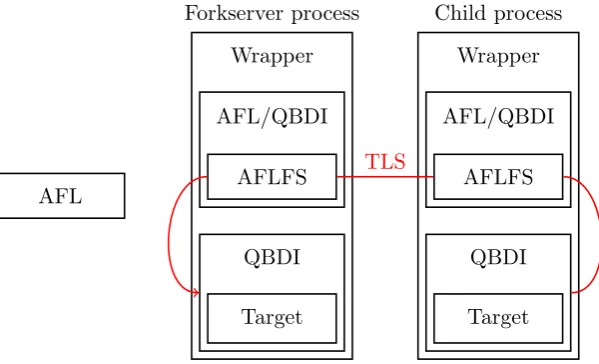
AFLFS AFL/QBDI
Target QBDI Wrapper Forkserver process
AFLFS AFL/QBDI
Target QBDI Wrapper Child process
AFL
[image:24.595.130.430.58.240.2]TLS
Figure 4.1: Basic block pre-caching
4.1.3 Architecture
The last important difference that AFL/QBDI possesses is constituted by how the handling of the communication between the instrumentation code and the fuzzer happens. This is mostly due to the use of QBDI to perform the instrumentation, which required some changes in the original design taken from AFL.
The most important thing to note is that every communication between the fuzzer and the library wrapper is handled through a shared library called AFLFS. This library is also used to support both the fork server and the persistency functionalities, which allow to achieve better performance in specific scenarios.
In detail, a fork server is used to avoid forking and then exec-ing each new library wrapper process directly from the fuzzer process; indeed, this is an expensive operation because it does not take advantage of the memory copy-on-write features implemented in modern kernels. In practice, this technique consists in having a copy of the library wrapper process, called indeed fork server, that is used to fork the wrapper processes necessary for fuzzing, thus eliminating the need for the exec system call. In AFL/QBDI, this mechanism is even more important since it allows to exploit the pre-caching mechanism present in QBDI: when a new basic block is found and assembled in one of the forked child processes, the location of the block is sent back to the fork server which passes it through to its QBDI instance. This allows QBDI to assemble that same basic block in the fork server too, so that every new forked child will benefit from that new cache entry. An overview of the architecture on a process level and of the information flow for the pre-caching process, marked as TLS, is presented in Figure 4.1.
The support for persistency, instead, consists in reusing the same library wrapper process for multiple calls to the target function; this works only for stateless libraries since they do not change the global state of the process. The advantage of this technique is that it allows to fork a new process only once for a fixed number of executions and not every time; this is useful mostly on macOS, where the time taken for a fork system call is considerably higher than Linux, where the difference is only noticeable for fast targets. [9]
The advantage of supporting these two features through an external library is that it allows to hide all the complexity from the user that is writing the library wrapper.
4.1.4 Comparison unrolling
The problem with this implementation was that, while working on small examples, it did not scale on larger programs. First of all, queuing comparison progress test cases as inputs with additional coverage leads to the queue flooding effect that was discussed in Section 3.1; this is a considerable loss of time due to the fact that all mutation operators are used when a single targeted modification is usually sufficient to crack a condition. In addition, reporting comparison progresses on the same shared memory map used for coverage information makes collisions, and thus masking interesting branches, more likely.
4.2
Steelix integration
This section is meant to illustrate the modifications that were made, starting from the original tool, in order to integrate the Steelix heuristic in it. These comprehend changes both in the instrumentation code and in the fuzzer, since the heuristic supposes that the fuzzer is able to distinguish comparison progresses and coverage progresses. This last point implied a complete rewrite of the comparison unrolling instrumentation present in the original version.
Each of the following paragraphs presents a, more or less, self contained modification made on the instrumentation code or on the fuzzer.
4.2.1 Comparison progress reporting
The first thing that was necessary to change was how comparison progresses were reported to the fuzzer. The previous method of mixing them with the execution trace was inefficient since it could create collisions in the shared memory map used to record the trace and would have required an additional mean of communication in order to distinguish between comparison progresses and coverage progresses.
In order to solve both problems at once, it was decided simply to duplicate the size of the memory shared between the fuzzer process and the wrapper process: this allowed to have enough room for an additional bloom filter to be used for comparisons exclusively. A discussion on whether the fact that the size of the map was doubled is significant from a performance perspective is discussed in depth in Sections 5.3.2 and 5.4.2.
In order to implement this modification, both the instrumentation and the fuzzer code were mod-ified making them, respectively, write and read on the right portion of the shared memory area. An additional modification was introduced in the source code of the fuzzer program in order to allow for the separate processing of comparison progress inputs, distinguishing them from coverage progress ones.
An important technical limitation that needs to be highlighted is that QBDI, while allowing to access the runtime value of the operands of a certain instruction, it does not currently allow to access it when this value is obtained through a memory access. Instructions with such accesses are less common in optimized code, but they are still present; when encountered, they can only be ignored.
4.2.2 Queue handling
The second modification that was implemented is related to how test cases are processed during a single run. It is important to note that this modification slightly deviates from what the Steelix heuristic described, hoping to obtain better performance.
In detail, instead of queuing comparison progresses in the main queue after marking them, they are appended to a separate queue, which can be handled separately from the main one. This comparison progress queue is then always processed before the main one, so that comparison progresses discovered while fuzzing a particular test case are processed right after it.
test case. It was thus decided to fuzz comparison progresses, that are reduced in number and fast to process, before extracting a new test case from the main queue.
The priority given to comparison progresses is not absolute, there is a certain probability that the fuzzer will jump directly to the main queue. This probability was introduced in order to avoid starvation in edge scenarios; several probability values were tested and the results can be seen in Sections 5.3.3 and 5.4.3.
It is important to remember that, while coverage progress test cases are never removed from the main queue, the heuristic states that comparison progresses should be removed if they produce an additional comparison progress or additional coverage. This same rule is applied to the double queue architecture presented above: when a comparison progress is processed, it is always removed from the comparison progress queue; if it produces an additional progress, it is simply discarded, if instead it does not produce any progress, it is appended to the main queue. The behavior of queueing sterile comparison progress test cases to the main queue can, in the worst case scenario, lead to the same queue flooding problem present in AFL-lafintel, but this also holds for what Steelix does and this is, in practice, quite unlikely.
Resume support was also implemented for the comparison progress queue so that stopping and then restarting the fuzzer does not lead to a loss of the current queue state.
4.2.3 Steelix mutation operator
The last change that was introduced is related to the implementation of the mutation operator required by the heuristic. This operator is able to produce test cases with every possible value of a specified target byte. Its behavior is equivalent to the one presented for Steelix.
In detail, when a comparison progress is produced, the last modified byte is recorded, if this is supported by the mutation operator that is being used. The position of this byte is important since one of its neighbors will become the target for the Steelix mutation operator when the comparison progress will be processed.
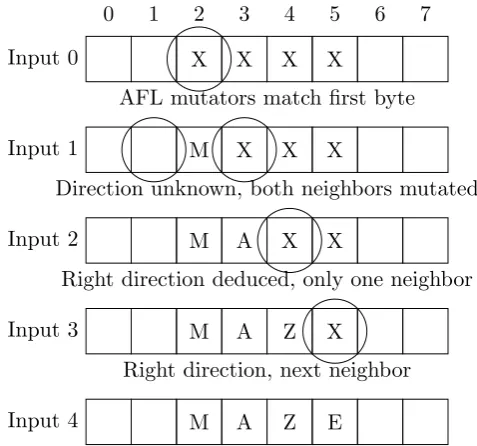
Which of the two neighbors of the last modified byte will be mutated is determined through the use of a mechanism that deduces the direction in which the magic byte sequence is encoded in the input. If the comparison progress is generated while using an AFL mutation operator, no direction can be deduced and thus both neighbors are targeted. If instead the comparison progress is generated while using the Steelix mutation operator, it is possible to know which of the two neighbors generated the new match; using this information, the direction of the magic byte sequence can be deduced and recorded. Once the direction is known, only the neighbor to the left or the one to the right needs to be fully mutated, allowing to process the test case faster.
Figure 4.2 illustrates an example of how the direction deduction technique works. In the graphics, the squares represent the input bytes, while the circles denote the bytes that are being targeted in the current step. The cells containing an “X” are the ones that contain a portion of the magic sequence that is yet to be matched; the sequence is “MAZE” in the example.
4.3
Other improvements
This section is meant to give an overview of the other improvements that were introduced in the original design, but that are unrelated with the Steelix heuristic presented in Section 3.1.
4.3.1 Support for executables
As stated in Section 4.2, AFL/QBDI was designed with the goal of testing a function belonging to a library; as a consequence, it provides the user with an API that can be used to write library wrappers, but it is not compatible with the interface offered by the upstream version of AFL.