
University of Warwick institutional repository: http://go.warwick.ac.uk/wrap
A Thesis Submitted for the Degree of PhD at the University of Warwick
http://go.warwick.ac.uk/wrap/1932
This thesis is made available online and is protected by original copyright. Please scroll down to view the document itself.
Soft Volume Simulation using a
Deformable Surface Model
by
Sylvester Arnab
A thesis submitted in partial fulfilment of the requirements for the degree
of Doctor of Philosophy in Engineering
University of Warwick, School of Engineering
In Loving Memory
of
Table of Contents
TABLE OF CONTENTS... I LIST OF FIGURES ... VI LIST OF TABLES ... XI ACKNOWLEDGEMENTS...XII DECLARATION... XIII ABSTRACT... XIV LIST OF ABBREVIATIONS ... XV
CHAPTER 1: INTRODUCTION... 1
-1.1 CONTEXT AND MOTIVATION... 1
1.1.1 Context... 1
1.1.2 Motivation... 2
-1.2 DESCRIPTION OF THE PROBLEM... 3
-1.3 AIM,OBJECTIVES AND CONTRIBUTIONS... 8
1.3.1 Aim... 8
1.3.2 Objectives ... 8
1.3.3 Contributions ... 9
-1.4 THESIS OUTLINE... 9
PART I -BACKGROUND CHAPTER 2: SOFT VOLUME SIMULATION ... 14
-2.1 INTRODUCTION... 14
-2.2 DEFORMABLEMODEL... 16
2.2.1 Material properties ... 16
2.2.2 Modelling... 26
2.2.3 Interactive Simulation... 35
-2.3 PHYSICS-BASEDMETHODS... 38
2.3.1 Finite Element Method (FEM)... 39
-2.4 ISSUES... 47
2.4.1 Types of Simulation... 48
2.4.2 Properties Estimation ... 51
2.4.3 Properties Reestimation ... 56
2.4.4 Volume behaviour... 57
-2.5 DISCUSSION... 60
-2.6 CONCLUSIONS... 62
CHAPTER 3 ... 64
DEFORMABLE SURFACE MODEL ... 64
-3.1 INTRODUCTION... 64
-3.2 STATE OF THE ART... 66
3.2.1 Volume Behaviour ... 66
3.2.2 Properties Estimation ... 77
-3.3 DISCUSSION... 84
-3.4 CONCLUSIONS... 88
PART II -THE PROPOSED DEFORMABLE MODEL CHAPTER 4: THE PROPOSED FRAMEWORK... 91
-4.1 INTRODUCTION... 91
-4.2 THESIMULATIONFRAMEWORK... 92
4.2.1 General Overview ... 92
4.2.2 The Scope of the Deformable Model... 95
-4.3 THESURFACEMODEL... 97
4.3.1 Surface Springs Topology... 97
4.3.2 Volume Springs Topology... 98
4.3.3 The force model ... 100
-4.4 VOLUMEDISCRETISATION... 102
4.4.1 Surface Elements ... 103
4.4.2 Radial Relationship ... 104
4.4.4 The relationship with volume object ... 111
4.4.5 Volume distribution ... 112
-4.5 CONCLUSIONS... 113
CHAPTER 5: THE CONFIGURATION OF THE MODEL ... 115
-5.1 INTRODUCTION... 115
-5.2 SPRINGSTIFFNESS... 116
5.2.1 Surface Springs... 116
5.2.2 Volume Springs... 116
5.2.3 Force Orientation ... 117
-5.3 VOLUMEBEHAVIOUR... 119
5.3.1 Shape Preservation ... 120
5.3.2 Volume Preservation ... 120
5.3.3 Local and Global Deformation... 122
-5.4 MASSESTIMATION... 125
5.4.1 Mass Preservation ... 125
5.4.2 Estimation based on volume distribution... 125
-5.5 PROPERTIESRE-ESTIMATION... 126
-5.6 CONCLUSIONS... 128
PART III -EVALUATION ANALYSIS & DISCUSSION CHAPTER 6: EVALUATION FRAMEWORK... 130
-6.1 INTRODUCTION... 131
-6.2 THE EVALUATION AIM... 131
-6.3 THE EVALUATION HYPOTHESES,OBJECTIVES AND TECHNIQUES... 131
6.3.1 Properties estimation... 132
6.3.2 Volume behaviour... 133
-6.4 THEMATERIALS... 138
6.4.1 Experiment samples ... 138
6.4.2 The configuration schemes ... 140
CHAPTER 7: PROPERTIES ESTIMATION ... 145
-7.1 INTRODUCTION... 145
-7.2 EVALUATIONOBJECTIVES... 146
-7.3 ELASTICITY... 147
7.3.1 Shape preservation ... 147
7.3.2 Stress and Strain Relationship ... 148
7.3.3 Displacement Comparison... 154
7.3.4 Summary ... 155
-7.4 HOMOGENEITY... 156
7.4.1 Properties Distribution ... 156
7.4.2 Properties Reestimation ... 159
7.4.3 Distortion... 168
7.4.5 Summary ... 176
-7.5 CONCLUSIONS... 176
CHAPTER 8: VOLUME BEHAVIOUR ... 178
-8.1 INTRODUCTION... 178
-8.2 EVALUATIONOBJECTIVES... 179
-8.3 VOLUME VARIATIONS... 180
8.3.1 Gravitational pull ... 180
8.3.2 External Force Interaction ... 184
8.3.3 Summary ... 189
-8.4 GLOBALDEFORMATIONEFFECT... 190
8.4.1 Deformation in response to volume variation... 190
8.4.2 Interacting with a breast model ... 192
8.4.3 Radius and orientation of influence... 194
8.4.4 Summary ... 196
-8.5 VOLUMEMASSSPRINGSYSTEMS(VMSS) ... 196
8.5.1 Complexity ... 196
8.5.2 Performance comparison... 197
-CHAPTER 9:
DISCUSSION………-200-9.1 INTRODUCTION... 200
-9.2 OVERVIEW... 200
-9.3 THE SURFACE APPROACH... 203
9.3.1 Properties estimation... 205
9.3.2 Volume behaviour... 207
9.3.3 Towards breast simulation... 208
-9.4 KNOWLEDGECONTRIBUTIONS ANDIMPLICATIONS... 209
9.4.1 A novel extension to the configuration of a physicsbased surface model... 209
9.4.2 Implication in the application of medical training ... 215
-9.5 CONCLUSIONS... 216
CHAPTER 10: CONCLUSIONS ... 217
-10.1 SUMMARY... 217
10.1.1 Background... 217
10.1.2 Aim and objectives ... 218
10.1.3 The proposed framework ... 219
10.1.4 The contributions ... 219
-10.2 PERSPECTIVES... 221
10.2.1 Breast simulation ... 222
10.2.2 Algorithms ... 223
10.2.3 Interdisciplinary approach ... 224
APPENDIX A: MATERIAL PROPERTIES ... 226
-A.1 YOUNG’S MODULUS OF TISSUES RELATED TO BREAST... 226
APPENDIX B: HAPTICS ... 227
-B.1 HAPTIC RENDERING... 227
-B.2 HAPTICS DATA STRUCTURE... 228
APPENDIX C: THE PROPOSED FRAMEWORK... 229
-C.1 THE INITIALISATION AND RUNTIME STRUCTURE... 229
REFERENCES... 230
-List of Figures
1.1: THE PARAMETERS AND ISSUES THAT INFLUENCE THE CONFIGURATION... 7
-1.2: THE OVERVIEW OF THE THESIS STRUCTURE... 10
-2.1: SOLID BODIES: (A)RIGID METAL(B)NON-RIGID PROSTHESIS... 14
-2.2: THE VARIOUS TISSUE TYPES CONSISTED IN A BREAST... 17
-2.3: THE STRESS STRAIN CURVE... 18
-2.4: YOUNG’SMODULUS(E)EXTRACTED FROM THE STRESS-STRAIN RELATIONSHIP... 20
-2.5: REAL STRESS-STRAIN(IN RED)IN RESPONSE TO THE CHANGE IN CROSS-SECTIONA... 21
-2.6: SHEAR FORCE ACTING PERPENDICULARLY TO THE TOP SURFACE OF THE BOX... 22
-2.7: PRESSURE CAUSING CHANGE IN VOLUME FROMVTOV’ (SUNDARAJ, 2004) ... 23
-2.8: MRIMAGE SLICES OF A BREAST... 25
-2.9: PRESSURE DISTRIBUTED TO PROMOTE INCOMPRESSIBILITY UPON INTERACTION... 25
-2.10: ASIMPLISTIC ILLUSTRATION OF THE CREATION OF A HOLLOW BOX MODEL... 27
-2.11: DATA STRUCTURE FOR THE MESH TOPOLOGY(TOBLER ANDMAIERHOFER2006)... 28
-2.12: (A) REGULAR TOPOLOGY AND(B)IRREGULAR MESH TOPOLOGY... 29
-2.13: THE BREAST WIREFRAME MODEL WITH IRREGULAR MESH TOPOLOGY... 29
-2.14: THE DIFFERENTLODS OF A HAND MODEL(CACCIOLA2007) ... 30
-2.15: VOLUME MODELS WITH REGULAR TETRAHEDRAL ELEMENTS... 30
-2.16: THE RENDERED SURFACE OF FIGURE2.13 ... 31
-2.17: PARTIALLY-CONVEX APPROACH... 31
-2.18: INTERACTING WITH A SOFT SOLID, ... 33
-2.19: SIGNIFICANT GLOBAL POSITIONAL DYNAMISM... 33
-2.20: (A) BREAST MODEL FIXED ON A CHEST FRAME (B) APROSTATE GLAND... 33
-2.21: ASPHERICAL PROBE INTERACTING WITH THE OBJECT SURFACE(HONG ET AL. 2006) ... 34
-2.22: PRESSING AN OBJECT IN(A)CAN DEMONSTRATE(B)GLOBAL AND(C)LOCAL DEFORMATION.... 34
-2.23: LOCAL AND GLOBAL DEFORMATIONS UPON AN INTERACTION(JAMES& PAI1999)... 35
-2.24: THE SIMULATION FRAMEWORK ADAPTED FROM(HU ET AL. 2005)... 36
-2.25: MIST SUTURINGSIMULATION(MENTICE2008) ... 37
-2.27: ASPRING CONNECTION... 43
-2.28: THE TIME VERSUS ACCURACY REQUIREMENTS... 49
-2.29: MOLECULES SYSTEM WITH1000MOLECULES AND7560SPRING CONNECTIONS(MACIEL2005) 53 -2.30: FORCE PENALTY TO COMPENSATE THE VOLUME VARIATION(PICINBONO ET.AL. 2001) ... 58
-2.31: RADIAL FORCEFTO PRESERVE TETRAHEDRAL VOLUME... 59
-2.32: ASTIFFER DEFORMATION PRODUCED BYVP ... 59
-3.1: THE CLASSIC SURFACEMSSCOLLAPSES WHEN GRAVITY IS SWITCHED ON AT RUNTIME... 65
-3.2: INCORRECT GLOBAL DEFORMATION DUE TO THE ABSENCE OF THE INTERNAL VOLUME... 65
-3.3: THE FLOW OF A VOLUME MESH GENERATOR(NLM 2001) ... 67
-3.4: ABLOOD VESSEL... 68
-3.5: (A) LEM (B) REM (BALANIUK ET.AL., 2006)... 69
-3.6: MUSCLE CONTRACTION BASED ON A SURFACE MESH... 71
-3.7: PRE-COMPUTED WEIGHTS TO CONSTRAIN DEFORMATION EFFECT... 72
-3.8: THE BALLOONING EFFECT OF PRESSURE WITHIN A SURFACEMSS (MATYKA& OLLILA2003) .... 74
-3.9: SHAPEPRESERVINGSPRINGS(GREEN MEMORY SPRINGS) (CHOI ET AL. 2005) ... 76
-3.10: DEFORMATION BEHAVIOUR... 76
-3.11: (A) AREGULAR TRIANGLE(B) REGULAR AREA DISTRIBUTION(C) THE SUM OF AREA... 78
-3.12: ELASTIC SURFACE MEMBRANE(A)UNLOADED(B)STRETCHED (C)STRETCHED... 80
-3.13: (A) BEFORE REFINEMENT(B)AFTER ONE-LEVEL REFINEMENT... 82
-3.14: DEFORMED(A)ORIGINAL MESH(B)ONE-LEVEL MESH SUBDIVISION(C)TWO-LEVEL... 82
-3.15: MASS NODES IN MULTIPLE DETAILS LEVEL(CHOI ET AL., 2005) ... 83
-3.16: DISPLACEMENTCOMPARISONS(CHOI ET AL. 2005)... 83
-4.1: THE INITIALISATION FLOW FOR THE DEFORMABLE MODEL THREAD... 93
-4.2: EXTRACTING A GEOMETRICAL MESH FOR A BREAST AND CREATE THE VISUAL REPRESENTATION 93 -4.3: A HAPTIC DEVICE(PHANTOMDESKTOP)USED TO INTERACT WITH THE VIRTUAL MODEL... 94
-4.4: AGENERALISED DEFORMABLE BREAST MODEL INTERACTED WITH A HAPTIC PROBE... 94
-4.5: SURFACE MESH TOPOLOGY... 98
-4.6: THE MASS SPRING NETWORK WITH SURFACE AND VOLUME SPRINGS... 99
-4.7: AN INNER SPRING STRETCHED DURING SIMULATION... 99
-4.9: OBJECT SURFACE WITH INNER DISCRETISATION... 105
-4.10: BOUNDING BOX FOR A2DOBJECT... 106
-4.11: EXTRACTING INDIVIDUAL MASS FOR THE TRIANGLE... 106
-4.12: THE RADIAL CONNECTION OF THE NODES TO THE OBJECT CENTRE... 107
-4.13: ALTERNATIVE DISCRETISATION... 108
-4.14: THE CORRECT VOLUME DISCRETISATION BASED ON THE NORMAL AT NODE PI... 109
-4.15: NEIGHBOURING SURFACE ELEMENTS WITH THE SAME SURFACE NORMAL... 110
-4.16: EXPLICIT VOLUMETRIC DISCRETISATION METHOD... 110
-4.17: TETRAHEDRAL VOLUME THAT INFLUENCES THE PROPERTIES AT PIRELATIVE TO ITS NORMAL. 111 -4.18: VOLUMETRIC DISCRETISATION OF AN OBJECT... 111
-4.19: VOLUME CONTRIBUTION FROM THE NEIGHBOUR TRIANGLES... 112
-4.20: THE WIRE-MESH OF A SPHERE AND THE RESPECTIVE VOLUME DISTRIBUTION(... 113
-5.1: FORCE VECTOR RELATIVE TO THE NODE NORMAL VECTOR... 118
-5.2: FORCE ORIENTATION RELATIVE TO THE NORMAL AT THE NODE( ... 118
-5.3: ASPHERE AT REST,UNDER DEFORMATION AND BACK TO THE ORIGINAL SHAPE... 120
-5.4: RADIUS OFINFLUENCE: THE RED NODES ARE WITHIN THE RADIUS... 122
-5.5: COSINE FUNCTION... 123
-5.6: THE ORIENTATION OF INFLUENCE... 123
-5.7: MASS DISTRIBUTION OF A BREAST MODEL BASED ON THE RESPECTIVE MESH TOPOLOGY... 126
-5.8: TOPOLOGICAL REFINEMENT(A) PRE-REFINEMENT(B) POST-REFINEMENT... 126
-6.1: THE EVALUATION TAXONOMY OF PROPERTIES ESTIMATION... 137
-6.2: THE EVALUATION TAXONOMY OF VOLUME BEHAVIOUR... 137
-6.3: MODELS BASED ON THE PARAMETERS... 139
-6.4: SURFACE GEOMETRIES... 139
-7.1: THE EVALUATION OF PROPERTIES ESTIMATION... 145
-7.2: SNAPSHOTS OF THE DEFORMATION OF A SPHERE... 147
-7.3: THE CHANGE IN CROSS SECTION IN RESPONDS TO A STRETCHING FORCE(SCHEMED)... 152
-7.4: STRESS ANDSTRAINRELATIONSHIP OFSCHEMED (E = 3.25KPA)... 153
-7.5: STRETCHINGDISPLACEMENTANALYSIS(3.25KPA)OFFEMANDSCHEMED... 155
-7.7: GRAVITY TEST... 156
-7.8: SNAPSHOTS OF SOFT MATERIAL DEFORMATION... 157
-7.9: PATTERN COMPARISON... 158
-7.10: THE DISTRIBUTION OF(A)MASS AND(B)STIFFNESS... 158
-7.11: LOOP SUBDIVISION OF IRREGULAR MESH TOPOLOGY... 159
-7.12: THE DIRECTION OF FORCE ALONG THE NORMAL AT THE NODE... 160
-7.13: DISPLACEMENT MAGNITUDE PLOT OF NODE750 (CONSTANT FORCE5*10-4N)... 162
-7.14: PROPERTIES RE-DISTRIBUTION AFTER REFINEMENT... 163
-7.15: THE RELATIONSHIP BETWEEN THE STANDARD DEVIATION AND THE MEAN DEVIATION... 164
-7.16: PATTERNS FOR THE PRE-AND POST-REFINEMENT OF BREAST MODEL... 165
-7.17: THE RELATIONSHIP BETWEEN THE MEAN AND THE STANDARD DEVIATION... 166
-7.18: DISPLACEMENT PATTERNS OFSCHEMEBANDD ... 166
-7.19: DISPLACEMENT PATTERNS... 167
-7.20: ASUMMARY OF THE STANDARD AND THE MEAN DEVIATION OVER FORCE(SCHEMED)... 167
-7:21: REST(UNLOADED)STATE OF(A)CUBE(B)SPHERE AND(C)BREAST... 168
-7.22: COMPARING STRETCHING DISTORTION FOR REGULAR PROPERTIES ESTIMATION
………-169-7.23: STRETCHING DISTORTION FORSCHEMECANDD... 170
-7.24: SNAPSHOTS OF THE DEFORMATION UNDER GRAVITY... 171
-7.25: COMPARING SHEARING DISTORTION FORSCHEMEAAGAINSTSCHEMED ... 172
-7.26: COMPRESSED... 172
-7.27: REST STATE OF A CUBE WITH IRREGULAR MESH TOPOLOGY ... 172
-7.28: DISTORTION COMPARISON OF PRE-AND POST-REFINEMENT... 173
-7.29: SHEARING DISTORTION FORSCHEMED... 174
-7.30: THE SPHERE DEFORMED IN RESPONSE TO AN OUTWARD FORCE IMPOSED ON THE SURFACE... 174
-7.31: BREAST WITHE= 3.25 KPA UNDER THE INFLUENCE OF GRAVITY... 175
-8.1: THE EVALUATION OF VOLUME BEHAVIOUR... 178
-8.2: VOLUME DEVIATION(SCHEMED)OVER TIME UNDER GRAVITY... 181
-8.3: BREASTMODEL OFSCHEMEDUNDER THEUNLOADED ANDGRAVITY LOADED CONDITIONS... 182
-8.4: BREAST POSITION UNDER GRAVITY(TOP SUPINE AND PRONE VIEWS)... 182
-8.6: DISPLACEMENT MAPPING FROM THE MAXIMUM VALUE(RED)TO THE MINIMUM(BLUE)A... 184
-8.7: SNAPSHOTS OF OBJECT DEFORMATION UNDER A CONSTANT FORCE... 184
-8.8: THE PERCENTAGE OF THE AVERAGE VOLUME DEVIATION... 185
-8.9: VOLUMEDEVIATIONPERCENTAGE... 186
-8.10: MEANVOLUMEDEVIATIONPERCENTAGE... 187
-8.11: VOLUMEDEVIATIONPERCENTAGE(SCHEMED) ... 188
-8.12: MEANVOLUMEDEVIATIONPERCENTAGE... 189
-8.13: SHAPE CHANGE OFSCHEMEDDUE TO VOLUME VARIATION... 191
-8.14: DEFORMATION UNDER GRAVITY... 191
-8.15: INCOMPRESSIBILITY IS EMULATED... 192
-8.16: REALISTIC RESPONSES TO INTERACTION... 193
-8.17: THE WHITE LINES REFLECT THE WEIGHTED FACTORS AT THE NODES... 194
-8.18: RUNTIME WEIGHTED FACTORS... 195
-8.19: DISPLACEMENTANALYSIS SHOWING A GLOBAL DEFORMATION EFFECT... 195
-A.1: THE VALUES FOR NORMAL ADIPOSE AND GLANDULAR TISSUES... 226
-B.1: HAPTICRENDERING(BASDOGAN& SRINIVASAN2002)... 227
-B.2: 3D GEOMETRIC AND MATERIAL PROPERTY DATA STRUCTURE(CAI ET AL. 1999)... 228
-List of Tables
1.1: THE ASSUMPTIONS OF MATERIAL PROPERTIES... 6
-1.2: THE THESIS OBJECTIVES... 10
-2.1: THE MODULUS(E)VALUES FOR VARIOUS TISSUE TYPES... 24
-2.2: THE RANKING OF THE COMMON METHODS IN DEFORMABLE MODELLING... 61
-3.1: SUMMARY OF MAIN APPROACHES DISCUSSED IN VARIOUS WORKS... 85
-3.2: SUMMARY OF THE MAIN SOFT ASSUMPTIONS ON MATERIAL PROPERTIES... 86
-6.1: EXPERIMENTS TO ASSESS ELASTICITY AND HOMOGENEITY... 135
-6.2: EXPERIMENTS BASED ON THE PARAMETERS... 135
-6.3: THE SUMMARY OF THE CONSIDERATIONS TAKEN BY THE SCHEMES... 142
-6.4: THE KEY EVALUATIONS EMPLOYED FOR THE SCHEME COMPARISON... 143
-6.5: RANKING TABLE IN REFERENCE TO THE KEY EXPERIMENTS... 143
-6.6: THE MAIN ATTRIBUTES OF THE EVALUATION ANALYSIS INPARTIII... 144
-7.1: THEYOUNG’SMODULUS OF TISSUES(AS CORRELATED FROMTABLE2.1)... 149
-7.2: EXTRACTION OFYOUNG’SMODULUS(E)I... 150
-7.3: PERCENTAGE ACCURACY OF THE PROPOSEDSCHEMED... 151
-7.4: E-EXTRACTION FOR ADIPOSE AND GLANDULAR TISSUE... 153
-7.5: COMPARISON WHEN THE MODEL IS STRETCHED(FORCE= 0.5 N)... 154
-7.6: THE MEAN AND STANDARD DEVIATION OF THE DISPLACEMENT PATTERNS... 164
-7.7: RANKING OF THE SCHEMES(OUT OF4STARS) ... 177
-8.1: TOTALFPS COMPARISON... 198
-8.2: RANKING OF THE SCHEMES(OUT OF4STARS)IN REFERENCE TO THE KEY EXPERIMENTS... 199
-9.1: THE HYPOTHESES OF THE EVALUATION... 201
-9.2: THE STATUS OF THE KEY EVALUATION OBJECTIVES... 202
-9.3: RANKING OF THE SCHEMES(OUT OF4STARS)IN REFERENCE TO THE KEY EXPERIMENTS... 202
-10.1: THE STATUS OF THE OBJECTIVES OF THE THESIS AS ADDRESSED BY THE CHAPTERS... 218
-Acknowledgements
I would like to acknowledge the following people for their direct and indirect
contribution towards the completion of my doctorate research.
Professor Vinesh Raja for his support and encouragement as my supervisor,
Universiti Malaysia Sarawak (UNIMAS), The Malaysian Public Service Department (JPA) and the High Education Commission (KPT) for the Training
Award that funded me during my first three years of research,
The examiners who made the VIVA VOCE experience insightful,
My family for their constant encouragement and love,
Cliff Davies for his moral support and a shoulder to lean on,
Dr. Kevin Neailey for his advices on various issues in relation to my doctorate research,
Mitan Solanki for proof-reading some of my written work,
Jacey-Lynn Minoi, Irine Runnie and Oak Phoomboplab for being in the same shoes,
The Informatics and VR research group,
Faculty and Staff of the Engineering Department, especially WMG
Everyone who has kept me in their thoughts and prayers
But most of all, I would like to thank God for His divine intervention, unconditional
DECLARATION
This thesis is presented in accordance with the regulations for the degree of Doctor of
Philosophy. It has been composed by myself and has not been submitted in any
previous application for any degree. The work in this thesis has been undertaken by
Abstract
The aim of the research is to contribute to the modelling of deformable objects, such
as soft tissues in medical simulation. Interactive simulation for medical training is a
concept undergoing rapid growth as the underlying technologies support the
increasingly more realistic and functional training environments. The prominent
issues in the deployment of such environments centre on a fine balance between the
accuracy of the deformable model and real-time interactivity. Acknowledging the
importance of interacting with non-rigid materials such as the palpation of a breast for
breast assessment, this thesis has explored the physics-based modelling techniques for
both volume and surface approach. This thesis identified that the surface approach
based on the mass spring system (MSS) has the benefits of rapid prototyping, reduced
mesh complexity, computational efficiency and the support for large material
deformation compared to the continuum approach. However, accuracy relative to real
material properties is often overlooked in the configuration of the resulting model.
This thesis has investigated the potential and the feasibility of surface modelling for
simulating soft objects regardless of the design of the mesh topology and the
non-existence of internal volume discretisation. The assumptions of the material
parameters such as elasticity, homogeneity and incompressibility allow a reduced set
of material values to be implemented in order to establish the association with the
surface configuration. A framework for a deformable surface model was generated in
accordance with the issues of the estimation of properties and volume behaviour
corresponding to the material parameters.
The novel extension to the surface MSS enables the tensile properties of the material
to be integrated into an enhanced configuration despite its lack of volume information.
The benefits of the reduced complexity of a surface model are now correlated with the
improved accuracy in the estimation of properties and volume behaviour. Despite the
irregularity of the underlying mesh topology and the absence of volume, the model
reflected the original material values and preserved volume with minimal deviations.
Global deformation effect which is essential to emulate the runtime behaviour of a
real soft material upon interaction, such as the palpation of a generic breast, was also
demonstrated, thus indicating the potential of this novel technique in the application
List of Abbreviations
2D Two Dimensional
3D Three Dimensional
BEM Boundary Element Method
CT Computed Tomography
E Elasticity Modulus
FEM Finite Element Method
FPS Frame perSecond
kPa Kilo Pascal
LEM Long Element Method
LOD Level of Detail
MRI Magnetic Resonance Image
MSS Mass Spring Systems
PDE Partial Differential Equation
REM Radial Element Method
SMSS Surface Mass Spring Systems
VDM Volume Distribution Method
VMSS Volume Mass Spring Systems
Chapter 1
Introduction
1.1 Context and motivation
1.1.1 Context
The context of this research is within the framework of developing a computer-based
simulation of soft objects. Soft objects refer to three-dimensional objects that are
deformable upon interaction, such as soft furnishings, soft toys and human organs.
The simulation of such entities has to be reflective of this behaviour.
The degree of accuracy and realism, however, is subjective to the domain of
applications. The applications may range from scientific analysis to real-time training
simulations. Scientific analysis, such as the investigation of the behaviour of human
tissue for the design of new procedures or implants, demands accuracy of the
deformation rather than a very short computation time. A training simulation, on the
other hand, emphasises real-time interactivity rather than perfect accuracy. However,
realism can be achieved by utilising a reduced set of behaviour parameters in the
adoption of the appropriate assumptions for real-time simulation.
The requirement of a training simulation can generally be defined based on the user’s
role in the environment. Flight simulation, for instance, requires the pilot to react to
the simulated environment and medical simulation expects the trainee doctor to
interact with the simulated scenarios (Sundaraj 2004). Reacting excludes the
importance of direct interactivity with deformable objects in the environment, which
simulator in the actual training settings is also faster. On the contrary, the necessity to
interact with soft tissues in real-time medical simulation demands consideration of the
computational power, accuracy and the algorithmic complexity. This substantially
limits the development of a medical simulator.
1.1.2 Motivation
In the field of medical education, vast amounts of practical training are essential to
broaden physiological knowledge of the anatomy as well as medical procedures.
Novice physicians or surgeons have to be adequately trained before coming into
contact with real patients. During the period of in-house training, “observe and
repeat” is the key method in learning medical procedures by watching other certified
practitioners performing on real patients (Sundaraj 2004). They will then be thrown
into the deep end, where they have to repeat what they have observed during the
training. This introduces the risk of making incorrect judgements due to the lack of
hands-on training.
Great discomfort can also be imposed to real patients. For instance, the training of
breast assessment requires a physician to palpate the breast in order to learn the
appropriate techniques in tumour detection. Moreover, the scenarios of breast
variations during the training are highly limited. For this reason, instead of using real
patients, cadavers or animals in training, which impose cultural and ethical issues in
most countries, a virtual approach to training can be a logical solution.
Real-time visual and behaviour replications of soft tissues in a training environment
are of great importance. It is a plausible solution to avoid such undesirable risks and
research studies indicate that simulation improves learning (Grantcharov et al. 2004).
such an environment by investigating a new approach for soft objects simulation. The
approach can be used to emulate deformable behaviour of soft objects such as a
human breast. The implication of this is significant in the development of a training
simulation that hones the skill in tumour detection through breast palpation.
Therefore, before dealing with a more specific training application, a deformable
model that can support soft objects such as breasts is substantial. In this context, the
dynamic behaviour of interest is confined within the definition of a deformable solid
with a static global positioning, such as a deformable breast fixed on a static chest.
Similar constraint is also true for most organs simulated for surgery training, where
they are confined within the cavity of a human body. However, in this thesis, the
breast is employed only as an illustration to substantiate the research implications as
well as the scope of the proposed deformable model and its properties.
1.2 Description of the problem
Existing medical training simulations are generally based on geometric
representations of the anatomical structures that take no account of their physical
nature or the patient-specific properties. The issues in the deployment of such
applications revolve around the accuracy of the employed deformable model as well
as the need for real-time interactivity (Brown et al. 2001, Sundaraj 2004, Delingette &
Ayache 2004; Mezger et al. 2008).
Many algorithms have been proposed for deformable models that promote and aspire
to real-time computation but very often at the cost of overlooking the physics
principles and bio-material properties. High-fidelity training simulators are possible if
a physical, as opposed to a geometric, mathematical model of anatomical structures is
the quality of a training simulation are the accuracy of the virtual models and the
real-time capability.
To achieve both accuracy and realism in the simulation of the dynamic behaviour of a
soft object, it is of paramount importance that the resulting models are simulated
based on its physical and material parameters. Representing the physical attributes
and more specifically the realistic modelling of soft tissue will not only improve the
existing training simulation but will also considerably extend the set of applications
and the credibility of medical training simulation (Delingette 2000, Al-Khalifah &
Roberts 2004; Grantcharov et al., 2004), from laparoscopic to open surgery
simulation.
In order to include such properties in the configuration, volume datasets and the
resulting volume model are commonly utilised. Volume models have been
implemented to simulate deformable objects, such as human organs, due to their solid
characteristics. The dynamic behaviour can then be configured using the
physics-based methods such as the Finite Element Method (FEM) and the Mass Spring
Systems (MSS), where it has to portray a deformable behaviour upon any user
interaction.
The FEM method is, however, more suitable for scientific analysis and it is effective
for small deformations (Dimaio & Salcudean 2005). This method is, thus, known to
be computationally expensive (Batteau et al.,2004; Maciel 2005; Paloc et al. 2006).
The optimised method based on FEM, such as the Boundary Element Method (Nealan
et al. 2006), is limited by the pre-defined constraints that restrict its versatility. MSS,
on the other hand, supports real-time and large deformations. The computational
in its configurations compared to FEM. MSS promotes faster prototyping and is more
suitable for real-time simulation, where it puts more emphasis on the computation
speed rather than perfect precision (Laugier et al. 2003).
Nevertheless, the accuracy of a volume model in general is substantially
overshadowed by the latency of the simulation due to the complexity of the
consequent geometrical mesh that imposes high computation and less usability in
real-time applications (Delingette 1998; Al-Khalifah & Roberts 2004; Batteau et al. 2004).
Thus, there is a great need for a deformable model that emulates real material
properties of soft solid objects without sacrificing the computational efficiency. It is
within this domain, this research work is proposed.
To address the issue of real-time interactivity, there has been a significant interest in
employing a surface model as an alternative to the volume counterpart due to its
simplicity and the possibility of reducing the computational cost (Aubel & Thalmann
2000; Brown et al. 2001; Vassilev & Spanlang 2002; Zhang et al. 2002; Mendoza et
al. 2002; Laugier et al. 2003; Matyka & Ollila 2003; Sundaraj 2004; Choi et al. 2005;
Marchal et al. 2005; Payandeh et al. 2005; Balaniuk et. al. 2006; Hong et al. 2006;
Nealan et al. 2006 ). Rapid generation of highly detailed surface models is now
possible by utilising 3D data acquisition devices such as the structured light scanners
(Simple3D 2006, Mezger et al., 2008).
The complexity of a surface model is one order of magnitude lower than the volume
models (Sundaraj 2004; Holbrey 2004). Even though, the dimension is reduced, the
feasibility of utilising this approach is supported by the existence of the published
assumptions of material properties. The assumptions include the parameters of
deemed feasible due to the limited visual and tactile perception of a human operator
of a virtual environment (Wall & Harwin 1997; Bordegoni et al. 2001; Wade &
Swanstons 2001; Batteau et al. 2004; Sur et al. 2004; Payandeh et al. 2005; Wuillemin
et al. 2005). The scope of the deformable model (section 4.2.2) is based on these
[image:24.595.114.533.249.449.2]properties.
Table 1.1:The assumptions of material properties to promote realism without sacrificing the computational efficiency (see section 2.2.1 and table 3.2)
Parameters References
Elasticity
Cotin et al. 1999; Tanner et al. 2001; Janssen and Vergeest 2002; Maciel et al. 2003; Maciel 2005; Etzmuss et al. 2003; Chui et al. 2007; Zhang et al. 2007.
Homogeneity
Koch et al. 2002; Basdogan et al. 2004; Roose et al. 2005; Balaniuk et al. 2006; Ruiter et al. 2006; Zhang et al. 2007 ; Rajagopal et al. 2008.
Incompressibility
Girod et al. 1996; Delingette 1998; Laugier et al. 2000; Picinbono et al. 2001; Azar et al. 2001; Delingette & Ayache 2004; Sundaraj 2004; Chui et al. 2007; Roan & Vemaganti 2007; Samani et al. 2007; Rajagopal et al. 2008.
Within the scope of a surface approach, it is of paramount interest to explore the key
issues that influence the deployment of a deformable surface model in soft volume
simulation. The main concerns in utilising a surface model are:
i) The complexity in estimating the properties based on the real material
properties increases due to the absence of volume. To correctly emulate
the volume behaviour of a real solid, the physical and material properties
of the surface model have to be configured to promote realism.
ii) The complexity in estimating properties for surface elements is
significantly magnified when the design of the mesh topology that defines
iii) The drawbacks in the absence of the internal volume also include the
difficulty in conserving volume and solid behaviour during simulation.
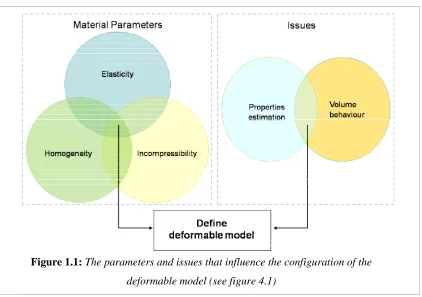
Based on these concerns, the two key issues are the estimation of properties and
volume behaviour.
The key parameters and issues are further established and discussed in Chapter 2 and
3. Figure 1.1 demonstrates the relationship between these parameters and issues in
relation to the definition of the ensuing deformable surface model. This relationship
[image:25.595.113.535.312.609.2]compliments the proposed framework demonstrated later in figure 4.1.
Figure 1.1:The parameters and issues that influence the configuration of the
In reference to this relationship, the classic MSS is further explored. The proposed
deformable model is specifically aimed at addressing these issues and pa
They are further established in the background of this thesis and explored in the
design and the evaluation of the deformable model. The evaluation hypotheses based
on these issues and parameters are also discussed
The drawbacks in the absence of the internal volume also include the
ifficulty in conserving volume and solid behaviour during simulation.
concerns, the two key issues are the estimation of properties and
The key parameters and issues are further established and discussed in Chapter 2 and
3. Figure 1.1 demonstrates the relationship between these parameters and issues in
relation to the definition of the ensuing deformable surface model. This relationship
compliments the proposed framework demonstrated later in figure 4.1.
e parameters and issues that influence the configuration of the
deformable model (see figure 4.1)
In reference to this relationship, the classic MSS is further explored. The proposed
deformable model is specifically aimed at addressing these issues and pa
They are further established in the background of this thesis and explored in the
design and the evaluation of the deformable model. The evaluation hypotheses based
arameters are also discussed (see section 5.6.1).
The drawbacks in the absence of the internal volume also include the
ifficulty in conserving volume and solid behaviour during simulation.
concerns, the two key issues are the estimation of properties and
The key parameters and issues are further established and discussed in Chapter 2 and
3. Figure 1.1 demonstrates the relationship between these parameters and issues in
relation to the definition of the ensuing deformable surface model. This relationship
compliments the proposed framework demonstrated later in figure 4.1.
e parameters and issues that influence the configuration of the
In reference to this relationship, the classic MSS is further explored. The proposed
deformable model is specifically aimed at addressing these issues and parameters.
They are further established in the background of this thesis and explored in the
design and the evaluation of the deformable model. The evaluation hypotheses based
1.3 Aim, objectives and contributions
1.3.1 Aim
The aim is to increase the accuracy of the configuration of a surface model towards
simulating soft solid objects in terms of the estimation of properties and volume
behaviour as well as in reference to the material parameters: elasticity, homogeneity
and incompressibility.
1.3.2 Objectives
To achieve the aim, the research objectives are:
i) To investigate the surface approach in relation to the issues of properties
estimation and volume behaviour
ii) To address the shortcomings of a surface model, which are the non-existence
of internal volume and the design of the surface mesh topology
iii) To propose an enhancement to the surface model, which increases the
accuracy by considering the real material properties in the novel extension to the
configuration.
iv) The research incorporates a proof of concept by the means of empirical
evaluations that leads to the justification of the novel contributions to knowledge.
Therefore, the objectives of this thesis are to:
i) Investigate the issues related to deformable modelling and the
physics-based techniques in the volume approach,
ii) Explore the attempts in surface modelling in relation to the issues of
properties estimation and volume behaviour,
iv) Evaluate the proposed model relative to the issues of properties estimation
and volume behaviour, and the material parameters that include elasticity,
homogeneity and incompressibility, and
v) Discuss the evaluation findings and the consequent contributions and
implications.
1.3.3 Contributions
In relation to the aim and objectives, the thesis has contributed in terms of the
following:
i) The review of volume and surface approach in modelling deformable
solids and the identification of issues in this domain.
ii) A potential alternative to deformable modelling of soft objects in a
real-time and interactive simulation. The thesis proposes a novel extension to
the physics-based surface model that increases the accuracy of the
configuration of the deformable objects.
iii) The implication of the proposed framework in the domain of medical
training. Soft objects such as breast can be simulated based on their
material properties. The potential is in the future work of breast assessment
via haptic palpation towards the detection of tumours.
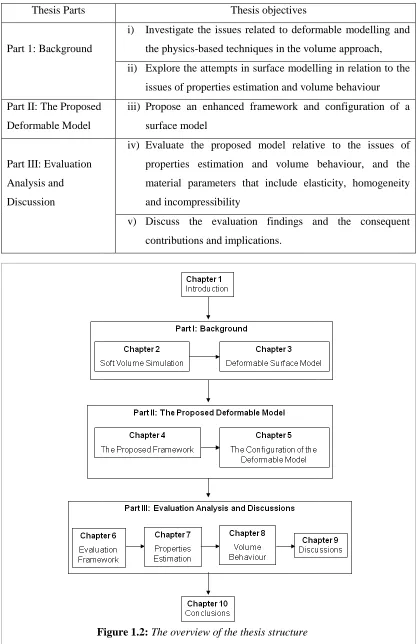
1.4 Thesis outline
According to the objectives, the main body of the thesis is organised into three main
parts addressing correlated themes. Table 1.2 summarises the objectives in relation to
the respective parts. Figure 1.2 illustrates the flow of the thesis, where each part sets
Thesis Parts
Part 1: Background
Part II: The Proposed
Deformable Model
Part III: Evaluation
Analysis and
[image:28.595.112.529.99.743.2]Discussion
Figure 1.2:
Table 1.2:The thesis
Thesis objectives
i) Investigate the issues related to deformable modelling and
the physics-based techniques in the volume approach,
ii) Explore the attempts in surface modelling in relation to the
issues of properties estimation and volume behaviour
II: The Proposed iii) Propose an enhanced framework and configuration of a
surface model
iv) Evaluate the proposed model relative to the issues of
properties estimation and volume behaviour, and the
material parameters that include elasticity, homogeneity
and incompressibility
v) Discuss the evaluation findings and the consequent
contributions and implications.
Figure 1.2:The overview of the thesis structure
Investigate the issues related to deformable modelling and
based techniques in the volume approach,
Explore the attempts in surface modelling in relation to the
issues of properties estimation and volume behaviour
Propose an enhanced framework and configuration of a
Evaluate the proposed model relative to the issues of
properties estimation and volume behaviour, and the
material parameters that include elasticity, homogeneity
Part I focuses on the background of soft volume simulation. This part begins with
Chapter 2, where the important concepts and issues as well as the state of the art in
soft volume simulation are reviewed. Soft assumptions employed for the material
properties are also included in the discussion. Chapter 3 follows up from the key
issues concluded in chapter 2, where the approaches and attempts specific to a surface
model are discussed. This chapter establishes the scope and the goal of the proposed
solution based on the correlated findings.
Based on the background discussed in Part I, Part II proposes a deformable surface
model that addresses the considerations concluded in Chapter 3. Part II begins with
Chapter 4, where the proposed simulation framework and the scope of the deformable
model are introduced. The new deformable surface model is presented where
achieving volume behaviour based on real material properties is of paramount
importance.
Based on the relationship between the surface model and the object volume discussed
in Chapter 4, Chapter 5 introduces the novel estimation technique for the model
properties and its volume behaviour.
Part III discusses the empirical evaluation and the analysis of the ensuing findings
based on the same key issues and material parameters explored in Part I and Part II.
The first chapter in this part, Chapter 6, establishes the aim and objectives of the
ensuing empirical evaluation to set the scene for the analysis and discussion in the
following chapters. Chapter 7, addresses the evaluation of the estimation technique in
consideration of the elasticity and homogeneity parameters. The findings extracted
from the experiments are analysed and the hypotheses and the objectives are
met and the versatility of the estimation technique is demonstrated. The corresponding
volume behaviour is evaluated in Chapter 8. This chapter not only describes the
feasibility of the proposed model to emulate volume behaviour, but it also further
establishes both the feasibility and the versatility of the proposed estimation technique
in employing the soft assumptions of the material properties. Part III concludes with a
discussion chapter, Chapter 9, where the major findings and knowledge contributions
are correlated and summarised. The key research question and the objectives are also
evaluated, where they are correlated with the analyses of the proposed model.
The thesis is finally concluded in Chapter 10, where the findings are summarised
within the research aim, objectives and contributions. Further work and the future
direction of this research are also discussed in this chapter in relation to the limitations
PART I
-BACKGROUND
“A man travels the world over
in search of what he needs and returns home to find it.”
George Moore
“A man travels the world over
in search of what he needs and returns home to find it.”
Chapter 2
Soft Volume Simulation
2.1 Introduction
A solid object portrays volume behaviour that reflects the existence of the internal
substance encapsulated by its exposed surface. The behaviour can either be rigid or
non-rigid (figure 2.1). Non-rigid is also known as deformable or soft. Therefore, the
obvious difference between a rigid and a deformable object is the latter allows internal
position change, where the relative positions of two or more different nodes of the
same object vary in response to external interventions such as gravity and interaction
(Maciel 2005). Rigid objects such as metal could allow small if not negligible local
deformation.
(a) (b)
Figure 2.1:Solid bodies: (a) rigid metal (b) non-rigid prosthesis
Global shape change is possible such as a metal rod bending upon the existence of
external forces. Rigid models are the most widely used today, despite the fact that
they cannot reproduce visible deformations and surface tractions. This is due to their
apparent efficiency and relative simplicity. However, deformable models are
increasingly employed in animation, edutainment and medical training due to the need
In a virtual environment, a three dimensional (3D) model is manipulated to
demonstrate such deformable behaviour. In the development of a medical simulation,
for instance, 3D anatomical models are generated from scanned images such as from
MRI and CT scans (NLM 2001; Al-Khalifah & Roberts 2004). To promote realism,
the appropriate dynamic behaviour of the models has to be merged with the respective
3D visual representation. To achieve such configuration, techniques such as the
physics-based modelling are commonly employed to define the dynamic and
deformable behaviour of the model.
For such technique, volume dataset seems to be of utmost importance due to the
co-existence of many entities within the same constrained space such as the various
tissue types in an organ and the many organs contained in a human’s body. The
variation of materials within the solid object could be explored if volume data is
employed as it holds some information about the internal anatomical structure of the
tissues (Al-Khalifah & Roberts 2004). The main drawback of a volume method is that
it significantly demands high storage space and high computational power to handle
such massive data. Also, the necessity of such data has to be addressed.
The choice of the deformable models is governed by the computational power and
accuracy. The nature of the applications that employ such models is also important.
For instance, for pre-operative medical planning, accuracy is more important than
speed. For intra-operative medical training, the simulation must be able to support the
needs for real-time interactivity. Material homogeneity has often been assumed for the
emulation of solid objects (Ruiter et al. 2006; Roose et al. 2005) to provide a
simulation that is qualitatively effective with both real-time visual and interaction
The scope of this thesis includes the exploration of the non-rigid and dynamic solid
models towards emulating real material properties as well as volumetric behaviour.
Therefore, in this chapter, the concepts, assumptions, issues and methods engaged in
simulating a deformable object are discussed.
2.2 Deformable Model
Most materials encountered in medical simulation can be regarded as deformable
objects. In the scope of such simulator, it is not possible to model the complete
biomechanical complexity of living soft tissue (Delingete 1998; Delingette & Ayache
2004; Dimaio & Salcudean 2005). Instead, most authors have resorted to simplified
models to decrease the implementation complexity and to optimise computational
efficiency (Tanner et al. 2001; Etzmuss et al. 2003; Roose at al. 2005; Ruiter et al.
2006; Zhang et al. 2007; Rajagopal et. al. 2008). Hence, to enable the design of the
consequent partially generic framework for the deformable model, the parameters that
influence the configuration of a deformable model has to be investigated. The relevant
assumptions on how to effectively utilise these parameters are examined in the next
subsections.
2.2.1 Material properties
This section discusses the three key parameters that define the material of deformable
bodies, which are homogeneity, elasticity and compressibility.
2.2.1.1 Homogeneity
Homogeneity generally means the same all throughout. A material is homogenous if it
is made of the same material as a whole. However, objects such as human organs can
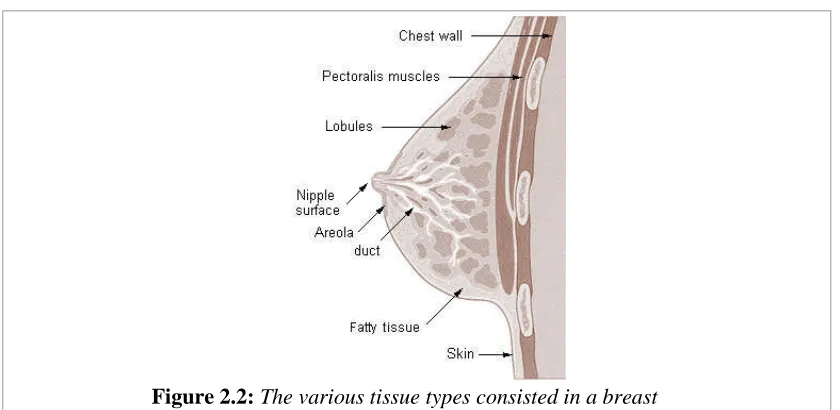
The respective properties are dissimilar for the different sections of each organ. A
breast, for instance, is made up of various tissue types but mostly fatty (adipose)
[image:35.595.112.532.153.358.2]tissue confined within an elastic skin that gives breast its shape (figure 2.2).
Figure 2.2:The various tissue types consisted in a breast
However, the tactile sensation produced from direct interaction with the skin surface
demonstrates an assumption of a homogeneous material regardless of the different
tissue types. For real-time simulation, such an assumption (Rajagopal et al. 2008) can
be crucial in order to create a more simplified model. Ruiter et al. (2006) concluded
that the material model with similar bio-tissue properties for a breast as a whole is
sufficient and more complex inhomogeneous models do not increase simulation
accuracy. Roose et al. (2005) supported the concept by stressing that the dependency
of the overall deformation on the inhomogeneous nature can be avoided altogether by
eliminating the need to model the variations in the substance composition.
An object material can display isotropic or anisotropic behaviours despite the level of
material homogeneity. A material is isotropic if its properties are the same in any
direction irrespective of the direction and orientation of internal or external forces,
incidence to the radius of interaction. However, force orientation influences the
surface behaviour reflects the accumulated behaviour of the internal volume
composition.
2.2.1.2 Elasticity
Elasticity refers to the level of reversibility of the material to its original relaxed state
when deformed, reflecting the conservation of shape as a response to a deforming
force. Linear elasticity is perfectly reversible and such behaviour can be represented
by the relationship of stress and strain of the material. It is based on Hooke’s law
where the stress and strain are proportional upon smaller deformation, conforming to
the constraint that both yield and tensile (ultimate) stresses are not exceeded. This
relationship is illustrated in figure 2.3.
Figure 2.3:The stress strain curve
In general, most materials are linear up to a yield limit and translate to the non-linear
mode or plasticity when deformed. The material will experience rupture when the
tensile (ultimate) strength is exceeded. For non-invasive interaction, such as palpating
a human breast, the yield and tensile limit of the material is never achieved. The
published compression pressure of a mammography was claimed to be around 41 kPa
(Russel &Ziewacz 1995; Ruiter et al. 2006). The advised palpation force is within the
range of 1 to 2 Newton or 0.1 to 0.2 kg of weight (Patkin 1998), while a similar
However, the palpation pressure has to be adapted to the attributes such as the size,
shape and consistency of tissue (Saslow et. al 2004).
In physiological situations, biological tissues can be classed as viscoelastic. A
material having this property is considered to combine the features of a perfectly
elastic solid and a perfect fluid, such as living tissue, which is essentially made up of
water (Picinbono et al. 2001). To replicate the behaviour, the material behaviour can
be approximated from a reduced set of material values. One of these is the linear
elastic deformation of soft bio-tissues and estimating the material properties as a
whole, assuming a homogeneous set up. The assumption of homogeneity is
demonstrated in the notion of fluid as the main material composition of a living tissue.
Furthermore, to introduce viscosity to a linear system, the ambient approach has been
employed which was based on the resistance to material movement within a medium
of known density (Jansson & Vergeest 2002; Maciel et al. 2003; Maciel 2005).
Consequently, linear elasticity theory has often been utilised as a good approximation
of the behaviour of a deformable body. It has also been claimed that linear elasticity
provides the standard for simulations in science and engineering (Cotin et al. 1999;
Etzmuss et al. 2003). Moreover, the influence of linear elastic tissues differs little
from non-linear on the overall model. Modelled with the addition of linear elastic
skin, non-rigid models such as breast models deform plausibly (Tanner et al. 2001;
Zhang et al. 2007).
2.2.1.2.1 Elasticity Modulus
The elasticity of a material is described by the stress and strain relationship (figure
2.3) as well as the loading directions. This allows for many types of elastic modulus to
i) Young’s Modulus
Young’s Modulus is a measurement of material elasticity which is represented by the
uni-axial tensile elasticity, or the tendency of an object to deform along an axis when
opposing forces are applied along that axis. It is defined as the ratio of the tensile
stress to the tensile strain. It is also often referred to simply as the elastic modulus.
The modulus is derived from the stress-strain or force-elongation relationship as
illustrated by figure 2.4.
E (2.1)
where, is the stress, is the strain and E is the Young’s Modulus. Stress is defined as a pressure exerted on an object. It is calculated by dividing the force by its
area of application. Strain in turn is the amount of deformation and it is derived by
dividing the variation of the specimen length by its original rest length to give strain.
Figure 2.4: Young’s Modulus (E) extracted from the stress-strain relationship
WhereFis the force imposed on an areaA,Lis the rest length of the material andL is the length variation in response to forceF, the relation is:
L L E A F
The linear relationship, which is employed to extract the modulus, is generally
described as the engineering approach. The strain and stress can also be represented
by the true approach which is illustrated in figure 2.5. In this approach, the significant
Figure 2.5:Real stress-strain (in red) in response to the change in cross-section A
For deformable model, elasticity is also associated with the level of stiffness of the
model material. Based on the force-elongation relationship, stiffness constant can be
defined by force divided by the elongation, or based on the engineering or linear
stress-strain relationship for a Hookean material such as a spring with stiffnessk,
L A E
k (2.2)
where, stress is proportional to the strain for all strains.
ii) Shear Modulus
The shear modulus (G) is also known as the rigidity modulus. The material displays
shearing behaviour when the external force is perpendicular to the surface normal. G
describes an object's tendency to shear when acted upon by the opposing forces,
which is defined by shear stress over shear strain. When an object like a block (figure
2.6) of heightLand cross sectionAexperiences a forceFperpendicular to the surface
normal, the sheared surface will move a distanceΔx. The shear stress is defined as the
magnitude of the force per unit cross-sectional area of the face being sheared (F/A).
Figure 2.6:Shear force acting perpendicularly to the top surface of the box
The shear modulus denotes the material rigidity, where the relationship between the
change in the horizontal distance (strain) and the amount of force (stress) is linear.
Therefore, shear and rigidity are used interchangeably. This behaviour demonstrates
that the elastic behaviour is influenced by the orientation of force. The resistance to
this imposing force is different from the force that is imposed along the axis parallel
to the surface normal as described by the E.
Assuming that the deformation does not exceed the yield limit, G can be expressed as
a function of E and Poisson ratio (v) which is the ratio of radial strain to axial strain:
) 1 (
2 v
E G
(2.3)
Most materials havevbetween 0.0 and 0.5. Materials such as cork and sponge, show
almost no Poisson contraction, meaning that they are compressible. Materials such as
rubber and fluid have a Poisson ratio of nearly 0.5, which means that they are nearly
incompressible. A perfectly incompressible material will have a Poisson's ratio of
exactly 0.5 when deformed at small strains. However, most materials are nearly
incompressible, where bulk modulus can be used to define their property.
iii) Bulk Modulus
The bulk modulus (B) is also known as the modulus of compression. Based on the
change. It also describes volumetric elasticity, or the tendency of an object's volume
to deform when under pressure. Therefore, it is defined as volumetric stress over
volumetric strain, and is the inverse of compressibility. Therefore, the larger the
value, the more incompressible the material is.
B is an extension of E to three dimensions, where it influences the magnitude of
pressure distributed to the surface of the volume object upon change of volume.
Assuming that pressure does not cause the deformation to exceed the yield limit, B
can also be expressed as a function of E andv:
) 2 1 (
3 v
E B
(2.4)
It is a numerical constant that describes the elastic properties of a solid or fluid under
pressure from all sides (figure 2.7). Consequently, it is actually the ratio of the tensile
stress or compressive force per unit surface area to the change in volume (V) per unit volume (V) (strain) of the solid or fluid. This relationship can be defined as:
V V B
P (2.5)
Figure 2.7:Pressure causing change in volume from V to V’ (Sundaraj, 2004)
2.2.1.2.2 Young’s modulus of soft tissues
There is a large bibliography on the study of soft tissue deformation in the domain of
tissues range from the order of 100 Pa for the brain to 100 kPa for soft cartilage.
However, there exists no property that is more accurate than another. These properties
were extracted from small tissue samples and were influenced by the extraction
method, device accuracy, the number of test samples and the origins of the samples.
For example, the combination of various tissue types changes with various
constraints, such as age. A younger person will have more glandular tissue in their
breast than an older person. However, these estimations can be employed towards
emulating the tissue behaviour in a virtual environment.
Table 2.1 summarises some of the values that describe the elasticity modulus of soft
tissues. The values vary due to factors such as the initial pre-compression imposed on
the tissue sample during the extraction of the elasticity modulus as well as the
dissimilar samples of tissue and equipments employed by the authors. More values of
similar tissue types published by different authors are illustrated in appendix A.
Table 2.1:The modulus (E) values for various tissue types
Tissue Type E (kPa) Author(s)
Breast adipose tissue 3.25 ± 0.91 Samani et al. (2007)
18 ± 7 to 22 ± 12 Krouskop et al (1998)
5 to 50 Saravazyan et al. (1994)
15 to 25 Kruse et al. (2000)
Breast glandular tissue 3.24 ± 0.61 Samani et al. (2007)
28 ± 14 to 35 ± 14 Krouskop et al (1998)
5 to 50 Saravazyan et al. (1994)
30 to 45 Kruse et al. (2000)
Prostate 1 to 5 Saravazyan et al. ( 1994)
Liver 0.64 Levental et. al (2007)
Intermediate grade carcinoma 19.99 ± 4.2 Samani et al. (2007)
2.2.1.3 Compressibility
Compressibility refers to the change of volume when deformed by stresses on the
surface. Therefore, incompressible material reflects constant volume preservation
However, elastic and incompressible material resists both shape and volume change
upon interaction.
The shape may change during deformation but volume will be preserved assuming
that the tensile and yield strength have not been exceeded and density is constant. For
instance, a constant change in pressure, exerted on a human breast, is transmitted
undiminished throughout the breast tissue and constrained by the elastic skin. Volume
compensation is achieved by the reaction displayed by the surface skin deformation.
Figure 2.8 demonstrates image slices of a breast at different positions under the
influence of gravity.
(a) (b) (c)
Figure 2.8:MR image slices of a breast (Rajagopal et al. 2008) (a) prone gravity-loaded (b) predicted ungravity-loaded position (c) supine gravity gravity-loaded
This is true to Pascal's Principle where it states that a change in pressure, exerted on
an enclosed static fluid, is transmitted undiminished throughout this substance and
acts perpendicularly on the surface of the container (figure 2.9).
Living tissue has been deemed incompressible due to being essentially made up of
fluid (Picinbono et al. 2001; Delingette & Ayache 2004). The incompressibility of the
fluid imposes the constraint that the volume of the deformable object is maintained at
all times. In this case, it is actually nearly incompressible as its bulk modulus is a
finite value. Soft tissues, such as breast and liver tissues can be considered as such
(Girod et al. 1996; Laugier et al. 2003; Sundaraj 2004; Chui et al. 2007; Roan &
Vemaganti 2007; Rajagopal et al. 2008).
As a further illustration, a liver consists of an elastic skin called Capsule of Glisson as
the surface and the Parenchyma that includes a complex vascular network filled with
95 percent blood (Laugier et al. 2000; Sundaraj 2004). Due to the high content of fluid
in the liver, it is possible to assume that the liver is incompressible and is of
homogeneous material. The elastic capsule indicates a behaviour that obeys Hook's
Law to some extent. Similar assumptions can be made for breast, where the skin is
elastic and the internal material is made up of mainly adipose and glandular which
have rather similar elasticity moduli (Aubel &Thalmann 2000; Samani et al. 2007).
2.2.2 Modelling
Such estimation in material properties has to be reflected by the visual responses of
the solid model during simulation. Therefore, the visual representation of both static
and dynamic behaviour has to be explored.
2.2.2.1 Visual representation
The visual or graphical representation of the deformable model has to support both
static and dynamic behaviour. The geometry of the model is defined by the
polygon mesh. This section discusses the fundamentals that influence the modelling
of the visual model as well as its dynamic behaviour.
2.2.2.1.1 Mesh topology
A polygon mesh or unstructured grid is an assortment of vertices, edges and faces that
defines the shape of a polyhedral object in 3D computer graphics and solid modelling.
The faces are usually defined as triangles, quadrilaterals, or other simple convex
polygons. The different types of elements have to be stored to assist the need to access
the respective geometrical information during modelling.
The polygonal mesh employed to define deformable models typically consists of
triangular elements in 2D and tetrahedral elements in 3D. These elements are joined at
discrete node points which are the smallest mesh element. The members of a mesh
include the vertices (nodes), edges, faces, polygons and surfaces. Generally, only
vertices, edges and faces are stored. Figure 2.10 illustrates a box object made up of
the triangular mesh topology.
Figure 2.10:A simplistic illustration of the creation of a hollow box model from the nodes (vertices from the point clouds) based on triangular mesh topology
Once the object geometry and the required level of detail (LOD) of the surface
topology are known, an appropriate set of elements and interpolation functions can be
employed to create the mesh. The best choices of elements and their LOD depend on
Some common two and three dimensional elements utilised in finite element are the
triangular elements with three nodes, the rectangular elements with four nodes and the
three dimensional tetrahedral elements with 4 nodes. These elements are used to
define the surface and volume mesh of the object.
As demonstrated in figure 2.10, these elements when combined create a geometrical
mesh of nodes and edges. The relationship of the elements of a mesh topology, which
are faces and their respective edges and vertices (nodes), can be represented by the
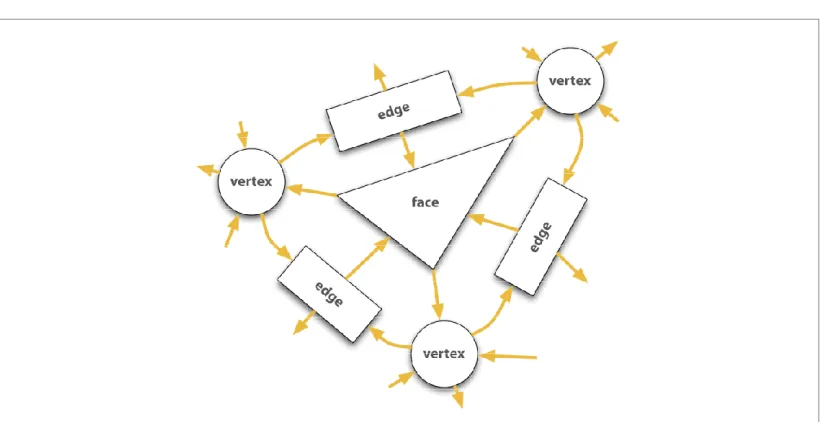
mesh data structure illustrated in figure 2.11. This promotes efficient traversing of
mesh elements when employed in a simulation for rendering as well as for the
definition of the properties of the deformable model. This data structure (Tobler &
Maierhofer 2006) has been particularly optimised for real-time rendering based on the
other data structures (Baumgart 1972; Campagna et al. 1998; Kettner 1998; Botsch et
[image:46.595.118.529.435.646.2]al. 2002).
Figure 2.11:Data structure for the mesh topology (Tobler and Maierhofer 2006)
The face elements can be of dissimilar sizes depending on the concentration of the
nodes. Hence, the characteristic of the mesh topology can either be regular or
deformable objects are hig
illustrates these characteristics
Figure 2.12
Furthermore, most objects are not of regular shape. Consequently, the surface
topology also varies. Therefore, the regularity of a mesh topology has to support these
characteristics. For example, some part
topology compared to other
topology as a whole as illustrated by th
Figure 2.13:
Figure 2.14 illustrates the differe
topology. The analysis of the LOD methods is not a part of the research scope.
However, topological refinement is widely employed to increase visual acuity
et al. 2002; Choi et al.
topological refinement of a mesh requires the material properties to be re
approximated to define the behaviour of the new elements. Hence, the re
has to be supported.
deformable objects are highly topology-dependent (Bielser 2003).
illustrates these characteristics.
(a) (b)
Figure 2.12:(a) Regular topology and (b) irregular mesh topology
Furthermore, most objects are not of regular shape. Consequently, the surface
topology also varies. Therefore, the regularity of a mesh topology has to support these
characteristics. For example, some parts of the object may demand more refined mesh
o others. This will consequently produce a more irregular mesh
topology as a whole as illustrated by the wire mesh model in figure 2.13
:The breast wireframe model with irregular mesh topology
illustrates the different LOD of a hand model with irregular mesh
topology. The analysis of the LOD methods is not a part of the research scope.
However, topological refinement is widely employed to increase visual acuity
et al. 2002; Choi et al. 2005, Payandeh et al. 2005). For a deformable model, a
topological refinement of a mesh requires the material properties to be re
d to define the behaviour of the new elements. Hence, the re
2003). Figure 2.12
irregular mesh topology
Furthermore, most objects are not of regular shape. Consequently, the surface
topology also varies. Therefore, the regularity of a mesh topology has to support these
s of the object may demand more refined mesh
. This will consequently produce a more irregular mesh
e wire mesh model in figure 2.13.
ar mesh topology
of a hand model with irregular mesh
topology. The analysis of the LOD methods is not a part of the research scope.
However, topological refinement is widely employed to increase visual acuity (Zhang
2005). For a deformable model, a
topological refinement of a mesh requires the material properties to be
Figure 2.14:The different LODs of a hand model (Cacciola 2007)
For volume datasets, tetrahedral elements (figure 2.15) have been widely employed to
represent the internal medium of the object. Furthermore, similar topology design and
adaptive modification (Sifakis et al. 2007) can be imposed on the resulting internal
mesh.
Figure 2.15:Volume models with regular tetrahedral elements
The complexity of a volume mesh is significantly larger than the surface mesh of the
same object. The tetrahedral elements are employed to define the dynamic behaviour
of the internal volume, which is visually reflected by the surface elements. Therefore,
the visual rendering is carried out on the elements that are visible within the field of
view at runtime.
2.2.2.1.2 Visual rendering
As shown in figure 2.13, the outline of the object is represented by the immediate wire


![Poly[[tetrakis(μ2 pyrazine N,N′ dioxide κ2O:O′)neodymium(III)] tris(perchlorate)]](data:image/gif;base64,R0lGODlhAQABAIAAAP///wAAACH5BAEAAAAALAAAAAABAAEAAAICRAEAOw==)