University of Warwick institutional repository: http://go.warwick.ac.uk/wrap
A Thesis Submitted for the Degree of PhD at the University of Warwick
http://go.warwick.ac.uk/wrap/3623
This thesis is made available online and is protected by original copyright. Please scroll down to view the document itself.
1
Time-based visual selection with emotional faces
by
Elisabeth Lynne Blagrove, BSc (Hons).
A thesis submitted in partial fulfilment of the requirements
for the degree of
Doctor of Philosophy in Psychology
University of Warwick, Department of Psychology
2
This thesis is dedicated to my grandparents.
The much loved, and deeply missed,
Audrey, Birch and Paul.
And the gloriously long-lived and glamorous, Sylvia.
Thank you for teaching me, above all, to be true to myself.
And to seize every opportunity Life throws my way.
And also, to my darling niece, Sophie.
Who has taught me that it is very important to laugh, long and loud.
3
Acknowledgements
These parts of theses are notoriously difficult to write, either exhaustively or dispassionately. With that in mind, my first acknowledgement is to everyone, past and present, who has helped me
towards the achievement of this goal (whether I name you below or not). This thesis is a tribute to your support and faith in me.
Secondly, my utterly amazing supervisory team:
Derrick Watson; a truly wonderful supervisor. Constant source of unparalleled expertise, common sense, genuine kindness and respect- yes, really! (It is said frequently, but never more wholeheartedly;
This thesis would not have happened without you. Thank you so much.)
Melina Kunar and Friederike Schlaghecken; guardians of my sanity and confidence. (Thank you for letting me moan and for listening to endless silly questions…and the hugs/ coffee/
chocolate/ straight-talking support strategy. I don‘t know what I would have done without you.)
Thirdly, in gratitude for the tireless and unstinting support of my friends and family:
My long suffering mother, Wendy, and endlessly patient, best friend (In All The World & Margate), Lizzy (You two are the best; I don‘t have the words to tell you without crying!); Brother and sister-in-law (Superstars, and generous providers of the much adored Sophie); Michelle Ellefson (official conference mentor); Robbie Nash (who is far-too-smart, but lovely, nevertheless); and Sarah, who always listens. Barbara, Esther, Sue, Erika, Em and Kim (who understand that I may drift, but I love them), The Girls (giggles and wine); my Gorgeous Godchildren; the Kaffee Klatsch; The Elizabeths; The Warwick Attention & Perception Research Group; Warwick academic staff; Office Mates (bisous!); Fellow Postgrads; Chris & my Yoga Buddies (Namaste!); Technical and Support Staff (thank you. I‘m sorry I‘ve been such a pain); Warwick Undergraduates (thanks for the data, Guys; it‘s been fun!); and generous colleagues in the scientific community for your insight and encouragement in my work. Lastly, to The Boys Who Didn‘t Run Away. You have opened my eyes...
4 Abstract
The biological and behavioural importance of the face has led to the proposition of
several mechanisms dedicated to highly efficient specialized processing (e.g., M.H.
Johnston, 2005). This is reflected in the attentional properties attributed to facial stimuli,
especially when they contain affective information (e.g., R. Palermo & G. Rhodes, 2007).
This thesis examines those attentional properties via a modified version of the visual search
paradigm (i.e. the preview search task; D.G. Watson & G.W. Humphreys, 1997), which
proposes that observers can intentionally suppress items seen prior to a full search array, for
effective search performance (i.e. the preview benefit; D.G.Watson & G.W. Humphreys,
1997, 1998).
The findings from this thesis show that it is possible to deprioritize previewed facial
stimuli from search, although only a partial preview benefit was shown. Emotional valence
of previewed faces had little impact on this effect, even when preview duration was
extended from 1000-3000ms. However, when duration was reduced to 250-750 ms,
negatively valenced faces were more difficult to suppress than positively valenced faces. In
addition, when previewed faces changed expression concurrently with the onset of the full
search array, the preview benefit was abolished, irrespective of the direction of the
expression change (i.e. neutral to positive, or neutral to negative). A search advantage for
negative face targets was demonstrated throughout all of the investigations in this thesis.
These findings are consistent with previous work establishing preferential detection of, and
selectively impaired disengagement from, negative faces (e.g., J.D. Eastwood, D. Smilek, &
P.M. Merikle, 2001; E.Fox, R. Russo, R.J.Bowles, & K. Dutton, 2001). However, they also
suggest the sensitivity of the visual marking mechanism to ecological considerations (such
as the nature of the stimulus), and the overall relevance of emotional face stimuli to the
5
Table of Contents
1 Chapter 1 Faces: What, how and why?………..25
1.1 Overview………..25
1.2 Aims and objectives of this thesis………25
1.3 Processing the face………...28
1.3.1 Face processing models and neural substrates……….29
1.3.2 Subcortical face processing………..33
1.3.3 Preferential processing of facial affect……….35
1.3.4 Specialized cognitive mechanisms for face processing…………42
1.3.4.1 Holistic processing of faces………...43
1.3.4.2 Expertise effects: More than faces?...46
1.4 The emotional face: What is being processed?...49
1.4.1 What is a facial expression?...49
1.4.2 Facial affect: What is shown and how is it understood?...52
1.4.2.1 The Universality Hypothesis………52
1.4.2.2 What are basic emotions?...57
2 Chapter 2 Visual attention and selection ………..61
2.1 Overview………..61
2.2 Visual attention and selection………...61
2.2.1 The locus and nature of selection in attention………..63
2.2.1.1 The early versus late selection debate………63
2.2.2 What is selective attention for?...64
6
2.2.2.2 Selection for awareness………..65
2.2.2.3 Selection for action……….66
2.2.3 Spatial selection in visual attention……….66
2.2.4 A metaphor for attention: The attentional spotlight……….67
2.2.5 The visual search task………...69
2.2.6 How can search be designated efficient or inefficient?...72
2.2.7 Models of visual search………74
2.2.7.1 Feature Integration Theory………75
2.2.7.2 Attentional Engagement Theory………77
2.2.7.3 The Guided Search model……….78
2.2.8 The control of attention………80
2.2.8.1 Exogenous control of attention………80
2.2.8.2 Endogenous control of attention……….82
2.2.8.3 Inhibitory processes in endogenous control of attention………...84
2.2.8.3.1 Inhibition of Return………..84
2.2.8.3.2 Negative Priming……….87
2.2.9 Time-based selection in visual attention: The preview search task………...88
2.2.9.1 Can the Preview Benefit be explained by IOR?...90
2.2.9.2 Negative priming and Preview Benefit………..…92
2.2.9.3 A feature map inhibition account...93
7
2.2.9.5 The contribution of top-down and bottom-up factors….95
2.2.10 How can Preview Benefit be explained? Three accounts…...…96
2.2.10.1 Visual marking………..96
2.2.10.2 Perceptual grouping by temporal asynchrony………...99
2.2.10.3 Attention capture by abrupt onsets………..100
3 Visual search with emotional faces………103
3.1 Overview………103
3.2 Early research into visual search with faces………...104
3.3 The search advantage for threat faces………105
3.3.2 The distinction between threatening and negative faces………107
3.3.3 Dissenting voices………110
3.4 Are emotional faces processed preattentively?...111
3.4.1 Evidence from comparative search performance………...112
3.4.2 Evidence from search asymmetries………114
3.5 Can we consider the visual search for faces research as a coherent whole?...117
3.5.1 Methodological differences in the literature………..117
3.5.1.1 Set size variation………..117
3.5.1.2 Target- Distractor mapping………..119
3.5.1.3 Prior knowledge of target identity………121
3.5.1.4 Disparity in facial stimuli……….123
3.5.2 Sources of the attentional properties of the emotional face…..126
8
3.5.2.2 Emotional content of affective face………127
3.5.2.3 Elements of face, ―characteristic‖ of affect…………129
3.6 Overview of the remaining thesis chapters………132
3.6.1 Chapter 4: Does contrast polarity make a difference?...132
3.6.2 Chapter 5: Emotional schematic faces in preview search……..133
3.6.3 Chapter 6: Time course of Preview Benefit with emotional faces………133
3.6.4 Chapter 7: The effect of facial expression change…………..133
3.6.5 Chapter 8: Conclusions………...134
4 Chapter 4 Visual search with emotional schematic faces: Does contrast polarity make a difference?...137
4.1 Abstract………...137
4.2 Introduction………138
4.2.1 Criticisms of schematic facial stimuli………139
4.2.2 Inversion of schematic faces………..141
4.2.3 Contrast polarity and facial stimuli………143
4.2.4. Purpose of the current chapter………145
4.3 Experiment 1: Contrast polarity comparison in visual search with upright faces………...146
4.4 Method………147
4.4.1 Participants……….147
4.4.2 Stimuli and Apparatus………147
9
4.5 Results ………..150
4.5.1 Reaction time data……….150
4.5.2 Error data………152
4.6 Discussion………..154
4.7 Experiment 2: Contrast polarity comparison in visual search with inverted faces……….155
4.8 Method………156
4.8.1 Participants……….156
4.8.2 Stimuli and Apparatus………156
4.8.3 Design and Procedure……….156
4.9 Results………156
4.9.1 Reaction time data………...156
4.9.2 Effects of valence on search efficiency………..157
4.9.3 Error data………159
4.10 Discussion………..161
4.11 Conclusions………163
4.11.1 Summary of findings………..163
4.11.2 The effect of contrast polarity on visual search for faces……...165
4.11.3 Evidence for valenced-based effects………...166
4.11.4 Face inversion effects……….167
4.11.5 Implications for thesis methodology………..169
5 Chapter 5 Emotionally valenced schematic faces in preview search………...172
10
5.2 Introduction………174
5.2.1 Time-based visual selection………...176
5.2.2 Purpose of the current chapter………177
5.3 Experiment 3: Preview search with valenced targets and neutral distractors………...178
5.4 Method………179
5.4.1 Participants……….179
5.4.2 Stimuli and Apparatus………179
5.4.3 Design and Procedure……….180
5.5 Results………183
5.5.1 Reaction time data………..183
5.5.2 HEB vs. FEB vs. Preview Condition………..184
5.5.3 HEB vs. FEB………….……….185
5.5.4 HEB vs. Preview Condition………...187
5.5.5 FEB vs. Preview Condition………187
5.5.6 Effects of valence in each condition………...188
5.5.7 Error data………188
5.6 Discussion………...188
5.7 Experiment 4: Comparison of visual search for valenced faces with and without top-down knowledge of the target………192
5.8 Method………...193
5.8.1 Participants……….194
11
5.8.3 Design and Procedure……….194
5.9 Results………195
5.9.1 Reaction time data………..195
5.9.2 Error data………197
5.10 Discussion………..198
5.11 Experiment 5: Ignoring positive faces………...199
5.12 Method………....199
5.12.1 Participants……….199
5.12.2 Stimuli and Apparatus………200
5.12.3 Design and Procedure………200
5.13 Results………200
5.13.1 Reaction time data………..200
5.13.2 HEB vs. FEB vs. Preview Condition………..202
5.13.3 HEB vs. FEB………..202
5.13.4 HEB vs. Preview Condition………...202
5.13.5 FEB vs. Preview Condition………204
5.13.6 Error data………204
5.14 Discussion………..206
5.15 Experiment 6: Ignoring negative faces………..206
5.16 Method………....207
5.16.1 Participants……….207
5.16.2 Stimuli and Apparatus………207
12
5.17 Results………207
5.17.1 Reaction time data………..207
5.17.2 HEB vs. FEB vs. Preview Condition………..208
5.17.3 HEB vs. FEB………..208
5.17.4 HEB vs. Preview Condition………...208
5.17.5 FEB vs. Preview Condition………210
5.17.6 Error data………210
5.18 Discussion………...210
5.19 Experiment 7: Replication of Experiments 5 and 6 using a within-participants design………..213
5.20 Method………213
5.20.1 Participants……….213
5.20.2 Stimuli and Apparatus………214
5.20.3 Design and Procedure……….214
5.21 Results………214
5.21.1 Overall reaction time data…...………...214
5.21.2 Ignoring positive faces: Reaction time data………...215
5.21.2.1 HEB vs. FEB vs. Preview Condition……….215
5.21.2.2 HEB vs. FEB………..215
5.21.2.3 HEB vs. Preview Condition………...217
5.21.2.4 FEB vs. Preview Condition………217
5.21.3 Error data………217
13
5.21.4.1 HEB vs. FEB vs. Preview Condition……….218
5.21.4.2 HEB vs. FEB………..218
5.21.4.3 HEB vs. Preview Condition………...218
5.21.4.4 FEB vs. Preview Condition………220
5.21.5 Error data………220
5.22 Comparing preview search efficiency for ignoring positive and negative faces………..221
5.23 Discussion……….………...………...223
6 Chapter 6 The time course of Preview Benefit with positively and negatively valenced faces………...225
6.1 Abstract…………..………...225
6.2 Introduction..……….………226
6.2.1 The time course of the Preview Benefit...………..227
6.2.2 Temporal aspects of valence effects………..230
6.2.3 Purpose of the current chapter……….………...231
6.3 Experiment 8: Reducing the preview duration with positive and negative preview displays……….232
6.4 Method………..………232
6.4.1 Participants………..232
6.4.2 Stimuli and Apparatus………233
6.4.3 Design and Procedure……….233
6.5 Results……….……….…234
14
6.5.2 Search slope data.………...234
6.5.3 Error data………237
6.5.4 Experiment 8b: Ignoring negative faces……….239
6.5.5 Search slope data………239
6.5.6 Error data…………..………..240
6.6 Comparison of Search slope data across Experiments 8a and 8b………...242
6.7 Discussion………..242
6.8 Experiment 9: Increasing the preview duration with positive and negative preview distractors……….244
6.9 Method………244
6.9.1 Participants……….244
6.9.2 Stimuli and Apparatus………244
6.9.3 Design and Procedure……….244
6.10 Results………245
6.10.1 Experiment 9a: Ignoring positive faces………..245
6.10.2 Search slope data………246
6.10.3 Error data………....246
6.10.4 Experiment 9b: Ignoring negative faces………249
6.10.5 Search slope data………249
6.10.6 Error data………250
15
6.12 Discussion………..……….251
7 Chapter 7 The effect of facial expression change on time-based visual selection……….255
7.1 Abstract………..255
7.2 Introduction………256
7.2.1 Ecological importance of changes in the visual environment………...258
7.2.2 The effects of change in preview search………..259
7.2.3 Purpose of current chapter………260
7.3 Experiment 10: Preview search with neutral to negative facial expression change………263
7.4 Method………264
7.4.1 Participants……….264
7.4.2 Stimulus and Apparatus………..264
7.4.3 Design and Procedure……….266
7.5 Results………268
7.5.1 Reaction time data…..………268
7.5.2 HEB vs. FEB vs. Preview Condition……….268
7.5.3 HEB vs. FEB………..270
7.5.4 HEB vs Preview Condition………270
7.5.5 FEB vs. Preview……….270
7.5.6 Error data………270
16
7.7 Experiment 11: Preview search with neutral to negative
facial expression change………273
7.8 Method………274
7.8.1 Participants……….274
7.8.2 Stimulus and Apparatus………..275
7.8.3 Design and Procedure……….275
7.9 Results………275
7.9.1 Reaction time data………..275
7.9.2 HEB vs. FEB vs. Preview Condition………..276
7.9.3 HEB vs. FEB………..276
7.9.4 HEB vs Preview Condition………278
7.9.5 FEB vs. Preview……….278
7.9.6 Error data………278
7.10 Discussion………...280
7.11 Comparison between Experiments 10 and 11……...…………281
8 Chapter 8 Conclusions………284
8.1 Aims of this thesis……….284
8.2 Summary of main findings……….285
8.3 Theoretical implications……….290
8.3.1 Ignoring face stimuli………..290
8.3.2 The effects of stimulus valence on performance in preview search………293
17
intentionally suppress?...296
8.3.4 A caveat: Negative valence versus threat detection…...300
8.3.5 Increasing ecological application: Expression changes in previewed faces………..302
8.3.6 Changes to shape and object identity……….303
8.3.7 The absence of valence-based differential processing
in facial expression change………305
8.3.8 Consistency with previous work: The negative target
search advantage and time-based selection………306
8.3.9 Implications for theories of time-based selection……..308
8.4 Implications for future work………...310
8.4.1 Effects of valenced targets versus valenced distractors.310
8.4.2 Establishing why negative face are more difficult
to suppress………..311
8.4.3 Evalution of stimulus valence………312
8.4.3.1 Conceptualizing negative affect……….312
8.4.3.2 Stimulus norming for affective valence……….313
8.4.4 Facial schematics and the Preview Benefit……….314
8.4.5 Possible influence of participant anxiety levels……….316
8.4.6 Using colour to support inhibitory processes in
preview search………317
8.5 Concluding remarks………318
18 List of Figures
Figure 1.1 Bruce and Young‘s (1986) cognitive model of face processing………..29
Figure 1.2 A model of the distributed human neural system for face perception….32
Figure 2.1 Examples of a visual search task………..70
Figure 2.2 Examples of typical search slopes for single feature and
conjunction searches……….72
Figure 2.3 Example of a preview search task………89
Figure 2.4 Watson & Humphreys (1997) depiction of the Visual
Marking mechanism……….98
Figure 3.1 Examples of schematic face stimuli………...124
Figure 4.1 Examples of schematic face targets and distractors………...148
Figure 4.2 Mean correct RTs for detecting positive and negative targets, as a
function of contrast polarity and display size for Experiment 1………151
Figure 4.3 Mean correct RTs for detecting inverted positive and negative targets,
as a function of contrast polarity and display size for Experiment 2...158
Figure 5.1 Examples of schematic face targets and distractors………...179
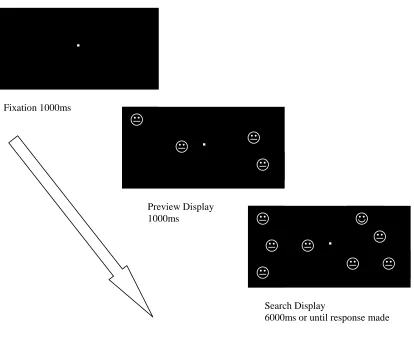
Figure 5.2 An example preview search trial (Experiment 3)………..182
Figure 5.3 Mean correct RTs for detecting negative (Panel A) and positive (Panel B)
targets, as a function of condition and display size
for Experiment 3……….186
Figure 5.4 Mean correct RTs for detecting positive and negative targets, as a
19
Figure 5.5 An example preview search trial (Experiment 5)…………..………….201
Figure 5.6 Mean correct RTs for ignoring positive distractors, as a function of
condition and display size for Experiment 5…….……….………203
Figure 5.7 Mean correct RTs for ignoring negative distractors, as a function of
condition and display size for Experiment 6…………..………209
Figure 5.8 Mean correct RTs for ignoring positive (Panel A) and negative (Panel B)
distractors, as a function of condition and display size
for Experiment 7……….219
Figure 6.1 Mean correct RTs for ignoring a positive preview (Panel A) and negative
preview (Panel B), as a function of condition and display size
for Experiment 8……….236
Figure 6.2 Mean correct RTs for ignoring a positive preview (Panel A) and negative
preview (Panel B), as a function of condition and display size
for Experiment 9……….247
Figure 7.1 Right angled bracket changing into an H
(from Watson & Humphreys, 2002; Experiment 1)………….………..262
Figure 7.2 An example preview search trial (Experiment 10)……….……265
Figure 7.3 Mean correct RTs for ignoring a change from neutral to negative facial
expression, as a function of condition and display size
for Experiment 10……….………..269
Figure 7.4 Mean correct RTs for ignoring a change from neutral to positive facial
expression, as a function of condition and display size
20 List of Tables
Table 1.1 Requirements of Minimal Universality………56
Table 4.1 Search slope statistics for Experiment 1, by contrast type
and target valence………...151
Table 4.2 Mean percentage error rates for Experiment 1, by contrast, target valence
and display size……….……….153
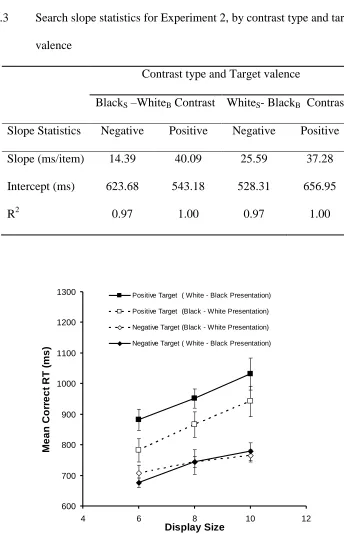
Table 4.3 Search slope statistics for Experiment 2, by contrast type
and target valence………..158
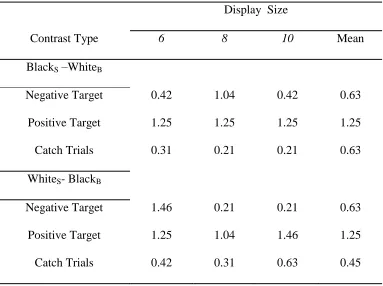
Table 4.4 Mean percentage error rates for Experiment 2, by contrast, target valence and display size……….……….160
Table 5.1 Search slope statistics for Experiment 3, by search condition
and target valence………...180
Table 5.2 Mean percentage error rates for Experiment 3, by search condition, target valence, and display size……….………...189
Table 5.3 Search slope statistics for Experiment 4, by block type
and target valence………...196
Table 5.4 Mean percentage error rates for Experiment 4, by block type, target valence, and display size……….………...197
Table 5.5 Search slope statistics for Experiment 5, for detecting negative targets amongst positive and neutral distractors, by search condition………...203
21
Table 5.7 Search slope statistics for Experiment 6, for detecting positive targets amongst negative and neutral distractors, by search condition………209
Table 5.8 Mean percentage error rates for Experiment 6, by search condition and
display size……….………211
Table 5.9 Search slope statistics for Experiment 7, by search condition and preview distractor valence………..……216
Table 5.10 Mean percentage error rates for Experiment 7, by search condition, target
valence and display size……….………222
Table 6.1 Search slope statistics for Experiment 8a, ignoring positive preview faces, by block type and preview duration………..………….235
Table 6.2 Mean percentage error rates for Experiment 8a, by block type, preview duration and display size……….………..238
Table 6.3 Search slope statistics for Experiment 8b, ignoring negative preview faces, by block type and preview duration………..…..239
Table 6.4 Mean percentage error rates for Experiment 8b, by block type, preview duration and display size……….………..241
Table 6.5 Search slope statistics for Experiment 9a, ignoring positive preview faces, by block type and preview duration………..…………245
Table 6.6 Mean percentage error rates for Experiment 9a, by block type, preview duration and display size……….……….248
22
Table 6.8 Mean percentage error rates for Experiment 9b, by block type, preview duration and display size……….……….250
Table 7.1 Search slope statistics for Experiment 10, change from neutral to negative expression, by search condtion and preview duration….……….269
Table 7.2 Mean percentage error rates for Experiment 10, by search condition display size……….………271
Table 7.3 Search slope statistics for Experiment 11, change from neutral to positive expression, by search condtion and preview duration….………..277
24
Chapter 1
Faces: What, how and why?
―The human face – in repose and in movement, at the moment of death as in life, in
silence and in speech, when seen or sensed from within, in actuality or as represented in
art or recorded by the camera – is a commanding, complicated, and at times confusing source of information.‖
25
1 Faces: What, how and why?
1.1 Overview
This chapter will be a particularly eclectic one. In its role as the first introductory
chapter of this thesis, it will address the aspects of face processing most relevant to the
empirical work presented later; in other words, the ―what?” and ―how?” of the face
processing and facial expression literatures. Specifically, it will look briefly at how face
processing is understood, via both cognitive mechanisms and underlying neural
architecture. In addition, it will address how facial expression is processed; examining
evidence from a more social psychological perspective. Lastly, in the course of those
reviews, it will briefly discuss those facets of this processing that set faces apart from
other objects in our visual environment- in essence, the ―why?‖.
However, before those themes are explored, this chapter will present the main
aims and objectives of this thesis, together with the overarching research questions that
motivate its empirical investigations. This might appear self-indulgent to the reader,
perhaps even superfluous. However, at the beginning of what is often acknowledged as
the Herculean labour of any doctoral student, it is useful to focus on why this particular
task has been chosen. This is where this thesis begins.
1.2 Aims and objectives of this thesis
Faces are hugely important to us as social beings. Through their visual salience
(e.g., Rousselet, Macé, & Fabre-Thorpe, 2003) and ecological relevance, they appear to
dominate our cognitive processing (e.g., Pegna, Khateb, Michel, & Landis, 2004; Lavie,
26
behaviour (e.g., Ro, Russell, & Lavie, 2001; Wilson & MacLeod, 2003; Wong & Root,
2003; Murphy & Zajonc, 1993). In fact, phenomenologically speaking, it is possible to
suggest that the faces of those around us impact upon almost every area of our lives, and
from the first moment we are born (e.g., Valenza, Simion, Macchi Cassia, & Umiltà,
1996; Johnson, Dziurawiec, Ellis, & Morton, 1991; see Pascalis & Kelly, 2009 for a
review). It is also possible to say that this impact is heightened by the addition of facial
affect (amongst other factors, such as familiarity or specific identity). Ordinarily, how
many humans fail to experience some response to facial displays of joy or sorrow? Or to
a familiar face, searched for in an unfamiliar context?
However clearly, this is not a scientific view to propose. How it feels to scrutinize another‘s facial expression, or to scan a crowd for a familiar face, does not
contribute to understanding human behaviour more fully. Nor does it allow us to draw
valid conclusions from what observations we might make in the course of our
experience. This is the underlying motivation for this thesis; to understand how emotional faces affect behaviour in the domain of visual attention. Despite the face‘s
ubiquity in everyday experience and inherent emotional content, if a representation of
the human face is placed into a robust experimental paradigm, it is possible to
investigate the effects of an emotionally valenced face in a scientifically rigorous
manner.
This thesis aims to fulfill precisely the objective stated above. It will evaluate the
impact of emotionally valenced faces within an experimental context (i.e. visual search)
that has been extensively examined previously, and thus, is both well-controlled and
27
innovation to that experimental context. Whereas most previous work (i.e. visual search
with emotional faces) has focused on the attention-attracting properties of an emotional
face (i.e. attention capture attributable to a specific facial expression; see Hansen &
Hansen, 1988; Hampton, Purcell, Bersine, Hansen & Hansen, 1989; Purcell, Stewart, &
Skov, 1996; Öhman, Lundqvist, & Esteves, 2001; Eastwood, Smilek, & Merikle, 2001;
Fox et al., 2000; Hortsmann & Bauland, 2006; and see Frischen, Eastwood, & Smilek,
2008; Horstmann, 2007 for reviews) this thesis will explore the reverse attentional
function. By using a paradigm (i.e. preview search, see Watson & Humphreys, 1997)
that is suggested to rely on the ability to ignore stimuli presented to an observer (rather than purposefully orient attention to them), a different facet of the face‘s attentional
properties is examined.
In summary, this thesis will determine whether it is possible to ignore a
representation of a human face; and in particular, whether different emotional content
results in differential processing in this context. This is important to issues of both social
fluency and efficient processing, since arguably, any degree of cognitive flexibility
should allow some mastery over even behaviourally-relevant stimuli. However, this
would present a striking contrast to the literature suggesting that affective faces
(specifically, those that show an expression that is threatening to the observer) are
processed with high efficiency, for example, by a dedicated fear-oriented module (i.e.
LeDoux, 1996; 1998; Öhman & Mineka, 2001). In exploring the parameters of any
differential processing attributable to facial affect, the following thesis will examine not
only a stimulus of direct social and adaptive relevance to human function, but also its
28
1.3 Processing the Face
At the outset of this section, it is important to underline the magnitude of the face
processing literature. In line with its behavioural importance to human functioning,
understanding how faces impact on our thoughts and actions has been a focus of enquiry
since ancient philosophers debated the nature of the universe (e.g., Aristotle, n/d 1913).
Indeed, biblical references1 suggest that human understanding of the fundamental links
between facial expression, emotion and behaviour have had a profound influence on
human experience and beliefs for centuries. This focus is still reflected today, with a
proliferation of sophisticated electrophysiological investigations into specific processing
centres and neural correlates of face processing (e.g., Santesso et al., 2008; Evans et al.,
2008; Eimer & Holmes, 2007; Wang, McCarthy, Song, & LaBar, 2005; Winston et al.,
2004; Grill-Spector, Knouf, & Kanwisher, 2004; Kawasaki, et al., 2001). As a result
(and perhaps, unsurprisingly), this makes the face processing literature a rich, but
sprawling, source of information.
Necessarily then, this section aims to be selective and highly focused in its
outlook. Inevitably, this means that considerable amounts of information may have to be
overlooked; however, there are also portions of the literature that are not entirely
relevant to this thesis (e.g., discussion of mechanisms implicated in face recognition).
Thus, these will only be addressed insofar as they impact upon general processing
mechanisms and specific affective face phenomena.
1 For example, a passage from Ezekiel (39.18), which quotes God as saying ―…My fury shall come up in
29
1.3.1 Face processing models and neural substrates
Bruce and Young (1986) were amongst the first to provide a comprehensive
functional model of face processing (see Figure 1.1 below; see also Calder & Young,
2005, for an overview). Whilst the focus here was arguably face recognition–centred, its
operation spoke directly to the underlying functions attributed to general face
[image:30.612.115.530.289.712.2]processing.
Figure 1. 1 Bruce and Young‘s (1986) cognitive model of face processing
SPATIAL ENCODING
FACE RECOGNITION UNITS
PERSON IDENTITY NODES
NAME GENERATION
EXPRESSION INDEPENDENT DESCRIPTIONS
VIEW-CENTRED DESCRIPTIONS
FACIAL INPUT
EXPRESSION ANALYSIS
FACIAL SPEECH ANALYSIS
DIRECTED VISUAL PROCESSING
COGNITIVE SYSTEM
30
Moreover importantly, this model acknowledged the need to distinguish between
functions of face recognition and facial expression identification.
Bruce and Young (1986) proposed a modular system comprising an initial
structural encoding mechanism of an observed face, using viewer-centred
―descriptions‖. These then fed into separate modules processing i) emotional expression,
ii) facial movement aspects of speech, iii) visual coding of attributes, discernible by
appearance (i.e. sex, race, or age), and finally, iv) recognition of familiar faces. This last
module fed into a process, by which facial familiarity was determined, semantic and
biographical information associated with an individual retrieved, and labelling by name
made.
Whilst this straightforward model reflects the diversity of functions indicated by
a distributed face processing system, it remains difficult to map onto the underlying
neuroanatomy. In fact, Breen, Caine and Coltheart (2000) suggested that the ―conflation of these two levels of description…has seemed to imply a neuranatomical
underderpinning to the cognitive modelling of two separable routes to face [processing]. This is problematic…‖ (p 55). That said, neuropsychological evidence has led to a
general acceptance of a dual-route face processing system (e.g., Bauer, 1984; 1986;
Tranel & Damasio, 1985; Ellis & Young, 1990). For example, a patient with
prosopagnosia demonstrated a stronger skin conductance response (SCR) when shown
familiar faces than unfamiliar ones, despite no overt recognition of the facial stimuli
(Bauer, 1984; 1986). Bauer asserted that this autonomic response constituted implicit
31
In contrast, Ellis and Young (1990) explicitly attributed the SCR to activation of
affective information associated with a particular face, when applying a dual- route
model to patients with Capgras Syndrome (i.e. Capgras & Reboul-Lachaux, 1923; Todd,
1957). This syndrome might be seen as a counterpoint to prosopagnosia, in that patients
recognize the familiar face presented to them, but have the delusional belief that this
person has been replaced with an impostor. Ellis and Young (1990) proposed that this
symptomology was the result of damage to a secondary face processing route for
affective information, meaning that patients could process identity information, but not
the corresponding emotional information (see also Ellis et al., 1997; Hirstein &
Ramachandran, 1997; for converging evidence).
Since Bruce and Young‘s (1986) cognitive conceptualization of a distributed
face processing system, several further models have been explored, attempting to
account for both cognitive function and neural architecture (e.g., Ellis & Young, 1990;
Breen, Caine & Coltheart, 2000). Haxby, Hoffman and Gobbini (2000, 2002) have
presented a consistently influential distrubuted model, which similarly to Bruce and
Young (1986), maintains functionally and neurologically distinct streams for processing
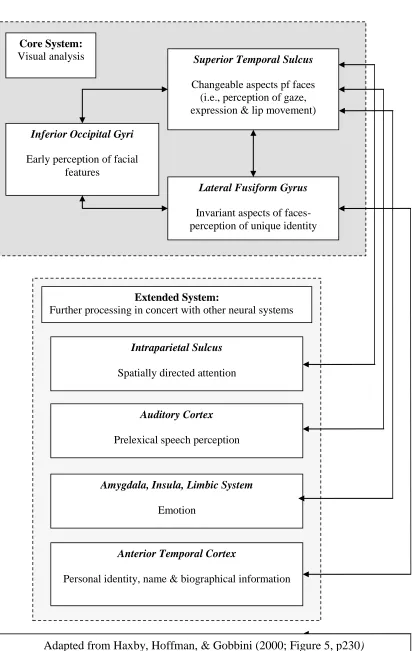
facial identity and facial expression. Their model presents three cortical areas for the
core visual processing of faces; the inferior occipital gyri (IOG), superior temporal
sulcus (STS) and lateral fusiform gyrus (i.e. the fusiform face area or FFA; see
Kanwisher, McDermott, & Chun, 1997). Respectively, these are thought to be
responsible for early perception of facial features (IOG), changeable aspects of faces
(i.e. facial expression, gaze or lip movement; STS) and fixed aspects of faces (i.e. unique
32
Core System:
Visual analysis
Extended System:
Further processing in concert with other neural systems
Intraparietal Sulcus
Spatially directed attention
Auditory Cortex
Prelexical speech perception
Amygdala, Insula, Limbic System
Emotion
Anterior Temporal Cortex
Personal identity, name & biographical information Inferior Occipital Gyri
Early perception of facial features
Superior Temporal Sulcus
Changeable aspects pf faces (i.e., perception of gaze, expression & lip movement)
Lateral Fusiform Gyrus
Invariant aspects of faces-perception of unique identity
[image:33.612.117.529.91.742.2]Adapted from Haxby, Hoffman, & Gobbini (2000; Figure 5, p230)
33
In addition, Haxby et al., (2000) also proposed a number of interconnected
cortical and subcortical regions that extend the function of the face processing system to
processing attentional, semantic and affective information associated with facial stimuli.
The latter of these functions, undertaken by the amygdala, insula and limbic system in
general, are most relevant to the processing required for evaluation of emotionally
valenced faces, in concert with the operation of the STS. Despite a substantial amount of
research continuing to examine specific mechanisms within this distributed system and
proposing alternative ways to explore its operation (e.g., Tsao & Livingstone, 2008;
Susskind et al., 2007; Calder & Young, 2005), this model retains strong explicatory
power within the cognitive and neuropsychological literatures. Individual face
processing mechanisms and brain areas will be discussed below, insofar as they are
implicated in processing facial affect.
1.3.2 Subcortical face processing
One aspect of the distributed face processing system that Haxby et al.,(2000)
alluded to in their model, is its interconnection with subcortical structures mediating
affective and behaviourally relevant processing (i.e. the amygdala, insula and limbic
system). Moving away from a ―cortico-centric‖ perspective (Johnson, 2005), this
introduces the concept of a mode of subcortical face processing; one not simply
subordinate to cortical processing, but actually modulating its function (Johnson; 2005;
see also Iidaka et al., 2001; George, Driver, & Dolan, 2001). Johnson suggests that this
acts as a rapid face detection mechanism, operating on low spatial frequency (LSF)
input, involving the superior colliculus, pulvinar and amygdala. Despite its potential
34
valenced faces), its contribution to preferential face processing remains contentious (see
for example, Krolak-Salmon et al., 2004; Cowey, 2004).
Evidence for this pathway has been presented from a number of perspectives.
Firstly, neuro-psychological data is highly suggestive of residual face processing
capabilities (particularly the presence of faces and some facial expression), even where
normal visual cortex function has been disrupted (e.g., in patients with blindsight, see
Morris, de Gelder, Weiskrantz & Dolan, 2001). In addition, patients exhibiting
hemispatial neglect have shown the ability to detect a stimulus resembling a face, in the
field that normally demonstrates extinction (e.g., Vuilleumier & Sagiv, 2001;
Vuilleumier, 2000). In addition, the rapidity of neural response, evidenced by
Event-Related Potentials (ERPs) and Magnetocephalography (MEG) studies, can also be seen
to occur prior to face-specific neural correlates associated with cortical activity (e.g., the
N170 and M170) at latencies of less than 100ms (see Eimer & Holmes, 2002, Streit et
al., 2003, Braeutigam, Bailey, & Swithenby, 2001; Pourtois et al., 2005). This suggests a
face-selective response, before activation of the primary visual cortex, and in
conjunction with evidence of selective activation to threat/ fear facial components in the
amygdala, after approximately 200 ms (e.g., Braeutigam et al., 2001; Bailey,
Braeutigam, Jousmaki, & Swithenby, 2005).
Further evidence for the operation of a face-selective subcortical mechanism can
be adduced from processing of the LSF information that can be derived from faces. This
information, consistent with broad facial configuration rather than facial detail, is carried
35
(i.e. Johnson, 2005; see Livingstone & Hubel, 1988; Merigan & Maunsell, 1993;
Schiller, Malpelli, & Schein, 1979; for converging neurophysiological evidence).
Moreover, the preference of neonates for facial stimuli over equivalent stimuli (i.e. those
matched for contrast, motion etc.; see Johnson et al., 1991), has been attributed to infants‘ preferential processing of LSF input, prior to maturation of cortical visual areas
(e.g., Morton & Johnson, 1991; de Schonen & Mathivet, 1989). Moreover, although the
subcortical structures involved in facial processing are, comparatively, more developed
at birth (i.e. than cortical visual processing centres), infants do not appear to demonstrate
the same selective responses to fear or threat faces as adults do (see Atkinson, 2000;
Johnson, 1990; for reviews).
Conversely, high spatial frequency information (HSF) about faces has been
shown, in functional Magnetic Resonance Imagery (fMRI) studies, to elicit selective
activation in the FFA, and to maintain these representations over time (e.g., Vuilleumier,
Armony, Driver, & Dolan, 2003). Thus, it appears that HSF information is likely to be
important for facial identity coding, whereas the subcortical route (remaining
unresponsive to HSF information), is best suited to rapid detection of faces in the
environment. Moreover, the operation of a LSF-responsive subcortical route would be
particularly important in the adaptive detection of potential threat, in the form of
negatively valenced facial expressions, as this can also be conveyed by LSF information
(e.g., Winston, Vuilleumier, & Dolan, 2003; Schyns & Oliva, 1999).
1.3.3 Preferential processing of facial affect
Although faces can be described as inherently emotional (e.g., on the basis of
36
2007)2, independently from their emotional content, arguably it is this aspect that is most
likely to have privileged access to visual processing. Calvo and Esteves (2005) have
presented behavioural evidence that unambiguously emotional faces require lower
thresholds for detection, and neurophysiological studies have indicated that affective
information is encoded and discriminated from faces extremely rapidly; from as soon as
80 ms post stimulus onset (see Palermo & Rhodes; 2007, p78, for an extensive review of
the time course of emotional face processing). Moreover, these rapid detection,
discrimination and explicit recognition functions have been demonstrated in a number of
cortical (e.g., occipital, temporal and frontal; see Pizzagalli, Regard, & Lehmann, 1999;
Poutois, Grandjean, Sander, & Vuilleumier, 2004; Eimer & Holmes, 2002; Holmes,
Vuilleumier, & Eimer, 2003; Kawasaki et al., 2001; Batty & Taylor, 2003; Liu,
Iaonnides, & Streit, 1999) and subcortical regions (i.e. amygdala and insula; see Streit
et al., 2003; Liu et al., 1999; Cowey, 2004; Krolak-Salmon et al., 2004).
Automaticity of processing is one benchmark by which preferential processing
might be evaluated. In any event, fulfilment of one or more of the criteria taken to
indicate automatic processing would be strong evidence of a special status for
mechanisms associated with facial expression. The neurophysiological data referred to
above (see Palermo & Rhodes, 2007) seems prima facie, to satisfy the rapidity criterion
(see also; Batty & Taylor, 2003; Öhman, 1997).
Evidence can also be drawn to support the non-conscious processing of facial
affect. Where emotional face primes are presented very briefly (for ~15ms) and
immediately backward masked, observers demonstrate a robust effect on their
2 see also Compton, 2003; for further discussion of the impact of emotionally significant stimuli on
37
subsequent affective ratings of neutral symbolic stimuli (i.e. following a happy face
prime, symbols are rated as more appealing, than after an angry face prime; e.g., Murphy
& Zajonc, 1993; Rotteveel, de Groot, Geutskens, & Phaf, 2001; Wong & Root, 2003).
Moreover, briefly presented affective faces (~30ms) can elicit facial mimicry (seen via
electromyography (EMG); e.g., Dimberg, Thunberg, & Elmehed, 2000) or conditioned
autonomic responses (e.g., Esteves, Dimberg, & Öhman, 1994) associated with specific
emotional expressions, although observers have no conscious awareness of the
corresponding facial stimuli.
Leaving aside neuropsychological evidence at this point, neuroimaging studies
with healthy participants also indicate selective activation of subcortical structures such
as the amygdala, in response to fearful faces or fear conditioned angry faces (e.g.,
Whalen et al.,1998; Morris, Öhman, & Dolan, 1998; Morris et al., 1999; see Zald, 2003;
for a review). However, this effect appears reliable only when observers have no
awareness of the threatening faces they are processing (but cf. Philips et al., 2004;
Pessoa, Japee, Sturman, & Ungerleider, 2006). This may imply that subcortical facial
processing is only directly invoked in highly specific circumstances; for example, when
the content of facial stimuli is ambiguous or subject to very brief exposure. That said,
selective amygdalar activation in response to happy faces rather than neutral faces
(Williams et al., 2004) is suggestive of a wider function. Perhaps then, the subcortical
face processing route is adapted to differentiate between affective and non-affective
faces, but not to categorize them thereafter.
A third criterion for automaticity, or in this context, evidence for privileged
38
ignore (e.g., Suzuki & Cavanaugh, 1995), even when local task-based processing
demands should outweigh global awareness of a facial configuration (see also Lavie, Ro,
& Russell, 1995; for an example in the perceptual load literature). This effect seems
accentuated by the addition of facial affect (e.g.; Fox, 2002; Vuilleumier & Schwartz,
2001; but cf. Mack & Rock, 1998), however in contrast, neurophysiological studies
suggest that this advantage may be only partial. For example, activation in the FFA (e.g., McCarthy, 2000; O‘Craven, Downing, & Kanwisher, 1999; Wojciulik et al., 1998)
and the magnitude of some face-selective neural components (e.g., the N170/M170;
Downing, Liu, & Kanwisher, 2001; Eimer, 2000; Holmes et al., 2003) is enhanced by
the presence of focused attention, rather than its absence. However, the
neurophyisological evidence is not unequivocal (see also, Carmel & Bentin, 2002;
Cauquil, Edmonds, & Taylor, 2000).
Moreover, some studies examining amygdalar activation in response to
emotional faces (e.g., Anderson et al., 2003; Vuilleumier et al., 2001; Williams,
McGlone, Abbott, & Mattingley, 2005a), suggest that processing is mandatory and does
not require attentional resources (see below). Vuilleumier et al., (2001) examined the
response of the amygdala, when a pair of houses or fearful faces, presented peripherally,
were matched (i.e. fearful faces were presented in both cases, but the focus of attention
was manipulated). No differential activation was observed corresponding to whether
participants actively attended the fearful faces or not; moreover, this effect has been
replicated where stimuli are presented foveally (e.g., Anderson et al., 2003). However,
39
example, Pessoa, McKenna, Guiterrez, & Ungerleider (2002) have asserted that
activation is modulated by attentional load (but cf. Williams et al., 2005).
In addition, it is also possible that individual differences between participants may account for differential amygdalar activation. In a replication of Vuilleumier et al.‘s
(2001) study described above, Bishop, Duncan and Lawrence (2004) tested both high
and low anxiety individuals. Although equivalent activation for attended and unattended
fearful faces was demonstrated for high anxiety participants, enhanced activation was
only shown in respect of attended fearful faces for participants with low levels of
anxiety. This correlates broadly with evidence from behavioural studies (i.e. Fox, 2002;
Fox, Russo, Bowles & Dutton, 2001; Mogg & Bradley, 1999; Georgiou et al., 2005; de
Jong & Martens, 2007), where the attentional properties of emotional faces appear
heightened in these circumstances.
A final criterion for determining automatic processing revolves around capacity
limits and resource demands. The requirement of little cognitive resource, so that
disruption from concurrent tasks is minimal, is held as characteristic of automatic
processing (see Schneider & Chein, 2003). However it should be noted that, according
to Palermo and Rhodes (2007), conflation of the mandatory and capacity-free
processing criteria occurs frequently in the face processing literature, due to the
dual-task paradigms often used. They assert that, theoretically, these two criteria can occur
independently (i.e. face processing can be mandatory, without being capacity-free, or
vice versa.).
Demands on processing resource have often been evaluated by examining visual
40
2001; see Frischen et al., 2008; for a review). However, this paradigm is examined in
considerable detail in the third chapter of this introduction on account of its relevance to
empirical work in Chapter Four onwards. For this reason, discussion of resource
demands relevant to emotional faces will be confined to the coding of facial affect.
As described above, Pessoa et al., (2002) found that neural response was
eliminated in all face-selective brain regions, when faces were unattended. As a result,
Pessoa et al., (2002) concluded that processing of facial affect was not mandatory or
capacity-free. However, in most dual-tasks paradigms where attention is directed away
from facial expression, FFA response is diminished, but not eliminated. Moreover,
amygdalar activation remains equivalent- overall, suggesting that cortical processing
may be reduced by a corresponding reduction in attentional resources, but that
subcortical processing is unaffected (see Anderson et al., 2003; Vuilleumier et al., 2001;
Wiliams et al., 2005).
Alternatively, it may be that processing demands are, in fact, reduced in the case
of emotional stimuli (Anderson, 2005). In an earlier neuropsychological study using
emotional words rather than faces, Anderson and Phelps (2001) found that healthy
participants were more likely to accurately report the second target in an Attentional
Blink (AB) task, when it was negatively valenced, rather than neutral. The authors
suggested that this was consistent with amygdalar involvement in early perceptual
coding of emotional-significant stimuli. In turn, this meant that, subsequently, these
stimuli would be less reliant on the deployment of attentional resources to reach
41
In contrast, whilst demands upon processing resource do not seem to impact on
subcortical activation generally, it may be that structures such as the amygdala are
sensitive to processing load, in terms of function. For example, under circumstances of
low processing load, selective activation is demonstrated in respect of fearful faces (even
where attentional resource is allocated elsewhere). However, when load is high, this
activation appears to arise from all negative face input (i.e. all potentially threatening
facial expressions; see Anderson et al., 2003), but not from positive faces (i.e. Williams
et al., 2005a). This suggests that specificity is lost when attention is depleted, and whilst
LSF (i.e. subcortical) input can facilitate broad differentiation between negative and
positive faces, it cannot differentiate between categories of negative expression (e.g.,
Palermo & Rhodes, 2007). This role may be fulfilled by more resource-dependent
cortical processing.
Neuropsychological evidence may also elucidate the cognitive resources needed
for coding individual features, and in turn, necessary for determining facial affect. Eye
movement studies indicate that healthy participants fixate on all the facial features of
emotional faces, but particularly on the eye and mouth regions (see Green & Phillips,
2004; for a review). Thus, attentional resources may be required to discriminate between
specific facial indicators of negative emotions (such as the eyebrows or eyes for facial
threat, or the nose for disgust) and the amygdala may be implicated in directing attention
to those features (e.g., Palermo & Rhodes, 2007). However, in cases of atypical
development (e.g., Spezio, Adolphs, Hurley, & Piven, 2007; for evidence appertaining
to Autistic Spectrum Disorders) or functional disruption in neuropsychological patients
42
scanning of facial features appear to co-occur with marked deficits in recognition of
facial affect (see Vuilleumier, 2005; for further discussion). This processing appears
particularly impaired in respect of negative valenced faces (e.g., Adolphs, Tranel, &
Damasio, 2001; Adolphs, Tranel, Damasio, & Damasio,1995; Adolphs et al., 1999;
Anderson, Spencer, Fulbright, & Phelps, 2000).
In summary then, whilst distinctions between basic categories of facial affect
(e.g., fear and happiness; Pourtois et al., 2004; Kawasaki et al., 2001) can be made
rapidly, without conscious awareness (e.g., Whalen et al., 1998; see Zald, 2003; for a
review), this appears to preclude more sophisticated differentiation between facial
expressions. In addition, some affective facial stimuli appear to be mandatorily
processed (e.g., fearful faces; Williams et al., 2005a). However, there seems to be some
heterogeneity in findings, in accordance with task-dependent loading of cognitive
resources or individual differences (see Palermo & Rhodes, 2007). Evidence suggests
that much of this automatic (or at least, preferential) processing is mediated by a
subcortical face processing route, although this also indicates a trade-off between an adaptive ―threat detector‖ (see Öhman & Mineka, 2001; LeDoux, 1996,1998) and
relatively impoverished information that requires additional resources to be fully
processed. This may be facilitated by cortical processing pathways, such as those indicated in Haxby and colleagues‘ (2000) model.
1.3.4 Specialized cognitive mechanisms for face processing
To this point, this introduction has focused, almost exclusively, on the
neuroanatomy and cognition associated with processing of affective faces. However,
43
emotional faces, despite their usual association with facial recognition. These fall
broadly under two interrelated umbrella terms: firstly, holistic processing (e.g., Farah,
Wilson, Drain, & Tanaka, 1998), a perceptual mechanism by which faces are processed
rapidly and efficiently as a gestalt whole, rather than by their constituent parts.
Secondly, expertise effects (e.g., Diamond & Carey, 1986) where differential processing
of facial stimuli is facilitated by frequent exposure and subsequent expertise with the
particular stimulus type. It should be noted that some commentators assert that holistic
face processing is simply a specialized form of more general expertise effects (e.g.,
Gauthier & Tarr, 1997; Diamond & Carey, 1986). Moreover, this would mean that
holistic processing and/or expertise effects are generalizable to a far wider range of
objects than might be supposed (i.e. any object with which the observer has a high
degree of exposure or familiarity). This debate will be discussed in more detail below.
1.3.4.1 Holistic processing of faces
Maintaining a distinction between holistic processing and expertise effects
underlines the assumption that faces are perceptually processed in a different manner to
other objects. Given the potential behavioural significance of faces, whether their affect
or identity is most important, this would not be particularly unexpected. Farah et al.,
(1998) compared the perceptual mechanisms underlying processing of faces, objects and
words, from a recognition perspective. In this study, Farah and colleagues used a
matching task, with briefly presented stimuli masked by whole and part stimulus masks
(i.e. whole face and whole word masks, compared with facial feature and non-word
44
Following Johnston and McClelland‘s (1980) logic that words could be equally
well masked by whole word and non-word masks (i.e. masks composed of letter
sequences, rather than a recognizable word), Farah and colleagues (1988) reasoned that
if faces were processed holistically, whole face masks should be more disruptive to
performance than masks only comprising facial features. They found selective
impairment of face matching when whole face masks were used, whereas matching of
inverted faces, words and houses was disrupted equally by part and whole stimulus
masks. This is also consistent with the notion that facial features are coded in parallel, at
least to some degree (e.g., Sergent, 1984; Smith & Nielson, 1970).
In addition, if faces are perceived as a whole, rather than analytically/
componentially (as proposed for non-face objects in several models of object
recognition; e.g., Biedermann, 1987, Hoffman & Richards, 1985; Marr & Nishihara,
1978), this would also involve the integration of configural information in the
representation. That is to say, the spatial relations of the individual features are coded
together with the facial features, per se (i.e. Rhodes, 1988; Young, Hellawell, & Hay,
1987). This contrasts with what would be expected for non-face objects in conventional object processing models. For example, according to Biedermann‘s (1987) influential
recognition-by-components (RBC) object recognition theory, the to-be-perceived object
would be decomposed into separable features, and then coded early and independently in
the processing stream. Subsequently, the spatial configuration of the individual features
would be specified, from a viewpoint-independent perspective, and input from these two
45
Further support for holistic processing effects has been demonstrated from a
number of sources. Firstly, extensive behavioural evidence has been presented. For example, Tanaka and colleagues‘ (Tanaka & Farah, 1993) parts-wholes paradigm, has
been described above. The face inversion effect (e.g., Yin, 1969; McKelvie, 1995; for
reviews, see Lipp, Price, & Tellegen, 2009; Valentine, 1988) where efficient recognition
of facial identity or expression is disrupted by stimulus inversion (also see Chapter 4
below, for detailed discussion of face inversion effects), has also been taken as evidence
for holistic representation of the upright face. In addition, composite effects (e.g., Young
et al., 1987; see also Hole, 1994; Le Grand, Mondloch, Maurer, & Brent, 2004) and
spacing effects (e.g., Freire, Lee, & Symons, 2001; see also Leder & Bruce, 2000; Le
Grand, Mondloch, Maurer, & Brent, 2001; Mondloch, LeGrand, & Maurer, 2002; but
cf. Yovel & Kanwisher, 2004; Youvel & Duchaine, 2006) are taken as illustration of the
sensitivity of face processing mechanisms to misalignment of upper and lower face
halves, and minor changes to spatial arrangement of features, respectively. These two
effects are demonstrated by comparing performance in upright versus inverted stimulus
presentation, given the prediction that performance is selectively impaired when
efficient holistic processing is disrupted by inversion. Moreover, these effects provide
converging evidence that spatial configuration of features is coded in holistic facial
processing, although individual processing of features is not.
Moreover, additional support for holistic processing of faces is provided by
neuroimaging studies. Face-selective fusiform activation has been reported in studies
since the early 1990s (e.g., Sergent, 1991) and this response appears lateralized, with
46
shown to respond to a wide variety of stimuli presenting facial information (i.e. Cartoon,
animal, Mooney faces and facial representations; see Kanwisher et al., 1997; Tong et al., 2000; O‘Craven & Kanwisher, 2000; Cox, Meyer, & Sinha, 2004). In particular, this is
also consistent with proposed hemispheric specializations for analytical (left
hemisphere) and holistic (right hemisphere) processing mechanisms (see Davidoff,
1982; Young & Ratcliff, 1983; for reviews).
Although the FFA is associated with facial recognition (e.g., Kanwisher et al.,
1997) and other fixed aspects of facial stimuli, that is not to say holistic processing is
precluded in other face-specific regions (i.e. the STS and IOG). The functional
dissociation between identity and expression processing (e.g., Hoffman & Haxby, 2000)
has also been indicated in studies examining the neural correlates associated with face
recognition or matching tasks (see Grill-Spector, et al., 2004; and Yovel & Kanwisher,
2005; respectively). However, although both FFA and STS have demonstrated reduced
activation following facial inversion (Yovel & Kanwisher, 2005), this effect appeared
somewhat unreliable across participants.
1.3.4.2 Expertise effects: More than faces?
The debate regarding face-specific holistic processing and a more generalized
expertise phenomenon was inspired by Diamond and Carey‘s seminal work (1986), and
continues to date (e.g., Tarr & Gauthier, 2000; McKone, Kanwisher, & Duchaine, 2007).
This study famously explored whether other classes of objects, with which observers had
substantial expertise, elicited equivalent configural processing to that demonstrated with
faces. In this instance, participants were dog experts with long-standing experience of
47
breed of dog each participant was an expert in) elicited equivalent inversion effects to
that normally shown with facial stimuli. This contrasted with the absence of selective impairment following stimulus inversion for dog ―novices‖.
Placing real world expertise into a laboratory setting, Gauthier and colleagues
(Gauthier & Tarr, 1997; Gauthier, Williams, Tarr, & Tanaka,1998; Gauthier & Tarr,
2002) trained participants with an artificial object class, the Greeble, which they used to
simulate equivalent processing demands as face recognition (e.g., unique names, family
membership, sex). This led to claims of holistic/configural processing effects with these
stimuli, arising from both behavioural (Gauthier & Tarr, 1997; Gauthier et al.,1998;
Gauthier & Tarr, 2002) and neurophysiological (Gauthier, Skudlarski, Gore, &
Anderson, 2000), Tarr & Gauthier, 2000; Rossion, Curran, & Gauthier, 2002) data.
However, the strength of this evidence remains somewhat contentious (e.g., McKone &
Kanwisher, 2005; McKone et al., 2007).
Subsequent studies have not substantiated the claims of Gauthier and colleagues;
with failures to replicate face-characteristic processing effects with Greebles (e.g.,
Gauthier & Tarr, 1997; Gauthier et al.,1998; Gauthier & Tarr, 2002), and a lack of
extension of trained expertise to new Greebles (Gauthier & Tarr, 1997). Moreover, no
clear evidence of everyday expertise producing face equivalent configural processing has emerged since Diamond and Carey‘s original study (1986; and cf. Robbins &
McKone, 2007; see McKone & Robbins, 2007; for further discussion). In fact, counter
evidence from more recent neuroimaging studies has shown activation in
48
(see Moore, Cohen, & Ranganath, 2006; Op de Beeck, Baker, DiCarlo, & Kanwisher,
2006; Yue, Tjan, & Biederman, 2006).
This is particularly important since cortical areas commonly associated with
face-selective activation (i.e. the FFA) have also been linked to expertise effects with
other non-face objects. (e.g. Gauthier et al., 2000, 1999; but cf. Grill-Spector et al.,
2004; and see McKone et al., 2007; for a review). However, that is not to say that
expertise effects do not play a role in face processing phenomena. For example, the
other race effect, where reduced holistic processing is demonstrated for faces of different racial origins than one‘s own (e.g., Rhodes, Brake, Taylor, & Tan, 1989;
Valentine & Bruce, 1986), is a possible outcome of greater familiarity with one class of
facial stimuli than another.
Although evidence supporting expertise effects as a unifying explanation for
face-selective cognitive mechanisms is weak, this does not weaken the overall case for
specialized face cognitive processing, per se. The wealth of support for holistic
processing for faces (see Section 1.3.4.1 above), within a number of paradigms (i.e.
part-whole tasks, face inversion, composite and spacing paradigms) appears robust,
especially in conjunction with face-selective neural correlates (i.e. activation in the FFA,
in response to a wide range of facial stimuli; Kanwisher et al.; 1997). Moreover,
although much of this literature focuses on the recognition aspect of face processing
(e.g., Young et al., 1987; Tanaka & Farah, 1993), discrimination of facial affect may
also be facilitated by mechanisms that evaluate faces as a gestalt whole (see Section
1.3.3 above, for details of preferential processing of facial affect). This might be