SIMULATION AND ANALYSIS OF NON-FERROUS ALLOYS SUBJECTED TO
CEC PROCESS BY USING AFDEX SOFTWARE
Siddartha S
1, Dr. Shantharaja M
2, Madhu H J
3, Rahul S
41,4
P.G. Scholar, Department of Mechanical Engineering, University Visvesvaraya College of Engineering, Bengaluru
– 560001, Karnataka, India
2
Associate Professor, Department of Mechanical Engineering, University Visvesvaraya College of Engineering,
Bengaluru – 560001, Karnataka, India
3
Research Scholar, Department of Mechanical Engineering, University Visvesvaraya College of Engineering,
Bengaluru – 560001, Karnataka, India
---***---Abstract – In recent years, Research & Development in the
Severe Plastic Deformation (SPD) process involves various experimental procedures of material forming that may be used to impose very high strains on materials leading to grain refinement, effective strain and hardness of the material. The CEC process enables material to be deformed arbitrarily to very large strains without changing the initial shape of the sample. In the present investigation, Rigid Plastic Finite Element Analysis is done using AFDEX software to investigate the plastic deformation behaviour of a non-ferrous alloys during its axis-symmetric extrusion and compression through a die. The result shows that the effective strain has been increased in each non-ferrous material after every CEC process. The effective strain value of aluminium, brass, copper and magnesium has increased from 0.8313 to 3.0751, 0.8336 to 3.1271, 0.8313 to 3.1174 and 0.8319 to 3.0975 up to 4th
cycles respectively. And also, it is noticed that the hardness value has been increased in aluminium, brass, copper and magnesium from 104.26 to 114.08, 299.04 to 417.27, 44.11 to 45.68 and 56.2 after 4th cycles respectively.
Keywords: Cyclic extrusion and compression (CEC), non-ferrous alloys, AFDEX software, effective strain.
1. INTRODUCTION
Severe Plastic Deformation (SPD) methods are used for processing ultrafine and nanocrystalline materials [1]. Applying extremely large deformation, exceeding the conventional range of plastic strain, the refinement of microstructure to the nanometric dimensions can be obtained. SPD methods typically produce ultrafine materials, however there are some data indicating the production of materials with an average grain size of about 100 nm [1-2]. As one kind of continuously Severe Plastic Deformation (SPD) processing, Cyclic Extrusion and Compression (CEC) seems to be more adaptable for industrial applications. Moreover, it is very suitable for refining the grains of non-ferrous materials such as Aluminium, Brass, Copper and Magnesium, since it imposes two-dimensional compression stresses during processing [3].
The CEC processing was proposed by Richert [4], and it has been successfully used to produce a variety of
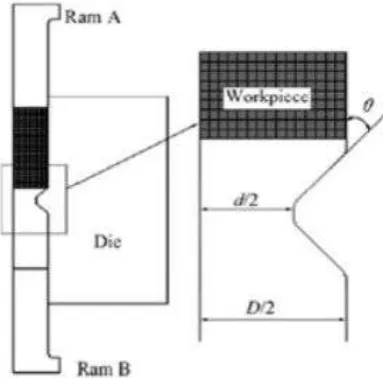
metallic materials with ultra-fine grain structures [3,5]. The CEC processing is performed by pushing a workpiece from one cylindrical chamber having the diameter D to another chamber with equal dimensions. The inter-chamber can be considered an extrusion die having a smaller diameter d [6], as show in fig. 1. The equivalent strain generated in the workpiece after n-pass CEC processing is given by the following equation [3,4,6].
Since strain affects the microstructure produced in the material, the homogeneity of strain across the cross-section and longitudinal cross-section of an extruded workpiece is of importance [8]. The strain homogeneity in the equal channel angular extrusion has been widely studied using finite element method (FEM), and it is found that the main factor affecting the strain homogeneity are the process parameters including the friction between workpiece and die, and die geometry [6,8,9]. The present study focuses on FEM tool used to investigation on the non-ferrous materials during the CEC process. The finial result will suggest which is the suitable material for the CEC process.
Adviser for metal Forming Process Design Expert (AFDEX) is a general-purpose metal forming simulator, which meets the following requirements for intelligent Bulk-Metal- Forming Simulation (BMFS). Currently, AFDEX is theoretically based on the rigid or elasto-thermoviscoplastic finite element method. AFDEX 2D and AFDEX 2D/DIE use quadrilateral finite elements. AFDEX 3D, AFDEX 3D/OPEN, and AFDEX 3D/DIE employ tetrahedral elements. AFDEX 2D/DIE and AFDEX 3D/DIE are integrated die structural analysis programs that accompany the respective BMF simulators, AFDEX 2D and AFDEX 3D. AFDEX MAT provides users with highly accurate true stress-strain curves for the materials in use at room or elevated temperature [10].
2 MATERIALS USED AND DIE SPECIFICATIONS
2.1 MATERIALS USED
SL.
No Materials
Major compositions
of material
Minimum Yield Strength
(MPa)
Working condition
a Aluminium (6061)
Silicon (0.40-0.8), copper (0.15), magnesium (0.8-1.2), iron (0.7) and manganese (0.8-1.2)
100 Cold
b (CDA377) Brass
Copper (58-61), iron (0.3), lead (1.2-2.5) and zinc
remaining
170 Cold
c Copper(cu-30zn) Copper (70) and zinc (30) 550 Hot
d Magnesium (AZ91)
Aluminium (8.84), Silicon (0.02), iron (0.02), manganese (0.18) and zinc (0.61)
150 Hot
2.2 DIE SPECIFICATIONS
The cylindrical die and workpiece can be simplified to an axisymmetric case. Fig 1 shows the axisymmetric FEM model for the simulation of the CEC processing. In the present study, cylinder chamber diameter ‘D’is 15 mm and channel diameter ‘d’is 12.5 mm. The conical die angle is 450.
3. SIMULATION PROCEDURE
During the simulation process, some assumptions are considered for CEC process as followers.
1. The Die is considered as rigid body.
2. The extrusion billet is a rigid-plastic material
3. The friction factors between the workpiece, ram, and die are constant i.e., 0.03.
4. The simulations consider the extrusion and compression of non-ferrous materials. (Aluminium, Brass, Copper and Magnesium)
The effects of process parameters on the strain were investigated up to 4th cycle of CEC. Two-dimensional, Axisymmetric plane-strain, Rigid–plastic FEM simulations of the CEC processing have been carried out using the commercial finite element software, AFDEX. In the simulation, the die and the ram can be assumed as rigid bodies since their strength is much higher than the workpiece material. Automatic remeshing was used to accommodate large deformation during the simulations.The billet is auto-meshed with Quadrilateral element. After meshing, the software gives the output model consists of 1120 nodes and 999 elements. A self-adaptive step length was used as the distance of the calculation. The friction between the billet and the die was modelled with the Coulomb friction law.
[image:2.595.320.542.434.755.2] [image:2.595.66.258.569.758.2]4. RESULTS AND DISCUSSIONS
[image:3.595.37.284.116.376.2]4.1 Comparison of effective strain in different
materials during 1
stcycle
Fig 3: Materials after 1st cycle of CEC process
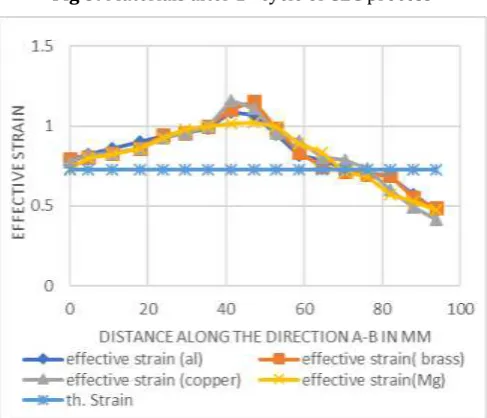
Fig 4: Effective strain of all four materials from the distance (A-B) in 1st cycle
From the Fig 4, it can be seen that effective strain induced in all the four materials along the length of the specimen(A-B) is strain distribution is inhomogeneous in the workpiece after 1st cycle of the CEC process. When the strain value of the different materials was compared with the theoretical strain value, the error observed in Aluminium, Brass, Copper and Magnesium is 14%, 14.31%, 14% and 14.05% up to 1st cycle respectively.
[image:3.595.314.540.132.374.2]4.2 Comparison of effective strain in different
materials during 2
ndcycle
Fig 5: Materials after 2nd cycle of CEC process
Fig 6: Effective strain of all four materials from the distance (A-B) in 2nd cycle
[image:3.595.309.557.387.608.2] [image:3.595.40.284.396.605.2]4.3 Comparison of effective strain in different
materials during 3
rdcycle
[image:4.595.309.549.101.609.2]Fi
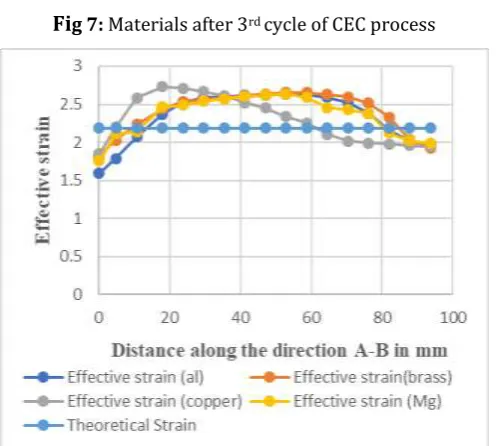
g 7: Materials after 3rd cycle of CEC processFig 8: Effective strain of all four materials from the distance (A-B) in 3rd cycle
From the Fig 8, it can be seen that effective strain induced in all the four materials along the length of the specimen(A-B) is inhomogeneous in the workpiece after 3rd cycle of the CEC process. When the strain value of the different materials was compared with the theoretical strain value, the error observed in Aluminium, Brass, Copper and Magnesium is 6.73%, 9.78%, 8.66% and 8.44% up to 3rd cycle respectively. The error value is reduced when compared to 2nd cycle.
4.4 Comparison of effective strain in different
materials during 4
thcycle
[image:4.595.46.272.125.386.2]Fig 9: Materials after 4th cycle of CEC process
Fig 10: Effective strain of all four materials from the distance (A-B) in 4th cycle
[image:4.595.311.557.358.597.2] [image:4.595.39.288.388.611.2]4.5 Comparison of hardness for different materials
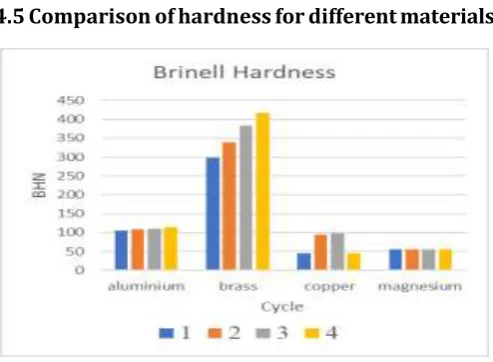
Fig 11: Brinell hardness of different materials
The Fig 11 shows the simulation values of Brinell hardness for different materials. It can be clearly seen from the above plot, that the hardness value for Aluminium and brass material is increased as compared to the other material. Having Aluminium and brass can be preferred for CEC process. BHN of Copper material has been increased is hardness up to 3rd cycle, then it has been decreased on the 4th cycle which clearly reveals that the material is about to turn brittle so it is not good for CEC process. The magnesium material is not showing any appreciable improvement in hardness during CEC process.
5. CONCLUSIONS
Rigid Plastic Finite Element Analysis with AFDEX software, is used to evaluate the plastic deformation behaviour of a non-ferrous material during its axis-symmetric extrusion and compression process through a CEC die and the following conclusions are drawn.
The effective strain has been increased in each non-ferrous material after every cycle of CEC process, the Aluminium, brass, copper and magnesium has increased from 0.8313 to 3.0751, 0.8336 to 3.1271, 0.8313 to 3.1174 and 0.8319 to 3.0975 up to 4th cycles respectively.
The BHN for Aluminium and brass has increased from 104.26 to 114.08 and 299.04 to 417. 27. The BHN of copper material has been increased hardness from 44.11 to 97.69 up to 3rd cycle, then it is decreased to 45.68 after 4th cycle, it is clearly noticed that the material is about to turn brittle. So, it is not good for CEC process. And there is no appreciable improvement in the hardness of the magnesium material compared to other materials.
References
[1] K.S.Kumar, H.Van Swygenhoven, S.Suresh. Mechanical Behaviour of Nanocrystalline Metals and Alloys. Acta Materialia, 51 (2003), p. 5743-5774.
[2] A.Rosochowski, L.Olejnik, M.Richert. Metal forming technology for producing bulk nanostructured metals. Proc. Of the 10th International Conference on Metal Forming, ed. J.Kusiak, P.Hartley, J.Majta, I.Pillinger, M.Pietrzyk, September (2004), p. 19.
[3] WANG Q D, LIN J B, PENG L M, CHEN Y J. Influence of cyclic extrusion and compression on the mechanical property of Mg alloy ZK60 [J]. Acta Metall Sin, 2008, 44: 55_58.
[4] RICHERT J, RICHERT M. A new method for unlimited deformation of metals and alloys [J]. Aluminium, 1986, 62(8): 604_607.
[5] LEE S W, YEH J W. Microstructural evolution and super plasticity of Al_5.8Mg_0.23Mn alloys processed by reciprocating extrusion [J]. Metall Mater Trans A, 2005, 36: 2225_2234.
[6] LIN Jin-bao, WANG Qu-dong, LIU Man-ping, CHEN Yong-jun, Hans J. ROVEN. Finite element analysis of strain distribution in ZK60 Mg alloy during cyclic extrusion and compression [J]. Trans. Nonferrous Met. Soc. China 22(2012) 1902_1906.
[7] M. Richert, H.P. Stu¨we, M.J. Zehetbauer, J. Richert, R. Pippan, Ch. Motz, E. Schafler. Work hardening and microstructure of AlMg5 after severe plastic deformation by cyclic extrusion and compression [J]. Materials Science and Engineering A355 (2003) 180-185.
[8] ORUGANTI R K, SUBRAMANIAN P R, MARTE J S, GIGLIOTTI M F, AMANCHERLA S. Effect of friction, backpressure and strain rate sensitivity on material flow during equal channel angular extrusion [J]. Mater Sci Eng A, 2005, 406: 102_109.
[9] REN Guo-cheng, ZHAO Guo-qun, XU Shu-bo, WANG Gui-qing. Finite element analysis of homogeneous deformation of AZ31 magnesium during equal channel angular pressing process [J]. Transactions of Nonferrous Metals Society of China, 2011, 21(4):849_855.