© 2019, IRJET | Impact Factor value: 7.211 | ISO 9001:2008 Certified Journal
| Page 148
Design, Deploy, Test the Performance Evaluation of Intelligent Street
Light System for Smart City
Rina Yadav
1, Dr. Rajesh Bansode
21
Rina Yadav, PG Student, Thakur College of Engineering and Technology, Kandivali (E), Mumbai
2
Dr. Rajesh Bansode, Prof of I.T Department, Thakur College of Engineering and Technology,
Kandivali (E), Mumbai
---***---Abstract -In a country like India, where people day in day out suffer problems due to power shortage, it is important to use it intelligently. Lighting systems, particularly within the public sector, are still designed as per the previous standards of reliability and they don’t usually complement latest technological developments. Street Lights accounts for almost 20% of the energy consumptions, however this figure rises sharply for large cities and municipal corporations, wherein almost 40% of electrical energy cost is attributed to street lights, lights in parks and other public amenities. With rising energy cost and reducing energy budget, there is an ever-increasing demand for resourceful and energy efficient street lights without compromising public security and safety. Intelligent lighting control and vitality the executive’s framework is an ideal answer for vitality sparing, particularly out in the open lighting the board. It understands remote on/off and diminishing of lights, which can spare vitality by 40%, spare lights support costs by half, and draw out light life by 25%. The streetlight control for every light will minimize in streetlight power and support cost, and increment accessibility of Street light.)
Key Words: IoT, Intelligent Lighting Control, Energy efficient, Power consumption, Street Light.
1. INTRODUCTION
Street Lights accounts for almost 20% of the energy consumptions, however this figure rises sharply for large cities and municipal corporations, wherein almost 40% of electrical energy cost is attributed to street lights, lights in parks and other public amenities. With rising energy cost and reducing energy budget, there is an ever-increasing demand for resourceful and energy efficient street lights without compromising public security and safety [1].
The IoT based lighting technology resolves the scalability challenges to manage a large number of streetlight facilities by aggregating and act on large amounts of data generated by IoT street lights to improve urban lighting services, maximize energy savings and reduce operation costs. As such, IoT networking technology creates a practical opportunity for more direct integration of LED street lighting into computer-based systems [1-2].
Recently, however, the increasing pressure associated with the raw material prices and also the increasing social
sensitivity to CO2 (Carbon Dioxide) emissions are leading towards development of new techniques and technologies which permit significant cost savings and larger respect for the environment [2].
The advantages of Smart street lighting system can be as follows:
Automatic Operation: The intelligent Street lights integrates high precision ambient light sensor for fully autonomous operation with optional manual mode of operation. In manual mode, facility managers can control each street lights individually or zone wise.
Adaptive Dimming: Each of intelligent street lights lits up with 40% brightness, the brightness level automatically increases to 100% whenever a presence is detected and reverts backs to defaults value after preset time if no further presence is detected. This helps reduce energy consumption significantly. The intelligent street lights also notifies neighboring street light to increase brightness on presence detection. Facility/Estate manager can define the default brightness level with Web based Integrated Smart City Manager Application. Anytime, Anywhere Connectivity: The Intelligent Street light uses industry standard 802.15.4 protocol for wireless connectivity with self-forming, self-healing mesh networking topology for highly reliable and scalable network with dynamic range enhancement. Each of our Intelligent street light being a unique IPv6 device, it can be accessed, monitored and controlled from anywhere, anytime with internet connectivity using our user friendly and feature rich our Smart City Manager Application.
© 2019, IRJET | Impact Factor value: 7.211 | ISO 9001:2008 Certified Journal
| Page 149
2. BACKGROUND AND MOTIVATION
2.1 Background
The IoT based lighting technology resolves the scalability challenges to manage a large number of streetlight facilities by aggregating and act on large amounts of data generated by IoT street lights to improve urban lighting services, maximize energy savings and reduce operation costs. As such, IoT networking technology creates a practical opportunity for more direct integration of LED street lighting into computer-based systems.
Increased life-expectancy: LED lights typically last between 20-25 years, compared to just three to six years for conventional lighting. This translates into reduced maintenance costs, fewer lamp renewals and less physical monitoring.
Demonstrable health and safety benefits: LED lights are more focused, which improves night-time visibility, reduces light spillage onto residential properties and can reduce vehicle accidents and crime.
Cost savings: Significant overall savings are generated from reduced energy usage, protection against rising energy prices, and lower maintenance and inspection costs.
2.2 Motivation
Street lights can be made intelligent by placing cameras or other sensors on them, which enables them to detect movement (e.g. Sensity's Light Sensory Network, GE's "Currents"). Additional technology enables the street lights to communicate with one another.
Different companies have different variations to this technology [2-3]. When a passer-by is detected by a camera or sensor, it will communicate this to neighboring street lights, which will brighten so that people are always surrounded by a safe circle of light.
The Smart Lighting technology of the Anhalt University of Applied Sciences does this as well, and has been installed in Bernburg-Strenzfeld in Germany. Street lights illuminate at a longer distance ahead of the pedestrian than behind the pedestrian in the Smart Lighting concept. Some companies also offer software with which the street lights can be monitored and managed wirelessly [4]. Clients, or other companies, can access the software from a computer, or even a tablet. From this software, they can gather data, pre-set levels of brightness and dimming time; receive warning signals when a light defect [5].
One of the scopes that IERC identifies for smart cities is smart lighting [2], which is also the problem addressed in this paper. The design of control strategies meant to match the emitted light level to the actual needs can lead to a significant reduction in energy costs and, in turn, to an
efficiency improvement. One of the popular strategies that city councils carry out is replacing old, expensive lights by low-cost and low-CO2 emissions devices such as the LED-based devices [2].
According to [1], using LED technology can improve energy efficiency by up to a factor of five without altering light intensity levels and with a relatively low effort. The work described in [3] analyzes the effect of using LED street lights from technical and economic perspectives to indicate savings of $100,000 per year. Similarly, a study for the city of Dublin [4] shows that currently the township spends almost $250,000 a year for a street lighting system with 2,019 lights, 30% of them (the more expensive) mercury vapor lights. They predict that replacing these with more efficient LED-based lights would save about $15,000 per year.
3. METHODOLOGY
One-third of the world’s roads are still lit by technology dating back to the 1960s. These streetlights are notoriously expensive, and typically account for approximately 40% of a city’s overall electricity costs.
With the threat of crime and anti-social behavior, turning the lights off is not an attractive option. In recent years, local authorities are starting to make the switch from traditional sodium bulbs to LED lights, which provide the same amount of lighting, whilst significantly reducing energy usage, and therefore energy costs.
A. To calculate the traffic intensity and output in form of visual representation.
The number of vehicles on road and count will get increase on the server. The record of the vehicle count will get added into data base on per hour basis and show them in graphical representation format. Further, which can be used in terms of traffic density analysis. Based on the graphs we have to decide the light intensity timings for the street.
The decision will be manual and we have to set those timings. Intensity calculations will be done with the IR sensor, data will be sent with the help of Wi-Fi module.
B. To calculate the light intensity of particular street lampposts
Light intensity will be decided based on the timeslot given in the web portal. There are three categories (low, medium, bright) and we have to decide timings for those three categories.
© 2019, IRJET | Impact Factor value: 7.211 | ISO 9001:2008 Certified Journal
| Page 150
C. To change the light intensity when user crosses the road
When user/object crosses the road, the light intensity will be high and the light will glow with high intensity. And user/object sense will be recorded with the IR sensor.
When user or object crosses the IR sensor then light next to it will glow with high intensity it will high for few seconds and then again go to entre original state and next light will glow with full intensity. Spacing between each pole can be calculated as following:
(1)
Every behavior 𝑃𝑖𝑘 has a cost 𝑊𝑖𝑘 which depends on the energy cost per unit of time, and that can be expressed as:
(2)
D. Parking data collection
To calculate the parking data, the use of RFID or IR sensor will be used for the detection of presence of vehicle. When there is vehicle the rays by sensor will get reflected and based in that we will detect the presence of vehicle and mark the location as occupied by the vehicle. For demo we are using four sensors each for one parking location
To gather data on periodic basis, there will be continuous updation of the current parking status to online server.
In data base we will be having real time status of all the data for parking locations).
E. User Registration for parking and e-wallet for prepaid parking.
For the parking user registration, we are going to allow user to book paring places and pay from wallet so we should have entries for user in database.
For that we will be designing registration form and at the time of adding user we will be adding some amount to wallet.
To have table for parking locations, or when user want to book the location, user will open the booking page and he will see list of all locations with distance from the current location and the available
places then user can click on book button and book parking with time.
As user book parking, the amount will get deducted from balance and slot will be booked. Once user goes over there, user have to mark it as parked otherwise to will remain as booked in database.
Even user is not going there and have to cancel the parking, otherwise that will remain booked.
4. RELATED WORK
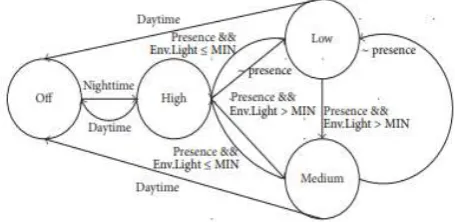
[image:3.595.327.555.324.435.2]The execution of any task in Ai k can generate a set of internal events. Consider for instance a task that measures the light emitted by a sensor node. Since the latency of the hardware when performing this operation cannot be neglected, there is a lapse of time between the instant when the operation is started and when it ends.
Figure 1: Transition diagram for the light intensity states. When the operation finishes the hardware generates an internal event (e.g., light Done()) to announce that the data is available. A sensor node may also observe external events which are generated by the environment rather than being a result of International Journal of Distributed Sensor Networks 5 the execution of some of its tasks. Examples of external events are the reception of a message from another sensor node, an alarm that goes off when a value exceeds some threshold, and so on.
Both internal and external events that occur in a node 𝑘 may have the role of a triggering event for some behavior. External events are enqueued in the event queue 𝐸𝑘 [10] in the order in which they occur. Meanwhile, a newly generated internal event will be processed immediately. We can think of an internal event as being conceptually processed as part of processing the external event whose associated task generated it. For the parking system the execution take place in the following steps using RFID.
© 2019, IRJET | Impact Factor value: 7.211 | ISO 9001:2008 Certified Journal
| Page 151
or any other distinct data. This step accomplishes the datafeed to the tag.
Step 2: Reading from the tag: The information from the tag needs to be read during the car parking. In this step, the data is read from the tag with the help of an RFID reader.
Step 3: Data feed to the System: The data from the RFID reader has to be transferred to the system for the actual comparison of data and further processes. During this phase the data from the RFID reader is fed to the system using RS232.
Step 4: Tracking the count: To properly utilize the parking lot, the number of the cars presented in the parking lot needs to be tracked. In this the number of cars in the parking lot is incremented for every car entering the lot and is decremented for every car leaving the lot
A. Calculating the distance between each Street Light Pole would be undergoing the following details:
Road Details: The Width of Road would be the major parameter need to take in consideration. The width would be denoted by “w”.
Pole Details: The Pole Height would be major concern in this parameter which need to be take inconsideration. The height of pole would be denoted by “h”.
Luminaire of each Pole: Various other elements would be listed below to calculate the luminaire. The following are the different parameters:
o Wattage of Luminaires
o Lamp Output denoted as “LO”.
o Required lux level denoted as “Eh”.
o Coefficient of Utilization factor denoted as “Cu”.
o Lamp Lumen Depreciation factor denoted as “LLD”.
o Lego Digital Designer denoted as “LDD”
Table-1: Values and Parameters for Distance Calculation
Parameters Values
Width of Road “w” 7 meter
Height of Pole “h” 30 foot
Wattage of Luminaires 250 Watt
Lamp Output denoted as “LO”. 3320 Lumen
Required lux level denoted as “Eh”. 5 Lux
Coefficient of Utilization factor 0.18
denoted as “Cu”.
Lamp Lumen Depreciation factor
denoted as “LLD”. 0.8
Lego Digital Designer denoted as
“LDD” 0.9
Spacing between each pole “D” = 52 Meter
B. Calculating Street light Luminaire Watt
Road Details: The Width of Road would be the major parameter need to take in consideration. The width would be denoted by “w”.
Distance of Pole: The distance would be another element that would be taken into consideration. For Luminaire Watt calculation the distance would be taken from the preceding calculation.
Illumination Level for Street Light: The required illumination level for street light would be calculated for desired illumination on roads. The required illumination level for street light would be denoted by “L”.
Luminous Efficiency: Luminous efficiency is a measure how well a light source produces visible light. The Luminous would be denoted by “Le”. Maintenance factor: It accounts for the reduction in
light levels over time. Here it could be denoted by “mf”.
Coefficient of Utilization: It is a measure of the efficiency of a luminaire in transferring luminous energy to the working plane in a particular area. Here it could be denoted by “Cu”.
Street Light Luminaire Watt can be as following:
(3) Table- 2: Values and Parameters for Luminaire
Calculation
Parameters Values
Width of Road “w” 7 meter
Distance of Pole “D” 52 meter
Illumination Level “L” 7 Lux/m
Luminous Efficiency “Le” 25 Lumen/watt
Maintenance factor “mf” 0.29
Coefficient of Utilization
© 2019, IRJET | Impact Factor value: 7.211 | ISO 9001:2008 Certified Journal
| Page 152
The Watt of Each street Light Luminaire will be calculated asfollowing:
Average lumen/Luminous Efficiency = 9762.86/25 = 390 watt
On the same line to calculate the required power for street light area would be carried out in following manner:
(3) Required Street light Area to be illuminated “A”is 1 Square Required Street Watt is 0.28 Watt per square meter.
C. Vehicle Intensity Chart:
The smart city scenario we are simulating involves a set of intelligent devices—in the Internet of Things (IoT) terminology things—which communicate and coordinate their actions to achieve intelligent street lighting.
[image:5.595.48.550.186.777.2] The devices are installed on the lampposts within the neighborhood that is being monitored and, additionally, in other strategic positions within this area.
Figure 2: Vehicle Intensity Chart
D. Parking data collection:
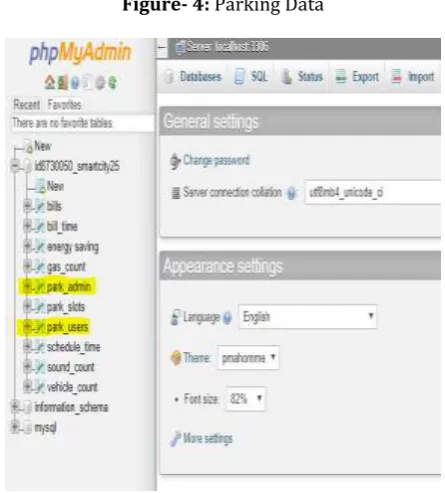
The following figure depicts the presence of vacant and occupied parking slots.
This includes booking of vehicle, unpark the vehicle, booking cancel and checking of balance
[image:5.595.322.545.235.482.2]Figure-3: Availability of Parking
Figure- 4: Parking Data
Figure-5: Parking Admin
E. View Noise Statistics
The following figures depicts the Noise Intensity Chart.
Here also we have to select the date and based on the date we are getting the graph that will give us idea of the Air pollution statistics.
© 2019, IRJET | Impact Factor value: 7.211 | ISO 9001:2008 Certified Journal
| Page 153
All statistics data (Air pollution, Noise pollution, Energysaving) will be saved in the below tables.
Figure-7: Statistics Data
F. Energy saving statistics:
Energy saving will be calculated based on energy saved between the 5 -11 in the evening.
We will set the light intensity based on the traffic statistics, if we set the light intensity to full bright then there will not be any saving but if we set intensity at mid or low then that will be consider as the energy saving. We have used below formulas and code for calculation of energy saving.
$total_consumption = 60* 6 * 2;
$low_start_explod= explode(":",$low_start);
$low_start_min =
60*$low_start_explod[0] + $low_start_explod[1];
$low_end_explod= explode(":",$low_end);
$low_end_min = 60*$low_end_explod[0] + $low_end_explod[1];
$low_energy_saving = $low_end_min - $low_start_min; // saving 70%
$mid_start_explod= explode(":",$mid_start);
$mid_start_min =
60*$mid_start_explod[0] + $mid_start_explod[1];
$mid_end_explod= explode(":",$mid_end);
$mid_end_min = 60*$mid_end_explod[0] + $mid_end_explod[1];
$mid_energy_saving = $mid_end_min - $mid_start_min; // saving 40%
$our_consumption = ($low_energy_saving * 2 * 0.3) + ($mid_energy_saving * 2 * 0.6);
$total_saving = $total_consumption - $our_consumption;
$percentage_saving =
$total_saving/$total_consumption * 100;
5. CONCLUSION
The design and analysis of Smart Street Light have been discussed with the execution schematics. In the next part, the energy estimation has been calculated with the, with addition to this, the distance calculation of the pole has been calculated for higher efficient results. In the last part, the calculation for the vehicle intensity chart and parking data collection has been done with Noise and Energy Saving.
REFERENCES
[1] IERC—Internet of Things, “The Internet of Things 2012—
New Horizons,” 2012,
http://www.internet-of-things-research.eu/ pdf/IERC Cluster Book 2012 WEB.pdf.
[2] G. S. Dutt, “Illumination and sustainable development.
Part I: technology and economics,” Energy for Sustainable Development, vol. 1, no. 1, pp. 23–35, 1994.
[3] M. Stockman, “Light-emitting devices: from nano-optics
to street lights,” Nature Materials, vol. 3, no. 7, pp. 423– 424, 2004.
[4] W. Murff and Kuntz, “Winter 2011: sustainable cities:
Salem street lights,” City of Salem, February 2012, http://www .cityofsalem.net/Residents/Sustainable-Salem/SCI/Documents/ StreetLights/Group1 Book.pdf.
[5] P. Leonard, “Memorandum: street lights,” City of Dublin,
February 2010,
http://www.upperdublin.net/information/sustainable/ streetlights.aspx.
[6] L. Martirano, “A smart lighting control to save energy,”
© 2019, IRJET | Impact Factor value: 7.211 | ISO 9001:2008 Certified Journal
| Page 154
Systems (IDAACS ’11), vol. 1, pp. 132–138, September2011.
[7] P. Elejoste, I. Angulo, A. Perallos et al., “An easy to deploy
street light control system based on wireless communication and led technology,” Sensors, vol. 13, no. 5, pp. 6492–6523, 2013.
[8] T. P. Huynh, Y. K. Tan, and K. J. Tseng, “Energy-aware
wireless sensor network with ambient intelligence for smart LED lighting system control,” in Proceedings of the 37th Annual Conference of the IEEE Industrial Electronics Society (IECON ’11), pp. 2923–2928, November 2011.
[9] X. Cao, J. Chen, Y. Xiao, and Y. Sun,
“Building-environment control with wireless sensor and actuator networks: centralized versus distributed,” IEEE Transactions on Industrial Electronics, vol. 57, no. 11, pp. 3596–3605, 2010.
[10] J. S. Sandhu, “Wireless sensor networks for commercial
lighting control: decision making with multi-agent systems,” in Proceedings of the AAAI Workshop on Sensor Networks, pp. 131–140, 2004.
[11] Y. Wu, C. Shi, X. Zhang, and W. Yang, “Design of new
intelligent street light control system,” M. Young, The Technical Writer’s Handbook. Mill Valley, CA: University Science, 1989.
[12] R. Nicole, “Title of paper with only first word
capitalized,” J. Name Stand. Abbrev., in press.