Improving and Comparing Data Collection
Methodologies for Decision Rule
Calibration in Agent-Based Simulation. A
Case Study of Dairy Supply Chain in
Indonesia
Dhanan Sarwo Utomo
This thesis is submitted for the degree of Doctor of Philosophy
September 2019
Declaration
This thesis has not been submitted in support of an application for another degree at this or any other university. It is the result of my own work and includes nothing that is the outcome of work done in collaboration except where specifically indicated. Many of the ideas in this thesis were the product of discussion with my supervisor Dr. Stephan Onggo and Dr Stephen Eldridge.
Excerpts of this thesis have been submitted or published in the following conference academic publications.
Utomo, D. S., Onggo, B. S., & Eldridge, S. (2018). Applications of agent-based modelling and simulation in the agri-food supply chains. European Journal of Operational Research. 269 (3), 794-805.
Utomo, D. S., Onggo, B. S., Eldridge, S., Daud, A. R., & Tejaningsih, S. (2018). Using Scenario-Based Questionnaire for Agent-Based Simulation Model Calibration and Validation: An Agri-food Supply Chain Example. Submitted to European Journal of Operational Research.
Utomo, D. S., Onggo, B. S., Eldridge, S., Daud, A. R., & Tejaningsih, S. (2018). Improving the Credibility of Agent-Based Simulation using Role Playing Games: A Case Study in Dairy Supply Chain. In preparation for submission to European Journal of Operational Research.
Dhanan Sarwo Utomo
Abstract
This study contributes to human behaviour (decision rule) modelling in the agent-based simulation, by improving the existing data collection methodologies and comparing their benefits. Improving data collection methodologies can help in developing a more realistic agent’s decision rule and increasing the validity and credibility of the final model. This study uses a dairy supply chain case because the actors in this context can have one to one correspondence with the agents in the simulation.
This study begins by presenting a literature review on the applications of agent-based simulation in the agri-food supply chain. This literature review highlights existing agent-based modelling practices in the agri-food supply chain such as the scope of the modelling, data collection, validation and sensitivity analysis techniques. This study then proposes some improvements to the existing data collection methodologies namely questionnaire survey and role-playing game. This study proposes the use of a scenario-based questionnaire to improve the benefits of a questionnaire survey for decision rules calibration. While to extend the usefulness of role-playing game this study propose the use of the design of experiment, and game scaling based on empirical probability distribution.
Acknowledgements
Contents
1 INTRODUCTION ... 1
1.1 Background and Motivation ... 1
1.2 Research Objectives ... 3
1.3 Research Methodology ... 5
1.4 Thesis Structure ... 7
2 APPLICATIONS OF AGENT-BASED MODELLING AND SIMULATION IN THE AGRI-FOOD SUPPLY CHAINS ... 9
2.1 Introduction ... 10
2.2 The Literature Search Methodology ... 12
2.3 Agent-based simulation applications in agri-food supply chain ... 14
2.3.1 Research context of the previous ABS applications in ASC ... 16
2.3.2 Objectives of the previous ABS applications in ASC ... 18
2.3.3 The use of data in the previous ABS applications in ASC ... 20
2.3.4 Agents, their decision-making rules and their interactions ... 22
2.3.5 Validation and Sensitivity Analysis ... 25
2.3.6 Model representation methods ... 29
2.4 Discussion ... 29
2.4.1 The state of research in ASC that uses ABS ... 30
2.4.2 The gap between ASC and ABS research topic ... 32
2.5 Conclusions ... 38
2.6 Reflection from the Excluded Literature ... 39
3 USING SCENARIO-BASED QUESTIONNAIRE FOR AGENT-BASED SIMULATION MODEL CALIBRATION AND VALIDATION: AN AGRI-FOOD SUPPLY CHAIN EXAMPLE ... 42
3.1 Introduction ... 43
3.2 Literature review ... 45
3.2.1 The use of the questionnaire survey method in ABS studies in ASC ... 45
3.2.2 The use of scenario-based questionnaires in eliciting human decision rules 47 3.3 ABS base model of dairy supply chain in West Java... 48
3.3.1 Description of the base model ... 51
3.3.2 The patch agent ... 52
3.3.3 The farmer household agent ... 53
3.3.4 The cooperative agent ... 62
3.4 Survey Instrument Design, Survey Process and Survey Findings ... 62
3.4.1 Survey instrument design and survey process ... 62
3.4.2 Empirical data for input parameter calibration and assumption validation . 67 3.4.3 Empirical buying decision making rule ... 70
3.4.4 Empirical selling decision making rule ... 72
3.4.5 Empirical sorting decision making rule ... 73
3.4.6 Respondents’ perception toward the scenario-based questionnaire ... 74
3.5 Experiment Results and Sensitivity Analysis ... 75
3.5.2 Impacts of empirical decision rules on model outputs ... 80
3.5.3 Effects of various decision making rules on the system performance... 83
3.6 Discussion ... 87
3.6.1 Insights from scenario-based questionnaire data collection process ... 87
3.6.2 Insights from experiments with a variety of empirical decision rules ... 91
3.6.3 Insights for policymaking ... 93
3.6.4 Generalizability of the applicability of scenario-based questionnaire of the results ... 95
3.7 Conclusions ... 96
4 IMPROVING THE CREDIBILITY OF AGENT-BASED SIMULATION USING ROLE PLAYING GAMES: A CASE STUDY IN DAIRY SUPPLY CHAIN ... 98
4.1 Introduction ... 99
4.2 Literature Review ... 102
4.2.1 The process to design and use an RPG for ABS calibration ... 102
4.2.2 The use and the validation of RPG calibrated ABS models ... 104
4.2.3 The purposes of the RPG extension ... 106
4.2.4 ABS model of dairy supply chain in West Java and the hypothesised decision rules ... 107
4.3 RPG development and data collection process ... 108
4.3.1 RPG development process ... 109
4.3.2 RPG data collection process ... 119
4.4 Findings from the RPG data collection ... 122
4.4.1 Forage collection decision ... 122
4.4.2 Cow selling decision ... 124
4.4.3 Selling priority decision ... 125
4.4.4 Cow buying and upgrading decision ... 125
4.4.5 Cow trading partner ... 126
4.4.6 Players’ experiences ... 127
4.5 ABS Calibration and Simulation Experiment ... 128
4.5.1 Impacts on model outputs relative to the base model ... 129
4.5.2 Impacts on operational validity ... 130
4.5.3 Effects of various decision-making rules on the system performance ... 135
4.6 Discussions ... 141
4.6.1 Methodological insights ... 141
4.6.2 Insights from experiments with a variety of calibrated models ... 145
4.6.3 Practical insights ... 146
4.7 Conclusions ... 149
5 DISCUSSION ... 151
5.1 Comparison between data collection methods ... 151
5.1.1 Hypothesis 1: Different data collection methods can produce empirical decision rules with different properties ... 152
5.2 Contributions of this study ... 175
6 CONCLUSION AND FURTHER RESEARCH ... 178
6.1 Conclusions ... 178
6.2 Limitations and Further Research ... 180
7 REFERENCES ... 183
List of Tables
Table 2. 1 Keywords used in database searching and the number of returned articles .. 13
Table 2. 2 Distribution of journals that publish ABS applications in ASC ... 16
Table 2. 3 Summary of the research context ... 17
Table 2. 4 Classification based on the type of research objectives ... 18
Table 2. 5 Classification based on policy scope ... 20
Table 2. 6 Input and output data in the previous ABS applications... 21
Table 2. 7 Summary of model details ... 23
Table 2. 8 Paper classification based on the validation technique ... 27
Table 2. 9 Summary of output analysis... 29
Table 2. 10 Classification based on model representation techniques ... 29
Table 2. 11 Summary of discussion from other literature review ... 31
Table 2. 12 Top 10 popular keywords in each cluster of ASC research ... 34
Table 2. 13 Top 10 popular keywords in each cluster of ABS research ... 35
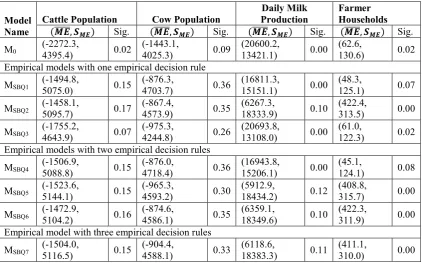
Table 3. 1 Empirical parameters for model initiation ... 69
Table 3. 2 Decision rules in models calibrated with scenario-based questionnaire. ... 76
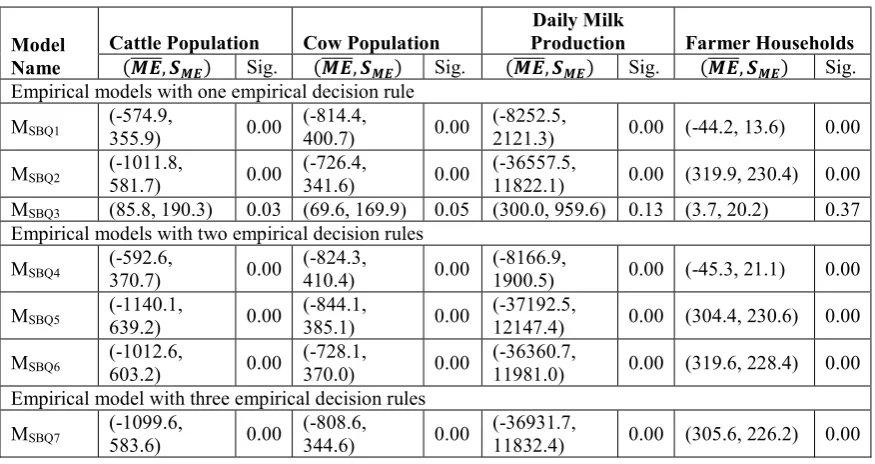
Table 3. 4 The descriptive statistics and t-result of ABS models’ error from the real data
... 78
Table 3. 5 Summary of regression analysis between the simulation outputs and the real data ... 80
Table 3. 6 The descriptive statistics and t-result of empirical ABS deviation from the base model ... 81
Table 4. 1 Summary of RPG’s parameters ... 116
Table 4. 2 The RPG experiment sets ... 118
Table 4. 3 Player composition in the RPG experiments ... 120
Table 4. 4 Decision rules in models calibrated with RPG ... 128
Table 4. 5 the descriptive statistics and t-result of empirical ABS deviation from the base model (* indicates significant at 5%) ... 130
Table 4. 6 Cattle population, cow population, average daily milk production and the number of farmer households in Pangalengan West Java 2010-2016 (KPBS, 2016) ... 131
Table 4. 7 Summary of regression analysis between the simulation outputs and the real data (* indicates significant at 5%) ... 132
Table 4. 8 The descriptive statistics and t-result of ABS models’ mean error (* indicates significant at 5%) ... 134
Table 5. 1 Summary of the first hypothesis analysis ... 161
Table 5. 2 Summary of the second hypothesis analysis ... 164
List of Figures
Figure 1. 1: Research methodology ... 7
Figure 2. 1: PRISMA flow diagram of publication data collection process ... 14
Figure 2. 2: Publication of ABS application per year (2016 contains two-month worth of data) ... 15
Figure 2. 3: Bibliographic mapping of ASC research ... 33
Figure 2. 4: Bibliographic mapping of ABS in ASC ... 35
Figure 3. 1 Income from retaining and selling the cows ... 58
Figure 3. 2: Process used in developing the scenario-based questionnaire ... 65
Figure 3. 3 the average of cow population in 2015 across different number of replications ... 82
Figure 3. 4 Cow population of models calibrated with scenario-based questionnaire .... 83
Figure 3. 5 Cattle mortality rate of models calibrated with scenario-based questionnaire ... 84
Figure 3. 6 The number of farmer households of models calibrated with scenario-based questionnaire ... 84
Figure 3. 8 Average daily milk production of models calibrated with scenario-based
questionnaire ... 86
Figure 3. 9 Cow population under different forage competition scenarios ... 87
Figure 4. 1: Research methodology for extending RPG data collection method ... 109
Figure 4. 2: The RPG game board ... 111
Figure 4. 3: Cow, vehicle, event and mortality cards translated to English from Bahasa Indonesia. All images used are taken from public domain ... 113
Figure 4. 4: Clustering result to select players for RPG experiments ... 119
Figure 4. 5: The average farmer’s asset of models calibrated with RPG ... 135
Figure 4. 6: The cooperative’s total asset of models calibrated with RPG ... 136
Figure 4. 7: The average daily milk production of models calibrated with RPG ... 137
Figure 4. 8: The cow population of models calibrated with RPG... 138
Figure 4. 9: The daily cattle mortality of models calibrated with RPG ... 139
Figure 4. 10: The number of farmer household of models calibrated with RPG ... 139
Figure 4. 11: Total amount of forage remaining on patch of models calibrated with RPG ... 141
List of Abbreviations and Acronyms
ABS: Agent-based simulation
ASC: Agri-food Supply Chain
RPG: Role Playing Game
List of Appendices
Appendix 1 Questions to validate model assumptions and identify input parameters . 211
Appendix 2 Scenarios validate and calibrate agent’s decision rules ... 214
Appendix 3 Statistical analysis of empirical buying decision rules... 217
Appendix 4 Statistical analysis of empirical buying decision rules... 218
1
Introduction
1.1
Background and Motivation
Agent-based simulation (ABS) is an operational research/management science (OR/MS) technique that is gaining popularity in supporting decision making. ABS attempts to open the black box of modelling by allowing researchers to identify both the agents’ behaviours and how the agents make decisions within the system. Therefore, it allows researchers to relate the human decision rules to the emergent/macroscopic patterns. ABS does not necessarily guarantee an improvement in the model’s predictive capabilities, but it does provide the opportunity to generate more insights into how the system works from the perspective of the agents’ behaviours. These insights can have a practical value for policymakers because they enable the evaluation of interventions aimed at modifying agent behaviours even if other system parameters are beyond the policymakers’ direct control.
2007), and the empirical validation process for ABS also tends to be more complicated (Heath et al., 2009). Unfortunately, behavioural modelling is still a challenge in ABS methodology owing to the difficulties in acquiring the data necessary to develop a more realistic agent’s behaviour (Macal, 2016). This approach to behavioural modelling is also important in other research fields such as operations management (Bendoly et al., 2006, Bendoly et al., 2010).
Data collection is also the most common problem in any simulation project, especially when modelling systems with high complexity (Onggo et al., 2013). There are previous studies aimed at comparing the benefits of different data collection methods in a simulation study and in developing ABS.
Eldabi et al. (2002) compared the benefits and potential biases of quantitative and qualitative data collection methods in a simulation study.
Janssen and Ostrom (2006) summarised the benefits of different empirical methods to calibrate ABS in social sciences (i.e., survey with a close-ended questionnaire, case studies, stylized facts, role-playing games, and laboratory experiments) from various studies.
Robinson et al. (2007) summarised experiences from many researchers in using various data collection methods (i.e. sample surveys, participant observation, field and laboratory experiments, companion modelling and GIS) to calibrate ABS in land use science. They presented one case study for each data collection method.
Smajgl et al. (2011a) mapped the usefulness of various data collection methods (survey, interview, experiment, observation, RPG, and expert knowledge) in each step of model parameterisation. They presented five case studies to demonstrate different steps of model parameterisation.
An (2012) reviewed applications of ABS to model human decision in coupled human-natural systems, including in term of data collection methods.
The previous literature has shown that each data collection method has its advantages and disadvantages. However, ABS research which aims to improve a data collection method and test its benefits in increasing a model’s validity is considerably rare, especially in the field of agri-food supply chains that become the context of this study.
Additionally, when comparing the benefits of various data collection methods, previous literature mainly draws lesson learned from different case studies. This practice can be biased because the complexity of the case under study may influence the benefits of a data collection method in calibrating an agent’s decision rule. Hence, this research seeks to improve and compare different data collection methods in the same case study and the same target population. Since this study uses the same case study, the calibrated models should produce the same outputs. This strategy enables us to examine and compare the model validity resulting from different calibration approaches. It also allows us to compare respondents’ experience (from the respondents’ perspective) during their participation in the two data collection processes.
1.2
Research Objectives
approach, and role-playing game (RPG) that is more inductive qualitative. Further reasons why these two data collection methods were selected are explained in Chapter 2.
Secondly, this study proposes potential improvements to the questionnaire survey and RPG methods, in order to reduce their weaknesses and extend their benefits. Improvement on the questionnaire survey method that was done by incorporating scenarios is discussed in Chapter 3. The process to improve the RPG by incorporating the design of experiment and increasing the correspondence between RPG and the reality is discussed in Chapter 4.
Thirdly, this study compares the benefits of these data collection methods in calibrating decision rules in ABS. In this comparison the following hypotheses are discussed:
H1: Different data collection methods can produce empirical decision rules with different properties. Properties in this study include the structure of the decision rule, whether it can incorporate the context of an agent’s decision, and whether the decision rules can be related to the previous theories.
H2: Different data collection methods can produce empirical models with different levels of operational validity. A model’s operational validity in this study is measured based on the match between the model’s outputs and the real world data.
Finally, through computer experiments, this study proposes several behavioural interventions for the real system.
This study uses a context of dairy supply chain in Indonesia to test the benefits of the data collection methods mentioned above. This context is appropriate because the respondents (smallholder farmers) mainly controlled their own decisions. Hence, it is likely that their responses reflect their behaviour in reality. Chapters 2 and Chapter 3 further explain the uniqueness of the context discussed in this study compared to previous ABS applications.
1.3
Research Methodology
This study began by selecting a case study appropriate to test the research hypotheses. The case study that was selected is the dairy supply chain in Indonesia. The reason for this case study selection is explained further in Chapter 2.
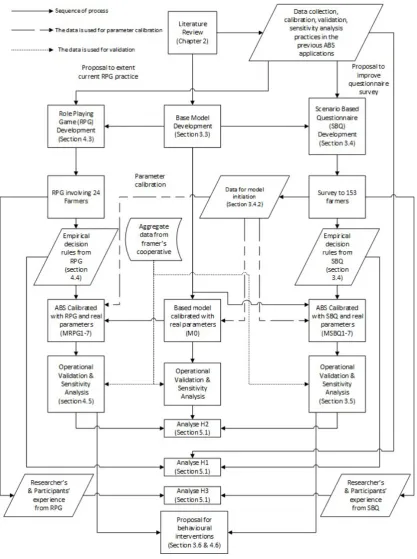
Based on the literature collected in Chapter 2, a base model was developed (see Figure 1.1). All of the assumptions in the base model were face validated by the experts in the case study site. The assumptions in this base model serve as hypotheses to be tested with empirical data collection. Important parameters to initiate the base and calibrated models were also identified through empirical data collection. Empirical data collection using the scenario-based questionnaire was done in 2016. 153 farmers in 16 villages in West Java were involved in this data collection. The RPG data collection was done in 2017 and involved 24 farmers. In each data collection, the stakeholder’s experiences and behaviours were recorded.
analysis were done to analyse the data from RPG. The empirical decision rules found in the two data collection exercises are used to calibrate the decision rules in the base model. Seven combinations of possible calibration are found from each data collection process.
Figure 1. 1: Research methodology
1.4
Thesis Structure
agri-food supply chain. This discussion gives justification that the two data collection methods to be compared are relatively new and have rarely been used in the previous ABS applications in the agri-food supply chain. Therefore, their potential benefits, especially in developing models of the actor’s behaviour, need to be investigated further. This chapter also highlights the uniqueness of the case study being used, compared to the previous ABS applications.
The specification of the base model that was developed to represent the phenomena occurring in the case study is then explained in Chapter 3. This section also discusses the process to develop a scenario-based questionnaire to identify farmers’ decision rules and a questionnaire to collect empirical data for model initiation. Finally, findings from the data collection, calibration results, and lessons learned from the use of scenario-based questionnaire are discussed.
Chapter 4 focuses more on the RPG data collection and calibration. It starts by describing the way an RPG is commonly developed. This discussion shows that an RPG is mainly used to facilitate discussion and support the learning process for real-world actors, but not for developing a realistic representation of human decision rules. In order to use an RPG for this purpose, several modifications to the common practice are proposed. This section then discusses the findings, the calibration results and the lessons learned from the RPG data collection.
Chapter 5 summarises the lessons learned from the two data collection process. It starts by analysing the three research hypotheses and then discusses the potential contributions of this study.
2
Applications of
Agent-Based Modelling and
Simulation in the Agri-Food
Supply Chains
This chapter is taken from an invited review paper authored by Dhanan Sarwo Utomo, Dr Bhakti Stephan Onggo, and Dr Stephen Eldridge, from Lancaster University and Trinity Business School. This paper has been published in the European Journal of Operational Research, volume 269, page 794-805, 2018. Adjustments are made, and commentaries are added to the original manuscript to improve the coherence with other parts of this thesis.
Abstract
products, empirical (as opposed to hypothetical) data; decision-making related to production planning and investment; and the use of black box validation. The second part of this paper uses bibliographic mapping to analyse areas in ASC research which are yet to be addressed using ABS. The findings from bibliographic mapping show that areas such as collaboration and competition, buyer-seller relationships, and service are under-researched. In addition, key actors in ASC such as food processors, supermarkets and retailers have not been included in the ABS models reported. Furthermore, important supply chain management theories, such as Transaction Cost Economics and Resource-Based View, are not used in the existing models.
Keywords: Literature review, Agent-based modelling, Agri-food supply chain, bibliographic mapping
2.1
Introduction
al., 2016). Actors in ASC have to adapt to these external factors in order to survive. In the light of these characteristics, it is not surprising that some authors (e.g., Ahumada and Villalobos (2009)) argue that ASC are complex and hard to manage.
The complexities of ASC have attracted the interest of Operational Research and Management Science (OR/MS) researchers since the late 1940s (Borodin et al., 2016) and they have been the subject of a number of reviews. Ahumada and Villalobos (2009) reviewed the application of mathematical models in agricultural production and distribution planning while Janssen and van Ittersum (2007) reviewed the use of optimisation models (known as bio-economic farm model in the agriculture literature) to assess farm innovations and responses to policies. More recently, Soto-Silva et al. (2016) reviewed the applications of OR/MS methods in fresh fruit supply chain and Borodin et al. (2016) reviewed the methods to handling uncertainty in ASC. The OR/MS techniques in these reviews include Agent-Based Simulation (ABS) and the benefits of using ABS in ASC have been highlighted by a number of authors (e.g., Higgins et al. (2007), Nolan et al. (2009), Higgins et al. (2010), Krejci and Beamon (2012) and Pla et al. (2014)).
Initially, the literature search methodology is described in Section 2.2. We then present an overview of the application of ABS in ASC based on our literature review and discuss the models and modelling approaches reported. In particular, the modelling objectives, application context, models (inputs, outputs, actors, rules and interactions), output analysis, experimentation, validation and model representation are discussed (in Section 2.3). Subsequently, we present a bibliographic mapping analysis and discuss the ASC topics that are yet to be addressed by ABS researchers (in Section 2.4). Finally, the conclusions of this literature review are presented in section 2.5.
2.2
The Literature Search Methodology
The literature search employed the following databases: ABI/INFORM, Academic Search Complete, Business Source Complete, Science Direct and Web of Science. The search is restricted to articles published in international peer-reviewed journals that were written in English and published before February 2016. The keywords used in literature search and the results returned from the search are presented in Table 2.1. The keyword search was applied to the content of the articles (i.e., not limited to title and abstract only).
Table 2. 1 Keywords used in database searching and the number of returned articles Code Keywords ABI / INFORM Academic Search Complete Business Source Complete Science Direct
Web of Science Total A ("agent based" OR "multi agent") AND (“simulation ” OR (“modelling ” OR “modelling” ))
6,360 5,029 2,014 27,148 11,885 41,736
B
"supply chain" OR "supply chains"
44,606 9,774 23,230 43,972 23,100 144,682
C
“agriculture” OR
“agricultural ” OR “food” OR “agri-food” OR “livestock” OR “fisheries”
276,808 1,139,158 116,263 1,877,194 716,254 4,125,677
D B AND C 13,608 2,000 1,849 16,035 2,444 35,936
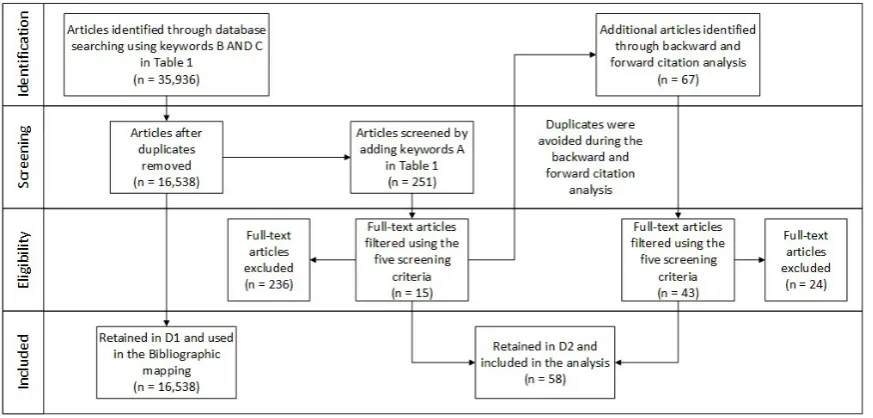
the reference section. Finally, the article must address research questions related to supply chain topics (e.g., processes and production systems, inventory management, demand management and improving the performance in the supply chain (Oliveira et al., 2016) and include one or more ASC actors (e.g., producers, harvesting & transport, food processor & storage, packaging & handling, distributors, retailers, consumers, and waste management). Similar to Cunningham (2001), Da Silva and de Souza Filho (2007), Webber and Labaste (2009) and Higgins et al. (2010), we include articles that discuss livestock, crops, fisheries, and food products in our agri-food supply chain review. Using these screening criteria, 15 articles were retained. Next, backwards and forward citation analysis of these articles was conducted using Google Scholar and Web of Science. After applying the same screening criteria, the number of articles increased to 58. These comprise dataset D2 that was used for our review.
Figure 2. 1: PRISMA flow diagram of publication data collection process
2.3
Agent-based simulation applications in agri-food supply
chain
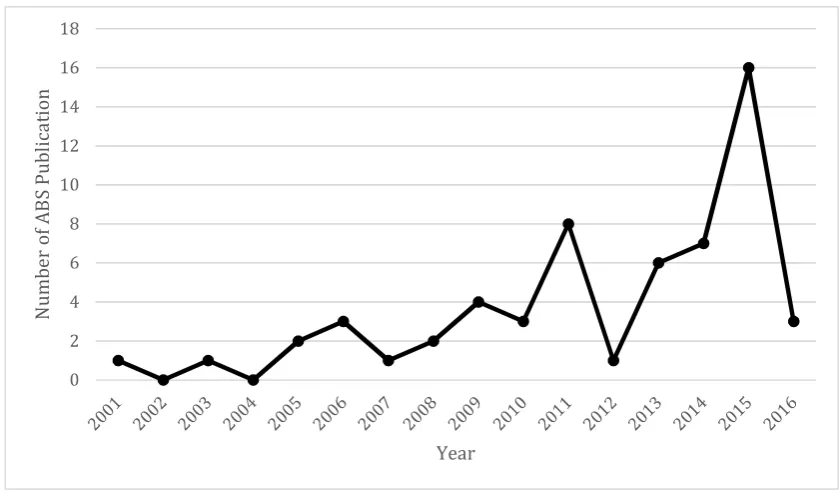
application of ABS in ASC has been increasing, especially during the last four years (2013-2016). These articles are published in a variety of journals in the fields of environmental science, agriculture, computer science and operational research (see Table 2.2).
Figure 2. 2: Publication of ABS application per year (2016 contains two-month worth of data)
The most active discussion on this topic takes place in environmental science journals (e.g., Ecological Economics, Ecological Modelling, Ecology and Society, Environmental Modelling & Software and Environmental Science & Policy) and agriculture journals (e.g., Agricultural Economics, Agricultural Systems, American Journal of Agricultural Economics, and Canadian Journal of Agricultural Economics). Although ASC is an important and interesting application domain for ABS, the number of publications in OR/MS specific journals is relatively low. One of the possible explanations is that many authors have focused on ASC specific research questions and ABS is used as a modelling tool to answer those questions. Hence, it makes more sense
[image:29.595.115.535.184.432.2]to discuss the findings in domain-specific journals such as environmental science and agriculture.
Table 2. 2 Distribution of journals that publish ABS applications in ASC
Journal Type Number of papers (percentage)
Environmental science 23 (39.65%)
Agriculture 20 (34.48%)
Computer science 7 (12.06%)
Operational research 1 (1.72%)
Other 7 (12.06%)
2.3.1
Research context of the previous ABS applications in ASC
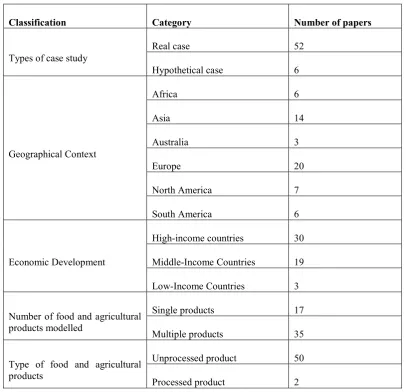
production. This suggests that a need to extend the reach of ABS research in ASC, particularly in low income countries.
Table 2. 3 Summary of the research context
Classification Category Number of papers
Types of case study
Real case 52
Hypothetical case 6
Geographical Context
Africa 6
Asia 14
Australia 3
Europe 20
North America 7
South America 6
Economic Development
High-income countries 30
Middle-Income Countries 19
Low-Income Countries 3
Number of food and agricultural products modelled
Single products 17
Multiple products 35
Type of food and agricultural products
Unprocessed product 50
Processed product 2
2.3.2
Objectives of the previous ABS applications in ASC
This section discusses the objectives of research in ASC that uses ABS as the main modelling method. The research objectives can be categorized into theory development (i.e., to explain ASC phenomena or to test a theory in the context of ASC), methodology development (i.e., to improve existing methods or to propose new methods for ABS in the context of ASC) or policy development (i.e., to predict or to analyse the impact of a management/policy decision). As shown in Table 2.4, all three types of objective feature in dataset D2 and it should be noted that a paper could contribute in more than one category. Interestingly, between 2001 and 2005, most ABS applications focused on theoretical contribution while in more recent years, between 2011 and early 2016, ABS applications for policy development (38.3%) and methodology development (36.2%) studies become increasingly popular. This trend occurs because the benefits of ABS in supporting decision making have started to be acknowledged in the 2010s.
Table 2. 4 Classification based on the type of research objectives
Research Objectives 2001-2005 2006-2010 2011-early 2016 Total
Theory development 4 6 12 22
Methodology development 0 1 17 18
Policy development 1 5 18 24
cooperation networks; the formation of clusters; and change in market power (e.g., Castella et al. (2005a), Ng (2008), Følgesvold and Prenkert (2009), Bert et al. (2011), Boero (2011), Ross (2011), Boyer and Brorsen (2013), Bakker et al. (2015), Krejci and Beamon (2015), Albino et al. (2016)). There is also a significant number of studies related to how innovation is adopted and spread among ASC actors (e.g., Berger (2001), Kaufmann et al. (2009), Olabisi et al. (2015)).
The methodological papers propose either new or improved methods in ABS using ASC case studies with a view to possible extensions beyond ASC. Methodological developments are proposed in a range of topics including: agents’ decision-making rules (e.g., Schreinemachers and Berger (2011) and Morgan et al. (2015)); simulation parameterization (e.g., Berger and Schreinemachers (2006), Schreinemachers et al. (2009), Nainggolan et al. (2012), Troost and Berger (2015), Zimmermann et al. (2015)); sensitivity analysis (e.g., Schouten et al. (2014), Brändle et al. (2015)); model validation (e.g., Smajgl et al. (2011b), Bert et al. (2014), Kaye-Blake et al. (2014), Ge et al. (2015a)); and hybrid modelling approaches (e.g., Happe et al. (2011), Aurbacher et al. (2013), Marohn et al. (2013), Reidsma et al. (2015)).
(Schreinemachers et al., 2007); tree crop innovations (Schreinemachers et al., 2010); organic agriculture (Gagliardi et al., 2014); and technology standards (Zheng et al., 2015). There are a number of smaller groups of research related to policy making such as how supply chain actors should cooperate to adapt to climate change (Wang et al., 2013) or minimise the risk of bioterrorist attack (Chaturvedi et al., 2014). Other studies explore: suitable inspection policies to improve product quality (Ge et al., 2015b, Ge et al., 2015a) or food safety (McPhee-Knowles, 2015); appropriate harvesting management plans (Worrapimphong et al., 2010); and policies for manure handling (Zheng et al., 2013) or animal welfare (Osinga et al., 2015).
Research in the policy category can be further divided into categories based on the scope of the policies. Julka et al. (2002) propose that the scope of supply chain policies can be classified into: intra-enterprise policies that cover departments within an organisation and their interface with other organisations; inter-enterprise policies that cover an organisation and its supply chain; and cluster policies that cover all industries in a sector including their suppliers and customers and government. Table 2.5 shows that the majority of the studies have focused on the cluster category (please note that a paper may analyse more than one policy scope).
Table 2. 5 Classification based on policy scope
Scope of policy Number of Papers
Intra-enterprise 5 Inter-enterprise 5 Cluster 16
2.3.3
The use of data in the previous ABS applications in ASC
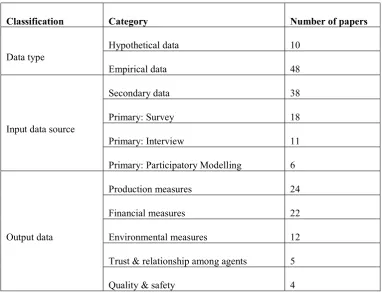
studies that use a real case study but use hypothetical data. This is because these studies incorporate hard to measure variables, even though they aim to replicate real world supply chains. The most popular empirical data sources are from secondary sources such as Farm Accountancy Data Network (FADN) and agricultural census data (e.g., Happe et al. (2006), Happe et al. (2011), Zimmermann et al. (2015)). These types of publicly available data are usually presented in aggregate owing to confidentiality concerns. Aggregated data poses a challenge to ABS modelling when generating a representative population though approaches such as that proposed by Troost and Berger (2015) can mitigate this limitation. Hypothetical data are used when researchers build a stylised model to test theories (e.g. Krejci and Beamon (2015)) or when empirical data are difficult to collect (e.g. food contamination McPhee-Knowles (2015)).
Table 2. 6 Input and output data in the previous ABS applications
Classification Category Number of papers
Data type
Hypothetical data 10
Empirical data 48
Input data source
Secondary data 38
Primary: Survey 18
Primary: Interview 11
Primary: Participatory Modelling 6
Output data
Production measures 24
Financial measures 22
Environmental measures 12
Trust & relationship among agents 5
ABS can be used to produce and analyse various output data relevant to ASC as shown in Table 2.6. Output data related to production, finance and environment described in the papers can be easily measured and this reflects the prevalence of their use in ABS studies. However, output data related to trust, relationship, quality and safety are more difficult to measure objectively and, similarly, these measures are considered to be more difficult to model (Tykhonov et al., 2008). Nevertheless, ABS is being used to model both types of measures.
The most popular output data related to aspects of production such as yield and produced quantity (e.g., Bharwani et al. (2005), Happe et al. (2006), Berger and Schreinemachers (2006), Zheng et al. (2013), Zimmermann et al. (2015)) and finance such as income and wealth (e.g., Berger (2001), Becu et al. (2003), Bharwani et al. (2005), Berger et al. (2006), Schreinemachers et al. (2007), Marohn et al. (2013)). Examples of models that produce environmental metrics include Schreinemachers et al. (2009), Uthes et al. (2011) and Quang et al. (2014). Examples of models that use difficult-to-measure output data include: trust and honesty, measured using a probability (Tykhonov et al., 2008); the stability of symbiotic relationship, measured by relationship duration (Albino et al., 2016); cooperation, measured by how many times agents decide to work together with others (Krejci and Beamon, 2015, Boero, 2011); and inspection quality, measured by the probability of product misclassification (Ge et al., 2015b, Ge et al., 2015a).
2.3.4
Agents, their decision-making rules and their interactions
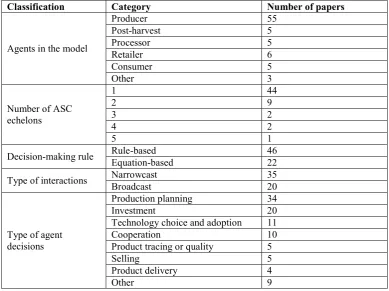
farmer) is included in most ABS models because it is considered the most important actor, especially in agriculture and environmental science journals. This can also explain why the existing reported studies focus on unprocessed agricultural products (see Table 2.3).
[image:37.595.131.521.430.721.2]Table 2.7 shows that the scope of most ABS models is one echelon. This is likely to reflect a need to keep the models simple and, in agriculture studies, the focus of the analysis is often on the producer. However, our sample shows that the number of ABS models that incorporate multiple echelons is increasing (2001-2005: one paper, 2006-2010: three papers, 2011 onward: nine papers). This is a welcome trend as modelling multi-echelons should provide more insights for supply chain research (e.g., van der Vorst et al. (2000)).
Table 2. 7 Summary of model details
Classification Category Number of papers
Agents in the model
Producer 55
Post-harvest 5
Processor 5
Retailer 6
Consumer 5
Other 3
Number of ASC echelons
1 44
2 9
3 2
4 2
5 1
Decision-making rule Rule-based Equation-based 46 22
Type of interactions Narrowcast Broadcast 35 20
Type of agent decisions
Production planning 34 Investment 20 Technology choice and adoption 11 Cooperation 10 Product tracing or quality 5
Selling 5
Product delivery 4
Other 9
The equation-based representations use mathematical equations such as: linear programming (e.g., Becu et al. (2003)); mixed integer programming (e.g., Berger (2001), Happe et al. (2006) and Schreinemachers and Berger (2011)); and regression modelling (e.g., Bakker et al. (2015)). The rule-based representation uses declarative languages such as “if then else” rules (e.g., Morgan and Daigneault (2015)), threshold models (e.g., Quang et al. (2014)) and imitation models (e.g., Osinga et al. (2015)).
The interactions among agents in an ABS model can be divided into narrowcast (i.e., an agent only interacts with its neighbours) or broadcast (i.e., an agent interacts with all or most of other agents) (Onggo et al., 2014). An example of narrowcast interaction is described in Zheng et al. (2015) in which agents gain knowledge regarding innovations from their neighbours. An example of broadcast interaction is presented in Quang et al. (2014) in which agents monitor the adoption rate in the population and compare it to their willingness to take risk when deciding to adopt an innovation.
In terms of types of decision, we proposed the following categories:
Production planning: determining the type and quantity of commodities to be produced, land allocation and resource allocation. All these decisions are usually modelled together (e.g., Berger (2001), Happe et al. (2006) and Krejci and Beamon (2015)).
Investment: deciding to buy or sell land, adding or selling machinery (e.g., Schreinemachers et al. (2009), Schouten et al. (2014)).
Cooperation: deciding when and how to cooperate with other agents (e.g., Krejci and Beamon (2015)) and selecting partners with whom to cooperate (e.g., Gagliardi et al. (2014)).
Product tracing or quality: deciding how to control product quality and how to trace a product’s source (e.g., Ge et al. (2015b), Ge et al. (2015a)).
Selling: deciding where the agent will sell its products (e.g., Krejci et al. (2016)).
Product delivery: deciding, for example, whether the agent will send products according to the specifications agreed with the buyer or not (e.g., Tykhonov et al. (2008)).
Others: decisions including managing irrigation in Becu et al. (2003) and pricing in Graubner et al. (2011).
Table 2.7 shows the dominance of production planning decisions and reflects the focus on just the producer as the only supply chain echelon (31 of 34 studies). Even so, understanding how farmers determine their production strategy and its consequences is important and interesting for researchers.
2.3.5
Validation and Sensitivity Analysis
theoretical (i.e., comparing model behaviours with theory), and empirical validation (i.e., comparing model behaviours with observation or expert judgement).
It is also possible to classify the validation techniques of simulation models, including ABS models, into black box and white box validation (Kleijnen, 1995a, Montanola-Sales et al., 2011). Black box validation evaluates whether the model outputs either reflect the empirical observations for the same set of inputs (e.g., Malawska and Topping (2016), Berger (2001)) or are consistent with the result from a mathematical model (e.g., Onggo and Karatas (2016), Ge et al. (2015a)). White box validation evaluates whether the decision rules of agents represent the decision rules of actors in the real world and whether the structure of the model (such as the network between agents) represents reality. This includes techniques such as examining the validity of the model structure, i.e. static logic and the dynamic logic of the model components and behaviours (Pidd, 2004, Montanola-Sales et al., 2011) and interactive modelling sessions (Berger and Troost, 2014, Arnold et al., 2015).
Table 2. 8 Paper classification based on the validation technique
Validation
information Classification Category Number of papers
Absent or unclear N/A N/A 27
Present
Based on data Theoretical 7 Empirical 25
Process Black box 30 White box 2
Empirical validation is the most popular means to validate ABS models in ASC. This method includes: visual comparison between the trends produced by simulation and the actual trends (e.g., Brändle et al. (2015)); statistical comparison (e.g., Malawska and Topping (2016)); and fitting a regression line between the simulated and actual data (e.g., Berger (2001), Schreinemachers et al. (2007), Schreinemachers et al. (2010) and Marohn et al. (2013)). Alternatively, theoretical validation is adopted frequently when validating difficult-to-measure qualitative behaviours (e.g., Tykhonov et al. (2008)). Reasons for this include the lack of widely available historical qualitative data or this data may not be in a form that can be readily used for simulation. Furthermore, standard statistical techniques may not be suitable for validating qualitative behaviour. Only two papers in our dataset employs white-box validation (i.e., Bert et al. (2014) and Arnold et al. (2015)) which is a concern, especially considering that black-box and white-box validations are complementary activities (Montanola-Sales et al., 2011).
350 replications. The only exception is the study by Osinga et al. (2015) which uses an objective method based on the coefficient of variation (Lorscheid et al., 2012).
Table 2. 9 Summary of output analysis
Output analysis Category Number of papers
Number of replications
Determined with subjective method 28 Determined with objective method 1 N/A but confidence intervals were given 6 N/A, confidence intervals not given 23
Sensitivity analysis
OFAT 38
GSA 4
N/A 16
2.3.6
Model representation methods
A good model representation is important for the communication between stakeholders which affects the credibility of a model (Onggo, 2013). It is also important to ensure that the model can be duplicated and developed further by other researchers (Collins et al., 2015). Table 2.10 shows that most papers do not use any structured model representation techniques (i.e. they describe the model in unstructured text). Simple flowcharts, Overview Design and Details protocol (ODD) (Grimm et al., 2010) and Unified Modelling Language (UML) are the most popular in those papers that use a structured representation technique. In our sample, flowchart representation has been used for a long time and ODD has started to gain popularity since 2011. ODD representation is particularly popular for papers published in environmental science journals.
Table 2. 10 Classification based on model representation techniques
Scope of policy Number of Paper (percentage)
Flowchart 13 (22%) ODD 11 (19%) UML 1 (2%) N/A 33 (57%)
2.4
Discussion
ABS even though ABS has been shown to be useful in those areas in other application domains.
2.4.1
The state of research in ASC that uses ABS
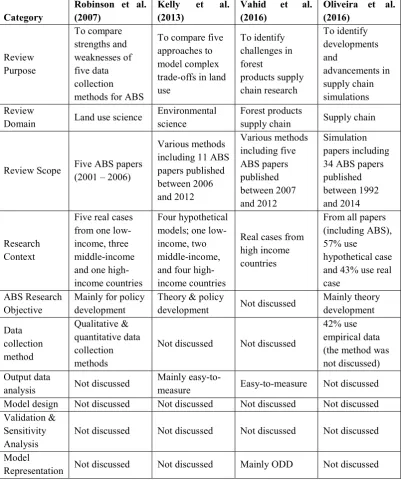
There have been a number of reviews on the application of ABS in related application domains such as land use (Robinson et al., 2007), environmental science (Kelly et al., 2013) and forest product supply chains (Vahid et al., 2016). Table 2.11 summarises and compares these related reviews. We include Oliveira et al. (2016) because it provides the latest review on supply chain simulation (which includes 34 ABS papers). Consistent with our observations, Oliveira et al. (2016) and Vahid et al. (2016) both note the increase in the numbers of papers that use ABS which demonstrates that that ABS has been accepted as one of the analytical tools in these domains.
also been used in natural resource management domain (Castella et al., 2005b). Qualitative data collection methods are very important since they may provide a deeper understanding of how actors make decision for a given context (Robinson et al., 2007). Our findings also confirm those of previous literature reviews that illustrate that most models use easy-to-measure output data.
Table 2. 11 Summary of discussion from other literature review
Category
Robinson et al. (2007)
Kelly et al. (2013)
Vahid et al. (2016)
Oliveira et al. (2016) Review Purpose To compare strengths and weaknesses of five data collection methods for ABS
To compare five approaches to model complex trade-offs in land use To identify challenges in forest products supply chain research To identify developments and advancements in supply chain simulations Review
Domain Land use science
Environmental science
Forest products
supply chain Supply chain
Review Scope Five ABS papers (2001 – 2006)
Various methods including 11 ABS papers published between 2006 and 2012 Various methods including five ABS papers published between 2007 and 2012 Simulation papers including 34 ABS papers published between 1992 and 2014
Research Context
Five real cases from one low-income, three middle-income and one high-income countries
Four hypothetical models; one low-income, two middle-income, and four high-income countries
Real cases from high income countries
From all papers (including ABS), 57% use
hypothetical case and 43% use real case
ABS Research Objective
Mainly for policy development
Theory & policy
development Not discussed
Mainly theory development Data collection method Qualitative & quantitative data collection methods
Not discussed Not discussed
42% use empirical data (the method was not discussed) Output data
analysis Not discussed
Mainly
easy-to-measure Easy-to-measure Not discussed Model design Not discussed Not discussed Not discussed Not discussed Validation &
Sensitivity Analysis
Not discussed Not discussed Not discussed Not discussed
Model
Our review differs from the previous literature reviews by considering the model designs used in ABS studies (e.g., number of echelons, type of agents, agent’s decision rules, and types of interaction). We find that most ABS applications in ASC focus on one echelon (i.e., the producer) and the simulation of production planning and investment decisions. The agents in the models mostly incorporate rule-based decision-making and narrowcast interactions. Furthermore, our review is exceptional in that it considers how the experimentation and model validation have been conducted and demonstrates that there has been an increase in the number of studies that carry out validation and sensitivity analysis. Finally, in terms of model representation, the most commonly used methods for model representation are the flow chart and ODD but our findings also show that the majority of articles do not use any method for model representation. Overall, when compared with these earlier reviews, our review provides a more detailed analysis of the characteristics of ABS model design (number of echelons, type of agent, agent’s decision, model representation and interaction), validation and sensitivity analysis. In other words, our review is done from the perspective of an ABS modeller.
2.4.2
The gap between ASC and ABS research topic
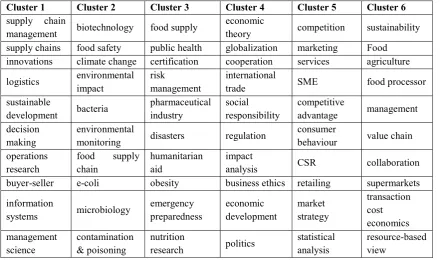
co-occurrences of those terms. Based on this network, VOSviewer identifies a number of clusters. Figure 2.3 shows the co-occurrence network of the terms used in ASC literature and the clusters identified (each colour represents one cluster and we have also added the circles to make the cluster more visible). There are six clusters in Figure 2.3. There are many intersections between these clusters. This indicates that many articles discuss multiple aspects of ASC. This also indicates that many articles were published in multi-disciplinary journals.
Figure 2. 3: Bibliographic mapping of ASC research
Table 2. 12 Top 10 popular keywords in each cluster of ASC research
Cluster 1 Cluster 2 Cluster 3 Cluster 4 Cluster 5 Cluster 6
supply chain
management biotechnology food supply
economic
theory competition sustainability supply chains food safety public health globalization marketing Food innovations climate change certification cooperation services agriculture
logistics environmental impact
risk
management
international
trade SME food processor sustainable
development bacteria
pharmaceutical industry
social responsibility
competitive
advantage management decision
making
environmental
monitoring disasters regulation
consumer
behaviour value chain operations
research
food supply chain
humanitarian aid
impact
analysis CSR collaboration buyer-seller e-coli obesity business ethics retailing supermarkets
information
systems microbiology
emergency preparedness economic development market strategy transaction cost economics management science contamination & poisoning nutrition
research politics
statistical analysis
resource-based view
Figure 2. 4: Bibliographic mapping of ABS in ASC
Table 2. 13 Top 10 popular keywords in each cluster of ABS research
Cluster 1 (18 papers)
Cluster 2 (20 papers)
Cluster 3 (15 papers)
Cluster 4 (22 papers)
Cluster 5 (15 papers) process policy method system dynamic
development
farmer decision
making scenario decision agriculture land use market value information interaction structure Price uncertainty environment choice Farm Role relationship social network resource Income stakeholder design heterogeneity farm household Production assessment management complexity application Characteristic climate change parameter comparison innovation agricultural
system adaptation
sensitivity
analysis behaviour
policy intervention Crop individual policy change food supply chain diffusion
Cooperation, competition and collaboration: These keywords appear in clusters 4, 5 and 6 in Table 2.12 but are missing from Table 2.13. ABS has been used to study cooperation, competition and collaboration in other domains. For example, in innovative product supply chains, Arvitrida et al. (2015) used ABS to explain the effect of competition and collaboration on supply chain performance (supply chain’s survival and profit). He et al. (2013) provide an example of an ABS application in a retail supply chain. Specifically, they study the optimal strategy to respond to competition in the retail industry and find that everyday-low-price strategy is the best. From data set D2, we can only find two papers studies the collaboration between ASC actors (Krejci and Beamon (2015) and Boero (2011)). One main advantage of ABS is its ability to model the interactions between actors in a social network. Hence, ABS should play more important role in the research into cooperation, competition and collaboration in ASC. For example, we could use ABS to study the effect of the collaboration strategy between farmers and supermarkets on supply chain survivals.
supply chain (e.g., Schieritz and Grobler (2003)). In another context, Franke et al. (2005) use ABS to demonstrate how buyer’s trust and seller’s reputation can lead to more stable supply chains and in some cases, monopoly to arise. Hence, we believe that ABS has potential for research into different aspects of buyer-seller relationships in ASC. For example, we can use ABS to study the impact of strength of buyer-seller relationship (e.g., level of loyalty) on the average market price and production volume of an agri-food product.
Service: This keyword is a result of thesaurus grouping, and includes sub-keywords such as customer service, food service, service industries and service architecture. The keyword service appears in cluster 5 of Table 2.12 but is missing from Table 2.13. ABS is one of the methods that is suitable for research into services in supply chains (Lusch, 2011). For example Rouzafzoon and Helo (2016) use ABS to study the service distribution and location problem in a healthcare supply chain. We believe that ABS is also relevant to researching services in ASC. For example, we can use ABS to study the effect of locations of service providers (e.g. post-harvesting, handling, bottling and packaging) and the level of service provision on ASC performance.
may be useful in providing to access individual data. As for the aggregated data, methods such as that proposed by Troost and Berger (2015) are needed to calibrate an ABS model. Another technique that can be used is to ask these agents only to disclose reasonable assumptions regarding confidential information and parameters. The researchers then can perform sensitivity analysis on these parameters and check whether the corresponding variances are still within acceptable boundaries (see, for example, Sonderegger-Wakolbinger and Stummer (2015) in luxury goods context).
We also observed that ASC research frequently uses Transaction Cost Economics and/or the Resource-Based View to provide its theoretical foundation. These keywords are also missing from Table 2.13 which indicates that they have not yet been used in the ABS models for ASC despite there being a number of examples that illustrate how these theories can be incorporated, in ABS in general (e.g., Klos and Nooteboom (2001), Bylund (2015)).
2.5
Conclusions
We have presented a literature review of research in Agri-food supply chain (ASC) that uses agent-based simulation (ABS) as the main modelling tool. Our findings demonstrate that the number of papers addressing ASC policies has increased which suggests that researchers have started to apply ABS to real world decision-making related to ASC. Similarly, there has been an increase in the number of papers addressing the methodological aspect of ABS for ASC research, which indicates that ABS has gained acceptance as a modelling tool in this application domain. The increase in the number of papers with model validation is another positive development.
products; use of empirical data (especially from secondary sources, surveys and interviews); decisions related to production planning and investment; and the use of black box validation (especially in combination with empirical data). In comparison to earlier reviews of the use of ABS in other related domains, this review encompasses more papers and, more importantly, it provides a comprehensive review of ABS model design and ABS modelling approaches in ASC research.
We have also demonstrated how the bibliographic mapping technique can be used to highlight potential research areas within ASC that have not yet taken advantage of ABS despite ABS being shown to be valuable in similar research areas in other application domains. The identified research areas are: cooperation and competition; buyer-seller relationships; and service in supply chains. We have highlighted that some important actors in ASC, such as food processors and supermarkets, are rarely modelled using ABS. Furthermore, general theoretical frameworks such as Transaction Cost Economics and the Resource-Based View could potentially be incorporated into the design of these models.
2.6
Reflection from the Excluded Literature
example Bommel et al. (2014)). Hence, the proportion of studies using Asian context is lower than what is reported in Table 2.3. In terms of types of agricultural product modelled, most of the excluded papers also focussed on unprocessed products (for example D'Aquino et al. (2003), Etienne (2003), Cockburn et al. (2013) and Bommel et al. (2014)).
In terms of research objectives, most of the excluded papers focussed on developing theory (for example Cockburn et al. (2013)) or developing policies (for example D'Aquino et al. (2003), Etienne (2003) and Bommel et al. (2014)). If these papers were considered in this literature review, then the proportion of ABS methodological research is lower than what is reported in Table 2.4. This finding supports the claim in this study that more methodological researches are needed to develop the ABS methodology further.
In terms of the types of data, most of the excluded papers utilised empirical data. Popular techniques to collect empirical data were survey (for example Courdier et al. (2002)) and participatory modelling (for example D'Aquino et al. (2003), Etienne (2003) and Bommel et al. (2014)). Consistent with the finding described in Table 2.6, most of the excluded papers focussed on analysing production measures. Nevertheless, there were papers that focus on analysing the degree of specialisation among agents (Cockburn et al., 2013) and quality measures (Courdier et al., 2002).
3
Using Scenario-Based
Questionnaire for
Agent-Based Simulation Model
Calibration and Validation:
An Agri-food Supply Chain
Example
accepted, subject to revisions. Adjustments are made and commentaries are added to the original manuscript to improve the coherence with other parts of this thesis.
Abstract
A scenario-based questionnaire is a survey method that aims to identify the respondents' decision rules using their responses to a series of scenarios. It is rarely used in ABS with most researchers preferring a survey with closed questions as the data collection method. This is particularly true for ABS studies in ASC. In our paper, we explore how to design and deploy the scenario-based questionnaire in ABS using the case of a dairy supply chain. Our findings suggest that the decision rules extracted using a scenario-based questionnaire can improve ABS validity. Furthermore, we demonstrate that the decision rules extracted using this approach highlight opportunities for behavioural interventions to improve system performance.
Keywords: OR in Agriculture, calibration, validation, agent-based simulation, agri-food, dairy
3.1
Introduction
enable the evaluation of interventions aimed at modifying agent behaviours even if other system parameters are beyond the policymakers’ direct control. Furthermore, this approach to behavioural modelling is also important in other research fields such as operations management (Bendoly et al., 2006, Bendoly et al., 2010). However, behavioural modelling is still a challenge in ABS methodology owing to the difficulties in acquiring the data necessary to develop better representations of agent behaviour (Macal, 2016).
Researchers commonly use a questionnaire survey method with closed questions as a means of data collection to develop their ABS. This approach enables the measurement of emergent behaviours (i.e., system outputs), the value of controllable and uncontrollable parameters, the agents’ attributes, and the agents’ decision parameters (i.e., information used by the agents when making their decisions). However, the use of this type of questionnaire is problematic in respect of the validation and calibration of the agents’ behaviours and their decision rules (i.e., how they process information when making a decision) which are also necessary within an ABS. This validation and calibration of agents’ decision rules is especially important if researchers would need truer representations of human behaviour in the ABS (Macal, 2016).
ABS. We then explore the potential impact of policy interventions that could influence behaviours in the real system. Using these findings, we seek to highlight the benefits of a scenario-based questionnaire for ABS calibration.
To achieve these objectives, we begin, in section 3.2, by discussing how the scenario-based questionnaire might be useful to calibrate decision rules in ABS. In section 3.3, we discuss the base model in this study and its validation process. In section 3.4, we describe the sequence followed in order to develop a scenario-based questionnaire from the base model, the survey process, the data analysis and the derivation of the empirical decision rules. We then describe, in section 3.5, the simulation experiment process adopted to test the effects of these empirical decision rules on the model outputs. In section 3.6, we discuss the insights obtained from the scenario-based questionnaire survey and simulation experiments. Example of the scenarios and statistical analysis tables can be found in the appendices.
3.2
Literature review
In this section, we discuss how the questionnaire survey method has been used in ABS modelling in areas relevant to the case study (i.e., ASC) prior to reviewing the use of scenario-based questionnaires to identify human decision rules in a variety of management studies.
3.2.1
The use of the questionnaire survey method in ABS studies in
ASC
influenced by several factors including internationalisation (Glover et al., 2014) and consumer perceptions towards food safety (Ge et al., 2015a). This degree of complexity leads to ABS being considered suitable as a research methodology for studying and supporting decision making in supply chains in general and especially in ASC (see, for example, Utomo et al. (2018), Taticchi et al. (2015)).
Macal (2016) suggests behavioural modelling (i.e., developing more realistic models of human behaviours) as one of the challenges facing the ABS methodology. One means that can be taken to overcome this challenge is to validate and calibrate the agents' behaviour using empirical data (Bankes, 2002, Macal, 2016) though discussion in Chapter 2 shows that only 46% of ABS studies in the ASC area use primary data collection. The remaining studies relying on hypothetical or secondary data, which suggests that ABS modelling in ASC is facing a similar challenge.
structures from their survey to classify clusters of agents. Similarly, Krejci et al. (2016) develop agent classifications based on their respondents’ personae.
However, the use of questionnaire data to calibrate decision rules (i.e., modifying predefined rules or derive new rules) in ABS models related to ASC is rare.
3.2.2
The use of scenario-based questionnaires in eliciting human
decision rules
Observing respondents’ responses to a written scenario is one way of identifying real actors' decision rules. Researchers have used this data collection method in a variety of business and management studies. For example, in operations management, it has been used to explore the factors influencing the decision to outsource the manufacture of a component (Mantel et al., 2006). Urda and Loch (2013) use scenarios to explain how emotions and social preferences influence decision making. Choo et al. (2015) investigate how knowledge accumulation and manufacturing improvements are influenced by the style of executive problem solving adopted by an organisation. More recently, Azadegan et al. (2017) use scenarios to identify the drivers for managers in developing countries to increase their environmental investments. Similarly, Su et al. (2017) use a scenario-based questionnaire to investigate the effects of individual negotiation styles on the opportunism and compliance behaviours of buyers and suppliers.
in contrast to retrospective self-reports, scenarios may reduce the biases from memory loss (Grewal et al., 2008, Su et al., 2017).
The scenarios used by researchers are usually based upon a theory (e.g., the theory of planned behaviour (Jafarkarimi et al., 2016)) or a number of null hypotheses to be tested. Responses to the scenario are then used to support or reject these null hypotheses. Unlike in other quantitative methods, researchers using the ABS methodology will hypothesize mechanisms and decision rules (Axelrod, 1997) rather than factors or parameter values. However, we believe that these hypothesized decision rules can be equivalent to null hypotheses when constructing scenario-based questionnaires. Hence, in this study, we developed the scenarios in our survey using the hypothesized decision rules created for the base model that we developed earlier from the findings of a literature review. We used a narrative for each scenario that was adapted from the real world farmers’ experience. A previous study highlights that scenarios that are designed using real world situations allow the researcher to make generalizations or draw conclusions about an individual’s or a group’s behaviours in reality (Cowlrick et al., 2011). We then used the data collected from the survey to calibrate (accept or reject and adjust) the decision rules in the base model.
3.3
ABS base model of dairy supply chain in West Java
In this section, we present the ABS base model that we subsequently calibrated using the scenario-based questionnaire.