© 2019, IRJET | Impact Factor value: 7.211 | ISO 9001:2008 Certified Journal | Page 1910
Multilevel Object Sorting System using PLC Controller
Rohit R. Yadav
1, Shubham S. More
2, Onkar N. Mutekar
3, Aditya L. Mogal
4, Rayappa S. Mahale
51,2,3,4
UG Students, Department of Mechanical Engineering, D Y Patil School of Engineering Academy, Pune,
Maharashtra
5
Assistant Professor, Department of Mechanical Engineering, D. Y. Patil School of Engineering Academy, Pune,
Maharashtra, India.
---***---Abstract:-
In many industrial applications there is need of sorting. Sorting can be done by using many ways like sorting of object according to their dimensions (height, length etc.), according to their colours, according to their weight, using machine vision (image processing), according to the material of an object etc. For example in Thermal Power Station electromagnetic sorting technique is used to sort ferromagnetic materials from coal.In this project, the development of a LCA (Low Cost Automation) system to sort objects according to their height has been designed. This LCA system is controlled by Programmable Logic Controller (PLC). This project consists of two parts, first consisting of software which contains ladder logic programming which is used to program PLC that controls the whole process of the project step by step according to input data sequence. Second is the hardware part which consists of conveyors used to transport the objects, sensors used to sense the height (i.e. laser sensors) of the objects, electronic system used to sort the objects and motors to drive the conveyors.
Keywords: Automation, Programmable Logic Controller (PLC), Low Cost Automation, Sorting, Manufacturing.
1. INTRODUCTION
Our aim in this project is to create the electronic material handling system which can be used to reduce the efforts of workers as well as to reduce the time spent in inspection of the components, during their manufacturing.
It also reduces the efforts in transferring the components manufactured to another workstation. The most apparent reasons that are associated in installing of automatic system in industry are,
i. Saving Man Power.
ii. Improved Quality and Efficiency. iii. Increase consistency and Flexibility.
An automatic sorting machine has main task of sorting components according to the sizes. This also consists of conveyor belt, which reduces the efforts of material handling. Also both processes take place simultaneously like material handling and inspection.
2. COMPONENTS:
2.1 PLC
A programmable logic controller (PLC) or programmable controller is an industrial digital computer which has been ruggedized and adapted for the control of manufacturing processes, such as assembly lines, or robotic devices, or any activity that requires high reliability control and ease of programming and process fault diagnosis.
PLC programs are typically written in a special application on a personal computer, and then downloaded by a direct-connection cable or over a network to the PLC. The program is stored in the PLC either in battery-backed-up RAM or some other non-volatile flash memory. Often, a single PLC can be programmed to replace thousands of relays.
Currently five programming languages for programmable control systems: function block diagram (FBD), ladder diagram (LD), structured text (ST; similar to the Pascal programming language), instruction list (IL; similar to assembly language), and sequential function chart (SFC).These techniques emphasize logical organization of operations.[1]
We used function block diagram (FBD) programming language for our PLC programming.
2.1.1 PLC specifications:
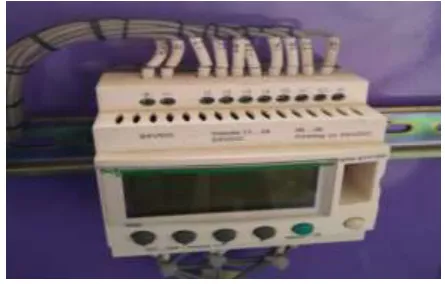
PLC CPU-Schneider SR2 B121BD/ Zelio PLC Software- Somachine Basic 3.1/Zelio Soft
[image:1.595.322.545.605.747.2]© 2019, IRJET | Impact Factor value: 7.211 | ISO 9001:2008 Certified Journal | Page 1911
2.2 Conveyor Belt
A conveyor belt consists of two or more pulleys, with a continuous loop of material which rotates over them. One or both of the pulleys are powered, moving the belt and material on the belt forward.
There are two main industrial classes of belt conveyors; those in general material handling such as those moving boxes along inside a factory and bulk material handling such as those used to transport industrial and agricultural materials, such as grain, coal, ores etc.[11]
Essential properties of Belt are:
Flexibility
Transverse rigidity
Low mass per unit length
High strength
Simplicity
Longer life
Wear resistant
Fire resistant
Belt material
Belts are typically made from:-
Canvas
Kevlar
Nitrile
Steel cord
Teflon
Rubber
Wire mesh
Rubber
2.2.1 Belt Design
The actual belt of a system is determined on what the conveyor is going to be used for.
Item to consider when choosing a belt:
1 Size of items being moved. 2 Weight of items.
3 Shape of items.
This will help to decide what belt to use so coefficients of friction can stay low so the motors won’t be over worked.
2.3 Pneumatic Double Acting Actuator
Pneumatic cylinders are mechanical devices which use the power of compressed gas to produce a force in a reciprocating linear motion.
Double-acting cylinders (DAC) use the force of air to move in both extends and retract strokes. They have two ports to allow air in, one for outstroke and one for instroke.
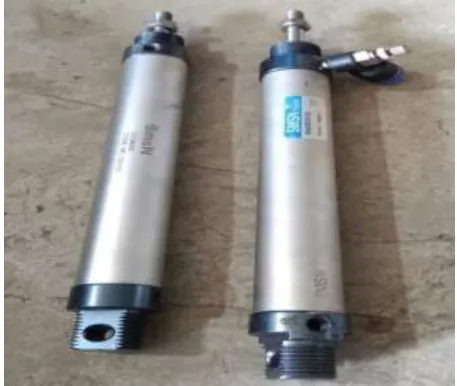
2.3.1 Cylinder Specifications
SMSN Pneumatic cylinder.
Model: MC16X100.
Pressure: 1.5- 8 kgf /cm square.
Fig -2: Pneumatic Cylinders
2.4 Solenoid Valve
A solenoid valve is an electromechanically operated valve. The valve is controlled by an electric current through a solenoid: A solenoid valve has two main parts: the solenoid and the valve. The solenoid converts electrical energy into mechanical energy which, in turn, opens or closes the valve mechanically.
2.4.1 Solenoid Valve Specifications:
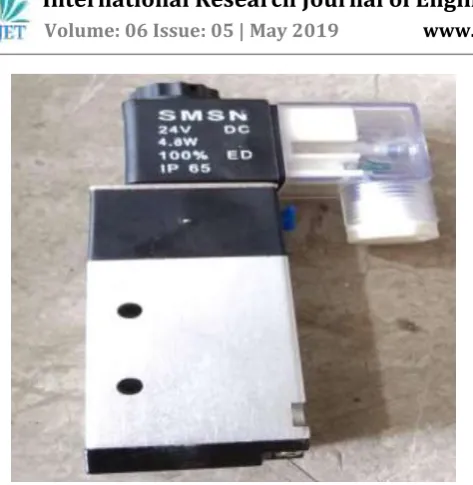
SMSN 5/2 Single Solenoid Valve AC220V Coil
[image:2.595.324.553.328.521.2]© 2019, IRJET | Impact Factor value: 7.211 | ISO 9001:2008 Certified Journal | Page 1912
Fig -3: SMSN Solenoid Valve
2.5 Photoelectric Proximity Sensor
A proximity sensor is a sensor able to detect the presence of nearby objects without any physical contact. A proximity sensor often emits an electromagnetic field or a beam of electromagnetic radiation (infrared, for instance), and looks for changes in the field or return signal. The object being sensed is often referred to as the proximity sensor's target. Different proximity sensor targets demand different sensors. For example, a capacitive proximity sensor or photoelectric sensor might be suitable for a plastic target; an inductive proximity sensor always requires a metal target.
We used Photoelectric Proximity Sensor in our project. A photoelectric sensor, or photo eye, is equipment used to discover the distance, absence, or presence of an object by using a light transmitter, often infrared, and a photoelectric receiver.
2.5.1 Sensor Specifications:
Model: JG 8/12/18/30 TYPE
Detection Range: 1- 30CM
Detecting Object: Metal, Non-metal, Plastic, Wood etc.
Fig -4: Photoelectric Sensor
2.6 DC Motor and Gear Box:
A DC motor is any of a class of rotary electrical machines that converts direct current electrical energy into mechanical energy.
We used DC motor with gear box for speed reduction purpose.
DC Gear Motor Specifications:
Model: 60RPM, 12VDC Power Supply
Load carrying capacity: 3-5kg @ 60RPM
Fig -5: DC Gear Motor
[image:3.595.50.287.56.299.2] [image:3.595.311.552.61.239.2] [image:3.595.326.541.429.577.2] [image:3.595.317.552.607.741.2]© 2019, IRJET | Impact Factor value: 7.211 | ISO 9001:2008 Certified Journal | Page 1913
3. CONSTRUCTIONAL DETAILS:
1. The unit consists of the conveyor belt which is driven by electric motor.
2. The conveyor belt is mounted on the mild steel frame which is fabricated using the angles and channels.
3. At the two ends of the frame, using journal bearing, two drum pulleys are bolted to the frame over which the belt runs.
4. For the drive, the electric motor is used. For the speed reduction, the sub frame is fabricated which is having intermediate shafts.
5. This speed reduction system contains two stage reduction using belt pulley assemblies.
6. For the purpose of idling, the sheet metal is used which also acts as scrubber to reduce the dust on the belt.
7. Then sensors are located on the conveyor belt.
8. For the wiring and electronic assembly, the separate sheet metal block bolted to frame.
9. For the pushing and sorting purpose, the pushing mechanisms are mounted on the frame.
10. This mechanism consists of pneumatic cylinders operated by solenoid valve.
After sorting, the provision is made for collecting the sorted objects.
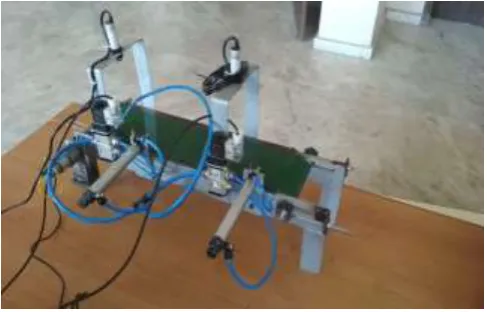
Fig -7: Actual Project Model
4. TESTING OF THE UNIT:
1. The product will be placed on the conveyor.
2. Then the switch will be made on which will start the conveyor and the product will flow to discharge end.
3. During its travel, sensor will sense the height of the product.
4. The signal will be then given to PLC.
So according to the signal the corresponding push mechanism will operate and small, medium and large objects will be sort out.
Fig -8: Sorting Process Block Diagram
Fig -9: Actual Project Model Setup
5. RESULTS:
The operation of the system has been accomplished and has obtained the sorting results as follows.
1. When sensor1 is activated then cylinder1 is operated which pushes the object away from the conveyor belt.
[image:4.595.317.550.239.366.2] [image:4.595.307.567.397.581.2] [image:4.595.40.284.519.675.2]© 2019, IRJET | Impact Factor value: 7.211 | ISO 9001:2008 Certified Journal | Page 1914
6. CONCLUSION:
The study and development of PLC Controlled Multilevel Object Sorting System has been performed. Thus the completion of project work brought better results and let us to study the PLC system of Schneider SR2 B121BD/ Zelio and also the various parts of the hardware used. This system can be effectively used in industry.
7. APPLICATIONS:
Manual sorting of any object consumes a lot of time and labor. Hence, PLC object sorting system finds wide application in the following industries.
1. Water Bottle Packaging Plant:
The filled water bottles in industry during dispatched can be sorted according their volume capacity.
2. Brick Manufacturing Process:
In Brick manufacturing Process the quality of bricks considering their height as a parameter can be checked. If the height is more or less from the original size then the defective bricks can be sorted out.
3. Quality Checking of Solid Objects:
If the height of the solid material is taken as a criteria in quality check of that object then this system can be used effectively.
4. In Food Processing Industries:
The food packing of the food stuffs of different sizes can be sorted in such type of industries where various quantities of packed food are running on a single line.
8. FUTURE DEVELOPMENTS:
Following developments can be done in the system to increase the production rate as well as to minimize cost.
1. Using high quality sensor like Laser sensor we can increase the speed of the process.
2. Objects sorted can be distinguished easily by improving extra circuitry. It is also economical.
3. This system can be used to sort more than one object in one cycle by suitably altering the hardware and software of the system.
Also we can use such systems with some modification for various types of inspection such as
1. Inspection Parameter 2. Diameter, hole diameter 3. Height
4. Thickness 5. Surface defect 6. Crack, burr 7. Roundness
8. Minor and major diameter 9. Chamfer angle etc.
9. REFERENCES:
1 .Automatic Sorting in Process Industries using PLC by P. Thirumurugan , R. Aravind , M. Arun Kumar, S. Manjunath, R. Kalaiselvan GRD Journals- Global Research and Development Journal for Engineering | Volume 3 | Issue 3 | February 2018ISSN: 2455-5703.
2. Automatic Sorting Machine by Moe Win Khaing Dr. Aye Mya Win, Daw Thida Aye (2018) International Journal of Science and Engineering Applications Volume 7–Issue 08,138-142, 2018, ISSN:-2319–7560.
3. Automatic Sorting Machine by Moe Win Khaing Dr. Aye Mya Win, Daw Thida Aye (2018) Prof Dhaval Tailor et al. / International Journal of Engineering and Technology (IJET).
4. Conveyor loading control & object sorting by using Programmable logic controller by Diksha Deotale, Varsha Sirsat and Swati Khule (April 2017) International Journal For Technological Research In Engineering Volume 4, Issue 8, April-2017 ISSN (Online): 2347 – 4718.
5. Automatic sorting machine by Prof. V.W. Patil, Gaikwad Sachin, Babar Nikhil, Shevante Pramod, Gaikwad Ganesh (June 2017) Vol-3 Issue-3 2017 IJARIIE-ISSN(O)-2395-4396.
6. Automatic detection and sorting of products by Akshay varpe, snehal Marne, manasi morye, dr. Manisha jadhav (2017) international journal of innovations in engineering research and technology [ijiert] issn: 2394-3696 Conference Proceedings of TECHNO-2K17 (Technical Symposium).
7. An innovative approach for modeling and simulation of an automated industrial robotic arm operated electro-pneumatically by L Popa, V Popa (2017) IOP Conf. Series: Materials Science and Engineering 227 (2017) 012097 doi:10.1088/1757-899X/227/1/012097.
8. PLC Based Object Sorting Automation by Prof. Nilima Bargal, Aditya Deshpande, Rucha Kulkarni, Rucha Moghe (July 2016) International Research Journal of Engineering and Technology (IRJET) Volume: 03 Issue: 07 | July-2016.
9. Automatic Sorting Machine by Acy M. Kottalil, Bijin B. Krishnan, Ashik Anto, Boney Alex (June 2016) Journal for Research | Volume 02 | Issue 04 | June 2016 ISSN: 2395-7549.
© 2019, IRJET | Impact Factor value: 7.211 | ISO 9001:2008 Certified Journal | Page 1915 Engineering Research and Applications www.ijera.com ISSN:
2248-9622, Vol. 5, Issue 11, (Part - 3)November 2015, pp.37-42.
11. Standard Handbook of Machine Design, Joseph E. Shigley and Charles R. Mischke, Second Edition, McGraw-Hill Publishers.
10. BIOGRAPHIES:
Rohit R. Yadav is now pursuing his Bachelor of Engineering in Mechanical Engineering at D Y Patil School of Engineering Academy, Ambi, Pune, Maharashtra.
Shubham S. More is now pursuing his Bachelor of Engineering in Mechanical Engineering at D Y Patil School of Engineering Academy, Ambi, Pune, Maharashtra.
Onkar N. Mutekar is now pursuing his Bachelor of Engineering in Mechanical Engineering at D Y Patil School of Engineering Academy, Ambi, Pune, Maharashtra.
Aditya L. Mogal is now pursuing his Bachelor of Engineering in Mechanical Engineering at D Y Patil School of Engineering Academy, Ambi, Pune, Maharashtra.