RESEARCH ARTICLE
LEADERSHIP DEVELOPMENT INTERVENTION: AN EXPERIMENTAL STUDY
A. Velayudhan*
Department of Psychology, Bharathiar University, Coimbatore
ARTICLE INFO ABSTRACT
The Purpose of the present paper is to find out the effectiveness of a Leadership Development Intervention in improving Leadership Skills among students. Three hundred and forty three students at P.S.G. College of Arts and Science, Coimbatore, India formed the sample for the present investigation. A Single group Pre-test, Post-test and Follow-up quasi-experimental design was used. All the students received the Leadership Development Intervention voluntarily and were assessed at Pre and Post-test and Follow-up periods. The Intervention was delivered in 40 sessions, included Training and Lecture Methods. Effective skill based techniques were used for the students enhancement of Leadership Skills. The Leadership Style Questionnaire developed by Marshall Sashkin and Morris (1987) measuring 6 Dimensions of leadership style such as Management of Attention, Management of Meaning, Management of Trust, Management of Feelings, Management of Risk and Management of Self was used before, after and Follow-up of the intervention. Repeated Measures ANOVA was used to differentiate the difference between the Pre, Post, and Follow- up phases. The Results indicates a significant difference in three times of assessment of Leadership Skill in the Management of Attention, Management of Meaning, Time Management, Management of Risk and Management of Self. Study results indicated the usefulness of a Leadership Development Intervention among students.
Copy Right, IJCR, 2011, Academic Journals. All rights reserved
INTRODUCTION
Leadership is an important and necessary skill for achieving individual, group and organizational performance. It is the ability to persuade others to seek defined objectives enthusiastically. It is the human factor, which binds a group together and motivates it towards the goal. More clearly, it is a process whereby one person influences others to work towards a goal and help them pursue a vision. A leader inspires his followers with a vision and helps them to cope with changes. Leaders start by articulating a direction or vision of what future might look like, then develop strategies for producing changes needed to move in that direction. Leadership is “the ability to persuade others to seek defined objectives enthusiastically. It is the human factor which binds a group together and motivates it towards goals” (Keith, (1967). The observation that leadership has an effect on individual well-being would come as no surprise to any working adult (Gilbreath, 2004). Leadership has been linked to an array of outcomes within occupational health psychology: positive outcomes such as psychological well-being (Arnold, Turner, Barling, Kelloway and McKee, 2007), and organizational safety climate (Zohar, 2002) and negative outcomes, including
employee stress (Offerman and Hellman, 1996),
cardiovascular disease (Kivimaki, Ferie, Brunner, Head,
*Corresponding author:[email protected]
Shipley, Vahtera and Marmot, 2005), workplace incidents and injuries (Barling, Loughlin and Kelloway, 2002; Kelloway, Mullen and Francis, 2006; Mullen and Kelloway, 2009) and health related behaviours such as alcohol use (Bamberger and Bacharach, 2006). The study on Leadership Style and Team processes in self-managed teams done by Stephanie (2008) team processes are explored within self-managed teams that develop different leadership styles. In particular, two leadership styles are compared: shared leadership and single leadership. The results of the study suggesedt that teams with shared leadership had motivational and cognitive advantages over teams that took the traditional approach of relying on a single leader. Sosik and Godshalk (2000) found that transformational leadership behaviour (e.g., social support provided through mentoring – a form of individualized consideration) indirectly predicted reduced job-related stress.
Bono et al. (2007) examined the effects of transformational
leadership on stress and satisfaction at work. Supportive leadership enhanced the success of a ―broad band organizational health promotion programme designed to reduce obesity, smoking and alcohol use (Whiteman, Snyder, and Ragland, 2001) as well as programmes focused specifically on single behaviours such as smoking cessation (Eriksen, 2005). Students who dedicate time to leadership development experiences strongly increase their leadership skills, the ability to set goals, to make educated decisions, and utilize conflict resolution skills. They also develop a
ISSN: 0975-833X
International Journal of Current Research
Vol. 3, Issue, 8, pp.133-139, August, 2011
INTERNATIONAL JOURNAL OF CURRENT RESEARCH
Article History:
Received 28th
May, 2011 Received in revised form
19th
June, 2011
Accepted 5th
July, 2011
Published online 5th
August, 2011
Key words:
Leadership,
Management of Attention, Meaning,
dedication to helping others develop their own leadership skills, get involved with programmes in their communities, and work with racial and ethnic groups to promote understanding and advocacy of leadership (Astin and Leland, 1991). Kouzes and Posner (2002) claim that enabling
self-leadership, providing choice, developing competence,
confidence and fostering accountability are necessary factors in strengthening others to act. College students and early career workers need to recognize that "leaders accept and act on the paradox of power: we become more powerful when we give our power away". Empowering others to act can be achieved by creating a climate of trust, listening to others, connecting others to sources of power, educating and creating a learning environment. According to Dugan (2006a), leadership is a relationship-building, developing, procedural, educated, and transformational experience. The training of leaders for the future has been noted as one of the focal points of higher education’s missions. Mullen and Kelloway (2009) examined data from both the 54 participant leaders and 115 matched respondents in order to assess the effectiveness of the training. They found that participation in training resulted in improvements in leaders’ own safety attitudes, intent to promote safety in the workplace and safety-related self-efficacy. Avolio, Reichard, Hanna, Walumba and Chan (2009) provided a comprehensive review of the effectiveness of leadership interventions. Drawing on data from over 200 studies over a period of more than 50 years based on a variety
of leadership theories, Avolio et al. (2009) reported evidence
that leadership interventions do in fact result in enhanced leadership.
Increase in opportunities to participate in leadership development activities would allow students the chance to gain a sense of responsibility and ownership. This may be a way to improve these low levels of academic achievement, high levels of student boredom and disaffection, and disproportional dropout rates in urban areas (National Research Council and Institute of Medicine, 2004). A grounded theory of high-quality leadership programmes:
perspectives from student leadership development
programmes in higher education by Darin (2008) revealed 16 attributes of high-quality Leadership programmes organized into three clusters: (a) participants engaged in building and sustaining a learning community; (b) student-centered experiential learning experiences; and (c) research-grounded continuous programme development. The training of leaders for the future has been noted as one of the focal points of
higher education’s missions (Dugan, 2006b). Management of
stress and stressors as college students differ markedly in the effectiveness of their adjustments to these stressors (Matheny
et al., 2002). It has been established that cognitive-behavioural
stress management and health promoting interventions can reduce both perceived and physiologically measured stress irrespective of the method of delivery (Eisen, Allen, Bollash and Pescatello, 2008; Lustria, Cortese, Noar and Glueckauf, 2009). Some stress management experts contended that person achieves more effective social interactions, ones mental stress decreases and happiness increases, irrespective of the coping strategy used (Lazarus and Folkman, 1984; Hirokawa, Yagi and Miyata, 2002). In addition, pioneers in the field of positive psychology found that happiness levels and overall well-being can be enhanced through several useful interventions involving multiple exercises (Fordyce, 1977; 1983).
An exploratory study of Entrepreneurial Leadership
Development of University Students done by Bagheri (2009) shows that the university entrepreneurship development programmes facilitate entrepreneurial leadership development of students in many ways including experiential learning, social interaction learning and opportunity recognition. Entrepreneurial leadership development occurs in a process of transforming the knowledge acquired from experience and social interactions to identify the opportunities of personal development creation. The study done by Garger and Jacques (2007) investigated the impact of self leadership on student
performance. Students from a mid-sized, regional,
comprehensive university returned completed surveys. Results suggest that students' transformational self leadership positively correlates with grade point averages while passive/avoidant self leadership negatively correlates with grade point averages.
Need for the Study
kinds of student organizations in school and universities and it is only necessary that educational institutions should give attention to leadership skills development for students. Through this kind of programme, students can learn how to become and how to be good and effective leaders. There can be many kinds of student leaders and the kind of leadership that they must have will depend on the situation they are in. And through leadership skills development programme, students will be able to better understand different Leadership Styles that best work for certain situations.
Objective: The Objective of the present study is to find out the effectiveness of a Leadership Development Intervention in improving Leadership skills among students.
MATERIALS AND METHODS
Design: A Single group Pre-test, Post-test and Follow-up quasi-experimental design guided the study. The leadership style questionnaire was administered to all the subjects before the beginning of the Intervention (Pre/before). After 40 sessions of Intervention the leadership style questionnaire was once again administered to all subjects (Post/after). After a period of one month the leadership style questionnaire was once again administered to all the students (Follow-up).
Sample: Three hundred and forty three students at P.S.G. College of Arts and Science, Coimbatore, India formed the sample for the present investigation.
Interventions Used: The Intervention was delivered in 40 sessions, included Lecture and Training Methods. Lecture Method involves Self-esteem, Assertiveness, Leadership, Goal-Setting, Stress Management, Creativity, Memory, Motivation, and Transactional Analysis. In Training Method Ice Breaking Exercise, Profile About Themselves, Memory and Attention Game, Tower Building Game, Group Discussion, One Minute Presentation, Yoga and Relaxation. The duration of the Leadership Development Programme was 40 sessions.
Tool Used: The Leadership Style Questionnaire developed by Marshall and Morris (1987) measuring 6 Dimensions of
leadership style such as Management of Attention- Leaders
pay close attention to people with whom they are communicating. They help others to see the key points clearly. They have clear understanding or priorities of different issues
under discussion; Management of Meaning- It focuses on the
leader’s communication skills, specifically the ability to get the meaning of a message across, even if this means devising
some innovative approaches; Management of Trust- The key
factor is the perceived trustworthiness to follow through on the promises, avoidance of “flip-flop” shifts in position, and
willingness to take clear position; Management of Self- Is
concerned with the general attitudes towards self, others and their feelings, as well as for “taking care of” feelings about
oneself in a positive sense; Management of Risk – Effective
leaders are deeply involved in what they do and do not spend excessive amounts of time or energy on plans to protect themselves against future. These leaders are willing to take risks, not on a ‘hit or miss’ basis but after a careful estimation
of the odds of success or failure; and Management of
Feelings-Leaders seem to generate consistently a set of positive feelings
in others. Others feel that their work becomes more meaningful and that they are the “master” of their own behaviour i.e. they feel competent. They feel a sense of oneness with their colleagues and co-workers. The
questionnaire had a reliability coefficient of 0.71,
0.81,0.76,0.72,0.86 and 0.91 respectively. The content validity was also established.
RESULTS AND DISCUSSION
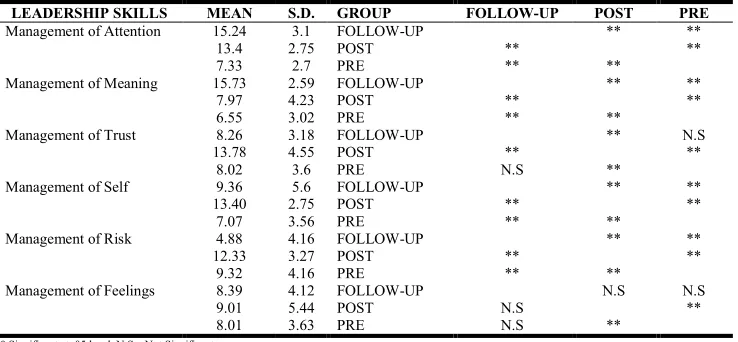
Table 1 shows the Mean, S.D’s, of all dimensions of the Leadership Skills of the students in the Pre, Post and Follow-up phases. Table 2 shows the F value for the Leadership Skill Questionnaire for the students across the Pre, Post and Follow-up. The Repeated Measures ANOVA results show a significant difference at 0.01 level for all the variables except the variable Management of Feelings which was found to be significant at 0.05 level. This indicates that the Intervention Programme had certainly had an impact on the students. The Leadership Skill which is very much essential for management of attending to others, conveying what is required to be conveyed, gaining trust of others, understanding what is going on within oneself and others, taking calculated measures towards success, and creating confidence in others. The results of the Sidak Post hoc Comparisons is to differentiate the difference between the Pre and Post, Post and Follow-up of the students in the Leadership Skills are presented in the above Table 3. It indicates a significant difference in three times of assessment of Leadership Skill in the Management of Attention, Management of Meaning, Management of Trust, Management of Self, Management of Risk and Management of Feelings.
attention-related problems also found that as adults they have lower levels of educational attainment, occupational rank, job performance and self-esteem (Mannuzza and Klein, 1999). Research also indicates that, when considered separately, attention and related skills are more predictive of later achievement than more general problem behaviours (Barriga
et al., 2002; Hinshaw, 1992; Konold and Pianta, 2005; Ladd.,
Birch and Buhs, 1999, Normandeau, 1998; Trzesniewski et al.,
2006).
There is a significant difference among the students in the pre, post and follow-up phases with regard to Management of
Meaning. This dimension throws light on the
students’ communication skills and also their ability to get the meaning of a message across. This can be due to the group discussions conducted during the programme. The students were divided into different groups and they were instructed to discuss any topic. Later on, they were asked to present their view points in front of the group one after the other. During this session, they improved their communication skills,
language ability and they were given chance to express and share their feelings. They developed a sense of group cohesiveness and understood the social norms. When compared to the post phase, students improved their management of Meaning in the follow-up phase. The students understood that attention is important and they realized that the message should be passed meaningfully; only then the output could be effective. Pincus and DeBonis (2004) contended that leadership is at its heart a communication
process because it seeks to strengthen human relationships by increasing trust and understanding. A student who lacks interpersonal communication skills will not only experience problems communicating but also during the learning process as discussion forms the very basis of today’s teaching and learning process (Yahaya and Nordin, 2006). This inadequacy will indirectly erode a student’s confidence and self-concept thus affecting his academic performance.
[image:4.612.149.461.173.246.2]
Table 1. Means and S.D’s of Pre, Post, and Follow-up in the Leadership Skill of the Students
Variables PRE POST FOLLOW-UP
MEAN S.D. MEAN S.D. MEAN S.D.
Management of Attention 7.34 3.11 13.41 2.76 15.24 2.71
Management of Meaning 6.56 3.02 7.97 4.24 15.73 2.59
Management of Trust 8.03 3.60 13.78 4.55 8.27 3.18
Management of Self 7.07 3.56 13.41 2.76 9.36 5.61
Management of Risk 9.33 4.17 12.33 3.27 4.88 4.53
Management of Feeling 8.01 3.63 9.01 5.45 8.40 4.13
[image:4.612.147.464.275.406.2]
Table 2. Approximate ‘F’ (Greenhouse-Geisser) for the Pre, Post, Follow-Up in the Leadership Skill of the Students
Variable Dimensions Type III Sum of
Squares df
Mean
Square F
Leadership
Mgt. of Attention 11737.636 1.869 6281.685 655.331*
Mgt. of Meaning 16739.629 1.917 8731.599 740.452*
Mgt. of Trust 7276.169 1.861 3910.739 226.007*
Mgt. of Self 7061.280 2 3530.640 198.288*
Mgt. of Risk 9634.171 1.908 5049.957 285.161*
Mgt. of Feelings 173.458 1.846 93.989 4.484**
Error
Mgt. of Attention 6125.567 639.044 9.586
Mgt. of Meaning 7731.705 655.659 11.792
Mgt. of Time 11010.498 636.312 17.304
Mgt. of Self 12179.068 591.926 20.575
Mgt. of Risk 11554.496 652.458 17.709
Mgt. of Feelings 13228.542 631.163 20.959
** Significant at0 .05 level * Significant at 0.01 level
Table 3. Sidak Post hoc comparison among Pre, Post, and Follow-Up phases of the Students in the Leadership Skill
LEADERSHIP SKILLS MEAN S.D. GROUP FOLLOW-UP POST PRE
Management of Attention 15.24 3.1 FOLLOW-UP ** **
13.4 2.75 POST ** **
7.33 2.7 PRE ** **
Management of Meaning 15.73 2.59 FOLLOW-UP ** **
7.97 4.23 POST ** **
6.55 3.02 PRE ** **
Management of Trust 8.26 3.18 FOLLOW-UP ** N.S
13.78 4.55 POST ** **
8.02 3.6 PRE N.S **
Management of Self 9.36 5.6 FOLLOW-UP ** **
13.40 2.75 POST ** **
7.07 3.56 PRE ** **
Management of Risk 4.88 4.16 FOLLOW-UP ** **
12.33 3.27 POST ** **
9.32 4.16 PRE ** **
Management of Feelings 8.39 4.12 FOLLOW-UP N.S N.S
9.01 5.44 POST N.S **
8.01 3.63 PRE N.S **
[image:4.612.124.493.438.609.2]There was a significant difference among the students in the pre, post and follow-up phases with regard to Management of Trust. This could be possible due to the Tower Building Game played during the programme. In the Tower Building Game, the students were divided into different groups. They were instructed to build a tower using wooden blocks. One individual among the group should be blind – folded and the other group members should help to construct a tower. The blind folded person trusts his group members, following the instructions given by them and builds a tower. Without having trust on others, one can’t survive in this world. Because man is a social animal and always depended on others, willingness to take positions is an important factor to develop one’s personality. The students should have trust in themselves which will lead to having trust in others. There is a change in the follow-up phase when compared to the post phase. This could be because of the student’s lack of opportunity in trusting others. Team structure was significantly associated with team performance, whereas trust and conflict management contributed to teamwork satisfaction. (Liu., Magjuka and Lee, 2007). Lapidot, Kark, and Shamir (2007) found that leader benevolence was most important to building trust and that ability and integrity were more important in situations where trust was lost. Research evidence is mounting that trust is important to organizational and individual performance (Dirks and Skarlicki, 2009; Mayer and Gavin,
2005; Davis et al., 2000). Trust was essential for relationship
development; trust taught them more about themselves, and by learning to trust these individuals felt more self-confident (Mietzner and Lin, 2005). The results on Management of self depict the difference among the students in the Pre, Post and Follow-up phases in the Leadership style. This dimension explains the students’ attitudes towards their self and their feelings. The students were directed to introspect themselves asking some questions as given below and write responses in a piece of paper.
What are highest and least accomplishments? What are your strengths and weaknesses? What is your real aim in life?
Who am I? etc., The received responses were shuffled and randomly interchanged among the students and they were asked to present in front of the other students. They were
asked to practice this, while presenting the
others’ achievements, ambition, strengths and weaknesses. The students were able to know about others’ abilities and it would be helpful for them to improve and learn more skills and make it less frightening and encourage the belief that, “I can do it” i.e. facing the audience, speaking in front of the audience etc. In this dimension, there is a significant change in the Pre, Post and Follow-up phases. In the follow-up phase, the students did not concentrate on their self because they were busy with their curriculum. Their main aim was to get good marks in their semester examination. In future they might get a chance to identify their own self for the vocational purposes. Self Management approach offers a number of potential benefits for secondary students (Cole, 1992). Self- Management procedures have been effective in promoting a wide range of social and academic behaviours among students with mild disabilities in school settings (Nelson, Smith, Young and Dodd, 1991). A student’s ability to plan is but one skill among several for student self-management, the training of which is studied by Gerhardt (2007). Self management procedures have been considered to have many benefits
including the likelihood of increased maintenance and generalization of obtained behaviour change; they help students accept additional levels of responsibility for their own behavior, and are effective with a variety of students, (Kern, Dunlap, Childs, and Clarke, 1994). “Consistency is the essence of leadership” (Badaracco and Ellsworth 1989).
From the table 3 it can be observed that there is a significant difference among the students in the Pre, Post and Follow-up phases with regard to Risk Management of Leadership Style. The Risk Takers are those who have the willingness to take risks, but after careful estimation of success or failure. The evolution of Enterprise Risk Management has emerged both as a concept and a management function (Dickinson, 2001). The students showed very high interest in taking risks in the post phase. They were very much involved in what they did because the students were also learners, so they were in a better position to take more ventures. In the follow-up phase, they scored low when compared to the post phase. The students tried to be on the safer side and they were not ready to accept responsibilities and they planned to protect themselves from danger. The students were not ready to spend excessive amounts of time and energy. The result of research by Reynaldo (2002) showed students were weakest in opportunity seeking; risk taking, and self-confidence and practicing entrepreneurs were weakest in Risk Taking. A significant difference was noted among the students in the Pre, Post and Follow-up phases regarding the Management of Feeling. Leaders seem to consistently generate a set of positive feelings in others. They feel a sense of unity with their teammates as they are trained to understand the feelings of others when they are in a group. Staying in groups and interacting with one another is the primary necessity of human species. Group life, not only gives satisfaction but also becomes instrumental in fulfilling certain desires and wishes. Sharing one’s feelings or ideas with different people gives a great pleasure because one’s own worries are expressed and shared. Group living overcomes the sense of loneliness. Some people felt very diffident to share with others but by observing the teammates, they started to share and expressed their feelings. They developed a sense of proximity. There is a change found in the follow-up phase of Leadership Development Programme when compared to the post phase. This may be because the investigator did not give any intervention before the follow-up assessment and the students found no time to express and share their feelings, because of their routine activities. A number of studies found different factors that contribute to increasing the rate of attrition among doctoral students. Some of these factors are directly related to the students themselves while others are related to the design and structure of the doctoral programmes as well as the demographic specifics of their student population (Bourner, Bowden and Laing, 2001; Hockey, 1994; Lewis, Ginsberg, Davies and Smith, 2004; Mehmet and Ekrem, 2000). Among the emotional issues that are often neglected in doctoral programs is the feeling of isolation that is experienced by the students during their
journey to obtain their doctoral degree (Lewis et al., 2004).
Conclusion
It can be concluded that Leadership skill can be fine tuned by using leadership training programmes for students. “The Leadership Development Programme” was found to be effective in improving Leadership Skills among the students on various aspects such as Management of Attention, Meaning, Trust, Self, Risk and Feeling. In order to have a sustainable impact on the students the leadership development programmes must be conducted as an ongoing programme at college levels. This will enable the future generation to have constant self directed effort towards improving ones’ leadership skill and thus in turn leading to be a way of life.
REFERENCES
Arnold, K. A., Turner, N., Barling, J., Kelloway, E. K., and McKee, M. C. (2007). Transformational leadership and psychological well-being: The mediating role of
meaningful work. Journal of Occupational Health
Psychology, Vol. 12(3), 193-203.
Astin, H. S. and Leland, C. (1991). Women of influence,
women of vision: A cross generational study of leaders
and social change. San Francisco, Jossey-Bass.
Avolio, B. J., Reichard, R.J., Hannah, S.T., Walumba, F.O. and Chan, A. (2009). A meta-analytic review of leadership impact research: Experimental and
Quasi-experimental studies. The Leadership Quarterly.
Badaracco, J. L., and Ellsworth, R. R. (1989). Leadership and the Quest for Integrity. Harvard Business School Press: Boston.
Bagheri, Afsaneh. (2009). Development of University
Students. European Journal of Social Sciences, 11, 1-
177.
Bamberger, P. A. and Bacharach, S. B. (2006). Abusive supervision and subordinate problem drinking: Taking resistance, stress and subordinate personality into account.
Human Relations, 59(6), 723-752.
Barling, J., Loughlin, C. and Kelloway, E. (2002). Development and test of a model linking safety-specific transformational leadership and occupational safety.
Journal of Applied Psychology, 87, 488 – 496.
Barriga, A.Q., Doran, J.W., Newell, S.B., Morrison, E.M., Barbetti, V. and Robbins, B.D. (2002). Relationships between problem behaviours and academic achievement in adolescents: The unique role of attention problems.
Journal of Emotional and Behavioral Disorders, 10(4),
233–40.
Bono, J.E., Foldes, H., Vinson, G. and Muros, J.P. (2007). Workplace emotions: The role of supervision and
leadership. Journal of Applied Psychology, 92(5), 1357 –
1367.
Bourner, T., Bowden, R. and Laing, S. (2001). Professional
doctorates in England. Studies in Higher Education,
26(1), 65-83.
Cole, C. L. (1992). Self – Management Interventions in the
schools. School Psychology Review, 21, 188 – 192.
Darin Eich, A. (2008). Grounded Theory of High-Quality
Leadership Programs Perspectives from Student
Leadership Development Programs in Higher Education.
Journal of Leadership and Organizational Studies, vol. 15
no. 2 176-187.
Davis, J. H., Schoorman, F. D., Mayer, R. C. and Tan, H. H. (2000). The trusted general manager and business unit
performance: Empirical evidence of a competitive
advantage. Strategic Management Journal, 21, 563-576.
Diamond, A., Barnett, W.S., Thomas, J. and Munroe, S. (2007). Preschool program improves cognitive control.
Science, 318, 1387–1388.
Dickinson, G. (2001). Enterprise Risk Management: Its
Origins and Conceptual Foundation. Geneva Papers on
Risk and Insurance: Issues and Practice, 26(3): 360-366.
Dirks, K. T. and Skarlicki, D. P. (2009). The relationship between being perceived as trustworthy by coworkers and
individual performance. Journal of Management, 35,
136-157.
Dugan, J. P. (2006a). Involvement and leadership: A descriptive analysis of socially responsible leadership.
Journal of College Student Development, 47(3), 335-343.
Dugan, J. P. (2006b). Explorations using the social change model: Leadership development among college men and
women. Journal of College Student Development, 47(2),
217-225.
Eisen, K, P., Allen, G, J., Bollash, M. and Pescatello, L, S. (2008). Stress management in the workplace: A comparison of a computer-based and an in-person
stress-management intervention. Computers in Human
Behavior, 24, 486–496.
Eriksen, W. (2005). Work factors as predictors of smoking
relapse in nurses’ aides. International Archives of
Occupational and Environmental Health, 79 (3), 244 –
250.
Falk, David. (1975). Campus Environments, Student Stress,
and Campus Planning." In Psychological Stress in the
Campus Community, edited by B. Bloom. New York:
Behavioural Publications.
Fordyce, M, W. (1977). Development of a program to increase
personal happiness. Journal of Counseling Psychology,
24, 511–521.
Fordyce, M, W. (1983). A program to increase happiness:
Further studies. Journal of Counseling Psychology. 30,
483–498.
Garger, John. and Jacques, Paul, H. (2007). Self leadership and academic performance (Report). Academic Exchange Quarterly.
Gerhardt, M. (2007). Teaching self-management: The design
and implementation of self management tutorials. Journal
of Education for Business, 83(1), 11-18.
Gilbreath, B. (2004). Creating Healthy Workplaces: The Supervisor’s Role. In C. Cooper and Robertson, I. (Eds.).
International Review of Industrial and Organizational
Psychology, Volume 19. Chichester, UK: John Wiley and
Sons.
Hinshaw, S.P. (1992). Externalizing behaviour problems and
academic underachievement in childhood and
adolescence: Causal relationships and underlying
mechanisms. Psychological Bulletin, 111, 127–155.
Hirokawa, K., Yagi, A. and Miyata, Y. (2002). An Examination of the Effects of Stress Management Training for Japanese College Students of Social Work.
International Journalof Stress Management, 9, 113-123.
Hockey, J. (1994). New territory: Problems of adjusting to the
first year of a social science, Ph.D. Studies in Higher
Education, 19(2), 177-190.
Keith, D. (1967). Human Behaviour at Work. McGraw-Hill
Kelloway, E.K., Mullen, J.E. and Francis, L. (2006). Divergent effects of passive and transformational
leadership on safety outcomes. Journal of Occupational
Health Psychology, 11, 76 – 86.
Kern, L., Dunlap, G., Childs, K. E. and Clarke, S. (1994). Use of a classwide self-management program to improve the behaviour of students with emotional and behavioral
disorders. Education and Treatment of Children, 17, 445-
458.
Kivimaki, M., Ferrie, J.E., Brunner. E., Head.J., Shipley, M.J., Vahtera, K. and Marmot, M. (2005). Justice at Work and Reduced Risk of Coronary Heart Disease Among
Employees: The Whitehall II Study. Archives of Internal
Medicine, 165: 2245- 2251.
Konold, T.R. and Pianta, R.C. (2005). Empirically-derived, person-centred patterns of school readiness in typically-developing children: Description and prediction to first
grade achievement. Applied Developmental Science, 9,
174-87.
Kouzes, J.M. and Posner, B.Z. (2002). The Leadership challenge (3rd ed.). San Francisco, CA: Jossey-Bass. Ladd, G.W., Birch, S.H. and Buhs, E.S. (1999). Children’s
social and scholastic lives in kindergarten: Related
spheres of influence? Child Development, 70(6), 1373–
400.
Lapidot, Y., Kark, R. and Shamir, B. (2007). The impact of situational vulnerability on the development and erosion
of followers' trust in their leader. Leadership Quarterly,
18, 16-34.
Lazarus, R. S. and Folkman, S. (1984). Stress, appraisal, and
coping. New York: Springer.
Lewis, C. W., Ginsberg, R., Davies, T. and Smith, K. (2004). The experiences of African American Ph.D. students at a predominantly white Carnegie I – research institution.
College Student Journal, 38(2), 231-245.
Liu, X., Magjuka, R. and Lee, S.H. (2007). An Examination of the Relationship among Structure, Trust, Conflict Management Styles in Virtual Teams. In C. Montgomerie
and J. Seale (Eds.). Proceedings of World Conference on
Educational Multimedia, Hypermedia and
Telecommunications. 1861-1869.
Lustria, M.L.L., Cortese, J., Noar, S.M. and Glueckauf, R.L. (2009). Computer-tailored health interventions delivered over the web: Review and analysis of key components.
Patient Education and Counseling, 74, 156- 173.
Mannuzza, S. and Klein, R.G. (1999). Adolescent and adult outcomes in attention deficit/hyperactivity disorder. In
H.C. Quay and A.E. Hogan (eds) Handbook of disruptive
behavior disorders. New York, NY: Kluwer Academic.
Marshall Sashkin. and William Morris, C. (1987). Experiential
Exercises in Management. 132, Wesley Publishing
Company, Addison – Wesley Longman Inc.
Matheny, K. B., Curlette, W, L., Aysan, F., Herrington, A., Gfroerer, C. A., Thompson, D. and Hamarat, E. (2002). Coping Resources, Perceived Stress, and Life Satisfaction among Turkish and American University Students.
International Journal of Stress Management, 9, 81-97.
Mayer, R. C. and Gavin, M. B. (2005). Trust in management and performance: Who minds the shop while the
employees watch the boss? Academy of Management
Journal, 48, 874-888.
Mehmet, H. A. and Ekrem, M. (2000). Assessing supervision requirements of PhD students: The case of construction
management and engineering in the UK. Journal of
Engineering; 25,1.
Mietzner, S. and Lin, L.W. (2005). Would you do it again? Relationship skills gained in a long-distance relationship.
College Student Journal, 39(1), 192–200.
Mullen, J.E. and Kelloway, E.K. (2009). Safety leadership: A longitudinal study of the effects of transformational
leadership on safety outcomes. Journal of Occupational
and Organizational Psychology.82, 253-272.
National Research Council and Institute of Medicine. (2004).
Engaging schools: Fostering high school students’
motivation to learn. Washington, DC: National Academy
Press.
Nelson, J. R., Smith, D. J., Young, R. K. and Dodd, J. M. (1991). A review of self management outcome research conducted with students who exhibit behavioral disorders.
Behavioral Disorders, 16(13), 169-179.
Normandeau, S. (1998). Preschool behaviour and first-grade achievement: The mediational role of cognitive
self-control. Journal of Educational Psychology, 90, 111–121.
Offermann, L. R. and Hellmann, P. S. (1996). Leadership
behaviour and subordinate stress: A 360o view. Journal
of Occupational Health Psychology, 1, 382-390
Pincus, J. D. and DeBonis, J. N. (2004). Top dog: A different
kind of book about becoming an excellent leader. New
York: McGraw-Hill.
Reynaldo, S. (2002). The Personal Entrepreneurial
Capabilities of BS Entrepreneurship Students of the
Cordillera Administrative Region and Practicing
Entrepreneurs in the Cities of Baguio, Dagupan and San Fernando, La Union: A Comparison. Sponsored by the Commission on Higher Education.
Sosik, J. J. and Godshalk, V. M. (2000). Leadership styles, mentoring functions received, and job-related stress: A
conceptual model and preliminary study. Journal of
OrganizationalBehavior, 21, 365–390.
Stephanie, T. Solansky. (2008). Leadership Style and Team
Processes in Self-Managed Teams. Journal of Leadership
and Organizational Studies, 14 (4), 332-341.
Trzesniewski, K.H., Moffitt, T.E., Caspi, A., Taylor, A. and Maughan, B. (2006). Revisiting the association between reading achievement and antisocial behaviour: New evidence of an environmental explanation from a twin
study. Child Development, 77, 72–88.
Whiteman, J., Snyder, D. and Ragland, J. (2001). The value of leadership in implementing and maintaining a successful health promotion program in the Naval Surface Force, US
pacific Fleet. American Journal of Health Promotion, 15
(6), 437 – 440.
Yahaya, Azizi and Nordin, Kamaliah (2006). Relationship between Self-Concepts, Motivation and Parenting Styles Effected Students Achievements. Unpublished article. UniversitiTechnology, Malaysia.
Yen, C., Konold, T.R. and McDermott, P.A. (2004). Does learning behaviour augment cognitive ability as an
indicator of academic achievement? Journal of School
Psychology, 42, 157–169.
Zohar, D. (2002). The effects of leadership dimensions, safety climate, and assigned priorities on minor injuries in work