Twitter Sentiment Analysis System
Shaunak Joshi
Department of Information Technology
Vishwakarma Institute of Technology
Pune, Maharashtra, India
Deepali Deshpande
Department of Information Technology
Vishwakarma Institute of Technology
Pune, Maharashtra, India
ABSTRACT
Social media is increasingly used by humans to express their feelings and opinions in the form of short text messages. Detecting sentiments in text has a wide range of applications including identifying anxiety or depression of individuals and measuring well-being or mood of a community. Sentiments can be expressed in many ways that can be seen such as facial expression and gestures, speech and by written text. Sentiment Analysis in text documents is essentially a content – based classification problem involving concepts from the domains of Natural Language Processing as well as Machine Learning. In this paper, sentiment recognition based on textual data and the techniques used in sentiment analysis are discussed.
Keywords
Machine Learning, Python, Social Media, Sentiment Analysis
1.
INTRODUCTION
What do you do when you want to express yourself or reach out to a large audience? We log on to one of our favorite social media services. Social Media has taken over in today's world, most of the methods we use to connect and communicate are using social networks, and Twitter is one of the major places where we express our sentiments about a specific topic or a concept.
Twitter serves as a mean for individuals to express their thoughts or feelings about different subjects. [1] These emotions are used in various analytics for better understanding of humans. [2] In this paper, we have attempted to conduct sentiment analysis on “tweets” using different machine learning algorithms. We attempt to classify the polarity of the tweet where it is either positive or negative. If the tweet has both positive and negative elements, the more dominant sentiment should be picked as the final label.
2.
PROBLEM STATEMENT &
APPLICABILITY
Since the Advent of the Internet, humans have used it as a communication tool in the form of mostly text messages and nowadays video and audio streams and as we increase our dependence on technology it becomes increasingly important to better gauge human sentiments expressed with the help of technology. However, in this textual communication data, we lose the access to sentiments or the emotions conveyed behind a sentence, as we often use our hands and facial expressions to express our intent behind the statement. From this textual
data, we can gain insights into the individual. Insights which can be used for multiple different uses such as content recommendation based on current mood, market segmentation analysis and psychological analysis in humans. [3]
In this project, we have attempted to classify human sentiment into two categories namely positive and negative. Which helps us better understand human thinking and gives us an insight which can be used in a variety of ways as stated above.
3.
PROPOSED METHODOLOGY
In this paper we classify sentiments with the help of machine learning and natural language processing (NLP) algorithms, we use the datasets from Kaggle which was crawled from the internet and labeled positive/negative. The data provided comes with emoticons (emoji), usernames and hashtags which are required to be processed (so as to be readable) and converted into a standard form. We also need to extract useful features from the text such unigrams and bigrams which is a form of representation of the “tweet”. We use various machine learning algorithms based on NLP (Natural Language Processing) to conduct sentiment analysis using the extracted features. Finally, we report our experimental results and findings at the end.
3.1
Data Description
36 Table1:Statistics of Preprocessed Train Dataset
Total Unique Average Maximum Positive Negative
Tweets 800000 N/A N/A N/A 400312 399688
User Mentions 393392 N/A 0.4917 12 N/A N/A
Emoticons 6797 N/A 0.0085 5 5807 990
URLs 38698 N/A 0.0484 5 N/A N/A
Unigrams 9823554 181232 12.279 40 N/A N/A
Bigrams 9025707 1954953 11.28 N/A N/A N/A
Table2:Statistics of Preprocessed Test Dataset
Total Unique Average Maximum Positive Negative
Tweets 200000 N/A N/A N/A N/A N/A
User Mentions 97887 N/A 0.4894 11 N/A N/A
Emoticons 1700 N/A 0.0085 10 1472 228
URLs 9553 N/A 0.0478 5 N/A N/A
Unigrams 2457216 78282 12.286 36 N/A N/A
Bigrams 2257751 686530 11.29 N/A N/A N/A
3.2
Preprocessing
Raw tweets scraped from twitter generally result in a noisy and obscure dataset. This is due to the casual and ingenious nature of people’s usage of social media. Tweets have certain special characteristics such as retweets, emoticons, user mentions, etc. which should be suitably extracted. Therefore, raw twitter data must be normalized to create a dataset which can be easily learned by various classifiers. We have applied
an extensive number of pre-processing steps to standardize the dataset and reduce its size. We first do some general pre-processing on tweets which is as follows:
● Convert the tweet characters to lowercase alphabet. ● Replace 2 or more dots (.) with space
● Strip spaces and quotes (" and ’) from the ends of tweet.
● Replace 2 or more spaces with a single space. We handle special twitter features as follows:
3.2.1
Uniform Resource Locator (URL)
Users often share hyperlinks to other webpages in their tweets. Any particular given URL is not important for text classification as it would lead to very sparse features and incorrect classification. Therefore, we replace all the URLs in
tweets with the word URL. The regular expression used to match URLs is ((www\.[\S]+)|(https?://[\S]+)).
3.2.2 User Mention
Every twitter user has a handle associated with them. Users often mention other users in their tweets by @handle. We replace all user mentions with the word USER_MENTION. The regular expression (regex) used to match user mention is @[\S]+. 2.
3.2.2
Emoticon
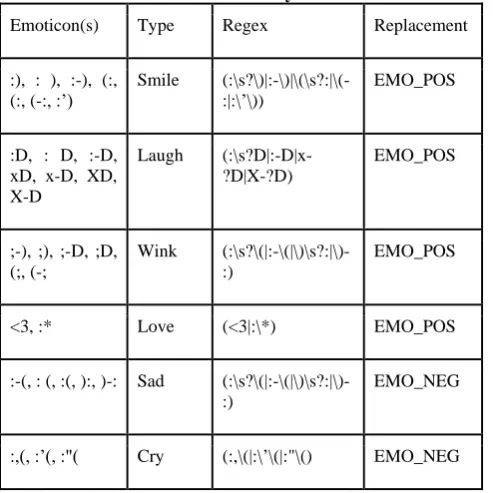
Table3:List of Emoticons matched by our method
Emoticon(s) Type Regex Replacement
:), : ), :-), (:, (:, (-:, :’)
Smile (:\s?\)|:-\)|\(\s?:|\(-:|:\’\))
EMO_POS
:D, : D, :-D, xD, x-D, XD, X-D
Laugh (:\s?D|:-D|x-?D|X-?D)
EMO_POS
;-), ;), ;-D, ;D, (;, (-;
Wink (:\s?\(|:-\(|\)\s?:|\)-:)
EMO_POS
<3, :* Love (<3|:\*) EMO_POS
:-(, : (, :(, ):, )-: Sad (:\s?\(|:-\(|\)\s?:|\)-:)
EMO_NEG
:,(, :’(, :"( Cry (:,\(|:\’\(|:"\() EMO_NEG
3.2.3
Hashtag
Hashtags are un-spaced phrases prefixed by the hash symbol (#) which is frequently used by users to mention a trending topic on twitter. We replace all the hashtags with the words with the hash symbol. For example, #hello is replaced by hello. The regular expression used to match hashtags is #(\S+).
3.2.4
Retweet
Retweets are tweets which have already been sent by someone else and are shared by other users. Retweets begin with the letters RT. We remove RT from the tweets as it is not an important feature for text classification. The regular expression used to match retweets is \brt\b.
After applying tweet level pre-processing, we processed individual words of tweets as follows:
● Strip any punctuation [’"?!,.():;] from the word. ● Convert 2 or more letter repetitions to 2 letters.
Some people send tweets like I am sooooo happpppy adding multiple characters to emphasize on certain words. This is done to handle such tweets by converting them to I am soo happy.
● Remove - and ’. This is done to handle words like t-shirt and their’s by converting them to the more general form tshirt and theirs.
● Check if the word is valid and accept it only if it is. We define a valid word as a word which begins with an alphabet with successive characters being alphabets, numbers or one of dot (.) and underscore(_).
Some example tweets from the training dataset and their normalized versions are shown in table 4.
Table
4:
Example Tweets from the Dataset and their Normalized VersionRaw misses Swimming Class. http://plurk.com/p/12nt0b
Normalized misses swimming class URL
Raw @98PXYRochester HEYYYYYYYYY!! its Fer from
Chile again
Normalized USER_MENTION heyy its fer from chile again
Raw Sometimes, You gotta hate #Windows updates.
Normalized sometimes you gotta hate windows updates
Raw @Santiago_Steph hii come talk to me i got candy :)
Normalized USER_MENTION hii come talk to me i got candy EMO_POS
Normalized @bolly47 oh no :’( r.i.p. your bella
Raw USER_MENTION oh no EMO_NEG r.i.p your bella
3.3
Feature Extraction
We extract two types of features from our dataset, namely unigrams and bigrams. We create a frequency distribution of the unigrams and bigrams present in the dataset and choose top N unigrams and bigrams for our analysis.
3.3.1
Unigrams
[image:3.595.54.301.81.328.2]Probably the simplest and the most commonly used features for text classification is the presence of single words or tokens in the text. We extract single words from the training dataset and create a frequency distribution of these words. A total of 181232 unique words are extracted from the dataset. Out of these words, most of the words at end of frequency spectrum are noise and occur very few times to influence classification. We, therefore, only use top N words from these to create our vocabulary where N is 15000 for sparse vector classification.
Figure 1: Statistics of Unigram Occurrence Frequency 0
10000 20000 30000 40000
Frequencies of Top 20
Unigrams
[image:3.595.315.555.95.377.2] [image:3.595.315.542.561.752.2]38
3.3.2
Bigrams
[image:4.595.54.540.173.567.2]Bigrams are word pairs in the dataset which occur in succession in the corpus. These features are
a good way to
model negation in natural language like the phrase
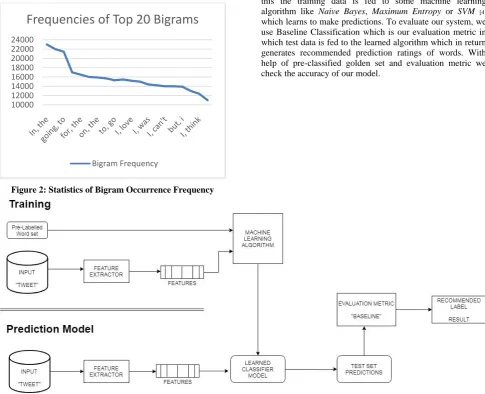
– This is not good. A total of 1954953 unique bigrams were extracted from the dataset. Out of these, most of the bigrams at end of frequency spectrum are noise and occur very few times to influence classification. We therefore use only top 10000 bigrams from these to create our vocabulary.Figure 2: Statistics of Bigram Occurrence Frequency
4.
MODEL
We will be using a model consisting of both test and training dataset model using various algorithms as due to the modular nature of the program we can add and remove the algorithms with ease. Let’s understand the workflow of our system with the help of above diagram. First, we have split the data into training and test set. We also keep separate positive and negative pre-labelled datasets for training the model and checking their generalization classification in test set. After this the training data is fed to some machine learning algorithm like Naive Bayes, Maximum Entropy or SVM [4] which learns to make predictions. To evaluate our system, we use Baseline Classification which is our evaluation metric in which test data is fed to the learned algorithm which in return generates recommended prediction ratings of words. With help of pre-classified golden set and evaluation metric we check the accuracy of our model.
Fig 3: Machine Learning Model for Twitter System Analysis System
4.1
Algorithms
4.1.1
Baseline (Evaluation Metric)
For a baseline, we use a simple positive and negative word counting method to assign sentiment to a given tweet. We use the Opinion Dataset of positive and negative words to classify tweets. In cases when the numbers of positive and negative words are equal, we assign positive sentiment.
4.1.2
Naïve Bayes
Naive Bayes classifiers are a family of simple "probabilistic classifiers “based on applying Bayes' theorem with strong (naive) independence assumptions between the features.” [5]
Naive Bayes is a simple model which can be used for text classification. In this model, the class 𝑐 is assigned to a tweet t, where
𝑐 = 𝑃 𝑐 𝑡 𝑎𝑟𝑔𝑚𝑎𝑥 𝑐
𝑃 𝑐 𝑡 ∝ 𝑃 𝑐 𝑃 𝑓ⅈ 𝑐
𝑛
𝑖 = 1
In the formula above, 𝑓ⅈ represents the 𝑖-th feature of total 𝑛
features. 𝑃 𝑐 𝑡 and 𝑃 𝑓ⅈ 𝑐 can be obtained through
maximum likelihood estimates. We used MultinomialNB from sklearn.naive_bayes package of scikit-learn for Naive Bayes classification. We used Laplace smoothed version of Naive Bayes with the smoothing parameter α set to its default value of 1. We used sparse vector representation for classification and ran experiments using both presence and frequency feature types. We found that presence features outperform frequency features because Naive Bayes is essentially built to 10000
12000 14000 16000 18000 20000 22000 24000
Frequencies of Top 20 Bigrams
work better on integer features rather than floats. We also observed that addition of bigram features improves the accuracy.
4.1.3
Maximum Entropy
Maximum Entropy Classifier model is based on the Principle of Maximum Entropy. The main idea behind it is to choose the most uniform probabilistic model that maximizes the entropy, with given constraints. [6] Unlike Naive Bayes, it does not assume that features are conditionally independent of each other. So, we can add features like bigrams without worrying about feature overlap. The model is represented by
𝑃 𝑀 𝐸 𝑐 𝑑, 𝜆 = 𝑃
exp[ 𝜆𝑖 𝑖𝑓𝑖(𝑐, 𝑑)]
exp𝑐′ [ 𝜆𝑖 𝑖𝑓𝑖(𝑐, 𝑑)]
Here, 𝑐 is the class, 𝑑 is the tweet and 𝜆 is the weight vector. The weight vector is found by numerical optimization of the lambdas to maximize the conditional probability.
The nltk library provides several text analysis tools. We use the MaxentClassifier to perform sentiment analysis on the given tweets. Unigrams, bigrams and a combination of both were given as input features to the classifier. The Improved Iterative Scaling algorithm for training provided better results than Generalized Iterative Scaling
5.
EVALUATION METRICS
For evaluation metrics, we use the baseline algorithm which uses simple positive and negative word counting method to assign sentiment to a given tweet. We use the Golden Dataset of positive and negative words to classify tweets. In cases when the magnitude of positive and negative words is equal, we assign positive sentiment. A baseline is a method that uses heuristics, simple summary statistics, randomness, or machine learning to create predictions for a dataset. We can use these predictions to measure the baseline performance (e.g. accuracy) this metric will then become what we compare any other machine learning algorithm against.
6.
CONCLUSION
We tried to build a sentiment analysis system by studying and implementing algorithms of machine learning. We implemented Naive Bayes and Maximum Entropy algorithms. Baseline model performed the worst with no doubt as it had least number of features. The modular system we've built can easy be scaled for new algorithms be it in Machine Learning, Deep learning or Natural Language Processing. Sentiment analysis system is an active field of research and we can still further improve our system by working more on the
algorithms, trying out different things in preprocessing and checking which ones get the best precision metrics.
6.1
Future Work
6.1.1
Handling Emotion Ranges
We can improve and train our models to handle a range of sentiments. Tweets don’t always have positive or negative sentiment. At times they may have no sentiment i.e. neutral. Sentiment can also have gradations like the sentence, This is good, is positive but the sentence, This is extraordinary. Is somewhat more positive than the first. We can therefore classify the sentiment in ranges; say from -2 to +2.
6.1.2
Using symbols
During our pre-processing, we discard most of the symbols like commas, full-stops, and exclamation mark. These symbols may be helpful in assigning sentiment to a sentence.
7.
ACKNOWLEDGMENTS
We wish to express our thanks towards Prof. Deshpande, Dr. Ghadekar and our families as without their constant support and guidance this project would have not been possible.
8.
REFERENCES
[1] R. Plutchick. “Emotions: A general psychoevolutionary theory.” In K.R. Scherer & P. Ekman (Eds) Approaches to emotion. Hillsdale, NJ; Lawrence Ealrbaum Associates, 1984.
[2] P. Basile, V. Basile, M. Nissim, N. Novielli, V. Patti. “Sentiment Analysis of Microblogging Data”. To appear in Encyclopedia of Social Network Analysis and Mining, Springer. In press.
[3] Johan Bollen, Huina Mao, and Alberto Pepe, “Modeling public mood and emotion: Twitter sentiment and socio-economic phenomena.,” in International AAAI Conference on Weblogs and Social Media (ICWSM’11), 2011.
[4] Cortes, Corinna; Vapnik, Vladimir N. (1995). "Support-vector networks". Machine Learning. 20 (3): 273–297.
[5] Russell, Stuart; Norvig, Peter (2003) [1995]. Artificial Intelligence: A Modern Approach (2nd ed.). Prentice Hall. ISBN 978-0137903955.