RESEARCH ARTICLE
UPTAKE OF LEAD, NICKEL AND COPPER BY THREE
Mucuna
SPECIES
1
Omosun, G.*,
1Edeoga, H. O.,
2Markson, A. A. and
2Madunagu, B. E
1Department of Biological Sciences, Michael Okpara University of Agriculture, Umudike Nigeria 2Department of Botany, University of Calabar, Calabar, Nigeria
ARTICLE INFO ABSTRACT
Agricultural soils of oil producing states in Nigeria have been severely affected by oil exploration activities and there is need to restore such soils to a manageable level. Phytoremediation uses plants whose rhizospheres are able to accumulate heavy metals from the soil. In order to know the capacity of Mucuna species to grow in soils polluted with crude oil and assess their capability to accumulate heavy metals which are normal components of crude oil, a field experiment was carried out. This experiment was a factorial (3 x 5) arrangement in a completely randomized design. Factors and levels were three species of Mucuna (M. veracruz, M. jaspodea and M. ghana) and crude oil concentrations (volume/weight) in the soil (0 %, 1 %, 2 %, 3 %, and 4 %). Heavy metals (nickel, lead, copper and vanadium) concentrations of crude oil provoked soils were determined prior to planting and then 12 WAP. The three Mucuna species accumulated heavy metals in their vegetative parts. Nickel accumulated more in the roots, than in the leaves, while copper and lead were more concentrated in leaves of the three Mucuna species, the concentration of copper was higher (highest value of 87 mg/g). However, the highest percentage of heavy metals reduction in the contaminated soils was that of lead with a percentage of 47.37 % reduction in the soil. The uptake of these three heavy metals by the vegetative parts of these Mucuna species in response to oil pollution was discussed as a possible use in phytoremediation.
INTRODUCTION
Crude oil is a complex mixture of thousands of hydrocarbons and non-hydrocarbon compounds including heavy metals. Although the toxicity of each individual component is known, the toxicity of complex mixtures such as crude and refined products is extremely difficult to assess (Overton et al., 1994). Excess concentrations of some heavy metals in soils such as cadmium, chromium, copper, nickel and zinc have caused the disruption of natural aquatic and terrestrial ecosystems (Meagher, 2000). Some heavy metals at low doses are essential micronutrients for plants but in higher doses they may cause metabolic disorders and growth inhibition for most of the plant species (Claire et al, 1991).
Onuoha et al., (2003) reported that beyond 3%
concentration in an environment, crude oil becomes increasingly deleterious to soil biota and crop growth. Some workers have observed that some plants can survive metalliferous soils and can tolerate greater than usual amounts of heavy metals or other toxic compounds (Raskin and Ensley, 2000). Several studies have been conducted in order to evaluate the effects of different heavy metal concentrations on live plants.
*Corresponding author: [email protected]
Most of these studies have been conducted using seedlings or adult plants (Pichtel et al., 2000; Chartterjee and Chartterjee, 2000; Reeves and Baker, 2000; Raskin and Ensley, 2000). In some studies, the seeds have been
exposed to the contaminants (Claire et al., 1991;
Vojtechova and Leblova, 1991; Xiong, 1998).
Alternative agriculture which expands the use of plants well beyond food and fiber is beginning to change plant biology. Biotechnology offers value added use of plants which include phytoremediation, the use of plants to remove pollutants from the environment or render them harmless. With the exception of root crops, plant roots are less utilized and studied than the shoots. However this situation may be changing because of the emerging biotechnology that exploits the ability of plants to transport valuable molecules into and out of their roots. This root based technology is called phytoextraction, a subset of phytoremediation, which uses plants to remove toxic heavy metals from the soil. Chelate assisted
phytoextraction (Gleba et al., 1999) has been successfully
used to remove heavy metals from contaminated soils using specially selected varieties of plants (Dushenov et al., 1997; Raskin et al., 1997).
The idea of using plants to remove metals from soils came from the discovery of different wild plants often endemic to naturally mineralized soils that accumulate high concentrations of metals in their foliage
(Baker and Brooks, 1989; Raskin et al., 1997). It is
ISSN: 0975-833X
Available online at http://www.journalcra.com
International Journal of Current Research Vol. 4, pp. 098-103, May, 2010
INTERNATIONAL JOURNAL
OF CURRENT RESEARCH
© Copy Right, IJCR, 2010 Academic Journals. All rights reserved.
Key words:
Copper Heavy metals Lead, Mucuna Nickel Uptake Vegetative
Article History:
Received 13th April, 2010
Received in revised from 20th April, 2010
Accepted 27th April, 2010
099 International Journal of Current Research, Vol. 4, pp. 098-103, May, 2010
unfortunate that the enormous costs associated with the removal of pollutants from soils by means of traditional physico – chemical methods have been encouraging companies to ignore the problem. As reported by Raskin
et al., (1997), the state of the art technology for the remediation of metal polluted soils involves the excavation and burial of the soil at hazardous waste sites at an average cost of $1,000,000 per acre.
Considering the growing number of commercially successful applications and the lack of serious
environmental concerns both technologies of
phytoremediation and phytoindication are gaining
acceptance from the scientific community, the general public and regulators. Due to the problems of pollution in agricultural lands of oil producing states of Nigeria, this is an attempt to validate the technology of phytoremediation to solve these problems. This work therefore will be a major contribution to these innovative technologies which could economically remediate polluted soils by providing a cheap and simple means of restoring crude oil contaminated soils and possibly other soil pollution types. Most of the plants that have been reportedly used for
phytoremediation such as Arabidopsis thaliana, Thlaspi
caerulescens (Baker et al., 1994); Helianthus annus,
Brasicca juncea (Sridhar and Diehl, 2005) are mostly exotic. There is therefore need to search for a novel phytoextracting plant adapted to our particular ecosystem
and climate. In this case, Mucuna has been chosen as the
plant of choice considering its earlier reported use for
phytoremediation (Santos et al, 2004). As stated by
Garbisu and Alkorta, (2001), a plant to be used for phytoremediation must have a rapid growth rate, possess the ability to produce a high biomass in the field and have
a profuse root system. Mucuna spp. have these quality
stated above, hence its choice for this study. The objectives of this study therefore are to investigate the reduction in heavy metal content of the polluted soil at different levels and also look at the possible accumulation of these heavy metals in the vegetative parts of these
Mucuna species.
MATERIALS AND METHOD
Study AreaThe experiment was conducted in an experimental farm at Michael Okpara University of Agriculture, Umudike. Umudike is located approximately at latitude 050 291 N, longitudes 070 321 E. Umudike falls within the rainforest zone of southeastern Nigeria with a mean
altitude of 123m. Daily mean temperature ranges from 230
C and 320 C. The field work was carried out between the
months of August to November, 2008.
Design of the Experiment
A factorial arrangement (5 x 3) was used in a completely random experimental design. The factors were crude oil concentration (volume/weight) in the soil (0%,
1%, 2%, 3%, and 4%) and three Mucuna species (M.
veracruz, M. jaspodea and M. ghana), a total of 15 treatments with 5 replications.
Collection of Samples
The soil used in this study had no previous history of crude oil contamination. The soil sample was obtained from the top soil (0 – 15 cm) collected within the Campus of Michael Okpara University of Agriculture, Umudike.
The seeds of the Mucuna ascensions used were obtained
from the Seed Bank of International Institute of Tropical Agriculture, Ibadan. The crude oil was a Nigerian Bonny light blend obtained from Shell Petroleum Development Company (SPDC) Limited Port-Harcourt, Nigeria.
Soil Treatment
Soil samples collected were homogenized and sieved. The contamination with the crude oil was done by thoroughly mixing with the soil in their respective plastic buckets. Soil of 4 kg was treated with 40 ml, 80 ml, 120 ml and 160 ml of crude oil to obtain 1, 2, 3, and 4% v/w (volume/weight) crude oil contamination. Each treatment including the control (0% v/w) was replicated five times.
Determination of Heavy Metals in Soil and Plant Samples
Soil, root and leaf samples were analyzed for presence and quantification of heavy metals. Heavy metals determined were Nickel, Lead and Copper which are normal constituents’ of crude oil (Osuji and Onojake, 2004).
Soil Samples
The soil samples at different levels of crude oil contamination and the control (uncontaminated soil sample) were air dried. The dried soil samples were crushed and sieved using a 2 mm sieve. 4 g each of the air dried and finely ground soil samples were weighed and
added into crucibles. 4 ml HClO4, 5.0 ml of HNO3 and 0.5
ml of H2SO4 wasadded into crucibles. The crucibles were
swirled gently and slowly digested (heated on a hot plate until white fumes appears. The crucibles were set aside to cool. The samples were transferred to a 50 ml volumetric flask and the content transferred to a 50 ml volumetric flask and the content was diluted to 40 ml volume. The solutions were filtered through Whatman No. 42 filter paper.
Plant Samples
Root and leaf samples of the three Mucuna species
were oven dried at 300 C. These samples were later ground
and sieved. 5 g of each ground tissue sample were
weighed and placed in crucibles. 20 ml 1:1 HNO3 / HClO4
acid mixture added into the crucibles, these crucibles were swirled gently, slowly digested and heated to dryness. The cooled residue were then dissolved in 5ml concentrated HCl. This solution was then made up to 50ml using distilled water and filtered using Whatman No. 42 filter paper. Heavy metals (lead, copper, nickel and vanadium) concentrations of the digested soil and plant samples were determined using Atomic Absorption Spectrophotometer (UNICAM SOLAAR 32 Model).
Soil particle size analysis
Particle size of soil components was determined using the Gee and Bauder (1986) method. 50 g of air dried soil was weighed into 500 ml dispersing cup. Sodium hexametaphosphate was used as dispersing agent. 50 ml of calgon was added into the dispersing cup containing the soil samples and allowed to soak for 15 minutes. After 15 minutes, the sample was stirred for 10 minutes and poured into 1 litre cylinder and made up to the 1 litre mark with distilled water. The cylinder was covered with the palm and inverted several times and placed on a flat surface and immediately a hydrometer was slowly and carefully dropped into the soil suspension. The hydrometer reading was taken at exactly 40 seconds (H1). The temperature
Omosun et al., Uptake of lead, nickel and copper by three Mucuna species 100
suspension was allowed to stand for 2 hours. After 2 hours the second hydrometer and thermometer readings were recorded (H2 and T2).
Calculation
% Silt and Clay = [H1 + 0.2 (T1 - T) – 2.0] x 100/50 % Clay = [H2 + 0.2 (T2 – T1) – 2.0] x 100/50 % Sand = 100 - % (silt and clay)
Where T = constant (680 F)
Soil pH
10 g of soil was weighed into a plastic cup. 25 ml of distilled water was added. The mixture was stirred with a glass rod and allowed to stand for 30 minutes. The electrode of the pH meter was inserted into the soil suspension and the reading taken. (Thomas, 1996).
RESULTS AND DISCUSSION
Soil physical and chemical properties and heavy metal bioavailability
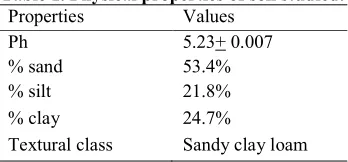
[image:3.612.318.533.97.185.2]The result of the textural class and the pH of the soil are shown in Table 1. From the result, the particle size analyses show the texture of the soil to be sandy clay loam. The pH of the soil is 5.23, this indicates that the soil is acidic in nature. These two physical parameters are very important when considering metal interactions in soils and their bioavailability to plants. Naidu et al., (2003) stated that soil characteristics (e.g. soil pH, clay, organic matter content and type, and moisture content) determine availability of metals to plants by controlling the speciation of the elements, temporary binding by particle surfaces (adsorption–desorption processes, precipitation reactions and availability in soil solution.
Table 1.Physical properties of soil studied.
Properties Values
Ph 5.23+ 0.007
% sand 53.4%
% silt 21.8%
% clay 24.7%
Textural class Sandy clay loam
Fotovat et al., (1997) have shown that natural soil of pH values of 5–6 retain less metals when compared to soils of pH 6–7 which retain more metals. On the contrary, soils with pH 5–6 exhibit high metal bioavailability to plants, while soils of 6 – 7 exhibit low bioavailability of metals to plants.
This means that plants growing in different soils with the same total metal concentration may vary in their phytotoxic response due to differences between the soils in their sorptive capacity. The results of particle size analysis shows that the soil is high in clay content (24.7%) and clayey soils are known to have a high, therefore low
binding capacity to the soil. Vanadium’s low
concentration in the soil might have been caused by the metal not binding to the soil and hence lost through leaching.
From Table 2 it can be seen that nickel and copper out of the three heavy metals investigated had higher concentration in the soil. Naidu et al., (2003) have listed cadmium, copper, zinc, arsenic, and lead as heavy metal contaminants of major concern. Copper and lead belong to this group.
Heavy metals uptake by the Mucuna species investigated (phytoextraction)
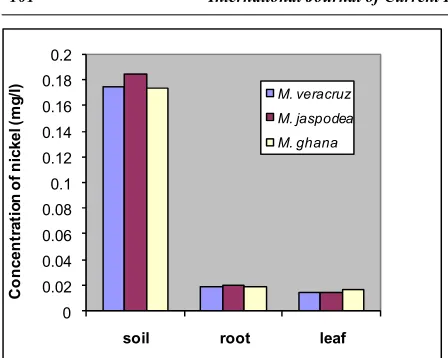
The result of the determination of the four heavy metals content in the different crude oil polluted soils and of the roots and leaves of the three Mucuna species are represented in Fig. 1 – Fig. 3. Fig. 1 shows the concentration of nickel in the soil and roots and leaves of
M. jaspodea, M. vereacruz and M. ghana. The highest concentration of nickel in the soil was (241 mg/g), while
the lowest was observed in the leaves of M. veracruz (21
mg/g) and M. jaspodea (14.2 mg/g). The same trend of
high contents of heavy metals in the soil than in the roots
and leaves of the three Mucuna spp. was recorded for
nickel, lead, and copper. However, nickel, lead, and copper accumulated more in the leaves than in the roots of
the three Mucuna spp. The mean value of copper
concentration (51 mg/g) in Mucuna ghana was more than
that of lead (3 mg/g) (Fig. 2 – Fig. 3).
Garbisu and Alkorta (2001) reported that some trace heavy metals such as lead are accumulated in roots, probably due to some physiological barriers against metal transport to aerial parts, while some others are easily transported in plants. This probably accounts for the high concentration of lead and nickel in the roots compared to the low concentration of copper in the roots of the three
[image:3.612.101.275.420.501.2]Mucuna species. Raskin et al. (1994) stated that most plants can accumulate heavy metals essential for growth and development such as iron, manganese, zinc, copper,
Table 2. Heavy metal content of the different concentrationof crude oil provoked soils investigated
Treated soils
Heavy metal concentration (mg/g)
Mean pH values
Ni Pb Cu
0% 98+0.034 7+0.087 95+0.500 5.23+0.007
1% 256+0.043 18+0.009 168+0.765 5.04+0.005
2% 273+1.090 26+0.560 192+0.548 4.94+0.098
3% 301+0.874 34+2.288 212+0.151 4.81+0.001
4% 323+01.776 38+1.124 241+0.009 4.72+0.061
Table 3. Percentage reduction of nickel, lead and copper in soil 12 weeks after planting of
the Mucuna species investigated
Mucuna species
Crude oil pollute d soil
Percentage reduction in the soil (%)
Ni Pb Cu
M. veracruz
0% 18.37 14.29 5.26
1% 32.81 27.78 29.76 2% 33.00 38.46 35.41 3% 31.56 47.06 36.79 4% 25.70 44.74 41.49
M. jaspodea
0% 23.47 14.29 6.32 1% 31.64 27.78 30.35 2% 25.64 38.46 34.90 3% 32.56 44.12 36.32 4% 26.31 47.37 41.49
M. ghana
0% 26.53 28.57 10.53
[image:3.612.339.527.424.634.2]101 International Journal of Current Research, Vol. 4, pp. 098-103, May, 2010
magnesium and molybdenum. Copper belongs to this class of essential metal elements needed by plants for growth. This could be an explanation for the high
concentration of copper in the leaves of the three Mucuna
species.
In addition, some plants have the capacity to accumulate heavy metals with no known biological
functions such as cadmium, chromium, lead, cobalt, mercury and selenium (Baker and Brooks, 1989). Lead has no known biological functions. Excess lead causes a number of toxicity symptoms in plants e.g. stunted growth, chlorosis and bsslackening of root system. Lead inhibits photosynthesis upsets mineral nutrition and water balance (Xiong, 1998). Highest mean value of 3 mg/g of
lead was observed in M. ghana. Lead is not usually
available for plant uptake in normal range of soil pH (Raskin et sssal., 1997). Cunningham et al., 1995) have reported vegetation growing in heavily contaminated areas having less than 50 mg/g in shoots. In the present study, the highest value of lead concentration in shots recorded (3 mg/g) was far less than the 50 mg/g mark reported by Cunningham et al. (1995).
The low level of nickel and lead in the roots and leaves compared to the relatively high concentration in the soil could be attributed to the heavy metal tolerance of these
three Mucuna species. Tolerance to heavy metals as
explained by Robinson et al. (1994), is based on the
sequestration of heavy metal ions in vacuoles, on binding them by appropriate ligands like organic acids, proteins
and peptides and on the presence of enzymes that can function at high levels of metallic ions. Garbisu and Alkorta (2001) listed among other factors, the
tolerance of a plant to high levels of a heavy metal, as a good characteristic of an ideal plant to be used for
phyto extraction purposes.
Plant roots can increase metal bioavailability by extruding protons to acidify the soil and mobilize metals. Crowley et al. (1991) observed this mechanism for iron (Fe) in some Fe-deficient dicot plants. Studies have shown that lowering the soil pH decreases the adsorption of heavy metals and thus increases their concentration in the soil solution for uptake by plants (Harter, 1983; Salt et al.,
1995; Garbisu and Alkorta, 2001). Salt et al. (1995)
further stressed that it may be possible to increase metal availability and hence plant uptake by maintaining a moderately acid pH in the soil through the use of
ammonium containing fertilizer or soil acidifiers.
M. jaspodea, M. veracruz and M. ghana are promising
hyperaccumulators considering the factors discussed
so far. Salt et al. (1995) identified the first
hyperaccumulators to be characterized to be members of
the Brassicaceae and Fabaceae families. Mucuna spp.
belongs to the Fabaceae family.
Table 4.3 shows the level of the heavy metals in the soil 12 weeks after planting. The highest percentage (47.37%) of ressduction was observed in lead, across the soils of the three species. From the table, the trend is a general reduction of metals in the soil as the crude oil
concentration increases. This means that the Mucuna
species accumulate more heavy metal as the concentration of oil in the soil increases. This increased accumulation or bioavailability of metals could be attributed to lower pH of the more polluted soils (Table 4.2). Fotovat et al. (1997) have reported that soils of lower pH exhibit high metal bioavailability to plants, while soils of higher pH exhibit low bioavailability of metals to plants.
0 0.02 0.04 0.06 0.08 0.1 0.12 0.14 0.16 0.18 0.2
soil root leaf
C
o
n
c
en
tr
a
tio
n
o
f
n
ic
k
el
(
m
g
/l
)
M. veracruz
M. jaspodea
[image:4.612.73.297.49.228.2]M. ghana
Fig 4.1. Respective concentrations of the nickel in soil, roots and leaves of the Mucuna spp. studied.
0 0.002 0.004 0.006 0.008 0.01 0.012 0.014 0.016
soil root leaf
Co
n
ce
n
tr
a
tio
n
o
f
le
ad
(
m
g
/l)
M. veracruz
[image:4.612.74.298.271.458.2]M. jaspodea M. ghana
Fig. 4.2. Respective concentrations of lead in soil, roots and leaves of the Mucuna spp. studied.
0 0.02 0.04 0.06 0.08 0.1 0.12 0.14
soil root leaf
Co
nc
en
tra
tion
of
cop
per(mg
/l
) M. veracruz
M. jaspodea
M. ghana
Omosun et al., Uptake of lead, nickel and copper by three Mucuna species 102
CONCLUSION
This study has provided an insight into the value-added
use of Mucuna species in the novel areas of
phytoremediation and phytomonitoring. The information generated can be practically applied for restoring oil polluted soils by using it to remove the heavy metal components of crude oil. The percentage reduction of heavy metals from the soils recorded proves that these
Mucuna species are good phytoextractors of heavy metals
from the soil. Using Mucuna for phytoremediation of
polluted soils will be innovative because it takes advantage of natural plant processes. This method if adopted requires less equipment and labor than other
methods since plants do most of the work. The Mucuna
plants will also help to revegetate the polluted site since these plants can tolerate oil polluted soils, and as well make the site more attractive. The site can be cleaned up without removing polluted soil or pumping polluted groundwater.
AKNOWLEDGEMENT
Our gratitude to the ‘Innovators of Tomorrow’ STEB-B Project of the Federal Ministry of Education, Nigeria in collaboration with World Bank for fully funding this Project.
REFERENCES
Baker, A. J. M. and Brooks, R. R. 1989. Terrestrial higher plants which hyperaccumulate metallic elements. A
Review of their distribution, ecology and
phytochemistry. Biorecovery, 1: 81-126.
Baker, A. J. M., Reeves, R. D., Hajar, A. S. N. 1994. Heavy metal accumulation and tolerance in British
populations of the metallophyte Thlaspi caerulescens.
New Phytol., 127: 61-68.
Chatterjee, J. and Chatterjee, C. 2000. Phytotoxicity of cobalt, chromium, and copper in cauliflower. Environmental. Pollution, 109: 69-74.
Claire, L. C., Adriano, D. C., Sajwan, K. S., Abel, S. L., Thoma, D. P. and Driver, J. T. 1991. Effects of selected trace metals on germinating seeds of six plant species. Water, Air, and Soil Pollution, 59: 231-240.
Crowley, D. E., Wang, Y. C., Reid, C. P. P. and Szaniszlo, P. J. 1991. Mechanism of iron acquisition from siderophores by microorganisms and plants. Plant Soil, 130:179-198.
Cunningham, S. D., Berti, W. R. and Huang, J. W. 1995. Phytoremediation of contaminated soils. Trends in Biotechnology, 13: 393-397.
Dushenkov, S., Kapulnik, Y., Blaylock, M., Sorochisky,
B., Raskin, I. and Ensley, B. 1997.
Phytoremediation: A Novel Approach to an Old Problem. Global Environmental Biotechnology Proceedings of the Third Biennial Meeting of the
International Society for Environmental
Biotechnology 15-20 July 1996, Boston MA, Elsevier, New York.
Fotovat, A, Naidu, R. and Sumner, M. E. 1997. Water: Soil ratio influences aqueous phase chemistry of indigenous copper and zinc in soils. Aust. J. Soil Res. 35: 687-710.
Garbisu, C. and Alkorta, I. 2001. Phytoextraction: A cost-effective plant-based technology for the removal of
metals from the environment. Bioresource
Technology, 77: 229-236.
Gee, G. W. and Bauder, J. W. 1986. Particle Size Analysis. In: Methods of Soil Analysis. Part 1. Physical and Mineralogical Methods. Klute, A. (Ed.).
Soil Science Society of America, Madison,
Wisconson.
Gleba, D., Borisjuk, N. V., Borisjuk, L. G., Kneer, R., Poulev, A., Skarzhinskaya, N, Dushenkov, S., Logendra, S., Gleba, Y. Y. and Raskin, J. 1999. Use of plant roots for phytoremediation and molecular farming. Proceedings of National Academy of Science, USA,, 96(11): 5973-5977.
Harter, R. D. 1983. Effect of soil pH on adsorption of lead, copper, zinc and nickel. Soil Science Society Am. Journal, 47: 47-51.
Meagher, R. B. 2000. Phytoremediation of toxic elemental and organic pollutants. Current Opinion in Plant Biol., 3: 153-162.
Naidu, R., Oliver, D and McConnell, S. 2003. Metal Phytoxicity in Soils. In: Proceedings of the Fifth National Workshop on the Assessment of Site Contamination. Langley, A., Gilbey, M. and
Kennedy, B. (Eds). National Environmental
Protection Council (NEPC), Adelaide. Pp 235-241. Onuoha, C. I., Arinze, A. E. and Ataga, A. E. 2003.
Evaluation of growth of some fungi in crude oil polluted environment. Global. Journal of Agric. Science, 2: 1596-2903.
Osuji, L. C. and Onojake, C. M. 2004. Trace heavy metals associated with crude oil: A case of Ebocha-8 oil spill polluted site in Niger-Delta, Nigeria. Chemistry and Biodiversity, 1(11): 1708-1715.
Overton, E. B., Sharp, W. D. and Roberts, P. 1994. Toxicity of Petroleum. In: Basic Environmental Toxicology. Cockerham, L. G. and Shane, B. S. (Eds.). CRC Press: Boca Raton, FL,; 133–156. Pichtel, J., Kuroiwa, K. and Sawyer, H. T. 2000.
Distribution of Pb, Cd, and Ba in soils and plants of two contaminated sites, Environmental. Pollution, 110: 171-178.
Raskin, I. and Ensley, B. D. 2000. Phytoremediation of Toxic Metals: Using Plants to clean up the Environment, John Wiley and Sons, New York.
Raskin, I., Kumar, P. B. A. N., Dushenkov, V. and Salt, D. E. 1994. Bioconcentration of heavy metals in plants. Current Opinoins in Biotechnology, 5: 285-290.
Raskin, I., Smith, R. D. and Salt, D. E. 1997. Phytoremediation of metals using plants to remove pollutants from the environment. Current Opinoins in Biotechnology, 8: 221-290.
Reeves, R. D. and Baker, A. J. M. 2000. Metal Accumulating Plants, In: Phytoremediation of Toxic Metals: Using Plants to Clean up the Environment. Raskin, I. and Ensley B. D. (Eds.). John Wiley and Sons, Inc, Toronto, Canada, p. 303.
103 International Journal of Current Research, Vol. 4, pp. 098-103, May, 2010
Salt, D. E., Blaylock, M., Kumar, P. B. A. N., Dushenkov, V., Ensley, B. D. Chet, L. and Raskin, L. 1995. Phytoremediation: A novel strategy for the removal of toxic metals from the environment using plants. Biotechnology, 13: 468-474.
Santos, J. B., Procopio, S. O. and Silva, A. A. 2004.
Phytoremediation of the herbicide trifloxysulfuron
sodium.Planta Daninha, 22(2): 323-330.
Sridhar, B. B. M. and Diehl, S. V. 2000. Anatomical changes due to uptake and accumulation of Zn and
Cd in Indian Mustard (Brassica juncea).
Environmental and Experimental Botany, 54(2): 131-141.
Thomas, G. W. 1996. Soil pH and Soil Acidity. In: Methods of Soil Analysis. Part 3. Chemical Methods. L. D. Sparks (Ed.). Soil Science Society of America (SSSA), Madison, Wisconson.
Vojtechova, M., and Leblova, S. 1991. Uptake of lead and cadmium by maize seedlings and the effects of heavy metals on the activity of phosphoenolpyruvate carboxilase isolated from maize, Biologia Plantarum, 33: 386-394.
Xiong, Z. T. 1998. Lead uptake and effects on seed
germination and plant growth in a Pb
hyperaccumulator Brassicapekinensis Rupr., Bulletin
of Environmental Contamination and Toxicology, 60: 285-291.