Research on Different Feature Parameters in Speaker
Recognition
Qiyue Liu, Mingqiu Yao, Han Xu, Fang Wang
Department of Communication and Information System, Hebei University of Science and Technology, Shijiazhuang, China. Email: [email protected]
Received March 15th, 2013; revised April 16th, 2013; accepted April 25th, 2013
Copyright © 2013 QiyueLiu et al. This is an open access article distributed under the Creative Commons Attribution License, which
permits unrestricted use, distribution, and reproduction in any medium, provided the original work is properly cited.
ABSTRACT
Feature parameters extraction is critical for speaker recognition research. The paper presents the function of pitch, for- mant and Mel frequency central coefficient (MFCC) in speaker recognition. It can increase the identification rate effec- tively for feature parameter sorts the speech corpus. Using Euclid Distance to compare feature parameters is very effec- tive.
Keywords: Pitch; Formant; MFCC; Euclid Distance
1. Introduction
People can distinguish different speakers through the ear, since people can know the difference, machine can also do it in some kind of method. Speaker recognition is to make a machine to identify different people, which are to let the machine know who is talking.
The ultimate purpose of speaker recognition is to iden-tify who is speaking, while to ignore the content of speech. In fact, it is the recognition of the characteristics of speech.
The human voice is a natural property, each person’s speech organs have their own characteristics and pronun- ciation habits. Therefore, to identify speaker exactly, the parameters that can fully reflect the personality charac- teristic must be extracted from the speech signal.
These feature parameters should have these character- istics [1,2]:
These can fully embody the large difference between different people, and can keep stability relatively when the speaker’s speech changes.
These can maintain good health and stubbornness when voice suffers from outside interference.
These cannot imitate easily.
These are easy to extract and compute, and have fa-vorable independence between each dimension of the characteristic parameter.
Voice is different from fingerprint, the fingerprint is fixed, but the voice is changing, so it has not been found in some kind of parameter which could fully meet all of
these features we mentioned above. The sound is con-nected with human emotion, health and environment, etc. And also has a relationship with the voice content. Therefore, all of the characteristic parameters we applied to have some defects now, which cannot accurately stand for the speaker’s personality traits.
2. Research on Different Feature Parameters
Speaker’s characteristics are generally reflected in chan-nel feature and the glottal feature.
In the case of ensuring the recognition rate, it should be very difficult to improve recognition time through reducing computational complexity. It has been used that expending computation time to improve the recognition rate. And in speaker recognition, with the increasing in the number of speakers, the time it takes to identify is increasing in a rectilinear fashion. Because every time recognition must be matched with every speaker model orderly, and then find the closest corresponding speaker model as the final recognition result. In this way, the more registered number, the longer discriminating time, it must be reached by a limit that leads to a very long time to identify, it cannot meet the requirement finally. In this case it could be nicely solved adopting classification.
2.1. Pitch Frequency
a very important parameter using to describe the charac- teristic of voice excitation source. The variational range of pitch frequency is generally from 50 Hz to 500 Hz, the cycle of the male voice is 50 Hz - 300 Hz, and the female is 100 Hz - 500 Hz. Although each person’s different vocal structure lead to different fundamental frequency, because of the pitch frequency’s scope is a little small, the gap between different people is little, and the most important is pitch frequency is affected by a lot of factors, such as emotion, tone, it is very difficult to achieve accu- rate fundamental frequency. Thus, the recognition rate is very low using the fundamental frequency for speaker recognition now. But male fundamental frequency is gen- erally lower than the female, it is a good argument as clas- sification.
Since the research of voice signal analysis, pitch ex- traction is always an important research topic. Speech signal changes complexly, which is affected by channel and has an ample harmonic constituent. Although many methods have been proposed at present, they all have limitations, cannot delegate speaker’s different characteris- tics, and can not adapt to different requirement and envi- ronment.
There are a variety of methods to extract the funda- mental tone [1]. These can be roughly divided into three categories, wave form estimation, correlation process and converter technique [3]. This paper used a converter tech- nique to extract pitch, it transforms the speech signal to the cepstrum domain, eliminates channel impact using homo- morphic analytical method, then obtains the information of pumping part, and ermittelts fundamental frequency.
Only voice sound has pitch alternation. The glottal ex- citation is less energy and white noise of spectrum evenly distributed when madding voiceless; when madding voice sound, it is a shock sequence having a certain pe- riod. This period is the pitch alternation. A finite length sequence of periodic impulse has a periodic impulse se- quence in cepstrum domain
0 M r r
ps n n
rT , Mis positive, r is crest factor, Tp is pitch alternation,
and the period cannot change in cepstrum domain, the amplitude increases along with r and the rate of decay is
faster than in the time domain. In this way, the method based on cepstrum can be used to extract fundamental frequency and it has a better effect.
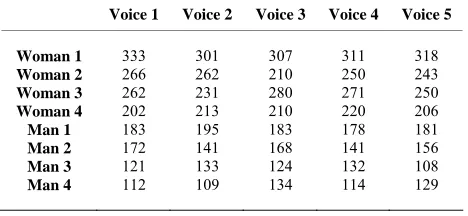
[image:2.595.307.541.629.737.2]Lab settings: Intel(R) Core(TM)2 Duo T6400, 2 GHz memory, Windows XP system, MATLAB7.0 develop- ment platform, the experiment’s voice data use Cool Edit Pro to transcribe, sampling frequency is 16,000 Hz, sam- pling precision is 16 bit, single track, the age of recorded speaker is in 8 - 60 years old, speaking mandarin, every- one speaks 7 sentences, the time of every sentence is in 3 - 12 s, including vowel, consonant, Chinese, English and
figure.
The experimental results were shown in Table 1,
every speaker’s pitch frequency could not be accurately achieved with this method. The result appears in a scope rather than is a exact value. The scope of different peo-ple’s pitch frequency has a small gap and intersection. So it is clearly not feasible only with a frequency value in the speaker recognition. The male voice’s pitch fre-quency is generally lower than the female, therefore, pitch can be used to distribute speakers.
2.2. Formant
Formant information include in spectral envelope. The formant is generally the maximum of spectral envelope, so the necessary procedure of extracting formant is to estimate spectral envelope.
Methods of fetching formant contain cepstrum method and linear forecasting method [1]. Formant generally de-fined as the attenuation sine component of sound channel impulse response. A primary question for extracting for-mant is that impulse response of the sound channel can-not measure directly. Voice signals are the convolution of all pole model and glottal quasiperiodic function, so when analyzing, it must solve convolution, separate im-pulse response and excitation function.
The paper adopts linear forecasting method to estimate formant, the specific method is peak detection. Analyz-ing formant with linear predictor coefficients is faster and better than others. The track function which is de-scribed by linear predictor coefficients (LPC) is com-puted firstly, the function is used to compute the spec-trum, according to the specspec-trum, the formant’s peak, fre-quency and bandwidth are computed [4].
The experimental environment is identical with pitch’s. The Table 2 shows that each formant could change
when the same person said different word. Even though the same person’s value of alteration has a scope, this scope includes others’. Therefore formant parameter can- not be the effective one in speaker recognition. Experi- mental data proved that children’s value of F1 are higher than adults’, so the parameter can be used to distinguish between child and adult.
Talbe 1. The result of pitch frequency with cepstrum me- thod.
Voice 1 Voice 2 Voice 3 Voice 4 Voice 5
Talbe 2. Formants of speech signals.
F1 F2 F3
Adult
Man 1 Man 1 (different content)
Man 2 Man 3 Man 4 Woman 1 Woman 2 Woman 3 Woman 4 704 616 652 581 438 618 544 551 590 1174 1831 1323 1830 1614 1814 1834 2653 1210 2456 2891 2721 2519 1780 2617 2960 2630 2279 Child Girl 1 Girl 2 Boy 1 Boy 2 749 1015 904 837 1405 1733 1353 1379 1643 2314 2990 2560
2.3. Mel Frequency Central Coefficient
In a noisy environment, people can also identify correctly different sound in the ear, the important reason is the cochlea played a role. The cochlear is equivalent to a set of filters, the filters are done to the signal on logarithmic frequency scale, and so human ear is more sensitive to low frequency signals [5].
A set of Mel filters of imitating the role of the cochlea are triangular filters, the center frequency is equispaced in the Mel frequency axis, and they have the same span on the Mel frequency scale. The number of filter bank is decided by cutoff frequency of signal, all of the filter bank collectively cover between 0 and 1/2 sampling fre-quency.
To emphasizing low frequency information of the sig-nal, MFCC change the linear frequency scale into Mel frequency scale, so useful information for identifying is highlighted and the noise jamming is shielded effectively. If Mel cepstrum is used, filtering and weighting in the cepstrum domain are based on linear spectrum process-ing [6].
MFCC generally reflect the static characteristics, but the human ear is more sensitive to the dynamic charac-teristics of voice. ΔMFCC can reflect dynamic property. This parameter can be acquired by computing first-order difference and second. The paper uses the parameter combining 12 dimensions MFCC with ΔMFCC.
The experimental environment is identical with pitch’s. Five methods of comparing to two MFCC were attempted.
1) Correlation coefficient
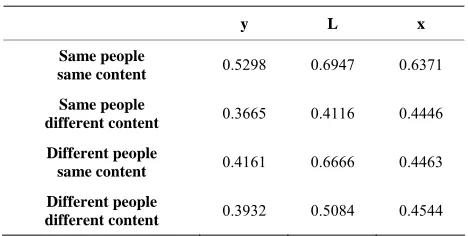
In theory, the correlation coefficient is the maximum when the same person speaks the same word, and it is the second highest when the same people speak different words. Only in this way, could the speaker be identified. Analyzing experimental result, the Table 3 shows that
[image:3.595.306.540.109.227.2]the correlation coefficient of female speaker L cannot be identified, because the value of the same people speaking different words is lower than the different people speak-ing the same word. So this means cannot be resultful
Table 3. Correlation coefficient of MFCC of two voice sig-nal.
y L x
Same people
same content 0.5298 0.6947 0.6371
Same people
different content 0.3665 0.4116 0.4446
Different people
same content 0.4161 0.6666 0.4463
Different people
different content 0.3932 0.5084 0.4544
method in speaker recognition.
2) Comparing to similarity of corresponding three- dimensional map
The data of the Figures 1 and 2 are from the same
person. Although they are similar in general, there are many data of MFCC, they don’t have regularity, the drew three-dimensional map is intricate, after smoothing, it is difficult to compare the similarity.
3) Comparing related coefficient of each column Because each MFCC dimension is uncorrelated, they can be compared independently.
As shown in Table 4, this method is not useful for
comparing MFCC. The part of women in different people different content is larger than same people same content in related coefficient of the first dimension. It is a nega-tive relationship in the first, second, fifth, sixth, tenth and twelfth dimension of same people same content. So this method cannot serve as the way of comparing MFCC.
4) Euclid distance
Table 5 shows that the euclid distance is minimum
when the same person speaks the same word, and it is second smallest when the same person speaks different words. Regardless of what the speaker said, the mini-mum Euclidean distance corresponding to the speaker is the recognition results.
3. Conclusions
Pitch and formant are both the most important parame-ters of the speech signal. In theory, because of the dif-ferences of buccal structure and sound track, everyone should have their own different characteristics of pitch and formant. Speech signal changes in complex, sound channel and noise have an effect on the signal, and ex-tracting methods are imperfect, so pitch or formant is not an effective parameter in speaker recognition recently, they can only play a supporting role. MFCC is effective for speaker identification, because it combines sensing features of the human ear with producing mechanism of voice.
Figure 2. Three-dimensional map of female consonant. Figure 1. Three-dimensional map of female vowel.
Table 4. Correlation coefficient of each dimension of MFCC.
Different people same content Different people different content Same people same content Same people different content
woman man woman man
1 −0.0053 −0.3237 −0.1266 −0.1800 0.0782 −0.2611 2 −0.3008 −0.1839 −0.2274 −0.3389 0.2223 0.1788 3 0.4592 0.3923 0.5468 0.3992 0.3423 −0.1024 4 0.3984 −0.1197 −0.0152 0.4367 0.2005 0.2433 5 −0.0324 −0.1635 0.3900 0.2537 −0.2118 −0.1130 6 −0.0547 0.0859 −0.2082 −0.0695 0.1711 −0.0897 7 0.0890 −0.0764 0.1685 −0.2432 −0.0870 0.1036 8 0.0187 0.2787 0.1434 0.1532 0.1763 −0.1018
9 0.4090 0.0681 0.2142 0.0786 0.2639 −0.0544 10 −0.0865 −0.1368 −0.0766 −0.1188 0.2791 0.3179
11 0.1750 −0.3922 0.4273 −0.2079 −0.2229 0.3064 12 −0.1299 0.0124 0.3571 0.0360 0.2908 0.0185
Table 5. Euclid distance of MFCC of two speech singnal.
y L x
Same people same content 92,338 41,214 79,086
Same people different content 124,110 90,346 139,190
woman 141,340 94,724 199,120
Different people same content
man 182,240 183,370 140,270
woman 176,860 92,334 219,090
Different people different content
[image:4.595.117.487.617.735.2]speaker’s characteristics, therefore, to improve the speaker recognition rate, many parameters should be combined to identify.
REFERENCES
[1] H. Hu, “Introduction to Speech Signal Processing,” Harbin Institute of Technology Press, Harbin, 2000. [2] X. J. Yang and H. S. Chi, “Digital Processing of Speech
Signals,” Electronic Industry Press, Beijing, 1995. [3] M. M. Sondhi, “New Methods of Pitch Extraction,” IEEE
Transaction on AU, Vol. 16, No. 1, 1968, pp. 262-266.
[4] K. Du, “LPC Analysis on Formant of Speech Signal,”
Natural Science Journal of Harbin Normal University, Vol. 2, 1998, pp. 49-52.
[5] N. Do Minh, “An Automatic Speaker Recognition Sys- tem,” Audio Visual Communications Laboratory Swiss Federal Institute of Technology, Lausanne, 2001.