The DNP: Knowledge and perceptions of students in an
accelerated master’s program in nursing
Young-Me Lee*, Karyn Holm, Elizabeth Florez, Megan Glauser, Erin Haswell
School of Nursing, DePaul University, Chicago, USA Email: *[email protected]
Received 31 January 2013; revised 8 March 2013; accepted 15 March 2013
ABSTRACT
While the nursing community generally agrees that the Doctorate of Nursing Practice (DNP) degree will strengthen nursing as an academic discipline, there is little known about students’ perceptions of the ad- vanced degree. Nursing students enrolled in an accel- erated master’s program in nursing (N = 45) were surveyed to assess their knowledge of the DNP degree while also identifying the perceived effect a DNP might have on their careers, on nursing as a discipline, and on public perceptions of nursing practice. In this study, 51% of participants supported the transition to the DNP as the standard degree for practice nursing while 29% were opposed. The majority of partici- pants (71%) planned to pursue an advanced prac- tice nursing degree/certification with 81% of this group signifying that they would do so even if a DNP is required. The majority of participants agreed that the DNP will improve public perception of advanced practice nursing, but 71% thought the title of “doc- tor” would confuse patients. While current nursing students are generally informed of the upcoming DNP transition, there is disagreement regarding its impli- cations for their careers and for the extent of public understanding.
Keywords:Knowledge; Perception; DNP; Nursing Students; Accelerated Master’s Program in Nursing
1. INTRODUCTION
The Doctor of Nursing Practice (DNP) degree, a prac- tice-focused doctoral degree in nursing, has been the subject of heated discourse within the nursing commu- nity over the past several years. In 2004, members of the American Association of Colleges of Nursing (AACN) released a position statement recommending that the DNP replace the current master’s degree as the entry level degree for Advanced Practice Nurses (APNs) by
2015 [1]. While the nursing community generally agrees that the DNP degree will serve to strengthen nursing as an academic discipline, confusion remains regarding its impact on a more practical level. For example, for stu- dents wishing to pursue advanced practice education there is more than one entry point for DNP programs (post-baccalaureate or post-master’s), curricula differs amongst institutions, consensus is lacking regarding ap- propriate certification, and certain advanced nursing practice organizations have concluded that the DNP is not a suitable terminal degree for their specialty and are not requiring it of their practitioners [2-4].
The DNP debate is further complicated by the discus- sions taking place outside of the nursing community. There are voices in the larger medical community that express concern about the implications that DNP gradu- ates could have on the title “doctor”, as is common within academia to refer to those with a doctorate degree. They argue that the distinction between “doctor” and “nurse” has been historically clear to this point, and that even the role of nurse practitioner is currently clear to patients. Their fear is that by requiring advanced practice nurses to have a doctorate, and thus receive the title of “doctor”, the public will be confused about the distinct roles of the physician and the nurse [5]. The education of nurse prac- titioners, including the new DNP degree, has been de- scribed within the medical literature as “half that of a medical doctor” [6]. It is clear that some within the medical community are threatened by the advent of ad- vanced practice nurses being educated to the DNP level and concerned that their patients will equate the roles and educational experience of practicing DNPs with those of physicians.
Despite the disagreement and confusion surrounding the DNP recommendation, interest in providing the DNP program has been steadily growing in schools throughout the United States. According to AACN data, there were only eight DNP programs offered in the spring of 2005; today there are 153 programs currently enrolling students and over 100 more programs in the planning phases [7]. As the DNP gains popularity, measures need to be taken
to provide clarity about the degree and its implications.
1.1. Problem Statement
The position of nursing students on the transition to the DNP has not been addressed in the literature, research- based or otherwise. At the present time, most of the lit- erature contains position statements on the transition to the DNP by nurse researchers, educators, or practitioners; however, there is a lack of true research conducted on the subject. Furthermore, questions regarding the validity, desirability and practicality of the DNP degree have not been posed to students currently working toward a gen- eral nursing degree, on whom the transition could argua- bly have the greatest impact.
These questions are particularly relevant to students in accelerated master’s programs in nursing sometimes re- ferred to as accelerated second-degree nursing program. These programs are designed to prepare people with bachelor’s degrees in any field to become a profes- sional registered nurse [8]. Program graduates earn a master’s of science degree for general professional nurs- ing practice and are eligible to take the NCLEX-RN exam upon degree completion [8]. Many of entry level master’s students pursue an advanced practitioner degree after completion of the accelerated master nursing pro- gram. On-going curricular adjustments will need to be made to accommodate the second degree graduate stu- dents who intend to obtain the DNP degree thus it is im- portant that the current perspectives of this population be addressed.
1.2. Purpose of Study
The purpose of this descriptive study was to examine knowledge and perceptions of the Doctorate of Nursing Practice (DNP) as the standard entry-level degree for advanced practice nurses from the perspective of stu- dents enrolled in an accelerated master’s program in nursing.
1.3. Research Questions
The following specific questions were asked to describe nursing students’ perceptions of the DNP degree:
What is the level of knowledge of the Doctorate of Nursing Practice (DNP) among nursing students in an accelerated master’s program in nursing?
What are nursing students’ perceptions of the impact that the DNP degree requirement will have on nursing as a discipline, professional career paths, and the pub- lic/consumers’ perceptions of nursing?
1.4. Conceptual Framework
This study was guided by the Transition Framework ini-
tially developed for use in the workplace [9]. Its funda- mental concepts easily applied to current transitions in nursing education, specifically the transition to the DNP, the framework incorporates the psychological and emo- tional aspects of transition at the individual and organ- izational levels. Fundamental to the Transition Frame- work is the distinction made between “change” and “transition”. Change is described as an external circum- stance, event, or sequence of events occurring during a specific time frame, which causes a community or indi- vidual to undergo transition, an internal period of emo- tional adjustment [9]. While others have described change as a simple event over which an individual has little or no control [9] or describe transition as a lengthy, often traumatic, psychological experience and involves the individual’s or community’s feelings, attitudes, and per- ceptions of the change [10].
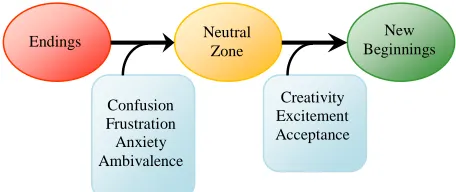
Accordingly, transition occurs in three phases. The first phase is “endings” and involves the letting-go of former behaviors, attitudes or approaches [9]. Once peo- ple have reached the point where they are comfortable with relinquishing their old patterns, they are considered to be in the second phase, or the “neutral zone”. This is described as an awkward in-between phase, where peo- ple have let go of their former patterns, but the new path is either unclear or not yet accepted [9]. The neutral zone is a tumultuous time, often characterized by confusion, anxiety, and a desire to return to what is familiar; how- ever, with a more adaptive outlook, this can be an op- portune time for creativity and experimentation with new ideas and approaches [10]. The final phase, the “new beginning” is the culmination of the transition process [9]. It is the time at which people are able to not only let go of old behaviors, but accept and demonstrate new ones. Measures that can be taken to facilitate transition to this phase include: providing a complete education and consistent message about the change, listening to and addressing concerns of those the change affects, and in- volving the community in the change process [9].
Confusion Frustration Anxiety Ambivalence
Endings Neutral Zone
New Beginnings
[image:3.595.57.285.84.180.2]Creativity Excitement Acceptance
Figure 1. Transition framework-three steps of transition.
incorporating the psychological and emotional aspects of transition that the individuals may experience.
2. REVIEW OF LITERATURE
Doctoral education was originally developed during the Middle Ages in order to prepare men to teach. The first doctoral program in the United States was established at Harvard College during the 17th century in order to pro- vide students with the highest level of education in the traditional learned professions, such as law [11]. Eventu- ally professional doctorates, i.e., the Juris Doctor became the practitioner’s degree while the Doctor of Philosophy (PhD) was identified as the scholar’s degree. Nursing is a traditional discipline seeking both a higher body of knowledge and a practice seeking to refine skills [11].
The need for advanced practice nursing in the United States is rooted in societal needs. Loretta Ford and Henry Silver were the first nurses to earn the advanced practi- tioner degree at the University of Colorado in 1965. Ford and Silver proposed the advance nurse practitioner role to solve the shortage of providers in child health clinics of the public health departments. At that time the physic- cian shortage was threatening the lives of American citi- zens [12]. The first doctoral degree for nurses was the Doctor of Education (EdD) degree that was offered by Columbia University in 1924. The first PhD in nursing was offered in 1934 by New York University, and by the 1950’s Boston University began offering the Doctor of Nursing Science degree (DNSc) [13]. While these de- grees focused on research, the first practice-focused doctoral degree in nursing was established at Case West- ern Reserve University in 1979. Known as a Doctor of Nursing (ND) this was offered as an entry-level nursing degree [12]. Throughout the next several decades, doc-toral programs in nursing were largely research-based in order to position the discipline of nursing on the same level of scientists and other knowledge-generating fields. Due to the lack of uniformity in the curricula of prac- tice doctorate programs in nursing, in 2002 the AACN Board of Directors formed a taskforce to examine the current status. In 2004 the AACN issued a position statement and noted the curriculum for the DNP had be- come very similar to the nursing PhD degree require-
ments. Therefore the DNSc was categorized as a research degree while the DNP degree was recommended as the terminal degree for nursing practice [14]. In the “Essen- tials of Doctoral Education for Advanced Nursing Prac- tice” published by the AACN in 2006, they identified eight areas of study that were to shape curricula: scien- tific underpinnings for practice; organizational and sys- tems leadership for quality improvement and systems thinking; clinical scholarship and analytical methods for evidenced based practice information systems/technol- ogy and patient care technology for the improvement and transformation of health care; interprofessional collabo- ration for improving patient and population health out- comes; clinical prevention and population health for im- proving the nation’s health; and advanced nursing prac- tice [14].
The DNP is a practice-focused degree, where the PhD is a research-focused degree. The DNP is intended to prepare students with the expertise for clinical practice. It places less emphasis on theory and research methodol- ogy than a PhD [1]. The DNP scholarly project will also differ from a PhD dissertation in that the DNP scholarly project is grounded in clinical practice and demonstrates ways in which research implicates practice. A PhD dis- sertation demonstrates the development of new knowl- edge to be contributed to the discipline of nursing [14]. It should be stressed that during the initial discussions held by the AACN about the DNP, there was very little rep- resentation of the community and public health nursing organizations. The DNP movement was shaped more by those with a predominate focus on the direct care of in- dividuals and families [4]. Thus, nursing leaders in community and public health did not see the immediate benefits to the requirement of the DNP to enter advanced practice nursing. According to the American Association of Nurse Anesthetists’ (AANA) position statement, they support doctoral education for entry into nurse anesthesia practice by 2025. However, the American College of Nurse Midwives (ACNM) currently does not support the requirement of the DNP for entry into practice [2].
2.1. Defense of the DNP
Advocates of this decision by the AACN cite a number of social, economic, educational and health-care related reasons for their support. While the practice doctorate for nursing is not a new concept, prior to the AACN’s posi- tion statement there was a lack of consistency among the existing nursing doctorate programs, and the line be- tween a practice-focused doctorate and research-focused doctorate was becoming increasingly blurred [13].
areas relating directly to the rapidly evolving health care system. The DNP position statement identifies the fol- lowing as benefits of a practice focused doctorate: “de- velopment of needed advanced competencies for in- creasingly complex practice, faculty, and leadership roles; enhanced knowledge to improve nursing practice and patient outcomes; enhanced leadership skills to strengthen practice and health care delivery; improved match of program requirements and credits and time with the cre- dential earned; provision of an advanced educational credential for those who require advanced practice knowledge but do not need or want strong research focus; enhanced ability to attract individuals to nursing from non-nursing backgrounds; and increased supply of fac- ulty for practice instruction ([15], p. 5).”
Another commonly provided rationale is that the es- tablishment of a DNP requirement for advanced practice nurses will create parity with other healthcare profes- sions, such as medical doctors, physical therapists, op- tometrists, podiatrists, psychologists, and pharmacists. It is thought that by adopting similar terminal degree re- quirements to these disciplines, nursing will be given an equal voice in health care-related matters [11].
2.2. Criticisms of the DNP
Despite the perceived benefits of the DNP transition, criticisms of this decision are prominent in the literature. Many current APNs and nurse leaders are concerned about the implications of mandating that new APNs ob- tain a doctorate-level degree in order to enter practice. They claim that the expense and accessibility of DNP programs will prevent some aspiring APNs to pursue further education. There are traditionally fewer financial resources available for those pursuing advanced educa- tion compared to undergraduate, which means the extra financial burden will be put on the students. Although the doctoral degree may elicit a higher salary in some positions, it is not a guarantee for all doctorally prepared graduates, therefore the financial payoff for students is uncertain. There is also potential for decreased access to APN education while current MSN programs are making the switch to DNP programs, meaning the public will have less access to APNs in a time of great need [12].
Opponents also emphasize that current practice for advanced nursing practice is thriving, financially and socially, and question the need for change. Furthermore, no data have shown that current master’s-level education is inadequate to prepare APNs for practice. Currently practicing APNs fear marginalization as the next genera- tion of APNs graduate with a higher educational degree [12]. In general, nurses are not opposed to the option to pursue the DNP degree, but rather prefer that it be of- fered as a post-master’s degree to those who wish to seek higher education, not required for entry into practice.
3. METHODS
3.1. Design
A quantitative descriptive design guided this study aim- ing to identify and describe knowledge and perceptions of students in an accelerated masters program in nursing regarding the DNP.
3.2. Sample
Students currently enrolled in a Master’s Entry to Nurs- ing Program, which is an accelerated master’s program in nursing, were recruited for this study. The only exclu- sion criterion was those students who were involved in reviewing and editing the questionnaire.
3.3. Setting
The researchers received permission from the director of the Master’s Entry to Nursing Program to contact current students. An email detailing the study and requesting participation was forwarded to the students. The emailed letter included the secure link to an online questionnaire hosted on Survey Monkey.
3.4. Formulation of Questionnaire
The questionnaire (Appendix) was designed to answer the study’s research questions, which were guided by the literature. The questionnaire included three sections, each with a different focus. The first was the demo- graphic portion, which asked participants’ age, gender, ethnicity, marital status, degrees earned, expected gradua- tion date, and previous experience in health care.
The next section was designed to determine the par- ticipants’ level of knowledge about the DNP. Partici- pants read a brief passage explaining the details of the DNP (adapted from several AACN website documents) and were asked about their awareness of specific facts prior to reading the excerpt.
3.5. Data Collection
Following institutional review board approval, the mas-ter’s entry to nursing program director forwarded the researchers’ email detailing the study and requesting par- ticipation. The request to participate letter directed par- ticipants to the secure link on Survey Monkey
(http://www.surveymonkey.com) where the questionnaire
was posted. The total estimated time for survey comple- tion was approximately 15 - 20 minutes. Completion of the survey served as consent for participation.
3.6. Data Analysis
Statistical Package for the Social Sciences software ver- sion 18 (SPSS Inc., Chicago, IL) was used to analyze the collected data. Demographic variables and key questions were computed using frequencies and descriptive statis- tics.
4. RESULTS
A total of 45 students participated in the study. The age range of participants was 21 - 57 years old with 88.9% female and 11.1% male. Most of the participants were Caucasian 75.6%, the ethnic breakdown of other partici- pants was: 4.4% African American, 8.9% Asian, 6.7% Hispanic, and 4.4% reporting other. All of the partici- pants have earned a minimum of a bachelor’s degree in varying fields. More than half of the participants, 64.4%, have previously worked in health care in varying capaci- ties.
Almost all of theparticipants, 97.8%, were aware of the DNP transition, while just 88.9% were aware of the
proposed transition date of 2015. Only 28.9% of students had knowledge of the proposed reconceptualization of current Master’s programs from specialist to generalist degrees; however, 93.3% of the participants knew that current master’s prepared APNs would be allowed to continue practicing with their current qualifications. Only 20% of students were aware that the American As- sociation of Nurse Anesthetists did not accept the 2015 transition date, a mere 8.9% of students were aware that the American College of Nurse Midwives rejected the transition to the DNP for students of midwifery. Students were nearly divided in their knowledge of the rapid growth and extensive offerings of the DNP programs nationwide with 57.8% responding yes. A majority of the student respondents received their information about the transition to the DNP through advisors and other faculty.
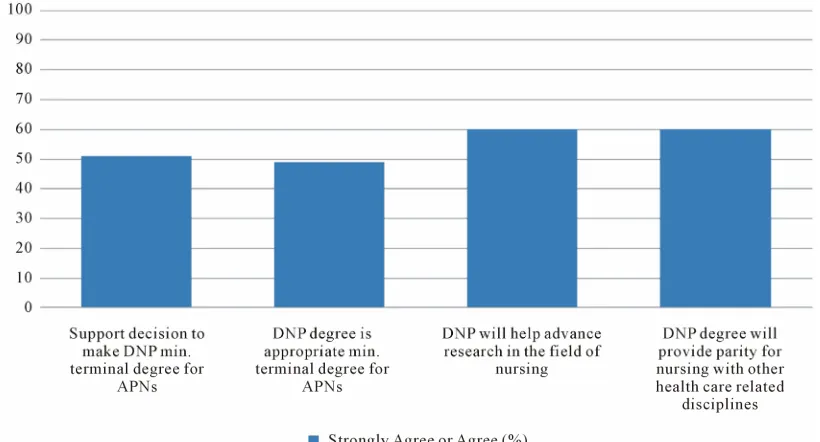
Approximately half the students, 51.1%, agreed or strongly agreed with the decision to make the DNP de- gree the minimum terminal degree for advanced practice nurses, with 48.9% of students agreeing or strongly agreeing the DNP degree is the appropriate terminal de- gree for advanced practice nurses. Most students, 60%, agreed or strongly agreed that the DNP will help advance research in the field of nursing and that the DNP degree will provide parity for nursing with other health care related disciplines (see Figure 2). Only 22.2% of stu- dents responded that current advanced practice nurses wouldn’t be marginalized by DNPs, with 48.9% of re- spondents unsure of marginalization.
[image:5.595.96.506.493.714.2]Most survey participants, 71.1% (n = 32), planned to pursue a career in advanced practice with 81.3% of these students planning to pursue a career in advanced practice even if the DNP is required.
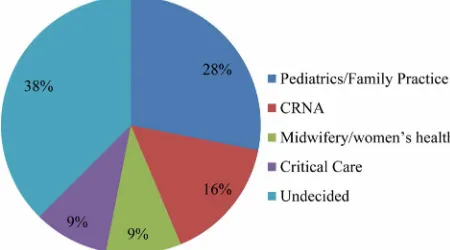
The field of interest among participants varied with 37.5% undecided, 28.1% in pediatrics/family practice, 15.6% as a Certified Registered Nurse Anesthetists (CRNA), 9.4% in midwifery/women’s health, and 9.4% in critical care (see Figure 3). All of the participants planned to complete their advanced practice education within the next ten years, with over half the students, 56.3%, preferring a part-time program. Students were divided on which type of program they plan to pursue, 46.9% responded with DNP as the preferred program, 34.4% selected masters/ post-masters certification, and 18.8% are undecided. 22.2% of students responded they were unsure if they would pursue a career in advanced practice nursing.
A majority of participants (60%) agreed or strongly agreed that the DNP will improve the public perception of nursing as a profession, with 65% of participants also agreeing the DNP degree will improve the public percep- tion of advanced practice nurses. However, 35.6% of students are unsure/undecided if nurses who receive their DNP should be called “doctor”. A majority of partici- pants (71.1%) agreed or strongly agreed that the title of “doctor” for DNPs will confuse patients.
5. DISCUSSION
The vast majority of the students were informed of the basic tenets of the proposed transition to the DNP degree. They were aware that it will be required for advanced practice by the year of 2015, and that current Masters- prepared APNs will be allowed to continue practicing with their current degrees. However, knowledge was lacking regarding the opposition to the proposed transi- tion demonstrated by both the AANA and the ACNM.
[image:6.595.58.283.589.714.2]Most of the students agreed that the DNP would pro- vide parity for nursing with other health care professions. Also most agreed that the DNP would improve public perceptions of the nursing discipline, and of nurse practi- tioners in particular. Regarding individual career aspira- tions, the majority of the participants planned to pursue careers in advanced practice, and all of these individuals
Figure 3. Nursing students’ planned APN career paths.
intended to complete this education within the next nine years.
Given the high level of interest in pursuing advanced practice and the perceived benefits of the DNP program for nursing, it was surprising to learn that only half of those surveyed supported the transition to the DNP and that less than half of those interested in advanced prac- tice preferred a DNP program for their own education. Furthermore, the responses demonstrated an existing concern that the DNP might marginalize current Masters prepared APNs as well as create confusion among pa- tients regarding nurses adopting the title of “doctor”.
Overall, it appears that the mixed emotions about the DNP cited in the nursing literature are echoed in the community of future nurses. Despite the positive re- sponses regarding the impact of the DNP on nursing as a discipline and profession, participants demonstrated a concern of the practical impact of the DNP on their per- sonal careers, and remained hesitant to support it. The fact remains that the transition to the DNP is well un- derway and that current students, particularly those in- terested in pursuing advanced practice, will be impacted by the DNP in one way or another. When viewing the current situation through the lens of Bridges’ Transition Framework, it is clear that the students in this study are currently in the “neutral zone”, where they have let go of their former patterns, but the new path is either unclear or not yet accepted [9].
In order to facilitate a transition to the “new begin- ning”, measures should be taken to alleviate the confu- sion and anxiety that the student population is experi- encing. Nursing faculty members were one of the main sources of information about the DNP for the students in this survey, indicating that schools and colleges of nurs- ing can play an important role in facilitating a smooth transition. Therefore schools/colleges of nursing must take a more formal role in providing an accurate and consistent education to students about the DNP. This education should address the practical changes that will impact the students’ career decisions, as well as the school’s position on the issue. Additionally, resources and contacts should be provided for those students who have remaining questions or concerns.
5.1. Limitations
5.2. Recommendations for Further Research
Future studies might sample a larger, less homogenous population. Additionally, questions should be added that address why students interested in pursuing advanced practice might be deterred from the DNP program. Hopefully these responses will provide data that could enable researchers to identify specific distressing factors.
6. CONCLUSION
The results of this study suggest that the majority of students in an accelerated master’s program in nursing were interested in careers in advanced practice nursing. Participants in this study were accepting, though not entirely supportive of the transition to the DNP. Therefore there is a need to educate current nursing students about the DNP to alleviate concerns, while enhancing their level of support for the new degree.
REFERENCES
[1] American Association of Colleges of Nursing (2004) AACN position statement on the practice doctorate in nursing. http://www.aacn.nche.edu/dnp/pdf/conf/Regionals/DNPP S.pdf
[2] American College of Nurse Midwives (2009) Position statement: Midwifery education and doctor of nursing practice (DNP).
http://www.midwife.org/siteFiles/position/Midwifery_Ed _and_DNP_7_09.pdf
[3] Peterson, T. (2008) Impact of the doctor of nursing prac- tice on nursing certification. American Nurse Today, 3, 34-36.
[4] Swider, S., Levin, P., Cowell, J., Breakwell, S., Holland, P. and Wallinder, J. (2009) Community/public health nurs- ing practice leaders’ views of the doctorate of nursing practice. Public Health Nursing, 26, 405-411.
doi:10.1111/j.1525-1446.2009.00798.x
[5] Gardiner, H. (2011) When the nurse wants to be called “doctor”. New York Times.
http://www.nytimes.com/2011/10/02/health/policy/02doc s.html
[6] Miller, J.E. (2008) The doctor of nursing practice: Rec- ognizing a need or graying the line between doctor and nurse? The Medscape Journal of Medicine, 10, 253. http://www.ncbi.nlm.nih.gov/pmc/articles/PMC2605113/ ?report=printable
[7] American Association of Colleges of Nursing (2011) DNP program schools.
https://www.aacn.nche.edu/dnp/program-schools
[8] American Association of Colleges of Nursing (2012) Accelerated baccalaureate and master’s degrees in nurs- ing.
http://www.aacn.nche.edu/media-relations/fact-sheets/acc elerated-programs
[9] Bridges, W. (2003) Managing transitions: Making the most of change. 2nd Edition, Da Capo P, New York.
[10] Shy, Y. and Mills, L. (2010) A critical new pathway to- wards change in abusive relationships: The theory of transition framework. Clinical Social Work Journal, 38, 418-425. doi:10.1007/s10615-010-0279-0
[11] Apold, S. (2008) The doctor of nursing practice: Looking back, moving forward. The Journal of Nurse Practitio- ners, 4, 101-107. doi:10.1016/j.nurpra.2007.12.003
[12] Cronenwett, L., Dracup, K., Grey, M., McCauley, L., Meleis, A. and Salmon, M. (2011) The doctor of nursing practice: A national workforce perspective. Nursing Out- look, 59, 9-17. doi:10.1016/j.outlook.2010.11.003
[13] Hawkins, R. and Greg, N. (2009) Doctoral education: Which degree to pursue. American Association of Nurse Anesthetists Journal, 77, 92-96.
[14] Chism, L. (2009) Toward clarification of the doctor of nursing practice degree. Advanced Emergency Nursing Journal, 31, 287-297.
[15] American Association of Colleges of Nursing (2006) The essentials of doctoral education for advanced nursing practice.
APPENDIX
Questionnaire
Title of the Study: The DNP: Knowledge and Percep- tions of Students in an Accelerated Master’s Program in Nursing
The following survey has been developed to assess knowledge and perceptions of the transition to the Doc- tor of Nursing Practice (DNP) by students currently en- rolled in an Accelerated Master’s Program in Nursing.
DEMOGRAPHICS (FILL IN THE
BLANK)
1) Age ______ 2) Gender ______ 3) Ethnicity ______ 4) Marital Status ______ 5) Degrees earned ______
6) Expected graduation date from current program ______ 7) Previous work experience in health care field? ______
If yes, specify. _________________________
KNOWLEDGE
Please read the passage below and answer the following questions. Information in the passage was adapted from
the DNP Fact Sheet, AACN Position Statement on the
DNP, and Frequently Asked Questions documents on the
AACN website, www.aacn.nche.edu.
On October 25, 2004, the member schools affiliated with the American Association of Colleges of Nursing (AACN) voted to endorse the Position Statement on the
Practice Doctorate in Nursing. This decision called for
moving the current level of preparation necessary for advanced nursing practice from the master’s degree to the doctorate-level by the year 2015.
The doctor of nursing practice (DNP) is designed for nurses seeking a terminal degree in nursing practice and offers an alternative to research-focused doctoral pro- grams. Multiple routes and mechanisms for career pro- gression will be possible and ultimately decided by each educational institution. The proposed model allows for progression to the DNP from the BS, MS or PhD level.
Master’s nursing education will continue, but the fo- cus will change. As specialty nursing education transi- tions to the doctoral level, the DNP Roadmap Task Force recommended that institutions consider reconceptualiz- ing their master’s degree programs to prepare generalists, rather than specialists.
The DNP will not alter the current scope of practice for APRNs. State Nurse Practice Acts describe the scope of practice allowed, and these differ from state to state. These requirements would likely remain unchanged. Current advanced practice nurses with master’s degrees
will continue to practice in their current capacities, but recommendations are included in the Roadmap Task
Force Report on how to facilitate rapid transition to the
DNP for master’s-level nurses seeking this credential. According to the American Association of Nurse Anesthetists (AANA) position statement, they support doctoral education for entry into nurse anesthesia prac- tice by 2025, rather than 2015. However, the American College of Nurse Midwives (ACNM) currently does not support the requirement of the DNP for entry into prac- tice. Accreditation for programs preparing nurse mid- wives and nurse anesthetists will continue by their re- spective accrediting agencies.
153 DNP programs are currently enrolling students at schools of nursing nationwide, and an additional 160 DNP programs are in the planning stages. DNP pro- grams are now available in 37 states plus the District of Columbia. States with the most programs (more than 5) include Florida, Illinois, Massachusetts, Minnesota, New York, Ohio, Pennsylvania, and Texas.
Prior to reading the above passage, were you aware (please answer yes or no):
1) Of the transition to the DNP? ____Yes ____No
2) Of the proposed transition date of 2015? ____Yes ____No
3) Of the proposed reconceptualization of current Mas-ter’s programs from specialist to generalist degrees? ____Yes ____No
4) That current master’s prepared APRNs would be al-lowed to continue practicing with their current qual- ifications?
____Yes ____No
5) That the American Association of Nurse Anesthe- tists did not accept the 2015 transition date?
____Yes ____No
6) That the American College of Nurse Midwives re- jected the transition to the DNP for students of mid- wifery?
____Yes ____No
7) Of the rapid growth and extensive offerings of DNP programs nationwide?
____Yes ____No
If you answered “yes” to any of the above questions, where did you receive your information? (check all that apply)
Current faculty advisor ______ Nursing instructor ______
PERCEPTION
This section will utilize a 5-point scale, with 1 = strongly disagree, 2 = disagree, 3 = unsure/undecided, 4 = agree, and 5 = strongly agree. Only one answer may be se- lected.
DNP Degree Impact on Nursing
Strongly
Disagree Disagree
Unsure/
Undecided Agree
Strongly Agree
1 2 3 4 5
I support the decision to make the DNP degree the minimum terminal degree for advanced practice nurses.1---2---3---4---5
The DNP degree is the appropriate minimal terminal degree for advanced practice nurses.1---2---3---4---5
The DNP degree is the appropriate minimal terminal degree for advanced practice nurses.1---2---3---4---5
The DNP degree will help advance research in the field of nursing.1---2---3---4---5
The DNP degree will provide parity for nursing with other health care related disciplines (i.e. medicine, pharmacy, etc.).1---2---3---4---5
Current advanced practice nurses will not be margin- alized by DNPs.1---2---3---4---5
Pursuit of Advanced Practice
I plan to pursue a career in advanced practice. 1---2---3---4---5
If “agree” or “strongly agree” (4 or 5):1) What field of advanced practice will you pursue? (fill in the blank) _________
2) When do you plan to complete the education: a) Within 1 - 3 yrs
b) 4 - 9 yrs c) 10+ yrs d) Undecided
3) What type of program do you prefer? a) DNP
b) Master’s/Post-Master’s certification 4) What length of program do you prefer?
a) Full Time b) Part Time c) Undecided
5) I will pursue a career in advanced practice even if the DNP is required.
a) Yes b) No
c) Unsure-please explain
Public Perception
The DNP degree will improve public perception of nursing as a discipline.1---2---3---4---5
The DNP degree will improve public perception of advanced practice nurses.1---2---3---4---5
Nurses who receive their DNP should be called “doctor”.1---2---3---4---5