Predicting Soil Corrosivity along a Pipeline Route in the
Niger Delta Basin Using Geoelectrical Method:
Implications for Corrosion Control
Kenneth S. Okiongbo*, Godwin Ogobiri
Department of Geology & Physics, Niger Delta University, Bayelsa State, Nigeria Email: *[email protected]
Received November 29,2012; revised February 18, 2013; accepted February 25, 2013
ABSTRACT
The corrosivity of the top three metres of the soil along a pipeline route was determined using soil electrical resistivity for the emplacement of a conduit intended to serve as a gas pipeline. Fifty-six Schlumberger vertical electrical sound- ings (VES) were carried using a maximum current electrode separation ranging between 24 - 100 m at 2.0 km interval. The data were interpreted using a 1D inversion technique software (1X1D, Interpex, USA). Model resistivity values were classified in terms of the degree of corrosivity. Generally, the sub-soil condition along the pipeline route is non-aggressive but being slightly or moderately aggressive in certain areas due to local conditions prevailing at the measuring stations. Based on the corrosivity along the pipeline route, appropriate cathodic protection methods are pre- scribed.
Keywords: Soil Corrosivity; Geoelectrical; Pipeline; Groundbed; Niger Delta
1. Introduction
The Niger Delta Basin is one of the prolific crude oil provinces in the world and as such there is an extensive network of pipelines. Pipelines play an extremely impor- tant role through-out the world as a means of transporting gases and liquids over long distances from their sources of production to distribution terminals. A buried operat- ing pipeline is unobtrusive and is rarely known except at valves, pumping, compressor stations or terminals, hence it is a preferred means of transportation of gases and liq- uids. A vast majority of underground pipelines is made of carbon steel, and these steels have inadequate alloy additions to be considered corrosion resistant and un- dergo a variety of corrosion failure modes/mechanisms in underground environments, including general corrosion, pitting corrosion, and stress-corrosion cracking (SCC) [1]. Given the implications of pipeline failures, and the role that external corrosion plays in these failures, it is ap- parent that prediction of corrosion and thus proper corro- sion control can have a major impact on the safety, envi- ronmental preservation and the economics of pipeline operation.
In this instance, a circular conduit of approximately 110 km in length was planned to be built from Obirikom (Rivers State) to Oben (Edo State) in the Niger Delta
Basin, Nigeria. The conduit would serve as a gas pipeline. The engineers involved in the project considered that the conduit would be trenched. Soil corrosion in this case was anticipated in regards to the pipeline which is ex- pected to be buried within the top three metres of the soil. Ruptured pipelines due to corrosion failure are ubiqui- tous in the Niger Delta, resulting in crude oil spills with devastating ecological consequences. The control and effective minimization of corrosion are possible by the proper understanding of the material characteristics and performance as well as the conditions of the environment in which the material will reside. This enhances the de- sign life of steel components and structures in contact with the soil. Aside, it saves money, improves safety and protects the environment. A key requirement to prevent corrosion and thus ensure a satisfactory performance of a piping system is the design and installation of an effec- tive cathodic protection system. The cathodic protection (CP) system is a proven, highly effective and elegant method of corrosion control. CP can be either galvanic or impressed current cathodic protection system, depending on whether the soil resistivity is low or high. Soil corro- sivity is not a measureable parameter. Therefore, in the evaluation of soil corrossivity/aggressivity, a host of critical parameters characteristic of the soil are usually employed. These include soil kind, condition, water con- tent, pH value, redox potentials, microbiological activity,
anion and cation levels and electrical resistivity. The electrical resistivity is highly significant in cases of in- situ determination of the degree of corrosiveness of soils. It is a main indicator of the corrosiveness of soils, as the rate of corrosion is a function of the electrical conductiv- ity. Consequently, in determining an appropriate ground- bed location for optimum cathodic protection system, the design of the cathodic protection is essentially based on shallow in-situ soil resistivity [2].
This paper describes the application of the shallow vertical electrical resistivity (VES) method to determine the electric resistivity variations with lithology and depth with a view to determining the corrosivity of the top three metres of the soil for the emplacement of a conduit intended to serve as a gas pipeline. The implications of the soil corrosivity variation to corrosion control are examined.
1.1. Study Area Description
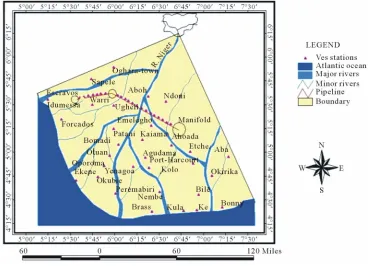
The project area is located in southern Nigeria between latitudes 4˚N and 6˚N, and longitude 3˚E and 6˚E (Figure 1). Physiographically the project area lies within the low Deltaic plain and freshwater swamps. The area is under- lain by the deposits of the modern and Holocene delta top deposits. They result from the sediment laden dis- charges of the River Niger that is spread on the delta by its various tributaries. The sediment is generally an ad- mixture of medium to coarse-grained sands, sandy clays, silts and clays that eventually settle in fluvial/tidal chan-
nel, tidal flat and mangrove swamp environments [3].
1.2. Background: Resistivity Survey
The electrical resistivity of the soil is a parameter that depends mainly on the salt concentration in the pore fluid, the particle size, and the tortuosity of the conduction path, the latter being related to porosity and structure [4]. In coarse soils, the salt concentration and porosity are fun- damental parameters, while in clayey soils, particle sur- face is also relevant. In general, gravels have higher re- sistivity than sands, and sands have higher resistivity than clays. In the presence of salty waters, as is the case in marine environments, the opposite trend may be ob- served [4].
This is because conductivity in soils is governed by conductivity of pore fluid and tortuosity. The higher the tortuosity, the lower the electrical conduction. Although tortuosity of clays is higher than that of granular soils, the higher conductivity of clays is due to the presence of adsorbed cations on particle surfaces.
When there is high salt concentration in the pore fluid, the electrical conduction through the pore fluid becomes dominant and the phenomenon is mainly controlled by tortuosity [5]. Therefore, at very high salt concentration in the pore fluid, the electrical conductivity of granular materials may become higher than that of clays due to the lower tortuosity of their conduction path. Table 1
[image:2.595.115.486.452.718.2]displays the resistivity range commonly encountered in some geological materials. One may note that the wide
Figure 1. Map of study area showing pipeline route.
Table 1. Representative values of resistivity for some geo- logic materials [7].
Material type Resistivity (Ωm)
Clay 1 - 100
Silts 10 - 150
Alluvium 10 - 800
Sandstone 8 - 4000
Shale 20 - 2000
Granite 5000 - 5.0 × 10⁶
Basalt 1000 - 106
Groundwater (fresh) 10 - 100
Sea water 0.2
range of resistivity values corresponds to different envi- ronmental conditions of the materials, particularly satu- ration and salt concentration in the pore fluid. Thus for a given material, the higher the saturation and salt concen- tration in the pore fluid, the lower the resistivity values.
2. Materials and Method
The location of the pipeline route is shown in Figure 1. The position for the VES stations was marked out by surveyors of the geotechnical consultants commissioned to carry out the geophysical investigation along the pipe- line route. The resistivity sounding was at 2.0 km inter- vals for total of 110 km. Although 2 km station interval was initially adopted, due to poor accessibility in some sections of the profile, this was adjusted to 1 - 3 km in- tervals in a few areas. A total of 56 soundings were oc- cupied along the pipeline route using the Schlumberger configuration. Basically, the potential electrodes (M & N) remain fixed and the current electrode (A & B) is ex- panded symmetrically about the centre of the spread. The Schlumberger data are mostly taken in overlapping seg- ments because at each step of AB spacing, the signals of the resistivity meter become weaker. Therefore, MN spacing was enlarged and two values for the same AB/2 were measured, one for the short and one for the long MN spacing. Maximum current electrodes separation used in this survey ranges between 24 - 100 m. Field precautions observed to ensure good VES data quality included firm grounding of the electrodes, and checking for current leakage and creeps to avoid spurious meas- urements. Also, adequate offsets were made for electrode positions that coincided with water logged areas. The instrument used was an Abem Terrameter SAS 3000, a digital self averaging instrument for DC resistivity work. A portable 12 V battery was used as the power source while four stainless metal stakes were used as electrodes.
The positions and surface elevations of VES sites were also recorded during survey with a GPS receiver. Soil borings at every VES station were performed to 5 m depths using a locally fabricated, easily dismantleable percussion rig. During the boring operations, disturbed samples were regularly collected at about 1.0 m intervals and also when a change of soil type was noticed. The field measurement of current, I and potential difference,
ΔV were used in the computation of the apparent resis- tiveityρa given by
a
V K
I
(1)
where K is the geometrical factor given by
2 2 2 π 1 4 a b K b a
(2)
where
a = half the distance between current electrodes;
b = distance between potential electrodes.
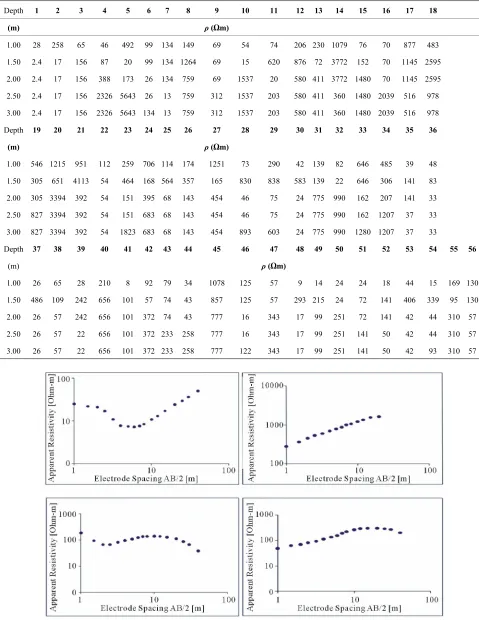
The data obtained was subjected to computer assisted iterative interpretation using 1-D inversion technique software (1X1D, Interpex, USA). The software yields the number, thickness, resistivity of the various layers and the root mean square (rms) error. The prediction of the degree of in-situ corrosiveness from resisivity measure- ments of the soil was made using the classification shown in Table 2 [6]. The classification was made at depths of 1.0, 1.5, 2.0, 2.5 and 3.0 m for each VES site. The results are presented in Table 3.
3. Results and Discussion
The geoelectrical curves obtained are shown in Figure 2
and vary considerably throughout the study area. Typical forms of these curves are HA, HK, KH and A types. Most of the sounding curves obtained were of the HA- type (ρ1 > ρ2 < ρ3 < ρ4), i.e. a bowl shaped curve with a steeply descending left branch and a gently ascending right branch representing the presence of four geoelectric layers. The descending left branch indicates a resistive top soil underlain by a conductive material (wet clays). The results of the interpretative models at the various stations are shown in Table 3. The results reveal widely
Table 2. Classification of soil aggressivity [6].
RESISTIVITY (Ohm-m) SOIL AGGRESSIVITY
Up to 10 Very Strongly Aggressive (VSA)
10 - 60 Moderately Aggressive (MA)
60 - 180 Slightly Aggressive (SA)
180 - above Practically Non-Aggressive (PNA)
[image:3.595.312.537.641.731.2]Table 3. Electrical resistivity at each VES station.
Depth 1 2 3 4 5 6 7 8 9 10 11 12 13 14 15 16 17 18
(m) ρ(Ωm)
1.00 28 258 65 46 492 99 134 149 69 54 74 206 230 1079 76 70 877 483
1.50 2.4 17 156 87 20 99 134 1264 69 15 620 876 72 3772 152 70 1145 2595
2.00 2.4 17 156 388 173 26 134 759 69 1537 20 580 411 3772 1480 70 1145 2595
2.50 2.4 17 156 2326 5643 26 13 759 312 1537 203 580 411 360 1480 2039 516 978
3.00 2.4 17 156 2326 5643 134 13 759 312 1537 203 580 411 360 1480 2039 516 978
Depth 19 20 21 22 23 24 25 26 27 28 29 30 31 32 33 34 35 36
(m) ρ(Ωm)
1.00 546 1215 951 112 259 706 114 174 1251 73 290 42 139 82 646 485 39 48
1.50 305 651 4113 54 464 168 564 357 165 830 838 583 139 22 646 306 141 83
2.00 305 3394 392 54 151 395 68 143 454 46 75 24 775 990 162 207 141 33
2.50 827 3394 392 54 151 683 68 143 454 46 75 24 775 990 162 1207 37 33
3.00 827 3394 392 54 1823 683 68 143 454 893 603 24 775 990 1280 1207 37 33
Depth 37 38 39 40 41 42 43 44 45 46 47 48 49 50 51 52 53 54 55 56
(m) ρ (Ωm)
1.00 26 65 28 210 8 92 79 34 1078 125 57 9 14 24 24 18 44 15 169 130
1.50 486 109 242 656 101 57 74 43 857 125 57 293 215 24 72 141 406 339 95 130
2.00 26 57 242 656 101 372 74 43 777 16 343 17 99 251 72 141 42 44 310 57
2.50 26 57 22 656 101 372 233 258 777 16 343 17 99 251 141 50 42 44 310 57
[image:4.595.57.536.102.722.2]3.00 26 57 22 656 101 372 233 258 777 122 343 17 99 251 141 50 42 93 310 57
irregular variation in resistivity both vertically and later- ally (Figures 3-5). This is an indication of the very com- plex depositional environment of the area. Since the conduit is expected to be buried within the top three me- tres of the soil, we restrict our interpretation to the top three metres only. The first unit corresponding to a depth range of 0 - 1.0 m (Table 3), representing the surface soil exhibits a resistivity range of 28 - 1251 Ωm. The varia- tions of the surface-soil resistivity are attributed to local conditions prevailing at the measuring stations. The rela- tively higher values of resistivity indicate dry soils and the presence of coarse sand, and the relatively lower val- ues indicate wet grains of finer sizes and different min- eralogical composition, such as fine sands, silts and clays. The finer the size of the grains, the greater the specific surface area per unit of bulk volume, grain volume, or pore volume, which enables the grains to absorb charged ions at their surfaces and thus the conduction of electric current will be easier [5]. The depth range of 1.0 - 1.5 m and 1.5 - 2.0 m (Table 3), representing the aeration zone above the water table, exhibits resistivity range of 2.4 - 3772 Ωm, while the depth ranges of 2.0 - 2.5 m and 2.5 - 3.0 m the water-table depth, exhibits a resistivity range of 2.4 - 2326 Ωm. Generally, we attribute resistivity varia- tions to changes in the lithology, size, and shape of the
grains, pore-water salinity and clay content [8].
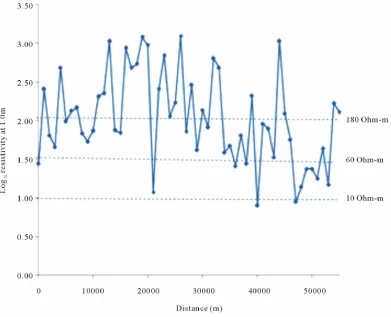
[image:5.595.103.494.398.715.2]The variations of the soil resistivities at the 1.0 m depth for all VES stations are shown in Table 3 and
Figure 3. The dataset shows that about 46% of the sam- pled points are non-aggressive (ρ> 180 Ωm), 25% of the sampled points are slightly aggressive (ρ = 61 - 180 Ωm) while 29% of the sample points are moderately aggres- sive (ρ = 11 - 60 Ωm). Generally the shallow subsoil condition at the 1.0 m depth is non-aggressive (effective aggressivity) (Figure 3), and corrosion risk to metallic structures at this depth is expected to be low, the few areas that are slightly or moderately aggressive are local- ized. The moderately aggressive or very strongly aggres- sive areas are anodic regions characterized by low resis- tivities such as in the vicinities of stations 1, 41, 48, 49, 50, 51, 52 and 54. These regions can form corrosion cells. The formation of large corrosion cells which can lead to severe corrosion failures are associated with low resis- tivities. Low resistivities are indicative of good electrical conducting paths usually due to reduced aeration and excessive electrolytes or wetness in the soil, or minerali- zation. This posses a significant risk to steel corrosion. Metallic pipes at these areas will have a high probability of degradation.
At the 2.0 m depth, the dataset shows that 45% of the
Figure 4. Variation in resistivity along the pipeline route at a depth of 2.0 m.
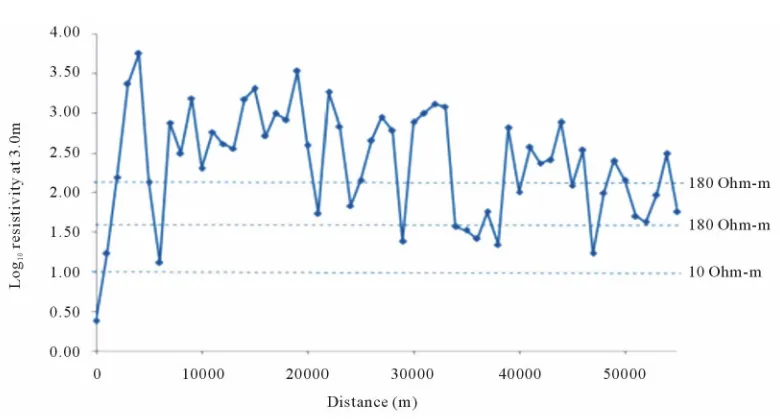
Figure 5. Variation in resistivity along the pipeline route at a depth of 3.0 m.
samples points are non-aggressive, 27% are slightly ag- gressive, about 27% are moderately aggressive and about 2% are very strongly aggressive.
Generally, the sub-soil at the 2.0 m depth is non-ag- gressive (effective aggressivity) (Figure 4). However, there are anodic regions in the vicinities of stations 1, 2,
[image:6.595.103.493.425.635.2]non-aggressive (effective aggressivity) (Figure 5). An- odic regions characterized by low resistivities oocur at the vicinities of stations 1, 2, 7, 30, 35, 36, 37, 38, 39, 48, 52, and 53. These locations are likely to form corrosion cells and corrosion risk is very significant.
Implications for Corrosion Control
Coating is often applied to prevent corrosion. But all coatings contain some defects or flaws that expose the bare pipeline steel to underground environment and thus undergo corrosion at these coating flaws. Therefore the most effective method to prevent corrosion is to use coating in conjunction with cathodic protection [1]. An important consideration from a design stand point in ca- thodic protection installation is the location and nature of the site where the anode is placed (groundbed). This is because in selecting groundbed sites, the number of an- odes required, the length and diameter of the backfill column, the voltage rating of the rectifier and the power cost are influenced by soil resistivity [2]. For the anodes of the groundbed system to discharge a useful amount of current, the contact resistance between the anodes and the earth must be low. The groundbed resistance RA was
derived by [9] and expressed as
4 ln 1 2π A L R L r
(3)
where
ρ = Soil resistivity (Ωm);
L = Active bed length (m);
r = Active bed radius (m).
Equation (3) above indicates that to achieve a reduc- tion in the groundbed resistance, given a high soil resis- tivity in a region, the active bed length and the active bed radius have to be given relatively higher values. Thus, this relationship indicates that higher soil resistivity would require more active bed length to size up the re- quired low bed resistance required for optimum Cathodic Protection (CP) System [10].
Cathodic protection can either be in the form of a rec- tifier or impressed current type system or sacrificial an- ode cathodic protection system. Soil corrosivity based on the resistivity data vary along the pipeline route. The sub-soil condition along the pipeline route is generally non-aggressive but being slightly aggressive or strongly aggressive in certain areas. It is therefore necessary that each CP system be designed based on the degree of cor- rosivity at a given location. For areas that are non-ag- gressive, with relatively high soil resistivity (Table 3), a high groundbed resistance (Equation (3)) would be ex- pected. An effective groundbed system in these areas would therefore require the reduction in the resistance to earth. This can be achieved by considering a deep-well
groundbed system [2]. This is essential in providing good current distribution for an effective CP system in those locations. Aside, in those areas, the natural potential to drive a sacrificial anode groundbed would be low. The sacrificial anode, which is the galvanic anode unit of a cathodic protection system, provides the driving potential from a natural electromotive force between the anode (groundbed) and the steel pipe to be protected. A sacrifi- cial anode groundbed may not therefore be required in those locations, as there will not be enough potential drive for the system. To further reduce the contact resis- tance, a multiple number of electrodes (anodes in parallel) would be necessary.
The net resistance Rnet can then be calculated using the relationship [2].
0.17 1
net one 2 e
n
R R n (4)
where
Rone = Resistance of one anode; n = Number of anodes.
It is preferred for the anode to be surrounded by a carbonaceous backfill. The backfill material acts as a sacrificial buffer between the anode and the reaction en- vironment. The backfill particles help to reduce anode resistance to earth, extend anode life by allowing anodic reactions to occur on their surface and provide a porous structure so that the gases produced can escape. Gas en- trapment tends to increase the groundbed resistance [2]. A shallow groundbed would be cost effective for areas with low resistivities. If soil conditions are unfavourable, shallow horizontal groundbeds are preferred. It is perti- nent to mention that in most parts of the Niger delta, soil resistivity increases with depth, and as a result, the lengths of the active zone of the groundbed should in- crease to minimize the final operating resistance of the system.
4. Conclusion
and implications are typical of the “worst conditions”, in terms of electrochemical corrosion of metallic materials buried in a soil. Each CP system be designed based on corrosivity at a given location. For locations with rela- tively high soil resistivity, an impressed current CP with a deep-well groundbed system will be necessary. But for locations with low soil resistivity, a sacrificial anode CP system can be used. If the soil conditions are unfavourable, shallow horizontal groundbeds would be preferred.
5. Acknowledgements
The authors are grateful to Prof. E.G. Akpokoje of the Department of Geology, University of Port Harcourt for his support. The cooperation of the Elders and Chiefs of the various communities deserve special appreciation.
REFERENCES
[1] J. A. Beavers and N. G. Thompson, “External Corrosion of Oil and Natural Gas Pipelines,” American Society of Mechanical Engineers Handbook 13C, Corrosion: Envi- ronments and Industries No. 05145, 2006, pp. 1015-1024. [2] A. W. Peabody, “Control of Pipeline Corrosion,” NACE,
Houston, 1967.
[3] B. Durotoye, “Quarternary Sediments in Nigeria”, In: C. A. Kogbe, Ed., Geology of Nigeria, Rockview, Jos, 1975, pp. 431-444.
[4] G. V. Kelly, “Electrical Properties of Rocks and Miner- als,” In: R. C. Carmichael, Ed., Handbook of Physical Properties of Rocks 1, CRC Press, Boca Raton, 1982, pp. 217-293.
[5] H. S. Salem and G. V. Chilingarian, “Determination of Specific Surface Area and Mean Grain Size from Well Log-Data and Their Influence on the Physical Behavior of Offshore Reservoir,” Journal of Petroleum Science and Engineering, Vol. 22, No. 4, 1999, pp. 241-252. doi:10.1016/S0920-4105(98)00084-9
[6] W. V. Baeckmann and W. Schwenk, “Handbook of Ca- thodic Protection,” Portcullis Press, London, 1975. [7] US Army Corps of Engineers, “Geo Physical Exploration
for Engineering and Environmental Investigations,” EM 1110-1-1802, 1995.
[8] H. S. Salem, “Modelling of Lithology and Hydraulic Con- ductivity of Shallow Sediments from Resistivity Meas- urements Using Schlumberger Vertical Electric Sound- ings,” Energy Source, Vol. 23, No. 7, 2001, pp. 599-618. doi:10.1080/00908310119202
[9] H. B. Dwight, “Calculation of Resistance to Ground,” American Institute of Electrical Engineers, Vol. 55, No. 12, 1936, pp. 1319-1328.
doi:10.1109/T-AIEE.1936.5057209
![Table 1. Representative values of resistivity for some geo- logic materials [7].](https://thumb-us.123doks.com/thumbv2/123dok_us/7741306.707944/3.595.312.537.641.731/table-representative-values-resistivity-geo-logic-materials.webp)