Adaptation of the Feedforward Postural Response to
Repeated Continuous Postural Perturbations
Ashleigh Kennedy1,2, Nicoleta Bugnariu3, Arnaud Guevel2, Heidi Sveistrup1,4
1School of Human Kinetics, Faculty of Health Sciences, University of Ottawa, Ottawa, Canada; 2Laboratory “Motricité, Interactions,
Performance” (EA 4334), University of Nantes, Nantes, France; 3University of North Texas Health Science Centre, Physical Therapy,
Fort Worth, USA; 4School of Rehabilitation Sciences, Faculty of Health Sciences, University of Ottawa, Ottawa, Canada.
Email: [email protected]
Received January 9th, 2013; revised February 10th, 2013; accepted February 22nd, 2013
ABSTRACT
We examined the adaptation of the postural response to repeated predictable platform oscillations. Our main goals were to determine whether the short-term changes that occurred during a minute long continuous postural perturbation trial were maintained in subsequent trials and to determine how many trials were required before participants fully adapted to the postural task. Ten participants performed ten minute-long postural trials on a platform that oscillated at 0.25 Hz before increasing to 0.50 Hz half way through each trial. Postural muscle onset latencies, burst amplitudes, and anterior posterior displacements of the center of pressure (COP) and center of mass (COM) were calculated for the last five cy-cles performed in each trial at 0.50 Hz. The postural strategy evolved in two phases: 1) immediate decrease in COP dis-placement; 2) earlier activation of the postural muscles with smaller muscle burst amplitudes. After seven trials the postural response remained consistent.
Keywords: Adaptation; Postural Control; Continual Perturbation
1. Introduction
Postural stability is maintained during externally initiated perturbations through modifications of the postural mus- cle activity and center of pressure (COP) displacement [1-4]. These changes allow effective control of postural stability in novel conditions; however, they may be ini- tially inefficient, requiring a high level of tibialis anterior (TA) and soleus (Sol) muscle activity [5]. With further experience short-term adaptation occurs, allowing the participants to tailor their postural response to meet the requirements of the environmental and internal variables [6,7].
In discrete postural perturbations experience provides participants with performance feedback resulting in acti- vation of postural muscles earlier in advance of the per- turbation and at smaller muscle burst amplitudes [8]. Postural adaptation also occurs during continuous, sinu- soidal oscillations of the platform [5,9-11]. In this type of recurrent, continual perturbation the postural response evolves rapidly to meet the environmental requirements. In fact, within only 3 to 5 sinusoidal platform oscillations young healthy adults transition from a reactive to an anti- cipatory postural response [10,11].
It is clear that short-term changes occur during both discrete and continuous postural perturbations; however
it has not been determined whether the rapid changes that occur during one postural trial are maintained in the steady state postural response of subsequent trials. To address this question we examined how postural muscle activity, center of mass and center of pressure displace- ment changed over the steady state of 10 distinct con- tinuous postural trials. The secondary aim of this study was to determine how many trials were required for the participant to reach a stable and consistent postural response. We hypothesized that it would take several trials for the postural response to reach this point and that once the response was stabilized; the ankle muscles would be consistently activated earlier in anticipation of the postural perturbation with smaller muscle burst amplitudes [8]. Since the COM is a priority variable in dynamic postural control [12], we hypothesized that it would be maintained while the COP displacement adapted to meet the environmental and task require- ments.
2. Methods
2.1. Participants10.4 kg; women height 166.7 ± 17.7 cm, weight 57.6 ± 9.4 kg) with no neurological impairment or history of serious injury that prevented them from participating in sport for more than 6 months gave informed consent to participate in this study. Elite athletes (collegiate level or higher) and dancers (participation more than four times/ week) were excluded from the sample. The experimental procedures were approved by the ethics board at the University of Ottawa and were performed in accordance with the Tri-Council Policy Statement [13].
2.2. Measurement Devices
Data from seven VICON cameras (Vicon Peak, Oxford, UK) and thirty-six retro-reflective markers, placed on anatomical landmarks and on four corners of the force plate, were used to estimate the position of the center of mass (COM) and the platform during the postural trials. A movable platform instrumented with a Kistler force plate (Type 9286, Kistler Instrument Corp, New York, USA) was used to record the ground reaction forces at 500 Hz during the postural trials (Nexus, Vicon Peak, Oxford, UK). Kinematic data were recorded at 200 Hz.
Surface electrodes (Myomonitor Wireless Delsys EMG system, Boston, USA) recorded electromyographical (EMG) activity from the gastrocnemius medialis (GM), biceps femoris (BF), tibialis anterior (TA) and rectus femoris (RF) in accordance with SENIAM recommenda- tions [14]. A ground electrode was placed on the patella. The EMG signals were pre-amplified, sampled at 1000 Hz and full wave rectified.
2.3. Procedure
Ten postural trials, each consisting of ~60 seconds of continuous, sinusoidal oscillations of the platform in the anterior/posterior direction, were performed. Fifteen se- conds of rest was afforded between each postural trial. During the trials participants stood barefoot with their eyes open and feet shoulder width apart on the platform as it oscillated 20 cm in the anterior-posterior plane (for further details see Bugnariu and Sveistrup 2006). In each postural trial, 8 ± 2 oscillations were performed at 0.25 Hz before the frequency of oscillation increased to 0.50 Hz for another 10 ± 2 cycles.
2.4. Data Analysis
The VICON Plug-in Gait biomechanical model, com- bined with anthropometric measurements and kinematic data, was used to estimate the forward and backward dis- placement of the center of mass (COM). The anterior/ posterior movement of the platform was subtracted from the COM data in order to provide a true representation of COM displacement relative to the base of support. Ground reaction forces were used to estimate the maxi-
mum anterior/posterior COP displacement.
Muscle burst onsets were determined using a two standard deviation threshold derived from the quiet stance period that occurred before every trial. Once the thresholds were identified (BioProc version 3.06, D.G.E. Robertson), muscle onset latencies were visually coded relative to the start of the forward or backward platform translations. Muscle onsets occurring in anticipation of the platform movement were coded as negative. Dyna- mic responses had to be recorded in at least 25% of the directionally specific oscillations in order to be included in calculations of group muscle onset latencies.
The COM and COP displacement, muscle onset la- tency and amplitude of the TA, GM, RF and BF were analyzed for the first (T1), third (T3), fifth (T5), seventh (T7) and tenth (T10) trials. In each trial, the values for the last five cycles at 0.50 Hz were averaged [10]. Data were ensemble averaged across participants in each of the time periods and reported for forward and backward platform translations separately.
2.5. Measurement Devices
Repeated measures analyses of variance (ANOVA) tests were used to determine whether COP and COM displace- ment and muscle burst amplitudes adapted with experi- ence following forward and backward oscillations. Post- hoc analyses performed with Tukey corrections were used to determine the point at which no further adapta- tion occurred. Muscle onset latencies of the four postural muscles were not normally distributed so significant dif- ferences between trials were determined using non- parametric Wilcoxan sign-ranked tests.
3. Results
3.1. COM and COP Displacement
Figure 1. Center of pressure (COP) displacement during forward and backward translation of the platform. Fol- lowing forward platform translation, the amplitude of COP displacement decreased significantly after the first trial (T1) with no further decrease through to the 10th trial (T10).
Following backwards translation, the COP decreased until the fifth trial (T5), with no additional decrease. Data dis- played as mean ± SE. *indicates p < 0.05 and NS indicates
no significant difference.
p = 0.708).
3.2. Muscle Burst Amplitude
The TA muscle burst amplitude adapted to the postural task over the first five trials (F (4, 36) = 20.268, p < 0.05) with a significant decrease between the amplitude found at T1 and T3 (p = 0.01) and between T3 and T5 (p = 0.019). There was no further decrease between T5 and T7 (p = 0.053) or T7 and T10 (p = 0.686). The muscle burst amplitude of the GM also adapted throughout the postural trials (F (4, 36) =10.133, p < 0.05), decreasing significantly between T1 and T3 (p = 0.001). There was no further decrease between T3 and T5 (p = 0.299), T5 and T7 (p = 0.21) or T7 and T10 (p = 0.274). The RF muscle burst amplitudes, which were only assessed for trials T1, T5, T7 and T10, showed a significant main effect of adaptation (F (3, 27) = 3.294, p < 0.05); how- ever, post-hoc analysis did not reveal any specific loca- tions of change throughout the 10 minute training period. The BF muscle amplitude, assessed for T1, T7 and T10, also showed a significant main effect of adaptation (F (2, 18), 3.805, p < 0.05). Post-hoc analysis did not reveal any specific location of change between these time points.
3.3. Muscle Onset Latency
The TA muscle onset latency adapted to the postural task over 10 trials (X2 (4, 10) = 12.12, p < 0.05). There was
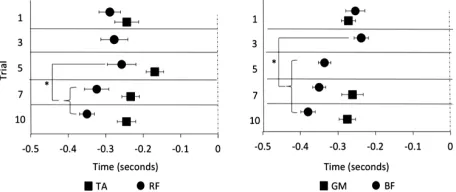
no change between T1 and T3 (p = 0.385) or T3 and T5 (p = 0.58); however, the TA was activated significantly earlier at T7 than it was at T5 (p = 0.017) with no further change in the onset latency between T7 and T10 (p = 0.35). The GM muscle onset latency also adapted to the
postural task (X2 (4, 10) = 7.2, p < 0.05). There was no
difference between the onset latency found at T1 and T3 (p = 0.110) but the GM muscle was activated signifi- cantly earlier at T5 than it was at T3 (p = 0.041). After this point there was no further change in the GM muscle onset latency (T5 and T7 p = 0.929, T7 and T10 p = 0.859) (Figure 2). Due to the infrequent muscle bursts, statistical analysis was only performed on the RF muscle onset latency at T1, T5, T7 and T10 and on the BF muscle onset latency at T1, T7 and T10. Adaptation did not occur over these time points for either the RF (X2 (3,
3) = 7.4, p > 0.05) or BF (X2 (4, 2) = 1.5, p > 0.05).
4. Discussion
The aim of this study was to determine how the postural response adapted to meet the requirements of the motor task as well as to establish the point at which the motor task no longer changed with further experience. The hy- pothesis that the COM displacement would be main- tained was based on previous research showing that the COM displacement is a performance variable that is preferentially controlled using muscle activity and indi- vidual joint motion in postural tasks [5,15]. The data from the present study confirmed our hypothesis, show- ing no change in the COM displacement over the 10 postural trials.
We also hypothesized that with experience the COP displacement and muscle activity would be progressively modified to maintain control of the COM in a more effi
-
cient way. Data from this study confirmed our hypothesis, showing a progressive adaption of the postural response throughout the first seven trials, after which point it no longer evolved. This adaptation process occurred in two phases beginning with a decrease in the COP displace
-
ment (Figure 1), followed by an earlier activation of the [image:3.595.310.538.520.616.2]postural muscles at a smaller muscle burst amplitude (Figure 2). This process is well described by the modi- fied systems theory in which the participant initially con- strains the body’s degrees of freedom to improve motor control. Practice then optimizes the movement, improv- ing the efficiency and adaptability of the task, allowing the participant to take advantage of the increased degrees of freedom [7].
At the start of the first phase the COP displacement was quiet large; however, the transition towards a more conservative postural response occurred rapidly, causing a significant decrease in the COP displacement between the first and third postural trials in both the forward and backwards directions. Similar to the temporal evolution of the postural kinetics found in previous research [16], the COP displacement measured in this study reached a stable level after 5 postural trials. After these initial changes the COP displacement no longer evolved with further experience, marking the end of the first phase of postural adaptation.
In the second phase of adaptation the postural response became more energy efficient. The postural muscles were recruited progressively earlier during this phase, reaching a stable level after 7 oscillations in the forward direction and 5 in backwards direction (Figure 2). Inter- estingly, these muscles were activated with smaller mus-cle burst amplitudes than were used in the first phase of adaptation (data not shown). Previous research has shown a similar decrease in the burst amplitude of the postural muscles as participants become more experi- enced with discrete [8] and continuous [5] postural per- turbations, although no one has examined the evolution of the postural response from one continuous postural trial to the next. We postulate that these changes in mus-cle activity represent the optimization of the postural response to avoid fatigue and/or to reduce the expendi- ture of energy required for the task [7].
In conclusion, the data from this study demonstrated that young healthy participants transferred the experience gained in one postural trial to subsequent trials. With experience the COP displacement decreased and the postural muscles were activated earlier in anticipation of the perturbation with smaller muscle burst amplitudes. After seven, minute long trials, the anticipatory postural response no longer evolved with further experience. Ex- perimental manipulations of factors influencing pos- tural control, such as augmented feedback and/or fatigue, should be performed after this point to ensure that the postural changes found in the performance of the motor task are due to the experimental manipulation and not to the adaptation process.
5. Acknowledgements
The authors would like to acknowledge Coren Walters-
Stewart for her help with the data processing. This re- search was funded by the Ontario Graduate Scholarship in Science and technology. The authors have no direct conflict of interest that would influence the content of this study.
REFERENCES
[1] L. M. Nashner, “Fixed Patterns of Rapid Postural Re- sponses among Leg Muscles during Stance,” Experimen-
tal Brain Research, Vol. 30, No. 1, 1977, pp. 13-24.
doi:10.1007/BF00237855
[2] F. B. Horak and L. M. Nashner, “Central Programming of Postural Movements: Adaptation to Altered Support-Sur- face Configurations,” Journal of Neurophysiology, Vol. 55, No. 6, 1986, pp. 1369-1381.
[3] A. S. Aruin, W. R. Forrest and M. L. Latash, “Anticipa- tory Postural Adjustments in Conditions of Postural In- stability,” Electroencephalography and Clinical Neuro-
physiology/Electromyography and Motor Control, Vol.
109, No. 4, 1998, pp. 350-359. doi:10.1016/S0924-980X(98)00029-0
[4] A. S. Aruin and M. L. Latash, “Directional Specificity of Postural Muscles in Feed-Forward Postural Reactions during Fast Voluntary Arm Movements,” Experimental
Brain Research, Vol. 103, No. 2, 1995, pp. 323-332.
doi:10.1007/BF00231718
[5] M. Schmid, et al., “Adaptation to Continuous Perturba- tion of Balance: Progressive Reduction of Postural Mus- cle Activity with Invariant or Increasing Oscillations of the Center of Mass Depending on Perturbation Frequency and Vision Conditions,” Human Movement Science, Vol. 30, No. 2011, pp. 262-278.
[6] J. Massion, “Movement, Posture and Equilibrium: Inter- action and Coordination,” Progress in Neurobiology, Vol. 38, No. 1, 1992, pp. 35-56.
doi:10.1016/0301-0082(92)90034-C
[7] A. Shumway-Cook and M. Woollacott, “Motor Control: Translating Research into Clinical Practice,” 3rd Edition, Lippincott Williams & Wilkins, Washington DC, 2007, [8] P. D., Hansen, M. H. Woollacott and B. Debu, “Postural
Responses to Changing Task Conditions,” Experimental
Brain Research, Vol. 73, No. 3, 1988, pp. 627-636.
doi:10.1007/BF00406622
[9] K. Van Ooteghem, et al., “Aging Does Not Affect Gener- alized Postural Motor Learning in Response to Variable Amplitude Oscillations of the Support Surface,” Experi-
mental Brain Research, Vol. 204, No. 4, 2010, pp. 505-
514. doi:10.1007/s00221-010-2316-1
[10] N. Bugnariu and H. Sveistrup, “Age-Related Changes in Postural Responses to Externally- and Self-Triggered Continuous Perturbations,” Archives of Gerontology and
Geriatrics, Vol. 42, No. 1, 2006, pp. 73-89.
[11] V. Dietz, et al., “Human Stance on a Sinusoidally Trans-lating Platform: Balance Control by Feedforward and Feedback Mechanisms,” Experimental Brain Research, Vol. 93, No. 2, 1993, pp. 352-362.
[12] J. P. Scholz, et al., “Motor Equivalent Control of the Cen- ter of Mass in Response to Support Surface Perturba-tions,” Experimental Brain Research, Vol. 180, No. 3, 2007, pp. 163-179.
[13] TCPS2, “Tri-council Policy Statement: Ethical Conduct for Research Involving Humans,” Canadian Institutes of Health Research, Natural Science and Engineering Re- search Council of Canada, and Social Sciences and Hu- manities Research Council of Canada, Tri-Council Policy Statement: Ethical Conduct for Research Involving Hu- mans, 2010.
[14] H. Hermens, et al., “Development of Recommendations
for SEMG Sensors and Sensor Placement Procedures,”
Journal of Electromyography and Kinesiology, Vol. 10,
No. 5, 2000, pp. 361-375.
doi:10.1016/S1050-6411(00)00027-4
[15] J. P. Scholz and G. Schöner, “The Uncontrolled Manifold Concept: Identifying Control Variables for a Functional Task,” Experimental Brain Research, Vol. 126, No. 3, 1999, pp. 289-306. doi:10.1007/s002210050738
[16] K. Fujiwara, et al., “Postural Control Adaptability to Floor Oscillation in the Elderly,” Journal of Physiologi-
cal Anthropology, Vol. 26, No. 4, 2007, pp. 485-493.