Munich Personal RePEc Archive
Spatial analysis of dumpsites volumes
from rural territory Case study: Neamt
County, Romania
Mihai, Florin-Constantin and Lamasanu, Andreea
"Alexandru Ioan Cuza" University, Department of Geography
2013
Online at
https://mpra.ub.uni-muenchen.de/61368/
Spatial analysis of dumpsites volumes from rural
territory. Case study: Neamţ County, Romania
Florin – Constantin MIHAI1,*, Andreea LĂMĂȘANU11Department of Geography, “Alexandru Ioan Cuza” University, Carol I Avenue, No. 20 A, RO-700505, Iași, Romania * Corresponding author, [email protected]
Received on <01-02-2012>, reviewed on <27-06-2012>, accepted on <26-03-2013>
Abstract
Open dumps was the main option of the local communities in household waste management, this practice being banned after July 16, 2009. The paper examines the correlation between dumpsites volumes, population density and local geographical conditions in the context that in most rural administrative-territorial units of the county there were no facilities for waste collection. The geographical distribution of dumpsites volumes reflects the disparities between different areas of the county and on the other hand, it highlights the spaces exposed to pollution. Also, the comparative analysis between 2004 (pre-accession) and 2009 (post-accession) reflects a rudimentary waste management system in this period which favored the waste dumping. This paper analyses the issues of rural waste management and its environmental implications at local scale. Such approaches are necessary for a proper analysis of EU environmental policies implementation at regional and local level.
Keywords: dumpsites, spatial analysis, geographical conditions, rural areas, Neamț county, Romania
Rezumat. Analiza spațială a volumelor
depozitelor de deșeuri din teritoriul rural. Studiu de caz: Județul Neamț, România
Depozitele de deșeuri neamenajate au reprezentat principala opțiune a comunităților locale privind gestionarea deșeurilor menajere, această practică fiind interzisă după data de 16 iulie 2009. Lucrarea examinează corelația dintre volumele acestor depozite, densitatea populației și condițiile geografice locale în contextul în care în majoritatea unităților administrativ-teritoriale rurale din județ nu existau facilități pentru colectarea deșeurilor. Distribuția geografică a volumelor acestor amplasamente reflectă disparități majore între spații ale județului și subliniază perimetrele expuse poluării. Totodată, analiza comparativă între anii 2004 (pre-aderare) și 2009 (post-aderare) reflectă o gestionare neconformă a deșeurilor din acest interval de timp, favorizând eliminarea necontrolată a deșeurilor. Lucrarea analizează problemele gestionării deșeurilor menajere din teritoriul rural și implicațiile asupra stării mediului la scară locală. Astfel de abordări sunt necesare pentru o analiză adecvată a implementării politicilor de mediu ale UE la nivel regional și local.
Cuvinte-cheie:depozite de deșeuri, analiză spațială,
condiții geografice, zone rurale, județul Neamț, România
Introduction
Poor solid waste management systems from the rural areas of developing countries lead to several environmental dysfunctions (Mamdouh et al. 2009; Abduli et al. 2008; Chen, 2010). Implementation of the acquis communautaire imposes quick changes on the traditional waste management systems from rural areas for new EU members. First, local authorities need to close and rehabilitate the rural dumpsites from rural areas and to limit the waste dumping (Athanassiou and Zabaniotou, 2007; Orosz and Fakezaz, 2008; Kulczycka and Zygmunt, 2008; Apostol and Mihai, 2011). Secondly, rural localities should provide their own sanitation services (Fig.1) or to sign contracts with private sanitation operators to collect and transport the waste generated.
Local waste management can be a solution to improving the waste management infrastructure with lower costs (Jolanta and Piotr, 2005; Massarutto, 2007; Bel and Mur, 2009). Waste management facilities are still lacking or rudimentary in Romania’s rural territory (Mihai et.al. 2012a).
Fig.1: Population served by waste collection
services (Data source: APM Neamţ, 2010)
This fact favored the illegal dumping of household waste generated and uncollected
(Lămășanu and Mihai, 2012). Physical-geographical
Spatial analysis of dumpsites volumes from rural territory. Case study: Neamţ County, Romania
reflected in disparities concerning the distribution of rural dumpsites within the same county, while in eastern counties (Botoșani, Iași and Vaslui) this distribution is more uniform due to a more homogeneous landscape (Mihai et al., 2012b). This paper aims to analyses if the pattern of distribution for dumpsites volumes within Neamt County is the same. Alongside socio-economic and demographic features of communes which reflect the amounts of generated waste, local landscape influence how the waste is disposed of by local communities.
Therefore, main parameters of a dumpsite (area, volume) also depend on the local landscape in the proximity of settlements. Thus, this approach cannot be ignored particularly in rural waste management studies. In time, the extension and improvement of waste facilities from rural areas will minimize this role.
Methods
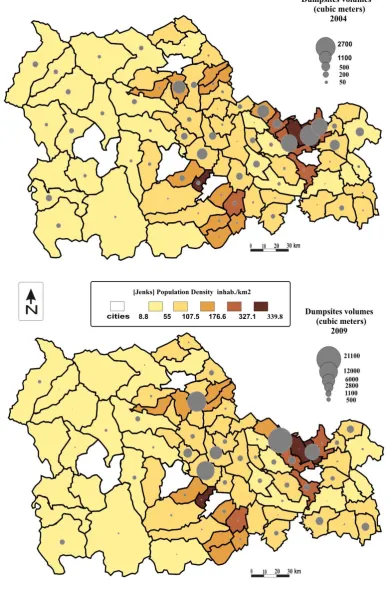
Often rural dumpsites are small (<1ha) having a short life (particularly in the proximity of rivers) with a various distribution within county, being difficult to follow in the field. In this context, a statistical distribution of dumpsites volumes at local administrative units is more proper using thematic cartography. Firstly, a database regarding the dumpsites volumes (m3) for 2004 (pre-accession) and 2009 (post-accession) was achieved, calculating the total sum for every commune which reported such sites on their territory. Data are provided by National Environment Guard, County Commissariat, being more reliable for 2009 due to the implementation of EU acquis on rural dumpsites, consisting in the inventory, closure and rehabilitation of all these sites. The full procedure for Neamț county was analyzed by Apostol and Mihai (2012). Mapping these data was performed using range colours for rural population density (relative values-hab. /km2) and correlated with dumpsites volumes (absolute values– m3) using proportional circles. Also, the Jenks discretization method was used for population density (2005) to outline the disparities between communes concerning demographic pressure on the local environment. Field observations during 2009-2011 (which covered more than half of the county from rural territory) comparative analysis (2004 vs. 2009) and geographical distribution of settlements across county contribute for a proper interpretation of results. The paper proposes a conceptual scheme (in situ - ex situ) for impact assessment of a dumpsite on local environment.
Discussion
The EU policy on waste management focuses on waste hierarchy concept which promotes to reduce, reuse, and recycle (3R), treatment, and incineration with energy recovery and in the last case land filling.
Several technological systems are used by EU members (Pires et al., 2011) and implementation of this policy across UE-27 is difficult due to major disparities reflected in municipal waste management systems (Mihai and Apostol, 2012a; Mengozzi,A.,2010 ). In order to mitigate these disparities, European directives on waste management are transposed into national laws and each member develops national, regional and local waste management plans according to these regulations. Romania, as new member, has a transition period for implementing the EU targets. Thus, the deadline for closure of rural dumpsites was 16th of July, 2009. Following this date, local authorities are obliged to provide waste collection on their territory. Therefore, during 2004-2009 period, the waste dumping on inappropriate sites was a common practice because of poor waste management services, dumpsites volumes ranging between communes. In the best cases, local authorities have chosen some sites where the waste could be disposed. Sanitation services were not well organized and waste collection did not occur regularly. The paper aims to offer a proper interpretation of their distribution taking into account the population density and local landscape. Physical-geographical transition from west to east leads to the uneven distribution of human settlements as well of population density (Fig. 2 and Fig. 3).
Fig.2 Distribution of human settlements
The highest concentration of human settlements (107.5 -339.8 hab./km2) is to be found on the terraces of the Siret and Moldova rivers, in the Cracău –Bistrița Subcarpathian depression (the communes downstream of Piatra Neamț town) and lower in the Moldavian Plateau or Carpathian region (< 55 hab./km2).
Spatial analysis of dumpsites volumes from rural territory. Case study: Neamţ County, Romania
In most communes, the dumpsites volumes from 2009 are significant larger than in 2004; moreover not all communes reported such sites on their territory even if they did not provide waste collection services. Field observations revealed the fact that such communes are facing illegal dumping. Dumpsites volumes in 2004, were frequently less than 100 m3, only 5 communes had more than 1000 m3, the maximum value being 2700 m3 for Tămășeni. On the other hand, in 2009 the largest volumes were registered in Gherăești commune, 21100 m3, followed by Petricani (13280 m3), Girov (12000m3) and others 8 communes with more 1000 m3. In mountain region, localities are placed linearly along the main valleys (the Bistrița and the Bicaz rivers) with numerous branches on tributary streams. The lack of waste collection services from this part of the county led to uncontrolled disposal of mixed waste (household waste, agricultural waste, sawdust) in rivers or on their river banks which are often filled by floods polluting the downstream lakes: Izvoru Muntelui, Pângărați, Bâtca Doamnei). These floods explain the low dumpsites volumes (< 500 m3) from the western half of the county comparing to other regions. The network of settlements is extended with higher population densities in Sub-Carpathian, plateau and corridor valley regions (>107.5 hab./km2). Dumpsites volumes are larger (or it should be ) in these areas than in the mountain sector because the waste disposal is done on several years in open dumps located ordinarily on alluvial plains, fluvial terraces, old geological sites, roadsides, forest areas or degraded lands. The development of compact human settlements on the large terraces of the Moldova and the Siret rivers allows a high concentration of population which explains the larger dumpsites volumes for these communes (e.g. Gherăești, Botești, Doljeşti etc). The lifespan of these sites is also greater than in the mountain or Subcarpathian regions, being less exposed to the floods. Therefore, well-populated communes (>100 hab./km2) located in the Subcarpathian depressions
(Neamţ, Cracău-Bistrița) had low dumpsites volumes
(< 500 m3) because of waste disposed on floodplains (Cracău, Bistriţa Ozana sector) or on the banks of tributaries, being “collected” by floods as well in mountain regions. The rivers in the proximity of human settlements from the mountain or Subcarpathians regions are most vulnerable to waste dumping because of the poor waste collection services. Also, in plateau region, local population dispose the household waste on streams (summer - dry riverbeds), but the impact of floods on these sites is more limited. In some cases, the large number of component localities (e.g. Bârgăoani commune-which include 11 dispersed small villages) increase the number and/or occupied areas (m2) of
open dumps, but with low volumes. Furthermore, the low population density and poverty of communes from the center and the south-eastern part of county reflect the low dumpsites volumes, usually < 500 m3. Toxic potential of a landfill varies depending on surface (ha), volumes/amounts of land filled waste (tons) and waste composition (the presence of hazardous waste). The geographical context of the dumpsite leading to various systemic interactions between the site and the surrounding, generating different types of pollution (air, water, soil, ecosystem and settlements pollution) and damaging the local landscape must also be taken into account (see Fig.5). These dumpsites from rural areas and those from small towns which covered less than 10,000 m2, and had a volume below 20,000 m3) were closed, compacted and covered by soil, (Fig.4) or the amounts of waste disposed were transported to the urban landfills in the proximity. Unfortunately, there are no studies concerning the waste composition at local scale, only estimations made by waste operators from urban areas.
Biodegradable waste (which has a ratio of over 50% of household waste in Neamţ County) is used by the local people as a source of food for livestock or it is biodegraded by traditional composting (mixed with manure) and reused to enrich soil. Recyclable waste (paper, cardboard, plastic, metal, wood), inert waste (glass, construction and demolition waste) and others (tires, WEEE, textiles) are disposed in such dumpsites representing less than half of the amounts of waste generated, thus reflecting the low dumpsites volumes from rural areas.
On the other hand, these dumpsites also contain not only household waste, but agricultural waste or even hazardous waste may be found as well. Also, sawdust was dumped widespread in mountain region but now a plant from Tașca commune uses this fraction as fuel. Following the closure of rural dumpsites, waste collected from communes should be transported to non-compliant landfills (Roman or
Târgu-Neamț).
Spatial analysis of dumpsites volumes from rural territory. Case study: Neamţ County, Romania
Fig.5: Geosystemic interactions between a landfill site and the surrounding area
(Mihai and Apostol, 2012b, modified)
Also, the sanitary landfill from Piatra Neamț town will be operational until 2017; following this term the waste collected will be disposed in Girov landfill. It should be noted that the sanitary landfill from Piatra
Neamț supported by ISPA funds does not allow the
disposal of the waste collected from rural areas. Because of this situation, waste collected (2009-2010) from peri-urban communes (Dumbrava Roşie, Girov, Gârcina, Alexandru cel Bun) are transported to
non-compliant landfill of Târgu Neamț town (deadline
for closure - July 2012), increasing the cost of these services until the transfer stations and regional landfill will become operational (Fig.5). Mixed waste collection prevails, separate collection is rarely seen and usually only plastic fraction is collected. However, in 2011, separate collection containers were installed for plastics, paper / cardboard, biodegradable and residual waste in Piatra Şoimului and Borlești communes. These facilities were supported by PHARE CES 2005 funds, including a transfer station in Roznov town which serves the surrounding rural areas.
Conclusions
Poor solid waste management facilities during 2004 -2009 encourage the bad practices such as waste dumping on inappropriate sites. Distribution of dumpsites volumes (2010 vs. 2004) reflects the same pattern as that for population density, low volumes in western half (mountain region) which increases in the eastern half of county. This paper highlights how local landscape (in the proximity of communes) influenced the distribution of dumpsites volumes. These sites have large volumes in well-populated communes located in hilly areas or on fluvial terraces (low vulnerability to floods). This approach is proper at local scale in the context of limited access of population to waste collection services. Therefore, these factors correlated with field observations cannot be ignored in rural waste management studies. Development of waste management sector services on rural territory is emerging under the pressure of EU regulations. Also, the PHARE and ENV-SOP funds contributed to the recent improvements of waste management facilities in the study area.
Acknowledgements
Authors would like to thank National Environmental Guard, County Commissariat of Neamţ for informational support.
References
Abduli, M. A., Samieifard, R. & Jalili, G.Z.M. (2008). Rural Solid Waste Management. Int. J. Environ. Res., 2(4), 425-430
Apostol, L., Mihai, F. C. (2011). The process of closing down rural landfills Case study : Neamţ county. Present Environment and Sustainable Development, 5 (2), 167- 174
Athanassiou, M., Zabaniotou, A. (2007). Techno-economic assessment of recycling practices of municipal solid wastes in Cyprus. Journal of Cleaner Production, 16, 1474-1483
Bel, G., Mur, M. (2009). Inter-municipal cooperation, privatization and waste management costs: Evidence from rural municipalities. Waste
Management, 29, 2772–2778
Chen, C. C. (2010). Spatial inequality in municipal solid waste disposal across regions in developing countries. Int. J. Environ. Sci. Tech., 7 (3), 447-456
Jolanta, M. K., Piotr, Ł. (2005). Local waste
management – the case of „BESKID Company. Acta Montanistica Slovaca Ročník 10 mimoriadne číslo 1, 186 – 189
Kulczycka, J., Zygmunt, K. (2008). Principles of municipal waste management in Poland and selected regions of Europe. Polish Journal of Chemical Technology, 10 (4), 28-33
Lămășanu, A., Mihai, F. C., (2012), The Illegal
Dumping of Waste in Forest Areas - Evidence from Rural Territory. Proceedings of the International Conference Integrated Management of Environmental Resources -,November 4-6th,
2011,Suceava,Romania, 46 – 50
Mamdouh, A. M., Gaber, A.Z. I. & Anwaar, K. A., (2009). Evaluation of Municipal Solid Waste Management in Egyptian Rural Areas. J Egypt Public Health Assoc, 84 ( 1 & 2), 51- 71
Massarutto, A. (2007). Municipal waste management as a local utility: Options for competition in an environmentally-regulated industry. Utilities Policy ,15 , 9-19
Mengozzi, A., (2010). Waste Growth Challenges Local Democracy. The Politics of Waste between Europe and the Mediterranean: a Focus on Italy,California Italian Studies Journal, 1(1),1-21 Mihai, F.C., Apostol, L.(2012a). Disparities in
municipal waste management across EU-27. A geographical approach. Present Environement and Sustainable Development, 6 (1), 169-180 Mihai, F.-C., Apostol, L. (2012b). Development of
waste collection services on rural territory from
Neamț County. Analele Universități Oradea,
Spatial analysis of dumpsites volumes from rural territory. Case study: Neamţ County, Romania
Mihai, F.C., Apostol,L., Lămășanu, A., Ghiurcă, A.A, (2012).Spatio-temporal analysis of Romania’s rural population access to sanitation services in the context of EU accession, Conference
Proceedings of 12th International Multidisciplinary
Scientific GeoConference,SGEM,17-23 June,
2012, Albena, Bulgaria, 5, 787-792, (DOI: 10.5593/sgem2012/s20.v5106)
Mihai, F.-C., Apostol, L., Ghiurca A.A, Lămășanu A., Bănică A., (2012). Geographical distribution of rural dumpsites in North-East Region from Romania,Conference Proceedings of 12th International Multidisciplinary Scientific GeoConference SGEM,17-23 June 2012,Albena,Bulgaria,5, 447-452, DOI: 10.5593/sgem2012/s20.v5060)
Orosz, Z., Fazekas, I. (2008). Challenges of municipal waste management in Hungary. AGD Landscape & Environment 2 (1) 78-85
Pires, A., Martinho, G., Chang, N.B. (2011). Solid waste management in European countries: A review of systems analysis techniques, Journal of Environmental Management,92, 1033-1050
*** APM Neamţ. 2010. Raport anual privind starea
factorilor de mediu in județul Neamț
*** ARPM Bacău. 2006. Planul regional de
gestionare a deșeurilor în regiunea 1N-E
*** CJ Neamț.2008. Planul județean de gestionare a