ORIGINAL RESEARCH
HEAD & NECK
Transorbital Sonography in Acute Optic Neuritis:
A Case-Control Study
P. Lochner, R. Cantello, F. Brigo, L. Coppo, R. Nardone, F. Tezzon, O. Raymkulova, G. Strigaro, C. Comi, and M.A. Leone
ABSTRACT
BACKGROUND AND PURPOSE: Acute unilateral optic neuritis is associated with a thickening of the retrobulbar portion of the optic nerve as revealed by transorbital sonography, but no comparison has been made between nerve sheath diameter and optic nerve diameter in patients with acute optic neuritis versus healthy controls. We evaluated optic nerve sheath diameter and optic nerve diameter in patients with acute optic neuritis and healthy controls and compared optic nerve sheath diameter and optic nerve diameter with visual-evoked potentials in patients.
MATERIALS AND METHODS: A case-control study was performed in 2 centers. Twenty-one consecutive patients with onset of visual loss during the prior 10 days and established acute noncompressive unilateral optic neuritis were compared with 21 healthy controls, matched for sex and age (⫾5 years). Two experienced vascular sonographers performed the study by using B-mode transorbital sonography. Visual-evoked potentials were performed on the same day as the transorbital sonography and were evaluated by an expert neurophysi-ologist. Sonographers and the neurophysiologist were blinded to the status of the patient or control and to clinical information, including the side of the affected eye.
RESULTS:The median optic nerve sheath diameter was thicker on the affected side (6.3 mm; interquartile range, 5.9 –7.2 mm) compared with the nonaffected side (5.5 mm; interquartile range, 5.1– 6.2 mm;P⬍.0001) and controls (5.2 mm; interquartile range, 4.8 –5.5 mm;P⬍ .0001). The median optic nerve diameter was 3.0 mm (range, 2.8 –3.1 mm) on the affected side and 2.9 mm (range, 2.8 –3.1 mm) on the nonaffected side (P⫽not significant.). Both sides were thicker than those in controls (2.7 mm; interquartile range, 2.5–2.8 mm;P⫽.001 and .009). No correlation was found between optic nerve sheath diameter and optic nerve diameter and amplitude and latency of visual-evoked potentials in patients with optic neuritis.
CONCLUSIONS: Transorbital sonography is a promising tool to support the clinical diagnosis of acute optic neuritis. Further studies are needed to define its specific role in the diagnosis and follow-up of optic neuritis.
ABBREVIATIONS:ON⫽optic neuritis; OND⫽optic nerve diameter; ONSD⫽optic nerve sheath diameter; TOS⫽transorbital sonography; VEP⫽visual-evoked potentials
O
ptic neuritis (ON) is an acute inflammation of the optic nerve that may cause a complete or partial loss of vision. The classic triad for its clinical diagnosis is visual loss, periocular pain,and dyschromatopsia.1ON typically occurs in young adults with
an approximately 3:1 female-male ratio. ON is mostly idiopathic but may be associated with autoimmune disorders and infectious, inflammatory, and demyelinating diseases, especially multiple sclerosis. It is diagnosed through a complete ophthalmologic and neurologic evaluation and a prolonged latency of the visual-evoked potentials (VEP). MR imaging with gadolinium is valu-able for differential diagnosis.2
Previous studies have shown that transorbital sonography (TOS) reliably investigates the optic nerve owing to its low reflec-tivity and the high reflecreflec-tivity of the perineural sheath and orbital fat.3TOS has been recognized as an accurate, noninvasive method
to identify papilledema.4,5Some TOS studies have shown that the
optic nerve may be enlarged in acute ON,6-11though the validity
of this technique for the diagnosis of ON has not yet been recog-Received March 24, 2014; accepted after revision May 22.
From the Department of Neurology (P.L., F.B., F.T.), General Hospital, Merano, Italy; Section of Neurology (P.L., R.C., L.C., G.S., C.C.), Department of Translational Medi-cine, University of Piemonte Orientale ‘‘A. Avogadro,” Novara, Italy; Department of Neurological and Movement Sciences (F.B.), Section of Clinical Neurology, Uni-versity of Verona, Verona, Italy; Department of Neurology (R.N.), Christian Doppler Clinic, Paracelsus Medical University, Salzburg, Austria; Head and Neck Department (O.R.), SCDU Neurology, MS Centre, AOU “Maggiore della Carita`,” Novara, Italy; and Interdisciplinary Research Center of Autoimmune Diseases (C.C., M.A.L.), No-vara, Italy.
Please address correspondence to Piergiorgio Lochner, MD, Department of Neu-rology, General Hospital Tappeiner, Rossinistr 5, 39012 Merano (Bolzano) Italy; e-mail: [email protected]
nized.12No sonographic data are available to distinguish
ment of the nerve itself from that of its sheath, though an enlarge-ment of the sheath in acute ON has been described with MR imaging.13
Previous studies did demonstrate good accuracy and reliabil-ity of sonographic quantification of optic nerve sheath diameter (ONSD).14,15
The primary aim of this study was to use TOS to assess enlarge-ment of the optic nerve and its sheath in acute ON by measuring optic nerve diameter (OND) and ONSD. The second aim was to identify whether OND and ONSD values were associated with any VEP abnormalities in cases of acute ON.
MATERIALS AND METHODS
PatientsAll consecutive patients presenting to the Neurology Outpatient Clinics of the Novara and Merano Hospitals between December 2012 and October 2013 with a diagnosis of the first acute episode of demyelinating unilateral ON were invited to enter the study. The study was approved by the local ethics committees and was performed in accordance with the Declaration of Helsinki. Writ-ten informed consent was obtained from all persons before enter-ing the study.
All patients underwent neurologic and ophthalmologic exam-inations, including visual acuity assessment, direct ophthalmos-copy, and laboratory examinations, including vasculitis screening and antineuromyelitis optica antibodies. MR imaging was per-formed to exclude other causes of ON or compressive lesions. Inclusion criteria were 18 –50 years of age, visual loss with onset ⬍10 days before the visit, and diagnosis of ON according to the Optic Neuritis Study Group.16Exclusion criteria were bilateral or
recurrent ON, suspected ischemic optic neuropathy, recent ste-roid treatment, and recent lumbar puncture.
Controls were 21 healthy volunteers, matched to patients by sex and age (⫾5 years) and selected among students, university personnel, relatives of patients admitted to the hospital, and their friends. Controls were examined to exclude a diagnosis of MS, ON, or other neurologic diseases; those with a relative affected by MS were excluded.
Patients and controls with a history of any major systemic diseases, including cardiovascular disease, arterial hypertension, hyperlipidemia, or diabetes, and pregnant or breast-feeding
women were excluded. The interval from the onset of symptoms was calculated from the first day the patient experienced visual loss or retro-orbital pain to the date of TOS.
Procedure
TOS was performed in patients and age- and sex-matched con-trols by 2 expert sonographers (P.L. and L.C.). VEP were per-formed only in patients, to avoid discomfort due to needle elec-trode placement in healthy controls, and were evaluated by an expert neurophysiologist (G.S.). TOS and VEP were always per-formed on the same day and before the onset of steroid treatment. Operators were unaware of the side involved (sonographers, VEP technicians, neurophysiologist) and of the condition of patients or controls (sonographers). To ensure blinding, we asked patients and healthy controls not to reveal their affected side (or their status) during examinations, and they were always placed on the tilt table before the arrival of the sonographer.
Transorbital Sonography
TOS was performed in B-mode by using a Vivid 7 sonography system with a 7- to 11-MHz linear array transducer (GE Health-care, Milwaukee, Wisconsin) and an Aplio XG equipped with a 4-to 11-MHz 5 S1 Linear Probe (Toshiba Medical Systems, Nasu, Japan). A procedure described previously in the literature was used.14,15Subjects were examined in the supine position with the
upper part of the body and the head elevated to 20°–30° to avoid any pressure on the eye and were asked to keep their eyes in a midposition and to suppress eye movements.
For safety reasons due to possible biomechanical side effects, the mechanical index was reduced to 0.2. The probe was placed on the temporal part of the closed upper eyelid by using a thick layer of sonography gel. The anterior part of the optic nerve was de-picted in an axial plane showing the papilla and the optic nerve in its longitudinal course. ONSD and OND were assessed 3 mm behind the papilla. To measure the ONSD, we quantified the dis-tance between the external borders of the hyperechogenic area surrounding the optic nerve. We measured the OND, marking the internal borders of this formation (Fig 1). To minimize intraob-server variability, we examined each bulb 3 times and calculated the means. Sonography was also used to evaluate the presence of papilledema.4,5The presence of papilledema, evaluated by
assess-ing optic disc elevation, was measured between the fundus and the
[image:2.594.54.531.48.171.2]dome of the papilla (Fig 1). Agreement between the 2 sono-graphers was preliminarily assessed for ONSD and OND by using the same device in 9 healthy subjects (see “Statistical Evaluation”).
Pattern-Reversal Visual-Evoked Potentials
Standard pattern-reversal VEP were performed according to re-cent guidelines17 with 4-channel equipment (Medtronic
Key-point, Denmark). The visual stimulus was a black-and-white pat-tern checkerboard (24⫻32) with 90% contrast, generated on an LED monitor (17-inch, high-resolution display; Acer, New Taipei City, Taiwan), with stimulus frequency, 2 Hz; observation dis-tance, 100 cm. Patients were preadapted to the room lighting, and all recordings were performed under dim room lights. Patients were instructed to fix on the red point in the center of the screen with their best refractive correction during the monocular stim-ulation. The recording electrode was placed on Oz, the reference electrode was placed on Cz, and the ground electrode, on Fz ac-cording to the International 10 –20 System. The impedance was kept below 3 k⍀on all electrodes. Signals were amplified and filtered with a bandpass filter from 0.2 to 3 kHz. One hundred responses were averaged for each side. Latencies of the N75, P100, and N145 waves and amplitude of the N75-P100 complex were analyzed.
Statistical Evaluation
If one assumed a median ONSD in controls of 5.0 mm, the sample needed to detect a mean difference of 1 mm was 10 patients and 10 controls with an␣error of .05 and aerror of 0.20. Continuous variables were described by their median with the interquartile range. Comparisons between groups were assessed by using para-metric (Studentttest) and nonparametric methods (Wilcoxon test, Fisher exact test, and Spearman correlation) when appropri-ate (deviation from normal distribution according to the Shapiro-Wilk test). In view of the large number of comparisons, the Bon-ferroni correction for statistical significance was used.
Interobserver agreement between the ONSD and OND
evalu-ations made by the 2 sonographers was preliminarily assessed with intraclass correlation coefficients.
RESULTS
We analyzed 21 patients with a first episode of ON, 17 women and 4 men; a visual loss⬎3/10 was present in 18 (85.7%). The right eye was affected in 16, and the left, in 5. Eleven patients had prior MS relapses (ON-MS), though never involving ON, and 10 had iso-lated ON. We enrolled 21 healthy controls. Mean age and body mass index were not different between patients and controls (Table). The Table reports clinical features and ONSD and OND values of patients and controls. Interobserver agreement was high for both ONSD (intraclass correlation coefficient, 0.98; 95% CI, 0.93–1.00) and OND (intraclass correlation coefficient, 0.98; 95% CI, 0.92–1.00). The main finding of our study was the statistically significant thickening of the ONSD on the affected side (intraclass correlation coefficient, 6.3 mm; 95% CI, 5.9 –7.2 mm) compared with the nonaffected side (intraclass correlation coefficient, 5.5 mm; 95% CI, 5.1– 6.2 mm;P⬍.0001) between patients and con-trols (Table). The median OND in the affected side (3.0 mm; range, 2.8 –3.1 mm) was similar to that in the nonaffected side (2.9 mm; range, 2.8 –3.1 mm) (P⫽not significant). Both sides were thicker than those in controls (median, 2.7 mm; range, 2.5–2.8 mm;P⫽.001 and .009). The OND and ONSD were strictly cor-related both in healthy controls (r⫽0.63,P ⫽.002) and the nonaffected eye (r⫽0.45,P⫽.039) but not in the affected eye (r⫽ ⫺0.15,P⫽.51).
Among controls, the ONSD or OND was similar in men and women. The median ONSD was 4.8 mm (interquartile range⫽ 4.8 –5.3 mm) in men and 5.3 mm (interquartile range⫽4.8 –5.6 mm) in women (P⫽.16); the median OND was 2.5 mm (inter-quartile range⫽2.3–2.8 mm) in men and 2.7 mm (interquartile range⫽2.5–2.9 mm) in women (P⫽.17). Neither ONSD (r⫽ 0.37) nor OND (r⫽ 0.13) was correlated with age (P ⫽ not significant).
Clinical and sonographic features of patients with optic neuritis and healthy control subjects
Characteristic ON Controlsa PValueb ON-MS Isolated ON PValuec
No. of patients 21 21 11 10
Age (mean) (SD) (yr) 30.3, 10.7 34.2, 8.7 NS 26.9, 9.5 34.0, 11.1 NS
Time to US examination: (median) (IQR) (days) 5, 3–7 7, 3–10 4, 3–7 NS
BMI (mean) (SD) (Kg/m2) 24.6, 4.8 23.6, 4.1 NS
Optic nerve sheath diameter (mm)d
Affected eye (median) (IQR) 6.3, 5.9–7.2 5.2, 4.8–5.5 ⬍.0001 6.2, 5.8–7.8 6.3, 5.9–7.0 NS
Fellow eye (median) (IQR) 5.5, 5.1–6.2 NS 5.5, 5.0–6.2 5.6, 5.1–6.4 NS
Optic nerve diameter (mm)e
Affected eye (median) (IQR) 3.0, 2.8–3.2 2.7, 2.5–2.8 .001 2.9, 2.8–3.0 3.1, 2.8–3.2 NS
Fellow eye (median) (IQR) 2.9, 2.8–3.1 .009 2.9, 2.7–2.9 3.0, 2.8–3.2 NS
VEP amplitude (V)
Affected eye (median) (IQR) 5.2, 2.2–12.2 7.1, 2.2–12.2 4.0, 2.6–9.3 NS
Fellow eye (median) (IQR) 8.4, 3.2–11.5 4.5, 2.8–8.7 11.1, 9.1–15.1 NS
VEP latency (ms)
Affected eye (median) (IQR) 124, 115–139 119, 115–128 134, 119–142 NS
Fellow eye (median) (IQR) 107, 103–114 104, 103–114 108, 106–113 NS
Note:—IQR indicates interquartile range; ON-MS, optic neuritis in patients with prior relapses of multiple sclerosis; US, ultrasound; BMI, body mass index; NS, not significant. a
The average value between the right and left eye was used as a measure of OND and ONSD in healthy controls. b
Level of significance at .01, according to the Bonferroni correction for multiple comparisons. c
Level of significance at .006, according to the Bonferroni correction for multiple comparisons. d
The comparison of the affected and fellow eye was significant (P⬍.0001) in all ON, ON-MS, and isolated ON. e
We did not find any significant difference between the ONSD and OND in patients with ON-MS and in those with isolated ON (Table).
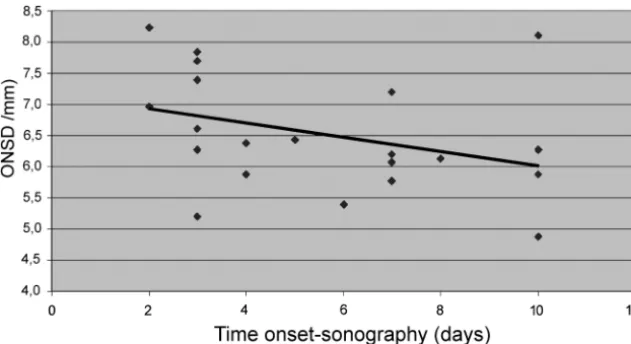
An almost significant inverse correlation between the delay of TOS examination and ONSD diameter in the affected eye was found, suggesting that the earlier the examination, the larger was the diameter (r⫽ ⫺0.42,P⫽.06) (Fig 2). No correlation was found between delay and OND (r⫽ ⫺0.11,P⫽.62).
TOS revealed papilledema in 9 patients (43%), 8 on the right side, and in none of the controls. There was no statistical differ-ence between patients with and without this elevation in terms of age, body mass index, ONSD, OND, VEP latency, and VEP am-plitude (data not shown).
No correlation (P⫽not significant) was found between the ONSD and either latency or amplitude of VEP both in the affected (latency,r⫽ ⫺0.01; amplitude,r⫽0.07) and the fellow eye (la-tency,r⫽0.05; amplitude,r⫽0.09). No correlation (P⫽not significant) was found between the OND and either latency or amplitude of VEP both in the affected (r⫽0.22;⫺0.16, respec-tively) and the fellow eye (r⫽0.23; 0.31, respectively).
DISCUSSION
Our study is the first to report transorbital sonographic measure-ment of both the ONSD and OND in patients with acute ON. Patients with ON had significantly increased ONSD values in the affected eye compared with the other eye and with values in age-matched controls. The thickening of the perineural space sur-rounding the optic nerve is probably related to inflammation of the optic nerve, resulting in an increase of the perineural sub-arachnoid fluid or edema caused by an impairment of axoplasmic flow, depending on the acute demyelinating plaque. Most inter-esting, it has been reported that narrowed optic canals, occurring for instance in osteopetrosis, may lead to compressive optic neu-ropathy.18,19It is, therefore, possible that within the anatomic
variability among different subjects, a tendency toward reduced diameter of the optic canals may lead to a further increase in perineural subarachnoid fluid and edema, with subsequent wors-ening of visual dysfunction. Our results, therefore, suggest that ONSD has a high sensitivity for the diagnosis of acute ON. Our
study was not designed to assess the specificity and predictive value of ONSD, which would require a larger sample size and controls with different diseases and different settings. Most in-teresting, although our patient popula-tion is not different from that in previ-ous studies,6-11 the mean ONSD was
slightly higher and corresponded to the ONSD values of patients with either chronically4 (6.4 mm) or acutely
ele-vated intracranial pressure (6.2 mm).20
We believe that this discrepancy could be explained by a different resolution of the sonography system, different probes, or by variability in the evalua-tion of sonographic anatomy and time of insonation. We also found that the sooner TOS is performed after symptom onset, the higher is the probability of detecting an increased ONSD. This observation supports the planning of further studies aiming to evaluate TOS for monitoring the evolution of inflammation.
The measurement of optic disc elevation is useful for detecting the presence of disc swelling (papilledema). Papilledema results from transmission of increased intracranial pressure to the sub-arachnoid space of the optic nerve, with compression of the nerve, stasis of axonal transport, and subsequent swelling of the optic nerve axons, particularly in patients with a narrow optic canal.21
In our study, we found a percentage of papilledema (45%) higher than that in previous studies (ranging from 6% to 37%).6-8,10
Although the OND in the affected eye was not thicker than that in the contralateral eye, both were slightly thicker than that in matched controls. We have no clear explanation for this finding. Such a difference may be due to chance alone, or it may suggest a subclinical involvement of the fellow nerve. We did not find any correlation between TOS and VEP measures, though VEP were performed only in patients. VEP specifically evaluate the conduc-tion time of the visual pathways, including the optic nerve tract: A slow conduction time (ie, prolonged latency of P100) is primarily due to a demyelinating process affecting the optic nerve. TOS instead evaluates the optic nerve and a different structure, its perineural space. Thus, these 2 techniques provide different, though complementary, information on the pathophysiology of ON.
This study is limited by the relatively small number of patients, the impossibility of obtaining a complete blinding of the clinical status of the patients, and the VEP performed only in patients. This study has several strengths, however, because we always per-formed sonographic assessments before starting steroid therapy and close to the onset of symptoms, and examiners were blinded to both clinical diagnosis and the side of ON. Furthermore, pre-liminary assessment of interobserver agreement between the ONSD and OND evaluations made by the 2 sonographers was high and similar to that found in a previous study by Ba¨uerle et al14(r⫽0.92– 0.97). These findings indicate that sonographic
[image:4.594.58.374.47.219.2]ONSD quantification can be performed with good accuracy and reliability.
CONCLUSIONS
ONSD measured by TOS is a noninvasive, inexpensive, and easy procedure, which may represent a promising tool to support and confirm the clinical diagnosis of acute ON, even if it can only examine the anterior portion of the optic nerve. Further investi-gations with larger sample sizes and longitudinal studies are re-quired to confirm our results.
Disclosures: Francesco Brigo—UNRELATED:Payment for Lectures (including service on Speakers Bureaus): UCB Pharma. Cristoforo Comi—UNRELATED: Grants/Grants Pending: Italian Ministry of Health,* Guillain-Barre´ Syndrome - Chronic Inflammatory Demyelinating Polyneuropathy Foundation International,*Comments: grants for re-search in neuroimmunology (€300,000), Travel/Accommodations/Meeting Ex-penses Unrelated to Activities Listed: Biogen, UCB Pharma, Novartis, AbbVie, Com-ments: meeting expenses (€5000). Maurizio A. Leone—UNRELATED: Board Membership:European Journal of Neurology,Comments: Associate Editor,Grants/ Grants Pending: Fondazion Comunita` del Novarese,*Comments: grant for home-care project in multiple sclerosis.*Money paid to the institution.
REFERENCES
1. Shams PN, Plant GT. Optic neuritis: a review. Int MS J 2009; 16:82– 89
2. Korsholm K, Madsen KH, Frederiksen JL, et al.Recovery from optic neuritis: an ROI-based analysis of LGN and visual cortical areas. Brain2007;130:1244 –53
3. Hansen HC, Helmke K, Kunze K.Optic nerve sheath enlargement in acute intracranial hypertension. Neuro-Ophtalmology1994;6: 345–54
4. Ba¨uerle J, Nedelmann M. Sonographic assessment of the optic nerve sheath in idiopathic intracranial hypertension. J Neurol
2011;258:2014 –19
5. Lochner P, Nardone R, Tezzon F, et al.Optic nerve sonography to monitor treatment efficacy in idiopathic intracranial hypertension: a case report.J Neuroimaging2013;23:533–34
6. Gerling J, Janknecht P, Hansen LL, et al.Diameter of the optic nerve in idiopathic optic neuritis and in anterior ischemic optic neurop-athy.Int Ophthalmol1997;21:131–35
7. Stefanovic´ IB, I Jovanovic´ M, Krnjaja BD, et al.Influence of
retro-bulbar neuritis and papillitis on echographically measured optic nerve sheath diameter.Vojnosanit Pregl2010;67:32–35
8. Neroev VV, Karlova IZ, Zaı˘tseva OV, et al.Role of ultrasonic B-scan-ning in differential diagnosis and prognosis of the course of optic neuritis[in Russian].Vestn Oftalmol2001;117:25–29
9. Elvin A, Andersson T, So¨derstro¨m M.Optic neuritis: Doppler ultra-sonography compared with MR and correlated with visual evoked potential assessments.Acta Radiol1998;39:243– 48
10. Karami M, Janghorbani M, Dehghani A, et al.Orbital Doppler eval-uation of blood flow velocities in optic neuritis.Korean J Ophthal-mol2012;26:116 –22
11. Dehghani A, Giti M, Akhlaghi MR, et al.Ultrasonography in distin-guishing optic neuritis from nonarteritic anterior ischemic optic neuropathy.Adv Biomed Res2012;1:3
12. Kolappan M, Henderson AP, Jenkins TM, et al.Assessing structure and function of the afferent visual pathway in multiple sclerosis and associated optic neuritis.J Neurol2009;256:305–19
13. Hickmann SJ, Miszkiei KA, Plant GT, et al.The optic nerve on MRI in acute optic neuritis.Neuroradiology2005;47:51–55
14. Ba¨uerle J, Lochner P, Kaps M, et al.Intra- and interobserver reliabil-ity of sonographic assessment of the optic nerve sheath diameter in healthy adults.J Neuroimaging2012;22:42– 45
15. Ba¨uerle J, Schuchardt F, Schroeder L, et al.Reproducibility and ac-curacy of optic nerve sheath diameter assessment using ultrasound compared to magnetic resonance imaging.BMC Neurol2013;13:187 16. The clinical profile of optic neuritis: experience of the optic neuritis treatment trial—Optic Neuritis Study Group. Arch Ophthalmol
1991;109:1673–78
17. Holder GE, Celesia GG, Miyake Y, et al.International Federation of Clinical Neurophysiology: recommendations for visual system testing.Clin Neurophysiol2010;121:1393– 409
18. Vanier V, Miller NR, Carson BS.Bilateral visual improvement after unilateral optic canal decompression and cranial vault expansion in a patient with osteopetrosis, narrowed optic canals, and in-creased intracranial pressure.J Neurol Neurosurg Psychiatry2000;69: 405– 06
19. Nardone R, Brigo F, Orioli A, et al.Optic nerve sonography in a patient with osteopetrosis.Can J Neurol Sci2014;41:400 – 01 20. Moretti R, Pizzi B, Cassini F, et al.Reliability of the optic nerve
ultrasound for the evaluation of patients with spontaneous intra-cranial hemorrhage.Neurocritic Care2009;11:406 –10