Performance Based Logistics
Information Exchange
Requirements on Information
Author:
ING.ERIK DUERINK
Supervisor: DR.ANDREAS WOMBACHER
DR.MAURICE VAN KEULEN
IR.ING.FERIT SERTI
M
ASTER
T
HESIS
Information System Data Flow within
Performance Based Logistics
by
Ing. Hendrik Lodewijk Duerink
A thesis submitted to the Faculty of Electrical Engineering, Mathematics and Computer Science of the UNIVERSITY OF TWENTE in fulfillment of the
requirements for the degree of
MASTER OF SCIENCE IN COMPUTER SCIENCE
with specialization
INFORMATION SYSTEMS ENGINEERING
FACULTY OF ELECTRICAL ENGINEERING,MATHEMATICS AND COMPUTER SCIENCE
UNIVERSITY OF TWENTE THE NETHERLANDS
I
ABSTRACT
III
“I hope that one day armies can be disbanded and humans will find a way of living together without vio-lence and oppression. But until that day comes, we will have to make ideals and human failure meet some-where in the middle”
V
A
CKNOWLEDGEMENTS
I would like to thank my supervisors Andreas, Maurice and Ferit. They challenged me to keep sharp and critical and supported me whenever I got stuck. I would like to thank Thales Nederland for the opportunity for conducting my research and all colleagues at Service Development for the help and ambiance at the work floor.
VII
C
ONTENTS
Abstract ... i
Acknowledgements ... v
1 Introduction ... 1
1.1 Context ... 1
1.1.1 Performance Based Logistics ... 2
1.1.2 Data Exchange ... 2
1.2 The Problem ... 3
1.3 Scope ... 3
1.4 Research Questions ... 4
1.5 Validation ... 5
1.6 Overview ... 5
1.7 Research Design ... 6
1.7.1 Orientation ... 6
1.7.2 Preparation ... 7
1.7.3 Focus ... 7
1.7.4 Development ... 8
1.7.5 Finalization ... 8
2 Related Work ... 9
2.1 PBL Implementation ... 9
2.2 Tooling ... 10
2.3 Data Exchange ... 11
3 Theoretical Background ... 12
3.1 Performance Based Logistics ... 12
3.2 Information Flow ... 14
3.3 Maintenance Management Information Systems (MMIS) ... 15
3.4 NATO CALS Data Model ... 16
3.5 Data Quality ... 17
3.6 Formats at Thales ... 18
3.7 Conclusion ... 19
4 Collecting Information ... 20
4.1 Information Construction ... 20
4.1.1 Medium ... 20
4.1.2 Category ... 21
4.1.3 Priority ... 22
VIII
4.1.5 Type ... 22
4.2 User Roles ... 23
4.2.1 Service Desk ... 24
4.2.2 PBL Project Team ... 24
4.2.3 Water Front Engineer ... 24
4.2.4 DoD Authority ... 24
4.2.5 Organizational Level Maintenance ... 24
4.3 Information Categorization ... 25
4.4 Information Prioritization ... 25
4.5 Conclusion ... 26
5 Information Assessment ... 27
5.1 Data Quality ... 27
5.2 Data Access ... 28
5.3 Barriers for Data exchange ... 30
5.3.1 Cyber Warfare ... 30
5.3.2 Exchangeable information ... 30
5.4 Conclusion ... 31
6 Development of a Solution ... 32
6.1 Determining the information requirements ... 32
6.1.1 The idea... 33
6.1.2 The Dimensions ... 33
6.1.3 The Critical Path ... 35
6.2 The Analysis Process ... 36
6.2.1 Elaboration On process diagram ... 37
6.3 Encountered difficulties ... 37
6.4 Enablers ... 38
6.4.1 Options for information exchange ... 38
6.5 Conclusion ... 39
7 Use Case ... 40
7.1 General ... 40
7.1.1 Situation ... 40
7.1.2 Parties Involved ... 40
7.2 Scenario’s ... 41
7.2.1 General ... 41
7.2.2 Home Base (HB) ... 42
7.2.3 Field Training Exercise (FTX) ... 43
7.2.4 Deployment ... 44
7.3 Analysis ... 45
7.3.1 Analysis Process ... 45
IX
8 Validation ... 46
8.1 The Setup ... 46
8.2 The Participants ... 47
8.3 Conducting the Validation ... 48
8.3.1 Scenario 1... 48
8.3.2 Scenario 2... 48
8.3.3 Scenario 3... 49
8.4 Results ... 50
8.5 Conclusion ... 51
9 Conclusions and further work ... 52
9.1 Conclusions ... 52
9.2 Recommendations / Further work ... 53
Abbreviations ... 54
List of Figures ... 55
References ... 56
Appendix A ... 58
Appendix B ... 60
Appendix C ... 61
Appendix D ... 62
Appendix E ... 63
1
1
I
NTRODUCTION
The complexity of the (weapon) systems used by Armed Forces is growing. Evolving technology leads to the increase of this complexity and the sustainment of these systems. In this modern day and age the sustain-ment of the modern systems has to be more efficient and effective. The primary focus has always been the acquisition of technology and systems, but the last decade there has been a shift from buying a system and conducting the sustainment of the system to a long-term (US DoD initiated) program to link performance to acquisition through a concept called Performance Based Logistics (PBL) [1], a concept which represents both acquisition and sustainment.
For the defense industry to offer PBL contracts to a Department of Defense (DoD), information exchange regarding the system under PBL should be addressed. To be able to exchange the needed information, trust of all parties is essential. Implementing a PBL contract is a contract for availability. The active management of the sustainment process (e.g. forecasting demand, maintaining inventory and scheduling repairs) becomes a re-sponsibility for the service provider. As a consequence, the supplier is now incentivized to improve the reliabil-ity of systems and reduce the inventories of spare parts. With fewer repairs and fewer spare parts the supplier makes more profit, while from the governments perspective PBL results in optimizing system availability and reducing cost and logistic footprint.
Integration or sharing of information with external parties is not one of the strongest points of a Depart-ment of Defense. This is however a subject of change with the introduction of Performance Based Logistics. Of course not over night, but it is certainly an important factor in today’s Defense industry.
The interchanging of information will depend on the contracted level of Performance Based Logistics. To simplify the process of analyzing the information requirement and the related information exchange there is a need for a model to facilitate this process. This thesis tries to answer the related questions by developing a general method and to validate it on a sensor under development.
The following sections give a general introduction to the thesis. First the context of the thesis is discussed, followed by an elaboration on the problem. After clarifying the problem the focus on the project is set via the scope and the research questions. Subsequently the validation is explained and this chapter is finished with the contribution and an overview of the thesis.
1.1
C
ONTEXT
The problem context of this thesis is that of Performance Based Logistics (PBL) and information require-ments in relation to data or information exchange. The implementation of PBL in the defense industry is a development that gains more and more ground. Together with potential implementation of PBL contracts, the need for system related information requirements emerges. Information requirements will differ per type of PBL contract.
2
1.1.1
P
ERFORMANCEB
ASEDL
OGISTICSSince PBL is the central object for this thesis, a short explanation is given. There are several definitions about PBL, but for this thesis the following definition is used [2]:
“An integrated acquisition and sustainment strategy for enhancing weapon system capability and readiness, where the contractual mechanisms will include long-term relationships and appropriately structured incentives with service providers, both organic and non-organic, to support the end user’s (warfighter’s) objectives.”
In short PBL is the approach to supporting weapon system logistics. It seeks to deliver product support as an integrated, affordable performance package designed to optimize system readiness. PBL meets perfor-mance goals for a weapon system through a support structure based on long-term perforperfor-mance agreements with clear lines of authority and responsibility. As said this is a brief summary of what PBL contains, Chapter 3 elaborates more on PBL.
However the focus will not be on PBL itself but on the related information requirements and data ex-change of the system under PBL.
To give a more simplified example to illustrate PBL:
The Department of Defense purchases a vehicle. Instead of conducting the maintenance themselves, a Per-formance Based Logistics contract is signed with a PBL-provider. In this contract there is agreed upon a certain level of availability, say 95% during a complete year. So in essence the DoD pays for available vehicles instead of paying for maintenance. The advantages for the DoD is that they don’t have to keep an inventory of spare parts, less cost on maintenance personnel and equipment and don’t have to deal with obsolete spare parts (DoD’s tend to keep their equipment for 20 years +). On the other hand the PBL-supplier (often the OEM) has a steady income, conducts maintenance in an efficient manner to generate revenue, but carries the risk of obso-lescence.
1.1.2
D
ATAE
XCHANGEAnother focal point of this research is on the exchange of information/data. A formal description accord-ing to Wikipedia [3]:
“Data exchange is the process of taking data structured under a source schema and actually trans-forming it into data structured under a target schema, so that the target data is an accurate representa-tion of the source data”
The exchange of data is key for the implementation of the PBL contract due to the fact the PBL-supplier needs information to be able to plan and execute activities to meet the contracted agreements on (for exam-ple) availability. Because of the (military) nature of the systems under PBL, the exchange of data is not some-thing to implement without restraints. Depending on the customer there will be variation in the standards for exchanging data. One can assume that there are always restrictions on what is tolerated regarding the ex-change of data, storage of data and the use and analysis of the data in information systems.
3
data to information), but coordinates of what? A ship, an airbase, a compound, troops, an incident? If this last piece of information is added then the information slightly shifts over to knowledge. Because one knows that the coordinates represent a location somewhere in the world and one knows the location of what. Have mul-tiple of these kinds of information and an overview can be created, hence knowledge.
1.2
T
HE
P
ROBLEM
The assignment is formulated by Customer Services and Support – Service Development and originates from the need of to have clear view on what the consequences are of offering a PBL contract with regards to information requirements and the subsequent information system data flow. There is a need for an analysis method that will function as a guide for determining the information flow barriers and possibilities, the re-straints for implementing such a system and availability of the data after retrieving it from the customer. As an example, a Department of Defense (DoD) buys a radar system from Thales Nederland (TNL), including a contract for availability (PBL). Such a contract for availability means that Thales Nederland needs to perform maintenance, related logistic sustainment processes such as maintaining spares stock level, solutions for obso-lescence and improvement of product reliability To make it possible to execute such a contract in an efficient manner, there is a need for (logistic and technical) information. However sharing information about an opera-tional system is not something a DoD (note: more than one nation, Thales has several countries as a customer) easily does. Rules apply for sharing “confidential” or sensitive information and these rules differ per nation and thus per customer. But as mentioned before, some information is essential to be able to execute a PBL con-tract. Lacking this information would lead to barriers for meeting the contracted agreement on service or availability. To be able to see what information is available and offer possibilities for information / data ex-change the assignment is formulated as follows:
Develop a solution for analyzing contractual information requirements in order to be able to facilitate in-formation system data exchange.
1.3
S
COPE
Thus far the research is quite broad. More focus is needed to get more depth in the research. To create more focus, the following constraints are defined:
The architecture of the information systems present at Thales Nederland is not part of the re-search. However the architecture facilitates possible software tooling that may be identified as essential to conduct PBL. As a result the outcome of the research might advise on a set of tooling, but will not elaborate on the standing or future IT/IS architecture of Thales Nederland.
This thesis is not intended to build a Maintenance Management Information System (MMIS). Best case it will result in advice on essential capabilities for the selection of an MMIS.
This research is not intended to write new communication protocols for the exchange of PBL re-lated data.
Logistic cost calculation as a result to information flow will not be part of this research.
All logistic operations are considered out of scope, only basic PBL related terminology will be ap-plicable in this research.
PBL related information from the Original Equipment Manufacturer (OEM) to its subcontractors is considered out of scope and therefore will not be part of this thesis. Hence the parties involved are the OEM (PBL supplier) and a DoD.
4
Both the terms data and information are commonly used to refer to the same thing, but as explained be-fore data and information are not the same. Sometimes in a specific context it is more suitable to use infor-mation instead of data, just to clarify a point, this thesis is no different. Thus, unless otherwise specified, this thesis will use the term data interchangeably with information.
This thesis is made at Thales Nederland (TNL). The complete research and the coined solution are based upon knowledge and personnel from TNL. It might be that the results are useable for other companies or insti-tutions and therefore Thales Nederland or TNL will be replaced by Original Equipment Manufacturer or OEM (where applicable and possible in the context) to give it a more generic character.
1.4
R
ESEARCH
Q
UESTIONS
In this section the focus for this thesis is defined. Concerns discussed in previous sections lead to a single point that creates potential barriers for information exchange, the (IT) communication with the Department of Defense. Because the type of PBL contract determines the complexity of the information requirement, every contract will have its own difficulties regarding information exchange. Eventually there is a need for a method to get a grip on the PBL related information requirements, this leads to the main question:
Can a solution be developed for analyzing contractual information requirements in order to be able to facilitate information system data exchange?
To be able to answer the main research question three sub-questions have been identified. To start it is necessary to know what information has to be exchanged. This leads to the following sub-question:
1. What is the PBL related required information inside and outside Thales? a. What are the information needs of Thales and a DoD?
b. What is the prioritization / classification of the data?
Second which quality is required, leading to the following sub-question:
2. What are the requirements imposed on the data? a. What is the required data quality?
b. What is the required level of access to the data? c. What are possible barriers for data exchange?
d. What is the consequence of not meeting these requirements?
Last how can the information need be enabled, leading to the following sub-question:
3. What are possible solutions to enable the DoD to provide the needed information? a. In relation to content of the data?
b. In relation to access of the data?
5
1.5
V
ALIDATION
The solution is validated by means of a use case. This use case is about a land based sensor which will be offered under PBL contract. Testing and validating the method in this way has the advantage that a newly de-veloped system can be exposed to the information requirements on the several level of PBL complexity.
The validation will focus on the following points:
Data quality
Effects of not meeting data requirements
Identifying possible barriers for implementation
Identification of information system requirements
1.6
O
VERVIEW
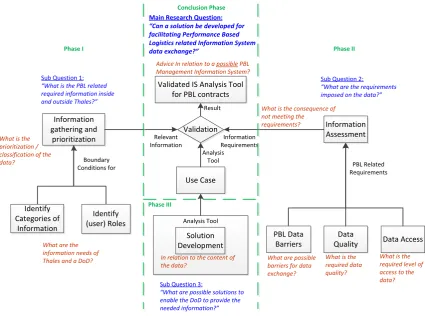
[image:18.595.82.508.408.724.2]The remainder of the thesis is organized as follows; section 1.7 describes the research approach in detail. Chapter 2 contains the related work and chapter 3 will elaborate on the theoretical background such as Per-formance Based Logistics, communication and data quality. The information gathering and prioritization of data and related is described in chapter 4, answering the first sub-question completing phase I (see Figure 1). The second sub-question (phase II) is answered in chapter 5, elaborating on the assessment of information. In chapter 6 and 7 cover phase III, answering the third sub-question and building the use case for validation. The main research question (conclusion phase)is answered in chapter 8 and 9. The latter discusses the conclusions from the research including advice on how to handle identified issues and future work.
FIGURE 1 RESEARCH DESIGN
Analysis Tool Validation Use Case Identify (user) Roles Information gathering and prioritization Solution
Development Data Access
Validated IS Analysis Tool for PBL contracts
Identify Categories of Information PBL Data Barriers Data Quality Boundary Conditions for Relevant Information Result Analysis Tool Sub Question 1:
“What is the PBL related required information inside and outside Thales?”
Sub Question 2:
“What are the requirements imposed on the data?”
Sub Question 3:
“What are possible solutions to enable the DoD to provide the needed information?”
What are the information needs of Thales and a DoD? What is the
prioritization / classification of the data?
What is the required data quality?
What is the required level of access to the data? What are possible
barriers for data exchange?
What is the consequence of not meeting the requirements?
In relation to the content of the data?
Advice In relation to a possible PBL Management Information System?
Information Assessment PBL Related Requirements Information Requirements
Phase I Phase II
Phase III
Conclusion Phase
6
1.7
R
ESEARCH
D
ESIGN
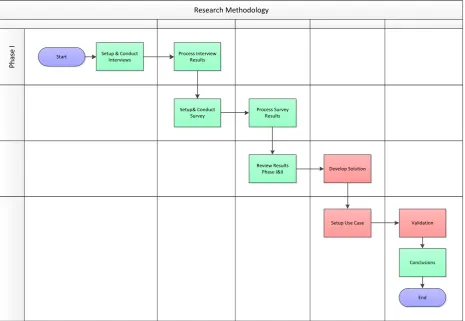
The schema (Figure 1) created an outline for the thesis and related the research (sub) questions to the chapters in the thesis. To create more detail, the phases defined in the introduction (Figure 1), are split up in steps. Each of these steps covers a specific stage in the research. To get a better insight in the design, Figure 2 depicts the graphical representation of the research design overview.
The horizontal swimming lanes cover the defined phases (Figure 1), where the columns represent the stages of the research:
Orientation
Preparation
Focus
Development
Finalization.
[image:19.595.74.540.315.636.2]The stages are explained in the remaining sections of this section.
FIGURE 2 RESEARCH DESIGN OVERVIEW
1.7.1
O
RIENTATIONTo get a better understanding of the dynamics within TNL and of course how the theory of PBL is inter-preted by the employees. The steps in this stage seem little, but they are time consuming and essential to get a good starting point for the rest of the research. The basis for the interviews is discussed in chapter 2.
TNL (Hengelo) is considered the audience for the interviews.
Research Methodology P h as e I P h as e II P h as e II I C o n cl u si o n P h as e Finalization Orientation Preparation Focus Development
Start Setup & Conduct Interviews Process Interview Results Setup& Conduct Survey Process Survey Results Review Results Phase I&II
Setup Use Case Validation
Conclusions
7
1.7.1.1
SETUP AND CONDUCT INTERVIEWS
A set of Subject Matter Experts (SME) relevant to PBL is selected to interview. Relevant SMEs are in this case employees active in logistics, sensor development, and sensor test engineer.
The basic interview is open to get as much information as possible from the interviewees. The general di-rection and introduction will be the same so that every interviewee has the same starting point. The main question will be: To your opinion what kind of information is in your area of expertise essential to be able to execute a PBL contract and why?
During the interview notes will be taken and stored by means of a spreadsheet. The use of a spreadsheet will enable future modifications and selections on notes and general information.
Another element during the interview is to gain knowledge about subjects as Data Quality, Data Access and possible implementation barriers to PBL related information.
1.7.2
P
REPARATION1.7.2.1
PROCESS INTERVIEW RESULTS
The interviews are face to face in an actual conversation. The notes will be entered on the spot in a spreadsheet and thus creating a source of information.
To be able to do the next step, the information collected until now has to be filtered to remove errors and typos. Subsequently doublings have to be identified, because this can point to an information element that is important. Information elements mentioned more than once are marked.
The result from the processing of interview results will be information that the SMEs deem to be im-portant for PBL. Note that at this point no prioritization has taken place in the bulk of information. Also infor-mation categories will be identified. The inforinfor-mation obtained via the interviews is classified into these catego-ries (without involvement of the SMEs).
1.7.2.2
SETUP & CONDUCT SURVEY
To prioritize and thus apply another filter on the collected information, a survey is created. The survey (Appendix B) is designed in such a way that the information elements identified during the interviews will be presented to the SMEs in the information categories and scored with essential, desired and optional. The sur-vey will be done via web based tooling, for which the participants will get an invitation via email.
1.7.3
F
OCUS1.7.3.1
PROCESS SURVEY RESULTS
The survey result will give an insight in what the SMEs deem to be the bare minimum on information needed to be able to conduct PBL or execute a PBL contract. The actual scoring of the SMEs will be totaled and the participants will be informed of the outcome thus far.
1.7.3.2
REVIEW RESULTS PHASE I & II
With the knowledge of the interviews and survey, an information construction will be developed. This construction will at least contain the information category and priority.
8
1.7.4
D
EVELOPMENTWith all information collected in the previous stages, a solution has to be developed. In the case of this re-search this will be a Decision Tree. The aim of this Decision Tree will be in a relatively simple tree structure to give a better understanding of the consequences of the (none) availability of information, identify choke points or barriers and possible enablers for gaining more information.
1.7.4.1
DEVELOP SOLUTION
For the analysis issue the choice has been made to use the concept of a decision tree. The information categories and identified information will function as input for the basic setup of the decision tree. The tree will be limited in its dimensions to prevent the exponential growth of the tree.
A critical path is the path in the Decision Tree that will enclose all the nodes in the tree that contain the minimal information to be able to execute PBL contracting in a successful manner. The critical path in the Deci-sion Tree will be marked to be able to speed up the analysis of information availability.
1.7.4.2
SETUP USE CASE
To be able to validate the “solution” or decision tree, the principle of a use case is applied. The topic of the use case is a land based sensor concept. The sensor concept, which is currently under design by Thales Neder-land, is ideal to use as the topic for a use case.
A scenario is going to be made that will cover the extremes of land-based deployment and during home base operations of this sensor.
1.7.5
F
INALIZATION1.7.5.1
VALIDATION
With the scenario in place the developed Decision Tree will be used to analyze the information availability in potential contracts, map this information and get an insight in the effect it will have on the execution of the PBL contract. During the validation an attempt will be done to identify possible barriers and potential enablers regarding to information exchange.
The SMEs involved during the interviews and survey, will be consulted to give their professional opinion if the developed solution (hence decision tree) is feasible, realistic and useable.
1.7.5.2
CONCLUSION
9
2
R
ELATED
W
ORK
During the literature research it became clear that there are enough publications about Performance Based Logistics (PBL) and what the added value is, how PBL can be implemented and as a result an organiza-tional change is imminent etc. But when searching for what the main obstacles are regarding information ex-change with a DoD, the result is very limited. Although most providers of software packages / tooling claim that integration with all common systems is possible, it never is explained how communication with a DoD is implemented. In this section related work is summarized that has a relation with my topic of Performance Based Logistics.
2.1
PBL
I
MPLEMENTATION
To be able to execute PBL in an efficient manner, it is essential to have a proper information system in place. It is possible to guarantee any form of operational availability in a long-term agreement when no accu-rate information is available, but at higher cost. The need for information is also emphasized by Ngai et al [4] . He stresses that the IT integration in the complete chain is key for a seamless flow and availability of infor-mation. The concept of PBL requires information exchange between parties involved, but the actual require-ments and responsibilities are laid down in a contract. The first time when a PBL contract is made, this is also called a transition contract. Sols and Johannesen [5] describe these contracts and identify lessons learned. Some of the key lessons are: what has to change to make it possible, what are the responsibilities (both sides) and what is measured. The main reason for using a transition contract is the fact that there is a significant way of doing business. Sols and Johannesen defined three blocks; Technical-contractual, Cultural-organizational, Business-political. These three blocks contain several barriers or hurdles, for example; what metrics should be used to measure system performance, how and when should the metrics be measured, do the existing proce-dures in the organization of customer and/or contractor lack the required flexibility to embrace PBL? And what intellectual and industrial property rights apply? The period that the transition contract should be in place is used to collect data on the complete process. This data collection is only possible when agreed upon in the contract itself.
PBL partnerships require a change of behavior, Wei et al[6] state that; instead of keeping contractors at arm’s length at an adversarial relationship, government and industry become active partners and build trust. Ultimately implementation of PBL will require leadership commitment to changing organizational culture and accepting new organizational roles. The tracking of performance data is required to ensure PBL is achieving the expected results of reducing costs and improved performance.
DeVries conducted a research on what enablers and barriers are for effective implementation [7]. In this research he identified barriers and enablers based upon a literature study and one of the most outstanding enablers seemed to be the correct definition of metrics. Hence what do we measure, how do we measure it and who will get the data? In the case of PBL at Thales Nederland (TNL) any information system can be imple-mented at TNL, but if the system is not fed with data from the systems under PBL the system will not produce the desired information to facilitate PBL. An integration of the complete information system chain from PBL supplier (OEM) to customer (DoD) may be feasible in the distant future, but for now the focus has to be on the basic sharing of data / information in order to enable PBL.
Berkowitz et al [1] stress to standardize decision making based upon (legacy) system output and document performance improvements and lessons learned across the organization, hence a correct management of all collected data from the PBL contract.
10
Gansler [9] identified a barrier that has a lot to do with the culture, nicely described by the following ex-ample: “ Some military commanders want to “see” the required inventory and do not trust a computer based response system”. This highlights how some parts of the military personnel sees the coming of PBL; Just an-other thing that is going to interfere with my work. On the an-other side an important enabler for PBL implemen-tation is; an effective IT infrastructure is essential for the required public private integration.
The PBL guide of the US DoD [10] mentions the following item: “The technical specialist must be aware of the following supplier chain flows:
Physical goods
Information
o Shipments are received and tracked. Senders and receivers send shipment information back and forth.
o Performance feedback is shared between supply chain partners”
Especially the information part is interesting with regards to stability. This is also identified: ”Supply chain partners should be able to establish and share critical information rapidly. As the stability of the supply chain decreases, the product, information, and cash flows will become more difficult to manage”. Hence this also implies that the exchange of information across open communication sources can result in a decrease in stabil-ity of the supply chain in relation to the information reliabilstabil-ity.
As seen up till now, cultural changes and organizational changes are inevitable when implementing PBL, mostly focusing on the Military organization. However Griffin [11] state: “ PBL strategies are cohesive, adapta-ble and responsive. They build upon sophisticated information technology support that enaadapta-bles data sharing, a common perspective of the battle space, early awareness of resource consumption and needs, commitment tracking and support for reconfiguration”. This means that the sharing of information is bi-directional, because of the fact that a major part of military operations is sustainment and therefore also an element in operational planning.
2.2
T
OOLING
There are several software packages, which are or facilitate a Maintenance Management Information Sys-tem (MMIS), in this section will briefly mention some software packages.
VisionWaves [12] is an MMIS that basically has a dashboard functionality with a representation of key per-formance indicators, hence at least the basic functionalities of an information system. VisionWaves claims that information system integration is possible; like data exchange via file export, SAP integration, Oracle ERP inte-gration, etc. IT Integration of the VisionWaves software in the existing Thales architecture is possible (probably via middleware), as well as the integration at the customer side. The recurring concern here is the same as the main focus of this thesis, the barriers for sharing a DoD’s (operational) information [13, 14].
Siemens PLM software sees a central role for the Logistic Support Analysis Record (LSAR)[15]. The soft-ware is developed according to the military standards like the NATO CALS (Continuous Acquisition Lifecycle Support) Data Model. NATO CALS [16] purpose is to facilitate the integration of digital information for weapon system acquisition, design, manufacturing and support functions. The complete logistic information support is described including usage of databases, again the communication to a DoD is not explained. The Siemens PLM software is not a software package currently under investigation at Thales Nederland.
11
Management (Information) System CMMS). Also this product emphasizes the need for operational information [1] and suggests that EDI (Electronic Data Interchange) is an option to communicate. However solutions to the common issues like operational security [8, 14] are not described.
All software manufacturers mentioned in this subsection (there are more without a doubt) are unanimous about the need for asset information to be able to execute PBL. One can conclude that there is enough tooling to facilitate the PBL process, the key here is the identification of the enablers for data exchange with a DoD. How different the countries may be in their issuing of rules for (operational) data security, it is essential to offer options for exchange data. These options can provide solutions for data exchange and create alternatives for a data exchange issues.
2.3
D
ATA
E
XCHANGE
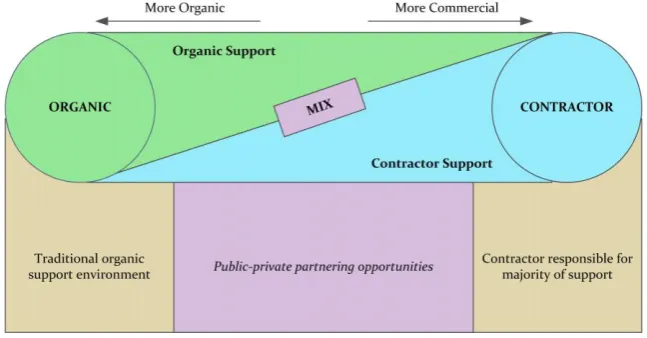
It became clear that the data responsibility, forms of exchange of data and information system integration are barriers for implementing PBL. The complexity strongly dependents on the level of maturity or PBL level. Hence the more contractor support (see Figure 3 PBL Spectrum) is contracted, the more the responsibilities of maintenance and (operational) system availability will shift to the contractor. Subsequently the shift of re-sponsibility will lead to an increase of information availability or access. Doerr [18] identified measurement issues and pinpointed the same issue that is raised here:
“Measurement issues are endemic to the relationship between commercial sector vendors and the DoD. From the point of view of measurement, the best PBL candidates are those with external markets for services, and clear outcomes that are easy to relate to mission objectives.”
There is a NATO standard for logistic support information systems: NATO CALS Data Model (NCDM). The NCDM is intended to support exchange of logistics data between different operations and applications [16]. It will need further research to determine if NCDM is useable for data exchange between TNL and a DoD. Up till now TNL stores the Logistic Support Analysis Record (LSAR) according to the mil-std-1388 (NATO standard of CALS).
Giannotti [17] suggests EDI as a means of data exchange. However the one of the outcomes of research done by Scala [19] is that EDI requires high initial capital expense and EDI requires high volumes before bene-fits are attained. These higher overhead costs are the result of the use of the EDIFACT standard (United Na-tions build standard: Electronic Data Interchange For Administration, Commerce and Transport). If the EDI suggestion by Giannotti is based on the more modern XML usage, than the overhead will be substantially low-er. JSON is unlike XMLEDI not commonly used as a format for data exchange. However open formats for data interchange like XML (Extensible Markup Language) and JSON (JavaScript Object Notation) are more recent and future-proof, something that could be very important because of the life span of military assets.
12
3
T
HEORETICAL
B
ACKGROUND
This chapter will elaborate on the theory of Performance Based Logistics and related topics that will be used in this thesis. Technologies that are common in today’s market will not be part of this chapter
3.1
P
ERFORMANCE
B
ASED
L
OGISTICS
Taken into account that there are a lot of different opinions for the same subject, there has to be a choice how to define the concept of PBL. In this thesis the definition of PBL from Berkowitz [2] is used:
“An integrated acquisition and sustainment strategy for enhancing weapon system capability and readiness, where the contractual mechanisms will include long-term relationships and appropriately structured incentives with service providers, both organic and non-organic, to support the end user’s (warfighter’s) objectives.”
[image:25.595.87.411.385.554.2]Figure 3 depicts the dynamics of a PBL environment. When implementing and executing PBL the responsi-bility of sustainment shifts from the owner (organic) to the PBL-provider (contractor or OEM). This shift means that it is rather difficult to define all scenarios upfront, the remaining conditions are determined during con-tract negotiations. In other words the concon-tract is rather fluid and has only boundaries in the extremes. It is important for the PBL provider (or OEM) to determine its critical path for a PBL contract in order to get the right information in the right amount at the right time to be able to execute a PBL contract in an efficient and effective manner.
FIGURE 3 PBL SPECTRUM
In simple terms PBL is a contract for availability, where the customer pays for an operational system. This means that the sustainment of the system shifts form the customer to the OEM, including all the risks. The risks include costs for keeping stock, lead-time for repairs or supply of COTS products from sub-contractors and obsolescence (a spare-part or article becomes a non-deliverable), but also the training of operators and maintenance personnel.
As of now OEM will be used during the course of this thesis to represent the entity that executes the PBL contract. In the literature the OEM also can be referred to as PBL supplier and contractor. The main focus of the PBL information exchange will be on the DoD and the OEM. The information exchange between the OEM and its subcontractors will not be a part of this thesis.
13
reports, log files and so on are required by the OEM in order to facilitate product improvement and cost reduc-tion in order to keep the sustainment costs as low as possible. With this informareduc-tion serves the purpose of prediction and optimization of support needs.
In principle the information need can be divided in the following categories:
1. Use(operational) information; this is information that is collected during use [21], hence Dynamic Preventive Maintenance data. This is all data that can be used to trigger maintenance on a sys-tem. Examples are hour counters of (sub) systems, deployment period (the time frame that the complete system is deployed). The second purpose of this information is (as mentioned above) to conduct statistical calculations for prediction and optimization of the sustainment. The third pur-pose is product improvement, which will lead to less system failure and more gain for the OEM. 2. Configuration information; how is the system build and of what components or subsystems, the system breakdown. This information has a close relation to use information because of the fact that the hour counters are related to a specific item [22].
3. Planning information; when will a system be deployed, what kind of spares are needed to ensure the sustainability during the deployment of the system. Execution of all pre- and post-deployment checks, and as a result when will the system be available for maintenance [22, 23]. Planning in-formation also includes supply/stock inin-formation. Intrinsic to PBL the OEM takes responsibility for the spares. This implies that the spares in stock at the location of a system (this can be an (air) base or a ship) are also the responsibility of the OEM. Thus the OEM has a requirement or even better the responsibility to know what the stock levels are at the different locations.
Availability planning is a normal process for a DoD, this planning will indicate when what equipment must be operational capable. This Material Availability Plan (MAP) is an essential source of information for a maintenance unit. The MAP is used plan the workload for a maintenance unit throughout the year. The MAP will have all essential equipment listed and when it must be available for the unit to be able to train and con-duct assigned operations (i.e. deployment). Creating a MAP is a DoD responsibility
It is in the OEMs interest to have information to the maximum extent in order to be able to predict or pre-vent failure and ultimately to keep costs as low as possible. Besides these costs, an OEM will face penalties whenever the contracted availability is not met. These penalties are settled during contract negotiations and vary from contract to contract including the availability level. PBL contracts can be arranged in many different ways from loose with only the end goal and some boundaries set to very ridged with the same end goal but very detailed regulations of what is allowed. Whatever the contract restrictions, boundaries or agreements are, the need for information does not change. The parties have a common interest regarding to what infor-mation will be exchanged and it is not only the OEM that requires inforinfor-mation. To be able to monitor the PBL process the DoD also has an information requirement such as available systems, availability of support etc. all key performance indicators (KPI).
14
[image:27.595.84.519.89.372.2]3.2
I
NFORMATION
F
LOW
FIGURE 4 INFORMATION FLOW SCHEMATIC
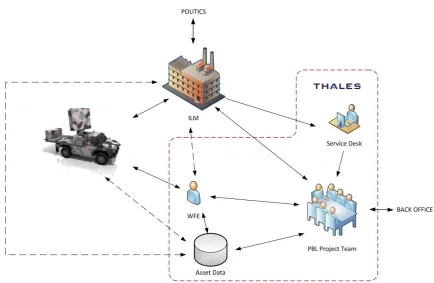
To be able to visualize the information flow that is inherent to PBL, it is useful to create a general overview of the parties involved. At the highest abstract level one can distinguish only the OEM (or PBL provider) and the customer (DoD), zooming in to a lower level more detail becomes visible. The OEM (Thales Nederland in this case) has several entities; (1) the service desk. (2) The PBL project team, (3) the Water Front Engineer (WFE).
The Water Front Engineer is the engineer on site. (4) A Defense Material Organization or Intermediate Level Maintainer (ILM) and of course the asset and asset data. In this thesis the theory is mapped over the general situation at Thales Nederland (Figure 4).
As seen in Figure 4, there are several lines, dashed and solid. These lines represent the information flow within a PBL contract. The solid lines represent the information flow that is likely to be implemented. Within the OEM organization there is an information flow as well, most of the time this exchange of information is related to product improvement or support to the main sustainment process that is contracted.
Although the sustainment of an asset is contracted via a PBL contract, the OEM has to keep in mind that the owner of the asset also has an information requirement. This information requirement is a result of the fact that a DoD has to be able to verify asset status, i.e. is the asset available or what preparations have to be done to be able to support the asset for a longer period of time in case of a deployment. Besides this infor-mation, it has to be considered as a possibility that a DoD wants to be able to view the technical status of its asset.
15
DoD wants to have the confirmation on the availability of essential spare-parts of a system (under PBL) at the start of a mission. The second dashed line from the system or asset to the DB represents an option to auto-mate data transfer to the DB / IS and the other way around, i.e. a full system integration, this is a topic for further research. In order to keep PBL feasible, it is important that the basic information exchange functionali-ty is in place.
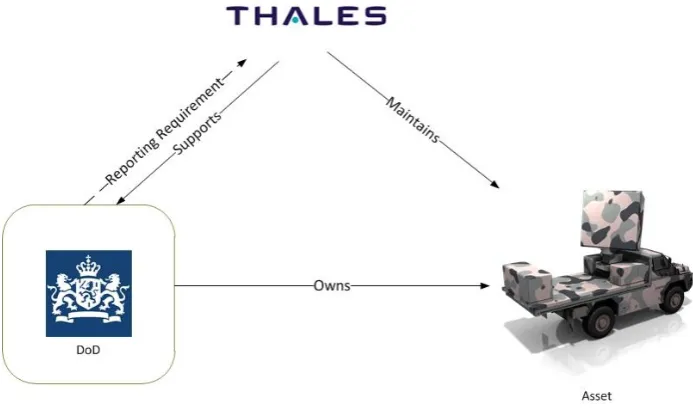
[image:28.595.88.435.250.456.2]The fact that an information dependency is mutual once a contract has been signed is already mentioned before. Figure 5 represents the relations and dependencies that emerge during a contract. Thales is the OEM and the customer is a DoD (the crest is from the Dutch DoD, but it could be a DoD of any nation). The OEM supports a customer by maintaining the product that the DoD owns. This support comes at a price and bound-ary conditions such as information availability and access. On the other hand the customer requires (status) reports from the OEM about the health of its asset(s).
FIGURE 5 INFORMATION FLOW RELATIONS
3.3
M
AINTENANCE
M
ANAGEMENT
I
NFORMATION
S
YSTEMS
(MMIS)
There are sufficient Maintenance Management Information Systems (MMIS) available on the market, even MMIS that are specifically tailored for PBL. A MMIS is also known as a Computerized Maintenance Manage-ment System (CMMS) or Computerized Maintenance ManageManage-ment Information System (CMMIS). These names for the same system will be encountered in the literature, but the function is the same. In this thesis the term MMIS will be used. What does a MMIS do? Information in an MMIS is intended to help maintenance workers do their jobs more effectively (i.e., determining which machines require maintenance and which locations contain the spare parts they need) and to help management make informed decisions (i.e., calculating the cost of machine breakdown repair versus preventive maintenance for each machine, possibly leading to better allocation of resources). MMIS data may also be used to verify regulatory compliance.
16
A typical setup of MMIS software includes the following job-elements:
1. Work orders
Scheduling jobs, assigning personnel, reserving materials, recording costs, and tracking relevant information such as the cause of the problem (if any), downtime involved (if any), and recom-mendations for future action. Typically, the MMIS schedules preventive maintenance automati-cally based on maintenance plans and/or meter readings.
2. Asset Management
Recording data about equipment and property including maintenance activities, specifications, purchase date, expected lifetime, warranty information, service contracts, service history, spare parts and anything else that might be of help to management or maintenance workers
3. Inventory control
Management of spare parts, tools, and other materials including the reservation of materials for particular jobs, recording where materials are stored, determining when more materials should be purchased, tracking shipment receipts, and taking inventory.
4. Safety
Management of permits and other documentation required for the processing of safety require-ments.
5. System integration
MMIS packages often link to enterprise software and process control systems.
The job-elements mentioned above organize the information requirement that an OEM has when execut-ing a PBL contract.
During this thesis there will be no specific advice on a MMIS, at most a set of requirements that must be met by candidate MMIS software. In the following chapters there will be an analysis on which information is needed and how it is prioritized
3.4
NATO
CALS
D
ATA
M
ODEL
NATO CALS Data Model (NCDM) defines a common set of data definitions that can be used to achieve con-sistency of interfaces at the information level without requiring standardization of hardware or software. The role of the NCDM is to standardize content of a life-cycle repository for defense technical information with the objective that Armed Forces with different Information Technology infrastructure, e.g., different hardware and software platforms, can make use of the same technical information.
The NCDM consists of a core model with several subsidiary models. The purpose of the core model is to provide a high-level definition of various views of a product; the product as specified, as designed and as built. The subsidiary models are:
1. Product configuration; 2. Failure Analysis 3. Task description
4. Technical documentation
5. Logistic Support Analysis
6. Supporting models; models to capture information about approvals, personnel, etc.
17
3.5
D
ATA
Q
UALITY
Data quality states something (as the name suggests) about the quality of the data. To be more specific, data quality (DQ) is the accuracy of the data presented by an information system and how it is in the real world [24]. The data quality of a system would be a 100% if the representation of the data by the information system is perfectly in line with the real world situation. It is not realistic to say that an information system has a DQ of 100%.
As opposed to what one would think the real concern with DQ is not the level of perfection of the data, but that the quality of data in the information systems is accurate enough and consistent enough for the users to make decisions. So if the latter is the case and users can make well-founded decisions based on the data, all additional effort to bring the DQ as close as possible to 100% is in fact wasting resources. Data which is fit for use by data consumers is also known as high-quality data [25].
According to feedback control system (FCS) theory whenever a system tracks the real world, there must be a mechanism to synchronize the data in the information system with the situation in the real world. Two things have to happen for data in any database to track the real world:
1. Someone or something (person or an automatic sensor) has to compare the data views from the system with the data from the real world.
2. Any deviations from the real world have to be corrected and reentered.
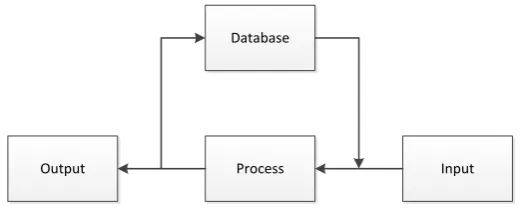
[image:30.595.175.438.491.595.2]To fully understand the FCS model in an information system see Figure 6. Data is entered in the system, processed resulting in an output and simultaneously stored in the database. This loop maintains the database and represents the real world as accurately as possible. Reflecting the FCS model onto the situation of TNL, this means that whenever data is received from the customer, there has to be a comparison to the information present in the database. An update of the data in the system is necessary to represent the real world situation. This is essential because more than one department within TNL will use the information in the database. A mismatch with reality will result in a less precise action based upon the data in the system.
FIGURE 6 INPUT-PROCESS-DATABASE-OUTPUT MODEL
It is common to collect large numbers of unused data elements [24], with the idea that someone might have a use for them somewhere in the future. If an organization is not using stored data, than over time real world changes will be ignored and the quality of data in the system will decline.
To make a point, storing data for use is essential for an information system to work. However if the idea is to store data just for the sake of having it at ones disposal, it will result in poor DQ and thus a possibly wrong (business) decision.
Process
Output Input
18
One approach is to conceptualize the processing and storage of data as a data manufacturing system [25]. Within a data manufacturing system three roles are identified: data producers; data custodians; and data con-sumers.
Roles Characteristics Tasks
Data producer People and other sources that produce data Data-production processes
Data custodians People who provide and manage computing
resources for storing and processing data
Storage, maintenance and security
Data consumers People or groups that use data Data utilization and potential data
aggregation and integration
TABLE 1 ROLES CHARATERISTICS AND TASKS
High quality data consists of four categories [25](see Table 2): Intrinsic, accessibility, contextual and repre-sentational aspects
DQ Category DQ Characteristics
Intrinsic DQ Accuracy, Objectivity, Believability, Reputation
Accessibility DQ Accessibility, Access security
Contextual DQ Relevancy, Value-added, Timeliness, Completeness, Amount of Data
Representational DQ Interpretability, Ease of Understanding, Concise Representation,
[image:31.595.68.533.259.343.2]Con-sistent Representation
TABLE 2 DQ CATEGORIES AND CHARACTERISTICS
Besides the overall meaning of data quality, an opportunity emerges for data selection in relation to the information requirements per PBL level. First of all only select and store the information that is required and not the information that “might be useful” for “possible analysis needs”, too many ifs. In addition the category accessibility can be used for identifying possible solutions for the availability of data from an asset.
3.6
F
ORMATS AT
T
HALES
As mentioned before in this chapter, to be able to execute a PBL contract it is necessary to have infor-mation about the system under PBL contract [2, 23]. Besides the logistic inforinfor-mation of the system under PBL (planning and spares information), there is the system information itself. The system information includes log files with information about sensors, hour counter, fault codes, etc. let’s say the current situation or health of the system. Hence this information is needed for maintenance activities and product improvement.
To be able to collect this kind of information, a maintenance application is running on the sensor called the Maintenance Center. Furthermore due to the complexity of the sensors build by Thales, test procedures are integrated so that it is possible to check the functioning of the system. These tests are called Build In Test (BIT). Information from the Maintenance Center can be viewed by means of a Maintainer Terminal, an application running on a laptop and interfacing with the Maintenance Center via a direct connection (RJ-45).
The results of the BIT’s as well as the information from the Maintenance Center (i.e. hour counters, etc.) are logged. All information logged by the system is bundled into a single file, the Event Log. The Event Log is a binary file, double compressed in order to keep its size as small as possible.
19
In general the majority of the information is stored in a binary format, only readable when using tooling. Thus the information that is to be exchanged on system level from the customer to the OEM is to be marked as binary.
3.7
C
ONCLUSION
Performance Based Logistics is a concept that has been coined by the US DoD to reduce costs and keep the level of availability as high as possible, overall reduce the footprint and make the logistic support and sustaina-bility more efficient and effective. For a PBL provider (in this research the OEM) to be able to provide the ex-pected level of available operational capacity one can assume by rule of thumb that the same information now required by the standing maintenance organization is required by the OEM to be able to perform their tasks in an efficient manner.
20
4
C
OLLECTING
I
NFORMATION
To get an overview of what information is needed, interviews with personnel of different disciplines are conducted. The disciplines are i.e. logistics engineering, technical engineering, service desk and service level managers.
This chapter will elaborate on the concept of information, the roles in the information exchange process, the information categories and which priorities are set on the availability of information.
4.1
I
NFORMATION
C
ONSTRUCTION
To ensure a common view about the information, it is necessary to have a common ground. This viewpoint has been confirmed in interviews and discussions. Thus there has to be a general concept for this thesis re-garding the “construction” of information.
So what can be said about information? The information has to be exchangeable via a medium, it says something about a system that is under PBL and as a result the information has a priority. So the main ele-ments (in random order) that are defined are (see also Figure 7):
Medium
Category
Priority
4.1.1
M
EDIUMThis part of the information indicates the possibility of information exchange via a communication chan-nel. With the current speed the technology develops, it is not unthinkable that in the near future new commu-nication technologies will be introduced. Thus listing the possibilities will be limited, without excluding the possibility that future communication technologies can and will be implemented.
Hands-on is actually the most simple but also effective manner to retrieve the information from a system. The WFE can download the data directly from the system or from a hot swappable drive. Note that this possi-bility only covers system information.
Telephone call: when other options fail, simple information like fault messages can be communicated. This is an emergency measure.
VPN: direct communication to exchange (larger amounts of) information, it also enables real time infor-mation.
Repository, FTP, etc.: more asynchronous exchange of information with the advantage that the system does not need to be online to retrieve needed information. The downside is that this communication medium excludes real time information exchange.
Mail; simple way to just send (parts of) information retrieved from the system under PBL contract.
Telemaintenance; this is a process on its own. It implies a form “secure” communication technology like VPN and remote maintenance of the system by means of resetting, software updates, etc.
21
FIGURE 7 INFORMATION CONSTRUCTION
4.1.2
C
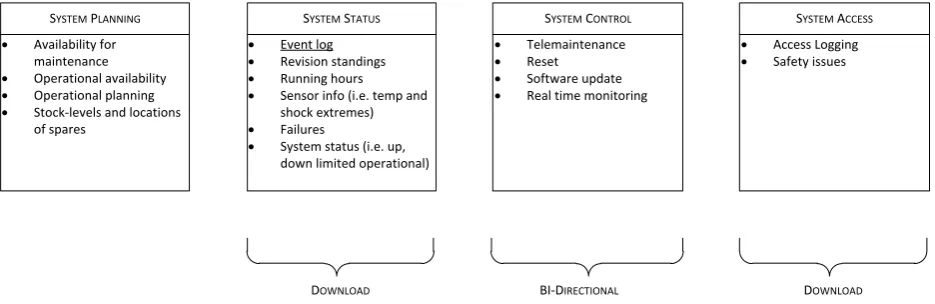
ATEGORYTo be able to categorize information, first the information categories have to be determined. Four catego-ries are identified (Figure 8): System planning, System Status, System Control and System Access. These cate-gories result from the first interviews where a need for planning of resources was identified, information about the system is needed, external actions want to be applied to a system and finally who has been working on the system [2].
System Planning contains all information needed to be able to conduct maintenance on the system under PBL, hence all preconditions.
System Status is all current and past (logged) information about the system under PBL, i.e. Configuration, Running hours etc.
System Control; These are all proceedings that can affect the system under PBL. Note the emphasis on can; the system is accessed but when there is only monitoring of the system (remotely of course) it does not influence the system itself. An example is that when a system has issues and the local technicians cannot figure out the problem, an engineer from the OEM can remotely login and view the behavior of the system. In this way there is access to the system, but there is no change.
System Access is logging of physical access of the system (opening of doors and cabinets) but also the ac-cess of the system electronically. This category can also contain the allocation of acac-cess rights to the system.
P
R
IO
R
IT
Y
MEDIUM CATEGORY CLASS TYPE
Information
Real time
Deferred
Raw data
Masked data
Raw data hands on (WFE)
Telephone call
VPN
Repository
Telemaintenance
Level
Essential
Desired
Optional System Access
System Planning
System Status
System Control
22
[image:35.595.73.541.138.290.2]PBL is more that system information alone (confirmed by an SME). There is also the need to know the lo-cation and status of maintenance significant items (MSI) or spare parts. These spares can be on several loca-tions i.e. the OEM, DoD or an external supplier. However the focus of this thesis is the information exchange between DoD and the OEM (bi-directional) and therefore the external parties are considered out of scope.
FIGURE 8 INFORMATION CATEGORIES
4.1.3
P
RIORITYInformation has a certain priority. To be able to conduct PBL some information is more important than others, thus every information element has to be scored. During this research there are three options for scor-ing the information priority: Essential, Desired or Optional. With Essential meanscor-ing that this information is absolutely necessary for the PBL process, Desired states that the information will be used and absolutely sup-ports the PBL process but if it’s not available the process will be hampered but not stopped. Lastly Optional, this is information that is useful and could support the PBL process but it will not damage the process in any-way if it’s not available. One could say it’s nice to have.
If there is no prioritization on information there is no way to determine on what part of the information is really important. Basically the message is send; “We must have all information”. But as stated earlier before there is also such a thing as too much information and that is just as undesirable as to little or faulty infor-mation [11]
4.1.4
C
LASSThe class indicates if the information element is preferred to be real time or deferred. The preference is set during the interviews
4.1.5
T
YPEThe type indicates if the information should be raw data, hence all of the recorded data or that a selection of this information would suffice.
SYSTEM STATUS
Event log
Revision standings
Running hours
Sensor info (i.e. temp and shock extremes)
Failures
System status (i.e. up, down limited operational) SYSTEM PLANNING
Availability for maintenance
Operational availability
Operational planning
Stock-levels and locations of spares
SYSTEM ACCESS
Access Logging
Safety issues
BI-DIRECTIONAL
DOWNLOAD
SYSTEM CONTROL
Telemaintenance
Reset
Software update
Real time monitoring
23
4.2
U
SER
R
OLES
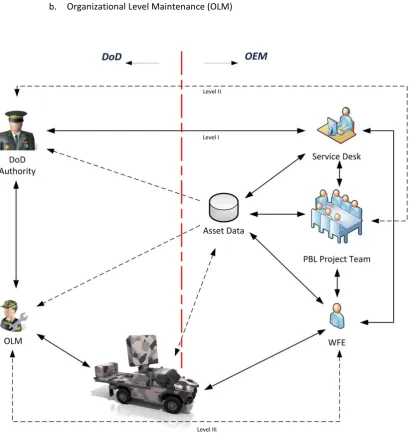
Figure 9 represents a graphical overview of the relations between user roles and the form of communica-tion amongst these roles. The user roles are based upon personal experience (DoD side) and a possible way of conducting the PBL process at TNL. In total five roles are identified:
1. Thales (OEM)
a. Service Desk
b. PBL Project Team (including PBL manager) c. Water Front Engineer (WFE)
2. DoD
a. DoD Authority
[image:36.595.94.505.232.670.2]b. Organizational Level Maintenance (OLM)
FIGURE 9 USER RELATIONS
24
The solid lines represent the communication between roles on day to day basis. The dashed lines repre-sent possible information needs or flows and of course the arrows depict the direction of the information. For example the dashed line from the database to the OLM or DoD authority represents the need from the cus-tomer to be able to see information regarding to asset status, this can be needed for operational planning or confidence building.
Also visible are the levels I, II and III. These levels represent escalation levels, level I represents normal day to day operations, there is an issue that the DoD authority reports at the service desk or any other request. At level II there is an urgent issue that requires attention from the PBL project team, therefore there is direct contact with the PBL project team bypassing the service desk. On the spot communication regarding a formal (reported) issue that has to be resolved immediately is represented at level III. The OLM and the WFE com-municate to solve the issue. Note; there will be also informal communication on the spot between the OLM and WFE on a day-to-day basis (this is not represented in Figure 9).
Not a role, but never the less worth mentioning is the resources, skills and tools that an OLM needs to per-form his job. These pre-conditions are also supplied by the PBL provider and are more important when there is a need for registration of these preconditions like in the aviation industry.
4.2.1
S
ERVICED
ESKThe service desk is the first contact for customers regarding all kinds of issues including technical problems and complaints. In normal circumstances the service desk should function as a single point of contact to the customers, hence the front office.
4.2.2
PBL
P
ROJECTT
EAMThe PBL project team is responsible for the execution of the PBL contract. This implies that they are also responsible for planning the maintenance of the system under PBL contract. As a result the PBL project team will have more interests than only the technical status of the system. The availability planning is important in order to be able to schedule servicing on the system and reserving own resources to be able to conduct the servicing of the system. The composition of the PBL Project Team can vary per project or contract phase, due to the different expertise’s that are needed.
4.2.3
W
ATERF
RONTE
NGINEERThe water Front Engineer is the onsite technical representative of the OEM. The WFE has knowledge of all systems access to the TNL resources (i.e. tooling and OEM engineers) and will be able to train the OLM on the job. The WFE will be responsible for the onsite support and sustainment of the system under PBL
4.2.4
D
OD
A
UTHORITYThe DoD authority can consist of several entities, like a systems manager or a complete department dedi-cated to the sustainment of the system under PBL up to a resources planner or an ILM. This structure will vary per DoD (of a Nation). Like the PBL project team, the DoD authority can change due course of life of a system. Hence in the implementation phase high-level involvement will probably be the case, whereas when the end of life (also known as ELOT) of the system is approached there is no need for a high level representative.
4.2.5
O
RGANIZATIONALL
EVELM
AINTENANCE25
4.3
I
NFORMATION
C
ATEGORIZATION
To record information that is collected during the interviews an excel worksheet is built (see Appendix A). Every information element mentioned by the interviewed SME also result in completing the remainder of the columns: Element; Category; Class; Deferring Time; From; To; Sys/DB; Contact.
Element: This is the name/description of the information element itself.
Category: The information category, this will be filled in after the interview.
Class: Can the required information be deferred or not.
Deferring Time: if the class indicates that the information can be deferred, this column repre-sents how long it can be deferred according to the SME.
From: The source of the information, who (which role) initiates the information transfer.
To: The receiving end of the information transfer.
System/DB: The location where the information should be stored. At this time this is the location as is, hence the same location where the information is stored now.
Contact: The name of the interviewee (SME)
After every interview the received information elements are categorized. This is done by determining what the information is about. Hence if the information is about preconditions for the system like planning, spare parts etc. than the information element belongs to the category System Planning, if it is about the system itself then it belongs to the category System Status. When the information element involves some kind of remote connection to the system, then the information element belongs to the category System Control and if it’s about access logging then it belongs to the category System Access.
4.4
I
NFORMATION
P
RIORITIZATION
When the information requirements are listed (see Appendix A), the prioritization has to take place. On average most SME’s agree upon the information requirements, however sometimes there will also be a devia-tion of this average. Typically this deviadevia-tion is a subject that correlates with the SME’s area of expertise [26] and therefore is very specific. To be able to create an overview of information requirements with a higher level of abstraction (hence less details), the listed information requirements have to be prioritized.
In case of this research the prioritization is done via an online survey. The survey is made using a tool available at TNL, Thales NL Enquete tool by LimeSurvey. For this survey questions are made (see Appendix B), that propose an information element and ask the question if this information element is Essential, Desired or
Optional. At the end of each series the SME can leave some remarks, in order to give the SMEs an opportunity to reflect on their choice. Not all information elements recorded during the interviews will be used, because of possible doublings or similarities. This is explained to the SME’s prior to the start of the survey. Sending this survey to all SME’s asking for their opinion will score the information elements.
26