
An Interactive Fuzzy Satisficing Method for Multiobjective
Stochastic Integer Programming with Simple Recourse
Masatoshi Sakawa, Takeshi Matsui Faculty of Engineering, Hiroshima University, Hiroshima, Japan Email: [email protected], [email protected]
Received May 29,2012; revised June 25, 2012; accepted July 3, 2012
ABSTRACT
This paper considers multiobjective integer programming problems involving random variables in constraints. Using the concept of simple recourse, the formulated multiobjective stochastic simple recourse problems are transformed into deterministic ones. For solving transformed deterministic problems efficiently, we also introduce genetic algorithms with double strings for nonlinear integer programming problems. Taking into account vagueness of judgments of the decision maker, an interactive fuzzy satisficing method is presented. In the proposed interactive method, after deter- mineing the fuzzy goals of the decision maker, a satisficing solution for the decision maker is derived efficiently by updating the reference membership levels of the decision maker. An illustrative numerical example is provided to demonstrate the feasibility and efficiency of the proposed method.
Keywords: Multiobjective Programming; Stochastic Programming; Fuzzy Programming; Interactive Methods; Simple
Recourse Model
1. Introduction
In actual decision making situations, we must often make a decision on the basis of imprecise information or un- certain data. For such decision making problems involve- ing uncertainty, there exist two typical approaches: sto- chastic programming and fuzzy programming. Stochastic programming, as an optimization method on the basis of the probability theory, has been developing in various ways [1-5], including two stage problem by [6], and chance constrained programming by [7]. Fuzzy mathe- matical programming representing the vagueness in deci- sion making situations by fuzzy concepts has been stud- ied by many researchers [8-12].
In most practical situations, however, it is natural to consider that the uncertainty in real world decision mak- ing problems is often expressed by a fusion of fuzziness and randomness rather than either fuzziness or random- ness. For handling not only the decision maker’s vague judgments in multiobjective problems but also the ran- domness of the parameters involved in the objectives and/or constraints, Sakawa and his colleagues incorpo- rated their interactive fuzzy satisficing methods for de- terministic problems [9,13] into multiobjective stochastic programming problems. Through the introduction of several stochastic programming models such as expecta- tion optimization [14,15], variance minimization [14], probability maximization [14,16,17] and fractile criterion optimization [14] together with chance constrained pro-
gramming techniques, they introduced several interactive fuzzy satisficing methods to derive a satisficing solution for a decision maker from Pareto optimal solution sets.
It should be stressed here that in the chance con- strained problems, for random data variations, a mathe- matical model is formulated such that the violation of the constraints is permitted up to specified probability levels. Compared with this, in a two-stage [18] or multistage [19] model including a simple recourse model as a special case, a shortage or an excess arising from the violation of the constraints is penalized, and then the expectation of the amount of the penalties for the constraint violation is minimized [20,21].
Furthermore, it is often found that in real-world deci- sion making situations, decision variables in a multiob- jective stochastic programming problem are not con- tinuous but rather discrete. From this observation, we discuss interactive fuzzy multiobjective stochastic integer programming which is a natural extension of multiobjec- tive stochastic programming with continuous variables. To deal with practical sizes of multiobjective stochastic nonlinear integer programming problems formulated for decision making problems in the real-world, we employ genetic algorithms to derive a satisficing solution to the decision maker.
this paper is to provide a novel decision making method- ology including a new model, solution concept and solu- tion algorithm to deal with more realistic problems in the real world, by simultaneously considering various con- cepts such as fuzziness, randomness, integer decision variables and interactive fuzzy programming, while most of previous papers dealt with either of the concepts or a part of them. Using the concept of simple recourse [20], the formulated multiobjective stochastic simple recourse problems are transformed into deterministic ones. For solving transformed deterministic problems efficiently, genetic algorithms with double strings for nonlinear in- teger programming problems are introduced. Assuming that a decision maker has a fuzzy goal for each of the objective functions, we present an interactive fuzzy satis- ficing method to derive a satisficing solution for the de- cision maker by updating the reference membership lev- els for fuzzy goals represented by the membership func- tions. An illustrative numerical example is provided to demonstrate the feasibility and efficiency of the proposed method.
2. Multiobjective Stochastic Integer
Programming with Simple Recourse
We consider a simple recourse model for the multi- objective stochastic integer programming problems
1 1
minimize
minimize subject to
0,1, , , 1, 2, , ,
k k
j j
z c
z c
A
x v j n
x x
x x
x b
(1)
where x is an n dimensional integer decision variable
column vector, cl, l = 1, 2, ···, k are n dimensional
coefficient row vectors, A is an m × n coefficient matrix,
and b is an m dimensional random variable column
vector. It should be noted here that, in a simple recourse model, the random variables are involved only in the right-hand side of the constraints.
To understand an idea of the formulation in the simple recourse model, consider a decision problem of a manu- facturing company where the decision variables actually make sense only if they are integer values. Suppose that the company makes m types of products which requires n
kinds of working processes, and a decision maker (DM) in the company desires to optimize the total profit and the total production cost simultaneously.
Let denote activity levels for the n
kinds of working processes which are integer decision variables, and then Tx denotes the amount of products,
where T is an m × n matrix transforming the n kinds of
activity levels of the working processes into the m types
of products. The total profit is expressed asc1Tx, where
an m dimensional coefficient vectorc1 is a vector of unit
product profits for the m types of products, and the total
production cost is represented by c2x, where an n
dimensional coefficient vector c2 is a vector of unit costs
for the n kinds of activity levels of the working processes.
Assume that the demand coefficients
1, , n
x x x
1, ,
T
m
d d d
for the m products are uncertain, and they are represented
by random variables. The demand constraints are expressed as TxIyIy d , where
y+ and y–
represent the errors for estimating the demands, and I is
the m dimensional identity matrix. These two objectives
are optimized under the demand constraints
Tx Iy Iy d together with the ordinary constraints Bx ≤e without uncertainty for the activity levels such as
the capacity, budget, technology, etc. The constraints
Ax = b in (1) can be interpreted as the combined form
of the demand constraints with random variables and the ordinary constraints without uncertainty.
Let us return to a general case of the recourse model. It is assumed that, in this model, the DM must make a decision before the realized values of the random variables involved in (1) are observed, and the penalty of the violation of the constraints is incorporated into the objective function in order to consider the loss caused by random date variations.
To be more specific, by expressing the difference between Ax and b in (1) as two vectors
1, ,
T m
y y
y
and
1, ,
T m
y y
y ,
the expectation of a recourse for the lth objective function is represented by
,
min
l l l
R E x
y y
x q y q y y y b A
(2) where l
q and ql are m dimensional constant row
vectors, and b(ω) is an m dimensional realization vector
of b for an elementary event ω. Thinking of each
element of
1, ,
T m
y y
y
and
1, ,
T m
y y
y
as a shortage and an excess of the left-hand side, respectively, we can regard each element of ql and ql
Then, for the multiobjective stochastic programming problem, the simple recourse problem is formulated as
1 1 minimize minimizesubject to 0,1, , , 1, 2, , ,
k k
j j
R
R
x v j n
c x x
c x x (3)
Because l and l are interpreted as penalty
coefficients for shortages and excesses, it is quite natural to assume that l and , and then, it is
evident that, for all i = 1, ···, m, the complementary relations
q q
0
q ql0
0 0
i i
y y ,
0 0
i i
y y
should be satisfied for an optimal solution. With this observation in mind, we have
1 1
, 0 if
n n
i i ij j i i ij j
j j
y b a x y b a
x ,
1
0, n if n .
i i ij j i i ij
j
a x b b a
y y 1 j j x
Recalling that b ii, 1, 2, , m are mutually indepen-
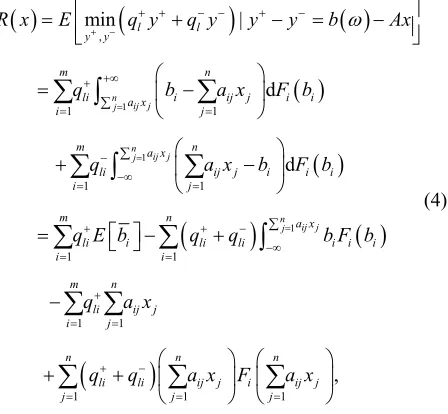
dent, (2) can be explicitly calculated as
1 1 1 , 1 1 1 1 1 1 1 1 m | d i d n n ij j j n ij j j n ij j j l l y y m nli a x i ij j i i
j
m a x n
li ij j i i i
j
m n a x
li i li li i i i
m i i n li j i i i
R x E q y q y y y b Ax
q b a x F b
q a x b F b
q E b q q b F b
q
1 1 1
,
ij j
n n n
li li ij j i ij j
j j j
a x
q q a x F a x
(4)where Fi is the probability distribution function of bi.
Then, (3) can be rewritten as
1
minimize
minimize
subject to 0,1, , , 1, 2, , ,
R R k j j z z
x v j n
x
x (5)
where
11 1 1
1 1
d
n ij j j
m n m
R
l li i lj lj li j
i j i
m n n
li li ij j i
j j ij j
i
a x
i i i
z q E c a q x
q q a x F a x
b F b b
x 1 3. Fuzzy Goals
In order to consider the imprecise nature of the DM’s judgments for each objective function R
l z x
R l z xin (5), by introducing the fuzzy goals such as “ should be substantially less than or equal to a certain value,” (5) can be interpreted as
1 1 minimize minimizesubject to 0,1, , , 1, 2, , ,
R R k k j j z z
x v j n
x
x (6)
where μl is a membership function to quantify a fuzzy
[image:3.595.324.515.86.195.2] [image:3.595.64.288.415.622.2]goal for the lth objective function in (5) as shown in
Figure 1.
It should be noted here that (6) is regarded as a multiobjective decision making problem, and that there rarely exists a complete optimal solution that simul- taneously optimizes all the objective functions. By directly extending Pareto optimality in ordinary multi- objective programming problems, Sakawa et al. defined M-Pareto optimality on the basis of membership function values as a reasonable solution concept for the fuzzy multiobjective decision making problem [9,13].
Definition 1 (M-Pareto optimal solution). A point *X
x is said to be an M-Pareto optimal solution if
and only if there does not exist another xX such
that
*
l zl l zl
x x
for all l
1, , k
and1
0
,1
R l
z zlR,0 zlR x
R
l zl x
*
j zj j zj
x x
for at least one , where X denotes the
feasible region of the problem.
1, ,
j k
To help the DM specify the membership functions, it is recommended to calculate the individual minima of by solving the nonlinear integer programming problems
R l
z x
int minimize, 1, 2, , subject to
R l
z
l X
x
x k (7)
where Xint denotes the feasible region of (6).
In order to find a candidate for the satisficing solution, the DM specifies the reference membership levels
, 1, ,
l l k,
and then by solving the augmented mini- max problem
1
max minimize
1
subject to 0,1, , , 1, , ,
R
l l l
k
R l
l l l
j j
z l k
z
x v j n
x
x (8)
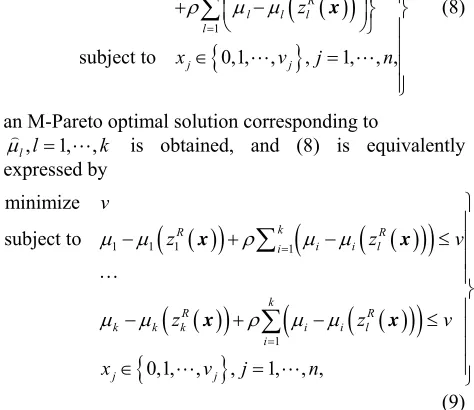
an M-Pareto optimal solution corresponding to
, 1, ,
l l k
is obtained, and (8) is equivalently expressed by
1 1 1 1
1
minimize subject to
0,1, , , 1, , ,
k
R R
i i l
i
k
R R
k k k i i l
j
i j
v
z z
z z
x v j n
vv
x
x x
x
(9) where ρ is a sufficiently small positive number.
Observing that (7) and (9) are nonlinear integer programming problems, we cannot directly apply GADSLPRRSU [11] for solving them.
4. Genetic Algorithms for Nonlinear Integer
Programming
For solving linear integer programming problems on the framework of genetic algorithms, Sakawa proposed GADSLPRRSU [11]. GADSLPRRSU is an abbreviation for genetic algorithms with double strings based on linear programming relaxation and reference solution updating. This method includes three key ideas: double strings (DS), linear programming relaxation (LPR), and reference solution updating (RSU). Unfortunately, however, due to nonlinearity, we cannot directly apply GADSLPRRSU
for solving (7) and (9). However, we can introduce the revised GADSLPRRSU where GENOCOPIII [22,23] is employed for solving a nonlinear continuous relaxation problem.
As an efficient approximate solution method, the revised GADSLPRRSU are designed for nonlinear integer programming problems formulated as:
minimize
subject to 0, 1, 2, ,
0,1, , , 1, 2, , ,
i
j j
f
g i m
x v j n
x
x (10)
where x is an n dimensional integer decision variable
column vector. Furthermore, f
and
, 1, 2, ,i
g i m may be nonlinear.
Quite similar to genetic algorithms with double (GADS) [11], an individual is represented by a double string shown in Figure 2. In Figure 2, for a certain j,
1, 2, ,
s j
n represents an index of a decision variable xs j
, 1, 2, ,
s j j
in the solution space, while
n
y does the integer value among
0,1, , vj
of the s j
th decision variable s j Now we can summarize the computational procedures of the revised GADSLPRRSU as follows.
x .
Computational procedures of the revised GADSLPRRSU
Step 0: Determine values of the parameters used in the
genetic algorithm.
Set the generation counter t at 0.
Step 1: Generate the initial population consisting of N
individuals based on the information of the optimal solution to the continuous relaxation problem.
Step 2: Decode each individual in the current po-
pulation and calculate its fitness based on the cor- responding solution.
Step 3: If the termination condition is fulfilled, stop.
Otherwise, let :t t 1.
Step 4: Apply reproduction operator using elitist ex-
pected value selection after linear scaling.
Step 5: Apply crossover operator, called PMX (Par-
tially Matched Crossover) for double string.
Step 6: Apply mutation based on the information of a
solution to the continuous relaxation problem.
Step 7: Apply inversion operator, return to Step 2.
Further details of GADSLPRRSU and the revised GADSLPRRSU can be found in [11,24].
5. Interactive Fuzzy Satisficing Method
We can now construct the interactive algorithm for
s(1) s(2) ··· s(n)
ys(1) ys(2) ··· ys(n)
[image:4.595.55.292.328.533.2]deriving a satisficing solution for the DM where (9) for the updated reference membership levelsis repeatedly solved until the DM is satisfied with an obtained optimal solution.
Interactive Fuzzy Satisficing Method for the Simple Recourse Model with Integer Decision Variables
Step 1: Calculate the individual minima ,min of
by solving (7) through the revised GADSLPRRSU.
R l
z
, 1, ,R l
z x l k
k
Step 2: Ask the DM to specify the membershipfunctions
, 1, ,
l l
taking into account the individual minima obtained in step 1.
Step 3: Set the initial reference membership levels at
1s, which can be viewed as the ideal values, i.e.
, 1, ,
l l k
.
Step 4: Solve the augmented minimax problem (9) for
the current reference membership levels , l l 1, , k
by using the revised GADSLPRRSU.
Step 5: The DM is supplied with the corresponding
M-Pareto optimal solution . If the DM is satisfied with the current membership function values
* x
R *
, 1, ,l zl l
x k
k
,
stop the algorithm. Otherwise, ask the DM to update the reference membership levels , l l 1, ,
, in con- sideration of the current membership function values, and return to step 4.
Here it should be stressed for the DM that any improvement of one membership function value can be achieved only at the expense of at least one of the other membership function values.
6. Numerical Example
In order to demonstrate the feasibility and efficiency of the interactive fuzzy satisficing method for the simple recourse model, as a numerical example of (1), consider the multiobjective stochastic integer programming problem formulated as
1 1 2 2
3 3 1 1 2 2 3 3
minimize minimize minimize subject to
0,1, , , 1, 2, ,10,
j j
z c
z c
z c
a b
a b
a b
x v j
x x
x x
x x
x x x
(11)
where b1, b2 and b3 are Gaussian random variables
N(230, 12), N(345, 18) and N(437, 22), respectively. Each element of coefficient vectors ,ai i1, 2,3 is randomly chosen from among a set of integers
1, ,10
, and each element of c1, c2 an dc3 is alsorandomly chosen from among sets of integers
1, , 1 0
,
1, ,10
and
1, , 10
l l
q
R
z
766.075
, respectively. These values are shown in Table 1. The penalty
coefficient row vectors l and for
violating the constraints are given in Table 2.
q , 1,
2,3
61.647 By using the revised GADSLPRRSU, the individual minima are calculated as 1,min ,
2,min and 3,min . Taking these
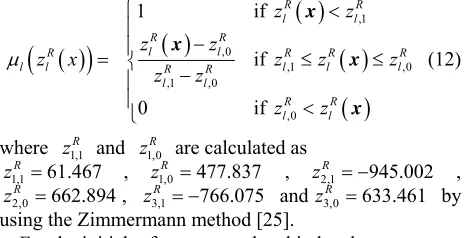
values into account, suppose that the DM determines the linear membership functions as
,mi
R l
z
945.0n02 zR
R
z
,1,1
,0
1 if
if
0 if
R R
l l
,0
,0 ,1 ,0
R R
l l
R R R
l l
R R
l l
z z
z z
z z
x
x x
R l
z
l zl x
1,1
R R
l l
z z
z z
x
(12)
where zR and
1,0R
z
1,0R
z
7
R
z
are calculated as
, , ,
2,0 , 3,1 and by
using the Zimmermann method [25].
1,1R 61.4
z
662
R
z 67.894
477.8 66.07
37 z2,1R
5 z3,0R
945.002 633.461
For the initial reference membership levels
1 2 3
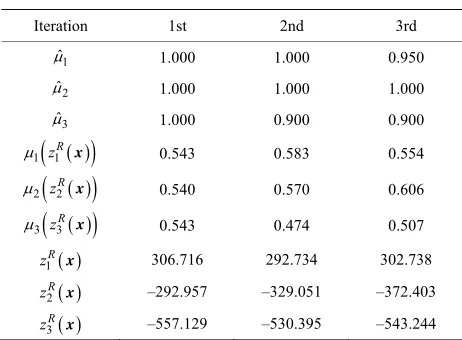
, the corresponding aug-mentedminimax problem (8) is solved by using the revised GADSLPRRSU, and the DM is supplied with the membership function values of the first iteration shown in Table 3.
, ,
1
c
1.00,1.00,1.00
Assume that the DM is not satisfied with these membership function values, and the DM updates the reference membership levels as for improving the satisfaction levels μ1 and μ2 at the expense
of μ3. For the updated reference membership levels, the
corresponding augmented minimax problem is solved
[image:5.595.308.540.260.379.2]
1.00,1.0 ,0.90 0
Table 1. Value of each element of ci, i = 1, 2, 3 and ai, i = 1, 2, 3.
−8 −1 −2 −7 −3 −5 −1 −4 −10 5
2
c 3 5 2 6 1 1 4 7 2 9
3
c 2 3 −10 4 4 5 −9 1 −8 2
1
a 4 4 1 2 6 1 1 7 5 8
2
a 10 2 6 1 2 2 8 5 2 8
3
[image:5.595.309.537.557.656.2]a 3 8 8 5 1 9 7 7 3 2
Table 2. Value of each element of q and l q , l = 1, 2, 3. l
1
q 2.0 0.4 0.4 q1 0.2 0.6 0.3
2
q 1.0 0.6 1.0 q2 0.5 2.0 3.0
3
[image:5.595.75.278.593.717.2] [image:5.595.312.539.685.735.2]Table 3. Process of interaction.
Iteration 1st 2nd 3rd
1
ˆ
1.000 1.000 0.950
2
ˆ
1.000 1.000 1.000
3
ˆ
1.000 0.900 0.900
1 z1R
x 0.543 0.583 0.554
2 z2R
x 0.540 0.570 0.606
3 z3R
x 0.543 0.474 0.507
1R
z x 306.716 292.734 302.738
2R
z x –292.957 –329.051 –372.403
3R
z x –557.129 –530.395 –543.244
again, and the membership function values calculated in the second iteration are shown in Table 3.
A similar procedure continues until the DM is satisfied with the membership function values. In this example, we assume that the satisficing solution for the DM is derived in the third interaction.
7. Conclusion
In this paper, we focused on multiobjective integer pro-gramming problems with random variables in in the right-hand side of the constraints. Through the use of the simple recourse model, the formulated multiobjective stochastic integer programming problems with simple recourse are transformed into deterministic ones. As-suming that the DM has fuzzy goals for the objective functions, an interactive fuzzy satisficing method for deriving a satisficing solution for the decision maker from among the M-Pareto optimal solution set has been proposed. In the proposed interactive method, after de-termining the fuzzy goals of the DM, a satisficing solu-tion is derived efficiently by updating the reference membership levels of the DM. Genetic algorithm for nonlinear integer programming, called the revised GADSLPRRSU were introduced for solving transformed deterministic ones efficiently.An illustrative numerical example was provided to demonstrate the feasibility and efficiency of the proposed method. Extensions to other stochastic programming models will be considered else-where.
REFERENCES
[1] J. R. Birge and F. Louveaux, “Introduction to Stochastic Programming,” Springer, London, 1997.
[2] P. Kall, “Stochastic Linear Programming,” Springer- Verlag, Berlin, 1976. doi:10.1007/978-3-642-66252-2 [3] P. Kall and J. Mayer, “Stochastic Linear Programming
Models, Theory, and Computation,” Springer, New York, 2005.
[4] I. M. Stancu-Minasian, “Stochastic Programming with Multiple Objective Functions,” D. Reidel Publishing Company, Dordrecht, 1984.
[5] I. M. Stancu-Minasian, “Overview of Different Ap- proaches for Solving Stochastic Programming Problems with Multiple Objective Functions,” In: R. Slowinski and J. Teghem, Eds., Stochastic Versus Fuzzy Approaches to Multiobjective Mathematical Programming under Uncer- tainty, Kluwer Academic Publishers, Dordrecht/Boston/ London, 1990, pp. 71-101.
doi:10.1007/978-94-009-2111-5_5
[6] G. B. Dantzig, “Linear Programming under Uncertainty,” Management Science,Vol. 1, No. 3-4, 1955, pp. 197-206. doi:10.1287/mnsc.1.3-4.197
[7] A. Charnes and W. W. Cooper, “Chance Constrained Programming,” Management Science, Vol. 6, No. 1, 1959, pp. 73-79. doi:10.1287/mnsc.6.1.73
[8] Y. J. Lai and C. L. Hwang, “Fuzzy Mathematical Programming,” Springer-Verlag, Berlin, 1992.
doi:10.1007/978-3-642-48753-8
[9] M. Sakawa, “Fuzzy Sets and Interactive Multiobjective Optimization,” Plenum Press, New York, 1993.
[10] M. Sakawa, “Large Scale Interactive Fuzzy Multi- objective Programming,” Physica-Verlag, Heidelberg, 2000. doi:10.1007/978-3-7908-1851-2
[11] M. Sakawa, “Genetic Algorithms and Fuzzy Multi- objective Optimization,” Kluwer Academic Publishers, Boston, 2001. doi:10.1007/978-1-4615-1519-7
[12] H.-J. Zimmermann, “Fuzzy Sets, Decision-Making and Expert Systems,” Kluwer Academic Publishers, Boston, 1987. doi:10.1007/978-94-009-3249-4
[13] M. Sakawa and H. Yano, “Interactive Fuzzy Satisficing Method Using Augumented Minimax Problems and Its Application to Environmental Systems,” IEEE Trans- actions on Systems, Man and Cybernetics, Vol. 15, No. 6, 1985, pp.720-729. doi:10.1109/TSMC.1985.6313455 [14] M. Sakawa and K. Kato, “Interactive Fuzzy Multi-
Objective Stochastic Linear Programming,” In: C. Kah- raman, Ed., Fuzzy Multi-Criteria Decision Making— Theory and Applications with Recent Developments, Springer, New York, 2008, pp. 375-408.
[15] M. Sakawa, K. Kato and I. Nishizaki, “An Interactive Fuzzy Satisficing Method for Multiobjective Stochastic Linear Programming Problems through an Expectation Model,” European Journal of Operational Research, Vol. 145, No. 3, 2003, pp. 665-672.
doi:10.1016/S0377-2217(02)00150-9
[16] M. Sakawa and K. Kato, “An Interactive Fuzzy Sa- tisficing Method for Multiobjective Stochastic Linear Programming Problems Using Chance Constrained Con- ditions,” Journal of Multi-Criteria Decision Analysis, Vol. 11, No. 3, 2002, pp. 125-137. doi:10.1002/mcda.322 [17] M. Sakawa, K. Kato and H. Katagiri, “An Interactive
Fuzzy Sets and Systems, Vol. 146, No. 2, 2004, pp. 205-220. doi:10.1016/j.fss.2004.04.003
[18] K. Frauendorfer, “Stochastic Two-Stage Programming,” Springer-Verlag, Berlin/New York, 1992.
doi:10.1007/978-3-642-95696-6
[19] P. Olsen, “Multistage Stochastic Programming with Re- course: The Equivalent Deterministic Problem,” SIAM Journal on Control and Optimization, Vol. 14, No. 3, 1976, pp. 495-517. doi:10.1137/0314033
[20] D. W. Walkup and R. J. B. Wets, “Stochastic Programming with Recourse,” SIAM Journal on Applied Mathematics, Vol. 15, No. 5, 1967, pp. 1299-1314. doi:10.1137/0115113
[21] R. Wets, “Stochastic Programs with Fixed Recourse: The Equivalent Deterministic Program,” SIAM Review, Vol. 16, No. 3, 1974, pp. 309-339. doi:10.1137/1016053 [22] S. Koziel and Z. Michalewicz, “Evolutionary Algorithms,
Homomorphous Mapping, and Constrained Parameter
Optimization,” Evolutionary Computation, Vol. 7, No. 1, 1999, pp. 19-44. doi:10.1162/evco.1999.7.1.19
[23] Z. Michalewicz and G. Nazhiyath, “Genocop III: A Co-Evolutionary Algorithm for Numerical Optimization Problems with Nonlinear Constraints,” Proceedings of the Second IEEE International Conference on Evolutionary Computation, Perth, 29 November-1 December 1995, pp. 647-651. doi:10.1109/ICEC.1995.487460
[24] M. Sakawa, K. Kato, H. Sunada and T. Shibano, “Fuzzy Programming for Multiobjective 0-1 Programming Problems through Revised Genetic Algorithms,” European Journal of Operational Research, Vol. 97, No. 1, 1997, pp. 149-158.
doi:10.1016/S0377-2217(96)00023-9
[25] H.-J. Zimmermann, “Fuzzy Programming and Linear Programming with Several Objective Functions,” Fuzzy Sets and Systems, Vol. 1, No. 1, 1978, pp. 45-55.
![7 [(Morpholin 4 yl)(phenyl)methyl]quinolin 8 ol](data:image/gif;base64,R0lGODlhAQABAIAAAP///wAAACH5BAEAAAAALAAAAAABAAEAAAICRAEAOw==)