© 2019, IRJET | Impact Factor value: 7.211 | ISO 9001:2008 Certified Journal
| Page 4466
Waste Bakelite as Partial Replacement of Coarse Aggregate in Building
Blocks
S.Sakthi Sasmitha
1, Dr.R.N.Uma
21
Student M.E. (CEM), Civil Engineering Department, Sri Ramakrishna Institute of Technology/Anna University,
Coimbatore, India.
2
Head of Department, Civil Engineering Department, Sri Ramakrishna Institute of Technology/ Anna University,
Coimbatore, India.
Abstract – Bakelite being a plastic material creates a disposal problem and causes health issues to the public as well as environment. In order to overcome this kind of problem, many researchers have involved in transforming waste Bakelite as a useful construction material in Civil engineering field. This usage of waste plastic material in construction industry creates a challenging job and also helps to improve the performance of building material in the construction sector. This study describes about the properties, strength and application of waste Bakelite into different forms of construction material by a partial replacement of coarse aggregate in construction sector. Paver Blocks & Solid Blocks were manufactured using waste Bakelite and various tests were conducted to examine its strength and durability by comparing with conventional material. Based on the test results, it is revealed that the optimum compressive strength achieved by the replacement of waste bakelite is 35% for solid block and 8% is for Paver block. Hence the application of waste bakelite will reduce the disposal problem and gives an effective building material in the construction sector. Key words: Bakelite, paver block, solid block, aggregates.
1. INTRODUCTION
Plastic is one of the recent engineering materials which consist of a wide range of synthetic or semi-synthetic organic compounds that are malleable and can be moulded into solid objects. Plastics can be made to different shapes when they are heated. It was found in the different forms such as cups, furniture, basins, plastic bags, food and drinking containers and they become waste material. Accumulation of plastic wastes can result into hazardous effects to both human and plant life. Therefore, there is a need for proper disposal method and also use of these wastes in the recycled form in various field are to be developed.
Bakelite is a thermoset plastic which is formed from an elimination reaction of phenol with formaldehyde and it is most commonly used for automobile parts, telephone casings, and kitchenware appliances for heat resistant. It cannot be remelted to form a new product and so it can be used as a heat resistant material.
Due to the presence of methyl and ethyl alcohol, it causes some toxic effects to the environment as well as health problems. Therefore to avoid such problems and to prevent water pollution disposal of Bakelite is to be avoided.
Waste Bakelite is one of the cross linked polymer, is a waste product procured from Workshop Signal and Telecommunication, Southern Railway, Podanur, Coimbatore. The use of plastic and related materials is increasing tremendously due to growth in population, urbanization and modern life style. Waste plastics are not disposed scientifically due to their non-biodegradability hence its disposal is now become a very big global problem which creates an unsafe disposal to the environment. Recently this waste plastic material is used as additives in road construction.
2. MATERIAL AND ITS PROPERTIES
2.1 Cement: The cement used for this project is 53 grades OPC as per the codal provision IS 12269:2013. The cement used was fresh and free from lumps. Following are the properties of cement which have been experimentally done in the laboratory,
Table – 1: Properties of Cement
Physical Property Cement
Specific gravity 3.15
Standard Consistency 29.4 %
Initial setting time 30 min
Final setting time 600 min
Fineness 1.5%
Soundness 7 mm
© 2019, IRJET | Impact Factor value: 7.211 | ISO 9001:2008 Certified Journal
| Page 4467
The fine aggregates used were manufactured sand and coarse aggregates used were crushed stone. The size, shape and other properties of aggregates should satisfy the code of IS: 383–1970. Following are the properties of both fine and coarse aggregates:
Properties of Aggregate
Table – 2: Properties of Fine Aggregate
Property Fine Aggregate
Type M – sand Eco – sand
Specific gravity 2.63 2.30
Water Absorption 2.4% 2.04%
Sieve Analysis 83.5 % 98.6 %
Table – 3: Properties of Coarse Aggregate
Property Coarse Aggregate
Type Crushed stone (10 mm)
Specific gravity 2.70
Water Absorption 2.4 %
Crushing Value 29.22 %
Impact Value 27.8 %
Bulk Density 1580.24kg/m3
Abrasion Value 49.15 %
2.3 Bakelite: Polyoxybenzylmethylenglycolanhydride was thermosetting phenol formaldehyde resin made from the condensation reaction of phenol with formaldehyde.
Collection of material: Waste bakelite is procured from Workshop Signal and Telecommunication, Southern Railway, Podanur, Coimbatore.
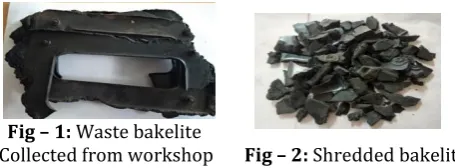
Shredding Process: The Collected waste bakelite has some irregularities in its shapes and textures, so that the material should be shreddedinto small pieces with the help of shredding machines.
Fig – 1: Waste bakelite
Collected from workshop Fig – 2: Shredded bakelite Classification of material: The shredded bakelite materials are classified based on their size. By means of coarse aggregates the shredded material should passed through 12.5 mm IS sieve and retained on 10 mm IS sieve, for fine aggregate the material should pass through 4.75 mm IS sieve.
Fig – 3: Coarser size Fig – 4: Finer size particle Particle
[image:2.595.41.269.595.679.2]The properties of bakelite in the form of fine and coarse aggregate were tested based on the codal provisions and results are tabulated below.
Table – 4: Properties of Bakelite as a Coarse Aggregate
Property Waste Bakelite
Type Shredded bakelite (10 mm)
Specific gravity 1.26
Water Absorption 1.38 %
Crushing Value 9.78 %
Impact Value 7.14 %
Bulk Density 1003.42kg/m3
Abrasion Value 14.8 %
2.4 Water: Portable water that are free from impurities and salt have been used for casting and curing the concrete blocks as per IS – 456-2006. The Water cement ratio used was 0.45.
3. CASTING OF BUILDING MATERIALS
In this project M25 concrete is designed and waste bakelite is used as a partial replacement of Coarse aggregate in manufacturing of Solid block and Paver block.
3.1 Mix Proportion of Solid Block
Solid block is casted with the dimension of 380 mm x 150 mm x 150 mm. The following table indicates the proportion of various materials added in the manufacturing of each Solid block for different proportions.
Table – 5: Mix Proportion of Solid Block
% Cement (kg)
Fine aggregate
(kg)
Coarse Aggregate
(kg)
Waste bakelite
(kg)
0% 1 5 10 0
5% 1 5 9.5 0.5
© 2019, IRJET | Impact Factor value: 7.211 | ISO 9001:2008 Certified Journal
| Page 4468
25% 1 5 8 2.0
35% 1 5 7.5 2.5
[image:3.595.319.533.92.208.2]45% 1 5 7 3.0
Fig – 5: Cast Solid block for various proportions of waste bakelite
3.2 Mix Proportion of Paver Block
Paver block is casted with the dimension of 190 mm x 170 mm x 60 mm. The following table indicates the proportion of various materials added in the manufacturing of each Paver block for different proportions.
Table – 6: Mix Proportion of Paver Block
%
Cement (kg)
Fine aggregate
(kg)
Coarse Aggregate
(kg)
Waste bakelite
(gm)
0 % 0.97 1.55 1.79 0
2 % 0.97 1.55 1.75 36
4 % 0.97 1.55 1.72 71
6 % 0.97 1.55 1.68 107
8 % 0.97 1.55 1.65 143
10 % 0.97 1.55 1.61 179
Fig – 6: Cast Paver block for various proportions of waste bakelite
The casted blocks were allowed for curing of 28 days and after proper curing the concrete solid blocks and paver blocks was tested for compressive strength, water absorption; block density, etc., in comparison with nominal blocks.
4. EXPERIMENTAL RESULTS
The various tests required to determine the properties, strength and performance of aggregate and structural elements made from various proportions of waste bakelite are as mentioned below.
4.1 Test results for Solid block
Various tests for Solid block was conducted as per the IS code 2185 (Part 1):2005 and the obtained results were analysed below.
Block Density
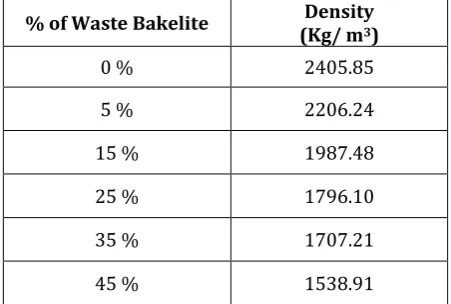
[image:3.595.36.276.98.269.2]Determination of block density for casted specimens was done as per the codal provisions. By dividing the mass (weight) of each block by its volume, the density of solid block was known. The test was carried out with 3 samples and the results were tabulated.
Table – 7: Test results for block density of solid block % of Waste Bakelite (Kg/ mDensity 3)
0 % 2405.85
5 % 2206.24
15 % 1987.48
25 % 1796.10
35 % 1707.21
45 % 1538.91
[image:3.595.323.549.555.707.2]© 2019, IRJET | Impact Factor value: 7.211 | ISO 9001:2008 Certified Journal
| Page 4469
Chart – 1: Block density test of solid blockTherefore from the test results it was observed that upto 35% replacement of waste bakelite, the block density of solid block was in the permissible limit. Hence when the percentage increases above the optimum level (35%), the block can only be used as a hollow block as per codal provisions.
Water absorption
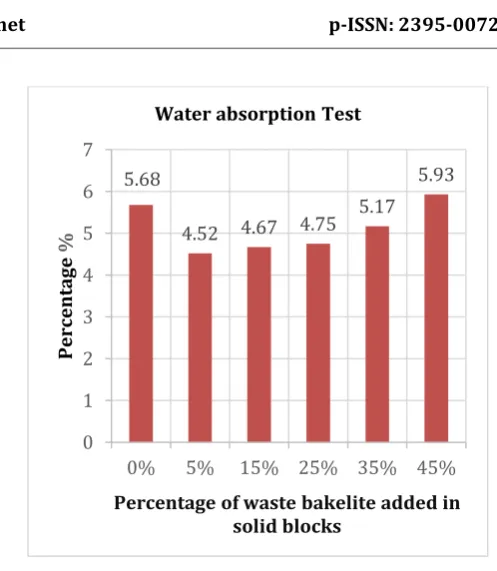
[image:4.595.308.557.56.342.2]Solid block is tested for its absorption capacity of water hence it can be used in the construction of buildings. This test helps to determine the water absorption of solid block as per IS 2185 (Part 1):2005. The test results are tabulated below.
Table – 8: Test results for Water Absorption of solid block
% of Waste bakelite Water Absorption (%)
0 % 5.68
5 % 4.52
15 % 4.67
25 % 4.75
35 % 5.17
45 % 5.93
Chart – 2: Water Absorption test of solid block From the above test results, it was found that the water absorption rate increases with increase in the addition of waste bakelite in solid block. But when it is compared with nominal solid block, there is a slight decrease in its absorption rate.
Compression strength
The Compressive tests are required to determine the strength of specimen which is one of the important tests for solid block to determine its suitability in construction field. The casted specimens were tested for 7, 14 and 28 days compressive strength by using hydraulic compressive testing machine strength and the test results are tabulated.
Table – 9: Test results for Compression Strength of solid block
% of Waste bakelite Compressive Strength 28 day test (N/mm2)
0 % 3.33
5 % 3.51
15 % 3.68
25 % 3.86
35 % 4.03
45 % 2.46
0 500 1000 1500 2000 2500 3000
0% 5% 15% 25% 35% 45%
D
ens
it
y
kg
/m³
Percentage of waste bakelite added in solid blocks
Block Density of Solid blocks
5.68
4.52 4.67 4.75 5.17
5.93
0 1 2 3 4 5 6 7
0% 5% 15% 25% 35% 45%
Per
cent
age
%
Percentage of waste bakelite added in solid blocks
[image:4.595.324.555.564.720.2]© 2019, IRJET | Impact Factor value: 7.211 | ISO 9001:2008 Certified Journal
| Page 4470
Chart – 3: Compressive Strength test of Solid blockThe test results mentioned above indicates that the compressive strength of solid block at 28 days gradually increases with increase in addition of bakelite upto 35% and starts decreasing from 45% of replacement. This shows that the solid block will be strong enough only upto the optimum replacement of 35% of waste bakelite.
4.2 Test results for Paver block
Various tests for Paver block was conducted as per the IS code 15658:2006 and the obtained results were analysed below.
Water absorption
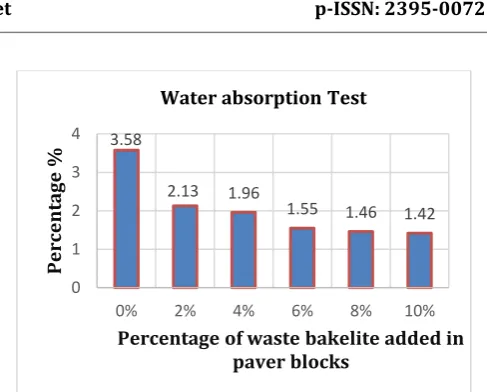
[image:5.595.315.559.64.260.2]Paver block is tested for its absorption capacity of water hence it can be used in the construction of buildings. This test helps to determine the water absorption of Paver block as per IS 15658:2006 and the test results are tabulated below.
Table – 10: Test results for Water Absorption of paver block
% of Waste bakelite Water Absorption (%)
0 % 3.58
2 % 2.13
4 % 1.96
6 % 1.55
8 % 1.46
10 % 1.42
Chart – 4: Water Absorption test of Paver block From the test results, it was observed that the water absorption rate decreases with increase in the addition of waste bakelite in Paver block. But when it is compared with conventional Paver block, there is a slight decrease in the rate of absorption.
Compression strength
The Compressive tests are required to determine the strength of specimen which is one of the important tests for Paver block to determine its suitability in construction field. The casted specimens were tested for 7, 14 and 28 days compressive strength by using hydraulic compressive testing machine strength and the test results are tabulated.
Table – 11: Test results for Compression Strength of Paver block
% of Waste Bakelite
Compressive Strength (N/mm2) 7 days 14 days 28 days
0 % 26.26 34.82 36.71
2 % 28.13 36.37 38.80
4 % 31.58 39.72 43.44
6 % 34.15 42.41 46.07
8 % 36.06 48.39 51.08
10 % 34.93 43.95 46.53
0 1 2 3 4 5
0% 5% 15% 25% 35% 45%
Comp
ress
ive
St
reng
th
kN
/m²
Percentage of Waste Bakelite added in Solid blocks
Compressive Strength Test
3.58
2.13 1.96
1.55 1.46 1.42
0 1 2 3 4
0% 2% 4% 6% 8% 10%
Per
cent
age
%
Percentage of waste bakelite added in paver blocks
© 2019, IRJET | Impact Factor value: 7.211 | ISO 9001:2008 Certified Journal
| Page 4471
Chart – 5: Compressive Strength test of Paver blockFrom the test results it was observed that the compressive strength of Paver block at 7, 14 and 28 days gradually increases with increase in addition of bakelite upto 6% and starts decreasing from 8% of replacement. This shows that the Paver block will strength only upto the optimum replacement of 6% of waste bakelite. 5. RESULTS AND DISCUSSION
In the present experimental study it was found that the optimum replacement of waste bakelite up to 35% in solid block shows a gradual increase in its compressive strength. Similarly, from the test results of Paver block it was observed that the compressive strength value decreased with the addition of waste plastics more than 8% of waste bakelite. Hence the addition of waste bakelite in concrete blocks and Paver blocks will helps in reusing of waste plastics in construction materials.
6. CONCLUSION
The present study reveals the properties, strength and use of waste Bakelite as a construction material in paver blocks and solid blocks with appropriate specifications. From the above aspects, the waste bakelite can be used in the cement concrete mix in the construction field. The optimum modifier content of waste bakelite is found to be 8% for paver blocks and 35% for solid blocks. This study helps to develop a material which will reduce the cost of construction to some extent and also to minimize the waste management problem created by waste plastics disposal.
REFERENCES
[1] Nopagon Usahanunth, Seree Tuprakay, Waranon Kongsong, Sirawan Ruangchuay Tuprakay (2018). “Study of mechanical properties and recommendations for the application of waste Bakelite Aggregate Concrete”, Case Studies in Construction Materials 8 299-314.
[2] Seree Tuprakay, Nopagon Usahanunth, Sirawan Ruangchuay Tuprakay (2017). “A Study of Bakelite Plastic Waste from Industrial Process in Concrete Products as Aggregate”, International Journal of Structural and Civil Engineering Research, Vol. 6, No. 4, November.
[3] Dinesh. S, Dinesh. A, Kirubakaran. K (2016). “Utilization of Waste Plastic in manufacturing of Bricks and Paver Blocks”, International Journal of Applied Engineering Research, ISSN 0973-4562 Vol. 11 No.3.
[4] Kalingarani.K, Harikrishna Devudu.P, Jegan Ram.M, Sriramkumar.V. “Development of Paver Blocks from Industrial wastes”, IOSR Journal of Mechanical and Civil Engineering (IOSR-JMCE), e-ISSN: 2278-1684, p-e-ISSN: 2320-334 X, PP 12-17. [5] Nivetha C, Rubiya M, Shobana S, Vaijayanthi R,
G.Viswanathan and R.Vasanthi (2016). “Production of Plastic Paver Block from the Solid waste (Quarry dust, Flyash, PET)”, APRN Journal of Engineering and Applied Sciences, ISSN: 1819-6608 Vol 11, No.2.
[6] Sarang Shashikant Pawar, Shubhankar Anant Bujone (2017). “Use of Flyash and Plastic in Paver Block”, International Research Journal of Engineering and Technology (IRJET) e-ISSN: 2395-0056 Vol. 04 Issue 11.
[7] Mohan D.M.S, Vignesh.J, Iyyappan.P, C.Suresh (2018). “Utilization of Plastic bags in Pavement Blocks”, International Journal of Pure and Applied Mathematics ISSN: 1314-3395, Volume 119 No. 15, 1407-1415.
[8] Sina Safinia, Amani Alkalbani (2016). “Use of recycled plastic water bottles in Concrete Blocks”, Science Direct, Procedia Engineering 164(2016) 214-221, Creative Construction Conference 2016, 25-26.
[9] S. Vanitha, V. Natarajan and M. Praba (2015). “Utilization of Waste Plastic as a Partial Replacement of Coarse Aggregate in Concrete Blocks”, Indian Journal of Science and Technology, Vol 8(12) ISSN: 0974-6846.
[10] Praveen Mathew, Ambika K P, Pavithra Prakash, Tony Barried, Varsha P (2016). “Comparative Study on Waste Plastic Incorporated Concrete Blocks with Ordinary Concrete Blocks”, 0
20 40 60 80 100 120 140 160
0% 2% 4% 6% 8% 10%
Comp
ress
ive
St
reng
th
kN
/m
²
Percentage of waste bakelite Compressive Strength of Paver
Blocks
© 2019, IRJET | Impact Factor value: 7.211 | ISO 9001:2008 Certified Journal
| Page 4472
International Research Journal of Engineering and Technology (IRJET) e-ISSN: 2395 -0056, Vol 03 Issue 05.
[11] R.S. Chougule, Sayali Yamgar, Sonam Salunkhe, Poonam Patil, Akshay Saitawadekar, Mandar Kapase. “Use of Plastic waste in Civil Construction”, International Journal of Engineering Technology, Management and Applied Sciences, April 2017, Vol 5 Issue 4, ISSN 2349-4476.
[12] Tanut Waroonkun1, Tanapong Puangpinyo & Yuttana Tongtuam (2017). “The Development of a Concrete Block containing PET Plastic Bottle Flakes”, Journal of Sustainable Development; Vol. 10, No. 6; ISSN 1913-9063 E-ISSN 1913-9071. [13] Anand Daftardar, Rashmi patel, Ronak Shah,
Parth Gandhi, Himanshu Garg. “Use of Waste Plastic as a Construction Material”, International Journal of Engineering and Applied Sciences (IJEAS) ISSN: 2394-3661, Vol.4, Issue 11, November 2017.
[14] B. Shanmugavalli and K. Gowtham, P. Jeba Nalwin and B. Eswara Moorthy. “Reuse of Plastic Waste in Paver Blocks”, International Journal of Engineering Research and Technology (IJERT) ISSN: 2278-0181, Volume 06(Issue 02), February 2016.
[15] R. Mahadevi, Abirami, P. Jananipriya, J. Karunya, and M. Sakthipriya. “An Experimental Investigation on Concrete Paver Block by Using PVC Plastic Material”, International Journal of Modern Trends in Engineering and Research (IJMTER), Volume 05(Issue: 03), March 2018. [16] Balasubramanian .B, Gopalakrishna.G and
Saraswathy.V (2016), “Investigation on Partial Replacement of Coarse Aggregate using E-Waste in Concrete”, ISSN: 0974-5904, Volume 09, No. 03. [17] S.Dinesh, K.Mohamed Shalman Parishee, J.Sriram, M. Mohamed Bashith and R.Jayasankar. “Effective use of Waste Plastic as manufacturing of Paver Block”, International Journal of Advanced Research in basic Engineering Sciences and Technology (IJARBEST) ISSN: 2456-5717, Vol.4, Issue 5, May 2018.
[18] S.Dharanidharan, N. Srivithya and N. Meena. “Experimental Study on the Flexural Behaviour of E-waste plastics in concrete”, International Journal of Engineering Sciences & Research Technology (IJESRT) ISSN: 2277-9655, Vol.4 (11), November 2015.
[19] S. A.Panimayam, P. Chinnadurai, R. Anuradha, K.Pradeesh, A. Umar Jaffer. “Utilisation of Waste plastics as a Replacement of Coarse Aggregate in Paver Blocks”, International Journal of ChemTech Research ISSN: 2455-9555, Vol.10, 2017.