© 2019, IRJET | Impact Factor value: 7.211 | ISO 9001:2008 Certified Journal | Page 4687
Energy efficient system for generalized MIMO using spatial modulation
and time diversity
Mohd Mujtahid Bhat
1,
Qareeb Ullah Sahil
1, Dr.Geetha D.D
2, Dr.mrinal sarvagya
21 School of ECE, REVA University, Bangalore India 2
Professor, School of ECE, REVA University, Bangalore India
---Abstract -
Future challenge in the field of wireless communication network is the attractive comparison between spectral efficiency and energy efficiency. Now the question arises how to make the system energy efficient that could lead a good result. In this context we have made it possible by decreasing the BER to a level where the energy efficiency increases with opposite proportionality to BER. Adding time diversity to a MIMO channel means that we are transmitting data through a single channel at different time intervals then switching the same channel to different receivers which lead to a well designed energy efficient system. The result will give you the idea about the achievement in the field of wireless communication which can be applicable to many appliances that are discussed in time dependent part.This paper offers a comprehensive discussion about the research challenges leading to analysis of technological issues relating SM-MIMO. The paper is concluded with the result and world’s first experiment on time diversity with MIMO. The time dependence concept and the relating result can be applied to 5G technologies to get the maximum output using limited energy which means that energy efficiency can be increased to a greater level by making whole system time diverse or time dependent.
Key Words: SM-MIMO, 5G technologies, BER, spectral
efficiency, time dependence.
1. INTRODUCTION
The advancement in the cellular market has lead to the more demand in this field. There are more than 50 million people in world which posse’s mobile phones even though they do not have electricity. Talking about the internet of things has been given more important as more people are moving to makes their world more and more energy efficient with the android operating system and the IOS to ELearning has been showing a tremendous growth in the wide area network [1-2].
The success and demand of social networking has improved in recent days thus the process of communication on demand
is being proved effective and mobile operator are struggling to satisfy data traffic demands in wireless cellular network while heading towards lower cost to mention the effect on traffic [3-5].
The literature survey has been done in relation to the tutorial paper which offers a compressive overview of the state of art in spatial modulation for generalized MIMO. The result can differ in the since that the time diversity concept is included which makes it different in application part, the data used [6-7]. energy efficiency can be increased to a greater extend by making the appliances time dependent that is the major challenge whether we can adjust to that situation we have changed the concept to time diversity to save time, data and also to reduce bit error rate, all of this counts for energy efficient system. if we adjust our self to the time diversity concept for generalized MIMO with spatial modulation we can gain more speed, as the number of user at a particular time, using the same data can be less that means the tradeoff between throughput and energy efficiency that this survey paper is in relation with can be neglected [9-10]. As in our tutorial users may count for throughput.
© 2019, IRJET | Impact Factor value: 7.211 | ISO 9001:2008 Certified Journal | Page 4688 Fig 1
-
SM-MIMO, figure shows the basis of literaturesurvey.
1.1 Analysis
Distributing the mobile data growth rate is higher as predicted. The traffic is showing about 3-fold increase as per the survey in 2010-2013 reached 885 Petabytes (PB) per month up from 320 PB per month, as expected the mobile data traffic will gear up to 11.2 extra bytes per month by 2017.The Asia pacific and North America are more prone, to this effect and will account 2/3 of the global traffic by 2019. Asia pacific will have 16.9 fold increases over the forecast period.
Time spent in the home becomes more important when traffic relating the home appliances and mobile user. According to recent survey approximately 40% of the mobile data is being used during the time at home, while 35% approximately spent on move and 25% at work. This survey reveals a high % of home based data users that suggests next generation requirement of access points installed by the home users full fully large demand and at the same time good QOS like voice, coverage, streaming etc.
1.2 Important change for the future
Most of the attention has been diverted to increase speed, throughput at the cost of energy while it is more important to have an energy efficient system which can handle the complex issues. New technologies, protocols have been developed only to make an effect on increasing throughput. A less attention is being given to energy consumption issues relating it which lead to global carbon emission. As we know for mobile data communication the traditional cellular network is not sufficient, so we go with innovative technologies that can fulfill the demand of energy efficiency. To overcome this problem we need to develop energy efficient wireless architectures, protocols and heterogeneous network solutions more specifically
spectral efficiency and throughput versus energy efficiency
and low complexity.
Different structure and cost effectiveness with low energy BSs have awareness to interference due to advantage of small cell based different networks, Specialized by maximum level of coverage and by less usage of energy lead to improvement in reliability and reduction in packet transmission through diversity effect.
1.3 Working principle:
For SM-MIMO generally we consider either PSK or QAM, but at the receiver side we considered optimum ML demodulation. Here for PSK or QAM modulation we consider Nt at the transmitter side antenna i.e. TAs and Nr as RAs. We consider here Nt=2Nt and M=2m where m and n
are two integers.
2. Distributing the system and making it time
dependent
In today’s scenario energy is main concern and energy efficient system is a rare case to find but by providing the solution of making the whole world time dependent can solve the problem. If we deal with the appliances and technologies relating them then we can simply use the concept of time diversity and distributing the system as periodic time, particular time, random time, fixed time. We may be using different system which is usable at different instants of time as mentioned above.
If these appliance or appliances making use of internet are made to run on these timing the whole system can be made energy efficient, a freezer can be made to work up to a particular low temperature after which it can be switched off and made work again when a particular temperature set is reached. A light bulb can be made to work based on timing when the light intensity gets decreased.
For student’s internet can be switched when they are in the class and at a particular timing when they are free to use the data, so the data may not be given in Mb’s or Kb’s but on timely bases which he/she can consume based on daily activity on the same way we can set particular timing for different appliances according to the time frame at home and outside, some appliances can also follow periodic time and can be switched on or off according to the periodic time set.
[image:2.595.44.275.64.252.2]© 2019, IRJET | Impact Factor value: 7.211 | ISO 9001:2008 Certified Journal | Page 4689 continuous time, so differentiating the appliances as
continuous time, periodic time, fixed time and random time can only give us the concept that where is issue of energy.
3. From MIMO TO TD-MIMO:
What MIMO does actually is that it transmits all the data in streams from all transmitting stations and thus increasing the throughput by sincerely making use of transmitting precoding matrices, time diversity gains can be obtained. By transmitting simultaneously does not lead to EE optimization compared to the single-antenna transmissions, MIMO communication obtain higher ratio and improved error performance at the of;
1) Complexity at the receiver is increased to increased signal processing caused by the need of counter acting the interference imposed by simultaneously transmitting many data streams.
2) Stricter synchronization is needed among TA’s so that we can make use of time coded and multiuser MIMO transmission.
3) To be able to simultaneously transmit many data streams multiple RF chains at the transmitter are needed. 4) Majority of the power is consumed at the transmitter due to use of independent power amplifiers for each RF chain.
Perspective relating to physical layer:
Physical layers standards of 4G networks are widely recognized as WIMAX (802.16.m-2011) and LTE-A. Power efficiency will depend a lot on physical layer standards in the next decade but both standards seemed to be dependent on SE with less concentration on EE. High data rates as been main focus without taking into consideration on EE and complexity. Future cellular networks will not mostly rely on this technology.
WIMAX and LTE-A standards are based on MIMO technology for realizing throughput. For the design of future wireless system including 5G cellular network MIMO constitutes promising techniques. MIMO system capacity is proportional to min {Nt, Nr}, Nt and Nr are numbers of TAs and RAs. If channel side information is available at both transmitter and receiver a theoretical limit can be achieved. Increasing the number of antennas, the throughput can be increased accordingly (linearly).
Without increase in spectrum utilization and the transmit power MIMO can provide high data rates. Mixer, synthesizer, filter, chains and other related circuitry increase the power dissipation. On the basis of recent studies EE gain of MIMO gets increased with no. of antennas if only transmission power is taken into account and circuit power dissipation is neglected. On the other hand, with the decrease in no. of active TAs EE gain of MIMO communication remains modest. These relations result in design of conceived multiuser multi-cell networks is an open research problem, when many parameters are considered such as bandwidth, transmission power and the no. of active TAs, RAs.
As we know MIMO communication is well known because of its SE advantages, but according to potential of EE for cellular network it’s not that understandable. Due to the recent results power optimization constrain for power amplifiers, TAs with weak channel gain should be turned off. With the help of filter and mixer, then BSs can allow related RF chains to be turned off which saves power. It makes implementation of optimal signal detection algorithm to be used a challenge for MIMO system. Hence, we need to develop new techniques that are capable of attractive tradeoff between SE and EE rather than SE only.
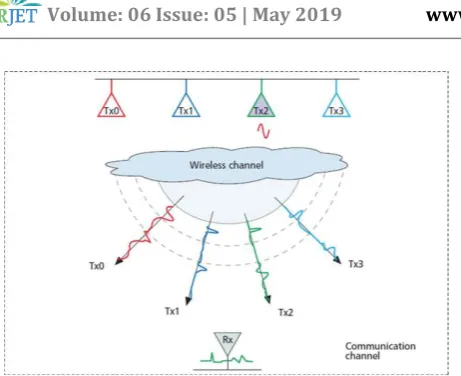
Fig-2-time diversity using spatial modulation
4. Result
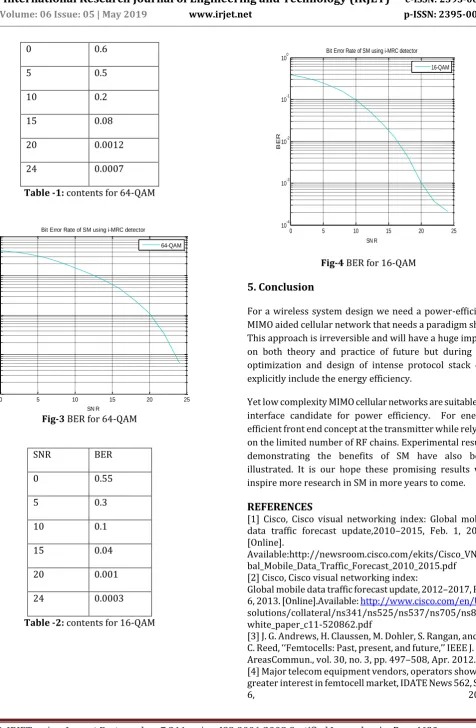
The result shows how the BER decreases with the increase in SNR. It is shown for both 16-QAM and 64-QAM.
16-QAM seems to be more energy efficient as compared to 64-QAM as it is shown in the graph that energy efficiency increases, as information is transmitted to different receiving antennas through a single channel while switching from 0 to 1 (time diversity). Thus diversity leads to decrease in BER and increase in efficiency.
SNR BER
© 2019, IRJET | Impact Factor value: 7.211 | ISO 9001:2008 Certified Journal | Page 4690
0 0.6
5 0.5
10 0.2
15 0.08
20 0.0012
[image:4.595.68.545.57.786.2]24 0.0007
Table -1: contents for 64-QAM
0 5 10 15 20 25
10-4 10-3 10-2 10-1 100
SN R
B
E
R
Bit Error Rate of SM using i-MRC detector
64-QAM
Fig-3 BER for 64-QAM
SNR BER
0 0.55
5 0.3
10 0.1
15 0.04
20 0.001
24 0.0003
Table -2: contents for 16-QAM
0 5 10 15 20 25
10-4 10-3 10-2 10-1 100
SN R
B
E
R
Bit Error Rate of SM using i-MRC detector 16-QAM
Fig-4 BER for 16-QAM
5. Conclusion
For a wireless system design we need a power-efficient MIMO aided cellular network that needs a paradigm shift. This approach is irreversible and will have a huge impact on both theory and practice of future but during the optimization and design of intense protocol stack can explicitly include the energy efficiency.
Yet low complexity MIMO cellular networks are suitable air interface candidate for power efficiency. For energy efficient front end concept at the transmitter while relying on the limited number of RF chains. Experimental results demonstrating the benefits of SM have also been illustrated. It is our hope these promising results will inspire more research in SM in more years to come.
REFERENCES
[image:4.595.341.525.104.310.2][1] Cisco, Cisco visual networking index: Global mobile data traffic forecast update,2010–2015, Feb. 1, 2011. [Online].
Available:http://newsroom.cisco.com/ekits/Cisco_VNI_Glo bal_Mobile_Data_Traffic_Forecast_2010_2015.pdf.
[2] Cisco, Cisco visual networking index:
Global mobile data traffic forecast update, 2012–2017, Feb. 6, 2013. [Online].Available: http://www.cisco.com/en/US/ solutions/collateral/ns341/ns525/ns537/ns705/ns827/ white_paper_c11-520862.pdf.
[3] J. G. Andrews, H. Claussen, M. Dohler, S. Rangan, and M. C. Reed, ‘‘Femtocells: Past, present, and future,’’ IEEE J. Sel. AreasCommun., vol. 30, no. 3, pp. 497–508, Apr. 2012. [4] Major telecom equipment vendors, operators showing greater interest in femtocell market, IDATE News 562, Sep.
© 2019, IRJET | Impact Factor value: 7.211 | ISO 9001:2008 Certified Journal | Page 4691 [Online]Available:http://www.idate.org/en/News/Femtoc
ells_62.html.
[5] Z. Hasan, H. Boostanimehr, and V. K. Bhargava, ‘‘Green cellular networks: A survey, some research issues and challenges,’’ IEEE Common. Surv. Tut., vol. 13, no. 4, pp. 524–540, Nov. 2011. on Green Wireless Networks. [Online]Available: http://www.fp7-greenet.eu/
[6] GREENT: Green Terminal for Next Generation Wireless Systems. [Online]Available: http://greent.av.it.pt/ [14]
GreenTouch. [Online].
Available:http://www.greentouch.org/
[7] European Commission, Commission pushes ICT use for a greener Europe, Dec. 3, 2009 [Online]. Available: http://europa.eu/rapid/press-release_IP-09-393_en.htm.
[8] G. Y. Li, Z. Xu, C. Xiong, C. Yang, S. Zhang, Y. Chen, and S. Xu, ‘‘Energy-efficient wireless communications: Tutorial, survey, and open issues,’’ IEEE Trans. WirelessCommun., vol. 18, no. 6, pp. 28–35, Dec. 2011.
[9] X. Wang, A. V. Vasilios, M. Chen, Y. Liu, and T. Kwon, ‘‘A survey of green mobile networks: Opportunities and challenges,’’ACM/Springer Mobile Netw. Appl., vol. 17, no. 1, pp. 4–20, Feb. 2012.
[10] Y. Chen, S. Zhang, S. Xu, and G. Y. Li, ‘‘Fundamental tradeoffs on green wireless networks,’’ IEEE Commun. Mag., vol. 49, no. 6, pp. 30–37, Jun. 2011.