warwick.ac.uk/lib-publications
Original citation:
Oozeerally, Ryan, Burnett, David L., Chamberlain, Thomas W., Walton, Richard I. and
Degirmenci, Volkan. (2017) Exceptionally efficient and recyclable heterogeneous
metal-organic framework catalyst for glucose isomerization in water. ChemCatChem .
Permanent WRAP URL:
http://wrap.warwick.ac.uk/95158
Copyright and reuse:
The Warwick Research Archive Portal (WRAP) makes this work by researchers of the
University of Warwick available open access under the following conditions. Copyright ©
and all moral rights to the version of the paper presented here belong to the individual
author(s) and/or other copyright owners. To the extent reasonable and practicable the
material made available in WRAP has been checked for eligibility before being made
available.
Copies of full items can be used for personal research or study, educational, or not-for-profit
purposes without prior permission or charge. Provided that the authors, title and full
bibliographic details are credited, a hyperlink and/or URL is given for the original metadata
page and the content is not changed in any way.
Publisher’s statement:
"This is the peer reviewed version of the following article: Oozeerally, Ryan, Burnett, David
L., Chamberlain, Thomas W., Walton, Richard I. and Degirmenci, Volkan, Exceptionally
efficient and recyclable heterogeneous metal-organic framework catalyst for glucose
isomerization in water (2017) ChemCatChem, doi:
10.1002/cctc.201701825’ has been
published in final form at
http://dx.doi.org/10.1002/cctc.201701825
This article may be used
for non-commercial purposes in accordance with Wiley Terms and Conditions for
SelfArchiving."
A note on versions:
The version presented here may differ from the published version or, version of record, if
you wish to cite this item you are advised to consult the publisher’s version. Please see the
‘permanent WRAP URL’ above for details on accessing the published version and note that
access may require a subscription.
Organic Framework Catalyst for Glucose Isomerization in Water
Ryan Oozeerally,
[a]David L. Burnett,
[b]Thomas W. Chamberlain,
[b]Richard I. Walton,*
[b]and Volkan
Degirmenci*
[a]Abstract: Heterogeneous catalysts are desired for the conversion of glucose, the most abundant sugar in renewable biomass, but presently their synthesis requires highly toxic chemicals with long synthesis times. We report the conversion of glucose to fructose and 5-hydroxymethyl furfural on a heterogeneous catalyst that is stable and selective and operates in most environmentally benign solvent, water. We used a bi-functional solid with Lewis and Brønsted acid sites by partially replacing the organic linker of the zirconium organic framework UiO-66 with 2-mono-sulfo-benzene-1,4-dicarboxylate. This catalyst shows high product selectivity (90 %) of 5-hydroxymethylfurfural and fructose at 140°C in water after 3 h reaction. It is recyclable and shows only minor loss of activity after a 3rd recycle, offering a realistic solution for the bottleneck reaction of
glucose isomerization for scale up and industrial application of biomass utilization.
Sustainable production of chemicals requires the utilization of renewable resources, one of the most promising of which is lignocellulosic biomass.[1-2] Biomass derived sugars (e.g., glucose or fructose) can be converted into platform molecules, e.g. 5-hydroxymethyl furfural (HMF), which can be further processed into monomers, fuel additives, paints and a variety of fine chemicals envisaged in a future biorefinery[3-4]. Although fructose can be converted into HMF easily[5], glucose is the main building block of lignocellulosic biomass and its conversion remains challenging.[4] The best performing heterogeneous catalyst for this conversion is tin-incorporated beta zeolite (Sn-beta) with Sn4+ occupying a fraction of tetrahedral sites in the zeolite framework.[6-8] Sn-beta can effect the isomerization of glucose to fructose in water with high selectivity (> 50%).[7] However, Sn-beta requires long crystallization times, up to 40 days, at high temperatures, 140°C, and, moreover, requires the use of hydrofluoric acid which is an acute poison and extremely corrosive.[7] In this work, we present a recyclable catalyst for glucose isomerization. It is based on modified UiO-66 (Figure 1a),[9] a thermally and hydrothermally robust metal-organic framework (MOF), which we show matches the conversion and product selectivity of Sn-beta for glucose isomerization.
The advantage of using MOFs as heterogeneous catalysts is the potential for tuning the solids’ properties by inclusion of desired functional ligands[10], such as acid sites,[11] and at the
same time via simple synthesis protocols; in this case without highly toxic and corrosive HF, in less than 24 h at 120°C.
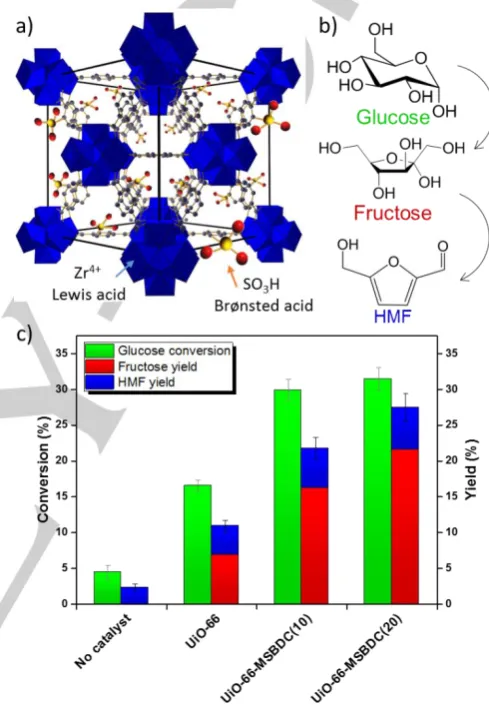
Figure 1. a) Schematic representation of UiO-66 framework. b) Glucose conversion to HMF through isomerization into fructose; c) Isomerization of glucose in water on metal organic framework catalysts; UiO-66, UiO-66-MSBDC(10) and UiO-66-MSBDC(20).
The challenge in the HMF production from glucose is to achieve high product selectivity. The reaction proceeds through isomerization of glucose to fructose (Figure 1b)[12] which is the limiting step to achieve high selectivity. It is proposed in the literature that the reaction is catalysed by Lewis acids[12], which enable a hydrate shift between carbon atoms of glucose[13], at the same time, proximal silanol groups or Brønsted acid sites form a hydrogen-bonding network, facilitating the proton mobility[14]. UiO-66 is a zirconium-based MOF with benzene-1,4-dicarboxylate (BDC) linkers, showing high stability in air up to 500°C as well as hydrothermal inertness[9]. Defects in the form of coordinatively unsaturated Zr4+ sites provide Lewis acidity.[15] We find that UiO-66 itself is active in glucose conversion (Figure 1c) showing 16 % conversion accompanied with 10 % product [a] Mr R. Oozeerally, Dr V. Degirmenci
School of Engineering University of Warwick Coventry, CV4 7AL, UK
E-mail: [email protected]
[b] Dr D. L. Burnett, Mr T. W. Chamberlain, Prof R. I. Walton Department of Chemistry
University of Warwick Coventry, CV4 7AL, UK E-mail: [email protected]
[image:2.595.300.545.200.553.2]yield at 140°C in 3 h. However, it lacks Brønsted acid sites. Therefore, we used a catalyst synthesized by partially replacing the BDC linker with 2-mono sulfonated benzene-1,4-dicarboxylic acid (MSBDC)[16-17] which shows 31 % glucose conversion under same reaction conditions with 28 % product yield (Figure 1c). This corresponds to an exceptional product selectivity of around 90 %, which is similar to previously reported Sn-beta zeolite.[7]
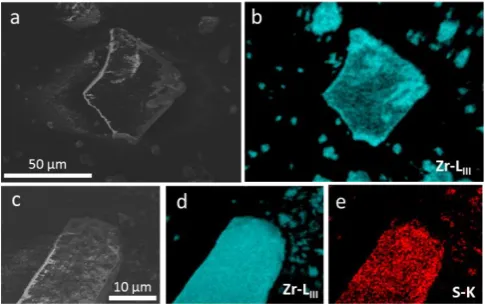
Figure 2. SEM Image (a) and zirconium EDX mapping of UiO-66. SEM Image (c), zirconium (d) and sulfur (e) EDX mapping of UiO-66-MSBDC(20).
The ratio between BDC and MSBDC linkers is critical for the successful synthesis of a stable functionalized UiO-66 material. Higher ratios of MSBDC within the framework have already been shown to decrease the stability UiO-66.[9, 17] Indeed, we find that if only MSBDC is used as the ligand then the material subsequently collapses on hydrothermal treatment (Supporting Information, Figure S1). As such, materials containing 10 and 20 percent functionalized linker were synthesized (UiO-66-MSBDC(y); where y represents the mol. % of MSBDC linker in total linker content). SEM images (Figure 2a, c) clearly show the crystalline structure of UiO-66 and UiO-66-MSBDC(20). Zirconium EDX mapping (Figure 2b, d) demonstrates the uniform distribution of zirconium atoms in both MOF structures, while, sulfur EDX mapping of the UiO-66-BDC(20) catalyst (Figure 2e) indicates a similar distribution of modified linker across the MOF crystal. Although EDXA mapping does not give information on the 3-dimensional distribution, it clearly implies the uniform distribution of Brønsted acid sites with some evidence for enrichment at the crystal surface UiO-66-MSBDC(20) catalyst (See SI Figure S2 for all catalysts). Further, EDX analysis of the MSBDC containing materials reveals an absence of sodium, supported by bulk ICP-OES analysis, consistent with the displacement of sodium ions during synthesis to yield Brønsted acidic SO3H sites.
The incorporation of sulfonic acid groups was also confirmed through FT-IR spectroscopy. New peaks appear in the UiO-66-MSBDC catalysts at 620, 1078, 1180 and 1223 cm-1 and their intensity increases with the increasing linker content (See SI Figure S3). These bands are attributed to the characteristic asymmetric bending and symmetric and asymmetric stretching of S=O double bonds and S-O bonds.[18-19] Elemental analyses of fresh catalysts also show S:Zr ratios close to the expected
values (See SI Table S1 and S2). Thermogravimetric analysis (TGA) shows an extensive loss in mass at around 510°C for both the standard and functionalized UiO-66 materials (See SI Figure S4). This is consistent with the reported decomposition temperature of 540°C for UiO-66 and approximately 500°C for sulfonic UiO-66 materials reported in literature.[9, 17] Mass loss indicates an MSBDC linker content of 14.6 % and 24.7 % for UiO-66-MSBDC(10) and UiO-66-MSBDC(20), respectively, close to the expected values. As a result, the ratio of the zirconium:linker in UiO-66, MSBDC(10) and UiO-66-MSBDC(20) were found as 5.51, 5.11 and 5.63 respectively and thus coordinatively unsaturated Zr4+ sites are present (See SI Table S3 and S4).
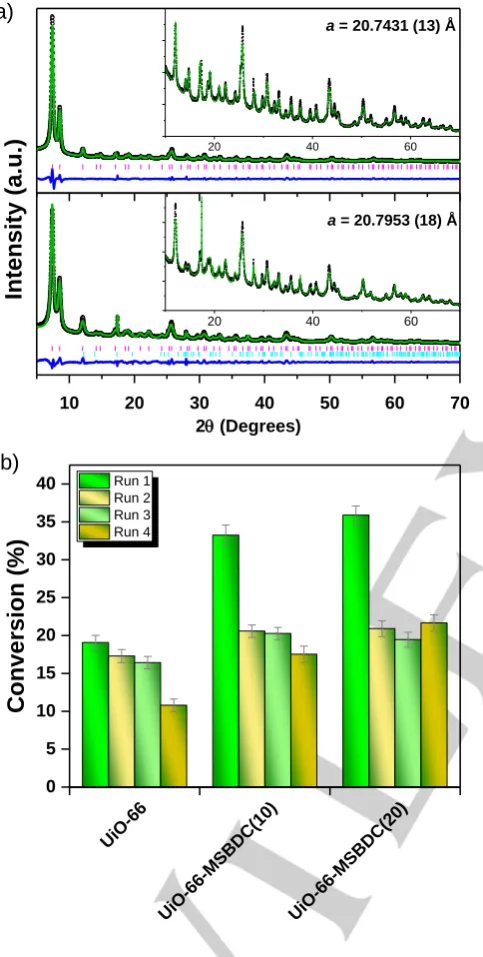
Powder X-ray diffraction (PXRD) analysis of the catalysts shows the formation of crystalline MOF structures (Figure 3a). Indeed, the addition of the MSBDC did not alter the average structure of UiO-66. The lattice parameter of the fresh UiO-66 was determined as 20.7516(2) Å (See SI Figure S5). This value compares well with the reported literate value of 20.7551(5) Å,[9] while the lattice parameter of UiO-66-MSBDC(20) was determined as 20.7431(13) Å (Figure 3a) and a similar result was obtained for UiO-66-MSBDC(10) (See SI Figure S5).
The significant increase in fructose yields, combined with marginal increases in HMF yields, suggests that the modification of UiO-66 with MSBDC could affect the Lewis acidity in two ways. First, more defective materials are formed; this is supported by the increase in the mesopore volume of the UiO-66-MSBDC catalysts (See SI Table S5 and Figure S6). Second, the Lewis acidity of Zr4+ is known to be enhanced significantly by the presence of a nearby electron-withdrawing group that has been extensively studied in sulfated zirconia catalysts.[20] This effect has recently been reported in MOFs in the presence of electron withdrawing fictional groups such as -NO2 on the organic linker,[21] and so it is conceivable that the sulfonyl acid groups have a similar effect.
reaction[3]. These insoluble products can accumulate on the catalyst surface and block the active sites. Indeed, the recovered catalyst mass in recycle tests increased due to the collection of inseparable side products (See SI Table S3), would explain the lower sulfur counts in EDX analysis of the recycled catalyst as compared to fresh catalysts.
Figure 3. a) PXRD patterns of the UiO-66-MSBDC(20) as fresh catalyst (above) and after the 4th run (below). Insets show the 2 theta region between
10 and 70 degrees. The green lines are the fitted profile, black dots are observed data and the blue line is the difference in the two patterns. The ticks represent positions of allowed Bragg peaks: pink for UiO-66 and pale blue,1,4-benzenedicarboxylic acid. b) Glucose conversion after recycle tests.
It is important to note, however, that elemental analysis of the reaction solution after first reaction cycle (3 h reaction at
140°C) showed only trace amounts of sulfur and zirconium present showing the stability of the catalyst with negligible leaching during the reaction (See SI Table S4). Finally, the performance of the UiO-66 materials were compared to Sn-beta. In the literature, Sn-beta is used as a glucose isomerization catalyst with a Sn to glucose ratio of 1:50 and catalyst weight of Sn-beta far exceeds the amount of MOF catalyst used in this study under similar reaction conditions, where Sn-beta shows 54 % glucose conversion with 30 % fructose yield[7]. Similar conversion (48 %) and product yield (34 %, See SI Figure S7) were obtained when 40 mg of catalyst (UiO-66-MSBDC(20)) was used, which is still less than the quarter of the amount of Sn-beta catalyst (200 mg).
Tailor-made MOFs with desired functionalities have made it possible to achieve exceptionally efficient catalysts for glucose isomerization in water. UiO-66-MSBDC catalysts containing dual acidity, Lewis and Brønsted, provide exceptional product selectivity of around 90 % for glucose conversion into fructose and HMF reaching the performance of Sn-beta zeolite. Other MOF catalysts reported in the literature for glucose isomerization use either frameworks constructed from toxic metals (e.g., chromium[22-25]) and/or have been used in non-aqueous solvents that are toxic or flammable (e.g. DMSO or THF[26]). Our results show that UiO-66-MSBDC(y) catalysts are highly promising for scale-up because as well as operating in aqueous conditions and being recyclable, their synthesis does not require the toxic and corrosive conditions with a simple protocol and short duration. Scale-up of MOF synthesis using continuous flow reactors makes this a realistic prospect.[27] Enzymes including metal centres and basic histidine moieties possessing multi-functional capabilities are Nature’s catalysts providing high selectivity at the expense of slow reactions and sensitive operational systems. Future work on the MOF catalysts will be devoted towards the better understanding of the active sites of this catalyst and their long-term stability in industrially relevant flow chemistry conditions.
Experimental Section
Synthesis of catalysts: UiO-66 was prepared by mixing 2.481 g zirconium chloride (Alfa Aesar), 3.54 g 1,4-benzenedicarboxylicacid (Sigma Aldrich), 100 ml N,N-dimethylformamide (Fisher Scientific) and 20 ml hydrochloric acid (37 %, VWR). The synthesis mixture was then transferred to a PTFE-lined autoclave and heated to 120 °C for 24 h. Afterwards, materials were filtered, washed with methanol and dried in air at 70°C. UiO-66-MSBDC(y) catalysts were prepared by substituting the benzene-1,4-dicarboxylic acid with monosodium 2-sulfo-benzene-1,4-dicarboxylate (TCI Chemicals). Catalytic activity tests: Catalyst (10 mg) was placed in a reaction vial (4 ml) with a magnetic stirring bar and 10 wt. % aqueous glucose solution was added. The vial was closed and placed in a preheated oil bath at 140 °C for 3 h. The reaction was quenched at 0°C and the product mixture analysed by HPLC. Characterisation of catalysts: Powder XRD data were collected using a Panalytical X’Pert Pro MPD equipped with monochromatic Cu Kα1 radiation and a PIXcel solidstate detector. Micrographs and elemental maps were obtained using a Zeiss Gemini scanning electron microscope with a large are SDD EDX detector, operating at 5 keV. Nitrogen adsorption isotherms were measured at -196°C on a Micromeritics ASAP2020 system. The samples were outgassed at 150°C for 12 h prior
10 20 30 40 50 60 70
a = 20.7953 (18) Å a = 20.7431 (13) Å
20 40 60
b)
Inte
nsit
y (a
.u.)
2 (Degrees)
a)
20 40 60
[image:4.595.51.293.162.641.2]to the sorption measurements. Infra-red spectra were recorded using a Perkin Elmer Paragon 1000 FT-IR Spectrometer in attenuated total reflection mode. Thermogravimetric analysis (TGA) was performed using a Mettler Toledo Systems TGA/DSC 1 instrument under a constant flow of air (50 mL/min). Elemental analysis was performed by Medac Ltd (UK) for Zr and S using ICP-OES after digestion and for CHN using combustion. Extended experimental details can be found in the supporting information.
Acknowledgements
We thank the Royal Society for funding a postdoctoral fellowship to DLB via Challenge Grant CH160099. This work was also supported by the UK Engineering and Physical Sciences Research Council (EPSRC) grant EP/P511432/1; Global Challenge Research Fund (GCRF) Institutional Award for the University of Warwick.
Keywords: biomass • MOF • HMF • catalyst • UiO-66
[1] M. J. Climent, A. Corma, S. Iborra, Green Chem. 2014, 16, 516-547. [2] J. S. Luterbacher, D. Martin Alonso, J. A. Dumesic, Green Chem. 2014,
16, 4816-4838.
[3] R.-J. van Putten, J. C. van der Waal, E. de Jong, C. B. Rasrendra, H. J. Heeres, J. G. de Vries, Chem. Rev. 2013, 113, 1499-1597.
[4] Z. Xue, M.-G. Ma, Z. Li, T. Mu, RSC Adv. 2016, 6, 98874-98892. [5] T. Wang, M. W. Nolte, B. H. Shanks, Green Chem. 2014, 16, 548-572. [6] R. Bermejo-Deval, R. S. Assary, E. Nikolla, M. Moliner, Y.
Román-Leshkov, S.-J. Hwang, A. Palsdottir, D. Silverman, R. F. Lobo, L. A. Curtiss, M. E. Davis, Proc. Natl. Acad. Sci. U. S. A. 2012, 109, 9727-9732.
[7] M. Moliner, Y. Román-Leshkov, M. E. Davis, Proc. Natl. Acad. Sci. U. S. A. 2010, 107, 6164-6168.
[8] M. Davis, Top. Catal. 2015, 58, 405-409.
[9] J. H. Cavka, S. Jakobsen, U. Olsbye, N. Guillou, C. Lamberti, S. Bordiga, K. P. Lillerud, J. Am. Chem. Soc. 2008, 130, 13850-13851. [10] H. Furukawa, K. E. Cordova, M. O’Keeffe, O. M. Yaghi, Science 2013,
341.
[11] J. Jiang, O. M. Yaghi, Chem. Rev. 2015, 115, 6966-6997.
[12] Y. J. Pagán-Torres, T. Wang, J. M. R. Gallo, B. H. Shanks, J. A. Dumesic, ACS Catal. 2012, 2, 930-934.
[13] E. A. Pidko, V. Degirmenci, R. A. van Santen, E. J. M. Hensen, Angew. Chem. Int. Ed. 2010, 49, 2530-2534.
[14] R. Bermejo-Deval, M. Orazov, R. Gounder, S.-J. Hwang, M. E. Davis,
ACS Catal. 2014, 4, 2288-2297.
[15] C. Caratelli, J. Hajek, F. G. Cirujano, M. Waroquier, F. X. Llabrés i Xamena, V. Van Speybroeck, J. Catal. 2017, 352, 401-414.
[16] J. Chen, K. Li, L. Chen, R. Liu, X. Huang, D. Ye, Green Chem. 2014, 16, 2490-2499.
[17] M. Lin Foo, S. Horike, T. Fukushima, Y. Hijikata, Y. Kubota, M. Takata, S. Kitagawa, Dalton T. 2012, 41, 13791-13794.
[18] B. Tyagi, M. Mishra, R. V. Jasra, J. Mol. Catal. A: Chem. 2010, 317, 41-46.
[19] D. Lane Melissa, Am. Mineral. 2007, 92, 1-18.
[20] V. Degirmenci, D. Uner, B. Cinlar, B. H. Shanks, A. Yilmaz, R. A. van Santen, E. J. M. Hensen, CatL 2011, 141, 33-42.
[21] F. Vermoortele, M. Vandichel, B. Van de Voorde, R. Ameloot, M. Waroquier, V. Van Speybroeck, D. E. De Vos, Angew. Chem. Int. Ed.
2012, 51, 4887-4890.
[22] A. Herbst, C. Janiak, New J. Chem. 2016, 40, 7958-7967.
[23] Y. Su, G. Chang, Z. Zhang, H. Xing, B. Su, Q. Yang, Q. Ren, Y. Yang, Z. Bao, AlChE J. 2016, 62, 4403-4417.
[24] D. Chen, F. Liang, D. Feng, M. Xian, H. Zhang, H. Liu, F. Du, Chem. Eng. J. 2016, 300, 177-184.
[25] Y. Zhang, V. Degirmenci, C. Li, E. J. M. Hensen, Chemsuschem 2011,
4, 59-64.
[26] M. Yabushita, P. Li, T. Islamoglu, H. Kobayashi, A. Fukuoka, O. K. Farha, A. Katz, Ind. Eng. Chem. Res. 2017, 56, 7141-7148.
Highly selective glucose conversion into fructose and 5-hydroxymehtyl furfural over metal-organic
framework catalyst (UiO-66-MSBDC). It operates in water at little over 100 °C, providing benign
conditions with non-toxic reagents. It is recyclabile and constructed from a readily available and
inexpensive organic ligands.
Layout 2:
COMMUNICATION
Text for Table of Contents
Author(s), Corresponding Author(s)*
Page No. – Page No.
Title