warwick.ac.uk/lib-publications
Manuscript version: Author’s Accepted Manuscript
The version presented in WRAP is the author’s accepted manuscript and may differ from the published version or Version of Record.
Persistent WRAP URL:
http://wrap.warwick.ac.uk/102330
How to cite:
Please refer to published version for the most recent bibliographic citation information. If a published version is known of, the repository item page linked to above, will contain details on accessing it.
Copyright and reuse:
The Warwick Research Archive Portal (WRAP) makes this work by researchers of the University of Warwick available open access under the following conditions.
Copyright © and all moral rights to the version of the paper presented here belong to the individual author(s) and/or other copyright owners. To the extent reasonable and
practicable the material made available in WRAP has been checked for eligibility before being made available.
Copies of full items can be used for personal research or study, educational, or not-for-profit purposes without prior permission or charge. Provided that the authors, title and full
bibliographic details are credited, a hyperlink and/or URL is given for the original metadata page and the content is not changed in any way.
Publisher’s statement:
Please refer to the repository item page, publisher’s statement section, for further information.
Learning to ignore: The development of time-based visual attention in children
Zorana Zupan1, Elisabeth Blagrove1 & Derrick G. Watson1,
1Department of Psychology, University of Warwick, UK
Email Addresses:
Zorana Zupan: [email protected]
Derrick G Watson: [email protected] Elisabeth Blagrove: [email protected]
Corresponding author: Zorana Zupan
Abstract
Adults can ignore old and prioritize newly-arriving visual stimuli, enabling optimal goal-directed search (visual marking; Watson & Humphreys, 1997). However, the ability to use time of appearance to enhance visual search is currently absent in work on attentional development in children. Experiment 1 examined children’s (six-, eight-, and 12-year-olds) and adults’ ability to ignore old and prioritize new stimuli and the relationship of this ability to executive functions. Experiment 2 examined whether the components involved in ignoring old items (encoding and maintenance) change across age, by presenting old stimuli for relatively short (500ms), medium (1000ms) or long (1500ms) durations. On average, all age groups could ignore old items presented for 1000ms to some degree, however 25% of six– year-olds were not able to prioritize new items effectively. No relationship was observed between the development of this ability and measures of executive function. On average, all age groups could ignore old items presented for short durations, however, six-year-olds had difficulty ignoring stimuli presented for long durations. The findings suggest that the ability to ignore old items in order to prioritize search through new information is relatively weak in six-year-olds, especially when ignoring items over longer durations. Furthermore, the
findings indicate that the encoding and maintenance components involved in prioritizing new items might follow distinct developmental trajectories.
Background
Our visual world is not static, but consists of a continuous flow of changing stimuli, with new information that must be dealt with when it appears. Visual events are also often
transient, and being able to prioritize new information ensures that such events will not be missed, allowing them to be processed efficiently and enabling preparation for fast and adaptive responses. Adults can prioritize their attention towards new objects by actively ignoring irrelevant objects already in the visual field, thus making signals associated with the appearance of new items relatively more powerful (Watson & Humphreys, 1997). However, it is not known whether children can use temporal information in a similar way, as a means of guiding their attention. For example, when looking out for something new, do children have to search through an entire visual scene (i.e., including both old and new objects) or can they also use time of appearance to prioritize new, goal-relevant objects? In other words, are children cognitively equipped to use time of appearance to control their attention and behavior in space efficiently?
Time-based selection: Mechanisms
all items are presented together (FEB), and can be equivalent to performance when the new stimuli are presented alone (HEB). Thus, adults are able to filter old, currently visible distracting information, in order to prioritize new, behaviorally-relevant information in a visual search task; this phenomenon is called the preview benefit.
There are different accounts of the underlying mechanisms that allow for this apparent prioritization of new items. The original account (visual marking) proposes that new objects are prioritized via top-down inhibition of old items (Watson & Humphreys, 1997, 2000). This inhibitory process is flexible and goal-directed, strategic (Zupan, Watson, & Blagrove, 2015) but resource-consuming as shown by dual-task paradigms (Watson & Humphreys, 1997; Humphreys et al., 2002). As such, the mechanisms that underlay its operation may require the development and operation of executive functions (EF) – switching, inhibition and working memory (Miyake et al., 2000). For example, prioritizing the search of new items may require goal-directed inhibition of old items which is achieved by the observer developing an
inhibitory goal-state and template to suppress the locations (Olivers, Watson & Humphreys, 1999; Watson & Humphreys, 1997, 2000) and/or features (Braithwaite, Humphreys & Hodsoll, 2003, 2004) of old stimuli to prevent them from competing for selection in visual search. Another relevant executive function involved in time-based selection could be switching between functional cognitive sets from ignoring one set of stimuli to searching through another (or holding both; Watson & Humphreys, 2005). Finally, past research has suggested that working memory may also play a role in the suppression of old items, by strategically biasing attention away from working memory representations (Al-Aidroos et al., 2012).
An alternative to the top-down account, suggests that new items are prioritized automatically via bottom-up onset capture (Donk & Theeuwes, 2001, 2003). Finally,
and new items, allowing processing to be directed differentially to the new group (Jiang, Chun, & Marks, 2002). The current position is that the preview benefit most likely arises from a combination of the inhibition of old items, along with attentional capture by change signals associated with the appearance of new elements (e.g., Watson & Humphreys, 1997; Watson, Humphreys & Olivers, 2003; von Mühlenen, Watson, & Gunnell, 2013).
Development of EFs goes through changes in childhood and the ability to disregard an irrelevant stimulus becomes more efficient over the childhood years, reducing interference from it (Davidson, Amso, Anderson, & David, 2004; Merrill & Conners, 2013). The
flexibility to shift from one mindset to another also becomes more efficient in older children, resulting in smaller switching costs (Davidson et al., 2004). While working memory structure is similar in children from the age of six years (and possibly earlier) and adults, its capacity increases with age (Gathercole, Pickering, Ambridge & Wearing, 2004). The increasing ability to ignore irrelevant dimensions of stimuli, to switch from the irrelevant stimulus set to prioritize newly arriving stimuli, and to hold more items in working memory to support suppression, may be closely related to the development time-based visual selection in childhood.
Development of time-based and space-based attention
Studies investigating time-based selection in search have mostly considered performance in young adults. However, the few that have examined age effects have shown that older adults have a preserved ability to exclude old stationary items from future search (Kramer & Atchley, 2000; Watson & Maylor, 2002). When examining time-based selection by
possibility of a developmental trajectory to this ability. Using other paradigms, recent studies have suggested that the ability to make predictions based on temporal relationships between warning cues and targets might be most successful after eight years of age (Mento &
Tarantino, 2015; Mento & Vallesi, 2016; Johnson, Bryan, Polonowita, Decroupet, & Coull, 2016).
Given that time-based visual selection includes a space-based attentional component studied via the visual search task (e.g., Treisman & Gelade, 1980, Wolfe, 1994), it is relevant to note that space-based attention also shows developmental change, especially for more difficult visual search tasks. For instance, it has previously been shown that one-year-olds and toddlers generally exhibit similar visual search patterns to adults in single-feature search tasks (e.g., search for single-feature defined targets; blue amongst green), producing flat search slopes (efficient search with no reaction time cost as the number of distractors increases). Younger children do, however, show a greater reaction time (RT) intercept
relative to adults, suggesting that they are slower to start searching (Scerif, Cornish, Wilding, Driver, & Karmiloff-Smith, 2004; Gerhardstein & Rovee-Collier, 2002). In contrast, for more difficult ‘conjunction’ search tasks (e.g., search for color-shape conjunction defined targets; blue circle amongst blue squares and green circles), search slopes are steeper for children than for adults (Donnelly et al., 2007; Trick & Enns, 1998; Hommel et al., 2004; Ruskin & Kaye, 1990; Thompson & Massaro, 1989; Taylor, Chevalier, & Lobaugh, 2003).
Previous research suggests that poorer conjunction search performance in younger children is due to reduced top-down control - higher order cognitive processes that are deployed in accordance with the observers’ goals (Posner, 1980; Yantis, 1998). In contrast,
targets from distractors, particularly when search items have less perceptually-salient features (Scerif et al., 2004). Children aged six to 10 years also show a bias to search for colors before orientation or size and cannot monitor over multiple dimension maps (e.g., color, orientation, size) as easily as adults, instead focusing on a single feature (Donnelly et al., 2007). Also consistent with this view, Merrill and Conners (2013) found that six to 10-year-old children performed similarly to adults in a standard single feature search task in which only bottom-up/automatic processes were engaged. However, if half the distractors in a single feature shape search task were given an irrelevant color then search performance declined even though the task was still a single feature search. Thus, children were distracted by the presence of the irrelevant feature dimension of color and found it more difficult to maintain the goal of searching for a circle target than adults. These results suggested that the observed age-related differences in visual search reflected the increasing ability to use top-down goals to focus and maintain attentional control (Merill & Conners, 2013). If top-down control processes involved in space-based attention are also pertinent for time-based visual selection, then we might also expect this ability to follow a developmental trajectory.
Further research indicates that processes related to top-down abilities that are likely to support visual search, such as processing capacity and visual working memory, also show developmental change. For example, toddlers in comparison to older children and adults, have difficulties rejecting distractors when there is a large number of items in the display, suggesting that processing capacity increases with age (Kaldy, Kraper, Carter, & Blaser, 2011). Similarly, between the ages of three and eight years, visual working memory begins to show improvements in capacity (Pailian, Libertus, Feigenson, & Halberda, 2016) which also supports visual search (Duncan & Humphreys, 1989). On the other hand, despite the
previously-presented configurations improves visual search in five to nine-year-old children (Dixon, Zelazo, & De Rosa, 2010) as does the presentation of verbal labels (the spoken name of the target) by strengthening the target representation in visual working memory (Vales & Smith, 2015). If we consider time of appearance to be a (temporal) cue, then separating irrelevant and relevant stimuli over time might similarly benefit search. However, this would require that children have sufficient top-down capacity for goal-directed processes to utilize the cue, or that the cue had its effects via the engagement of only bottom-up processes. The present study
The first question to be addressed is whether children can use temporal information to enhance visual search for relevant information. Past studies suggest that children might be able to use this ability at some point in development (Mason et al., 2003, 2004), however, this work considered a mixed age-group and thus did not address the developmental aspects of this ability. In other words, it is unclear at what point in development children are equipped with this ability and it is possible that the older children’s performance might have masked the performance of younger children.
presence of time-based visual selection in different age groups will be related to the development of effective EF performance.
The third aim was to examine which components of time-based selection may be
changing across development - the encoding of, or the maintenance of representations of old items (Humphreys et al., 2002). This was examined by manipulating the duration of old, previewed items before the new stimuli were added. It is possible that the two components might follow distinct developmental trajectories. For example, children might require longer to encode the locations of old items (or apply inhibition to them; assuming an inhibitory account) but once encoded, can ignore old items for relatively long durations. Alternatively, they might be able to set-up the inhibitory template for ignoring old items, but find it more difficult to maintain over longer time periods. Thus, measuring performance with reduced and extended preview durations across different age groups will be informative in
establishing the development, flexibility and robustness of the different cognitive components required for time-based selection.
Experiment 1: The development of time-based selection
In Experiment 1, we used the preview paradigm to determine any existence of time-based selection in children. We also examined the relationship between preview search performance and individual measures of EF, in order to illuminate any shared mechanisms and to determine whether these abilities are developmentally related.
Experiment 1: Method
Participants. Participants comprised 24 six-year-olds (10 male, age 5-6, M = 6 years, 3 months, SD = 3.3 months); 24 eight-year-olds1 (11 male, age 7-8, M = 8 years, 1 month, SD = 3.78 months), 24 12-year-olds (17 male, age 11-12, M = 12 years, 4 months, SD = 3.67
months), and 24 adults (4 male, age 18-29, M = 19 years, 8 months, SD = 32.2 months). Two six-year-olds did not complete a full set of baselines and were replaced by two additional participants. Sample sizes were based on those used in previous studies. Previous studies with adults have demonstrated robust full and partial preview benefits with sample sizes of 12 participants (e.g., Watson & Humphreys, 1997, 2000; Humphreys, Watson & Jolicœur, 2002;
Braithwaite et al., 2003, 2004, 2007) and a total of 56 children (28 ADHD and 28 controls) of mixed ages between eight and 14 years (Mason et al., 2003, 2004). Thus, our sample sizes (72 in total, 24 per group) coupled with a smaller range of ages (hence less variability) per group should have been adequate to detect the presence of preview effects – as indeed was found to be the case. Children were recruited from local schools in three UK counties: West Midlands, Warwickshire, and Oxfordshire, and adults were students at the University of Warwick. All children and adults had normal or corrected-to-normal vision. Fourteen six-year-oldsand 10 eight-year-olds were recruited via an opt-in procedure; the remaining children were recruited via an opt-out procedure with their Head Teacher’s agreement. Adult participants signed informed consent forms, while children gave their assent. Children received stickers for their participation and adults were either given course credit or paid for participation.Ethical approval was obtained from the Psychology Research Ethics Committee at the University of Warwick for the project: “Learning to ignore irrelevant information: The development of top-down time-based visual selection.”
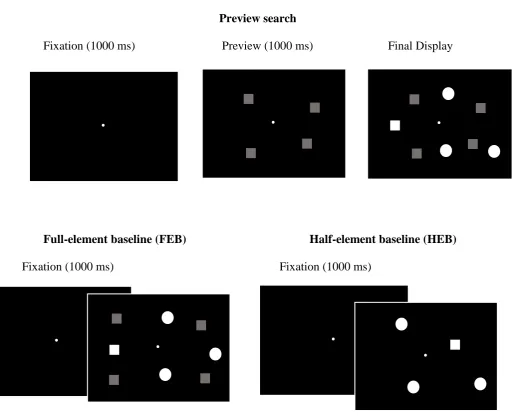
columns 1, 2, 5, or 6 to avoid left and right side location ambiguity. The number of blue and pink items on each side of the display was equal. There were three conditions: a preview search condition, a half-element baseline (HEB), and a full-element baseline (FEB). In the FEB, all search items appeared at the same time (forming a conjunction search), while in the HEB, only the second set of (blue) items were presented (forming a single feature search)2. All trials consisted of a blank screen (500 ms), followed by a central white [RGB =
180,180,180] fixation dot (2 mm × 2 mm), after which the stimuli were added. In the preview condition, 2, 4, or 8 pink squares were presented for 1000 ms (the preview items), after which 1, 3, or 5 blue circles (respectively) and one blue square target were added to the display to give a final display size of 4, 8, or 16 items. Participants were instructed to ignore the
previewed items and find the target amongst the new items, when they appeared. In the FEB, all search items appeared at the same time. In the HEB, only the second set of (blue) items were presented; hence, the display size was 2, 4, or 8 items (Figure 1). Participants responded by pressing the left- or right-shoulder button of a USB gamepad to indicate if the target was on the left or right of the display. Response errors were indicated by visual feedback
consisting of the word ‘incorrect’ for 1000ms presented at the center of the screen. Executive function tasks
Executive functions are characterized by related but separable components, consisting of switching, response inhibition, and updating (Miyake et al., 2000). Switching and response inhibition were assessed using the extended version of Shape School (Espy, 1997), adapted for older children, adolescents, and adults (Ellefson, Blagrove, & Espy, in preparation) while updating (i.e., here, working memory; WM) was measured with the Working Memory Test-Battery for Children (Pickering & Gathercole, 2001).
Shape School. The task is administered in a colorful story-book format. Stimuli consisting of cartoon shape figures with faces, arms, and legs, differ in color (red or blue), shape (square or circle), and task ‘performance cues’ (happy or sad faces; presence/ absence of hats). In all test conditions, there were 48 figures, arranged in eight lines of six.
Participants processed each figure sequentially, according to the specific condition instructions, as quickly and as accurately as they could.
In the Baseline Naming condition, participants named the color (red/blue) of each stimulus to ensure accurate recognition and naming, and to establish a baseline speed. In the
Inhibition condition, there were 24 happy figures and 24 sad figures, randomly interspersed, with happy figures having ‘finished their work’ and being ‘ready to go for lunch’, whereas for sad figures, this designation was reversed. The task instruction was to name the color of happy figures only (i.e., those ready for lunch), and suppress responses for sad figures (i.e., those not ready for lunch). In the Switching condition, half of the stimuli wore hats and half were hatless. Here, hat-wearing figures were named according to shape (square or circle), and hatless figures, according to color (red or blue); thus, switching occurred between two
response sets (color vs. shape). The Both condition measured inhibition and switching performance within the same trial block, with Inhibition and Switching cues combined (i.e., stimuli had happy or sad faces, and were also hat-wearing or hatless). Thus, participants needed to name happy figures only (suppressing responses for sad figures; Inhibition), according to their hat-status (Switching). Hat-wearing happy figures were named by shape (square or circle) and the hatless figures by color (red or blue). There were 24 happy figures (12 hat-wearing) and 24 sad figures (12 hat-wearing), arranged randomly. Prior to each condition, children completed a practice set of six figures to check for adequate rule
each condition, the dependent variable was the efficiency of responding, computed as Efficiency = (number correct – number of errors)/total time in milliseconds.
Working Memory Test-Battery for Children (WMTB-C). We used the Digit recall and Block recall tasks to measure the verbal and visuo-spatial Short-Term Memory (STM) components of WM, respectively (WMTB-C; Pickering & Gathercole, 2001; for other use of these tasks see e.g., Gathercole et al., 2004). The block recall task was selected particularly for its potential relevance to the visuo-spatial elements of the preview search task. In the
Digit recall task, spoken sequences of digits are presented to each participant, which they then have to recall in correct serial order. Test lists are constructed randomly (without
replacement) from the digits ranging from 1 to 9, read aloud by the experimenter at the rate of one digit per second. Following a practice trial, a maximum of six lists is presented at each length. If the child recalls four lists at that length correctly, list length is increased by one (this also occurs if the first four trials are correct). The procedure commences with single-digit lists and continues until the participant recalls three lists of a given length incorrectly. The number of lists correctly recalled is scored. The previously reported mean test–retest reliability coefficient for this measure for children between 4.5-11.5 years of age is .84 (Pickering & Gathercole, 2001). Similarly, in the Block recall task, each participant views nine wooden cubes located randomly on a board. The experimenter taps a sequence of blocks, and the participant is asked to repeat the sequence in the same order. The procedure starts with a single block tap and increases by one additional block following an identical span procedure to that outlined above. The mean test–retest reliability coefficient for this measure for children between 4.5-11.5 years is .83 (Pickering & Gathercole, 2001).
Design and procedure
counterbalanced order. The search tasks consisted of six blocks of 36 trials (two for each of the preview, FEB and HEB conditions), presented in a counterbalanced ABCABC order, giving a total of 216 trials. Participants completed a practice session of 10 trials for each condition to familiarize themselves with the tasks. Four additional practice trials preceded each block to remind participants of the task when blocks alternated. A self-paced break was given between blocks. The experimenter administered the Shape-School Extended and working memory tasks and recorded the participants’ responses (i.e., the accuracy of each response and the overall task RT for each condition).
Experiment 1: Results
Search tasks. RTs less than 200ms or greater than 10s were removed as outliers. This resulted in the removal of 0.31, 0.23 and 0.10% of trials for the six-, eight-, and 12-year-olds respectively. One 12-year-old completed one rather than two blocks of trials for each of the search tasks.
RTs: Figure 2 shows the mean correct RTs as a function of display size, age, and condition, with search slope statistics presented in Table 1. The size of the preview benefit was evaluated by comparing search slopes across the three conditions. Search slope values for the HEB were calculated using twice the true display size, in order to generate values that would be obtained in the preview condition if participants could fully ignore the old items (see Watson & Humphreys, 1997, for further details). Thus, if preview slopes matched HEB slopes, participants were able to ignore previewed items fully and restrict processing to new items only. In contrast, if preview slopes matched FEB slopes, no previewed items could be ignored. Finally, if preview search slopes fell between both baselines, this indicated that old items could be ignored to some extent, but not fully.
HEB, FEB, Preview) × 4 (Age: six-, eight-, 12-year-olds, adults) mixed-ANOVA with Age as the between-subject factor. This revealed a significant main effect of condition, F(2,184) = 108.46, p < .001, ηp2 = .54. Bonferroni-adjusted pairwise comparisons showed that search
slopes in the preview condition were steeper than in the HEB, by an average of 15.34 ms/item, and shallower than in the FEB by an average of 25.81 ms/item, both ps <.001. The main effect of age was also significant, F(3,92) =10.84, p < .001, ηp2 = .26 and
Bonferroni-adjusted pairwise comparisons revealed that the slopes of six-year-olds were steeper than all other age groups (mean overall differences for eight-year olds, 12-year olds, and adults, of 13.80 ms/item, p < .05, 21.73 ms/item, p < .005 and 25.88 ms/item, p < .001, respectively). None of the other comparisons reached significance.
There was also a significant Age × Condition interaction, F(6,184) = 8.81, p < .001, ηp2
= .22 , which was examined as a function of age individually for each condition (see Table 1 for search slope statistics). For the HEB condition there was no main effect of age, F < 1, while there was a main effect of age in the FEB condition, F(3,92) = 15.08, p < .001, ηp2 =
.33 and a significant linear trend, F(1,92) = 42.11, p < .001.
Six-year olds produced steeper FEB slopes than eight-year olds, 12-year olds, and adults by a mean difference of 28.63, 40 and 50.35 ms/item respectively, all ps < .005, and eight-year-olds produced steeper slopes than adults by a mean difference of 11.72 ms/item, p < .05. There was no significant difference in FEB search rate between eight-year olds and 12-year olds, p = .858, and 12-year-olds and adults, p = 1.
For the preview condition, there was also a significant main effect of age, F(3,92) = 7.50, p < .001, ηp2 = .20 with a significant linear trend, F(1,92) = 19.49, p < .001, indicating
that preview efficiency increased linearly across the four age groups.
olds and adults 18.23, 26.21, and 28.23 ms/item all ps < .05 respectively). There were no significant differences in preview search rate between the other age groups, all ps >.812.
To compare the differences in the strength of the preview benefit between the age
groups, we computed a measure independent of overall baseline (HEB and FEB) search slope values (see e.g., Blagrove & Watson, 2010) which provides an effective, non-biased measure of the behavioral benefit derived from previewing old stimuli. Preview efficiency (PE) values tending towards 1 indicate more efficient preview search, and values tending towards 0 indicate less efficient preview search; values from this measure are constrained to fall between 0 and 1.
𝑃𝐸 =𝐹𝐸𝐵 𝑠𝑙𝑜𝑝𝑒−𝑃𝑅𝐸𝑉𝐼𝐸𝑊 𝑠𝑙𝑜𝑝𝑒
𝐹𝐸𝐵 𝑠𝑙𝑜𝑝𝑒−𝐻𝐸𝐵 𝑠𝑙𝑜𝑝𝑒 (1)
When the PE index was compared across age groups, there was a numeric trend for preview search to become better with age (M = .42, .66, .77, .73; SD = 1.49, .29, .29, .27, for six-, eight-, 12-year-olds and adults, respectively), however, this difference did not reach significance, F(3,95) = 2.12, p = .104.
Errors: Overall error rates were low for all age groups: 3.07%, 3.45%, 2.31%, and 0.81% for six-, eight-, 12-year-olds and adults respectively (Table 2). A 3(Condition: FEB, HEB, Preview) × 3 (Display size: 4, 8, or 16 items) × 4 (Age: 6-, 8-, 12-year-olds, adults) mixed ANOVA, with Age as the between-subject variable, revealed a significant main effect of condition, F(2,184) = 12.68, p < .001, ηp2 = .12. Bonferroni-corrected pairwise
comparisons showed that the error rate was 1.75% higher in the FEB than in the HEB, and 1.33% higher in the FEB than in the preview condition, ps <.001. There was also a significant effect of age, F(3,92) = 5.44, p < .005, ηp2 = .15. Pairwise comparisons showed that the
Age interaction, F(6,184) = 2.56, p < .05, ηp2 = .08, however, no other effect or interaction
proved significant, all Fs < 1.
To unpack the Condition × Age interaction, errors were analyzed individually for each age group, using 3(Condition: HEB, FEB, Preview) × 3(Display size: 4, 8, 16) within-subject ANOVAs. The effect of condition was significant for all age groups except for adults (six-year-olds, F(2,46) = 7.95, p < .005, eight- year-olds,F(2,46) = 4.03, p < .005, and 12-year-olds, F(2,46) = 4.98, p < .05). Bonferroni-corrected pairwise comparisons indicated that the error rate for six-year-olds in the FEB was 2.60% higher than in the HEB and 2.3% higher than in the preview condition, ps <.05. Eight-year-olds made marginally more errors (2.84%) in FEB than in HEB, p = .053, while 12-year-olds made 1.22% more errors in FEB than in the preview condition, p < .05. Of most importance, there were no significant Condition × Display Size interactions for error rates nor Condition × Display Size × Age interactions, all
Fs < 1, which precluded speed/accuracy trade-offs in search performance. EF measures
Four six-year-oldparticipants and one eight-year-old were excluded from analysis, due to early termination of the Shape-School extended task. As shown in Table 3, EF
performance improved as age increased. A MANOVA revealed a significant effect of age on EF, F = (18, 232) = 11.78, p < .001; Wilk’s Λ = .16. Age had a significant effect on all measures: Baseline Naming Efficiency, F(3,87)= 73.61; p < .001; Inhibition Efficiency,
F(3,87)= 60.01; p < .001, Switch Efficiency, F(3,87)= 62.62; p < .001, Both Efficiency,
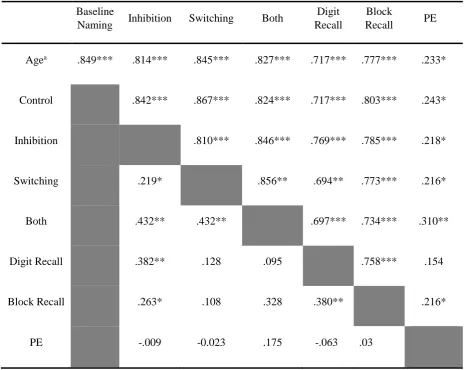
Table 4 shows the preliminary rank order, bivariate, and partial correlations across measures of PE, Age, Inhibition, Switching, Inhibition and Switching Combined (Both), and Verbal (Digit Span) and spatial (Block Recall) WM performance (raw scores from Shape-School Extended and the two WMTB-C subscales). Values above the diagonal refer to bivariate correlations between measures, while those below refer to correlations between PE and EF measures, partialling out Age and Baseline Naming Efficiency in the Shape School Extended Control condition. As full information on some dates of birth was not available, a monotonic relationship between age and preview efficiency was assessed (Spearman’s
coefficient was adopted as the most suitable statistic). No correlations between PE and EF
measures reached significance.
Experiment 1: Discussion
The main aim of Experiment 1 was to determine whether children can use temporal information to enhance visual search. The second aim was to assess whether the
development of time-based visual selection is related to EFs. All age groups showed, on average, a robust preview benefit suggesting that children as young as six were able to ignore old stimuli and prioritize the selection of new stimuli. Consistent with previous research (Donnelly et al., 2007; Trick & Enns, 1998; Hommel et al., 2004; Ruskin & Kaye, 1990; Thompson & Massaro, 1989; Taylor et al., 2003) there was also evidence that search efficiency improved with age for the more difficult FEB and preview search tasks with the easier (HEB) search task being relatively age invariant. Although, our PE index measure indicated a numerical trend for preview search efficiency to increase with age this did not reach statistical significance (we return to this question following Experiment 2).
Maylor, 2002). Whether a full preview benefit (i.e., search equivalent to HEB) or a partial preview benefit (i.e., search differs from both HEB and FEB) is obtained, often depends on the type of stimuli used (e.g., Blagrove & Watson, 2010; Gibson & Jiang, 2001). For
example, stimulus sets with targets that possess a salient feature (e.g., defined by a difference in color, motion, size or orientation, Wolfe & Horowitz, 2004, 2017) and which are dissimilar to their accompanying distractors (Duncan & Humphreys, 1989) often produce a weaker preview benefit; this suggests limits to how much the visual salience of a stimulus can be enhanced (Gibson & Jiang, 2001) when stimuli are separated in time. Thus, in the current study, the difference between the preview and HEB condition is most likely a result of using a relatively salient shape-color target to make the task suitable for children. Using less salient and more complex letter stimuli, as in previous studies, could have created a difference in the degree of familiarity with letters between younger and older children/adults, compromising the results.
A second aim was to explore the possible relationship between time-based selection and the development of EF in children. Here, we found no significant correlations between preview efficiency and EF in any age group. This is somewhat surprising given that
search efficiency. This lack of relationship might be due to our inclusion of trials with relatively large display sizes and (or) the presence of a color feature difference between the old and the new items. For example, with monochromatic displays, the role for visual WM appears to be most prominent when relatively small display sizes are used (Al-Aidroos et al., 2012). At larger display sizes, WM appears to play a reduced or little role. Thus, inclusion of displays with relatively large numbers of items might therefore account for the lack of
relationship observed in the current study. It is also possible that the color difference between the old and new items used in the present work allowed for the involvement of color-based inhibition (Braithwaite et al., 2003, 2004, 2007) which reduced the role for spatial WM processes (for further discussion see also Al-Aidroos et al., 2012). Of note, in the current work this finding appears to hold for all age groups.
In Experiment 2, we provide a replication of Experiment 1 and examine if there are age differences in two specific components of the preview benefit - the encoding of old items and the maintenance of the inhibitory template once established.
Experiment 2: Time-course of time-based visual selection
Experiment 2 provides a replication of Experiment 1 and addresses the developmental flexibility of time-based visual selection over different time durations. Previous work has shown that typically, a full preview benefit in adults requires a preview duration of
approximately 400ms (Watson & Humphreys, 1997), and that this can reflect time taken to initiate an inhibitory template using central resources (Humphreys et al., 2002). It is possible that six-, eight- and 12-year-olds might require more time to ignore old objects and may show reduced performance at shorter durations, given attentional demands and the results of Experiment 1 where they exhibited steeper slopes in Experiment 1 for the more difficult search conditions, consistent with reduced top-down control. Similarly, ignoring old
children in comparison to adults. This would result in a reduced ability to maintain old item inhibition over time. A bottom-up account, in contrast, predicts an improvement in
performance as the time between old and new increases. This is because new item luminance signals are likely to be more salient with greater temporal segregation from luminance signals associated with the onset of old items. Experiment 2 examined these possibilities by varying the preview duration between 500 and 1500ms. These timings were selected with reference to the minimum duration needed for the preview benefit to occur in adults (400ms; Watson & Humphreys, 1997), and as being 50% longer than the duration used in Experiment 1. We judged that this represented a substantial increase in duration, without being overtaxing for the youngest age group. If prioritizing new items for search requires top-down resources, and if children require more time to ignore old items and/or find it more difficult to continue ignoring old items, then we would expect performance impairments at preview durations of 500 and 1500 ms, respectively. In contrast, if prioritizing new items for search is based on purely bottom-up processes, then preview search performance should reduce with a shorter preview duration but increase with a longer preview duration.
Experiment 2: Method
Apparatus and Stimuli
Stimuli and apparatus were identical to Experiment 1. However, there were three preview conditions with preview durations of 500, 1000 and 1500ms (PRE500, PRE1000,
PRE1500) in addition to the FEB and HEB.
Design and Procedure
The design and procedure were identical to those of Experiment 1, except that no individual difference (i.e., EF) measures were taken. The FEB and the HEB were
administered to children in one session, with the three preview conditions administered in a different session. Sessions were blocked based on practical considerations and to avoid inducing fatigue in the younger children. Session order was counterbalanced across
participants, and all conditions were counterbalanced within the sessions. Adults completed the HEB/FEB and the preview conditions as separate parts of a single session.
Experiment 2: Results
RTs: Outlier RTs below 200ms or greater than 10s were removed; this represented 2.96% of the trials for the six-year-olds, .25% for the eight-year-olds, .19% for the 12-year-olds, and 1.70% for the adults. Mean correct RTs are shown in Figure 3 and search slopes in Tables 5 and 6. We first consider the extent to which the results from Experiment 1 replicated followed by a consideration of the effects of manipulating the preview duration across the four age groups.
Replication. To assess whether the findings of Experiment 1 replicated, we conducted a 2(Experiment) × 4(Age) × 3(Condition: FEB, HEB, and PRE1000) mixed ANOVA with age
and experiment as between-subject factors and search slope as the dependent variable. This revealed significant main effects of condition, F(2, 368) = 238.69, p < .001, ηp2 = .565, age,
F(3,184) = 5.07, p < .001, ηp2 = .25, and experiment, F(1,184) = 5.07, p < .05, ηp2 = .25.
.30. However, of most relevance there was no significant Experiment × Age, F(3,184) = 1.18,
p = .317, Experiment × Condition, or Experiment × Age × Condition interaction, Fs < 1. With respect to experiment, search slopes were shallower in Experiment 2 (M= 18.74,
SD = 26.63) than in Experiment 1 (M= 23.58, SD= 30.49) and this difference is most likely attributable to a general practice effect due to there being more conditions and trials in Experiment 2 than in Experiment 1. As in Experiment 1, Bonferroni-corrected pairwise comparisons showed that search slopes in the preview condition were steeper than in the HEB, by an average of 15.38 ms/item, and shallower than in the FEB by an average of 23.06 ms/item, both ps < .001. Regarding age, Bonferroni-adjusted pairwise comparisons revealed that the search slopes of six-year-olds were steeper than all other age groups (mean overall differences for eight-year olds, 12-year olds, and adults of 8.76 ms/item, p < .05, 16.88 ms/item, and 22.16 ms/item, ps < .001 respectively). The search slopes of eight-year-olds also steeper than the older age groups by a mean difference of 8.12 ms in comparison to 12-year olds, and 13.93 ms in comparison to adults, ps < .05. There was no significant
difference in RTs between 12-year olds and adults.
To examine the Condition × Age interaction, we analyzed the effect of age for each condition separately. Search slope statistics from the two experiments combined are presented in Table 5. For the HEB condition, there was a significant main effect of age,
F(3,188) = 4.79, p < .005, ηp2 = .07, and a significant linear, F(1,188) = 4.76, p < .05, and
the PRE1000 condition, there was again a significant effect of age, F(3,188) = 13.47, p < .001,
ηp2 = .18., with a significant linear trend, F(1,188) = 37.47, p < .001, suggesting that preview
efficiency increased proportionally across the four age groups.
As in Experiment 1, we calculated the Preview Efficiency index (equation (1)) for each participant (using the Preview1000 condition) of Experiment 2. These scores were analyzed
with a 4 (Age Group: six-, eight-, 12-year-olds, adults) × 2 (Experiment: 1 or 2) between-subjects ANOVA, which revealed a significant main effect of age, F(3,184) = 4.98, p < .005. As shown in Figure 4, the PE index increased from approximately 50% to 70% across the four age groups. Bonferroni-corrected comparisons indicated that the PE index for six-year-olds was significantly smaller than for 12-year-six-year-olds, (p < .005) and adults (p < .05). None of the other comparisons showed significant differences, all ps > .05. Neither the main effect of experiment, nor the Age × Experiment interaction were significant, both Fs < 1. However, notably, significantly more six-year-old children (12 in total; 25%) produced a PE index of 0, compared to eight-year olds, 12-year olds and adults, where there were only two
individuals per age group with a PE index of 0, χ2(3) = 18.4, p < .001. A PE index of 0 indicates that these participants had not exhibited any preview benefit. We next consider the effects of manipulating the preview duration.
Time-course of time-based visual selection. Search slopes were analyzed using a 5(Condition: HEB, FEB, PRE500, PRE1000, PRE1500) × 4 (Age group) mixed ANOVA, with
age as the between-subject factor. This revealed a significant main effect of condition, F(4, 368) = 52.08, p < .001, ηp2 = .36, age, F(3, 92) = 22.09, p < .001, ηp2 = .42, and a Condition ×
Age interaction, F(4, 368) = 8.62, p < .001, ηp2 = .22. With respect to condition,
Bonferroni-pairwise comparisons indicated that the search slopes in the HEB, PRE500, PRE1000, and
PRE1500 conditions were shallower than those in the FEB, by mean differences of 37.65,
PRE1000 and PRE1500 conditions were also steeper than those in the HEB, by 19.63, 16.41, and
19.09 ms/item, respectively, all ps < .001. There were no overall significant differences between the slopes of three preview (PRE500, 1000, 1500) conditions, ps = 1. With respect to age,
Bonferroni pairwise comparisons also revealed that overall, six-year-olds’ search slopes were steeper than those of all other age groups (mean overall differences for eight- and 12-year-olds’ and adults’ of 9.46 ms/item, p < .05, 17.62 ms/item, and 23.85 ms/item, ps < .001, respectively). Similarly, eight-year-olds produced steeper search slopes than adults by a mean difference of 14.39 ms/item.
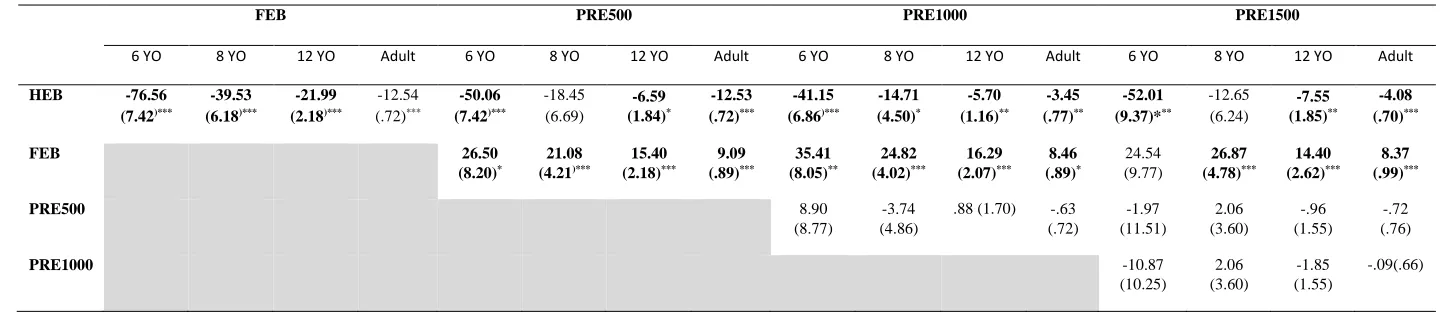
To unpack the Condition ×Age interaction, we compared the search slopes in each condition for each age group separately. Table 6 shows mean slope values and SDs for each condition. For the HEB condition there was a significant main effect of age, F(3,92) = 8.19, p
< .001, ηp2 = .211, with significant linear, F(1,92) = 12.10, p = .001, and quadratic trends, F(1,92) = 11.44, p = .001. Search slope statistics in Table 6 suggested a negative slope for the HEB condition in six-year-olds, only, while the other age groups produced flat slopes typical for single-feature search. Therefore, this trend was likely driven by more inconsistent responses of the youngest age for this condition in Experiment 2, group in HEB, perhaps due to impatience or distraction. Given that the results are observed in this condition are not crucial for determining the preview effect, this result does not impact overall conclusions. The analysis of the remaining conditions, FEB, PRE500, PRE1000, PRE1500 also indicated a
significant main effect of age, F(3,92) = 27.13, p<.001, ηp2= .469, F(3,92) = 9.89, p<.001,
ηp2= .244, F(3,92) = 6.08, p=.001, ηp2 =.165, F(3,92) = 10.57, p<.001, ηp2 = .256 and a
significant linear trend, F(1,92) = 80.53, p<.001, F(1,92) = 28.75, p<.001, F(1,92) = 17.83,
Table 7 shows the related Bonferroni-corrected pairwise comparisons. As shown, with a 500ms and 1000ms preview duration, all age groups displayed a reliable preview benefit, with the search slope of the preview condition significantly lower than that of the FEB condition. With a 1500ms preview duration, eight and 12-year-olds and adults showed a reliable preview benefit. However, for the six-year-olds’ there was no difference between the FEB and PRE1500 search slopes, suggesting lack of a preview benefit.
We also calculated and compared the PE index (equation (1)) for the three different preview duration conditions. A 3(Condition: PRE500, PRE1000, PRE1500) × 4 (Age) mixed
ANOVA with age as the between-subjects factor revealed that there was no significant effect of condition, F < 1, nor a Condition × Age interaction, F(1,92) = 1.10, p = .32. However, there was a significant main effect of age, F(3,92) = 5.11, p < .005, ηp2 = .41. Bonferroni-corrected pairwise comparisons indicated that the PE index for six-year olds (M = .43, SD = .36) was smaller than for 12-year olds (M =.67, SD =.30) and adults (M =.65, SD =.28), ps <.01 and marginally smaller than for eight-year olds (M =.61, SD =.36), p = .066. All the remaining comparisons did not reach significance, ps =1.
Errors
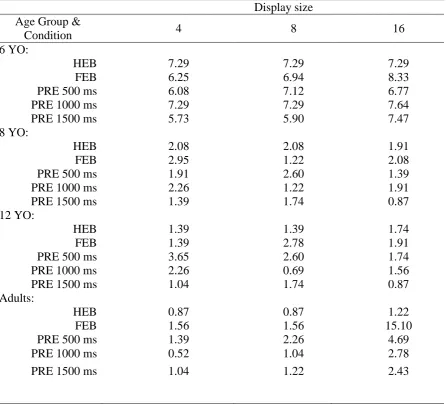
Error rates were low for all age groups (6.98%, 1.84%, 1.78%, and 2.57% for 6-, 8-, 12-year-oldsand adults respectively (Table 8). A 5(Condition: FEB, HEB, Pre500, PRE1000,
PRE1500) × 3 (Display size: 4, 8, or 16 items) mixed ANOVA with age as the between-subject
factor revealed a significant main effect of condition, F(4,368) = 4.45, p < .005, ηp2 = .05,
display size, F(2,184) = 13.53, p < .001, ηp2 = .13, and age, F(3,92) = 17.46, p < .001, ηp2 =
.36. Bonferroni-corrected pairwise comparisons indicated that more errors were made by six-year-olds in comparison to eight-six-year-olds by 5.29%, 12-year olds by 5.19% and adults by 4.41% (all ps < .001). The Condition × Display Size, F(8,736) = 5.01, p < .001, ηp2 = .05,
13.63, p < .001, ηp2 = .31, and Age × Condition × Display Size interaction, F(24,736) = 3.81, p < .001, ηp2 = .11, all proved significant. However, notably, the effect sizes of most of the
main effects and interactions were very small.
Nonetheless, errors were further analyzed individually by age group using 5(Condition: HEB, FEB, PRE500, PRE1000, PRE1500) × 3(Display Size: 4, 8, 16 items) within-subject
ANOVAs. There were no significant main effects or interactions for six- and eight-year-olds. For the 12-year-olds, overall error rates differed across condition, F(4,92) = 3.59, p < .01. However, pairwise comparisons revealed no significant effects. For the adults, errors were greatest in the FEB, F(4,92) = 18.12, p < .001, by a mean difference 5.09% in comparison to HEB, 3.23% in comparison to PRE500, by 4.63% in comparison to PRE1000, and by 4.51% in
comparison to PRE1500. More errors were also made in the preview condition in comparison
to HEB by a mean difference of 1.79%. Errors also increased with display size, F(2,46) = 37.70, p < .001. More errors were made at display size of 16 items, in comparison to 4 and 8 items by a mean difference of 4.17% and 3.85%, respectively. There was a significant Display Size × Condition interaction, F(8,184) = 16.09, p < .001, with more errors made in the FEB at larger display sizes. There was no difference in error rates between the three preview conditions. No other main effects or interactions were significant; all Fs < 1.74, ps
>.13. Taken as a whole, the results are consistent with RT patterns and do not suggest the presence of a speed-accuracy trade-off in search performance.
Experiment 2: Discussion
reduced in six-year-olds with 25% showing no ability to prioritize new items at all3. An analysis of the preview index from Experiment 2 alone also revealed that six-year-olds showed a weaker preview benefit than the older children and adults. One possibility why we obtained a significant effect of age on the PE index in Experiment 2 alone (but not in
Experiment 1 alone) is that Experiment 2 contained three preview conditions. This might have resulted in more stable preview performance in Experiment 2 than in Experiment 1 in which there was only one preview condition.
The second set of findings were that whilst all age groups exhibited a preview benefit at the reduced preview duration (500ms), six-year-olds appeared to have difficulty maintaining a preview benefit at the longer duration (1500ms). This is consistent with the notion that there are two preview components: i) a setting up of an inhibitory goal-state/template which
requires central resources, and ii) maintenance of the goal state/template via visual resources (Humphreys et al., 2000). The present findings suggest that these two processes are likely to develop at different rates, with setting-up an inhibitory goal state being developed by six years and maintenance via visual resources being developed from eight years of age. Past research has shown that while the presence of rudimentary inhibitory abilities are observed even in early infancy (e.g., Clohessy, Posner, Rothbart, & Vecera, 1991), volitional attention is immature in children younger than eight years of age (Ristic & Kingstone, 2009). It is possible that maintenance via visual resources requires extended volitional control, thus having a longer developmental course in comparison to setting-up an inhibitory template.
This finding is also consistent with the proposal that top-down maturation underlies the developmental trajectory observed in six-year-olds, since a bottom-up account of the preview benefit would predict better performance at longer durations. Note, however, that this specific conclusion is based on the results from the within-subjects PRE1500 vs. FEB comparison.
When the influence of preview duration was assessed using the (less powerful between-subjects) PE index, no age differences emerged. This difference likely reflects the difference in power between the two approaches (within vs. between measures). We also note that the performance became somewhat more variable as age decreased (see Tables 6 and 7). Thus, the increased variability in the responses of the six-year-olds might have contributed to the lack of a FEB-PRE1500 difference to some degree. However, we did obtain robust differences
between the HEB, FEB, PRE500 and PRE1000 conditions, and between the PRE1500 and HEB
conditions and thus increased variability alone is unlikely to explain the lack of a preview benefit at 1500ms for the six-year-old age group. Nonetheless, the above considerations indicate that some caution should be exercised when interpreting this particular finding.
General Discussion
The main aims of this study were to: 1) investigate whether children (ages six to 12) can use temporal information to enhance selective attention, 2) establish whether the development of time-based visual selection is related to the development of higher cognitive abilities such as EF, and 3) examine children’s flexibility and robustness in setting-up and maintaining the processes needed to prioritize visual search through new items.
developmental course. No relationship between the ability to suppress stimuli and EF emerged. Reducing the preview duration to 500ms had little influence, with all age groups able to prioritize new items. However, when the preview duration was increased to 1500ms, there was little evidence that six-year-olds could maintain the prioritization of new items and the data were suggestive of the absence of a preview benefit.
Mechanisms of time-based visual selection in development
In addition to the main aims, the findings also speak to the issue of what types of
mechanisms drive the prioritization of new items. As noted in the Introduction section, three broad theories have been proposed to explain the preview benefit in adults; inhibition of old items (Watson & Humphreys, 1997), automatic capture by new-item luminance signals (Donk & Theeuwes, 2001, 2003) and separation via temporal grouping cues (Jiang et al., 2002). Recent work has also suggested a role for visual working memory when displays contain relatively few items (Al-Aidroos et al., 2012). Since past research has demonstrated the involvement of top-down, general modality resources in time-based selection using a dual-task paradigm (Watson & Humphreys, 1997; Humphreys et al., 2002), we expected executive functions, using the model of Miyake et al. (2000), to be involved in the top-down component of the preview benefit.
However, we found no evidence for a link between our measure of response inhibition and the ability to ignore old items (i.e., the strength of the preview benefit). This is perhaps surprising, given the number of extant robust findings supporting a role for inhibition (see e.g., Watson et al., 2003 for a review). However, one explanation for this apparent
includes suppressing a pre-potent motor response and as such, they may not capture the inhibition used to suppress visually distracting stimuli. Thus, rather than dismissing the top-down account based on the observed lack of correlation, it would be useful for future studies to broaden the inhibition measures used in order to test for associations with different types of inhibition. Alternatively, attentional probe-dot approaches (e.g., Watson & Humphreys, 2000) could be used within the preview displays in order to measure the development of inhibition as a function of age directly.
We also observed no significant correlation between the preview index and our measure of switching, providing no evidence that the ability to switch between the “ignore” template of the first set of items and a “selection” template may underlie the strength of the preview benefit. This might be explained if participants simultaneously hold both an inhibitory attentional set against the old stimuli and an anticipatory set to the new items (see e.g., Watson & Humphreys, 2005) rather than having to switch sets. Similarly, no correlations were observed with measures of working memory. It is possible that spatial visual WM might have played little role in the current study given the color difference between the old and new items and the relatively large display sizes used (Al-Aidroos et al., 2012). If, in future studies, displays are limited to monochromatic stimuli with only a small number of items (e.g.,
display sizes of up to four) a developmental link between WM and the preview benefit might yet be obtained.
Our results do, however, suggest some involvement of a top-down component in the selection of new information (and as such, are consistent with the inhibitory visual marking account). First, the finding that 25% of six-year-olds could not prioritize new items suggests that new item prioritization does not rely solely on bottom-up/automatic processes. This follows because such bottom-up capture processes are relatively well developed in
& Conners, 2013). Second, the finding that new item prioritization is more robust from age eight is consistent with previous findings showing that children develop the ability to use attention volitionally (i.e., in a top-down manner) from this age (Ristic & Kingstone, 2009). Moreover, bottom-up processes related to the processing of abrupt luminance signals are limited to around four items (e.g., Yantis & Johnson, 1990) and as such, we would not expect to find any preview benefit at display sizes of 16 (in which eight new items were prioritized). Finally, if the preview benefit were driven solely by bottom-up grouping processes, then we would expect a stronger preview benefit when the time difference between the onset of old and new items was increased. For six-year-olds this was not the case – for this age group, there was little evidence that a preview benefit occurred when old and new items were separated by 1500ms, although as noted earlier some caution might be warranted when interpreting this specific finding.
A further consideration with regards to top-down or bottom up processing is the extent to which color-based grouping might contribute to the preview benefit. As in many previous studies, in the present work, old and new items differed in color. However, grouping-by-color, a bottom-up process, cannot alone account for the preview benefit. If it could,
the contribution of a developing top-down component, particularly for displays with larger numbers of items.
Components of the preview benefit
The results also speak as to the components underlying the preview benefit and their development. In Experiment 2 we found initial evidence to suggest that an age difference emerged when ignoring items that had been presented for 1500ms but not for shorter
durations. This can be interpreted as support for the two component model of visual marking which proposes an initial set-up phase followed by a maintenance stage (Humphreys et al., 2000). The age related difference suggests that these two stages might develop
asynchronously. As noted earlier, this age related difference was detected using a within-subjects approach in which participants’ preview performance was assessed by comparing with their own (HEB/FEB) baselines. An alternative, between-subjects analysis, based on PE index measures failed to detect an age related difference. However, this is most likely
because the latter approach has less statistical power than the within-subject method.
Nonetheless, given that ignoring old stimuli at long durations may be a developing ability in six-year-olds, exploring even younger age groups may give clearer confirmation of the development of the two components.
Implications and further research
ability follows the same trajectory in typically and atypically developing children, and if so, whether children with attentional problems can benefit from the use of temporal cues. The possibility that different types of inhibition may underlie different cognitive abilities might provide direction for future studies to examine the inhibition construct in a multi-faceted way both in preview search and in other cognitive tasks (see Erb et al., 2017).
Strengths and limitations
The present study makes two unique contributions to the literature on the development of attention. First, this study is the first to examine the use of time to guide visual search across multiple young age groups. Much research examines the development of attention in
typically and atypically developing children, but few studies have examined the involvement of time, despite time being a crucial component of real-world events and interactions.
Limitations of the study include use of a cross-sectional sample. Although this allowed us to examine time-based selection across different ages, a longitudinal design would inform the dynamic changes in the maturation and development of this ability. A further limitation is that our experiments included displays with relatively large numbers of search items. This likely precluded the engagement of mechanisms based on visual WM (Al-Aidroos et al., 2012). Thus future research would be useful to examine if the current findings hold when testing is limited to displays with small numbers of search stimuli. With respect to maintain old item suppression, Experiment 2 provided some evidence that six-year-olds could not maintain prioritization of new items for 1500ms, however, it remains an open question as to whether eight- and 12-year-olds would show a similar deficit if the preview duration was extended further. Finally, examining younger age group may be further beneficial for confirming the conclusions outlined in this study.
References
Altemeier, L., Jones, J., Abbott, R. D., & Berninger, V. W. (2006). Executive functions in
becoming writing readers and reading writers: Note taking and report writing in third and
fifth graders. Developmental Neuropsychology, 29, 161-173.
DOI:10.1207/s15326942dn2901_8
Andrews, L.S., Watson, D.G., Humphreys, G.W., & Braithwaite, J.J. (2011). Flexible
Feature-based Inhibition in Visual Search Mediates Magnified Impairments of Selection: Evidence from Carry-over Effects under Dynamic Preview-Search Conditions. Journal of Experimental Psychology: Human Perception & Performance, 37, 1007-1016.
Blagrove, E., & Watson, D. G. (2010). Visual marking and facial affect: Can an emotional face be ignored? Emotion, 10, 147-168. DOI:10.1037/a0017743
Braithwaite, J. J., Humphreys, G. W., & Hodsoll, J. (2003). Color grouping in space and time: evidence from negative color-based carryover effects in preview search. Journal of Experimental Psychology: Human Perception and Performance, 29, 758-778.
Braithwaite, J. J., Humphreys, G. W., & Hodsoll, J. (2004). Effects of colour on preview search: Anticipatory and inhibitory biases for colour. Spatial Vision, 17, 389-415. Braithwaite, J. J., Humphreys, G. W., Hulleman, J., & Watson, D. G. (2007). Fast color
grouping and slow color inhibition: evidence for distinct temporal windows for separate processes in preview search. Journal of Experimental Psychology: Human Perception and Performance, 33, 503-517, https://doi.org/10.1162/jocn.1991.3.4.345.
Bull, R., & Scerif, G. (2001). Executive functioning as a predictor of children's mathematics
ability: Inhibition, switching, and working memory. Developmental Neuropsychology, 19,
273-293DOI:10.1207/S15326942DN1903_3
Clohessy, A. B., Posner, M. I., Rothbart, M. K., & Vecera, S. P. (1991). The development of
Davidson, M. C., Amso, D., Anderson, L. C., & Diamond, A. (2006). Development of cognitive control and executive functions from 4 to 13 years: Evidence from
manipulations of memory, inhibition, and task switching. Neuropsychologia, 44, 2037-2078. https://doi.org/10.1016/j.neuropsychologia.2006.02.006
Dixon, M. L., Zelazo, P. D., & De Rosa, E. (2010). Evidence for intact memory‐guided attention in school‐aged children. Developmental Science, 13, 161-169.
Donk, M., & Theeuwes, J. (2001). Visual marking beside the mark: Prioritizing selection by abrupt onsets. Perception & Psychophysics, 63, 891-900. DOI: 10.3758/BF03194445 Donk, M., & Theeuwes, J. (2003). Prioritizing selection of new elements: Bottom-up versus
top-down control. Perception & Psychophysics, 65, 1231-1242. DOI: 10.3758/BF03194848
Donnelly, N., Cave, K., Greenway, R., Hadwin, J. A., Stevenson, J., & Sonuga-Barke, E. (2007). Visual search in children and adults: Top-down and bottom-up mechanisms. The Quarterly Journal of Experimental Psychology, 60, 120-136.
DOI:10.1080/17470210600625362
Duncan, J., & Humphreys, G. W. (1989). Visual search and stimulus similarity.
Psychological Review, 96, 433-458.
Ellefson, M. R., Blagrove, E., & Espy, K. A. The Shape School extended for older children, adolescents and adults. Manuscript in preparation.
Erb, C. D., Moher, J., Song, J. H., & Sobel, D. M. (2017). Reach tracking reveals dissociable processes underlying inhibitory control in 5‐to 10‐year‐olds and adults. Developmental
Science, 00:e12523. DOI: 10.1111/desc.12523
Espy, K. A. (1997). The Shape School: Assessing executive function in preschool children.
Developmental Neuropsychology, 13, 495-499. DOI:10.1080/87565649709540690 Friedman, N. P., & Miyake, A. (2004). The relations among inhibition and interference
control functions: a latent-variable analysis. Journal of Experimental Psychology:
General, 133, 101-135. DOI:10.1037/0096-3445.133.1.101
Gathercole, S. E., & Alloway, T. P. (2006). Practitioner review: Short‐term and working
memory impairments in neurodevelopmental disorders: Diagnosis and remedial support.
Journal of Child Psychology and Psychiatry, 47, 4-15. DOI:
10.1111/j.1469-7610.2005.01446.x
Gathercole, S. E., Pickering, S. J., Ambridge, B., & Wearing, H. (2004). The structure of
working memory from 4 to 15 years of age. Developmental Psychology, 40, 177 -190.
DOI:10.1037/0012-1649.40.2.177
Gerhardstein, P., & Rovee-Collier, C. (2002). The development of visual search in infants
and very young children. Journal of Experimental Child Psychology, 81, 194-215.
Gibson, B.S., & Jiang, Y. (2001). Visual marking and the perception of salience in visual search. Perception & Psychophysics, 63, 59-73. DOI: 10.3758/BF03200503
Hommel, B., Li, K. Z., & Li, S. C. (2004). Visual search across the life span. Developmental Psychology, 40, 545-558. DOI:10.1037/0012-1649.40.4.545
Hughes, C., Ensor, R., Wilson, A., & Graham, A. (2009). Tracking executive function across
the transition to school: A latent variable approach. Developmental Neuropsychology, 35,
Huizinga, M., Dolan, C. V., & van der Molen, M. W. (2006). Age-related change in
executive function: Developmental trends and a latent variable analysis.
Neuropsychologia, 44, 2017-2036. DOI:10.1016/j.neuropsychologia.2006.01.010
Humphreys, G. W., Watson, D. G., & Jolicœur, P. (2002). Fractionating the preview benefit
in search: Dual-task decomposition of visual marking by timing and modality. Journal of Experimental Psychology: Human Perception & Performance, 28, 640 -660.
DOI:10.1037/0096-1523.28.3.640
Jiang, Y., Chun, M. M., & Marks, L. E. (2002). Visual marking: Selective attention to asynchronous temporal groups. Journal of Experimental Psychology: Human Perception & Performance, 28, 717-730. DOI:10.1037/0096-1523.28.3.717
Johnson, K. A., Bryan, M., Polonowita, K., Decroupet, D., & Coull, J. T. (2016). Isochronous Sequential Presentation Helps Children Orient Their Attention in Time. Frontiers in Psychology, 7.
Kaldy, Z., Kraper, C., Carter, A. S., & Blaser, E. (2011). Toddlers with autism spectrum disorder are more successful at visual search than typically developing toddlers.
Developmental Science, 14, 980-988.
Kramer, A. F., & Atchley, P. (2000). Age-related effects in the marking of old objects in
visual search. Psychology and Aging, 15, 286-296. DOI:10.1037/0882-7974.15.2.286
Mason, D. J., Humphreys, G. W., & Kent, L. S. (2003). Exploring selective attention in ADHD: visual search through space and time. Journal of Child Psychology and Psychiatry, 44, 1158-1176. DOI: 10.1111/1469-7610.00204
Mason, D. J., Humphreys, G. W., & Kent, L. (2004). Visual search, singleton capture, and the control of attentional set in ADHD. Cognitive Neuropsychology, 21, 661-687.
Mento, G., & Tarantino, V. (2015). Developmental Trajectories of Internally and Externally
Driven Temporal Prediction. PLoS ONE, 10(8), e0135098.
http://doi.org/10.1371/journal.pone.0135098
Mento, G., & Vallesi, A. (2016). Spatiotemporally dissociable neural signatures for
generating and updating expectation over time in children: A High Density-ERP study.
Developmental Cognitive Neuroscience, 19, 98-106.
Merrill, E. C., & Conners, F. A. (2013). Age-related interference from irrelevant distracters in
visual feature search among heterogeneous distracters. Journal of Experimental Child
Psychology, 115, 640-654.
Miyake, A., Friedman, N. P., Emerson, M. J., Witzki, A. H., Howerter, A., & Wager, T. D.
(2000). The unity and diversity of executive functions and their contributions to complex
“frontal lobe” tasks: A latent variable analysis. Cognitive Psychology, 41, 49-100.
Olivers, C. N., & Humphreys, G. W. (2002). When visual marking meets the attentional blink: More evidence for top-down, limited-capacity inhibition. Journal of Experimental Psychology: Human Perception & Performance, 28, 22 - 42.
DOI:10.1037/0096-1523.28.1.22
Olivers, C.N.L., Watson, D.G., & Humphreys, G.W. (1999). Visual marking of locations versus feature maps: Evidence from within-dimension defined conjunctions.
Quarterly Journal of Experimental Psychology, 52A, 679-715.
Pailian, H., Libertus, M. E., Feigenson, L., & Halberda, J. (2016). Visual working memory capacity increases between ages 3 and 8 years, controlling for gains in attention,
perception, and executive control. Attention, Perception, & Psychophysics,78, 1556-1573. Piaget, J. (1964). Part I: Cognitive development in children: Piaget development and learning.
Journal of Research in Science Teaching, 2, 176-186.