Author’s Accepted Manuscript
Data Exfiltration: A Review of External Attack
Vectors and Countermeasures
Faheem
Ullah,
Matthew
Edwards,
Rajiv
Ramdhany, Ruzanna Chitchyan, M. Ali Babar,
Awais Rashid
PII:
S1084-8045(17)30356-9
DOI:
https://doi.org/10.1016/j.jnca.2017.10.016
Reference:
YJNCA1996
To appear in:
Journal of Network and Computer Applications
Received date: 8 August 2017
Revised date:
18 October 2017
Accepted date: 28 October 2017
Cite this article as: Faheem Ullah, Matthew Edwards, Rajiv Ramdhany, Ruzanna
Chitchyan, M. Ali Babar and Awais Rashid, Data Exfiltration: A Review of
External Attack Vectors and Countermeasures,
Journal of Network and
Computer Applications,
https://doi.org/10.1016/j.jnca.2017.10.016
This is a PDF file of an unedited manuscript that has been accepted for
publication. As a service to our customers we are providing this early version of
the manuscript. The manuscript will undergo copyediting, typesetting, and
review of the resulting galley proof before it is published in its final citable form.
Please note that during the production process errors may be discovered which
could affect the content, and all legal disclaimers that apply to the journal pertain.
1
Data Exfiltration: A Review of External Attack Vectors and
Countermeasures
Faheem Ullah1, Matthew Edwards2, Rajiv Ramdhany2, Ruzanna Chitchyan3, M. Ali Babar1, 4, Awais Rashid2
1
University of Adelaide, Australia & 4IT University of Copenhagen, Denmark
2
Security Lancaster, School of Computing and Communications, Lancaster University, UK,
3
Department of Computer Science, University of Leicester, UK
ABSTRACT
Context: One of the main targets of cyber-attacks is data exfiltration, which is the leakage of sensitive or private data to an unauthorized entity. Data exfiltration can be perpetrated by an outsider or an insider of an organization. Given the increasing number of data exfiltration incidents, a large number of data exfiltration countermeasures have been developed. These countermeasures aim to detect, prevent, or investigate exfiltration of sensitive or private data. With the growing interest in data exfiltration, it is important to review data exfiltration attack vectors and countermeasures to support future research in this field. Objective: This paper is aimed at identifying and critically analysing data exfiltration attack vectors and countermeasures for reporting the status of the art and determining gaps for future research. Method: We have followed a structured process for selecting 108 papers from seven publication databases. Thematic analysis method has been applied to analyse the extracted data from the reviewed papers. Results: We have developed a classification of (1) data exfiltration attack vectors used by external attackers and (2) the countermeasures in the face of external attacks. We have mapped the countermeasures to attack vectors. Furthermore, we have explored the applicability of various countermeasures for different states of data (i.e., in use, in transit, or at rest). Conclusion: This review has revealed that (a) most of the state of the art is focussed on preventive and detective countermeasures and significant research is required on developing investigative countermeasures that are equally important; (b) Several data exfiltration countermeasures are not able to respond in real-time, which specifies that research efforts need to be invested to enable them to respond in real-time (c) A number of data exfiltration countermeasures do not take privacy and ethical concerns into consideration, which may become an obstacle in their full adoption (d) Existing research is primarily focussed on protecting data in ‘in use’ state, therefore, future research needs to be directed towards securing data in ‘in rest’ and ‘in transit’ states (e) There is no standard or framework for evaluation of data exfiltration countermeasures. We assert the need for developing such an evaluation framework.
Keywords: Data Exfiltration, Data Leakage, Data Theft, Data Breach, External Attack Vector, Countermeasure
1.
Introduction
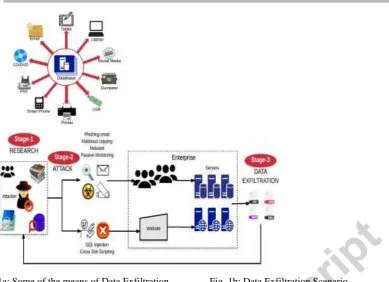
Data theft (formally referred to as data exfiltration) is one of the main motivators for cyber-attacks irrespective of whether carried out by organised crime, commercial competitors, state actors or even “hacktivists”. Preventing data exfiltration is increasingly becoming a challenging task due to two main reasons. First, over the span of last few years, cyber-crime has transformed from an individual’s act to an organizational act. This transformation has provided attackers (or often called hackers) with high budget, resources, and sophistication to become more professional in data exfiltration. Second, the existing data infrastructure contains several means (as shown in Fig. 1a) that are originally designed for the legitimate exchange of data but can be used for data exfiltration.
2
[image:3.595.93.483.67.349.2]
Fig. 1a: Some of the means of Data Exfiltration Fig. 1b: Data Exfiltration Scenario
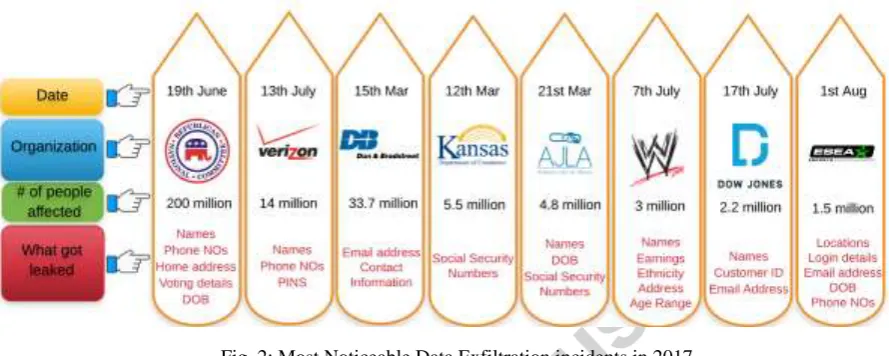
of data exfiltration starts as shown in Fig. 1b. Due to the sophistication of attacks and several available means, there has been a number of data exfiltration incidents reported recently. According to ITRC Breach Report1, until 3rd October 2017, there have been 1056 data exfiltration incidents in 2017. A popular incident reported in June 2017 was the leakage of data of 200 million American voters, which was compiled for Republican National Committee. The data contained personal information of voters that included name, home address, phone number, date of birth, and voter registration details. The leak occurred due to misconfiguration of the database holding the data. Equifax and Deloitte are two of the top companies, which have recently fallen victims to major cyber security attacks that have left millions of people’s private and business data exfiltrated23
. Both of the companies were entrusted with the responsibilities of safeguarding that very data that got stolen with known and unknown personal, professional, and business implications for private citizens as well as businesses. ITRC Breach Report has several other incidents among which the most noticeable are shown in Fig. 2. Recently, Verizon released 2017 Data Breach Investigations Report4 that revealed some interesting aspects of this growing concern. According to this report, 75% of data exfiltration attacks were perpetrated by external attackers (i.e., hackers) while 25% of the attacks involved actors within the victim organization. This report also reveals that among all the data leaks, about 24% occurred in the financial sector, about 15% occurred in the healthcare sector, about 15% occurred in retail and accommodation sector, and about 12% occurred in public sector entities.
As evident from the above-mentioned statistics, such proliferation of data exfiltration is becoming a serious concern for business and government organizations. For businesses, data exfiltration may cause huge financial and reputational damage by disclosing trade secrets, information about future projects, and customers’ profiles to competitors. For governments, the consequences of data exfiltration can be even more severe when national secrets or information about political settlements fall into the hands of adversaries. Driven by the need to address such a serious concern, security experts develop various security systems that include but not limited to Intrusion Detection System (IDS), Intrusion Prevention System (IPS), firewall, and Security Information and Event Management (SIEM). However, these systems fall short in dealing with data exfiltration due to unstructured and constantly evolving nature of data. To overcome this limitation, security experts and researchers come up with the idea of data exfiltration countermeasures, which specifically aim to detect, prevent, or investigate data exfiltration. Unlike traditional security systems (e.g., IDS, IPS, and firewall), which
1
http://www.idtheftcenter.org/images/breach/2017Breaches/ITRCBreachReport2017.pdf
2
https://www.theguardian.com/us-news/2017/sep/07/equifax-credit-breach-hack-social-security
3
https://www.theguardian.com/business/2017/sep/25/deloitte-hit-by-cyber-attack-revealing-clients-secret-emails
4
3
are supposed to act when an attacker tries to enter the enterprise, data exfiltration countermeasures are expected to work when an attacker is on its way back from the enterprise with the sensitive data.
[image:4.595.78.523.212.390.2]We assert that there is an important need of providing an extensive overview and in-depth analysis of the available literature to connect the knowledge about the current state of the art on this topic. We have carried out an extensive literature review on data exfiltration to derive and use a classification of external attack vectors (which accounts for 75% of total data exfiltration attacks) and countermeasures. We have systematically analysed the countermeasures in terms of their contributions and limitations. We have reviewed the countermeasures based on their goals, that is, whether a particular countermeasure is designed to prevent, detect or investigate data exfiltration. We have also analysed the available countermeasures based on the state of data that can either be in
Fig. 2: Most Noticeable Data Exfiltration incidents in 2017
in use, in transit or at rest. Furthermore, we have provided a mapping of the attack vectors to the selected countermeasures to help understand which countermeasures are applicable against which attack vectors. This literature review has enabled us to identify the areas where immediate research is required to cope with the future challenges. Our review has attempted to answer the following Research Questions (RQs):
RQ1: What are the attack vectors used by remote attackers to steal data from an individual or an organization?
RQ2: What are the countermeasures for preventing, detecting and investigating data exfiltration?
RQ3: What are the challenges in preventing, detecting and investigating data exfiltration?
As our aim is to survey both attack vectors and a broad set of countermeasures — preventive, detective and investigative — we refer to this topic as “data exfiltration” rather than “data leakage prevention”, which implies a specific focus on preventive measures. Both academia and industry refer to data exfiltration with other names too such as data theft, data leakage, data breach, or data stealing, therefore, these terms are used interchangeably in this paper. The terms external attacker, remote attacker, and hacker are also used interchangeably.
The rest of this paper is structured as follows. We begin with a discussion of the related work on existing surveys and compare them with our survey to justify the contributions of our survey in Section 2. Section 3 describes the methodology adopted for conducting this survey. Section 4 highlights the external attack vectors identified from the studied literature to address RQ1. Section 5 follows this by systematising the body of work on countermeasures to address RQ2. Following this, we present some of the future challenges for data exfiltration research in Section 6 to address RQ3. In section 7, we outline the limitations of our work. Finally, Section 8 concludes the paper.
2.
Related work
4
Data exfiltration is a highly active research area where literature has been reviewed from different perspectives. During our review process, we found five review papers on data exfiltration. We briefly summarize the key aspects of these review papers.
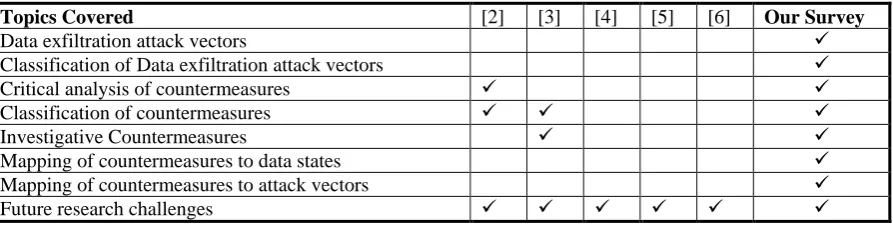
Alneyadi et al. [2] report a review on Data Leakage Prevention Systems (DLPs) challenges and countermeasures. Based on the analysis of 25 countermeasures, the authors identify some potential areas for future research that include contextual analysis, content analysis, term weighing techniques, internal misuse, and smartphone security. Shabtai et al. [3] present a review on data leakage detection and prevention. They propose a taxonomy for data leakage prevention solutions, discuss various data leakage prevention solutions in industry and academia, highlight the causes, locations, timings and motivators for data leakage, and at the end identify future trends for research in DLP. The review of Shabtai et al. includes only 37 DLPs from academic literature as this review is primarily focused on industrial DLPs. Raman et al. [4] literature survey describes the problem of DLP and highlights some basic approaches from the literature. They identify encryption, access control, semantic gap in DLP and collaboration as major challenges and test clustering and social network analysis as potential areas for research in DLPs. Raman et al. focus on challenges in data exfiltration and describe only three countermeasures from the academic literature. A review by Brindha and Shaji [5] highlights the issue of data exfiltration in the cloud environment with particular focus on data exfiltration caused by authorized entities. The authors highlight the leakage threats, causes of threats, types of information leaked, and data leakage channels. The number of papers included in the review process is unclear; however, this review does not report any countermeasure for data exfiltration. Tahboub and Saleh [6] report a survey of data leakage/loss prevention systems. This is a short survey paper limited to the definitions of data leakage, data states, capabilities of DLPs, and methods adopted by DLPs. The authors compare the scenarios of protecting data from outside (through tools such as Intrusion detection system, firewalls, and Security Information and Event Management (SIEM) systems) and inside through DLPs.
It is worth mentioning that it is a common practice to conduct multiple reviews on the same topic. For example, there are a number of reviews on network anomaly detection [7-11]. However, it is important to ensure that such reviews differ from each other in terms of objectives, included papers, and results. In the following section, we compare our review with existing related reviews.
2.2.Comparison to Existing Literature Reviews
In order to ensure the novelty and new contribution of our review, we thoroughly analyse the related reviews and compare them with our review in terms of objectives, included papers, and results.
Objective
Our review differs from the existing reviews in two ways: (1) whilst all the existing reviews report challenges in preventing or mitigating data exfiltration, our review reports the attack vectors used to exfiltrate data. By challenges, we mean factors such as several leakage channels, difficulty in managing access right, encryption, and steganography. An attack vector is a particular method or technique such as SQL injection, phishing, and passive monitoring that is used to exfiltrate data; (2) Due to undefined scope, the existing reviews provide some insights into insider attacks and unintentional data leakage. However, our review does not provide any such details rather provides insight into data exfiltration caused by malicious activities of a remote attacker. Whilst some of the countermeasures may also be applicable to insider attack vectors, such attacks are out of the scope of our review. We also consider the fact that data exfiltration is a broad research area and there are a number of resources from which data can be leaked such as computers, mobile phones, web servers, databases, virtual machines, printers, network, and IoT sensors. Hence, it is quite challenging to include papers from all domains. Therefore, the scope of this review is limited to data exfiltration from computers, web servers, databases, virtual machines, and network. We have excluded the papers that report data exfiltration from domains such as mobile devices, IoT devices, and printers.
Included papers
5
of 25, 37, and 3 countermeasures. The review of Brindha and Shaji [5] is focussed on data exfiltration challenges and does not report any countermeasures. Similarly, Tahboub and Saleh [6] define various tools and technologies relevant to data leakage but they do not report any countermeasure from the academic literature. The inclusion of a sufficiently large number of countermeasures (108) as compared to the number of countermeasures included in other related reviews (25, 37, and 3) provides a more comprehensive overview and supports the generalization and concreteness of our findings.
Results
The findings from our review do not overlap with the findings from the existing reviews. Unlike [2], [3], [4], and [5], which report the challenges faced by data leakage prevention systems, our review does not report any challenges, rather, it reports the data exfiltration attack vectors. Similar to [2] and [3], our review also presents a classification of the countermeasures, however, our criteria and the resulting classification are quite different to the classifications presented in [2] and [3]. The classification presented in [3] is based on multiple criteria that include data state, deployment scheme, leakage detection and prevention technique, and remedial actions. This classification overlaps with our classification to a certain degree. However, our classification is based on a single criterion (the technique employed), which enables us to present an in-depth classification of countermeasures into four levels unlike two-level classification presented in [3]. Similarly, the classification in [2] is quite shallow and categorises the countermeasures into high-level categories (two-level classification).
Some other novel aspects of our review, which are missing in related reviews, include investigative countermeasures, mapping of countermeasures to attack vectors, and mapping of countermeasures to data states. The open research challenges identified in our review differs significantly from the research areas or recommendations provided in other related reviews. [3] and [6] identify accidental data leakage and leakage of data from mobile devices as future research areas. These research challenges stem from insider activity and mobile domain covered in [3] and [6], which are outside the scope of our review. The articles [2] and [4] identify certain techniques such as text clustering, social network analysis, fingerprinting, and term weighting that are more likely to be adopted in future research in DLPs. Unlike [2] and [4], the future research challenges presented in our review relates to the quality and evaluation of the countermeasures that are explained in detail in Section 6.
Our Contributions
This paper provides a broad and structured overview on data exfiltration. In a nutshell, we make the following contributions in this paper:
Summarize and categorize the most frequently used data exfiltration attack vectors to contextualize the in-depth discussion, mapping, and critical analysis of the countermeasures against data exfiltration attacks
Provide an in-depth critical analysis of a large number (108) of data exfiltration countermeasures Present a four-level deep classification of the data exfiltration countermeasures
Report investigative countermeasures for investigating data exfiltration (which is missing in related review papers)
Provide a mapping of countermeasures to attack vectors
Provide a mapping of countermeasures to data states to provide insights about which countermeasures are applicable to protect which state of data.
6
Table 1. A comparison of our survey with existing survey articles
Topics Covered [2] [3] [4] [5] [6] Our Survey
Data exfiltration attack vectors
Classification of Data exfiltration attack vectors
Critical analysis of countermeasures
Classification of countermeasures
Investigative Countermeasures
Mapping of countermeasures to data states
Mapping of countermeasures to attack vectors
Future research challenges
3.
Research Methodology
The taxonomy and analysis presented in this paper are based on a structured review of a large number of papers on data exfiltration. We followed a structured process of identifying and selecting the relevant papers from which the relevant data was extracted and analysed to answer the research questions. Table 2 shows the research questions and their respective motivators that stimulated our analysis of the reviewed papers.
Table 2. Research Questions of this structured survey.
Research Question Motivation
RQ1: What are the attack vectors used by remote attackers to steal data from an individual or an organization?
To gain an understanding of the most frequently used remote attacks for exfiltrating data from an individual or an organization.
RQ2: What are the countermeasures for preventing, detecting and investigating data exfiltration?
To get an overview of the countermeasures designed and incorporated by research community for fighting against data exfiltration attacks.
RQ3: What are the challenging issues in preventing, detecting and investigating data exfiltration?
To unfold the research areas that requires further attention from researchers to enhance defences against data exfiltration attacks.
3.1.Data Source and Search Strategy
[image:7.595.72.519.114.227.2]Seven computer science publication databases shown in Table 3 were each queried for four search terms: “data exfiltration”, “data leakage”, “data breach” and “data theft”. We derived these search terms from a series of pilot searches, wherein various synonyms for data exfiltration were explored with the aim of finding a set of results which appeared most relevant and neither too broad nor too narrow. In the rest of this survey, we use the terms paper, study, and document interchangeably for referring to the papers selected for this survey.
Table 3. Database sources
Source URL
ACM http://portal.acm.org
Compendex https://www.engineeringvillage.com IEEE Xplore http://ieeexplore.ieee.org
ScienceDirect http://www.sciencedirect.com SpringerLink https://link.springer.com/ Wiley http://onlinelibrary.wiley.com/ Web of Science https://www.webofknowledge.com/
3.2.Selection of the Papers
7
made a binary decision as to whether the full text would be relevant to the study’s aims (i.e., it appeared to detail either exfiltration attack vectors or countermeasures). After the selection based on the title, the full text of each of the selected papers was reviewed. Some papers were discarded due to the lack of relevance of the full text to our research questions, bringing the pool of papers to its final total of 108 papers.
3.3.Data Extraction and Synthesis
After selecting 108 papers, we extracted the data using a pre-designed data exfiltration form for answering the research questions. The extracted attack vectors and countermeasures from the primary studies were analysed using qualitative analysis technique, namely thematic analysis [13]. We followed the six-step process developed by Braun and Clarke [13] to produce the results presented in Section 4, 5, and 6. The six steps include:
Familiarizing with the data: Data extracted from papers and recorded in excel sheet were read carefully to get deep understanding of the data exfiltration attack vectors, the countermeasures, and the research gaps. Generating initial codes: After deep understanding of the extracted data, initial codes were assigned to the
key points in the data.
Searching for themes: The themes were analysed to divide the attack vectors and countermeasures into potential themes at multiple levels. For example, for countermeasures, the first layer was preventive, detective, and investigative, and then inside each theme, further potential themes were identified.
Reviewing themes: The themes at all levels were reviewed and required modifications were made.
Defining and naming themes: The name of the themes were reviewed and themes were renamed as and where required.
Producing report: Our analysis produced two major categories of attack vectors, three major categories of countermeasures, and six open research areas. These categories of attack vectors, countermeasures, and open research areas are elaborated in section 4, 5, and 6 respectively.
4.
RQ1. Data Exfiltration Attack Vectors
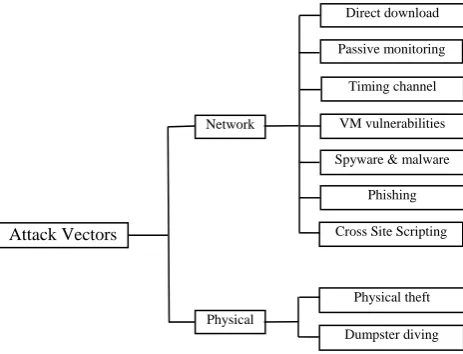
This section reports the results of data analysis about data exfiltration attack vectors. This section is meant to answer RQ1, “What are the attack vectors used by remote attackers to steal data from an individual or an organization?” Technical methods for extracting data from an individual or an organisation’s systems range from obvious methods commonly seen in attacks to niche vectors and cutting-edge methods for covertly moving data past current detection systems. It is worth noting that the attack vectors used by external attackers to steal data are not limited to what is highlighted in this section. There exists a large number of such attack vectors that have already been widely described in the computer security literature. For the details on these attack vectors, readers are referred to [14-16]. We highlight only those attack vectors that are mostly reported in our included data exfiltration countermeasures (108 countermeasures). That means that either the countermeasure is directly designed or evaluated with these attack vectors or there is some level of reflection from the countermeasure that makes the authors believe that such a countermeasure is most suitable for defence against a particular attack vector. For example, we found around 31 countermeasures applicable against malware attacks, so malware attacks have been included. We found only two and one countermeasure applicable to inference attack vector and Sybil attack vector respectively, so we have not included inference attack and Sybil attack in this section. Whilst these attack vectors have already been described in the literature, there is no specific categorization of these attack vectors. We categorize the included attack vectors based on the guidelines of thematic analysis [13]. The identified attack vectors can be categorized in a number of ways such as who initiates the attack (insider or outsider), what is the medium used for data exfiltration (network or physical) or what is the size of data to be leaked? Since we do not cover attacks initiated by an insider in our review, we decided to categorize the data exfiltration attacks based on the used medium. Fig. 3 shows that our initial categories are network and physical.
8
Fig. 3. Data Exfiltration Attack Vectors.
4.1.Network-based Attack Vectors
Network-based attack vectors include those vectors that use existing network infrastructure for stealing data from an (individual) organization. The identified network-based attack vectors are shown in Fig. 3 and described in following sub-sections.
4.1.1. Direct download
Perhaps the most direct method of data exfiltration for a remote attacker is manipulating a public-facing server into disclosing non-public information, such as through the well-known category of SQL injection attacks. The steps involved in identifying and exploiting such vulnerabilities are well-documented [17-19] and in many cases, the attacks are trivially automated for attackers by downloadable scripts.
4.1.2. Passive monitoring
Sniffing the wireless broadcast traffic is well-known but usually overlooked data exfiltration vector. With many wireless networks still insufficiently secure [20], and businesses making more and more use of wireless-connected laptops, tablets, smartphones and other devices, the threat of attackers passively listening to an organisation’s traffic is a very real one, and many connected devices leak information [21]. Such broadcast-interceptions are not limited to typical wireless networks. A notable example can be the incident in 2009 when it was discovered that military adversaries of the United States in Iraq were able to access the video feeds of Predator drones by simply listening on the correct channel [22]. Any medium which broadcasts information to an unknown number of users – be it a satellite transmission or a corporate wireless network – should sufficiently be secured when it comes to confidential information.
4.1.3. Timing channels
This method of data exfiltration appears in the literature describing threats but rarely in the literature aiming to detect or prevent exfiltration, yet it is a plausible exfiltration vector for sophisticated attackers. A timing channel is an extremely subtle form of a hidden channel which works by sending innocuous packets to an external recipient at particular times, such that the time delay between packets represents a particular byte value [15]. Such a vector is very difficult to detect, as any traffic could potentially be carrying a timing channel, and the communicated information is not embedded in the packets themselves, merely in the delay between them. Examples are channel operating locally via network sockets [23] and even in variations on keyboard usage [24].
4.1.4. Virtual machine vulnerabilities
Modern businesses are increasingly making use of Virtual Machines (VM) hosted by a third party. However, virtualised computing infrastructure carries its own risks with regards to data exfiltration – including the risk of
Attack Vectors
Direct download
Passive monitoring
Timing channel
VM vulnerabilities
Physical theft Spyware & malware
Phishing
Cross Site Scripting
Dumpster diving Network
9
a service provider being able to access data, even encrypted [25] – and a number of papers in our review point out covert channels available to attackers targeting such systems. These threats mostly come from co-residency, where a malicious virtual machine is set up on the same physical machine as a target virtual machine. Such a situation can be detected by the malicious machine [26, 27] using watermarks – unintrusive but identifiable ‘tags’ added to data – to identify the target for infiltration, and then a variety of covert channels can be employed to transfer data from one virtual machine to the other, including exploitation of the physical machine’s cache [28], memory bus [29] or network sockets [23].
4.1.5. Spyware and Malware
Spywares are installed on user’s computer to monitor user’s activity and report back to a third party [30]. Such software is normally used by software providers to enhance their performance by sending relevant updates to users based on their activities. Such monitoring can be used to leak a user’s information. Spyware includes malware, adware, cookies, web bugs, browser hijackers and key loggers [15]. Recently designed malware has the capability to scan user’s personal computer for personal information and send back such information as an email attachment to all email contacts of the user. It is important to note that such an information leakage is initiated by an internal source, therefore, firewalls often fail to detect such exfiltration [14].
4.1.6. Phishing
A very common method for exfiltrating the personal data of an individual is that of phishing. It is a form of social engineering where the individual is invited (usually via email) to visit a fraudulent website, which is set up for exfiltrating personal information of visitors [31]. Upon visiting the fraudulent website, the user is asked to enter username, password, bank account number and similar details, which ultimately leads to landing sensitive personal information in the hands of the hacker. Some of the famous types of phishing attacks include Deceptive phishing, DNS-based phishing, and Search Engine phishing [32].
4.1.7. Cross Site Scripting
Cross Site Scripting (XSS) is another way of stealing personal information from an authenticated session by injecting a malicious script in an attacked website [33]. Once the malicious script executes, it gives an attacker full access to the information held by the trusted website [34]. XSS is a popular method among attackers for stealing information as evident from the recent OWASP ranking [35] where it is considered as the third biggest attack vector for leakage of personal and sensitive information.
4.2.Physical Attack Vectors
Physical attack vectors include those attacks that get unauthorized and illegal physical access to data and move it to a new physical location. The identified physical attack vectors are shown in Fig. 3 and described in the following sub-sections.
4.2.1. Physical theft
Due to a variety of options available to attackers, it is very challenging to detect physical exfiltration of data [15, 16]. Data can be easily leaked by copying it to CD/DVD, USB, floppy drive or even a laptop [15]. It is also possible to first print data and then hide printed material while leaving premises of an organization. Instead of copying or printing sensitive data, an attacker may steal some physical device on which sensitive data is stored [14]. This may happen due to weak physical security at an organization’s premises or due to the carelessness of some individual employee who left a device unattended.
4.2.2. Dumpster diving
10
[image:11.595.73.518.113.324.2]A summary of reported attack vectors is shown in Table 4.
Table 4. Summary of attack vectors.
S# Attack Vector Description Study
Reference
1 Direct download Attack on a public facing server to directly download data [17-19]
2 Passive
monitoring
Passively listening and observing an organization network traffic for identification and leakage of sensitive information
[20-22]
[image:11.595.127.471.500.638.2]3 Timing channels Monitoring timing (instead of actual contents) of network packets and extracting information based on exploitation of time delays between packets
[15, 23, 24]
4 Virtual machine vulnerabilities
Service provider (such as cloud provider) leveraging and providing VM facility has access to personal data of user
[23, 25-29]
Establishment of covert channel for exfiltration of data between two VMs hosted on same physical machine
5 Spyware and
malware
Software used by remote attackers to identify personal information in a computer and send it back to the attacker via some medium such as email attachment.
[14, 15, 30, 36] 6 Phishing An individual is invited to visit a fraudulent website and visiting the website in turn leak the personal
information of the individual.
[31, 37]
7 Cross site scripting
Injects malicious script in a website which in turn gives attacker an access to personal information of users held by the trusted website
[33-35]
8 Physical theft Copying sensitive data to a removable device (CD, DVD, USB etc.) and taking device out of the organization [14-16] Stealing data in printed form from an organization
9 Dumpster diving Careless and weak practices of destroying sensitive information gives adversary an opportunity to search weakly destroyed material for information of his interest
[14]
5.
RQ2. Countermeasures
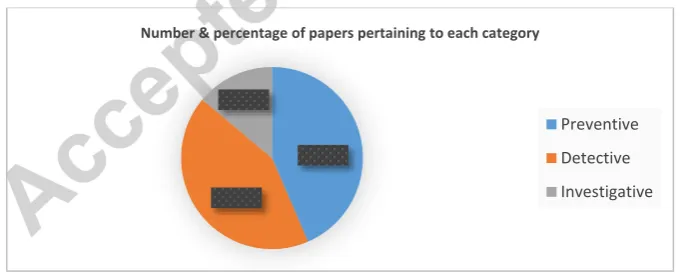
This section reports results of the data analysis about data exfiltration countermeasures. This analysis is meant to answer RQ2, “What are the countermeasures for preventing, detecting and investigating data exfiltration?” As mentioned in Section 3.3, we employed Thematic Analysis method to produce the results reported in this section. The research community has presented a number of solutions to address the issue of data exfiltration. At the abstract level, these countermeasures can be divided into three categories based upon whether a countermeasure is preventing, detecting or investigating data exfiltration. In some cases, these aims overlap such as a particular countermeasure may both prevent and detect data exfiltration or another countermeasure may both detect and investigate an exfiltration attempt. But this is not the case always and wherever a countermeasure addresses multiple aims, it is clearly mentioned with the specific countermeasure. Our selected studies include preventive, detective and investigative countermeasures. The number and percentage of the selected studies related to each of these three categories are shown in Fig. 4. It can be seen that the research community is primarily focussing on preventive and detective countermeasures, while investigative countermeasures lack sufficient exploration.
Fig. 4. Statistics of surveyed papers based on category
A possible reason for such a lack of focus on investigative countermeasures could be that individuals and organizations are more interested in protecting their data rather than identifying when, how and who leaked their data. It appears that researchers have focused on preventive countermeasures followed by detective countermeasures as deploying preventive and detective countermeasures is more effective (as compared to investigative countermeasure) for stopping or at least reducing data exfiltration.
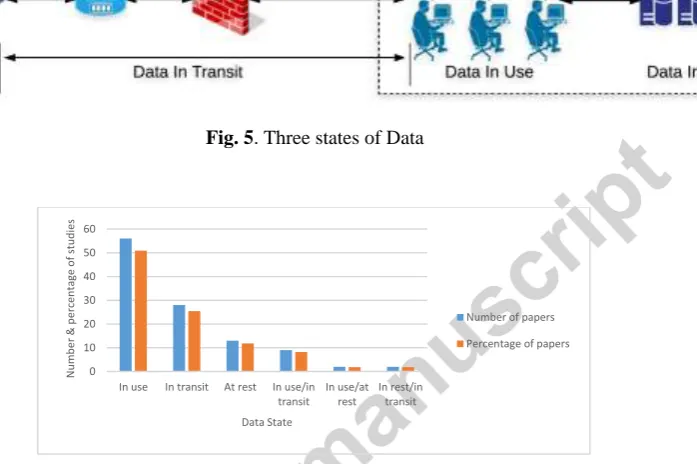
Another important aspect of our research is to focus on the state of the data; in use, in transit, and at rest as depicted in Fig. 5. Data in use is the data that is not just stored rather being processed by an application or a
Number & percentage of papers pertaining to each category
Preventive
Detective
11
user. Data in transit is the data that is in the form of transmission from one node of a network to another node of the same or another network. Data at rest is the data that is stored in a storage device (hard drive or mobile device) and is not currently under any kind of processing. A data exfiltration countermeasure addresses data in single or combination of two states as shown in Fig. 6. Most of the countermeasure address data in “in use” state. A possible reason can be that data in use is susceptible to various kinds of vulnerabilities and it is challenging to protect data in this state [38].
[image:12.595.78.523.160.266.2]Fig. 5. Three states of Data
Fig. 6. Number and percentage of selected studies pertaining to each data state.
5.1.Classification of countermeasures
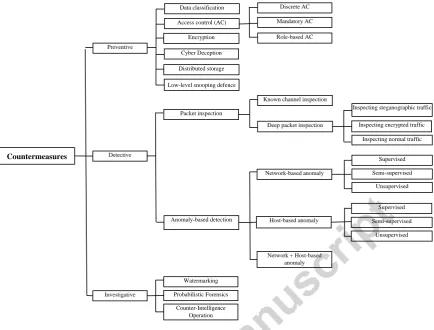
Since the number of countermeasures pertaining to each of the three basic categories (preventive, detective and investigative) was quite high, we have further categorized the countermeasures based on our thematic analysis as reported in Section 3.3. For the basis of such a categorization, we had several options such as types of applications, methodological approaches or domains. On one hand, categorizing the extracted countermeasures based on the types of applications would result in too many categories and on the other hand categorizing the countermeasures based on domains would result in very few categories. Therefore, our categorization of countermeasures is based on the methodological approaches used to address a particular aim (preventive, detective, investigative) relevant to data exfiltration. Our classification of countermeasures is shown in Fig. 7.
0 10 20 30 40 50 60
In use In transit At rest In use/in transit
In use/at rest
In rest/in transit
N
u
mb
er
& p
ercen
tage
o
f
st
u
d
ies
Data State
[image:12.595.140.489.218.450.2]12
Fig. 7. Classification of Data exfiltration countermeasures
5.1.1. Preventive countermeasures
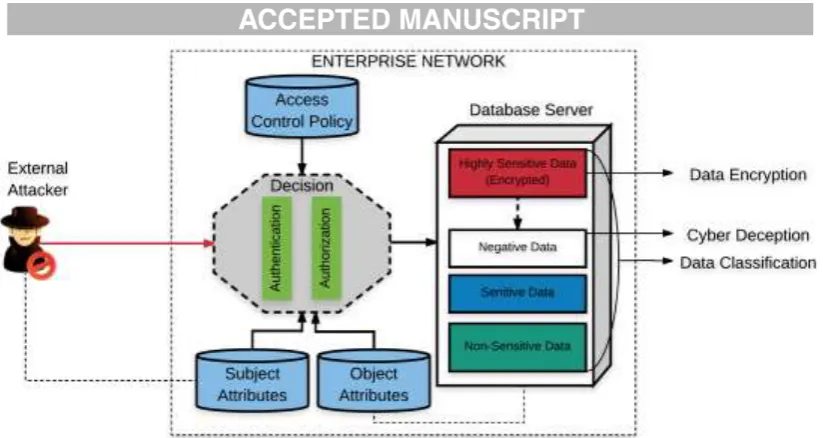
This category includes the countermeasures for preventing an attacker from stealing data. Preventive countermeasures are proactive and resistive in nature. Unlike reactive countermeasures (detective) that comes into play once an attack is detected, preventive countermeasures are more proactive to resist against data exfiltration attempts. These countermeasures are incorporated in the endpoint devices (such as PCs, Laptops, and Servers) to control access to the data resided on these devices or apply particular security tactics (such as encryption, data classification, and cyber deception) to help secure data against exfiltration attacks. Preventive countermeasures are primarily applicable to protect data that is currently under processing (data in use) or stored in a database server (data in rest). A simple scenario of how preventive countermeasures can defend against data exfiltration attack is depicted in Fig. 8. As shown, several preventive countermeasures (Access Control, Encryption, Cyber Deception, and Data Classification) have been employed by the enterprise. Data is classified into different classes based on the sensitivity of data and highly sensitive data is encrypted to enforce strong security measures. Similarly, a chunk of data is shown as negative data. This negative data is a fake copy of the highly sensitive data to deceive attackers. Access control is enforced to stop unauthorized access to the data. Preventive countermeasures are further divided into six categories. The papers pertaining to each category are shown in Fig. 9 and analysed in the following sections.
Countermeasures
Preventive
Detective
Investigative
Data classification
Access control (AC)
Encryption
Cyber Deception
Distributed storage
Low-level snooping defence
Packet inspection
Anomaly-based detection
Known channel inspection
Deep packet inspection
Inspecting steganographic traffic
Inspecting encrypted traffic
Inspecting normal traffic Discrete AC
Mandatory AC
Role-based AC
Network-based anomaly
Host-based anomaly
Network + Host-based anomaly
Supervised
Semi-supervised
Unsupervised
Supervised
Semi-supervised
Unsupervised
Watermarking
Probabilistic Forensics
13
[image:14.595.93.505.52.271.2]Fig. 8: Depiction of Preventive Countermeasures incorporated in an Enterprise
Fig. 9. Papers pertaining to each category in Preventive countermeasures
5.1.1.1. Data classification
[image:14.595.81.519.297.604.2]14
Liu et al. [39] present an approach, called SeCage, for separating secret data and corresponding code manipulating this secret data from the rest of the data (non-secret data) and code. Such a separation helps to prevent leakage of data through memory disclosure attack both at application and OS level. Entire data and code are divided into two compartments (secret compartment and main compartment) using static and dynamic analysis. This separation ensures that only functions inside the secret compartment can access the secret data. SeCage utilizes hardware-based virtualization to ensure strong isolation between secret and main compartments. If any function outside of the secret compartment tries to access the secret data, SeCage notifies hypervisor to handle the violation. The proposed approach protect against various attacks such as buffer over-read attack and hijacking attacks. Also, SeCage stops an attack from stealing data directly from services or through attacks such as timing channel and passive monitoring. Based on the results reported after evaluating the approach, this work seems quite solid, the incorporation of such an approach requires high processing capability. Similarly, the semi-automatic nature of SeCage deployment makes this approach relatively labour-intensive.
Using keyword filtering and data labelling, Li et al. [40] present a technique for preventing leakage of unstructured data from an organization. According to this technique, unstructured data is classified into four categories (highly sensitive, sensitive, internal, and public) based on sensitivity level. After classification, public-private key pairs are assigned to data of highly sensitive, sensitive and internal levels. Data of these three categories is labelled using EIGamal signature algorithm. When data leaves an organizational network, network protection server filters the unstructured data to check if the source IP is organization’s network IP and destination IP is external. Next, network protection server filters the cover and attachments with the data using mirror traffic and sensitive keywords. If any sensitive keyword is detected, the public key is used to verify the label. If the label is verified, data is considered sensitive and is blocked. The monitoring of outgoing traffic via network protection server can protect against data leakage attacks such as SQL injection, phishing, and malware attacks, but such it is unclear how much delay has been caused by such extensive monitoring and verification. The real significance of the technique can only be obtained through a formal evaluation. Whilst authors outline the steps for implementing the proposed technique, there is no such evaluation presented that can specify the detection rate or delay caused by the incorporation of the proposed technique.
Alneyadi et al. [41] present an approach to classifying any document leaving the premises of an organization based on the secrecy level using statistical term weighing analysis and if a document is classified of high secrecy level then required blocking actions are taken. Term weighing is a way for defining the importance of each term in a document. The weight of each term inside a document is calculated using Term Frequency-Inverse Document Frequency (TF-IDF) function. Based on the outcome of TF-IDF, a document is classified into a level of secrecy (no restriction, restricted, and top secret). For testing the proposed DLP, 360 documents were divided into three categories (known, partially known, and unknown) based on whether the specific document is known to the DLP. The proposed DLP showed significant detection rates (96.67% and 80.83%) for known and unknown documents, but it failed to detect unknown documents (57.22%) to a reasonable accuracy rate. Similar to Li et al. [40], this approach will protect against data leakage via attacks like phishing, malware, however, it is not reported that how much delay has been introduced in the network flow due to the incorporation of this approach.
Salperwyck et al. [42] highlight an exfiltration vector posed by data analyses which rely on combining public data with private data, where they suspect some portion of the infrastructure around the public data may be attempting to exfiltrate the private information – such as spyware on a public machine. Their solution proposes that private data are kept on a specialised hardware device, which is designed to be resilient to tampering, and that the processing regarding the private data is handled on the specialised device, removing the need for it to be loaded into memory on an untrusted machine. This scheme is resilient to direct leakage of the whole of a private dataset through spyware attacks and demonstrates a solution to one of the trickier areas of policy enforcement. However, it leaves open secondary avenues such as leakage through examining the content of queries to the public dataset and of course the eventually distributed results of the analysis. The authors do not mention the implications of executing queries on a USB device in terms of query processing time for hidden data. This approach requires specialized hardware that might not be a feasible option for several individuals and organizations.
15
different network zones based on the sensitivity of data and nodes. Any data packet or node belonging to a particular zone cannot enter another zone unless it passes through specified filters and gateways. A network manager can promote a node from lower to a higher security zone. The proposed architecture reduces the possibility of data leakage via direct copy-paste, emailing, botnets and malware attacks, however, this approach can have significant performance plenty as a result of having a porthole and promoting nodes. With the requests for changing zones going through a network manager can have scalability issues, so an automation support is required.
Schmidt et al. [44] present Trustbox, a system designed to handle sensitive data by restricting users’ ability to leak it. The system consists of a trusted virtual machine, which can access sensitive data via an IPSec tunnelled connection to a network storage device. A restricted set of applications allow users to manage an office suite or email but prevent the use of browsers or instant messaging applications – usage of which can be handled in a separate untrusted VM that has restricted ability to communicate with the trusted VM. Email communication is similarly monitored by a deep packet inspection tool. These are all features of a remote client, with some gaps in perimeter security that might be exploited (e.g., user encryption of data to be exfiltrated), but the authors also note that offline usage of the system – and access to data – is desirable, and address this via having the trusted VM check out sensitive data to the local encrypted virtual hard-drive. Whilst a combination of a locked-down virtual environment, secure local storage of data, and preventing the use of portable storage media enhances data protection against attacks like phishing, malware, and physical theft, this approach decreases the data transfer rate from 72.6 MB/sec to 41.3 MB/sec due to the full disk encryption. Similarly, starting an application (e.g., Microsoft Excel) inside a virtual machine instead of a physical machine leads to increased start-up time, which in this case increases from 671 milliseconds to 1104 milliseconds.
Bhandari et al. [45] present a framework for secure storage and retrieval of data from the cloud using data classification, detecting errors in data during transmission via Hashed Message Authentication Code (HMAC), and index building. With this approach, data is first classified into three sections (i.e., public, private, and limited) based on confidentiality, integrity, and availability. Then data is indexed using index building so that it can be searched after encryption. After encrypting data using RSA and adding HMAC to it, data is stored in a cloud. While retrieving the data, a user receives the requested data in encrypted form. The encrypted data is decrypted using the keyword provided by the data owner. A user can apply HMAC check to verify the integrity of the downloaded data. The encrypted transmission and verification of transmitted data help prevent against passive monitoring, however, the framework involves several manual steps that make the adaptation of the framework unrealistic. The authors argue that their approach is better than RSA for ensuring data security in the cloud; however, the paper does not provide any reasoning for justification of this point. The authors do not provide any details about the implementation of the framework.
5.1.1.2. Access control
It is important to enforce authentication and authorization mechanisms for ensuring that only legitimate users with the required credentials can access the data. Such access control mechanisms help the preventive systems to differentiate between legitimate and malicious users. Authentication verifies that a user who wants to access the system is already a registered user while authorization ensures that although the user is a registered one, even such a user should only be granted access to the resources for which the user has already registered. For effectively securing the data and other services, the rule of least possible privilege should be implemented so that users should be granted access to least possible required resource. Although, access control mechanisms provide sufficient defence against attackers who intends to steal data, but such mechanisms cannot be fully relied upon particularly while data is in transit [4]. Access control policies found in the literature can primarily be divided into three categories; mandatory, role-based and discretionary [46]. Access control is in itself a particularly rich area of study and a plethora of techniques has been proposed to control unauthorized access to resources. Of the several access control approaches, only a few are briefly described here.
5.1.1.2.1. Mandatory Access Control
16
Liu et al. [48] attempt to prevent data leakage through the application of a form of encrypted file system coupled with an authentication server. Rather than actually encrypt the data, their scheme encrypts access functionality (passwords) defined when the file is created. This scheme means exfiltration attempts focused on data stored on disk remain entirely feasible. Policy enforcement is relegated to control of the appropriate passwords for files, the assumption being that passwords are given out in accordance with policy. In contrast with the far-reaching scheme of Van’t Noordende et al. [49], who leverages mobile agents to allow content providers to have control over access to their data, this proposition more realistically reflects achievable objectives in security practices. However, it seems the combination of special user-space file system, encryption, and authentication server would most likely affect the I/O performance if a large amount of data is being processed. The paper does not provide any evaluation of the proposed approach.
Squicciarini et al. [50] began with work which looked at various accesses to data – such as indexing – which could violate privacy or data protection concerns with data stored in the cloud. They address this concern with nested JAR files, which bind data to a policy consisting of a service level agreement between tenant and service provider about the permitted access to and use of data. The authors take this further by introducing the notion of autonomous security-aware objects (SAOs) [51] which protect encapsulated data by applying security policies associated with data. The encapsulated data is protected by cryptographic techniques. The protection is defined in the formal security policy, which places conditions on actions relating to the data. The policy of decryption on the fly and transferring data to the content rendering application protects against unauthorized copying. Authors provide a detailed experimental evaluation of the proposed approach. The protection offered is more powerful as it enables different levels of authorisation and access to the protected data. It would appear from various design decisions – including that both government and service provider policies have priority over data owner policies – that the system intends to protect only against exfiltration via certain levels of malicious intrusion, and not, for example, a compromise of cloud service provider’s systems.
Chen et al. [52] go further in the same direction and propose a joint software and hardware approach, called DataSafe, to self-protecting data at rest, in transit and during execution. Rather than the model of [50, 51], where access to data is managed with reference to agreed policies, Chen and colleagues consider the situation where a process is unvetted and the process operating on the data is unaware of policies. As well as preventing unauthorised access, the DataSafe architecture aims at preventing dissemination to unauthorised recipients. For preventing dissemination to unauthorized recipients, the high-level security policy for sensitive data is translated into hardware enforceable tags and a Secure Data Compartment (SDC) is created where these tags are associated with the sensitive data residing in the memory. The enforcement of unpassable output control in DataSafe prevent against data breaches through malware installed on authorized machines. The authors compare their idea with the related ideas to demonstrate the superiority of their approach in terms of translating software policies and runtime data tracking. However, the proposed approach has several limitations in terms of performance and cost. The redirection of file calls and setting of SDCs by the DataSafe software is a computationally expensive operation. Similarly, tracking of information flow by DataSafe hardware costs in terms of performance.
The traditional access control measures control access to the file level and not to the individual records in a file while it is quite possible that some records in a file may contain sensitive information. Ulusoy et al. [53] present a framework, GaurdMR, which provides fine-grained access control mechanism at the key-level in MapReduce systems [54] by dynamically creating authorized views of the data based on the roles of a user in an organization. GaurdMR consists of two main modules: Access Control and Reference Monitor. The access control module consists of filters and roles, which are used to create authorized views of data for a specific user. The reference monitor takes input from access control module about security policies and ensures the enforcement of these security policies in a MapReduce system. The datasets (Twitter textual data and Google image data) seem quite adequate for the required evaluation. The high processing and storage capability (8 core processor and 32 GB main memory) may hinder the adaptation of the proposed approach to ensuring controlled access in a system. The incorporation of this approach would also lead to a small overhead in performance as compared to other related approaches (Integrated and Vigiles System) shown by the authors in their experimental evaluation.
17
key’s management on the client side by storing the security control information for each file in the form of a separate security control file along with the corresponding encrypted data file. Authors introduce a proxy server, which is responsible for authentication and access control. The proxy server leverages the security control information stored with the data file to authenticate and authorize various operations. This security architecture can provide defence against well know attacks that include DoS attack, passive monitoring, timing channel attacks, and rollback attacks. The authors provide sufficient evaluation and comparison with eCryptfs [56] (related approach) for justification of the proposed architecture. The evaluation demonstrates that a single proxy server can handle 45,000 user requests per second, which is quite admirable. Whilst the access control through a proxy server enhances security to prevent data leakages, it reduces the performance efficiency by 7%-13%.
Cheng et al. [57] present a hypervisor-based approach, AppShield, for protecting data, code and execution integrity of an application against OS level malware attacks. In this design, hypervisor separates the address space for application to be protected from the rest of the applications. After separation of address space, any access request from the kernel first gets authorised through system call and then permitted to access the protected application. A system call from the application to kernel may also contain sensitive data and AppShiled provides Spatial protection [58] to such data to ensure that OS access only authorized data. Based on the evaluation and implementation details, AppShield seems a reliable approach for controlling unauthorized access to resources. However, AppShield protection introduces a performance overhead of 0.2% to 10.3%.
Suzuki et al. [59] develop an operating system, called Salvia, with a focus on preventing data leakage. Salvia has two distinct file types: regular files, which can be protected with existing file access controls and “privacy files”, which are related to certain data protection policies. These policies are enforced with reference to the contexts surrounding the process accessing a file – these ranging from data such as the connected wireless network ESSID to the system call history of a process. In the policies associated with “privacy files”, system calls available to a process are made conditional upon the contexts of that process at the time a call is attempted, with system call functionality broadly grouped to enable easier policy-writing. The implementation of Salvia shows that compared to Linux OS, Salvia on average takes extra 10.35 us in processing a file. The results show that registering of entries in system call histories consumes extra memory. The experiments were conducted in 2007 on a machine with limited processing power and memory (1.0 GHz processor and 256 MB RAM).
5.1.1.2.2. Role-based Access Control
Unlike mandatory access control where data objects are labelled, in role-based access control users are assigned a particular role (e.g., developer, tester, accountant) and based on the role of the user, access is granted to various resources [47]. A number of studies propose role-based access control mechanisms.
Doshi et al. [60] present a multi-layer security framework for a database to prevent data leakage. The proposed framework consists of three security layers: (1) Role-based Access control: intercept user’s requested query to check whether the user has the privilege for accessing requested table. The request query is forwarded to next layer (Row-based access control) only if user has required privilege else request is rejected (2) Row-based Access Control: If there is any security policy defined at the row level, the requested query is forwarded only if it complies with the security policy else request is rejected (3) Column-based Access Control: If there is any security policy defined at the column level, the requested query is entertained only if it complies with defined column-level security policy else request is rejected. The proposed security framework can protect web applications against SQL injection and blind injection attacks. The authors claim that the proposed approach does not introduce any overhead in performance and deployment, which seems unrealistic based on the fact that introduction of three security layers would definitely have some effect on query processing time. The evaluation provided is quite weak in the sense that the authors have tested the approach for a very simple and single scenario and the results obtained from such a scenario cannot be generalized.
18
seems a significant contribution, however, this work is primarily theoretical and needs some rigorous experimental evaluation for confirmation of its reliability. Since most of the data on social media is in unstructured form, it will be interesting to look into the transformation rules for unstructured data too.
Gampala et al. [62] propose model controls access of a user using these steps: (1) User requests for uploading or downloading from cloud (2) user is authenticated by asking several personal questions and if user provides a wrong answer for four consecutive times, user is blacklisted, otherwise, the user is given an access (3) a one-time password is sent to the user’s email and phone number for next log-in (4) if a user wants to upload a file, the file is encrypted using enhanced elliptic curve cryptography [63] (5) Next time, if the user wants to download file, the file is decrypted using elliptic curve cryptography. The proposed approach can help in preventing the access of a hacker, who had stolen the credentials (username and password) of a user or website admin using an attack vector such as phishing, spyware, or XSS, to personal information resided in the rest state in a cloud. However, this approach is not quite user-friendly as a legitimate user may not be willing to answer several questions each time for a login. It is unknown how the approach has been evaluated.
Oostendorp et al. [64] present a combination of perimeter security policies offered by firewalls and the more flexible Domain and Type Enforcement (DTE) operating system level access policies. They extend DTE over network communications by treating individual packets as objects with their own attributes: the type of information, the domain (of the source) and the DTE uid of the source process. Specified relations between DTE objects then define the access controls across a network. The authors describe the deployment of the system to control exported services, with DTE policies controlling access to local resources and permitting only valid clients to communicate with their respective servers. In this approach, firewalls will only allow ingress network traffic if a DTE policy exists for that particular flow between two processes belonging two DTE domains. As long as data flows occur between known DTE domains, access control can be applied. We see this as a plausible solution to police network-based data traffic between virtual machines or containers on a cloud platform. A set of containerised microservice instances can be determined to belong to a particular DTE domain; these can be forced to communicate only with microservices in another DTE domain as allowed by access policies. This ensures that rogue processes are not allowed to interact with microservices processing sensitive data. It is unclear, on the other hand, how this solution applies to an untrusted model where a software process in a known DTE domain needs to interact with another process in an unknown domain. Also, policy enforcement requires that inter-DTE-domain communication always occurs in a closed loop; if attackers were able to take over one of the processes, for instance by injecting code (e.g. stack smashing), then the solution will be ineffective.
Muthukumaran et al. [65] describe FlowWatcher for mitigating data exfiltration in web applications by monitoring HTTP traffic under the shadow of User Data Access (UDA) policy. The authors define the access policy language, UDA policy language, which is used to define the intended access model by relating users to the data they are going to interact. Since FlowWatcher only monitors HTTP communication, therefore, UDA policy language defines the access policy based on information contained in HTTP communication. This language is designed to accommodate evolving access control requirements dynamically. FlowWatcher sits between the user and web application to monitor HTTP requests and responses. After intercepting a user’s request, FlowWatcher updates the access policy based on matching credentials of a user’s request with updates rules. Next, FlowWatcher forwards the request to the web application and waits for the response. Upon intercepting the response, FlowWatcher checks if the response contains any data that should not be seen by the user. If any such data is found, the response is modified to remove this data else original response is forwarded to the users. FlowWatcher seems an effective countermeasure for preventing XSS attacks as it strips all HTML tags from the response body. The strength of this work lies in its rigours evaluation where authors wrote and tested UDA policies for 7 web applications. The effect on performance also seems negligible as results show a maximum of 10% increase in CPU utilization. As a whole, FlowWatcher seems an applicable approach for monitoring data in transit and in use for malicious exfiltration.