Unsupervised Machine Learning for Networking:
Techniques, Applications and Research Challenges
Muhammad Usama
1, Junaid Qadir
1, Aunn Raza
2, Hunain Arif
2, Kok-Lim Alvin Yau
3,
Yehia Elkhatib
4, Amir Hussain
5, Ala Al-Fuqaha
61Information Technology University (ITU)-Punjab, Lahore, Pakistan
2School of EE and CS, National University of Sciences and Technology (NUST), Pakistan 2Sunway University, Malaysia
4MetaLab, School of Computing and Communications, Lancaster University, UK 5University of Stirling, United Kingdom
6Western Michigan University, United States of America
Abstract—While machine learning and artificial intelligence have long been applied in networking research, the bulk of such works has focused on supervised learning. Recently there has been a rising trend of employing unsupervised machine learn-ing uslearn-ing unstructured raw network data to improve network performance and provide services such as traffic engineering, anomaly detection, Internet traffic classification, and quality of service optimization. The interest in applying unsupervised learning techniques in networking emerges from their great success in other fields such as computer vision, natural language processing, speech recognition, and optimal control (e.g., for developing autonomous self-driving cars). Unsupervised learning is interesting since it can unconstrain us from the need of labeled data and manual handcrafted feature engineering thereby facilitating flexible, general, and automated methods of machine learning. The focus of this survey paper is to provide an overview of the applications of unsupervised learning in the domain of networking. We provide a comprehensive survey highlighting the recent advancements in unsupervised learning techniques and describe their applications for various learning tasks in the context of networking. We also provide a discussion on future directions and open research issues, while also identifying potential pitfalls. While a few survey papers focusing on the applications of machine learning in networking have previously been published, a survey of similar scope and breadth is missing in literature. Through this paper, we advance the state of knowledge by carefully synthesizing the insights from these survey papers while also providing contemporary coverage of recent advances.
I. INTRODUCTION
Networks—such as the Internet and mobile telecom networks—serve the function of the central hub of modern human societies, which the various threads of modern life weave around. With networks becoming increasingly dynamic, heterogeneous, and complex, the management of such net-works has become less amenable to manual administration, and can benefit from leveraging support from methods for optimization and automated decision-making from the fields of artificial intelligence (AI) and machine learning (ML). Such AI and ML techniques have already transformed multiple fields— e.g., computer vision, natural language processing (NLP), speech recognition, and optimal control (e.g., for developing
autonomous self-driving vehicles)—with the success of these techniques mainly attributed to firstly, significant advances in unsupervised ML techniques such as deep learning, secondly, the ready availability of large amounts of unstructured raw data amenable to processing by unsupervised learning algorithms, and finally, advances in computing technologies through ad-vances such as cloud computing, graphics processing unit (GPU) technology and other hardware enhancements. It is anticipated that AI and ML will also make a similar impact on the networking ecosystem and will help realize a future vision of cognitive networks [1] [2], in which networks will self-organize and will autonomously implement intelligent network-wide behavior to solve problems such as routing, scheduling, resource allocation, and anomaly detection.
The initial attempts towards creating cognitive or intelligent networks have relied mostly onsupervised ML methods, which are efficient and powerful, but are limited in scope by their need for labeled data. With network data becoming increas-ingly voluminous (with a disproportionate rise in unstructured unlabeled data), there is a groundswell of interest in leveraging
unsupervised ML methodsto utilize unlabeled data, in addition to labeled data where available, to optimize network perfor-mance [12]. The rising interest in applying unsupervised ML in networking applications also stems from the need to liberate ML applications from restrictive demands of supervised ML for labeled networking data, which is expensive to curate at scale (since labeled data may be unavailable and manual annotation prohibitively inconvenient) in addition to being suspect to being outdated quickly (due to the highly dynamic nature of computer networks) [13].
We are already witnessing the failure of human network administrators to manage and monitor all bits and pieces of network [14], and the problem will only exacerbate with fur-ther growth in the size of networks with paradigms such as the Internet of things (IoT). An ML-based network management system (NMS) is desirable in such large networks so that faults/bottlenecks/anomalies may be predicted in advance with reasonable accuracy. In this regard, networks already have ample amount of untapped data, which can provide us with decision-making insights making networks more efficient and self-adapting. With unsupervised ML, the pipe dream is that
Survey paper Published In Year # Refer-ences
Areas Focused Unsupervised ML
Deep Learning
Pitfalls Future Challenges Patcha et al. [3] Elsevier
Computer Networks
2007 100 ML for Network Intrusion Detec-tion
≈ × × √
Nguyen et al. [4] IEEE COMST 2008 68 ML for Internet Traffic Classifica-tion
≈ × × ×
Bkassiny et al. [5] IEEE COMST 2013 177 ML for Cognitive Radios ≈ × × ×
Alsheikh et al. [6] IEEE COMST 2015 152 ML for WSNs ≈ × × √
Buczak et al. [7] IEEE COMST 2016 113 ML for Cyber Security Intrusion Detection
≈ × × √
Klaine et al. [8] IEEE COMST 2017 269 ML in SONs ≈ × × √
Meshram et al. [9] Springer Book Chapter
2017 16 ML for Anomaly Detection in In-dustrial Networks
≈ × × √
Fadlullah et al. [10] IEEE COMST 2017 260 ML for Network Traffic Control ≈ √ × √
Hodo et al. [11] ArXiv 2017 154 ML Network Intrusion Detection ≈ √ × ×
This Paper - 2017 323 Unsupervised ML in Networking √ √ √ √
TABLE I: Comparison of our paper with existing survey and review papers. (Legend: √means covered; ×means not covered; ≈means partially covered.)
every algorithm for adjusting network parameters (be it, TCP congestion window or rerouting network traffic in peak time) will optimize itself in a self-organizing fashion according to the environment and application, user, and network’s Quality of Service (QoS) requirements and constraints [15]. Unsupervised ML methods, in concert with existing supervised ML methods, can provide a more efficient method that lets a network manage, monitor, and optimize itself, while keeping the human administrators in the loop with the provisioning of timely actionable information.
Unsupervised ML techniques facilitate the analysis of raw datasets, thereby helping in generating analytic insights from unlabeled data. Recent advances in hierarchical learning, clus-tering algorithms, factor analysis, latent models, and outlier detection, have helped significantly advance the state of the art in unsupervised ML techniques. Unsupervised ML has many applications such as feature learning, data clustering, dimensionality reduction, anomaly detection, etc. In particular, recent unsupervised ML advances—such as the development of “deep learning” techniques [16]—have however signifi-cantly advanced the ML state of the art by facilitating the processing of raw data without requiring careful engineering and domain expertise for feature crafting. The versatility of deep learning and distributed ML can be seen in the diversity of their applications that range from self-driving cars to the reconstruction of brain circuits [16]. Unsupervised learning is also often used in conjunction with supervised learning in a
semi-supervised learningsetting to preprocess the data before analysis and thereby help in crafting a good feature represen-tation and in finding patterns and structures in unlabeled data.
The rapid advances in deep neural networks, the democrati-zation of enormous computing capabilities through cloud com-puting and distributed comcom-puting, and the ability to store and process large swathes of data, have motivated a surging interest in applying unsupervised ML techniques in the networking field. The field of networking also appears to be well suited to, and amenable to applications of unsupervised ML tech-niques, due to the largely distributed decision-making nature of its protocols, the availability of large amounts of network data, and the urgent need for intelligent/cognitivenetworking.
Consider the case of routing in networks. Networks these days have evolved to be very complex, and they incorporate multiple physical paths for redundancy and utilize complex routing methodologies to direct the traffic. Our application traffic does not always take the optimal path we would expect, leading to unexpected and inefficient routing performance. To tame such complexity, unsupervised ML techniques can autonomously self-organize the network taking into account a number of factors such as real-time network congestion statistics as well as application QoS requirements [17].
The purpose of this paper is to highlight the important advances in unsupervised learning, and after providing a tutorial introduction to these techniques, to review how such techniques have been, or could be, used for various tasks in modern next-generation networks comprising both computer networks as well as mobile telecom networks.
Fig. 1: Outline of the Paper
of the unsupervised ML trends, as well as the suitability of various unsupervised ML techniques. A tabulated comparison of our paper with other existing survey and review articles is presented in Table I.
Organization of the paper: The organization of this paper is depicted in Figure 1. Section II provides a discussion on various unsupervised ML techniques (namely, hierarchi-cal learning, data clustering, latent variable models, outlier detection and reinforcement learning). Section III presents a survey of the applicationsof unsupervised ML specifically in the domain of computer networks. Section IV describes future work and opportunities with respect to the use of unsupervised ML in future networking. Section V discusses a few major pitfalls of the unsupervised ML approach and its models. Finally, Section VI concludes this paper. For the reader’s facilitation, Table II shows all the acronyms used in this survey for convenient referencing.
II. TECHNIQUES FORUNSUPERVISEDLEARNING
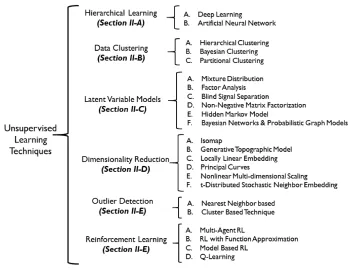
In this section, we will introduce some widely used unsuper-vised learning techniques and their applications in computer networks. We have divided unsupervised learning techniques into five major categories: hierarchical learning, data cluster-ing, latent variable models, outlier detection, and reinforcement learning. Figure 2 depicts a taxonomy of unsupervised learning
techniques and also notes the relevant sections in which these techniques are discussed.
A. Hierarchical Learning
Fig. 2: Taxonomy of Unsupervised Learning Techniques
unlabeled data and generate a feature vector on the basis of which further tasks are performed.
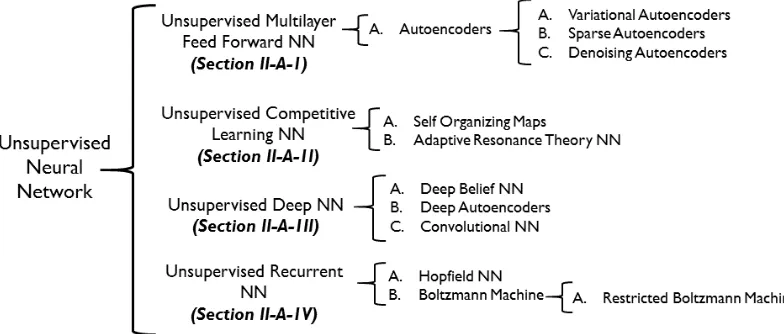
Hierarchical learning is intimately related to two strongly correlated areas: deep learning and neural networks. In partic-ular, deep learning techniques benefits from the fundamental concept of artificial neural networks (ANNs), a deep structure consists of multiple hidden layers with multiple neurons in each layer, a nonlinear activation function, a cost function and a back-propagation algorithm. Deep learning [21] is a hierarchical technique that models high level abstraction in data using many layers of linear and nonlinear transformations. With deep enough stack of these transformation layers, a machine can self-learn a very complex model or representation of data. Learning takes place in hidden layers and the optimal weights and biases of the neurons are updated in two passes, namely, feed forward and back-propagation. A typical ANN and typical cyclic and acyclic topologies of interconnection between neurons are shown in Figure 3. A brief taxonomy of Unsupervised NNs is presented in Figure 4.
An ANN has three types of layers (namely input, hidden and output, each having different activation parameters). Learning
is the process of assigning optimal activation parameters enabling ANN to perform input to output mapping. For a given problem, an ANN may require multiple hidden layers involving long chain of computations, i.e., itsdepth[34]. Deep learning has revolutionized ML and is now increasingly being used in diverse settings—e.g., object identification in images, speech transcription into text, matching user’s interests with
items (such as news items, movies, products) and making recommendations, etc. But until 2006, relatively few people were interested in deep learning due to the high computational cost of deep learning procedures. It was widely believed that training deep learning architectures in an unsupervised manner was intractable, and supervised training of deep NNs (DNN) also showed poor performance with large generalization errors [35]. However, recent advances [36]–[38] have shown that deep learning can be performed efficiently by separate unsuper-vised pre-training of each layer with the results revolutionizing the field of ML. Starting from the input (observation) layer, which acts as an input to the subsequent layers, pre-training tends to learn data distributions while the usual supervised stage performs local search for fine-tuning.
1) Unsupervised Multilayer Feed Forward NN: Unsuper-vised multilayer feed forward NN, with reference to graph theory, has a directed graph topology as shown in Figure 3. It consists of no cycles, i.e., does not have feedback path in input propagation through NN. Such kind of NN is often used to approximate a nonlinear mapping between inputs and required outputs. Autoencoders are the prime examples of unsupervised multilayer feed forward NNs.
approxima-Fig. 3: Illustration of an ANN (Left); Different types of ANN topologies (Right)
Fig. 4: Taxonomy of Unsupervised Neural Networks
tion function and trained using backpropagation and stochastic gradient decent (SGD) techniques. Autoencoders are the first of their kind to use back-propagation algorithm to train with unlabeled data. Autoencoders aim to learn compact represen-tation of the function of input using the same number of input and output units with usually less hidden units to encode a feature vector. They learn the input data function by recreating the input at the output, which is called encoding/decoding, to learn at the time of training NN. In short, a simple autoencoder learns low-dimensional representation of the input data by exploiting similar recurring patterns.
Autoencoders have different variants [39] such as varia-tional autoencoders, sparse autoencoders, and denoising au-toencoders. Variational autoencoderis an unsupervised learn-ing technique used clusterlearn-ing, dimensionality reduction and visualization, and for learning complex distributions [40]. In a sparse autoencoder, a sparse penalty on the latent layer is
applied for extracting unique statistical feature from unlabeled data. Finally, denoising autoencoders are used to learn the mapping of a corrupted data point to its original location in the data space in unsupervised manner for manifold learning and reconstruction distribution learning.
2) Unsupervised Competitive Learning NN: Unsupervised competitive learning NNs is a winner-take-all neuron scheme, where each neuron competes for the right of the response to a subset of the input data. This scheme is used to remove the re-dundancies from the unstructured data. Two major techniques of unsupervised competitive learning NNs are self-organizing maps and adaptive resonance theory NNs.
[image:5.612.110.502.276.443.2]TABLE II: List of common acronyms used
ADS Anomaly Detection System
A-NIDS Anomaly & Network Intrusion Detection System AI Artificial Intelligence
ANN Artificial Neural Network ART Adaptive Resonance Theory BSS Blind Signal Separation
BIRCH Balanced Iterative Reducing and Clustering Using Hierarchies CDBN Convolutional Deep Belief Network
CNN Convolutional Neural Network CRN Cognitive Radio Network DBN Deep Belief Network DDoS Distributed Denial of Service
DNN Deep Neural Network DNS Domain Name Service
DPI Deep Packet Inspection EM Expectation-Maximization GTM Generative Topographic Model GPU Graphics Processing Unit GMM Gaussian Mixture Model HMM Hidden Markov Model
ICA Independent Component Analysis IDS Intrusion Detection System IoT Internet of Things LSTM Long Short-Term Memory
LLE Locally Linear Embedding LRD Low Range Dependencies MARL Multi-Agent Reinforcement Learning
ML Machine Learning MLP Multi-Layer Perceptron
MRL Model-based Reinforcement Learning MDS Multi-Dimensional Scaling MCA Minor Component Analysis NMF Non-Negative Matrix Factorization NMS Network Management System
NN Neural Network
NMDS Nonlinear Multi-dimensional Scaling OSPF Open Shortest Path First
PU Primary User
PCA Principal Component Analysis PGM Probabilistic Graph Model QoE Quality of Experience QoS Quality of Service
RBM Restricted Boltzmann Machine RL Reinforcement Learning
RLFA Reinforcement Learning with Function Approximation RNN Recurrent Neural Network
SDN Software Defined Network SOM Self-Organizing Map SON Self-Organizing Network SVM Support Vector Machine SON Self Organizing Network SSAE Shrinking Sparse Autoencoder
TCP Transmission Control Protocol
t-SNE t-Distributed Stochastic Neighbor Embedding TL Transfer Learning
VoIP Voice over IP
VoQS Variation of Quality Signature VAE Variational Autoencoder WSN Wireless Sensor Network
activated in a real-valued output, results having only single neuron (or group of neurons), called winning neuron. This is achieved by creating lateral inhibition connections (negative feedback paths) between neurons [43]. In this orientation, the network determines the winning neuron within several itera-tions; subsequently it is forced to reorganize itself based on the input data distribution (hence they are called Self-Organizing Maps). They were initially inspired by the human brain, which has specialized regions in which different sensory inputs are represented/processed by topologically ordered computational
maps. In SOM, neurons are arranged on vertices of a lattice (commonly one or two dimensions). The network is forced to represent higher-dimensional data in lower-dimensional rep-resentation by preserving the topological properties of input data by using neighborhood function while transforming the input into a topological space in which neuron positions in the space are representatives of intrinsic statistical features that tell us about the inherent nonlinear nature of SOMs.
Training a network comprising SOM is essentially a three-stage process after random initialization of weighted connec-tions. The three stages are as follow [44].
• Competition: Each neuron in the network computes its value using a discriminant function, which provides the basis of competition among the neurons. Neuron with the largest discriminant value in the competition group is declared the winner.
• Cooperation:The winner neuron then locates the center of the topological neighborhood of excited neurons in the previous stage, providing a basis for cooperation among excited neighboring neurons.
• Adaption: The excited neurons in the neighborhood increase/decrease their individual values of discriminant function in regard to input data distribution through subtle adjustments such that the response of the win-ning neuron is enhanced for similar subsequent input. Adaption stage is distinguishable into two sub-stages: (1) the ordering or self-organizing phase, in which weight vectors are reordered according to topological space; and (2) the convergence phase, in which the map is fine-tuned and declared accurate to provide statistical quantification of the input space. This is the phase in which the map is declared to be converged and hence trained.
One essential requirement in training a SOM is the redun-dancy of the input data to learn about the underlying structure of neuron activation patterns. Moreover, sufficient quantity of data is required for creating distinguishable clusters; with-standing enough data for classification problem, there exist a problem of gray area between clusters and creation of infinitely small clusters where input data has minimal patterns.
TABLE III: Applications of Hierarchical Learning/ Deep Learning in Networking Applications
Reference Technique Brief Summary
Internet Traffic Classification
Lotfollahi et al. [22] SAE & CNN SAE and CNN were used for feature extraction from the Internet traffic data for classification and characterizing purpose.
Wang et al. [23] CNN CNN is used to extract features from the Internet traffic where traffic is considered as an image for malware detection.
Yousefi et al. [24] Autoencoder Autoencoder is used as a generative model to learn the latent feature representation of network traffic vector, for cyber attack detection and classification.
Anomaly/Intrusion Detection
Aygun et al. [25] Denoising Autoen-coder
Stochastically Improved autoencoder and denosing autoencoder are used to learn feature for zero day anomaly detection in Internet traffic.
Putchala et al. [26] RNN Gated recurrent unit and random forest techniques are used for feature extraction and anomaly detection in IoT data.
Tuor et al. [27] RNN RNN and DNN are employed to extract feature from raw data which then used for threat assessment and insider threat detection in data streams.
Network Operations, Optimization and Analytics
Aguiar et al. [28] Random Neural
Network
Random neural network are used for extracting the quality behavior of multimedia application for improving the QoE of multimedia applications in wireless mesh network.
Piamrat et al. [29] Random Neural Network
Random neural network are used for learning the mapping between QoE score and technical parameters so that it can give QoE score in real-time for multimedia applications in IEEE 802.11 wireless networks.
Emerging Networking Application of Unsupervised Learning
Karra et al. [30] DNN&CNN Hierarchical learning is used for feature extraction from spectrogram snap shots of signal for modulation detection in communication system based on software defined radio.
Zhang et al. [31] CNN Convolutional filters are used for feature extraction from cognitive radio waveforms for automatic recognition.
Moysen et al. [32] ANN Authors expressed ANN as a recommended system to learn the hierarchy of the output, which is later used in SON.
Xie et al. [33] RNN RNN variant LSTM is used for learning memory based hierarchy of time interval based IoT sensor data, from smart cities datasets.
among neurons to accommodate any new information.
ART model resonates around (top-down) observer expecta-tions and (bottom-up) sensory information while keeping their difference within the threshold limits of vigilance parameter, which in result is considered as the member of the expected class of neurons [45]. Learning of an ART model primarily consists of a comparison field, recognition field, vigilance (threshold) parameter and a reset module. The comparison field takes an input vector, which in result is passed, to best match in the recognition field; the best match is the current winning neuron. Each neuron in the recognition field passes a negative output in proportion to the quality of the match, which inhibits other outputs therefore exhibiting lateral inhibitions (competitions). Once the winning neuron is selected after a competition with the best match to the input vector, the reset module compares the quality of the match to the vigilance threshold. If the winning neuron is within the threshold, it is selected as the output, else the winning neuron is reset and the process is started again to find the next best match to the input vector. In case where no neuron is capable to pass the threshold test, a search procedure begins in which the reset module disables recognition neurons one at a time to find a correct match whose weight can be adjusted to accommodate the new match, therefore ART models are called self-organizing and can deal with the plasticity/stability dilemma.
3) Unsupervised Deep NN: In recent years unsupervised deep NN has become the most successful unsupervised struc-ture due to its application in many benchmarking problems and applications [46]. Three major types of unsupervised deep NNs are deep belief NNs, deep autoencoders, and convolutional NNs.
Deep Belief NN: Deep Belief Neural Network or simply Deep Belief Networks (DBN) is a probability based generative graph model that is composed of hierarchical layers of stochas-tic latent variables having binary valued activations, which are referred as hidden units or feature detectors. The top layers in DBNs have undirected, symmetric connections between them forming associative memory. DBNs provide a breakthrough in unsupervised learning paradigm. In the learning stage, DBN learns to reconstruct its input, each layer acting as feature detectors. DBN can be trained by greedy layer-wise training starting from the top layer with raw input, subsequent layers are trained with the input data from the previous visible layer [36]. Once the network is trained in unsupervised manner and learned the distribution of the data, it can be fine tuned using supervised learning methods, or supervised layers can be concatenated in order to achieve the desired task (for instance, classification).
the first of which is used to encode the input vector, while the second decodes. By the end of the training of the deep autoencoder, it tends to reconstruct the input vector at the output neurons, and therefore the central layer between both DBNs is the actual compressed feature vector.
Convolutional NN: Convolutional NN (CNN) are feed for-ward NN in which neurons are adapted to respond to overlap-ping regions in two-dimensional input fields such as visual or audio input. It is commonly achieved by local sparse connections among successive layers and tied shared weights followed by rectifying and pooling layers which results in transformation invariant feature extraction. Another advantage of CNN over simple multilayer NN is that it is compara-tively easier to train due to sparsely connected layers with the same number of hidden units. CNNs represent the most significant type of architecture for computer vision as they solve two challenges with the conventional NNs: 1) scalable and computationally tractable algorithms are needed for pro-cessing high-dimensional images; and 2) algorithms should be transformation invariant since objects in an image can occur at an arbitrary position. However, most CNNs are composed of supervised feature detectors in the lower and middle hidden layers. In order to extract features in an unsupervised manner, a hybrid of CNN and DBN, called Convolutional Deep Belief Network (CDBN), is proposed in [47]. Making probabilistic max-pooling1 to cover larger input area and convolution as an inference algorithm makes this model scalable with higher dimensional input. Learning is processed in an unsupervised manner as proposed in [37], i.e., greedy layer-wise (lower to higher) training with unlabeled data.
CDBN is a promising scalable generative model for learning translation invariant hierarchical representation from any high-dimensional unlabeled data in an unsupervised manner taking advantage of both worlds, i.e., DBN and CNN. CNN, being widely employed for computer vision applications, can be employed in computer networks for optimization of Quality of Experience (QoE) and Quality of Service (QoS) of multimedia content delivery over networks, which is an open research problem for next generation computer networks [48].
4) Unsupervised Recurrent NN: Recurrent NN (RNN) is the most complex type of NN, and hence the nearest match to an actual human brain that processes sequential inputs. It can learn temporal behaviors of a given training data. RNN employs an internal memory per neuron to process such sequential inputs in order to exhibit the effect of previous event on the next. Compared to feed forward NNs, RNN is a stateful network. It may contain computational cycles among states, and uses time as the parameter in the transition function from one unit to another. Being complex and recently developed, it is an open research problem to create domain-specific RNN models and train them with a sequential data. Specifically, there are two perspectives of RNN to be discussed in the scope of this survey, namely, the depth of the architecture and the training of the network. The depth, in the case of a
1Max-pooling is an algorithm of selecting the most responsive receptive
field of a given interest region.
simple artificial NN, is the presence of hierarchical nonlinear intermediate layers between the input and output signals. In the case of a RNN, there are different hypotheses explaining the concept of depth. One hypothesis suggests that RNNs are inherently deep in nature when expanded with respect to sequential input; there are a series of nonlinear computations between the input at timet(i)and the output at timet(i+k). However, at an individual discrete time step, certain tran-sitions are neither deep nor nonlinear. There exist input-to-hidden, hidden-input-to-hidden, and hidden-to-output transitions, which are shallow in the sense that there are no intermediate nonlinear layers at discrete time step. In this regard, different deep architectures are proposed in [49] that introduce interme-diate nonlinear transitional layers in between the input, hidden and output layers. Another novel approach is also proposed by stacking hidden units to create hierarchical representation of hidden units, which mimic the deep nature of standard deep NNs.
Due to the inherent complex nature of RNN, to the best of our knowledge, there is no widely adopted approach for training RNNs and many novel methods (both supervised and unsupervised) are introduced to train RNNs. Considering unsupervised learning of RNN in the scope of this paper, Klapper-Rybicka et al. [50] employ Long Short-term Memory (LSTM) RNN to be trained in an unsupervised manner using unsupervised learning algorithms, namely Binary Information Gain Optimization and Non-Parametric Entropy Optimization, in order to make a network to discriminate between a set of temporal sequences and cluster them into groups. Results have shown remarkable ability of RNNs for learning temporal sequences and clustering them based on a variety of features. Two major types of unsupervised recurrent NN are Hopfield NN and Boltzmann machine.
Hopfield NN: Hopfield NN is a cyclic recurrent NN where each node is connected to other. Hopfield NN provides an abstraction of circular shift register memory with nonlinear activation functions to form a global energy function with guaranteed convergence to local minima. Hopfield NNs are used for finding clusters in the data without a supervisor.
Boltzmann Machine: Boltzmann machine is a stochastic symmetric recurrent NN that is used for search and learn-ing problems. Due to binary vector based simple learnlearn-ing algorithm of Boltzmann machine, very interesting features representing the complex unstructured data can be learned [51]. Since Boltzmann machine uses multiple hidden layers as feature detectors, the learning algorithm becomes very slow. To avoid the slow learning and to achieve faster feature detection instead of Boltzmann machine, a faster version, namely restricted Boltzmann machine (RBM), is used for practical problems [52]. Restricted Boltzmann machine learns a probability distribution over its input data. It is faster than a Boltzmann machine because it only uses one hidden layer as feature detector layer. RBM is used for dimensionality reduc-tion, clustering and feature learning in computer networks.
creat-Fig. 5: Clustering process
ing intelligent systems in computer vision and natural language processing whereas their application in computer networks are very limited, they are employed in different networking applications such as classification of traffic, anomaly/intrusion detection, detecting Distributed Denial of Service (DDoS) attacks, and resource management in cognitive radios [53]. The motivation of using DNN for learning and predicting in net-works is the unsupervised training that detects hidden patterns in ample amount of data that is near to impossible for a human to handcraft features catering for all scenarios. Moreover, many new research shows that a single model is not enough for the need of some applications, so developing a hybrid NN architecture having pros and cons of different models creates a new efficient NN which provides even better results. Such an approach is used in [54], in which a hybrid model of ART and RNN is employed to learn and predict traffic volume in a computer network in real time. Real-time prediction is essential to adaptive flow control, which is achieved by using hybrid techniques so that ART can learn new input patterns without re-training the entire network and can predict accurately in the time series of RNN. Furthermore, DNNs are also being used in resource allocation and QoE/QoS optimizations. Using NN for optimization, efficient resource allocation without affecting the user experience can be crucial in the time when resources are scarce. Authors of [55], [56] propose a simple DBN for optimizing multimedia content delivery over wireless networks by keeping QoE optimal for end users. Table III also provides a tabulated description of hierarchical learning in networking applications. However, these are just a few notable examples of deep learning and neural networks in networks, refer to Section III for more applications and detailed discussion on deep learning and neural networks in computer networks.
B. Data Clustering
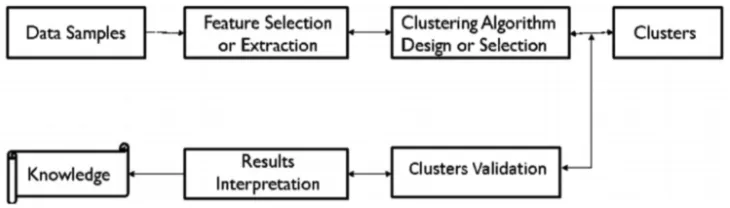
Clustering is an unsupervised learning task that aims to find hidden patterns in unlabeled input data in the form of clusters [57]. Simply put, it encompasses arrangement of data in meaningful natural groupings on the basis of the similarity between different features(as illustrated in Figure 5) to learn about its structure. Clustering involves the organization of data in such a way that there is high intra-cluster and low inter-cluster similarity. The resulting structured data is termed as
data-concept[58]. Clustering is used in numerous applications
from the fields of ML, data mining, network analysis, pattern recognition and computer vision. The various techniques used for data clustering are described in more detail later in Section II-B. In networking, clustering techniques are widely deployed for applications such as traffic analysis and anomaly detection in all kinds of networks (e.g., wireless sensor networks and mobile adhoc networks), with anomaly detection [59].
Clustering improves performance in various applications. McGregor et al. [60] propose an efficient packet tracing ap-proach using the Expectation-Maximization (EM) probabilistic clustering algorithm, which groups flows (packets) into a small number of clusters, where the goal is to analyze network traffic using a set of representative clusters.
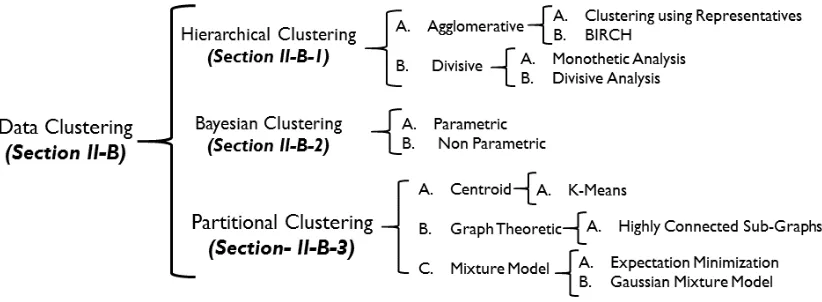
A brief overview of different types of clustering methods and their relationships can be seen in Figure 6. Clustering can be divided into three main types [61], namely hierarchical clustering, Bayesian clustering, and partitional clustering. Hierarchical clustering creates a hierarchical decomposition of data, whereas Bayesian clustering forms a probabilistic model of the data that decides the fate of a new test point probabilistically. In contrast, partitional clustering constructs multiple partitions and evaluates them on the basis of certain criterion or characteristic such as the Euclidean distance.
Before delving into the general sub-types of clustering, there are two unique clustering techniques, which need to be discussed, namely density-based clusteringandgrid-based clustering. In some cases, density-based clustering is classified as a partitional clustering technique; however, we have kept it separate considering its applications in networking. Density-based models target the most densely populated area of a data space, and separates it from areas having low densities, thus forming clusters [62]. Chen and Tu [63] use density-based clustering to cluster data stream in real time, which is important in many applications (e.g., intrusion detection in networks). Another technique is grid-based clustering, which divides the data space into cells to form a grid-like structure; subsequently, all clustering actions are performed on this grid [64]. Leung and Leckie [64] also present a novel approach that uses customized grid-based clustering algorithm to detect anomalies in networks.
[image:9.612.129.494.53.157.2]Fig. 6: Clustering Taxonomy
1) Hierarchical Clustering: Hierarchical clustering is a well-known strategy in data mining and statistical analysis in which data is clustered into a hierarchy of clusters us-ing an agglomerative (bottom up) or a divisive (top down) approach. Almost all hierarchical clustering algorithms are unsupervised and deterministic. The primary advantage of hierarchical clustering over unsupervised K-means and EM algorithms is that it does not require the number of clusters to be specified beforehand. However, this advantage comes at the cost of computational efficiency. Common hierarchical clustering algorithms have at least quadratic computational complexity compared to the linear complexity of K-means and EM algorithms. Hierarchical clustering methods have a pitfall: these methods fail to accurately classify messy high-dimensional data as its heuristic may fail due to the structural imperfections of empirical data. Furthermore, the computa-tional complexity of the common agglomerative hierarchical algorithms is NP-hard. SOM, as discussed in Section II-A2, is a modern approach that can overcome the shortcomings of hierarchical models [65].
2) Bayesian Clustering: Bayesian clustering is a proba-bilistic clustering strategy where the posterior distribution of the data is learned on the basis of a prior probability distribution. Bayesian clustering is divided into two major categories, namely parametric and non-parametric [66]. Major difference between parametric and non-parametric techniques is the dimensionality of parameter space: if there are finite dimensions in the parameter space, the underlying technique is called Bayesian parametric; otherwise, the underlying tech-nique is called Bayesian non-parametric. A major pitfall with the Bayesian clustering approach is that the choice of the wrong prior probability distributions can distort the projection of the data. Kurt et al. [67] performed Bayesian nonparametric clustering of network traffic data to determine the network application type.
3) Partitional Clustering: Partitional clustering corresponds to a special class of clustering algorithms that decomposes data into a set of disjoint clusters. Given n observations, the
clustering algorithm partitions a data into k < n clusters [68]. Partitional clustering is further classified into K-means clustering and mixture models.
a) K-Means Clustering: K-means clustering is a simple, yet widely used approach for classification. It takes a statistical vector as an input to deduce classification models or classifiers. K-means clustering tends to distribute m observations into
n clusters where each observation belongs to the nearest cluster. The membership of an observation to a cluster is determined using the cluster mean. K-means clustering is used in numerous applications in the domains of network analysis and traffic classification. Gaddam et al. [69] use K-means clustering in conjunction with supervised ID3 decision tree learning models to detect anomalies in a network. ID3 decision tree is an iterative supervised decision tree algorithm based on the concept learning system. K-means clustering provided excellent results when used in traffic classification. Yingqiu et al. [70] show that K-means clustering performs well in traffic classification with an accuracy of 90%.
K-means clustering is also used in the domain of network security and intrusion detection. Meng et al. [71] propose a K-means algorithm for intrusion detection. Experimental results on a subset of KDD-99 dataset show that detection rate stays above 96% while the false alarm rate stays below 4%. Results and analysis of experiments on K-means algorithm have demonstrated a better ability to search clusters globally. Another variation of K-means is known as K-medoids, in which rather than taking the mean of the clusters, the most centrally located data point of a cluster is considered as the reference point of the corresponding cluster [72]. Few of the applications of K-medoids in the spectrum of anomaly detection can be seen here [72] [73].
computer vision, ML, etc. Finite mixtures, which are a basic type of mixture model, naturally model observations that are produced by a set of alternative random sources. Inferring and deducing different parameters from these sources based on their respective observations lead to clustering of the set of observations. This approach to clustering tackles drawbacks of heuristic based clustering methods, and hence it is proven to be an efficient method for node classification in any large-scale network and has shown to yield efficient results compared to techniques commonly used. For instance, K-means and hierarchical agglomerative methods rely on supervised design decisions, such as the number of clusters or validity of models [74]. Moreover, combining EM algorithm with mixture models produces remarkable results in deciphering the structure and topology of the vertices connected through a multi-dimensional network [75]. Bahrololum et al. [76] used Gaussian mixture model (GMM) to outperform signature based anomaly detec-tion in network traffic data.
4) Significant Applications of Clustering in Networks:
Clustering can be found in mostly all unsupervised learning problems, and there are diverse applications of clustering in the domain of computer networks. Two major networking applications where significant use of clustering can be seen are intrusion detection and Internet traffic classification. One novel way to detect anomaly is proposed [77], and this approach preprocesses the data using Genetic Algorithm (GA) com-bined with hierarchical clustering approach called Balanced Iterative Reducing using Clustering Hierarchies (BIRCH) to provide an efficient classifier based on Support Vector Machine (SVM). This hierarchical clustering approach stores abstracted data points instead of the whole dataset, thus giving more accurate and quick classification compared to all past meth-ods, producing better results in detecting anomalies. Another approach [64] discusses the use of grid-based and density-based clustering for anomaly and intrusion detection using unsupervised learning. Basically, a scalable parallel framework for clustering large datasets with high dimensions is proposed and then improved by inculcating frequency pattern trees. Ta-ble IV also provides a tabulated description of data clustering applications in networks. These are just few notable examples of clustering approaches in networks: refer to Section III for detailed discussion on some salient clustering applications in the context of networks.
C. Latent Variable Models
A latent variable model is a statistical model that relates the manifest variables with a set of latent or hidden variables. Latent variable model allows us to express relatively complex distributions in terms of tractable joint distributions over an expanded variable space [86]. Underlying variables of a pro-cess are represented in higher dimensional space using a fixed transformation, and stochastic variations are known as latent variable models where the distribution in higher dimension is due to small number of hidden variables acting in a combination [87]. These models are used for data visualization, dimensionality reduction, optimization, distribution learning, blind signal separation and factor analysis. Next we will begin
our discussion on various latent variable models, namely mix-ture distribution,factor analysis,blind signal separation, non-negative matrix factorization,Bayesian networks & probabilis-tic graph models (PGM), hidden Markov model (HMM), and
nonlinear dimensionality reduction techniques (which further includes generative topographic mapping, multi-dimensional scaling,principal curves, Isomap, localliy linear embedding, andt-distributed stochastic neighbor embedding).
1) Mixture Distribution: Mixture distribution is an important latent variable model that is used for estimating the underly-ing density function. Mixture distribution provides a general framework for density estimation by using the simpler para-metric distributions. Expectation maximization (EM) algorithm is used for estimating the mixture distribution model [88], through a maximization of the log likelihood of the mixture distribution model.
2) Factor Analysis: Another important type of latent vari-able model is factor analysis, which is a density estimation model. It has been used quite often in collaborative filtering and dimensionality reduction. It is different from other latent variable models in terms of the allowed variance for different dimensions as most latent variable models for dimensionality reduction in conventional settings use a fixed variance Gaus-sian noise model. In factor analysis model, latent variables have diagonal covariance rather than isotropic covariance.
3) Blind Signal Separation: Blind Signal Separation (BSS), also referred to as Blind Source Separation, is the identification and separation of independent source signals from mixed input signals without or very little information about the mixing process. Figure 7 depicts the basic BSS process in which source signals are extracted from a mixture of signals. It is a fundamental and challenging problem in the domain of signal processing although the concept is extensively used in all types of multi-dimensional data processing. Most common techniques employed for BSS are principal component analysis (PCA) and independent component analysis (ICA).
a) Principal Component Analysis (PCA) is a statistical procedure that utilizes orthogonal transformation on the data to convertnnumber of possibly correlated variables into lesserk
number of uncorrelated variables named principal components. Principal components are arranged in the descending order of their variability, first one catering for the most variable and the last one for the least. Being a primary technique for exploratory data analysis, PCA takes a cloud of data inndimensions and rotates it such that maximum variability in the data is visible. Using this technique, it brings out the strong patterns in the dataset so that these patterns are more recognizable thereby making the data easier to explore and visualize.
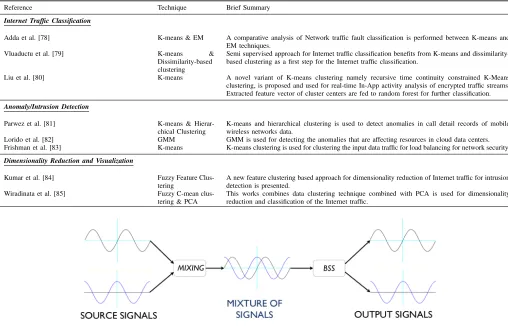
TABLE IV: Applications of Data Clustering in Networking Applications
Reference Technique Brief Summary
Internet Traffic Classification
Adda et al. [78] K-means & EM A comparative analysis of Network traffic fault classification is performed between K-means and EM techniques.
Vluaductu et al. [79] K-means & Dissimilarity-based clustering
Semi supervised approach for Internet traffic classification benefits from K-means and dissimilarity-based clustering as a first step for the Internet traffic classification.
Liu et al. [80] K-means A novel variant of K-means clustering namely recursive time continuity constrained K-Means clustering, is proposed and used for real-time In-App activity analysis of encrypted traffic streams. Extracted feature vector of cluster centers are fed to random forest for further classification.
Anomaly/Intrusion Detection
Parwez et al. [81] K-means & Hierar-chical Clustering
K-means and hierarchical clustering is used to detect anomalies in call detail records of mobile wireless networks data.
Lorido et al. [82] GMM GMM is used for detecting the anomalies that are affecting resources in cloud data centers. Frishman et al. [83] K-means K-means clustering is used for clustering the input data traffic for load balancing for network security.
Dimensionality Reduction and Visualization
Kumar et al. [84] Fuzzy Feature Clus-tering
A new feature clustering based approach for dimensionality reduction of Internet traffic for intrusion detection is presented.
Wiradinata et al. [85] Fuzzy C-mean clus-tering & PCA
This works combines data clustering technique combined with PCA is used for dimensionality reduction and classification of the Internet traffic.
Fig. 7: Blind signal separation (BSS): A mixed signal composed of various input signals mixed by some mixing process is blindly processed (i.e., with no or minimal information about the mixing process) to show the original signals.
data is less than or equal to 1% by which 99% of variance is retained in thekprincipal components. But, depending on the application domain, different designs can increase/decrease the ratio while maximizing the required output. Commonly, many features of a dataset are often highly correlated; hence, PCA results in retaining 99% of the variance while significantly reducing the data dimensions.
b) Independent Component Analysis(ICA) is another tech-nique for BSS that focuses in separating multivariate input data into additive components with the underlying assumption that the components are non-Gaussian and statistically independent. The most common example to understand ICA is the cocktail party problem in which there are n people talking simulta-neously in a room and one tries to listen to a single voice. ICA actually separates source signals from input mixed signal by either minimizing the statistical dependence or maximizing the non-Gaussian property among the components in the input signals by keeping the underlying assumptions valid. Statistically, ICA can be seen as the extension of PCA, while PCA tries to maximize the second moment (variance) of data,
hence relying heavily on Gaussian features; on the other hand, ICA exploits inherently non-Gaussian features of the data and tries to maximize the fourth moment of linear combination of inputs to extract non-normal source components in the data [90].
5) Hidden Markov Model: Hidden Markov Model (HMM) are stochastic models of great utility, especially in domains where we wish to analyze temporal or dynamic processes such as speech recognition, primary users (PU) arrival pattern in cognitive radio networks (CRNs), etc. HMMs are highly relevant to CRNs since many environmental parameters in CRNs are not directly observable. An HMM-based approach can analytically model a Markovian stochastic process in which we do not access to the actual states, which are assumed to be unobserved or hidden; instead, we can observe a state that is stochastically dependent on the hidden state. It is for this reason that an HMM is defined to be a doubly stochastic process: first, the underlying stochastic process is not observ-able; and second, another stochastic process, dependent on the underlying stochastic process, that produces a sequence of observed symbols [93].
6) Bayesian Networks & Probabilistic Graph Models (PGM): In Bayesian learning we try to find the posterior probability distributions for all parameter settings, in this setup, we ensure that we have a posterior probability for every possible parameter setting. It is computationally expensive but we can use complicated models with small dataset and still avoid overfitting. Posterior probabilities are calculated by dividing the product of sampling distribution and prior distribution by marginal likelihood; in simple words posterior probabilities are calculated using Bayes theorem. Basis of re-inforcement learning was also derived by using Bayes theorem [94]. Since Bayesian learning is computationally expensive a new research trend is approximate Bayesian learning [95]. Authors in [96] has given a comprehensive survey of different approximate Bayesian inference algorithms. With the emer-gence of Bayesian deep learning framework the deployment of Bayes learning based solution is increasing rapidly.
Probabilistic graph modeling is a concept associated with Bayesian learning. A model representing the probabilistic relationship between random variables through a graph is known as probabilistic graph model (PGM). Nodes and edges in the graph represent a random variable and their probabilistic dependence, respectively. PGM are of two types: directed PGM and undirected PGM. Bayes networks also fall in the regime of directed PGM. PGM are used in many important areas such as computer vision, speech processing and communication systems. Bayesian learning combined with PGM and latent variable models forms a probabilistic framework where deep learning is used as a substrate for making improved learning architecture for recommender systems, topic modeling, and control systems [97].
7) Significant Applications of Latent Variable Models in Networks: In [98], authors have applied latent structure on email corpus to find interpretable latent structure as well as evaluating its predictive accuracy on missing data task. A dynamic latent model for social network is represented in [99]. A characterization of the end-to-end delay using a Weibull mixture model is discussed in [100]. Mixture models for end host traffic analysis has been explored in [101]. BSS is a set of statistical algorithms that are widely used in different applica-tion domains to perform different tasks such as dimensionality
reduction, correlating and mapping features, etc. Yan et al. [102] employ PCA for Internet traffic classification in order to separate different types of flows in a network packet stream. Similarly, authors of [103] employ PCA for feature learning and a supervised SVM classifier for classification in order to detect intrusion in an autonomous network system. Another approach for detecting anomalies and intrusions proposed in [104] uses NMF to factorize different flow features and cluster them accordingly. Furthermore, ICA has been widely used in telecommunication networks to separate mixed and noisy source signals for efficient service. For example, [105] extends a variant of ICA called Efficient Fast ICA (EF-ICA) for detecting and estimating the symbol signals from the mixed CDMA signals received from the source endpoint.
In other literature, PCA uses a probabilistic approach to find the degree of confidence in detecting anomaly in wireless networks [106]. Furthermore, PCA is also chosen as a method of clustering and designing Wireless Sensor Networks (WSNs) with multiple sink nodes [107]. However, these are just a few notable examples of BSS in networks, refer to Section III for more applications and detailed discussion on BSS techniques in the networking domain.
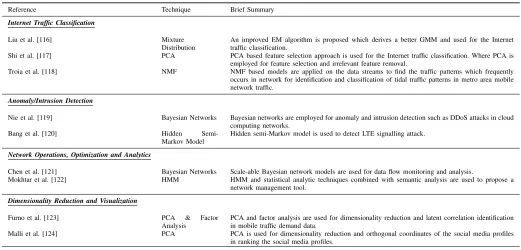
Bayesian learning has been applied for classifying the Internet traffic, where Internet traffic is classified based on the posterior probability distributions. Real discretized conditional probability is used to construct a Bayesian classifier for early traffic identification in campus network has been proposed in [108]. Host level intrusion detection using Bayesian networks is proposed in [109]. Authors in [110] purposed a Bayesian learning based feature vector selection for anomalies classi-fication in BGP. Port scan attacks prevention scheme using Bayesian learning approach is discussed in [111]. Internet threat detection estimation system is presented in [112]. A new approach towards outlier detection using Bayesian belief networks is described in [113]. Application of Bayesian net-works in MIMO systems has been explored in [114]. Location estimation using Bayesian network in LAN is discussed in [115]. Similarly Bayes theory and PGM are both used in Low Density Parity Check (LDPC) and Turbo codes, which are the fundamental components of information coding theory. Table V also provides a tabulated description of latent variable models applications in networking.
D. Dimensionality Reduction
TABLE V: Applications of Latent Variable Models in Networking Applications
Reference Technique Brief Summary
Internet Traffic Classification
Liu et al. [116] Mixture
Distribution
An improved EM algorithm is proposed which derives a better GMM and used for the Internet traffic classification.
Shi et al. [117] PCA PCA based feature selection approach is used for the Internet traffic classification. Where PCA is employed for feature selection and irrelevant feature removal.
Troia et al. [118] NMF NMF based models are applied on the data streams to find the traffic patterns which frequently occurs in network for identification and classification of tidal traffic patterns in metro area mobile network traffic.
Anomaly/Intrusion Detection
Nie et al. [119] Bayesian Networks Bayesian networks are employed for anomaly and intrusion detection such as DDoS attacks in cloud computing networks.
Bang et al. [120] Hidden
Semi-Markov Model
Hidden semi-Markov model is used to detect LTE signalling attack.
Network Operations, Optimization and Analytics
Chen et al. [121] Bayesian Networks Scale-able Bayesian network models are used for data flow monitoring and analysis.
Mokhtar et al. [122] HMM HMM and statistical analytic techniques combined with semantic analysis are used to propose a network management tool.
Dimensionality Reduction and Visualization
Furno et al. [123] PCA & Factor Analysis
PCA and factor analysis are used for dimensionality reduction and latent correlation identification in mobile traffic demand data.
Malli et al. [124] PCA PCA is used for dimensionality reduction and orthogonal coordinates of the social media profiles in ranking the social media profiles.
sometimes used interchangeably with feature selection [127] [128], a subtle difference exists between the two [129]. Feature selection is traditionally performed as a supervised task with a domain expert helping in handcrafting a set of critical features of the data. Such an approach generally can perform well but is not scalable and prone to judgment bias. Dimensionality reduction, on the other hand, is more generally an unsupervised task, where instead of choosing a subset of features, it creates new features (dimensions) as a function of all features. Said differently, feature selection considers supervised data labels, while dimensionality reduction focuses on the data points and their distributions in N-dimensional space.
There exist different techniques for reducing data dimen-sions [130] including projection of higher dimensional points onto lower dimensions, independent representation, and sparse representation, which should be capable of reconstructing the approximate data. Dimensionality reduction is useful for data modeling, compression, and visualization. By creating repre-sentative functional dimensions of the data and eliminating redundant ones, it becomes easier to visualize and form a learning model. Independent representation tries to disconnect the source of variation underlying the data distribution such that the dimensions of the representation are statistically in-dependent [21]. Sparse representation technique represents the data vectors in linear combinations of small basis vectors.
It is worth noting here that many of the latent variable models (e.g., PCA, ICA, factor analysis) also function as tech-niques for dimensionality reduction. In addition to techtech-niques such as PCA, ICA—which infer the latent inherent structure of the data through a linear projection of the data—a number of nonlinear dimensionality reduction techniques have also been
developed and will be focused upon in this section to avoid repetition of linear dimensionality reduction techniques that have already been covered as part of the previous subsection. Linear dimensionality reduction techniques are useful in many settings but these methods may miss important nonlinear structure in the data due to their subspace assumption, which posits that the high-dimensional data points lie on a linear subspace (for example, on a 2-D or 3D plane). Such an assumption fails in high dimensions when data points are random but highly correlated with neighbors. In such environ-ments nonlinear dimensionality reductions through manifold learning techniques—which can be construed as an attempt to generalize linear frameworks like PCA so that nonlinear structure in data can also be recognized—become desirable. Even though some supervised variants also exist, manifold learning is mostly performed in an unsupervised fashion using the nonlinear manifold substructure learned from the high-dimensional structure of the data from the data itself without the use of any predetermined classifier or labeled data. Some nonlinear dimensionality reduction (manifold learning) tech-niques are described below:
1) Isomap: Isomap is a nonlinear dimensionality reduction technique that finds the underlying low dimensional geometric information about the dataset. Algorithmic features of PCA and MDS are combined to learn the low dimensional nonlinear manifold structure in the data [131]. Isomap uses geodesic distance along the shortest path to calculate the low dimension representation shortest path, which can be computed using Dijkstra’s algorithm.
map-ping from continuous low dimensional distributions embedded in high dimensional spaces [132]. Data space in GTM is rep-resented as reference vectors and these vectors are a projection of latent points in data space. It is a probabilistic variant of SOM and works by calculating the Euclidean distance between data points. GTM optimizes the log likelihood function, and the resulting probability defines the density in data space.
3) Locally Linear Embedding: Locally linear embedding (LLE) [125] is an unsupervised nonlinear dimensionality re-duction algorithm. LLE represents the data in lower dimen-sions yet preserving the higher dimensional embedding. LLE depicts data in single global coordinate of lower dimensional mapping of input data. LLE is used to visualize multi-dimensional multi-dimensional manifolds and feature extraction.
4) Principal Curves: Principal curves is a nonlinear dataset summarizing technique where non-parametric curves passes through the middle of multi-dimensional dataset providing the summary of the dataset [133]. These smooth curves minimize the average squared orthogonal distance between data points, this process also resembles to the maximum likelihood for nonlinear regression in the presence of Gaussian noise [134].
5) Nonlinear Multi-dimensional Scaling: Nonlinear multi-dimensional scaling (NMDS) [135] is a nonlinear latent vari-able representation scheme. It works as an alternative scheme for factor analysis. In factor analysis, a multivariate normal distribution is assumed and similarities between different ob-jects are expressed as a correlation matrix. Whereas NMDS does not impose such a condition, and it is designed to reach the optimal low dimensional configuration where similarities and dissimilarities among matrices can be observed. NMDS is also used in data visualization and mining tools for depicting the multi-dimensional data in 3 dimensions based on the similarities in the distance matrix.
6) t-Distributed Stochastic Neighbor Embedding: t-distributed stochastic neighbor embedding (t-SNE) is another nonlinear dimensionality reduction scheme. It is used to represent high dimensional data in 2 or 3 dimensions. t-SNE constructs a probability distribution in high dimensional space and constructs a similar distribution in lower dimensions and minimizes the KullbackLeibler (KL) divergence between two distributions (which is a useful way to measure the difference between two probability distributions) [136].
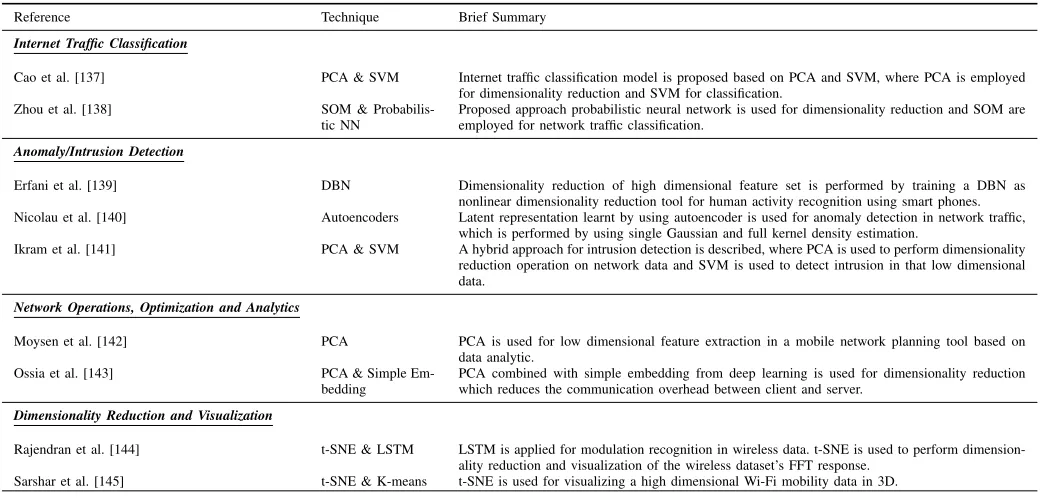
Table VI also provides a tabulated description of dimension-ality reduction applications in networking. The applications of nonlinear dimensionality reduction methods are later described in detail in Section III-D.
E. Outlier Detection
Outlier detection is an important application of unsupervised learning. A sample point that is distant from other samples is called an outlier. An outlier may occur due to noise, measurement error, heavy tail distributions and mixture of two distributions. There are two popular underlying techniques for unsupervised outlier detection upon which many algorithms are designed, namely nearest neighbor based technique and clustering based method.
1) Nearest Neighbor Based Outlier Detection: Nearest neighbor method works on estimating the Euclidean distances or average distance of every sample from all other samples in the dataset. There are many algorithms based on nearest neighbor based techniques, with the most famous extension of nearest neighbor being k-nearest neighbor technique in which only k nearest neighbors participate in the outlier detection [146]. Local outlier factor is another outlier detection algo-rithm, which works as an extension of the k-nearest neighbor algorithm. Connectivity based outlier factors [147], influenced outlierness [148], and local outlier probability models [149] are few famous examples of the nearest neighbor based techniques.
2) Cluster Based Outlier Detection: Clustering based meth-ods use the conventional K-means clustering technique to find the dense locations in the data and then perform den-sity estimation on those clusters. After denden-sity estimation, a heuristic is used to classify the formed cluster according to the cluster size. Anomaly score is computed by calculating the distance between every point and its cluster head. Local density cluster based outlier factor [150], clustering based multivariate Gaussian outlier score [151] [152] and histogram based outlier score [153] are the famous cluster based outlier detection models in literature. SVM and PCA are also suggested for outlier detection in literature.
3) Significant Applications of Outlier Detection in Networks:
Outlier detection algorithms are used in many different appli-cations such as intrusion detection, fraud detection, data leak-age prevention, surveillance, energy consumption anomalies, forensic analysis, critical state detection in designs, electrocar-diogram and computed tomography scan for tumor detection. Unsupervised anomaly detection is performed by estimating the distances and densities of the provided non-annotated data [154]. More applications of outlier detection schemes will be discussed in Section III
F. Reinforcement Learning
TABLE VI: Applications of Dimensionality Reduction in Networking Applications
Reference Technique Brief Summary
Internet Traffic Classification
Cao et al. [137] PCA & SVM Internet traffic classification model is proposed based on PCA and SVM, where PCA is employed for dimensionality reduction and SVM for classification.
Zhou et al. [138] SOM & Probabilis-tic NN
Proposed approach probabilistic neural network is used for dimensionality reduction and SOM are employed for network traffic classification.
Anomaly/Intrusion Detection
Erfani et al. [139] DBN Dimensionality reduction of high dimensional feature set is performed by training a DBN as nonlinear dimensionality reduction tool for human activity recognition using smart phones. Nicolau et al. [140] Autoencoders Latent representation learnt by using autoencoder is used for anomaly detection in network traffic,
which is performed by using single Gaussian and full kernel density estimation.
Ikram et al. [141] PCA & SVM A hybrid approach for intrusion detection is described, where PCA is used to perform dimensionality reduction operation on network data and SVM is used to detect intrusion in that low dimensional data.
Network Operations, Optimization and Analytics
Moysen et al. [142] PCA PCA is used for low dimensional feature extraction in a mobile network planning tool based on data analytic.
Ossia et al. [143] PCA & Simple Em-bedding
PCA combined with simple embedding from deep learning is used for dimensionality reduction which reduces the communication overhead between client and server.
Dimensionality Reduction and Visualization
Rajendran et al. [144] t-SNE & LSTM LSTM is applied for modulation recognition in wireless data. t-SNE is used to perform dimension-ality reduction and visualization of the wireless dataset’s FFT response.
Sarshar et al. [145] t-SNE & K-means t-SNE is used for visualizing a high dimensional Wi-Fi mobility data in 3D.
how the environment will respond to its actions—i.e., given the state and the action performed therein by the agent, the model predicts stochastically the next state and the expected reward.
To apply RL, the RL model (embedded in each agent) is identified by defining the state, action, and reward represen-tations; this allows an agent access to a range of traditional and extended RL algorithms, such as the multi-agent approach. Most applications that apply RL take advantage of the benefits brought about by its intrinsic characteristics. Notably, RL takes account of a wide range of dynamic factors (e.g., traffic characteristics and channel capacity) affecting the network performance (e.g., throughput) since the reward represents the effects to the network performance. Also, RL does not need a model of the operating environment. This means that an agent can learn without prior knowledge about the operating environment. Nevertheless, the traditional RL approach comes with some shortcomings, particularly its inability to achieve network-wide performance enhancement, large number of state-action pairs, and low convergence rate to the optimal action.
In recent times, there has been exciting developments in combining RL and deep neutral networks to create a more powerful hybrid approach called “deep reinforcement learning” that is also applicable to environments in which there are no handcrafted features available or where state spaces are not fully observed and low dimensional. Such techniques have been used to achieve human-level control that comfortably surpassed the performance of previous algorithms and achieved a level compared to professional human games tester across a set of 49 games including Atari 2600 games, using the
same algorithm, architecture, and hyper-parameters [157]. The generality of such an approach can be used profitably and applied in the future in a number of networking settings. Next, we show some popular extended RL models that have been adopted to address the shortcomings of the traditional RL approach.
1) Multi-agent Reinforcement Learning: While the tradi-tional RL approach enables an individual agent to learn about the optimal action that maximizes the local network perfor-mance, Multi-agent Reinforcement Learning (MARL) enables a set of agents to learn about each other’s information, such as Q-values and rewards, via direct communication or predic-tion to learn about the optimal joint acpredic-tion that maximizes the global performance [158]. A notable difference between MARL and the traditional RL approach is that both own and neighbors’ information is used to update Q-values in MARL, while only own information is used in the traditional RL approach. By using the neighbor agents’ information in the update of the Q-values, an agent takes account of the actions taken by its neighbor agents. This is necessary because an agent’s action can affect and be affected by other agents’ choice of actions in a shared operating environment. As time goes by, the agents select their respective action that is part of the joint action, which maximizes the global Q-value (or network-wide performance) in a collaborative manner. Various kinds of information can be exchanged including the Q-value of the current action [159] and the maximum Q-value of the current state (also called value function) [160].
2) Reinforcement Learning with Function Approximation: