© 2019, IRJET | Impact Factor value: 7.211 | ISO 9001:2008 Certified Journal
| Page 520
Smart Home Application using Internet of Things
Shatrughna Prasad Yadav
1, Abhijeet Kumbhare
2, Ravindra Parab
31
CSIT, Symbiosis University of Applied Sciences, Indore, India
2,3AME, Symbiosis University of Applied Sciences, Indore, India
---***---Abstract -In the recent years the Internet of Things (IoT) has become ubiquitous technology and has made human life more secured, convenient and comfortable. It has enhanced quality of life by providing intelligence feature in the physical objects (sensors and actuators). It has made the connectivity pervasive and has affected the human life in unimaginable way. IoT is being used in many applications which includes smart home, smart city, healthcare, retail management, smart grid, etc. In the present paper IoT has been used for smart home application with the help of Arduino Uno board, Bluetooth, android based smart phone application, sensors, relays, motors and actuators. It has been used to control lights, heating ventilation and air conditioning (HVAC) system, door bell, water pump, garage door and garden management system.
Key Words: Internet of Things, Lighting Control, Smart Home Appliances, Garden Management Systems.
1. INTRODUCTION
Internet of Things have made physical objects intelligent and smart by embedding in them the sensing, computing and communication capabilities. IoT has enabled physical objects as if they can see, hear and talk to each other without any human intervention. The sensors and actuators can share information and coordinate decisions among themselves. IoT has become ubiquitous and has made the connectivity almost pervasive [1]. It has eliminated the physical distance barrier and human interventions by enabling the physical objects with computing and networking capabilities. Figure 1 gives the broad definition of internet of things [2].
Internet of Things
Physical Object (Things)
Sensing (Data)
Communication (Data Streaming)
Computation (Programming)
Applications (services)
[image:1.595.308.560.398.610.2]=
+
+
+
+
Fig – 1:Definition of Internet of Things
Small microcontrollers (sensors) embedded with energy efficient operating systems, communication and transceiver capabilities are connected to the web through a robust network architecture and provides plethora of reliable services with minimum time delay and cost [3].
2. INTERNET OF THINGS ARCHITECTURE
The traditional Internet architecture uses standard protocols and have predefined protocol layers in them. As in the case of international standard organization (ISO) standard open systems interconnection (OSI) model is a seven layered framework. Each of these layers are related to each other with a set of protocols for moving information across the network [4]. These layers are physical, data link, network, transport, session, presentation and application [5]. Similarly in the case of transmission control protocol/internet protocol (TCP/IP) protocol suite, it consists of five layers, such as physical, data link, network, transport and applications layer. It is well known that TCP/IP protocol suite has become a standard internet protocol suite because of its compactness than the OSI model [6]. Figure 2 represents one of the possible 5 layer architecture of IoT.
Device/Physical Layer
Transport Layer
Application Layer
Businees Layer
[image:1.595.39.286.570.674.2]Processing Layer
Fig – 2:Five Layers architecture of IoT
© 2019, IRJET | Impact Factor value: 7.211 | ISO 9001:2008 Certified Journal
| Page 521
perception/device layer, transport layer, processing layer, application layer and business layer [8]. The processing layer acts as a middleware layer to provide additional facilities like storage, analysis and processing. Similarly, the business layer provides business, application and profit model management.
Apart from the two architectures described in the above paragraph, Cisco has suggested seven layer reference model for IoT applications. The seven layers have been termed as seven levels. First level has been specified for physical devices including sensors, machines and devices. Second level has been used for connectivity of communication and processing unit and third level for edge computing for the major focus on data analysis and transformation [9]. The work of data accumulation and storage has been defined in the fourth level, whereas level five performs the job of data aggregation and access. The job of application layer defined in sixth layer is of data analysis, reporting and control. The last and final, seventh level performs the work of collaboration and business process [10].
Similarly, internet engineering task force (IETF) has suggested IoT architecture based on 6 layers: Physical cum data link layer, data adaptation layer, network layer, transport layer, application support layer and application layer. International telecommunications union - telecommunications (ITU-T) reference model has only four layers: device, network, service and application and application layer. Last but not the least, European telecommunication standard institute (ETSI) has developed a set of standard for the network, devices and gateway for machine to machine (M2M) domain architecture based on only two domains: first as device and gateway and the second as application and network domain [11].
3. FOG/ EDGE AND CLOUD COMPUTING FOR IOT
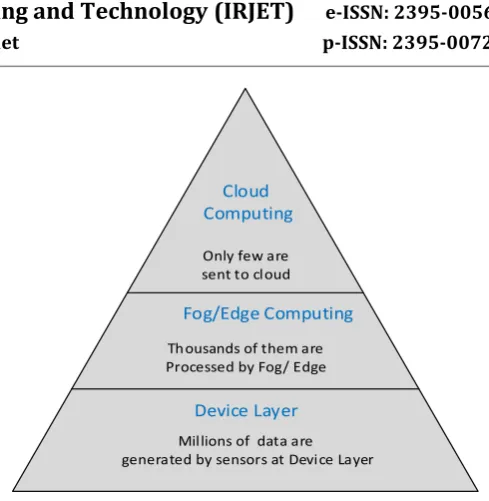
Cloud computing offers services, infrastructure and computational capabilities for on demand network access to a shared pool of configurable resources. But the sensors used in IoT applications generate huge amount of data which requires large computational capabilities and storages resources for the purpose of processing and analysis. Apart from the huge data generated, most of the IoT devices are mobile, requires reliable and real time actuation, power constraint and scalable in nature and hence its dependency on cloud based computing is not reliable and sufficient. The solution of this problem could be to provide computing, analysis and data storage facilities at local level, close to the edge of the network (devices). Figure three represents the overview of fog/edge computing. The data sent to cloud is barely essential data. Most of the computing is done at the fog/edge level itself.
Only few are sent to cloud
Thousands of them are Processed by Fog/ Edge
Millions of data are generated by sensors at Device Layer
Device Layer Fog/Edge Computing
[image:2.595.311.556.50.301.2]Cloud Computing
Fig – 3:Fog/ Edge and Cloud Computing
The fog/edge has features of low latency, location awareness, distributed nodes, mobility and real time response. Apart from these features it can interact with the cloud and send only those data which is required by the cloud. In other words, at one hand it reduces the burden of data handling by cloud and on the other hand it improves the efficiency of services provided by the IoT with enhanced security features and privacy of data [12]. Figure 4 depicts the work of IoT gateway services.
Things Communication Cloud Server Internet
Fig – 4:IoT Gateway services
4. SMART HOME APPLICATION USING IOT
[image:2.595.316.551.443.603.2]© 2019, IRJET | Impact Factor value: 7.211 | ISO 9001:2008 Certified Journal
| Page 522
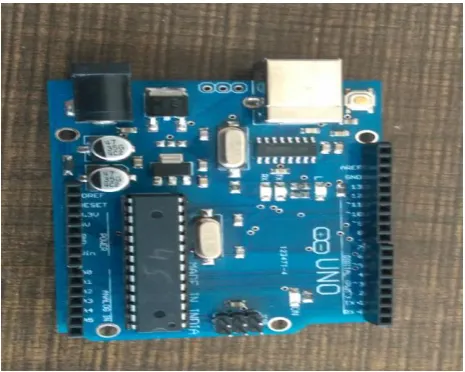
[image:3.595.45.278.184.370.2]and operates on 5 Volt DC power. It has 14 digital input/output pins, 6 analog input pins, 32 KB flash memory, 2 KB SRAM and 1 KB EEPROM. It has the provision of a USB, power jack, ICSP header and also has one onboard reset button. It has all the essential requirement for small IoT project requirements embedded on the printed circuit board itself [15].
Fig – 5: Arduino Uno Board Model R3
[image:3.595.317.550.242.413.2]In the present paper, smart home applications have been developed to resolve the basic needs of a home using internet of things. This application have been used to control lights, heating ventilation and air conditioning (HVAC) system, door bell, water pump, garage door and garden management systems, etc. [16]. The major equipment used for this application includes Arduino Uno board, Bluetooth model, android based smart phone application, driver, sensor, relay, motor, actuator and other accessories like transistors, resistors, etc. Figure 6 shows the blue tooth model HC 05. It operates at 2.4 GHz frequency in the ISM band and the modulation technique used is Gaussian Frequency Shift Keying. Its speed in the asynchronous mode is 2.1 Mbps and in the ssynchronous mode the maximum speed is 1 Mbps [17].
Fig – 6:Blue Tooth Model HC 05
In this work Arduino Uno Board model R3 along with Blue Tooth model HC 05 have been used. Ten number of different applications have been switched on from a distance of 10 meters wirelessly using android based smart phone applications [18]. The distance can be further increased up to 100 meters using Zig bee in place of blue tooth. The Zig bee and low energy blue tooth are low rate personal area network (Low rate PAN) devices, are not based on internet protocols (IP) and operates in the industrial, scientific and medicine (ISM) band with 2.4 GHz and 5.0 GHz frequency and follows the IEEE 802. 15. 4 and IEEE 802. 15. 1 standards respectively [19].
[image:3.595.315.553.560.701.2]Fig – 7:Set up for 12 different applications
Figure 7 shows the laboratory set up of the project [20]. The wireless operating distance can be further increased using low energy wireless fidelity (Wi-Fi) system which operates on 900 MHz frequency that uses IEEE 802.11 protocol and comes under wireless local area network (wireless LAN). Its coverage area can be further increased up to a distance of 1 KM by further lowering the operating frequency [21]. Figure 8 shows few application such as switching on lights, motor, doorbell, etc.
Fig – 8: Remote Switching of motor, doorbell and lights
[image:3.595.40.288.586.764.2]© 2019, IRJET | Impact Factor value: 7.211 | ISO 9001:2008 Certified Journal
| Page 523
mobile broadband wireless access system (MBWA) using IEEE 802.20 standard and wireless regional area network (WRAN) based on IEEE 802.22 standard with data rate up to 1 Mbps constituting wireless metropolitan area network (WMAN) and wireless wide area network (WWAN) respectively [22].
5. CONCLUSION
Apart from enhancing quality of life, IoT has made human life more secured, convenient and comfortable. Due to the pervasive connectivity it has affected the human life in unimaginable way. It has wide area of applications such as smart home, smart city, healthcare, retail management, smart grid, etc. The present paper demonstrates the application of IoT for smart home. It has been operated wirelessly from the distance of 10 meters using android based smart phone applications and operating distance can be further increased using IP based network protocols. The devices which has been operated includes lights, heating ventilation and air conditioning (HVAC) system, door bell, water pump, garage door and garden management system.
REFERENCES
[1] D. Evans, “The Internet of things: How the next evolution of the Internet is changing everything,” CISCO, San Jose, CA, USA, White Paper, 2011.
[2] O. Vermesan, P. Friess, P. Guillemin et al., “Internet of things strategic research roadmap,” in Internet of Things: Global Technological and Societal Trends, vol. 1, pp. 9–52, 2011.
[3] Yan, M., Shi, H. “Smart Living Using Bluetooth-Based Android Smartphone” International Journal of Wireless & Mobile Networks (IJWMN), vol. 5, no.5, pp. 65--72, 2013
[4] Piyare, R., Tazil, M. “Bluetooth based home automation system using cell phone”. In Consumer Electronics (ISCE), 2011 IEEE 15th International Symposium on, pp. 192-195, 2011.
[5] L. Atzori, A. Iera, and G. Morabito, “The Internet of Things: A survey,” Computer. Network, vol. 54, no. 15, pp. 2787–2805, Oct. 2010.
[6] I. Pena-Lopez, ITU Internet Report 2005: “The Internet of Things”, 2005.
[7] D. Yang, F. Liu, and Y. Liang, “A survey of the Internet of Things,” in Proc. 1st ICEBI, 2010, pp. 358–366.
[8] I. Mashal, O. Alsaryrah, T.-Y. Chung, C.-Z. Yang, W.-H. Kuo, and D. P.Agrawal, “Choices for interaction with things on Internet and underlying issues,” Ad Hoc Networks, vol. 28, pp. 68– 90, 2015.
[9] A. Schmidt and K. Van Laerhoven, “How to build smart appliances?” IEEE Personal Communications, vol. 8, no. 4, pp. 66–71, 2001.
[10] Z. Sheng et al., “A survey on the IETF protocol suite for the Internet of Things: Standards, challenges, and opportunities,” IEEE Wireless Communication., vol. 20, no. 6, pp. 91–98, Dec. 2013.
[11] S. Taylor, “The next generation of the Internet revolutionizing the way we work, live, play, and learn,” CISCO, San Francisco, CA, USA, CISCO Point of View, 2013.
[12] J. Manyika et al., “Disruptive Technologies: Advances that Will Transform Life, Business and the Global Economy”. San Francisco, CA, USA: McKinsey Global Institute, 2013.
[13] “Commercial building automation systems,” Navigant Consulting Res., Boulder, CO, USA, 2013.
[14] P. Guillemin and P. Friess, “The industrial Internet of Things volume G1: Reference architecture,” IoT Strategic Res. Agenda, Eur. Res. Cluster, Rep., Sep. 2009. [Online].
[15] Y.-C. Hu, M. Patel, D. Sabella, N. Sprecher, and V. Young, “Mobile edge computing a key technology towards 5G,” Sophia Antipolis, France, ETSI, White Paper, pp. 1–16, 2015.
[16] P. Schulz et al., “Latency critical IoT applications in 5G: Perspective on the design of radio interface and network architecture,” IEEE Communication. Magazine, vol. 55, no. 2, pp. 70–78, Feb. 2017.
[17] T. Taleb et al., “On multi-access edge computing: A survey of the emerging 5G network edge cloud architecture and orchestration,” IEEE Communication Surveys Tutorials., vol. 19, no. 3, pp. 1657–1681, 3rd Quart., 2017.
[18] L. Atzori, A. Iera, and G. Morabito, “The Internet of Things: A survey,” Computer Networks, vol. 54, no. 15, pp. 2787–2805, 2010.
[19] J. Gubbi, R. Buyya, S. Marusic, and M. Palaniswami, “Internet of Things (IoT): A vision, architectural elements, and future directions,” Future Generation. Computer System, vol. 29, no. 7, pp. 1645–1660, 2013.
© 2019, IRJET | Impact Factor value: 7.211 | ISO 9001:2008 Certified Journal
| Page 524
[21] Pallavi Sethi and Smruti R. Sarangi, “Internet of Things: Architectures, Protocols, and Applications” Hindawi, Journal of Electrical and Computer Engineering, Volume 2017, pp- 1-25.