... with 176 megabits of memory! Four CaelusQ!)Dual Disk Drives with a Caelus Controller will transform your mini into a maxi computer. All of this memory capacity at the lowest cost per bit in the industry, self contained with its own power supply, in our cabinet or your rack. Send for more facts or stop by and see the real thing at the S.J.C.C. Booth 2037.
I~l~
ff~
InSseconds
fro.m your .co.mmand,
.i ..< > ....•..••.•
i.
a paper copy ofyourrJisplElY
just like this:
~l{lU 15, 1971
---~~~--~-~~~~~~~~~-~
3 OPERATORS ON OUR TERMINALS REPLACE· 4 OPERATORS ON YOUR TERMINALS!
HAKE
TO FINO OUT HOW~ CLIP THIS ACTUAL SIZE COPY FROM OUR CRT, FILL IN DETAILS AHD MAIL TO: PHOTOPHYSICS, 1601 STIERLIN RD, MOUNTAIN UIEW~ CALIFORNIA 94040
---TITLE
---COMPANY
---ADDRESS ____________________________ __
CITY/STATE/ZIP
---
---r~afwtlme information on. ()tlrf~IIVlTlodularH"e()tl()terminals.phone:
. FRANCISCO: (415) 96~.~~09 • :LP$~N.~r;I.~~: .. (n.~).S57.2~22 CLEVE .... ·$..630.6 .. . . .
:: "".: . :, ~
··u'a(]3()qth·l$$~,SJCC
DATAMATIImN®
MAV15,1971
volume 17 number 10
departments
Letters to the Editor· 8 Look Ahead 19
Editor's Readout
23
Perspective72
News Scene
77
Hardware 101 Software
113
Literature 121 Washington Report 135
People 137 Books 141 Index to Advertisers 144 The Forum 148
Al
ay 15, 1971
[TJ
ECHNICAL
24 The Minicomputers Revisited
Defying last year's downward spiral, the minis
continued to proliferate. Our latest survey
con-tains the essential facts and figures on 49 of the
Tom Thumbers.
r~
ENERAL
38 The Rise and Fall of Viatron
Part 1 of a two-part article tracing the bold,
pio-neering, slightly incredible story of Viatron's
at-tempt to grab a big share of the data processing
market.
44 Also Sprach Von Neumann
Chapter Five.
56 SJCC Product Preview
Though the "industry standard" and five of the
six dwarfs are sitting this one out, numerous other
manufacturers will display a variety of new and
exciting products at the Spring Joint Computer
Conference. This section highlights many of the
products being introduced to the public for the
first time at the show.
SJCCconference particulars
and selected session extracts are covered in the
May 1 issue.
[MJ
ANAGEMENT
50 New Business Boom:
Requiescat in Pace
The unparalleled boom in new company start-ups
that characterized the late '60s is at an end. An
in-vestment advisor speculates as to why.
fCl
DMMENTARV
72 Perspective
In New York City, the various governmental
agen-cies go their own way with computers and
appli-cations, and the result is sometimes effective and
sometimes chaos, perhaps a proper reflection of
Fun City, itself.
Independent peripheral manufacturers speak
before the New York Society of Security Analysts
and appear before the Institutional Investors
Con-ference with words of confidence and hope in spite
of
IBl\I'Spricing and legal moves against them.
About the Cover
As computers get smaller, applications grow wider.
Our visually contracting and expanding design by
Barbara Benson focuses on the direction things
are taking, any way you want to look at it.
4
Buy this economical
80 column card reader.
Get a
96 column card reader,
free.
Our Model 8096 multiple card reader is priced competitively with standard 80 column card readers.
But it reads System/3 96 column cards, too. Just insert the appropriate hopper and stacker; the 8096 adjusts itself to the correct card size. In Continuous Mode, it reads 96 column cards at 775 CPM, 80 column cards at 375 CPM, stub varieties at up to 500 CPM.
The 8096 is rugged. Built to last 20,000 hours. That's about 10 years. And it won't make many mistakes-not more than one error for every 300 million possible data bits.
We also have a higher speed multiple card reader. And low and medium speed, single capability card readers for 80 column cards or 96 column cards. And field conversion kits that let you turn them into multiple card readers, easily and inexpensively,
Or, ask us to design and build special electromechanical peripherals for you.
Our main point is: you don't have to spend a fortune redesigning your hardware to read 96 colum~
cards. With the Model 8096 multiple card reader, you can do it free.
Send for details. They're free, too.
Ibdl
BRIDGE DATA
L.P
~
PRODUCTS, INC.
Subsidiary of Photon. Inc. Gentlemen:
738 S. 42nd Street Philadelphia, Pa. 19104
I like your kind of versatility. Send me details on the Model 8096.
Name
Title
Company
Address
City
State Zip
Phone
CIRCLE 41 ON READER CARD
DATAMATION®
MAY 15.1971
volume 17
number 10
This issue
116,910
copies
EDITOR
ROBERT B. FOREST
EDITORIAL STAFF
Managing Editor Senior Associate Editors Associate Editors
Copy Editor Assistant Editors
Special Features Editor Eastern Editors New England Editor Washington Editor Midwestern Editor European Editor Australian Editor Contributing Editors
Editorial Adviser Technical Consultant
EDWARD K. YASAKI WILLIAM J. ROLPH, TOM McCUSKER AUBREY DAHL, RICHARD A. McLAUGHLIN, EDITH D. MYERS,JOHN T. WATERHOUSE JANET EYLER MICHAEL WILLIAM CASHMAN ALMA O'STEEN ANGELINE PANTAGES JOHN WESSLER, F. BARRY NELSON W. DAVID GARDNER PHIL HIRSCH LAWRENCE RAGAN PEARCE WRIGHT FREDERICK A. BLAND HOWARD BROMBERG, ROBERT V. HEAD, PHILIP H. DORN, LOUIS B. MARIENTHAL, DANIEL D. McCRACKEN, F. G. WITHINGTON, PAUL ARMER, ROBERT P. BIGELOW ROBERT L. PATRICK LOWELL AMDAHL
EDITORIAL OFFICES
HEADQUARTERS: 94 S. Los Robles Ave., Pasadena, Calif. 91101, Phone: (213) 681·8486; EASTERN: 35 Mason St., Greenwich, Conn. 06830, (203) 661·5400; 19
Marlborough St., Boston, Mass. 02116, (617) 267·9414; 9805 Singleton Dr., Bethesda, Md. 20034, (301) 365·8671; MIDWESTERN: 407 S. Dearborn St., Chicago. III. 60605, (312) 922·8245. FOREIGN: 65, Hill Road, Chelmsford, Essex, England;
322, Park Regis, Park St., Sydney, NSW 2000, Australia.
GRAPHIC DESIGN
AND PRODUCTION
Art & Production Director CLEVE MARIE BOUTELL
Production Manager MARILEE PITMAN
Production Assistants GLORIA J. FASANA, LOUISE T. O'CONNOR
CIRCULATION
35 Mason Street Greenwich, Conn. 06830
Circulation Manager Marketing Research Director
PUBLISHER
GARDNER F. LANDON ASSISTANT PUBLISHER
JAMES M. MORRIS
Circulation audited by ~ Business Publications Audit ~
MAE VAN RENNES DOUGLAS DeCARLO
It:.
--AB~P Member, American
-..~ Business Press, Inc.
tp
DATAMATION is published twice monthly on or about the first and fifteenth day of every month by Technical Publishing Company, 1301South Grove Ave., Barrington, Illinois 60010; Arthur L. Rice Jr., Presi· dent; Gardner F. Landon, Executive Vice President. Executive, Circu. lation and Advertising offices, 35 Mason Street, GreenWich, Conn. 06830 (203) 661·5400. Editorial offices, 94 So. Los Robles Avenue, Pasadena, California
91l01. Published at Chicago. III.
DATAMATION is circulated without charge by name and title to certain qualified individuals who are employed by companies involved with automatic information handling equipment. Available to others by subscription at the rate of $25
annual!y .in the U.S. and. Cana~a. Reduced rate for qualified students. Foreign subSCriptIOns are on a paid basIs only at a rate of $38 annually. No subscription agency is authorized by us to solicit or take orders for subscriptions. Controlled circulation paid at Columbus, O. and Form 3579 to be sent to Technical Pub· lishing Company, P.O. Box 2000, GreenWich, Conn. 06830. Copyright 1971, Tech· nical Publishing Company. Microfilm copies of DATAMATION may be obtained from University Microfi Ims, A Xerox Company, 300 North Zeeb Road, Ann Arbor, Michigan 48106.
Pri nted by Beslow Associates, Inc.
In the
comput-er business,
the first thing
you've got to
do is learn how
to get along
with others.
Nobody knows that
bet-ter than we do. And nobody
does it better than we do. Case
in point: Our new 2200. A direct
access storage facility that's
in-stantly compatible with the IBM
2314 and 2319.
'
. Just roll right up, ladies
and gentlemen, and plug right in.
Our new 2200 and the
IBM 360 system were just made
for each other.
And the nice thing is, no
Thecost?Gladyouasked.
matter how you want it, it'll It's thousands of dollars less
change for you. If you want just· than the same article from IBM.
plain big memory, you can get That should bring a chortle of
the 2200 system with a con-
glee from your accounting
de-troller and a single drive unit.
partment.
Or for really mind boggling mem-
If you'd like to know more
ory you can get a controller with
about the 2200 or its little
an'ywher~
frort:l one t9 four
d~albrother, the 1100 (who's every
dnye Units, with a smgle dnve bit as good, but Just doesn't
Unit as a spare.
remember as much), remember
Anything to make you
to get in touch with your local
happy.
Bryant representative. Or write
But we know that even
to,
8~0Ladd Road, Walled Lake,
the most perfect relationship Michigan 48088.
requires an adjustment period.
~hathehas~osayshouldFor just such an eventuality,
put a smile on your mterface.
we have a 2-hour service force
standing ready.
The new Bryant 2200.
We never forget an interface.
1\[
ay
15, 1971I
IBM19J4
1
I,
t
I
. II
, ,
=
BR~ANT
COMPUTER PRODUCTS
THE BIG MEMORY EXPERT.
A UNIT OF
'XLO:
®EX-CELL-O CORPORATION
•
I
Xerox Is a registered trademark of Xerox Corporation
6
•
•
Here~
one:
We can't tell you how big
a Xerox Sigma 8 really is.
You have to tell us. Because
Sigma 8 has a flexible structure that allows
you to configure the hardware exactly to
suit your needs. Whether you need a
scien-tific system with data management, a
real-time system with batch, a batch system
with time-sharing, a full-blown
multi-processor system or anything in between.
What's more you can grow from one to all
the others.
The secret is memory oriented
architec-ture. Memory is expandable, from 64K bytes
to 512K bytes in increments of 64K. We
provide 12 access ports to which you can
attach 12 processors in any practical
com-binations of CPU's and lOP's. (Four CPU's
max., however.) There's a separate clock for
each system element, so you can shuttle
information in and out of memory, compute,
and communicate with your peripherals,
all at the same time, asynchronously.
We've included many features to make
sure that Sigma 8 is available when you
need it. Its availability is a combination of
reliability features and easy maintenance.
All transmissions are checked for parity,
there are hardware "snapshot" provisions,
and manual partitioning, to give just three
examples.
We also
have
a set of on-line hardware
diagnostics that allow our experts at
head-quarters to communicate with your system
over long distance telephone lines and offer
help with any necessary trouble shooting.
Of course we've included all the scientific
and real-time performance features you've
come to expect from Sigmas, and added a
few more. Very high speed. Up to 224 levels
of interrupt. 6 microsecond interrupt
re-sponse. Interleaving and instruction
look-ahead. Storable interrupt commands. A
powerful machine language: context
switch-ing, for example, is one instruction.
Software? Since Sigma 8 is a more
powerful, sophisticated, faster version of
Sigma 5, it uses all the field-proven
operat-ing systems that handle real-time,
time-sharing and batch, concurrently.
And if there's a nyth i ng else you need in
a Sigma 8 for a special application, call the
people at our Systems operation.
They'll make it shape up in a hurry.
Xerox Data Systems
8
~t
~~ ~
LETTERS
For Pete's sake
Sir:
I enjoyed reading Mr. Pete Lindley's informative "Field Application Note Identification of Right and Left Hand." However, I take exception to the format of the article (April 1, p. 35) .
It is advisable to print a WARNING before, not after, the procedural step that poses the potential hazard.
It is my hope that this error can be corrected before you are deluged with complaints from readers with mangled wrists.
ROBERT K. ROTH
Albertson, Long Island
Etal oot.
Left on
Sir:
Pete Lindley's Application Note has proven helpful to us and we are in-stmcting our field personnel in ac-cOl'dance with this standard. We find, however, that the terms Right and Left are not defined in the refer-enced Note. This is a distinct limita-tion to its usefulness, because:
( 1) Programmers and systems people never go outside of buildings, thus the common Moss method and
the Natural Horizon Method cannot be employed.
(2) Magnetic compasses used around edp gear generate glitch phenomena.
The programmer's normal response to this problem is of course to inter-rogate the cpu, or the operator there-of (more frequently the latter). This approach would be unavailing in the present instance, though, because the requisite analog reference data-the positional orientation of the inter-rogator-is not resident in core
stor-age.
Due to the symmetricality of the human anatomy, then, the basic ref-erent required is left indeterminate in your instmction, a predictable condition under Corollary-22 of the Murphy-Phynnagel Theorems.
We would appreciate it, therefore, if you would publish a definitive technique for making this prere-quisite determination of positional attitude.
C. SHERWOOD KIDDER
St. Paul, Minnesota
You have the right attitude now, Kidder.
Proffer toot
Sir:
In Letters (March 1, p. 11), Mr. Robert Mankin did grievous error in his proffering professions re profes-sionals. Please note that even in the second oldest (nothing is first) pro-fession, there are charlatans, knaves, and incompetents-surely filled oc-casionally at least. All this is, of course, extracurricular with respect to otherwise joyous encounters dur-ing which-in my innocence I assume -one also encounters knaves, etc. I think "rigorous body," "distribution," "ethics," and "scents" even may ap-ply to "our" other proffering profes-sionals.
D. BORETA
San Jose, California
Bonus, baby
Sir:
An idea for improvement of pro-grammer performance occurred to me, which I would like to pass along to you (free of charge) in the hope you can think of something to do with it. I am a government employee, and unfortunately it isn't appropriate in government due to personnel and pay regulations. The idea came to me when, after 10 years in data process-ing, I found I now have need to rent computer time for a personal project, and found myself moving carefully
since I'll be paying the bill.
I suggest that a bonus incentive system be estahlished for program-mers, on a per-program or per-system
basis in which the "bonus" is a "charge account" of a stated amount of money based on the complexity of the program or system. The pro-grammer's computer time would be chargeable (at a reduced rate) against this charge account. When this program or system is completed, debugged and in production, any unused money in his bonus charge account can be "cashed" as a dollar bonus to his paycheck.
In any conflicts on the use of com-puter time alleged to be due to op-erator or system error, the error would have to be proven by the pro-grammer for a rebate of the charges. I think the programmer will improve his performance for profit, doing more desk-checking, better testing, careful label checking of input, and programming test points for a audit trail. If the bonus is on a per-program or per-system basis, when he has fin-ished, a new charge account would be established for his next job as an incentive to keep moving on.
A company interested in trying the idea would determine the average cost of the computer per hour and the average testing time for accepta-ble performance in a job of a given complexity. A formula to compute the maximum bonus would be devel-oped such that even if the pro-grammer earned a large bonus, the company is ahead when compared to the expense of mnning extra mns for careless errors. The bonus could be calculated at, say, 10% of actual cost of mnning. If the programmer used up his charge account, the company will not have lost the bonus money, since the programmer will not have earned any. I do not believe a penal-ty is necessary, for although a bonus will not always be earned, I think programmers will try harder for the extra dollar incentive. Where he now humbly apologizes for a careless error, under this system the careless error is "money out of the program-mers pocket" in future bonuses. YVONNE C. TROUT
McLean, Virginia
Gomez is aware
Sir:
Regarding the letter that you pub-lished in your March 15 issue titled "Higher Him," I think that your edi-torial staff used extremely poor judg-ment in printing that letter. In these
(Continued on page 15)
/,":';II! iil).!i \'.·OWI ;;Iii iilh.;:;. I~IJI~C((: 111~n~::: 1~)I~iIYi'liil;~li': In'nl:agl InM~~il ~ (:. ii ;:II!";; I dlli H\II~I:, I lihr':H, ;: jilO~; ';;'2~~'
,: ""
:iil~'ri"M~ ill'llfn II;:"', . ':-Ihl ;:ili ilif'oIl~1 ie ,()lln'n Iii) '1UIiil;; (I : \~':-ii ,:-;II,n I: (II;; Ii"n~()ii I;;10\ ::r;i", Iii I Ii:;; Ii @llllifH.~lli;: ii 101 il'~1 3101 ((~ I~·'·~i, iii;;!; In'n .MIlI.::d I:. :aiIJdl;:I!)';:1( II,;:JI IwilWlUlii iil;;,ilifnu;I\::~~·:-,
1,:1::\::
n,
;:JiJlOwdi 'O~(.II; 'q~lJ ~ ;: II 11 lii\\ I!)I;;!; ii, ,/ ii In'll ~;:~Iill' ,;; 'Ull_n'n,TDS/BSL TERMINALS - Special data input devices let you enter data by keyboard, see It in digital format for verification, then, by pushing the SEND key, transmit it to tape, disc, computer or modem. Quiet, compact, easy to operate.
TDI/POI-8331733 - The disc storage IVltem that's 100% compatible with the 2314 and the 2319, Also showing the TDS/PGI-711 disc storage drive, a direct replacement for the 2311. And the TDS/PGI-700 Disc Drive Exerciser for off-line testing and theTDS1PGI-705 1/0 Tester,
TDS/REMCOM-2780 - The remote batch terminal that's truly compatible with OS/360 and DOS/360 and all IBM 2780 software. 300 or 600 CPM card reader, 400 or 600 LPM 132-column printer, electronics and Interface In one cabinet.
I
/1
TD8·1600 - Introducing the 30 CPS model of the TD5-1600 Impact conversational terminal series. A combination of high-speed performance and the simplicity and reliability of the 10/15 CPS TDS-1601.
~,
~--.--IP,.:·i'l,iill" I;~ If)'!ilill I;;: ILJillll::IUlliIP,.:I: ':I;;H~I 1i1;;I/II,.~(lb'llllllii\~ ;;~, .~II!II,;;~(14dlllii.". ::.Intil :.;-li'j IM( ,:~
.:, ~!'" f II d. " f~ " ,
1.~t:J I:.;',. II I' rI~' d. .': ~' : I • , I, • I , 0' " I , • , , , " • f , j ~ ,
,'t"I" "f,11 ,: , ' , '
. '·'r'·'·HI,
II;. ~t 1: ,: IH",' J"
BI 2600 AND BI 2610 - Synchronous magnetic tape units shown for the first time at SJCC.
II 1215 - Unique olcillating-bar printer with MOS memory and all IC logic. Built-In lelf-test electronics. Your choice of 84 or 96 character fonts at 300 or 230 WPM. 132 columns standard; 80 optional.
',I
, ,',I
',''':,g} 'l.: '''' ",lJl!,.,,,, '".,
,"li::~, ~;tl
fllr:J
1.,A.:.'~:1",i":"'~:;')li~;';!I~n~ll~l':'iol' :'tl;)j~)iJa'l-'\"'ii~"'H~"'I::\ "II'~i',!
",., , "_1!},:",,, ~l_,.~, ",' t"", ,,. "Lu l!H, , \.'" I:!:,~.f=tliif'~:~'iJ;'l ~~Y~':Ji;:mi::l '" \,'~ ",~", "·l,,·,,\,"~l t'Q)il':tlh\' I..'!: ' ... , ~"l I,;~-'i'il il':ti~~::f!,' '
\,,,!h;,,, I,'"~~I",
ffiHb:;{HHIl @I§.'\,1,{§1 \'l~lH i'.r!\.:t;1Iln~@' I!jl '''Hm:~#1'il;1 (~li"tj~tH~:~l,,'€t;i::>'
',-n
i~~ril'ili \~'Jh;1m;:n " L ' . , "" ""./ \",., ,.,', ,Holi! !'ifl:l£til ,~, _ !!h ,,"',,'\, ,i~~11:'!::\ ~I:'\ ",:,11" . . . . .or .,flf, ,r.f,";:1 'I,.~'t (-.lIill' ~~'~ll:,'1: h". ,"::\,
I~"'~'I!'(!fl
(€t!HI7~f~:' ~l),!lH (!gm§~~y~) (!Iil f::~mt¥H~l S:1~mlm:@ :§@ Wl~m '~A'Ah~Hh~ Jm:!l~'?)1'W??
1Ill1.HH!I.~ @H=I~'(!miITIl;ilnl~igI1l.!f?? iilit!Jl.mHrmij'l I'm:::
ifi'l {olin ito\r.'i~'E.f·j';1l "iYii1i::J:,'" , r, ", ~. """ '"'' '"'" " " .~"J"!,, ,,:~, '.,kt",..!l
, I:'~H.!.I l~lm,~f:9:,~1 iin'lJ:;} (QIHi m~l§:'i~:§lI~@;t;J @!Jifr~!Jll~fi
@Jit!1
fi@J§,'/~§lkFr~ml (Q)h9:!' @;f\~:J~~ @'fli';\ iK1W~r:) (fl"!1fi1!IiUl!U'§)
\'NHil
i.! ~
I =:Jf2;,iHi'
C§JiW 1.1i'l~. ~~~,~).
i"flb.lj}:lt!r.IJU !~I
<ffil! I1~:tit~j;~':tt~:t!~)i€1
:,1:/.1@:.1il i~liW
i!1Hlm
S~h:;mtfl ::~m!ll1f~y f~§~liH;:i
1,!~l:~liOl!)n#n,Wlnl
I@Mll!lii~~l§t:~ @i iH~ (~lii\!A§B \'!~Jm'\ I,Hr~l U;JMI (!i,I,!li1'i(~iH;Ji!,) (Q) ~JII:91~fim
/A'i"I'!I
;liY:¥} lii~l 1f"i'I#l"11§iII
,'r,;,Iil(jl
t#l!! H~'I j'!I#Im!r.b:;.~~l~:~lrH
:)""~'HIIII
Utit!1(~Hn i-,;~Ht:.'j!ltIn·1 i~IiJ~H~~:g§:::{§l!l. ~\!tytm~§'J!'
(:*lmf!,lin!h~" ~H:!Ii'1 i~b=J mt.1Hil:,!fUliH:€ (mm~rni\~" ~r;i::::tm~
W!w
(iT",,;1 1'::t,~!I'~H;Wmi jH~.dlm"@ 1~Y.')!J ~9'::w:::n;';11 (¥}:(~:1I,!§t'(~, (!i~il!n)
11:I~HHi/4::~ m~.!'~IJI.!I':H'?lmn;n !ITr*m'H#lil:'!i(~I;~ !=.'lb9:!'!
\,
" ~ I i iW,(!I; f!fl f : ' t!~~@l~~
fij"~5 1'@!,lllr!f:lI5
fijir~) fil~"
••
1 lIIu""J II ilL".!.'(=1·'.~i~1\
ffi!l
@!1'niilim'\~'l~Iii li.rHt~,=l:.1 rm!'Jnl~~,,::~
I ~ I ~ I ~I: I i; I r~!H1 (ffi€lll~l!R{?)~';~OO
(o.!
ml'i'
~r~ltJ!fffil t:J ~,::.! ~.,~~':1~1I:.1;m'i~1I fml~~nffiL , f f i , l€Wtmllt~r~\'~
CIRCLE 54 ON READER CARD
Cc eooth
At SJ
14
If
you're
.
underwhelmed
.. . with outside computer time-sharing,
con-sider the convenience of an in-house
TOS-1255.
It's the time-sharing system that lets you
write, debug and run big-system programs.
256K words big. Then run them, if you wish, on
big computers.
For example, with its enhanced FORTRAN
IV, the TDS-1255 has processed programs
writ-ten for the 1108 and the larger 360 systems with
no changes .
. TDS-1255 combines 512K words of virtual
memory with access to 8-, 16- or 32-million
characters of mass disc storage ... directly
ad-dressable in FORTRAN. It handles up to 16'
terminals simultaneously, local and remote.
And it accommodates additional peripherals to
facilitate batch processing concurrent with
time-sharing.
Other important features include File Edit,
MATH, built-in usage accounting, random and
sequential file management processors, and
extensive diagnostics that explain program
mistakes in English.
We can deliver it in 90 days for as low as
$2,700 a month,
including maintenance. No
extra shift charges. It's yours 24-hours-a-day.
We'd like to give you a live demonstration of
the TDS-1255. You may find it overwhelming.
. Contact Tracor Data Systems, 4201 Ed
Blue-stein Blvd., Austin, Texas 78721. Or call (512)
926-7770.
~
TRACOR
~MS ~;.~~
Quality in computer products.
~
At SJCC Booth No. 1219
Letters . . .
troubled times when racial problems should be of concern to any intelli-gent person, publishing a letter with obvious racial overtones shows very little sensitivity towards minority problems: Just because DATAMATION is a technical magazine should not imply that the people involved in publishing the magazine should be socially naIve.
Is Mr. Gomez aware of the plight of the Spanish-surnamed people? Better education, better jobs, and a better life are the goals of millions of socially deprived Mexican-Ameri-cans. Your publishing such an obvi-ously madeup letter can do nothing but. hurt the efforts of concerned Mexican-Americans. The extreme bad humor sterotyping Spanish-sur-named people as illiterates shows the same bad taste as the "Frito-Bandito" or any other racial stereotypes. The Mexican-Americans have come a long way towards social equality in the last few years, but the publishing of sick letters can only hurt their cause.
RICHARD F. CHAMBERLIN
Pasadena, California
Dvorak's new world
Sir:
The standardized keyboard proposed after "years of effort" by ANSI com-mittees neither provides for "ease of operation" nor "minimizes operator training and retraining." Most typing teachers are aware of the fact that the traditional ( Universal) keyboard is merely a haphazard arrangement. In contrast, Dvorak's'DsK (Dvorak Simplified Keyboard) represents a scientific approach to keyboard de-sign; people learn to type faster in less time on the DSK.
Ancona, Garland, and Tropsa (March 1, p. 32), in their accep-tance of the argument that the tradi-tional keyboard should be adopted because millions of people have been taught to use it, and because schools are still teaching it, seem "cowed" by the weight of numbers. What of the millions more who are to use key-board terminals in future-what of the fact that the day is surely coming when each person will have his own personal electric typewriter or ter-minal-what of the millions of dollars that are surely to be lost through blind faithfulness to an inefficient device?
Dvorak has shown that retraining typists on the DSK is not a serious
Afay 15, 1971
problem; further, in a few years (perhaps no more than it takes for a new car to wear out), Universal typists would have left the labor market and been replaced by DSK operators. And schools teach what they think industry likes.
Mr. Ancona, who is director of standards, IBM Office Products Div., of all people, should be willing to at least try the DSK; IBM, with its Selec-tric element; has it in its power to revolutionize typing instruction in American schools. By simply making ,the DSK element available to typing teachers (at the same price as the Universal), it would soon find out which keyboard is superior.
ENOCHHAGA
Society of Data Educators Northfield, Vermont
On the bloc
Sir:
I would like to bring to your atten-tion a major inaccuracy in the "World Roundup" item headlined "If It's IBM, It Must Be Belgium" (Feb.
1, p. 85).
It says: "Trade discrimination has been raised in another form with ob-jections lodged, mainly via IBM, to get the NATO committee that places em bargoes on sales to the Soviet block to restrict business being done in Rmsia by U.K.'s ICL." IBM had lodged no objections nor approached the U.S. government or any other agency in an effort to prevent the sale of ICL or any other manufac-turer's computers to the U.S.S.R. IBM has exercised no influence whatso-ever on the position taken by the U.S. government on this matter at COCOM meetings.
CHARLES FRANCIS
Director of Information IBM World Trade Corporation New York, New York
Fraudian clip
Sir:
Your articles on "Managing the Campus Computers" (March 1) were good, but they left out one very important aspect that many people are not aware of, and that is the use of university computing ~acilities by professors for their outside consulting work, which in many cases is neither billed nor accounted for as other than "research." While a professor's salary
is nothing to write home about, the outside fees obtainable by their free access to university computing facil-ities can quite readily reach astro-nomical proportions. It has been only a short while ago that reputable pro-fessors and concerned graduate stu-dents have prodded -the U.S. Joint Audit Agency to undertake· investi-gations where merited and help eliminate both fraud and unfair com-petition.
SAMUEL SHlPKOVITZ
Pittsburgh, Pennsylvania
Deepest penetration
Sir:
After reading Lowell Amdahl's Forum article, "Realizing the Unreal-ized" (March 1, p. 79), I just wish to say I feel it to be one of the most penetrating and succinct editorials ever.
H. T. NISSLEY
Toronto, Canada
Cycle mates
Sir:
Out here in Palo Alto we've been hit by the ecology types. My wife and I, the kids, etc., all collect newspapers. I've even found a way to recycle my tab cards. But no one can tell me . anything about recycling all that . paper and carbon paper that comes
out of my printer.
Would you please ask your readers if any of them know anything about computer paper reclamation. I'd like to know the names and phone num-bers of people to contact.
SAMUEL GORDON
Autologic, Inc.
San Francisco, California
Games play people
Sir:
Ethan I. Shedley ("Big System Games," April 1, p. 22) has suc-ceeded, using humor ( ?) to .expose the real culprit ( s ) behind big ( or small) system failures; people! But, alas, there's the rub; that very humor shall become the rationale for people to ignore his sage insights. Perhaps Mr. Shedley could add this last trick to his list of games called . . . "The Game of Games" or "The Three
Monkeys."
L. THOMAS HAMMOND
Denver, Colorado •
Meet George Taylor,
HP SystemsAnalyst.
He'll showyou
how
to
save a bundle
withyourown
time-share
system.
George is a systems analyst in our Englewood, Colorado,
office. Like his fellow HP analysts throughout the
country, he was specially selected and trained
as a time-share expert.
His role is a simple one: to help you realize the
full potential of in-house time-sharing, made possible by
HP's Series 2000 Systems. How? By working with
your engineering, manufacturing, marketing and
accounting people-so they'll know how to get the most
out of the system. And George won't take forever to
train them either. His objective is to make your people
self-sufficient. Usually it takes just about a month.
But George and company are just one part of our
great new deal for in-house time-sharing. For instance,
we've just added a unique new rental plan that lets
you try before you buy. Another nice thing - when
you do purchase you'll be happy to know that over
60 percent of your rental payments come right back
to you as additional equity.
Low cost is another part of our deal you'll
like. For just $69,900 you can start with our
16-terminal 2000A System. And expand it to a
32-terminal system at any time. They'll all provide
you with totally unattended operation, matrix, string
and random-access file capability. And our 2000C
model gives you all the bells and whistles -like
program chaining, 3-levels of libraries and up to
8 moving-head disc files.
Add it all up - the systems analyst, the new rental
plan, the low cost. You'll arrive at the only reasonable
solution to spiraling time-share costs - an HP Series
2000 System. So why not give George Taylor (or any
of our time-share analysts) a call and talk it over?
Or write for complete information to
Hewlett-Packard, Palo Alto, California 94304;
Europe: 1217 Meyrin-Geneva, Switzerland.
22019B
HEWLETT,@PACKARD
DIGITAL COMPUTERS
Our COM graphics capability
lets
you do
some great card tricks.
See that aperture card? It contains
a precise, microfilm image of
stored computer data. Time lapse
from data input to processed
output? Less than a minute.
Our new Microfilm Plotter lets you do some
other impressive tricks, too. A single-data input
com.mand can produce a circle, arc, line or
vec-tor in solid, dashed or broken lines.
Other capabilities include overplotting.
Pre-viewing on monitor scope. Optional
alpha-numeric character generator. Plus
other options depending on your
particular application.
Price? You'll be surprised how little
it costs.
So if you're still plotting computer data on
paper, chances are our Microfilm Plotter is just
what you need. to cut that work load down to size.
For details, contact The Bendix Corporation,
Computer Graphics, 23850 Freeway Park Drive,
Farmington, Michigan 48024. (313) 477·3700.
computer
Graphics
360/22: CAN A
26 BE FAR BEHIND?
TELETYPEtS MOD 38:
LAST OF THE IMPACTS?
HUGHES PUTS PRO
AT DP HELM
THOSE COMPUTERS OURS?
NO, SAYS RCA
Used computer dealers feel IBM's 360/22, to get rid
of its growing 360/30 inventory, has damaged their
market for used 30s, particularly 32K systems that
have been going for $65-70K, vs the 22 at $44K.
But
lessors say they don't fear loss of their mod 30
customers since the 22 has a 32K core limit and no
1400 series emulation.
There's a rumor of a 360/26, which would be a
stripped down mod 40 or a bigger stripped 30, not
competitive with the 135. Also, watch for continued
price cuts on a host of IBM peripherals. A cut on
the 2314 control unit would drive the independents
even tighter against the wall.
Look for a nonimpact terminal from Teletype Corp.
We
hear the device won't be called a CRT terminal but a
CDT (Communications Display Terminal), though the
firm won't comment.
It will say its new mod 38 unit
with built-in modem, to be introduced at the SJCC, is
probably the last highly mechanical device from
Teletype, which turns its attention tp electronic
units. This doesn't signal an end to the popular
impact terminals, a spokesman says.
For example, a
design team is still assigned to the mod '33 introduced
nine years ago.
For the next four years, production
plans for the 33 will stay the same as today's rate.
And that, according to industry sources, is about 5K
a month.
Under new management is Hughes Aircraft's computer
centers, which are undergoing a lengthy process of
reorganization.
With the hairy job of centralizing
three facilities and cutting costs is Carl Reynolds,
one-time president of Computer Usage Development
Corp.
Plans to centralize in Fullerton, Calif., are
afoot, demoralizing many, and some top jobs reportedly
have gone to Reynolds' cadre of execs.
We hear a
165 will replace a 65, with possibly a second 165
taking the place of another 65 and a GE 635.
It may
all
take2~years, inevitably will burn a few.
RCA is having tax problems in California, $1 million
worth.
That's the amount of property tax levied by
Sacramento county over the past three years on some
$8 million (assessed value) of RCA dp equipment used
by the state. And there's more at stake, for the
value of state-used RCA gear should go up by at
least $1 million in the next fiscal year as a result
of a decision to sole-source. computers for the
IS OCR NEXT
AT INFOREX?
CODASYL BROUHAHA
NO LAUGH TO IBM
MOORE FORMING
COr~PUTERPLAN
RUMORS AND
RAW RANDOM DATA
lost out and paid $80K in taxes on gear leased to the
county.
But the case is a little different, for a
county is prohibited by state law from entering into
a conditional sales contract where payments extend
beyond a fiscal year.
The state is not.
Both RCA
and the county have taken their cases to superior
court. Deputy county counsel Monte Fuller, handling
the county's case, expects any decision to be appealed,
so resolution of the issues appears a long way off.
Whatever the result, it should interest Honeywell and
Burroughs who have lease-purchase agreements with the
state similar to RCA's and have paid their taxes
quietly.
We hear there will be more bells'n whistles coming
for Inforex's data entry equipment.
OCR capability
maybe?
The firm won't comment, but we think so.
Our
educated estimate is that the ·Burlington, Mass.,
company has shipped more than 350 data entry systems,
making it far and away the leader in shipments,
perhaps more than double that of runner-up Computer
Machinery. Moreover, we hear Inforex is shooting to
mUltiply that figure by four by year's end.
The brouhaha over why IBM, followed by RCA, voted
"no" on the Codasyl Data Base Task Group report (see
April 1, p. 19) has propelled that report into the
public attention it apparently deserves.
"The work
to establish specifications for data. base languages
will have as much impact on the industry in the next
10 years as programming language efforts have had in
the last 15," said one large computer user. At this
writing, the report has not been widely distributed
and both IBM and RCA are this month submitting their
qualifying statements to the Codasyl programming
language committee, which will decide the next step.
Thus, specific arguments aren't yet clear.
IBM objected to implications in this column that
its 71 proposals for the report were a delaying
tactic.
In fact, 70 were implemented and IBM's work
is praised, which is why many wondered about the "no."
But IBM's objections center on the lack of fundamental
architectural considerations in the deliberations.
Moore Business Forms has entered the computer biz.
It
purchased 50 of Documentor Science's self-contained,
typewriter-size.d computers, which. read sales slips
and other transaction records, and will use them as
demonstrators in an initial sales effort in the L.A.
and San Francisco areas.
First concentration will be
in the foods industry, and if all goes well will be
expanded nationally and to other applications. A side
benefit for Moore, as the firm's Tom Steiner says:
"Those machines· use lots of forms."
the
... tosuccess
Courtesy of Scan-Data OCR Systems.
The systems that do what you've been
hoping OCR equipment would do
someday-·eliminate the need for
re-creation of source documents.
Which means no more of the costly and
time-consuming re-keying that has
made OCR equipment nothing more
than a promise unfulfilled.
Until we introduced SWAMI,
Software-Aided Multifont Input. The world's first,
and only self-teaching OCR system.
That reads vi rtually any consistent
font, even degraded
characters-directly from source documents.
Combined with our superior handprint
capabilities, SWAMI makes document
re-creation a thing of the past.
SCAN-DA.TA COAPOAATIC>I'J
And makes the economies of OCR a
thing of the present.
Add SWAMI to our ability to take direct
input from pages ordocuments from
3" x 7" through 11" x 14", no matter the
weight or grade of paper, and you have
an unbeatable combination.
We call it our one, two non-punch.
800 East Main Street/Norristown, Penna./{215} 277-0500
As portable data recorders go,
the three you see below leave all
the others behind.
Surprisingly
v~rsatilefor
their-size, they're yours for the taking
whenever and wherever there's a
need to record or reproduce'
ana-log signals.
Part of the broad line of TEAC
instrumentation. products,which
have' come along way in world;..
wide· business .. and industry. over
tile
pa~ttenyears,these portable
systems ,are . now set to . go places
. inthiscount,.y.
T~esrnallestofour
get-up-and-go trio is the low-pricedR-70
Series using Philips-type
instru-'mentation cassettes.
You can select direct or FM on
anyone of its four channels with
a flip of a switch., or add any
spoken data needed. And alight
R·70 SERIES
goes on to tell you when you've
come to the end of your tape.
Rugged and reliable, the R-70
will operate on self-contained
batteries, or on external AC or DC.
The R-200 Series Direct/FM
recorder is another fine idea that
you can never carry too far
~I n the
field or laboratory, it gives you
four independent record/
repro-duce channels, built-in
calibra-tion source, input/output level
meters and a direct-drive
closed-loop capstan.
It performs well
under mobile conditions on AC or
DC and takes voice· messages on
one channerwhen desired.
It'll even follow your directions
via a remote control unit. Which
guarantees your always having
everything well in hand.
The mightiest of our
light-weights, (only
67
pounds), the
Take
R-250 Series, is made to IRIG
standards. Using an FM system,
it will record and reproduce
ana-log signals from DC to 5kHz, on
its
V2"
tape.
You can take your choice of .
using one or more of its seven
independent channels plus one
edge-track voice channel.
While a bit heftier than the R-70
and R-200, it's worth its weight in
dependability, whether you're on
the move or not.
For additional details on these
portable recorders and other
TEAC systems, write or call Ken
Williamson, Director of
Market-ing, Technical Products, TEAC
Corporation of America, 2000
Colorado Ave., Santa Monica, CA
90404. Telephone: (213) 394-0240.
You'll see why there's a good
reason to go TEAC.
your
T EAC®
and
go.
EDITORJS*
R
E
DID AT LAST
A
D
o
U
T
The headaches started last June, and at first I thought it was just that awful relentless booming coming from the Northridge Noisies assembled in a yard next to that of the Wizard of Ego, the famed one-man-band nonpa-reil, Robert L. Patrick Hisself Esquire.
We were there to lay down prelim-inary plans for a new Directory that some nincompoop thought we ought to put out. Since the nincompoop had the power to enforce his whims, we thought so too.
Of course, since Patrick was in-volved, the Directory couldn't be just another directory. That was probably when the real headaches began.
We decided that this Directory ought to have some useful but easily digestible information in it about products and the companies that make them more or less available. We didn't want it to get a review like the one delivered once by a sixth grader: "This book tells me more than I want to know about rats."
And we didn't want it to tell us merely such drivel as only the names/ addresses of all the companies mak-ing Glitch Removers, either.
We decided that to manipulate the information we got-to organize it and present it in the most usable fash-ion-we should use a computer.
That's when the headaches got bad. This is not the place to catalog the oversights, undersights, dropped balls, misplays, miscues, mistakes, errors,
lUau
15, 1971and uglies that we and the friendly fellers down at the information fac-tory pulled on each other over several months.
But it does seem the place to point out an irony: that the Editor of
Data-mation-a magazine that has almost
worshipped the computer-should (af-ter years of avoiding any connection with the beasts whatsoever) become one of its victims.
I now have a new and startlingly deep empathy with the user, a new and surprisingly deep distrust of keypunchers, programmers, analysts, computer center managers, and Big> Deal computer consultants. I am also beginning to suspect that the user with a system design that is slightly less than completely clear and com-plete~and a design that he chooses to change whimsically midstream-may be (however small) a part of
some of the problems facing our in-dustry as it tries to do what it thought it could do with speed, laughter, and No Hands. No Way.
Well, the main point of all this running on is that we did survive, we did triumph, we did make our dead-lines, even if there are some guys still trying to recover from lack of sleep, overdoses of chocolate donuts, and the third-shift Whydintitworkthistime Blearies. like Directory Editor Dick Mclaughlin.
The result-the 1971 Datamation Industry Directory-is now available.
We've sent a bunch of free copies out to qualified Datamation installations,
and we've got a few left over for sale to those of you' who didn't qualify or who want one of your very own to play with.
The ads we're running in Datama-tion and in other publicaDatama-tions will tell
you more about why DID is really a swell thing that you will like immensely and use a lot. Some of you will see it at the Spring Joint.
In the meantime, we just wanted to let you know three things:
1. We at Datamation are always
thinking about you. The latest proof is the 1971 DID. Designed by Bob Patrick, put together by Dick Mc-Laughlin and a crew of computer spe-cialists, it should be a real help to you in tracking and narrowing down the companies and products most likely to help you solve your information processing problems.
2. After all these years of talking about computers, we' finally got did by one. We hope it will make us wiser and humbler than before.
3. We've already started to learn from our mistakes. First of all, there are just a few minor systems modifi-cations we'd like to make ...
But the big change will be the site of first planning meeting for the 1972 DID. Got to get away from those drums. I still think that's why we had
so much trouble.
-R.B.F.
24
A fresh look at the one segment
of the industry that continued
to grD\N last year
The
Minicomputers
[
- ] Many significant changes have occurred in
T
the minicomputer industry since the pre-vious survey article by the authors in the - - March 1969 issue of DATAMATION. Themost notable changes and trends are in lower costs, architecture, faster memories, and new technologies. Table 1 summarizes recent minicomputer charac-teristics and prices for machines believed to be in production at present. The data has been updated to include the many price reductions and changes in
characteristics anno~nced by manufacturers. Because of the rapid change in the minicomputer industry and the frequent announcements of new machines, it is important to note that the computers, prices, and characteristics in Table 1 (P. 26) were current as of early January 1971. There will undoubtedly be a number of additions to the minicomputer family by the time this article' reaches print. Ten of the mini-computer models included in the March 1969 survey have been discontinued, but 20 new ones have been added in this survey. Hence, 49 production minicom-puter models are included.in Table 1. The data on the characteristics and prices of the different minicompu-ters presented in Table 1 are based on info~mation supplied by the manufacturers in response to a de-tailed questionnaire and updated by telephone dis-cussions. ~onsiderable time has been spent validating this information and trying to achieve consistency of interpretation. However, the authors cannot gum-an-tee the accuracy of every figure and prices are subject
to change without notice.
The reader is referred to the discussions of mini-computer applications and features in the March IDG9 article which are not repeated here. The re-mainder of this article will discuss the more important changes and trends cited above with particular con-sideration of the future developments that can be
anticipated.
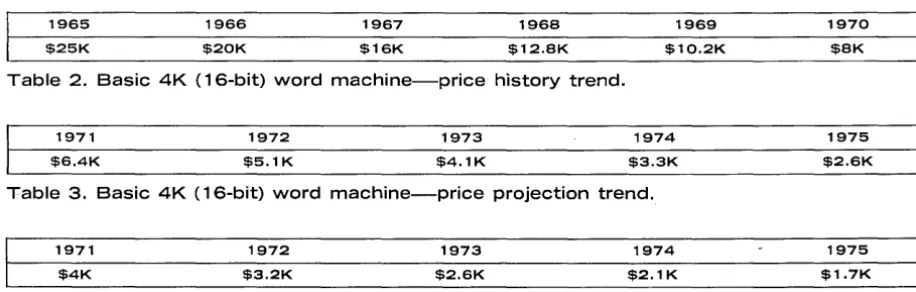
, \\lith the advent of Msr/Lsr logic and new memory technologies, minicomputer prices are expected to continue to drop in the next three to five years at a rate in the order of 20% per year as they have for the last five years. Table 2 shows the historical sales price trend for a basic 4K (16-bit) word memory machine. Applying this same rate of price decrease for the next five years gives the projection shown in Table 3.
The lower cost of the 8-bit word length computer, which evolved in 1968, opened many new applica-tion areas where cost had previously precluded con-sideration of the use of computers. The price trend projection for the 4K (8-bit) word machine over the same time period is shown in Table 4.
Architecture
Several new minicomputer organizations emphasize general purpose registers (a la the IBM System/ 360). New and unusual architectures are anticipated using variations of the general register theme. As register and logic costs go down, more and more effort is ex-pended in taking advantage of this technique; hence, many new cpu features will be incorporated that have not been found in minicomputers previously. A few of the newly announced minicomputers offer
a bus structure wherein the registers, the arithmetic unit, and the memory are directly linked to external peripheral devices. \Vith this technique each device on the bus is addressed in the same way as main memory. This tends to minimize data transfer over-head and housekeeping operations.
One important change in architecture that can be anticipated in the future as a result of wider use of semiconductor memories is in the distribution of memory among different parts of the machine. Cen-tralization of main memory has been forced in the past by the characteristic of core m('mori('s that the
Revisited
cost per bit decreases rapidly as module capacity increases. This is not true for semiconductor memories above some minimum size dictated by the basic ca-pacity of a single silicon chip. Hence, semiconductor memories can be distributed about the machine with-out a cost penalty. The architectural implications of
this have yet to be fully explOred.
The characteristics of semiconductor memories permit different design approaches and higher speeds. For example, with nondestructive read-out, overlapped fetch and execution of instructions, and a 100 nsec LSI memory speed, 2-3 million instructions per second (in terms of internal speed, not necessarily throughput) could be achieved.
The fact that conventional control circuit logic does not lend itself to the advantages of LSI has given great impetus to the us~ of microprogram control. The more regular or systematic organization in a micro-programmed control structure is amenable to imple-mentation by LSI. In addition, this approach offers much greater flexibility, including trading time for cost in implementillg features such as: floating point operations, multiprecision operations, push-down
1965 1966 1967
$25K $20K $16K
by D. J. Theis and L. C. Hobbs
stacks, sophisticated I/o routines, and specialized in-structions.
Microprogram capability is very powerful in cer-tain applications, such as communications processors, remote-batch terminals, smart terminals, and other specialized configurations, where advantages are gained by tailoring some instructions to the unique requirements of the applications.
Memory
In the past, main memory was implemented with magnetic core; however, a few manufacturers now offer semiconductor memories. MOS memory arrays are available with a 400 to 600 nsec cycle time with a potential of 150 to 250 nsec by 1975. This is in contrast to bipolar LSI memory arrays with cycle times
of 150 to 250 nsec. Main memories with less than 100 nsec are expected by 1975. Faster memories are available now in small buffer sizes at higher costs. A cost differential of approximately two-to-one is antici-pated between these two types of semiconductor
(The Tables of Characteristics follow on pages 26-33, text continues on p. 34.)
1968 1969 1970
$12.8K $10.2K $8K
Table 2. Basic 4K (16-bit) word machine-price history trend.
1971 1972 1973 1974 1975
$6.4K $5.1K $4.1K $3.3K $2.6K
Table 3. Basic 4K (16-bit) word machine-price projection trend.
1971 1972 1973 1974 1975
$4K $3.2K $2.6K $2.1K $1.7K
Table 4. Basic 4K (a-bit) word machine-price projection trend.
[image:27.617.86.544.597.743.2]Minicomputers ...
Table I
The machines in this survey are listed
in descending order of word length, from 18 to 8 bits.
MANUFACTURER AND MODEL NUMBER MEMORY
Memory Cycle Time, j.ts Memory Word Length, Bits Minimum Memory Size, Words Memory Increment Size, Words Maximum Memory Size, Words Parity Check
Memory Protect READ ONLY MEMORY CPU FEATURES
Instruction Word Length(s), Bits Number of Accumulators or
General·Purpose Registers That Can Be Used as Accumulators Number of Hardware Registers
Not Including Index Registers Number of Index Registers (Hardware,
Memory, or Other Technique) Indirect Addressing (Multilevel,
Single Level, or None)
ARITHMETIC OPERATION CAPABILITY Add Time for Full Word, /LS
Fixed-Point Hardware Multiply/Divide Multiply, j.ts
Divide, j.ts
INPUT/OUTPUT CAPABILITY Data-Path Width, Bits
Direct Memory Access (DMA) Channel Maximum DMA Word-Transfer Rate Number of External Priority Interrupt
Levels in Basic System
Maximum Number of External Interrupts OTHER FEATURES
Power Failure and Automatic Restart Real-Time Clock or Internal Timer SOFTWARE
Assembler (1 Pass, 2 Pass, Both) Relocatable Assembler
Minimum Core Size Necessary to Use Relocatable Assembler Macro Assembler Capability
Real-Time Executive Monitor Available Disc Operating System Available BASIC MAINFRAME COSTS Basic System Price with 4K
Words Including Power Supplies Total System Price Including
ASR-33 Teletype and CPU Basic System Price with 8K Words
Including Adequate Power Supplies, Enclosure, and Control Panel Total System Price Including
ASR-33 Teletype and CPU PERIPHERALS AVAILABLE Magnetic Tape
Approximate Price for Operational Unit Including Controller and Necessary Options Mass Storage Device
Approximate Price for Operational Unit Including Controller and Necessary Options High-Speed Paper Tape Reader
Speed, Characters per Second Approximate Price of Operational Unit High-Speed Paper Tape Punch
26
Speed, Characters per Second Approximate Price of Operational Unit
Digital Equipment PDp·15 0.8 18 4K 4K 128K Optional Optional None 18 9 Hardware Single Level
1.6 Optional 7.4 7.6 18 Standard
1 MHz
8 36
Optional Optional
2 Pass Yes 8K Yes Yes Yes $16,500 $16,500 $22,500 $22,500 Yes $22,000 Yes $9,750 Yes 300
Comb. $4,800 Yes
50
Comb. $4,800
Computer Automation 216/116 2.6/1.6 16 4K 4K 16K None None Optional 16 6
1 Hardware
Multilevel 5.3/3.2 Standard 12.6/13.6 13.1/14.4 8/16 Optional 625 KHz 3 256 Optional Optional
2 Pass Yes 4K No No No $7,900/ $8,490 $10,000/ $10,500 $12,840/ $12,290 $14,850/ $14,300 Yes $5,700/ $10,000 Yes $6,500/ $9,950 Yes 300 $2,200 Yes 60 $3,300 Control Data 1700 1.1 16 4K 4K 32K Standard Standard None 16 2 8 Hardware 1 Memory Multilevel 2.2 Standard 7 9 16 Optional 900 KHz 16 16 Standard Optional
2 Pass Yes 4K Yes Yes Yes $29,000 $35,000 (ASR-35) $37,000 $43,000 (ASR-35) Yes $22,500 Yes $27,500 Yes 350 $4,500 Yes 120 $5,100
Data General Nova ,1200 1.2 16 1K 1K,2K,4K 32K None Optional Optional 16 4 10
2 Hardware 16 Memory Multilevel 1.35 Optional 8.8 8.8 16 Standard 833 KHz 16 62 Standard Optional
[image:28.612.44.548.114.747.2]Data Mate Digital Electronic General General
Data General Computer Equipment Associates EMR Automation Automation GRI Computer
Supernova Systems 16 PDP-ll/20 640 6130 SPC-16 18/30 909
0.8 1.0 1.2 1.65 0.775 0.960 1.2 1.76
16 16 16 16 16 16 16 16
lK 4K 4K 4K 8K 4K 4K 1K
4K 4K 4K 4K 8K 4K 4K 1K,4K
32K 32K 64K 32K 32K 32K 32K 32K
None Optional Optional None Standard None Standard None
Optional Standard Optional Standard Standard Optional Standard None
Optional None Optional None None Optional Optional Optional
16 16 16 16/32 16/32 16/32 16 16
4 2 8 2 2 16 16
10 6 12 9 4 22 20 4
2 Hardware
16 Memory 1 Hardware 8 Hardware 1 Hardware 3 Hardware 8 Hardware 3 Hardware
Multilevel Multilevel Multilevel Multilevel Multilevel Multilevel Single Level Single Level
0.8 2.0 2.3 3.3 1.9 0.96 2.4 1.76
Optional Standard Optional Standard Standard Optional Standard Optional
3.8 6 4.3 18.15 6.4 9.6 12.0 10.0
6.9 7 4.8 18.975 9.6 17.8 ·13.2 11.7
16 16 16 16 16 16 16 16
Standard Optional Standard Optional Standard Optional Optional Standard
434 KHz 1 MHz 833 MHz 600 KHz 1.26 MHz 1.0 MHz 833 KHz 570 KHz
1 8 4 7 None 3 6 16
62 64 64 64 126 64 59 64
Standard Standard Standard Standard Standard Standard Standard Standard
Optional Optional Optional Optional Optional Optional Standard Optional
2 p'ass 2 Pass 2 Pass 2 Pass Both 2 Pass 2 Pass No
Yes Yes Yes Yes Yes Yes Yes No
4K 4K 8K 8K 8K 8K 4K
No Yes Yes No Yes No Yes No
Yes No No No Yes Yes No No
Yes No Yes Yes Yes Yes Yes Yes
$9,250 $13,900 $10,800 $26,500 N/A $10,000 $18,000 $8,290
$10,850 $15,900 $10,800 $27,700 $11,200 $19,500 $9,900
$12,718 $20,400 $14,300 $35,500 $39,500 $14,200 $25,000 $11,530
$14,318 $22,400 $14,300 $~6,700 $41,000 $15,000 $26,500 $13,140
Yes Yes Yes Yes Yes Yes Yes No
$30,000/ $35,000/ $14,000/
$9,900 $19,500 $22,000 $32,000 $67,200 $11,000 $25,000
Yes Yes Yes Yes Yes Yes Yes No
$7,250/ $18,000/ $20,200/ $9,000/ $14,000/
$9,750 $45,000 $9,750 $24,500 $54,700 $15,000 $30,000
Yes Yes Yes Yes Yes Yes Yes Yes
300 300 300 300 300 300 300 300
$2,650 $2,000 $2,000 Comb. $8,400 Comb. $10,000 $3,000 $2,500 $2,090
Yes Yes Yes Yes Yes Yes Yes Yes
63.3 120 50 120 60 120 60 50
$2,200 $4,000 $2,000 Comb. $8,400 Comb. $10,000 $4,000 $3,000 $1,750
Minicomputers ...
MANUFACTURER AND MODEL NUMBER
MEMORY
Memory Cycle Time, jl.s Memory Word Length, Bits Minimum Memory Size, Words Memory Increment Size, Words Maximum Memory Size, Words Parity Check
Memory Protect READ ONLY MEMORY CPU FEATURES
Instruction Word Length(s), Bits Number of Accumulators or
General-Purpose Registers That Can Be Used as Accumulators Number of Hardware Registers
Not Including Index Registers Number of Index Registers (Hardware,
Memory, or Other Technique) Indirect Addressing (Multilevel,
Single Level, or None)
ARITHMETIC OPERATION CAPABILITY Add Time for Full Word, jl.S
Fixed-Point Hardware Multiply/Divide MUltiply, jl.S
Divide, jl.S
INPUT/OUTPUT CAPABILITY Data-Path Width, Bits
Direct Memory Access (DMA) Channel Maximum DMA Word-Transfer Rate Number of External Priority Interrupt
Levels in Basic System
Maximum Number of External Interrupts OTHER FEATURES
Power Failure and Automatic Restart Real-Time Clock or Internal Timer SOFTWARE
Assembler (1 Pass, 2 Pass, Both) Relocatable Assembler
Minimum Core Size Necessary to Use Relocatable Assembler Macro Assembler Capability
Real-Time Executive Monitor Available Disc Operating System Available BASIC MAINFRAME COSTS Basic System Price with 4K
Words Including Power Supplies Total System Price Including
ASR-33 Teletype and CPU Basic System Price with 8K Words
Including Adequate Power Supplies, Enclosure, and Control Panel Total System Price Including
ASR-33 Teletype and CPU PERIPHERALS AVAILABLE Magnetic Tape
Approximate Price for Operational Unit Including Controller and Necessary Options Mass Storage Device
Approximate Price for Operational Unit Including Controller and Necessary Options High-Speed Paper Tape Reader
Speed, Characters per Second Approximate Price of Operational Unit High-Speed Paper Tape Punch
28
Speed, Characters per Second Approximate Price of Operational Unit
Hewlett-Packard 2114B/2114C 2.0 16 4K 4K 8K/16K Optional None None 16 2 7 None Multilevel 4.0 Optional 24 26 16 Optional 500 KHz 8 56 Optional Optional
2 Pass Yes 4K No No No $8,500 $10,500 $13,000 $15,000 Yes $9,500/ $15,000 Yes $16,000/ $31,500 Yes 500 $2,100 Yes 120 $4,100 Hewlett-Packard 2116B/2:116C 1.6 16 8K 8K 32K Optional Optional None 16 2 7 None Multilevel 3.2 Optional 19.2 20.8 16 Optional 625 KHz 16 48 Standard Optional
2 Pass Yes 4K No Yes Yes N/A $24,000/ $14,000 $26,000/ $16,000 Yes $9,500/ $21,500 Yes $16,000/ $31,500 Yes 500 $2,100 Yes 120 $4,100 Honeywell H-316 1.6 16 4K 4K 16K None None None 16 2 4
1 Hardware Multilevel 3.2 Optional 8.8 16 16 Optional 1 MHz
2 50 Standard Optional Both Yes 4K No Yes Yes $8,400 $10,100 $11,900 $13,600 Yes $23,355/ $35,430 Yes $12,300/ $36,000 Yes 300 $3,800 Yes 110 $4,500 Honeywell 516 0.96 16 4K 4K 32K Optional Optional None 16/32 2 5
1 Hardware Multilevel 1.92 Optional 5.28 10 16 Optional 1 MHz