Two Electronic Computers Share a Single Problem
· . . National Bureau of Standards
Roster of Organizations in the Computer Field (supplement)
IBM Electronic Data Processing Operations in the Midwest
· . . Neil D. Macdonald
Requiem
.... The First in a Series of Announcements ". on Progressive Expansion of Program and Facilities in Mathematics at the Knolls Atomic Power t.aboratory:
GENERAL ELECTRIC'S
K N' 0 II SAT D
MIG
POW E R lAB 0 RAT 0 R
Y
CONSTRUCTION OF A MODERN
CENTER FOR MATHEMATICS
Because we believe that theory is our most powerful weapon in dealing with reality, we are expanding our Mathematical Analysis Program. One of the first elements in this expansion is the creation of a new and modern -building for mathematicians and physicists, which will be the center of the Laboratory's efforts to meet by theoretical means the challenges of the nuclear energy field.
We are seeking men with strong mathematical training at all degree levels to participate in this expanding Numerical Analysis Program-a progrProgram-am growing not only in stProgram-aff, equipment, Program-and fProgram-acilities, but Program-also in concept and function. They will work in close association with our theoretical and experimental physicists. There are openings in each of the following fields:
RESEARCH IN MATHEMATICAL TECHNIQUES
Numerical solution of the diffusion equation for complicated geomet~ical arrays taxes even the most powerful electronic computers. Fundamental work in iterative techniques must lie carried out.
FORMULATION AND EVALUATION OF THEORIES
Due to the nature of physical situations now being encountered, the rough ap-proximations which were formerly adequate must now be improved. The ultimate test of such improvement ,is comparison with ~xperiment.
APPLICATIONS TO REACTOR PROBLEMS
A broad program 0/ computational tools lor reactor design must be effected ;ncor-.porating the best available techniques. Strong interests in computation and i"
machine properties are indicated. The program at Knolls offers the atmosphere~ the equipment, the richness 0/ subject matter and the material benefits conduciv6 to a satisfying career in applications of mathematics.
A. LETTER TO DR. S. R. ACKER. EXPRESSING YOUR INTEREST. WILL RECEIVE IMMEDIATE ATTENTION.
K~AtiJiiie,P~L~
GEN ERAL. ELECTRIC
COMPUTERS
AND
CYBERNETICS
ROBOTS
•
AUTOMATION
AUTOMATIC CONTROL
Vol. 5, No. 8 Au~st, 1956
ESTABLISHED-SEPTEMBER, 1951
ARTICLES
TWo Electronic Computers Share
a Single Problem
IBM Electronic Data Processing Operations
in the Midwest
llEFF.RENCE INFORMATION
Roster of Organizations in the COmputer Field
(supplement)
•••
...
National Bureau
of Standards
Neil D. Macdonald
New Patents
••• Raymond R. Skolnick
Books and Other Publications
FORUM
Complaint by Sperry Rand Corporation in Anti-Trust
Suit Brought Against International Business
Machines COrporation
Answer and Counterclaim by International Business
Machines Corporation to Anti-Trust Suit Brought
by Sperry Rand Corporation
FICTION
Requiem
The Editor's Notes
Index of Notices
Advertising Index
••• K. W. Bennett
Editor: Edmund C. Berkeley Assistant Edi tors: Neil D. Macdonald, F. L. Walker
Contributing Editors: Andrew D. Booth, John M. Breen, John W. Carr, III, Alston S. HOuseholder Advisory Comittee: Samuel B. Will~ams, Herbert F. Mitchell, Jr., Justin Oppenheim
Publisher: Berkeley Enterprises, Inc.
Main Office: 815 Washington Street, Newtonville 60, Mass. -- Decatur 2-5453 or 2-3928
Editorial Office: 36 West 11 Street, New York 11, N.Y. -- Gramercy 7-1157 or Algonquin 5-7177
Advertising Fepresentatives:
San Francisco - W.A.Babcock, 605 Market St., San Francisco 5, Calif •• Yukon 2-3954
Los Angeles - Wentworth F. Green, 439 So. Western Ave., Los Angeles 5, Calif., Dunkirk 7 -8135 Elsewhere - the Publisher
COMPUTERS AND AUIDMATION is published monthly. Copyright, 19 5~, by Berkeley Enterprises, Inc.
6
16
10
32
34
20
26
14
4 4
42
Subscription rates: in the United States - one year $5.50, two years $10.50; in Canada - one year $6.00, two years S11.SO; elsewhere - one year $6.~, two years $12.50
Bulk subscription rates: see page 9 Advertising rates: see page 38
Entered as second class matter at the Post Office, New York, N.Y • ...
.
-THE EDITOR,'S NOTES
ARGUMENT, DISAGREEMENT, CONFLICT AND COEXISTENCE
In this issue we publish the text of the legal complaint by Sperry Rand Corporation a-gainst International Business Machines Corp-oration as entered in court in December 1955. We also publish the legal answer and counter-claim by IBM against Sperry Rand, as entered in court in June 1956. These documents are interesting to read, and they deal with i~
portant matters. People in the computer field will watch with even more interest the evid-ence that will be produced and the develop-ment of the case, although of course this in-formation will not appear if, as is more like-ly, the case is settled out of court.
Publication of these complaints by two of the largest corporations in the computer field against each other, we realize, is to some ex-tent unconventional. It runs counter to a rather deep-seated tendency in any social unit, ranging from the family, or the group of peo-ple in any professional field, up to the coun-try as a whole: the desire to gloss over, take little notice of, the sea~ side of life, where important socially accepted principles have apparently not been followed. In a newspaper, for example, a f~ank admission by someone in authority that something has happened in his area of responsibility that should not have ,happened invites unfriendly and unfair attack.
It rarely calls up the more scientific and charitable attitude "He did it and he's sorry; maybe he has learned something."
In spite of the fact that the present con-flict deals with the less pleasant side of co~
petition in the computer field, we believe that discussion of it, airing of it, is bene-ficial and not harmful. Computer people and
the public in general, in regard to this and similar questions, cannot make up their minds in a vacuum, without data, without knowledge of things that have actually'happened. The texts of the complaints, of course, contain no evidence; it is the evidence to be offered that will be crucial.
In spite of the conflict there is a great unanimity about the way in which the conflict will proceed and tdll be settled.' The proced-ure is knot1.D and agreed on. Employees of the contending corporations will continue to talk amicably to each other at meetings of compu-ter people. The conflict is put into a co~
partment and localized. Everyone is agreed
4
-that no shooting over the argument will occur. The two corporations and everyone else have accepted coexistence as something that will inevitably happen.
In this issue we also publish a computer science-fiction story, ''Requiem''. It discusses another kind of conflict and pictures another kind of mentality -- one which would not ac-cept coexistence even if not to do so meant self-destruction. It also points out some of the logical consequences of computers. Scien-tists and computer people are not immune from the social consequences of the science and computer knowledge which they discover, and
they have a social responsibility for what they find out. And the pursuit of knowledge, the skillful extraction of the secrets of na-ture, with complete disregard of how these secrets will be used, is just as academic and can ~ell be far more harmful than to spend forty years of one's life in unraveling the grammar of ancient Greek.
END
-*---*
---*
INDEX OF N:OTIeES
For Information on:
Advertising Index Advertising Rates and
Specifications Back Copies
Bulk Subscription Rates Manuscripts
Reader's Inquiry Form Special Issues
See Page:
42
38
41
9
13
42
13
PROCRESS
REPORT
After Thirty-Four Months.
..
500
1954 1955 1956 1957
RESEARCH AND DEVELOPMENT PERSONNEL The above
curve shows the growth in Ramo-Wooldridge personnel which has taken place since our Progress Report one year ago. A significant aspect of this growth is the increase in our professional staff which today is made up of 135 Ph.D:s, 200 M .S:s and 265 B.S:s or B.A:s. Members of the staff average approximately ten years' experience.
,
FACILITIES Within the past few months, construction has
been completed at our Arbor Vitae complex, which now consists of eight modern buildings of 350,000 square feet, four of which are illustrated at the bottom of the page. Nearby is the R-W flight test facility, including hangar, shop, and laboratories, located on a 7-acre plot at Inter-national Airport.
To provide ,additional space for our continuing growth, construction (has been started on an entirely new 40-acre Research an~ Development Center, located three miles from the Arbor Vitae buildings. The photograph above is of a mod~l of the Center, which we believe will be one of the finest research and development facilities in the coun-try. The first three buildings, now under construction, will total 250,000 square feet.
A second major construction program is underway on a manufacturing plant for quantity production of electronic
systems. The initial unit of the plant, located on a 640-acre site in suburban Denver, Colorado, will be completed next spring and will contain approximately 150,000 square feet.
PROJECTS Our current military contracts support a broad range of advanced work in the fields of modern commu-nications, digital computing and data-processing, fire con-trol systems, instrumentation and test equipment. In the guided missile field, Ramo-Wooldridge has technical direc-tion and systems engineering responsibility for the Air Force Intercontinental and Intermediate Range Ballistic Missiles. Our commercial contracts are in the fields of operations research, automation, and data processing. All this development work is strengthened by a supporting program of basic electronic and aeronautical research.
THE FUTURE As we look back on our first three years of
corporate history, we find much to be grateful for. A wide variety of technically challenging contracts have come to us from the military services and from business and indus-try. We have been fortunate in the men and women who have chosen to join us in the adventure of building a com-pany. We are especially happy about the six hundred scien-tists and engineers who have associated themselves with R-W. Their talents constitute the really essential ingredient of our operations. We plan to keep firmly in mind the fact that the continued success of The Ramo-Wooldridge Corporation depends on our maintaining an organizational pattern, a professional environment, and methods of oper-ating the company that are unusually well suited to the special needs of the professional scientist and engineer.
The Ramo-Wooldridge Corporation
TWO ELECTRONIC
A SINGLE
COMPUTERS
PROBLEM
SHARE
National Bureau of Standards Washington 25, D.C.
Data-processing shared by two intercon-nected electronic digital computers has bee n successfully performed- at the National Bureau of Standards. SEAC and DYSEAC, two high-speed computers designed and built at the B u re a u, worked cooperatively on a common task to demon-strate program-controlled machine intercormnuni-cation in which coordinated programs t~ere read into both machines. The problem simula te d a situation where stock transaction reports are tabulated and summarized for fiscal ac count-ing, and then forwarded for posting to inven-tory control records elsewhere. The ex peri-ments were carried out by the -Bureau IS d a t a
processing systems laboratory as part 0 f a
cooperati ve program wi th the Navy Bur e a u of Supplies and Accounts to investigate the ap-plication of electronic techniques t o t h e problems of supply management. The experilDEDts showed that two digi t'al computers need not have identical operating characteristics to work together, provided that one of them has th e necessary control flexibility.
Typical applications of digital compute~
as data processors involve replacement of many small specialized machines by a single aut
0-matic system. However, for massive pap e r-handling operations, or for large-scale acti-vi ties requiring the processing of the sam e data for different purposes at differen t lo-cations, the use of roore than one high-speed data processor may be necessary. For instance, in the far-flung supply organizations of the armed services, expediting flow of mformation is essential to efficient supply management. Automatic cODlDunication between machines has been foreshadowed by direct input and outp u t provisions so that the computer continues with other useful work while transfers of informa-tion between it and external devices are in process, and by tape-proce~sing devices where search is under the program control of a com-puter. In this example, however, the inter-connection is between a computer serving as the nucleus of a processing system and othe r
parts of the same system. .
,
Most general-purpose electronic compute~
employ a generally compatible digi tal language, can receive and transmit data in the form of electrical signals via standard communication channels over any desired distance, and can al ter the course' of process ing programs in ac-cordance with new or revised information. It should therefore be possible to interconnect two or more general-purpose machines so that
6
-they can cooperate on a common task. For ex-ample, a versatile large-capacity data-proces-sor at a materiel control center might receive data fed to it automatically by smaller com-puters located at various supply depots. The supervisory processor (at the center) mig h t so control the system-wide processing that it would accept data from each of its repor ti n g sources in a scheduled sequence but would also be free to accept and handle priority requests for supply action from any of the depots at any time.
For the kind of interac tion where bot h information and exchanges of control are trans-ferred between computers, the question of pro-grammed control versus automatic interruption is particularly important. Programmed control depends to a cons iderable extent on hum a n anticipation of when and how the interchanges should occur; however, if two or more systems are to interact automatically wi thout h urn a n intervention, provision must be made for auto-matic interruption of a program in process in order to turn to the new information jus t re-ceived from another system. DYSEAC provides such interruption properties.
DYSEAC tfas designed at the National Bur-eau of Standards for the Department of Defense to serve as the nucleus of a generalized feed-back control network. This computer incorpor-ated a number of operating features enabl in g it to respond automatically to informa~nfrom
remote external devices. These 0 pe rat i n g
features include manual-monitor f ac iIi ties, program control flexibility, and s p e c i a 1 input-output controls. Together they provide DYSEAC wi th unusual properties of concurr e n t operation, self-regulation, and interruptibil-ity which enable it to interact effectively with another computer.
During a period of three weeks the two machines, SEAC and DYSEAC, were available for experiments in interconnection. The prog ram chosen for the experiment was a new method of sorting, merging, and posting of records. In the problem, stock transaction reports we r e tabulated and summarized by SEAC, then f 0
DYSEAC STARTS
I Two f:lectroni c Computers
r---,
-SEACPRDGRAM - - - - DYSEAC PROGRAM It I ••••••••••• DYSEAC PROGRAM It 2
r-I L-~---l
I I
1
I I I
----4
1
I
1 I
I
1 1
I
1
I I
·1
1
1
I I I
1
---1
flAG I &....!T 1
I
~
II
I
RI READ-1M RO READ-OUT
I
~---,
I
I I
1
I
1
t
1 - - _ - . 1
1
1 I
1
1 1 1
I I
Figure I -- Flow diagram of problem shared by the interconnected computers, SEAC and DYSEAC. In this problem, stock transaction reports are tabulated and summarized by SEAC, then fo~varded
to DYSEAC for posting. Results of this experiment demonstrate clearly the ability of DYSEAC to respond to monitor signals originating in SEAC and to interrupt its program in order to receive and process the detail data from SEAC. DYSEAC worked on an independent sequence of typical_ma-chine operations, silD.lllating a concurrent program, while waiting for SEAC to transmit data.
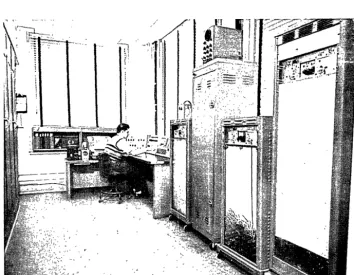
Figure 2 -- SEAC computing room at the National Bureau of Standards. far end of the room, and the computer proper is at the left. To the external storage units which store on magnetic tape such informa~ion
structions to the machine, and numerical data, as well as the entire and its solution when tr.e computation is completed.
7
[image:7.629.149.461.28.317.2] [image:7.629.124.478.405.680.2]Computers and processed, SEAC transmitted a special end-of-· set flag to DYSEAC. The coordinated DYSE A C program called for (1) responding to the SEAC transmi tted signal, (2) reading-in the message from SEAC .. (3) determining whether th.e message was a detail item or an end-of-set f13g, and (4) either tallying the appropriate mas t e r file item ill the first case, or reading 0 u t
one file section and reading in the next in the case of the flag.
A cable between the SEAC building and the trailer van housing DYSEAC provided interc 0
n-nection through a regular input-output terminal of each machine. Information transfers we r e ini tiated and terminated by trans mis s ion of control signals between the two machines. When-ever a SEAC output instruction called f o r se-lection of the particular output use d f o r transmission to DYSEAC, a 62-volt preparatory signal lfas sent from the SEAC external selector uni t to DYSEAC. This signal activated appropri-ate moni tor operations in DYSEAC. As s 0 0 n as
DYSEAC was ready to accept the data, it trans-mitted a 62-volt signal to SEAC. Only upon re-ceipt of this signal lfas SEAC able to proce e d wi th its next instruction. In effect, SEA C continued trying to complete this 0 u t pu t
in-struction until DYSEAC signalled readine s s to
accept the transfer.
This dual machine interconnection utilized both the special program control and the man u al-monitor features of DYSEAC. In terms of program control, DYSEAC is a three-address automatically sequenced machine; choice between 0 n e of two
counters as the source of the address 0 f the
actual next instruction is determined by c 0
n-trol-code digits in the ins truction being ex e-cuted at any operating time. In addi t ion, a special address-storage register can serve t 0
locate the next instruction when new information or new instructions are to be interpolated inm a program that is being processed '. as i nth e case of manual-monitor operations.
Manual-monitor operations are those th a t are carried out by the machine l"hen c e r t a i n prespecified conditions arise in the course of the machine's internal program and s imul t a n-eously in external switch settings. The switch settings are controlled either by the machine operator or by d-c voltage signals originating in external devices at any distance from DYSEAC. Thus, the machine can monitor its internal pro-gram to determine precisely when special opera-tions requested by an external source are tohe performed.
If the switch settings that are controlled by d-c voltages from the external device indi-cate that the device is ready, DYSEAC Ifill then carry out the indicated operation, s u c h a s direct loading of one or more memory locations, and select its next ins truction from the 1 0 c
a-Automation
tion specified by the address-storage register. The instruction selected in this manner the n indicates in its program-control -digits whic h of the two counters is to be used next. In this way, it can either return DYSEAC to a program that had been discontinued during the interrup-tion or initiate an entirely new seque n c e of
opera~ions.
For the DYSEAC-SEAC interconnection, mon-itor switch settings were arranged so that~n
receipt of the preparatory signal from SEA C, DYSEAC at its next breakpoint read in one i n-formation word to a predetermined m e m 0 r y
address aud took its next instruction from the location indicated in the address storage reg-ister. This next instruction was a "file" or-der which recorded both counter settings, reset the proper counter to the ini tiation 0 f the
routine for the processing of the data fro m SEAC and transferred control to that counte r. Upon completion of the processing of anyone set of data from SEAC, DYSEAC would return t 0
the sequence of operations it had been perform-ing immediately prior to each interruption.
When the coordinated programs had bee n read into both machines, SEAC was set t o r u n but was inhibited by a control signal from DY-SEAC. When DYSEAC had completed reading in tire
first file section and had proceeded to 0 th~ r
independent operations, a release of con t r 0 I
enabled SEAC to start. As soon as the S E AC-processed data were ready for posting, the y were converted t~ the proper format for DYSEAC, transmi tted, and checked by DYSEAC t 0 s e e
whether there had been garbling in transmission. The receipt of data simulating a detail i t e m resulted in a tally count for the appropriate master item in the file section.
Several runs of the shared program w ere successfully made, and the "posted" file s e c-tions lfere printed out on a DYSEAC mag net ic wire cartridge. These results clearly dem 0
n-strated the abili ty of DYSEAC to respond to the monitor signals originating in SEAC and to in-terrupt its program in order to rece i v e and process the detail data from SEAC. The -t w 0
machines were thus made to work cooperatively on the common task that involved preliminary processing of data by SEAC, transmiss ion 0 f
these data and program information from SEA C to DYSEAC, and further processing by DY SEAC. DYSEAC worked on an independent seque nee of typical machine operations, simulating a co n-current program, during the intervals in which it waited for SEAC to transmit data.
Only a limited form of master-s I a v e re-lationship was demonstrated. Only one of the two machines, DYSEAC, had the flexible system design features that provide for multiple pro-gram processing and interruptibility necessary in the interdependent sys tem. However. t his
-Two Electronic Computers
Figure 3 -- Cutaway view of the DYSEAC computer trailer constructed by the National Bureau of Standards. The forward ~art of the trailer, in front of the drop, contains the control console and the magnetic-wire input-output equipment. The three cabinets in the central portion house the computer itself. Immediately behind these are two additional cabinets which contain the 5l2-word acoustic delay-line memory. In the rear of the trailer is the air-conditioning equipment.
limited experiment did demonstrate the signif-cant fact that two machines need not h a v e identical capabilities and characteristics in order to share a common data-processing pro-gram, provided that one machine has the neces-sary flexibility. The one machine th a t is capable of rnul tiple-program process ing \II i t h
interruptibility can receive and process data fed directly to it from one or more external sources and, can therefore share its high-speed memory, computing ability, and output facili-ties with remotely located external devices, including other computers with different char-ac teris tics.
For further technical information, see The interconnection of two digital computers, M. E. Stevens, AlEE Conference Paper CP No.55-736 (1955); DYSEAC, the new NBS electronic computer, NBS Tech. News Bull. 38, 134 (Sept. 1954); SEAC, the NBS electronic automatic com-puter, Tech. News Bull. 34, 121 (Sept. 1950).
ENO
9
-*.l.' _ _ _ _ _ _ _ _ _
* - - - -
~BULK SUBSCRIPTION RATES
These rates apply to prepaid subscriptions
canin'J
;in! together direct to the publisher. For example, if 7 subscriptions come in together, the sav-ing on each one-year subscription will be 24 percent, and on each two-year subscription will be 31 percent. The bulk subscription rate s, depending on the number of simultaneous s u b-scriptions received, follow:Bulk Subscription Rates (Uni ted States)
Number of Simul taneous Subscriptions
7
or more4 to 6 3
2
Rate for Each Subscription, and Resulting Saving to Subscriber
One Year nvo Year§
$ 4.20, 24
%
4.60,16 5.00, 9 5.25, 5$ 7.25, 31 ~~
8 ..
00, 24 8 .. 80, 169 .. 55, 9
For Canada, add 50 cents for each yeari 0 u
[image:9.626.52.561.104.313.2]ROSTER
O,F ORGANIZATION'S
IN THE
COMP'UTER
FIELD
(Supplement, information as of July 3, 1956)
The purpose of this Roster is to report organ-izations (all that are known to us) in the compu-ter field: organizations making or developing co~
puting machinery or data-processing machinery; or-ganizations supplying computing services or consul-ting se.rvices in the computer field; and organiza-·tions supplying components or services used in the
computer field if significantly related to the fie~
(for example, magnetic drums would be such a co~
ponent, while octal sockets 1vould not be).
This listing is a supplement to the cumulative edition containing about 370 entries published in the June 1956 issue of "The Computer Directory, 1956", the June 1956 issue of "Computers and, Auto-mation". This listing contains only additions or revisions as compared with previous entries.
Entries. Each Roster entry if complete con-tains: name of the organization, its address / telephone number / description of its main activi-ties, main products in the field, any comments / size (expressed in number of employees), year
es-tablished, nature of its interest in the computer field, types of activities it engages in. The bmt four items are reported in abbreviations, which me
explained below. In cases where we did not have complete information, we have put d01fn what
l'
e have. Entries in this Roster are free.Accuracy. We )~ave tried to make each entry accurate to the extent of information in our pos~
sion. We shall be grateful for any more informa-tion or addiinforma-tions or correcinforma-tions that anyone is kind enough to send us. Although we have tried to be accurate and complete, we assume no liability for any statements expressed or implied.
The key to the Size
Abbreviations
abbreviations follows:
r;--
Large size, over 500 employees Ms Medium size, 50 to 500 employees Ss Small size, under 50 employees (no. inparentheses is approx. no. of e~~)
When Established
Le Long established organization (1925 or earlier)
Me Organization established a "medium" time ago (I926 to 1945)
Se Organization established a short time ago (1946 or later) (no. in paren-theses is year of establishment)
Interest in Computers and Automation
Dc Digital computing machinery Ac Analog computing machinery Ic Incidental interests in computing
machInery
10
-Sc Servomechanisms
Cc Automatic control machinery
Mc Automatic materials handling machinery
Activities
Ma Manufacturing activity Sa Selling activity
Ra Research and development Ca Consulting
Ga Government activity Pa Problem-solving Ba Buying activity
(Used also in combinations as in RMS a "research, manufacturing and selling activity")
*C This organization has kindly furnished us with information expressly for the purposes of
the Roster and therefore our report is likely to be more complete and accurate than otherwise might be the case. (C for Checking)
Organization Entry Form
The form to be completed for an entry in the Roster of Organizations follows:
1. Your organization's name? _ _ _ _ _ _ _ _ 2. Address? _ _ _ _ _ _ _ _ _ _ _ _ _ _ _ _
3. Telephone number?, _ _ _ _ _ _ _ _ _ _ _ _
4. Types of computing machinery or components, or computer-field products and services that you are interested in?
5. TYpes of activity that you engage in: ( ) research ( ) other (please explain): ( ) manufacturing
( ) selling ( ) cons ul ting
6. Approximate number of your employees?, _ _ _
7. Year when you were established? _ _ _ _ _ _
8. Any comments? _ _ _ _ _ _ _ _ _ _ _ _ _ _
Filled in by _ _ _ _ _ _ _ _ _ _ _ _ _ _
Roster of Or~8nizations
Aircraft-Marine Products, Inc., 2100 Paxton St., Harrisburg, Pa. / Cedar 4-0101 / ·C
Patchcord programmdng systems for critical low level circuits, as well as nonshielded systems for analog and digital computing systems, data processing, test equipment, other equipment and devices. Automatic wire terminators, taper pins (single and multiple), capacitors, terminals, connectors, etc.
Ls (1600) Me (1941) Ic RMSa
Allegany Instrument Co., Inc., 1091 Wills Mount-ain, Cumberland, Md.
Computers for ballistic measurements. Ac RMSa
Allies' Products Corp., 1028 Connecticut Ave. N.W., Washington, D.C. / RE 7-0504 / *C
Precision resistor components. Ss(12) Se (1952) Ic RMSCa
American Electronic Mfg., Inc., Instruments Div. of American Electronics Inc., 9503 W. Jefferson Blvd., Culver City, Calif. / Texas 05581 / ·C
Precision resolvers, servomotortachometers, resolver amplifiers, and systems. Ms(2oo) Se(l952) Ic RMSa
Amphenol Electronics Corp., 1830 S. 54th St., Chicago 50, Ill.
Connectors for computer applications: all types.
Armour Research Foundation, Illinois Inst. of Technology, 10 West 35th St., Chicago 16, Ill. / CAl umet 5-9600 / *C
Design and construction of developmental co~
puters, both analog and digital, for special applications only. Digital-to-analog and analog-to-digital converters. Data reduction systems. Magnetic recording. Automatic con-trol machinery. Servomechanisms. Instrumenta-tion. Computing service: analog, digital; have Goodyear Electronic Digital Differential Analyzers. nvo Channel Electronic Function Generator, card programmed calculator. Ls
(1150) Me (1937) DAISCe RCPa
Automation Engineering Laboratory, One E. Putnam Ave., Greenwich, Conn. / Greenwich 8-2300 /
Designs, engineers, and builds complete auto-mated unit or system. Ic RMCa
Avion Division-Alexandria (formerly ACF Electron~)
Div. of ACF Industries, Inc., 800 No. Pitt St., Alexandria, Va. / King 8-4900 / *C
Analog-to-digital encoders, and digital-to-analog decoders. Ms(177) Se(l954) DAc RMSa
Basic and Experimental Physics, Box 689, Falmouth, Mass. / Falmouth 2175.
Consultin~ services in design, development,
testing, and applications of digital and analog computer systems. Ss Se DAIc~ RCPa Bryant Gage and Spindle Division, Box 620,
Spring-field, Vt., Division of Bryant Chucking Grinder Magnetic Drums with speeds up to 100,000 RPM, capacity up to 5 million bits~ super-precision bearings. Ms Se' Ic RMSa
11
-Creed & Co., Ltd., Telegraph House, Croydon, Eng-land / Croydon 2121.
Teleprinter equipment for telecommunication. Also input and output equipment specifically intended for association with electronic computers, machine tool, and process'control systems. DIc RMSa
Daystrom Instrument Co., Archbald, Pa. / Jer~n
1100 / °C.
Digital and analog computers. Magnetic Core and magentic drum storage systems. Servo-mechanisms. / Ls (1000) Se (1950 DAISe RMSCa
.§
Edin Co., Inc., 207 Main St., Worcester 8, Mass. / PL 7-8394.
Direct tYriting oscillograph recorders; high gain D.C. amplifiers; frequency spectrum analyzer. Alc RMSa
Electra1ab, Inc., Industrial Center, Needham, Mass. / Needham 3-5000 / *C.
Printed circuits; printed assemblies; printed circuit boards with reliable plated-through holes--for computers and other applications.
Ms (75) Se (1951) Ic RMSa
Electro Instruments, Inc., 3794 Rosecrans St., San Diego, Calif. / Cypress 806144 / *C
Digital voltmeters; digital ohmmeters, ana-log-to-digital converters, card converters, frequency counters, X-Y Recorders, go no bO systems, automation systems, digital te$-ers, and other digital instruments. Ms(80) Se(l954) Ic RMSa
Electronic Associates, Inc., Long Branch, N.J. / Long Branch 6-1100 / *C
General purpose precision analog computers, special purpose analog computers, analog computer components, digital-to-analog con-verter, digital plotting system (Dataplotter). Automatic control of all machine tools. Ls
(591) Se(1945) DACe RMSCa
£
Fairchild Controls Corp., Components Div., 225 Park Ave., Hicksvine, L.I., N.Y., / Wells
8-5600 / and 6111 E. Washington Blvd., Los Angeles, Calif. / RAymond 3-5191 / ·C
Precision potentiometers, linear, non-linear, single turn, multi-turn, wire wound and noble metal film; trimmer potentiometers; pressure transducers. Subsidiary of Fairchild Camera and Ins trument Corp. Le (1920) Ls (2500, ' companYi 375, this division) Ic RMSa The Franklin Institute, Laboratories for Research
and Development, 20th St. and Benjamin Franklin
Par~Yay, Philadelphia 3, Pa. / LOCust 4-3600 / *C
Computers
equipment. Special purpose analog computers, large and small sc~le. Digital computer com-ponents. Prototype construction. Ms(325) Se
- (I 946) DASCMc RPCa
Friden Calculating Machine Co., Inc., San Leandro, Calif. / SWeetwood 8-0700 / *C
Desk calculating and adding machines. Compu-typer for automatic billing. Add-Punch Ma-chine for adding, subtracting, and for record-ing of integrated data. Ls(2700) Me (1934) Dc RM)a
Germanium Products Corp., 26 Cornelison Ave., Jer-sey City, N.J.
Silicon and germanium transistors for computer and other uses. Ic RMSa
l!
N.V. Hollandse Signaalapparaten, Hengelo (0), Ne-therlands / *C
Radar fire control systems and their computers for different types of armament. Directors, computers, trackers and radar systems for find-ing targets, then automatically sightfind-ing the guns under their control. Ls(I800) Le(I922) DAlc RMSa
Hoover Electronics Co., 3640 Woodland ~e., Balti-more 15, Md. / MO 4-2350 / *C
Analog to digital converter. Digital compu-ters. Sequential test sets and systems for computers, telemetering, and information
pro-c~ssing. Ms(60) Se(I952) Dc RMSa
1
International Resistance Co., 401 No. Broad St., Philadelphia 8, Pa. / WAlnut 2-2166 / *C
Fixed variable resistors, hermetic sealing terminals, selenium rectifiers, insulated chokes, molded printed electronic circuits. Ls(2100, including subsidiaries) Le(1924) Ic RMSa
George F. Kelk, Ltd., 130 Willowdale Ave., Willow-dale, Oot. / BA 5-3391 / *C
Digital plotting equipment. Specialized ana-log computers. Ss(12) Se(I953) DAc RMSCa Kleinschmidt, Inc., Deerfield, Ill. / Deerfield
1000 / *C
Page-printing read-out devices, tape reading and tape punching equipment. Ls(650) Se
(1946) Ic RMSCa
.1
Littlefuse, Inc., 1865 Miner St., Des Plaines, Ill./ Vanderbilt 4-1188
Fuses and fuse holders for computer and other us es • Ic RMSa
Litton Industries, Inc., Beverly Hills, Calif., and elsewhere / 'CRestview 4-7411 / *C
Radar systems with monopulse techniques; coun-termeasures, inertial navigation, automatic flight control, telemetering devices, communi-cations equipment, instrumentation and test equipment, servomechanisms. New digital
dif-and Automation
ferential Analyzer. Portable, electronic scientific computers (digital differential analyzer) and such accessories as graph plot-ters, followers, tape input and output de-vices, digital-analog converters, and mag-netic drums and heads. Advanced system de-sign and development. Ls(1300) Se(I953) DAICc RMSCa
Mack Electronics Div., Inc., 1120 So. 2nd St., Plainfield, N.J. '/ Plainfield 5-4600
Research facilities in the development of fire control, radar, missile tracking, co~
munications, ultrasonics and other complex developments for industry and the military. Formerly White Industries, Inc., a subsidiary of Mack Trucks, Inc. Ic RMSa
P.R. Mallory
&
Co., Inc., 40 So. Gray St., Indian-apolis 6, Ind.Transistors, resistors, and capacitors for computer and other uses. Ic RMSa
Markite Corp., 155 ~averly Place, New York 14, N.Y. / Oregon 5-1384
Precision potentiometers for computer and other uses. Ic RMSa
National Analysts, Inc., 1015 Chestnut St., Phila-delphia 7, Pa. / Market 7-8109 / *C
Consulting and computing service. Punched card machines; large scale general purpose electronic data processing equipment. Ss
(25) Se (1943) Ic CPa
.Q
Ohmite Manufacturing Co., 3601 Howard St., Skokie, Ill. / ORchard 5-2600
Capacitors, computer types; miniature wire-110und resistors; etc. Ic RMSa
ORRadio Industries, Shamrock Circle, Odelika, Ala./ SHerwood 5-4621 / *C
Magnetic recording tape for computers and telemetering applications. Ms(75) Se(1946) Ic RMSa
Samas Accounting Machines, Ltd., Powers-Samas House, Holborn Bars, London E.C. 1, Eng-land.
Punch card tabulating equipment using small, medium, and standard cards. Agency is Under-wood Corp., which SEE. Ls(6000) Le(1916) Dlc RMSa
Radiation, Inc., P.O. Drawer 37, Melbourne, Fla./ Melbourne 800 / *C / Data processing
Data processing, data conversion, and data reduction equipment; 32 channel digital tele-metering system, which includes data collec-tion, processing, and translating equipment for computer. Ms(400) Se(I950) Dlc RMSCa Radio Receptor Co., Inc., 251 West 19 St., New
York, N.Y. -/ Watkins 4-3633
Germanium diodes for computer and other uses IC RMSa
-12-Recording and Statistical Corporation, 100 Sixth Ave., New York 13, N.Y., / WOrth 6-2700 / and elsewhere.
Computing and data processing services using electronic digital computers and punched card equipment of latest types.
Servonics, Inc., 834 N. Henry St., Alexandria, Va. / TEmple 6-6800
Precision potentiometers incorporating digi-tal techniques, \11 th high linearity t and
ex-tended frequency limits without phase shift, multi-turn but continuous rotation.
Soroban Engineering, Inc., Box 338, Melbourne, Flaj *C
Data input-output systems; data preparation devices; output tabulating devicesi coding keyboards; paper tape readers and perfora-tors; specialized data computing systems and consulting services on all of above. Ss(35) Se(1953) Dlc RMSCa
Southern Electronics Corp., 239 W. Orange Grove Ave., Burbank, Calif. / Victoria 9-3193 / *C
Precision capacitors, adjustable capacitors. MS(60) Se(1951) Ic RMSa
Southwestern Industrial Electronics Co., P.O. Box 13058, Houston 19, Texas
Analog computers and simulators. At:, RMSa
Sylvania Electric Products, Inc., Electronic Sys-tems Division, 100 First St., Waltham 54, Mass./ TWinbrook 3-9200 / *C
Electronic digital computers, special purpose digital data transmission systems. Etched circui,ts; other computer components. (In-cludes the Division formerly at 70 Forsythe St., Boston). Ls(27,OOO companYi 700 this division). Le(1901) DAc RCa
Victor Adding Machine Co., 3900 No. Rockwell St., Chicago 18, Ill. / KEystone 9-8210 / *C
Digital computers and related integrated data processing systems. Digit-matic plain or calculating printers. Adding machines, etc. Ls(2200) LeU9lS) Dc RMSa
~
Zuse, K-G., Kreis H~nfeld, No. 69, Neukirchen, Germany / *C
Electronic digital computers. Zuse Model 'Z 4", ''Z-5'' and
"z
11" computers. Ms(90)Se(1949) Dc RMSa
o _____________________
* ____________________
~SP:ECIAL ISSUES OF
~~COMP,UTERS AND AUTOMATlON"
The June issue of "Computers and Automation" commencing with June, 1955, is a special issue, "The Computer Direc tory. "
, 13
-MANUSCRIPTS
We are interested in articles, papers,reference information, science fiction, and discussion re-lating to computers and automation. To be con-sidered for any particula~ issue, the manuror~t
should be in our hands by the fifth of the
pre-ceding month.
Articles. We desire to publish articles that are factual, useful, understandable, andin~sting
to many kinds of people engaged in one part oran-other of the field of computers and automation. In this audience are many people who haw expert knowledge of some part of too field, rut \ViI) are
lay-men in other parts of it. Consequently alaiter should seek to explain his subject, and shQw its context and significance. He should define un-familiar terms, or use them in a way that make s their meaning unmistakable. He should identify unfamiliar persons with a few words. He shruld use examples, details, comparisons, analogies, etc., whenever they may help readers to under-stand a difficult point. He should give data supporting his argument and evidence for his assertions. We look particularly for articles that explore ideas 'in the field of computers and automation, and their applications and im-plications. An article may certainly be contr~
versial if the subj ect is discussea- reason abl~
Ordinarily, the length should be 1(0) to 4000'
words. A suggestion for an article should be submitted to us before too much l~rk is done. Technical Papers. Many of the foregoing zequne-ments for articles do not necessarily apply to technical papers. Undefined technical terms, unfamiliar assumptions, mathematics, circuit diagrams, etc., may be entirely appropriate. Topics interesting probably to only a few people are acceptable.
Reference Information. We desire to print or re-print reference information: lists, roste~ ab-stracts, bibliographies, etc., of use to com-puter people. We are interested in m a kin 9 arrangements for systematic publication from time to time of such information, with other people besides our own staff. Anyone who,~
like to take the responsibility for a type of reference information should write us.
Fiction. We desire to print or reprint fiction which explore~ scientific ideas and possibili-ties about computing machinery, robots, cyber-ne1.ic.s.. autoJDation:. etc.. anq t;heir illtllicatials,
and \vhich at the same time is a good story. 0r-dinarily, the length should be 1000 to 40W tQ.'ds.
Discussion. We desire to print in "Forumf' brJff
discussions, arguments, announcements, news, letters, descriptions of.remarkable new devel-opments, etc., anything likely to be of sub-stantial interest to computer people.
REQUIEM
K. W,. RENNETT Lake Zurich, Ill.
It was one of the two most danger 0 us desks in the world. Cutter ran his pal m gently across its smooth g r e ens u r f ace, brushed his fingertips lightly across the big green buttons scattered like organ stops a-cross the desktop. His scrubbed finger ~raced
the letters beneath the buttons. "Moscow" was a big button. Beneath it ranked lesser buttons lettered "Murmansk", "Leningrad", "Baku", and the rest. Then there was a "China" sector with black buttons and an "Indian" sector with buttons that were red and small like beetles. And more, linked with fat armored cables to the ranks of computers that crowded the walls of the room.
Dangerous and clean and beautiful, this desk, like a loaded Luger pistol. And e a c h time he pushed a button, four hydrogen bombs
~uld waken to life in a distant place. A split sec/ond they would lie in their dark cradles be-neath the JOOuntain ice and windpacked s now, listening to the stream of measured impulses of latest calculation from these com p u te rs. Then their tail pipes would spurt comets 0 f
flame and they'd howl aloft and be gone atfour times the speed of sound through the strato---Sphere on an invisible guiding arc of computer
signals, fantas~ically rapid and fantastically accurate. When the bombs touched earth again, a city would die. Not bravely, but with co~
pleteness.
The alarm bell tinkled softly. It was regulated to tinkle softly to prevent alarming the guardian of the buttons. In accordanc e with regulations, Joe Cutter extended a hover-ing hand over the "Moscow" button and with the other unsheathed a loaded .45 Colt aut 0 m a tic and centered its black barrel on the door. The pmumatic ,door hissed up. A general, t he las t Generai, entered, smiling determinedly. Cutter 'sighed and subsided into a gray little man
be-hind an oversi~ed desk. He touched his helmet in half salutation and reholstered the .45 without getting up. The General closed the pneumatically operated steel slab. .be caugh t a remembered glimpse of clothes racks behind the General as the grey steel slab slid down.
The General marched to one of the three fat uphols tered chairs. He j ackknifea himself to a sitting position with military reluctance.
"Good mrning, Cutter," he beamed.
14
-"Good morning, General," s ai d Cut t e r. The General winced. It wasn't much fun, being the last General, Joe imagined. Like being an extinct species of moose preserved in a zoo.
"Everything all right, Cutter?" the Gen-eral demanded.
Joe himself winced, this time. The Gen-eral asked the same question each morning. He had for three years, ever since the co mp u te r room and desk installation had been completed following signing of the disarmament pact. And it was a ridiculous question. The nation.auld be on its knees before anything would be a
1-lowed
to go atf.ry in this crowded roomful 0 fcomputers and maps and lethal buttons.
The General rolled on with heavy cheer, "Good, Cutter. Must keep shipshape. Partic-ularly now. If the citizen exchange agree-ment is a fake, it means the enemy is smoke-screening us for good reasons. Might be the Big Attack."
Cutter tvavered between pity and bored dislike. The last General, fending off a d is -armed tforld. For an Army he had Cutter, and his shift-mates. a battery of the greatest electronic brains technology could pro d uc e , and a handful of technicians; all carefully buried from the world. A man who'd commanded thousands and tens of thousands. His only vis-ible command at the moment, during this shift, a ~mall ratlike man wearing a steel helmet fuat was several sizes too large, hunched behind an oversize desk and several rows of gray steel computers that chuckled electronically over the belly warmth of their live circuits. It must seem like commanding a homicidal mouse and a line of pinball machines, Joe decided.
"The Russki's are disarmed. General," Cutter said with gentleness. "And they're sending their top-men" here to prove faith."
The worn gambit still brought flame to the General's eyes. His raison d~~e. The old eagle gaze swept the room, iis four grey walls with their charted ballistic curves and maps and alternate attack plans ruled in red and yellow and black lines across the mottled, blue of the maps.
Wash-ReQ~iem
ington, D.C., Cutter. And we have weapons. You may be completely certain that the Ene my has a similar room. And similar 1 au nch i n g sites, perhaps in the Urals, or perhaps in Si-beria. But they have them and you can count on it they could blanket us with hydrogen banbs in a split ttdnkling. As we can them." .
"Intelligence never found their room or th:eir sites, General," Cutter murmured.
"No more than their inspection teams have been able to locate this place -- we hope. And tfhat inspection team tfould dare go slink in g through the bedroom of the Vice President's tdfe looking for a secret room? Faugh! 0 f course they have a room! An elementary tactic, Cutter."
"Well, General, if the exchange plan goes through, we'll have mass exchanges of peoples between the two countries with voting rig h ts while in residence. Who'd have time to fight? And they'll be sending their top men here --their leaders. What a struggle they'll have before they'll accept that provision1"
"Any overtures thus far may be a trick, Cutter. A sly trick."
Cutter shrugged and stared at the buttons. Superior or not, he was getting pretty sick of the General.
"Have you dusted, Cutter?" demanded the General.
"Sure," said Cutter, and then remembered to add the "Sir". The General donned a white glove and began po~ing behind the Number Three reserve computer. Cutter rolled his eyeballs at the ceiling. The alarm bell tinkled. Dy-namite Joe Cutter donned his helmet and aimed the .45 at the door, dropping the .45 in the process and picking it up again. The General, watching, winced only slightly. His control t'las improving, even for a General, Joe decided.
The gray steel slab of door hissed up, r~
vealing a closet interior carpeted with female---type shoes. The President stood among the pumps and sandals. He was a big, silver-haired man and he was smiling. Not a campaign smile, but a deep, happy smile. Joe smiled back. He liked the President. Whatever the guy's position, he really cared for all kinds of people. Little people like Joe. Joe figured the President e-ven liked the General.
. The President grinned at the .45. "Don't shoot, Joe," he said. "The Cold War is over. The exchange agreement is signed."
Joe couldn't help the stunned feeling. If they'd signed the exchange agreement, it meant
15
-no more wars. Really. No more desk with but-tons. No more Dynamite Joe •. Back to a $95 a week clerical job.
''Yes! Just like that! They've signed!" The President threw his handful of papers
ceil-in~'lard and they sailed down like big snowflakes across the floor and over the Number Four re-serve computer and even -- Joe felt a kind of distaste at the sight -- across the spotless desktop. The General departed from a posture of affability and began policing up the sheets of paper in a lost manner.
"It's not a trick," said the President in-to the silence.
The General was beginning to snap back. "Why not? We can't knot'l until their people be-gin to arrive here."
"Of course," said the President, "And the first plane load left Kharkov this morning. Their Premier and the Party Secre·tary are aboard, and it'll be a kind of triumphal tour witi stqs en route."
The General marched to the President's side in dawning anger.
"That's no proof. We can't deactivate the room. Not yet. The program must run for at least two or three more years before we'll be sure. "
"I can't take that chance, Hal," said the President. "If a truce team located this room now, there'd be a five minute war with nothing left standing on either side. I want it eli~
inated now -- immediately. I'm taking what you military people used to call a calculated risk."
"Calculated risk?" the General's face went turkey color and Joe noted that he was screaming, though in a military manner. "It's calculated insanity: If they've got weapons . enough -- why if they had two bombers, or two guided missiles, or -- two beanshooters, we'd be helpless. Helpless!"
Joe put his helmet back on. "Now, n a If, General," he said.
"Take that helmet off~ you icUot," snarled the General. "For God's sake,
Mr.
President, be reasonable.""We're deactivating this room, General. You are retiring as of today. They've given us their faith. Ye gods, their top men are already on that plane:"
'You've gone mad. This is what they've been t.zaiting for." The General chC)ked and tore at his collar. "Right now, t.ze've got a
IBM ELECTRONIC DATA PROCESSING OPERATIONS
IN THE MIDWEST
NEIL D.
~ACOONALDFollowing the trend tourard the automation of data processing and computing operations, mare and more manufacturers, business firms, and sci-entific organizations are installing electronic data processing systems. Installations of such systems produced by International Business Mach-ines Corporation throughout the country have in-creased sharply in the last year and a half; s~h
machines are being applied to a J.vide variety of both scientific and commercial problems. In the Midwest alone, there are nearly a hundred of the company's "electronic giant brains" not'/ at work, t\'1 th many more on order.
IBM's computers include the large-scale IBM 701, 702, 704 and 705 Electronic Data Processing Machines, and the medium-scale IBM 650 Magnetic Drum Data Processing Machine.
FollOlving are examples of the many fields in which IBM electronic data processing systems are being applied in the Midtvest.
INSURANCE
A company that will probably be one of the biggest users of IBM data processing equipment in the fire and casual ty insurance indus try is State Farm Mutual Automobile Insurance Company of Bloomington, Illinois. This company will e-ventually use 24 IBM 650 Magnetic Drum Data Pro-cess ing Machines. State Farm nOlY has two of the machines installed in its home office, one each in two regional offices, and 20 on order for its 12 regional offices thrcughout the U. S. It is expected that deliveries will be completed in 1957.
State Farm's applications for the 650's in-clude selective underwriting, automatic premium rating, policy reports and internal and external s ta tis tics.
The first 650 installed by an insurance com-pany in the Chicago area is at the Zurich-Ameri-can Insurance. Companies. .Its ini tial tasks in-clude consolidation of collection data, and re-cording and classifying of transactions by branch, agent, and type of insurance. This 650 combines and accelerates operations formerly requiring four separate machines. Its use will be extencirl to recording of claims and preparation of los s ratios.
The Iowa Mutual Insurance Company, DeWitt,
Iowa, uses its nel'l650, received early thi's spring, for automatic premium rating of auto-mobile policies. This 650, the first in the fire and casualty field in Iowa, will han dIe myriads of insurance calculations at h i g h speeds, enabling employees to be assigned to less routine and more creative work. T his "elec tronic clerk" will also do payroll, u n-earned premium calculation, agents' commdssion computation and various statistical distribu-tion summaries and analyses. Iowa Mutual plam to extend the machine's activities into the fire, burglary, general liability, and work-men's compensation divisions of the company.
Northt1Testern Mutual Life Insurance C om-pany of Milwaukee, Wisc., plans to add a 650 to its present line of IBM equipment this s~
mer. Initially the machine will compute an-nual dividends for more than 1,600,000 policies. Another application will be accounting and cal-culation of 80,000 mortgage loans, involving monthly payments of principal, interest and
taxes.
-Employers Mutuals of Wausau, Wisc., is put-ting a 650 into operation and expects it will greatly facilitate handling of voluminous re-cords and statistics of the insurance business. nvo initial applications are automobile policy rating and premium distribution reports.
. An insurance company with a decentralized policy of operation, Hardware Mutuals, will be-gin using a 650 late this year, for premium, loss, and expense distribution figures necess-ary for internal company reporting, annual statment, tax purposes, and insurance bureau r e-quirements. This company has 14 policywriting offices that send data to the home office in Stevens Point, Wisc., where it is converted to a medium that can be machine processed. Hard-ware Mutuals does all selling through 675 di-rect salesmen, and figures for any individual's territory will be obtainable very quickly with the 650.
The Royal Neighbors of America, Rock Is-land, Illinois, a fraternal life insurance co~
pany, uses a 650 to audit 4,700 camp reports per month, involving the processing of abo ut half a million punched cards. Other systems to be converted to machine operation are .automatic preparation of bond schedules for the annual statement, valuation of certificate reserves,
-Electro~ic Oata Processing calculation of dividends, and the processing
of the loan account.
Nationwide Insurance Company has a 650 in operation at its home office in Columbus, (hio, used primarily to check rates on new policies and to determine rates on r en ew a 1 policies. This information arrives a t the home office via transceiver network from ten regional offices. The transceiver is an IBM ,machine which makes possible duplication 0 f
punched cards over telephone and telegraph fa-cilities. The information received at Colu~
bus is processed in the 650 and returned to the respective region where the results are punched in the same card originally used to transmit the policy information.
An IBM "giant," the 705 Electronic Data Processing Machine, is scheduled for instal-lation this SUJIUOOr at the St. Paul Fire and Marine Insurance Company, St. Paul, Minnesota. The company plans to use the computer for ac-counting and statistical operations.
HOSPITALIZATION
Michigan Hospital-Medical Service has on order, for its general office in Detroit, a 705 which will be put to work on a gigantic task of up-dating records for 1,350,000 sub-scribers on a daily basis. Many complicated statistical reports, hitherto unobtainable or prohibitively expen~ive, will be made avail-able.
MANUFACTURING AND HEAVY INDUSTRY
The International Harvester Company's motor truck division at Fort Wayne, Indiana, recently installed an IBM 705 to serve as a centralized data processor for four pIa n. t s, including that of the farm tractor division in Louisville, Kentucky. In this installa-tion, tremendous savings in time have been ef-fected on such problems as cam design, bearing load, gas pressure and other engineering cal-culations.
The West Pullman Works of International Harvester Company, on Chicago's South Side, recently completed a year of 650 operation. Practically every commercial application com-mon to manufacturing plants has been run 0 n this 650 or is planned for the near future. West Pullman Works js part of the company's farm tractor division, manufacturing n i n e collateral products comprising 25,000 parts, for 29 other Harvester plants and other organ-izations.
The investigations section of the General Electric Company's aircraft gas turbine divi-sion is operating three large-scale IBM com-puters, one 701 and two 704's, the scientific
counterparts of the 702 and 705. The investi-gations section gives mathematical and compu-tational support to the aircraft gas turbine division of GE, an~ to all divisions of the company upon request. One of the 704's is at Lynn, Mass., and the other machines are i n Cincinnati, where they occupy the country's first permanent industrial building designed solely to house computers. The 701 at C i n -cinnati will shortly be replaced by an
addi-tional 704.
The Evendale Opera ting Department of Gen-eral Electric Company's jet engine plant near Cincinnati received delivery of a 650 1 a s t February. By March 5 the payroll of two de-partments had been completely converted from conventional machine accounting procedures to the 650. Other applications are being planned, including general ledgers, budget statements, and production scheduling.
General Electric Company's component mo-tor department in Fort Wayne has a 650 which solves complex motor design problems and hand-les the weekly payroll and indirect manufactur-ing expense reports. The computation of 100 motor design variations, completed in t h r e e hours, would require more than six months with a desk calculator.
Minnesota Mining and Manufacturing Com-pany will install an IBM 705 at its general office in St. Paul in September of this year. One of its .first tasks will be the computation of sales statistics. Other assignments include raw and semi-finished materials inventory, pay-roll and operating expense reports.
The Magnavox Company, Fort Wayne, Indiana, is processing payroll and labor distribution in one hOur and 15 minutes weekly on its 650. A manufacturing requirement computation, re-quiring 20 hours on conventional accounting machines, was recently done in just one hour, a saving of 95%. Later this 650 will be at work in the realm of higher mathematics, solv-ing problems in the design of transformers, filters, and circuits.
The Bendix Products Division of Bendix Aviation Corporation, South Bend, Indiana, has a 650 on order. An involved factory payroll of 9,000 persons, including incentive, set-up and piece work labor, will be assigned to the 650, which is expected to take about 11 hours a week for the job. Various production con-trol schedules, and machine load and engineer-ing applications are also beengineer-ing programed.
A.